Jump to: How it works | Huanarpo dosage | How to mix it | Specs | Powder vs capsules | Huanarpo FAQ | En español
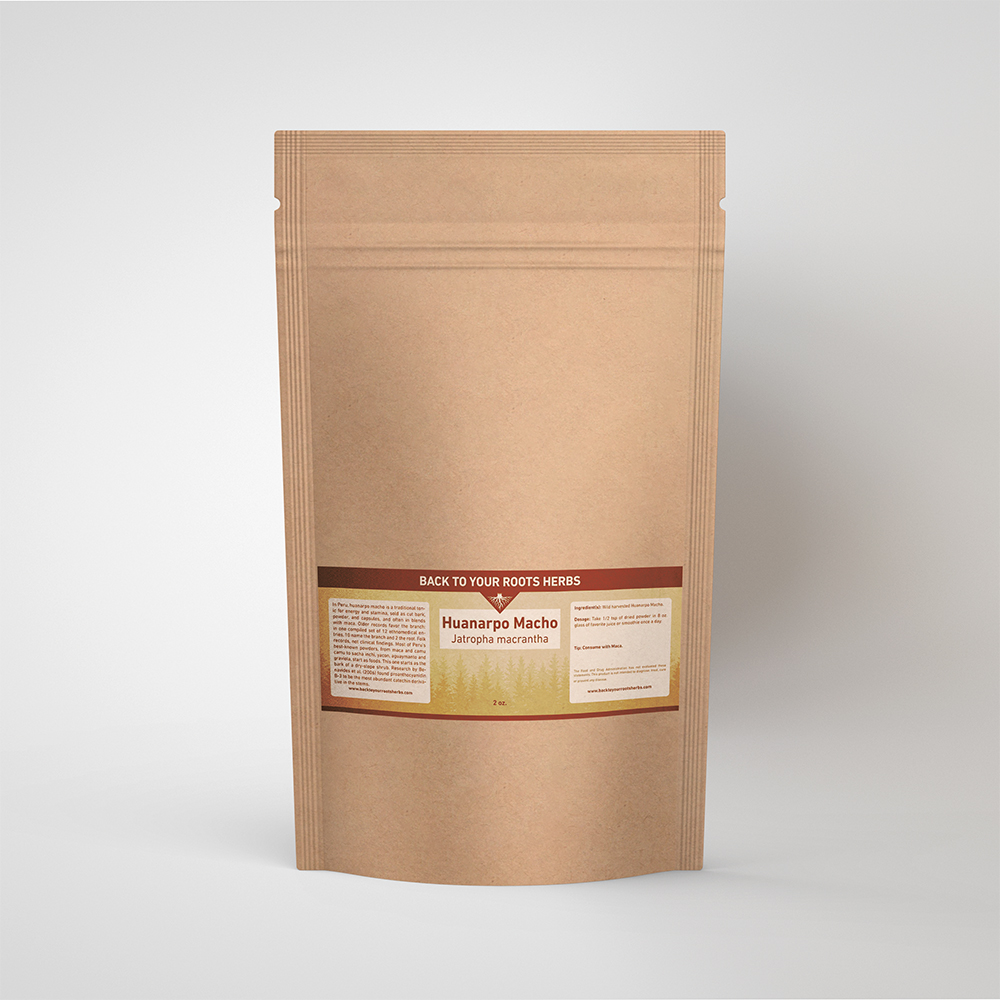
Huanarpo macho powder is the dried, ground bark of Jatropha macrantha Müll.Arg., a spurge-family shrub native to the Andes of Peru. US shops also sell it as red huanarpo powder. In Peru, it is a traditional tonic for energy and stamina, though no human trial has tested it. This 2 oz (56.7 g) package holds single-herb powder. No extract.
THE VERDICT (INTERNAL QUALITY SCORE):
Grade A for identity and heavy metals. This huanarpo macho powder passed an HPTLC fingerprint and microscopy for identity, plus a heavy metal screen. Identity comes first, because several plants share the name huanarpo. The terroir is specific and often misreported: rocky, cactus-dotted slopes on the dry western side of the Peruvian Andes, mostly at 1,500 to 2,400 m. Whole bark, milled fine. Not root. Not seed. Not an extract. No fillers.
– Back To Your Roots Herbs Research Group
SENSORY ANALYSIS OF RED HUANARPO:
- Look: A fine, red-brown, matte powder with a faintly fibrous grain. Darker than maca. Duller than achiote.
- Smell: Faint, dry and woody, like split kindling, with none of the resinous perfume of palo santo. No sweetness. No mustiness.
- Taste: Astringent first, then mildly bitter, a tongue-drying pull like strong black tea. The proanthocyanidins (condensed tannins) and catechins in huanarpo macho cause it.
Huanarpo in Water: Texture and Settling
Fiber does not dissolve. Stirred into water, the particles hang for a minute, then settle, so drink it before they do. Whisk a small paste first, the way you would start matcha, and you avoid dry clumps. A splash of milk softens the drying feel.
HOW DOES HUANARPO MACHO POWDER (JATROPHA MACRANTHA) WORK?
- The Herb: Jatropha macrantha bark sourced from Peru’s dry western Andean slopes, the heart of its native range.
- The Mechanism: Acts as a source of tannin-type polyphenols (catechins and proanthocyanidins), which show antioxidant activity in laboratory tests. How huanarpo macho acts in the human body has not been studied. Nothing is extracted or concentrated.
- The Evidence: Research by Benavides et al. (2006) found proanthocyanidin B-3 to be the most abundant catechin derivative in the stems and proposed the assay for quality control of raw materials and finished products (PMID 16300918).
- The Gap: No human clinical trial has tested this plant in any form. Every published effect comes from test tubes or animals.
Huanarpo Botany and Names
It is a semi-succulent shrub, rarely over 1 m, with grey stems scarred where old leaf stalks fell. Its three-lobed leaves open dark red, then turn glossy green, and the flowers have shiny red petals (LLIFLE succulent encyclopedia). The accepted name is Jatropha macrantha Müll.Arg. (GBIF taxonomy record), in the spurge family, Euphorbiaceae, which also holds cassava (yuca) and the rubber tree. Peruvian names include wanarpo, urco huanarpo, huanarpo de Canta, and simayuca. The catch: LLIFLE also lists huanarpo hembra for this species, while Peruvian researchers give that name to a different plant. Shared names are why we test identity.
Where Huanarpo Grows: Rocks and Cactus Scrub
GBIF lists 91 Peruvian records of the species. Of the 75 that name a region, 43 come from Lima and 14 from Arequipa, both on the Pacific side of the Andes, and just 1 from the Amazon lowlands (GBIF, October 2026). LLIFLE places it among rocks and columnar cacti at about 1,500 to 2,400 m. One vouchered collection came from Sacrapa, Ayacucho, at 15°16′47″ S, 73°20′45″ W and 2,691 m. Calling it an Amazon rainforest herb misses where most of it grows.
Huanarpo in Peruvian Tradition
In Peru, huanarpo macho is a traditional tonic for energy and stamina, sold as cut bark, powder, and capsules, and often in blends with maca. Older records favor the branch: in one compiled set of 12 ethnomedical entries, 10 name the branch and 2 the root. Folk records, not clinical findings. Most of Peru’s best-known powders, from maca and camu camu to sacha inchi, yacon, aguaymanto and graviola, start as foods. This one starts as the bark of a dry-slope shrub.
Huanarpo Research: Known and Unknown
The science is small and preclinical: mostly chemistry, plus a few rodent and cell studies.
Chemistry (Benavides et al. 2006)
The stems hold catechin, catechin-7-O-β-glucopyranoside, and proanthocyanidin B-3. Catechin belongs to the same flavan-3-ol family found in green tea and cocoa. Proanthocyanidin B-3 is a catechin dimer, a condensed tannin, and a source of that astringent bite.
Huanarpo Look-Alikes
Huanarpo Hembra (Cnidoscolus diacanthus)
A different genus in the same family. Peruvian researchers studied its leaves and stems as a separate species (Tinco-Jayo et al. 2024, PMID 39407486).
Jatropha cilliata
A 1996 study described a Peruvian medicinal plant called huanarpo as Jatropha cilliata (Okuyama et al., PMID 8998840). Same common name, different Latin name.
Jatropha curcas Seed
The physic nut sits behind most “is Jatropha poisonous” warnings. Its seeds carry toxic phorbol esters. This package holds Jatropha macrantha bark only, no seed, and its identity is confirmed by HPTLC and microscopy.
HUANARPO MACHO: CRITICAL USAGE, DOSAGE AND CONTRAINDICATIONS
Huanarpo Macho Dosage
- Take ½ level teaspoon (about 1 g) of huanarpo macho powder once a day with food.
- New to it? Start with ¼ teaspoon for 3 days.
- Do not exceed 1 serving in 24 hours. One package holds 50 to 60 servings, about a 2-month supply.
- No caffeine is added. Do not expect a coffee or guarana jolt.
- Several marketplace capsule labels list 1000mg per serving. Our ½ teaspoon is about the same amount: 1 g of whole bark.
- Stop if you notice stomach upset, a rash, or any unusual symptom.
How to Mix It
The powder tastes like strong tea and never dissolves, so the drink matters. Use one of these for your single daily serving.
Cold Drinks
Huanarpo in Juice
Stir the powder into 6 to 8 oz of orange or pineapple juice. Acidity and sweetness hide most of the astringency.
Huanarpo Smoothie
Blend the powder with banana, berries, and yogurt. Creaminess blunts the drying feel.
Huanarpo in Purple Corn Chicha
Stir it into chicha morada, Peru’s spiced purple corn drink, or into our purple corn powder with water and lime.
Warm Drinks and Pastes
Warm Water and Fresh Ginger
Steep ginger slices in hot water for 5 minutes, cool to warm, then stir in the powder.
Huanarpo Honey Paste
Mix the powder into a tablespoon of honey. Avoiding sugar? Use warm water and a drop of stevia.
Blends
Huanarpo and Maca
Keep the huanarpo at ½ teaspoon and add maca powder, whose malty sweetness offsets the bite. Try both powders alone first.
Huanarpo Side Effects and Who Should Avoid It
No formal human safety studies exist, so our cautions are conservative. Tannin-rich powders can unsettle an empty stomach, so take it with food and start small. Do not use this powder if you are pregnant, trying to conceive, breastfeeding, or under 18. Ask your doctor or pharmacist first if you:
- Take prescription medicine, especially for blood pressure, heart rhythm, blood sugar, or hormone therapy.
- Have a heart, liver, kidney, or hormone-sensitive condition, or another chronic health condition.
- Have surgery scheduled within 2 weeks.
General guidance: the FDA’s consumer information on dietary supplements and NCCIH’s Using Dietary Supplements Wisely.
Storage and Shelf Life
Powders pull moisture from the air and cake. Close the package tightly, keep the powder cool, dry, and dark below 77°F (25°C), and use a dry spoon. Use by the date printed on the label. Traveling? Pre-measure servings into small paper sachets.
CLINICAL SPECS:
| Spec | Detail |
|---|---|
| Serving Size | ½ Level Teaspoon (About 1 g of Powdered Bark) |
| Frequency | Once Daily With Food (50 to 60 Servings, a 2-Month Supply) |
| Active Marker | Catechins and Proanthocyanidin B-3 (Reported in Jatropha macrantha Stems, Benavides et al. 2006) |
| Processing | Dried, Milled Whole Bark (Not a Huanarpo Macho Extract, No Solvents) |
| Safety | Heavy Metal Tested (Pass), Identity Tested (HPTLC and Microscopy) |
| Ingredients | Huanarpo Macho (Jatropha macrantha) Bark |
| Other Ingredients | None (Single-Herb Powder) |
| Purity | Non-GMO, Vegan |
| Free From | Wheat, Gluten, Soy, Dairy, Added Sugar, Binders, Fillers |
| Origin | Peru (Dry Western Andean Slopes, Native Range of Jatropha macrantha) |
| Manufactured | Virginia Beach, VA, USA |
COMPARISON TABLE:
| Feature | BTYRH Huanarpo Macho Powder | Generic Huanarpo Powder |
|---|---|---|
| Origin | Peru, Dry Western Andean Slopes (Species Confirmed by Lab) | Unspecified |
| Preparation | Whole Bark, Milled Fine, No Extract, No Fillers | Root, Bark, or Blend, Plant Part Often Not Stated |
| Taste | Astringent, Woody, Mildly Bitter (Tannin-Rich) | Not Disclosed |
| Safety | Identity Tested (HPTLC, Microscopy) and Heavy Metal Tested (Pass) | Unknown/Untested |
Side by side: the loose powder, the same bark in capsules, and maca powder, a root often blended with it.
Huanarpo Macho Powder
- Form: Whole bark, milled fine. ½ level teaspoon daily in a drink or honey (huanarpo dosage notes).
- Taste: You taste it. Astringent, woody, mildly bitter.
- Research: Chemistry and animal data only.
Huanarpo Macho Capsules
- Form: The same bark, 600 mg per vegan capsule, 2 capsules once daily with food.
- Taste: None. The shell keeps the tannins off your tongue.
- Best for: Travel, or anyone who dislikes the taste. Searching for huanarpo macho powder capsules? Our huanarpo macho capsules are exactly that.
Maca Powder (Lepidium meyenii)
- Form: A dried root vegetable from about 4,000 m in the central Andes.
- Taste: Malty and slightly sweet.
- Research: Small human trials exist, unlike huanarpo.
How to Choose a Huanarpo Powder
- Find the Latin name. Huanarpo alone could mean any of three plants.
- Ask the brand for the plant part and a certificate of analysis with identity and heavy metal results.
- Ask where the bark comes from. Traceability and sustainability matter with any bark crop.
- Skip any brand that compares huanarpo to a prescription drug.
FAQ: HUANARPO POWDER, PERU, MACA AND SAFETY
Huanarpo powder or extract: which is this?
Huanarpo macho powder is whole bark, dried and milled, with nothing removed or concentrated. A huanarpo macho extract uses a solvent to pull part of the chemistry out, and some suppliers spray-dry it into an “atomized” extract whose strength varies from brand to brand. This is not an extract.
Is red huanarpo powder the same plant?
Yes. Red huanarpo is a name US shops use for huanarpo macho, Jatropha macrantha. It is not red maca or a red powder blend, so check the Latin name.
Huanarpo or maca powder: which should I choose?
Different plants, different evidence. Huanarpo is astringent, with animal data only. Maca is a malty root with small human trials. Taking both? Add them one at a time. Among other single-herb powders, ashwagandha is a root, tribulus a fruit, fenugreek a seed, and moringa a leaf. Huanarpo is the only bark. See our ashwagandha root powder, tribulus terrestris powder, and moringa leaf powder.
Why choose huanarpo from Peru?
Peru is the plant’s home and the source of its tradition. Origin alone proves nothing, though. A lab identity test confirms the species, and this lot carries one.
Is huanarpo scientifically proven?
No. No human clinical trial has tested it as powder, capsules or extract. We say so plainly because a supplement page should.
Does huanarpo powder have side effects?
No human safety studies exist, so no reliable side-effect profile has been published. Tannins can unsettle an empty stomach. Read the contraindications above and ask your doctor if you take medication.
Is Jatropha poisonous?
Most poisoning reports in the genus involve seeds, above all those of Jatropha curcas. This product is the bark of a different species, with no seed. No toxicity study has tested Jatropha macrantha bark itself, so follow the serving size and cautions.
How is it sourced, and can I see a COA?
It comes from Peru’s western Andean slopes. Ask our team for the certificate of analysis (COA) for your lot, with identity and heavy metal results. That quality assurance file is why we can name the plant with confidence.
Is it organic, and is it a drug?
Neither. This lot is not certified organic, and huanarpo macho is a traditional tonic, not a medicine. This single-herb powder supplement is sold in the US as a dietary supplement. Never replace a prescription with it.
Huanarpo macho en polvo: preguntas en español
¿Para qué sirve el huanarpo macho en polvo?
En el Perú, el huanarpo macho es un tónico tradicional para la energía y la resistencia. No es un medicamento y no hay estudios clínicos en personas. Es corteza entera molida de Jatropha macrantha, sin extracto.
¿Cómo se toma?
Media cucharadita rasa (alrededor de 1 g) en jugo, batido, agua tibia o miel, una vez al día con comida. Empiece con un cuarto de cucharadita durante 3 días y no tome más de una porción en 24 horas. No lo use si está embarazada, busca un embarazo, da de lactar o es menor de 18 años. Consulte a su médico si toma medicamentos, tiene alguna condición de salud o tiene una cirugía programada. Estas declaraciones no han sido evaluadas por la FDA. Este producto no está destinado a diagnosticar, tratar, curar ni prevenir ninguna enfermedad.
Huanarpo macho powder from Back To Your Roots Herbs: 2 oz of identity-tested, heavy metal-tested Jatropha macrantha bark from the Peruvian Andes, manufactured in Virginia Beach, VA. Prefer capsules? We also sell it as huanarpo macho powder capsules on our capsules page.
Last reviewed: October 2026 by the Back To Your Roots Herbs Research Group.
DISCLAIMER: These statements have not been evaluated by the Food and Drug Administration. This product is not intended to diagnose, treat, cure, or prevent any disease. Consult your healthcare provider before use.
Reviews
There are no reviews yet.