Jump to: How huanarpo macho capsules work | Huanarpo macho dosage | Huanarpo macho capsules FAQ | Huanarpo macho cápsulas en español | Huanarpo macho capsules specs | Huanarpo macho vs maca
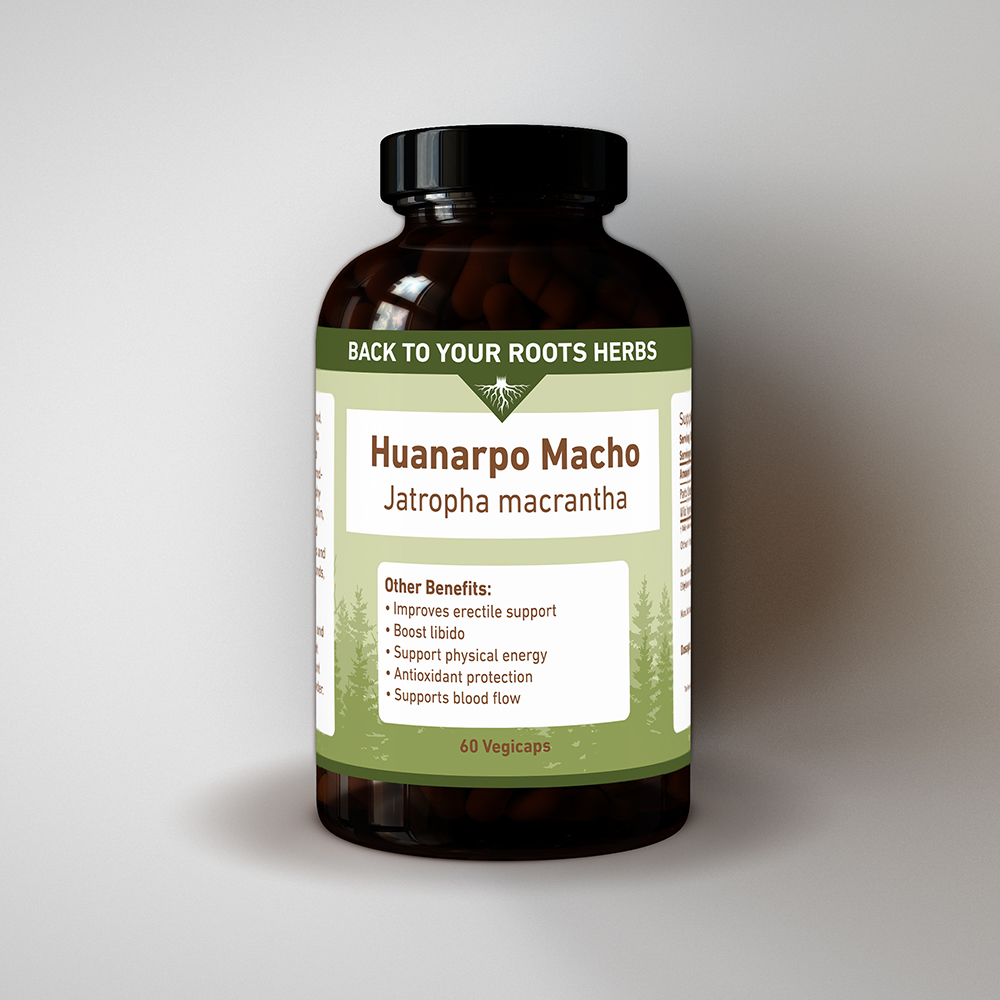
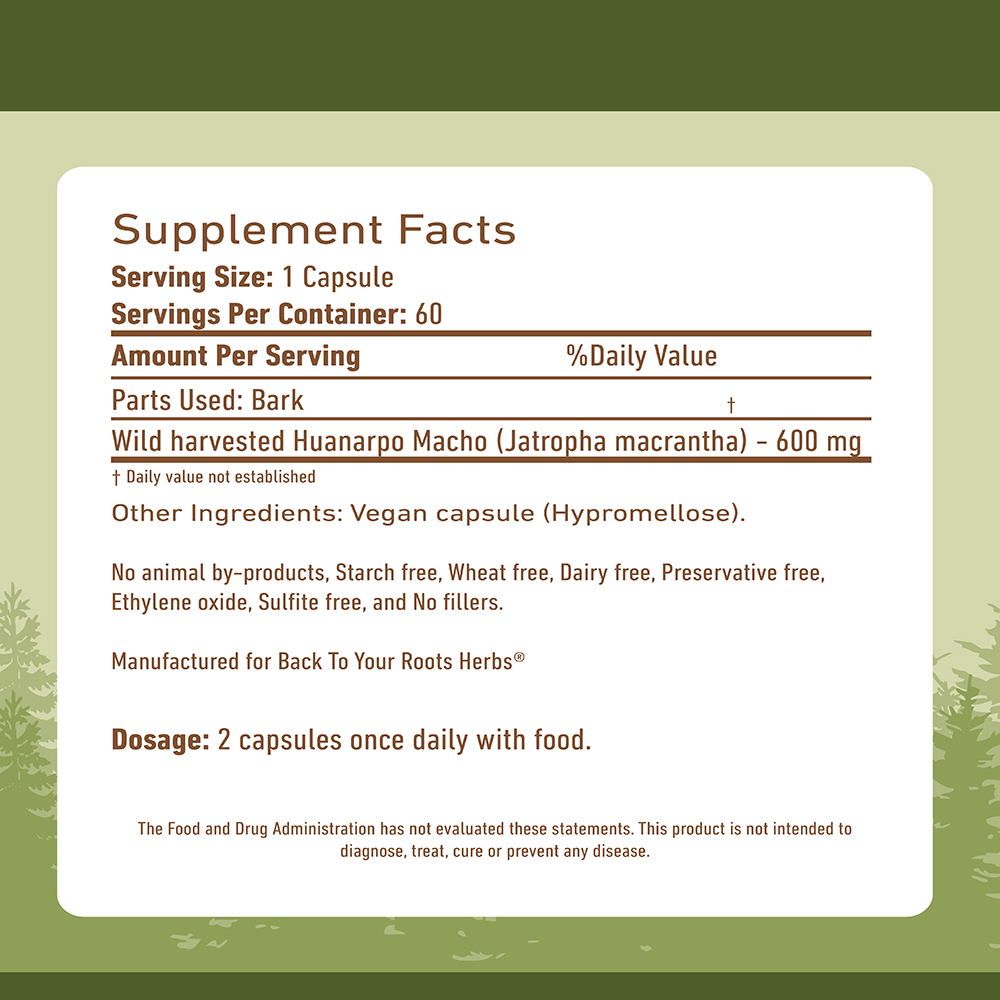
Huanarpo macho capsules hold the dried, powdered bark of Jatropha macrantha Müll.Arg., a shrub in the spurge family (Euphorbiaceae) that grows on the dry western slopes of the Andes in Peru. Some US shops sell the same bark as red huanarpo. In Peru, it is a traditional tonic for energy and stamina. Each huanarpo macho capsule holds 600 mg of whole bark, with 60 vegan caps per bottle. No extract. No fillers.
THE VERDICT (INTERNAL QUALITY SCORE):
Grade A for identity and heavy metal results. Our huanarpo macho bark powder passed identity testing by HPTLC fingerprint and microscopy, plus a heavy metal screen. That matters in this category, because the name huanarpo covers more than one plant. The terroir is specific and often misreported: the shrub grows among rocks and cacti on the arid western slopes of the Peruvian Andes, at roughly 1,500 to 2,700 m. It is a dry-scrub plant, not an Amazon rainforest tree. We grade these capsules on what a lab can confirm. Right plant. Right part. Clean metals.
– Back To Your Roots Herbs Research Group
SENSORY ANALYSIS OF HUANARPO MACHO BARK POWDER:
- Look: Open one of these capsules, and you find a fine, red-brown powder with a matte, slightly fibrous texture. Much darker than maca powder.
- Smell: Faint, dry, and woody, like split kindling. No sweetness and no mustiness.
- Taste: Astringent first, then mildly bitter. The tongue-drying pull comes from tannins, the catechins and proanthocyanidins in huanarpo macho bark. The capsules keep that taste off your tongue.
HOW DO HUANARPO MACHO CAPSULES WORK?
- The Herb: Huanarpo macho capsules use J. macrantha bark sourced from Peru, from a shrub native to the western Andean slopes.
- The Mechanism: Not established in humans. The plant’s stems carry catechin and proanthocyanidin polyphenols, which show antioxidant activity in laboratory tests. The capsules hold whole bark powder, which keeps the plant’s own mix of compounds, because nothing is extracted or concentrated.
- The Evidence: Research by Benavides et al. (2006) identified proanthocyanidin B-3 as the most abundant catechin derivative in J. macrantha stems and proposed the assay for quality control of raw materials and final products (PMID 16300918).
- The Gap: No human clinical trial has tested huanarpo macho in any form, capsules included. Every published effect so far comes from animal or test-tube studies, and no study has measured energy, stamina, or hormone outcomes in people.
Huanarpo Macho Capsules Botanical Description (Jatropha macrantha)
Huanarpo macho is a slightly branched, semi-succulent shrub, 1 to 2 m tall. Its grey bark carries raised scars where old leaf stalks fell away. Clusters of reddish-orange flowers sit on short, fleshy stalks. The spurge family also includes cassava and the rubber tree. Accepted name: Jatropha macrantha Müll.Arg. (GBIF taxonomy record).
Common Names in Peru and the Andean World
Peruvian common names include huanarpo macho, wanarpo, vanarpo, urco huanarpo, and simayuca. US sellers add red huanarpo. The word macho sets this plant apart from huanarpo hembra, a different shrub. It does not describe the customer. In Peru, the bark turns up in herbal market stalls and on pharmacy shelves, often as capsules.
Where Huanarpo Macho Grows: The Andes, Not the Amazon Rainforest
Many listings call huanarpo macho an Amazonian jungle herb. The botany disagrees. References compiled by the LLIFLE succulent encyclopedia place the species on the arid western slopes of the Andes in central Peru, in the Ancash, Arequipa, Cajamarca, Huánuco, Lima, La Libertad and Puno regions, among rocks in cactus scrub at about 1,500 to 2,400 m. A 2021 herbarium-vouchered collection (UNMSM voucher 039-USM-2020) came from Sacrapa, Paucar del Sara Sara province, Ayacucho, at 15°16′47″ S, 73°20′45″ W and 2,691 m. Dry mountain scrub. Not rainforest.
What the Research Shows on Huanarpo Macho (and What It Does Not)
The published work on huanarpo macho is small, preclinical, and mostly chemistry. None of it tested capsules in people. Here is the honest summary.
Chemistry: Catechins and Proanthocyanidin B-3
Benavides et al. (2006) isolated catechin, catechin-7-O-β-glucopyranoside, and proanthocyanidin B-3 from the stems and confirmed all three as major compounds, with proanthocyanidin B-3 the most abundant. These belong to the same polyphenol family found in green tea and cocoa, a family studied for antioxidant activity in test tubes. They also account for the dry, astringent bite of the powder.
Animal Data: Maca Plus Huanarpo Macho
Oshima et al. (2003) measured sex steroid hormones and embryo implantation in mice given maca (Lepidium meyenii), alone and together with huanarpo macho (PMID 14600359). Testosterone rose in mice given maca and in mice given maca plus huanarpo. Estradiol and implantation rates did not change. A short mouse study of a two-herb mix does not show what huanarpo macho capsules do in people, and we make no hormone claim.
Identity: Why Huanarpo Capsules Need Lab Testing
The name huanarpo is shared, which makes identity the first quality question in this category. Our certificate of analysis confirms the bark in these capsules by HPTLC fingerprinting and microscopy. Three look-alikes show why that test matters.
Look-Alike 1: Huanarpo Hembra (Cnidoscolus diacanthus)
The “female” huanarpo is a different genus in the same family, studied in Ayacucho as its own species (Tinco-Jayo et al. 2024, PMID 39407486). It does not belong in huanarpo macho capsules.
Look-Alike 2: Jatropha cilliata
A 1996 study of a Peruvian medicinal plant called huanarpo identified it as Jatropha cilliata (Okuyama et al., PMID 8998840). Same common name. Different species.
Look-Alike 3: Jatropha curcas Seed
The physic nut, Jatropha curcas, is the species behind most “is Jatropha poisonous” warnings. Its seeds are toxic.
Why This Bottle Contains No Seed
These huanarpo macho capsules contain bark powder only. No seed, no seed oil, and no other Jatropha species.
HUANARPO MACHO CAPSULES: CRITICAL USAGE AND DOSAGE
How to Take Huanarpo Macho Capsules
- Take 2 huanarpo macho capsules (1,200 mg of bark) once a day with food and a full glass of water.
- New to huanarpo? Start with 1 capsule a day for the first 3 days to check how your stomach handles it.
- Do not take more than 2 capsules in 24 hours. A 60-capsule bottle lasts 30 days.
- These capsules contain no added caffeine or stimulants. Do not expect a caffeine-style energy rush.
- No study has measured how long huanarpo macho takes to act, so we make no timeline claim. Stop taking the capsules if you notice stomach upset, a rash, or any unusual symptom.
Who Should Ask a Doctor First?
Huanarpo macho has no formal human safety studies, so our cautions are conservative. Do not use these capsules if you are pregnant, trying to conceive, or breastfeeding, or if you are under 18.
Ask your doctor or the pharmacist at your pharmacy before taking huanarpo macho capsules if you:
- Take any prescription medicine, especially for blood pressure, heart rhythm, blood sugar, or hormone therapy.
- Have a heart, liver, or kidney condition, a hormone-sensitive condition, or any chronic health condition.
- Have surgery scheduled within the next 2 weeks.
For general guidance, see the FDA’s consumer information on dietary supplements and NCCIH’s Using Dietary Supplements Wisely.
Frequently Asked Questions About Huanarpo Macho Capsules
Can women take huanarpo macho capsules?
Huanarpo macho is named for the plant, not the customer. Traditional use in Peru centers on men’s health, and no study has tested the herb in women. Women who are pregnant, trying to conceive, or breastfeeding should not use these capsules. Other women should ask a doctor first.
Will these capsules raise testosterone like a drug?
No. Huanarpo macho capsules are a whole-herb dietary supplement, not a hormone, steroid, or drug. The only testosterone data come from a 2003 mouse study of a maca and huanarpo mix, and animal results do not predict human effects.
Is huanarpo macho a substitute for prescription medicine?
No. Huanarpo macho is a traditional tonic, not a medicine. In the US, this huanarpo macho dietary supplement is regulated as a food, not a drug, and in Europe the same category is called food supplements. If you have a health condition or symptoms, see a doctor, and never stop or replace a prescription with capsules or any other herbal supplement.
Are huanarpo pills, tablets and capsules the same thing?
Shoppers search for huanarpo pills, huanarpo macho pills, huanarpo tablets, and huanarpo capsules as if they were one product. They are not. A tablet is pressed powder held together with binders. A capsule is loose powder inside a shell. No tablet press touches this product: whole bark powder goes into plant cellulose capsules, with no binders, and each capsule opens cleanly if you prefer to stir the powder into foods such as oatmeal or a smoothie. This is also not a huanarpo macho extract. A huanarpo extract concentrates part of the plant, and we keep the whole bark.
Is this herbal supplement vegan, vegetarian, and gluten-free?
Yes. The capsules use vegetable cellulose, not gelatin, which is made from animal collagen. Huanarpo macho caps from Back To Your Roots Herbs are a single-herb formula: vegan, vegetarian, non-GMO, and gluten-free, with no wheat, soy, dairy, binders, or fillers.
How should I store the bottle, and how long does it last?
Keep the capsules in the tightly closed bottle, in a cool, dry place away from sunlight, below 77°F (25°C). Each bottle holds 60 caps, a 30-day supply at 2 huanarpo macho capsules daily. Use by the date printed on the label.
Is this huanarpo macho certified organic?
No, and we do not claim it is. Our huanarpo macho stands on lab results rather than a seal. The quality assurance file for these capsules shows identity confirmed by HPTLC and microscopy, and a passing heavy metal test.
Preguntas en español: huanarpo macho cápsulas
¿Para qué se usa el huanarpo macho en cápsulas?
En el Perú, el huanarpo macho (Jatropha macrantha) se usa de forma tradicional como tónico para el bienestar y la energía del día a día. No es un medicamento y no hay estudios clínicos en personas. Estas capsulas contienen solo corteza molida, sin extracto y sin rellenos.
¿Cómo tomar las capsulas de huanarpo macho?
Tomar 2 capsulas al día con comida y agua (1200 mg de corteza). No exceder 2 capsulas en 24 horas. Consulte a su médico o farmacéutico antes de usar este suplemento si está embarazada o dando de lactar, si toma medicamentos o si tiene alguna condición de salud.
¿Son capsulas veganas y sin gluten?
Sí. Son 60 capsulas de celulosa vegetal, aptas para dietas veganas y vegetarianas, sin gluten, sin soya y sin lácteos. Un frasco rinde para 30 días.
CLINICAL SPECS:
| Spec | Detail |
|---|---|
| Serving Size | 2 Capsules (1,200 mg Huanarpo Macho Bark) |
| Frequency | Once Daily With Food (60 Capsules, 30 Servings per Bottle) |
| Active Marker | Catechins and Proanthocyanidin B-3 (Benavides et al. 2006) |
| Processing | Dried, Milled Whole Bark (Not a Huanarpo Macho Extract, No Solvents) |
| Safety | Heavy Metal Tested (Pass), Identity Tested (HPTLC and Microscopy) |
| Ingredients | Huanarpo Macho (Jatropha macrantha) Bark Powder, 600 mg per Capsule |
| Other Ingredients | Vegetable Cellulose (Capsule) |
| Purity | Non-GMO, Vegan |
| Free From | Wheat, Gluten, Soy, Dairy, Binders, Fillers |
| Origin | Peru (Western Andean Slopes, Native Range of Huanarpo Macho) |
| Manufactured | Virginia Beach, VA, USA |
COMPARISON TABLE:
| Feature | BTYRH Huanarpo Macho Capsules | Generic Huanarpo Pills |
|---|---|---|
| Origin | Peru, Western Andean Slopes (Species Confirmed by Lab) | Unspecified |
| Preparation | Whole Bark Powder, 600 mg per Vegan Capsule, No Extract, No Fillers | Pressed Pills or Maca Blends, Plant Part Often Not Stated |
| Taste | Astringent, Woody, Mildly Bitter (Tannin-Rich Bark) | Not Disclosed |
| Safety | Identity Tested (HPTLC, Microscopy) and Heavy Metal Tested (Pass) | Unknown/Untested |
How to Choose Huanarpo Macho Capsules
- Look for the Latin name on the label. Any huanarpo supplement should name Jatropha macrantha, not just “huanarpo”.
- Check that the plant part is named. Many brands sell huanarpo pills that name no plant part at all. Our capsules contain bark.
- Ask the brand behind any huanarpo macho capsules for a certificate of analysis with an identity test and a heavy metal test.
- Compare price per milligram of bark, not price per bottle of capsules. Count milligrams, not caps. Marketplace labels often read “500mg” or “1000mg” per serving. Ours is 1,200 mg per 2-capsule serving.
- Skip any brand that promises instant energy or compares huanarpo to a prescription drug. FDA has repeatedly found hidden drug ingredients in supplements sold with drug-like promises.
Huanarpo Macho vs Maca Root vs Ginseng
In Peru, huanarpo macho is often sold blended with black maca, and maca is the better-known Peruvian root. Maca shares shelf space with camu camu, sacha inchi, and yacon as one of Peru’s best-known export crops. These are different plants with different evidence.
- Huanarpo macho: bark of a dry-slope shrub (J. macrantha). Astringent and woody. Chemistry and animal data only.
- Maca root: a root vegetable (Lepidium meyenii) grown at about 4,000 m in the central Andes, eaten as food and sold worldwide as an energy food. Malty and sweet. Small human trials exist. See our maca powder capsules.
- Ginseng: an Asian root (Panax ginseng), not Peruvian, and the most studied of the three. See our red ginseng capsules or, for another Peruvian fruit, our camu camu capsules.
If you combine huanarpo macho capsules with maca powder capsules, start one at a time so you know how each one sits with you.
Huanarpo macho capsules from Back To Your Roots Herbs: 60 vegan caps, 600 mg of identity-tested Peruvian bark per capsule, heavy metal tested and made in Virginia Beach, VA.
DISCLAIMER: These statements have not been evaluated by the Food and Drug Administration. This product is not intended to diagnose, treat, cure, or prevent any disease. Consult your healthcare provider before use.
Reviews
There are no reviews yet.