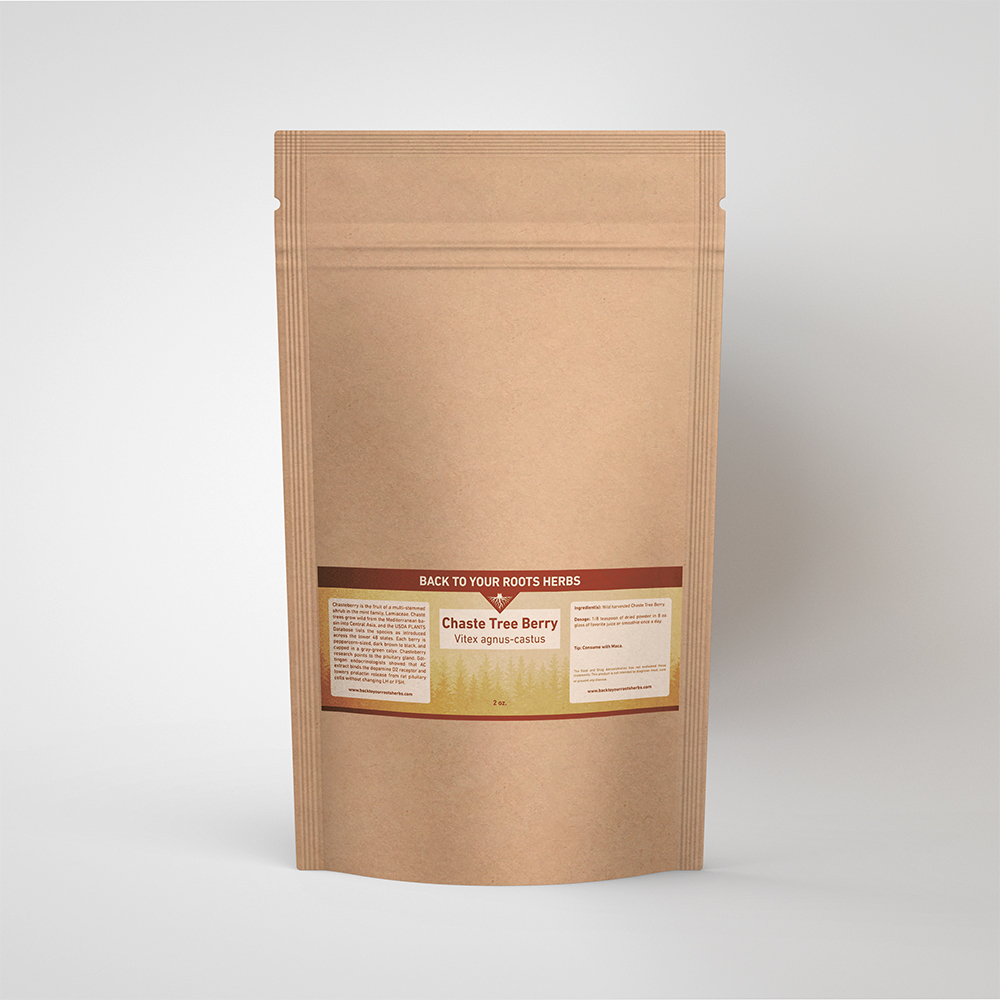
Chaste tree berry powder is the whole dried fruit of Vitex agnus-castus, milled fine. Chasteberry powder, chaste tree powder, and vitex berry powder all name the same ground fruit. This description covers the berry, the research, the dose, and who should skip it.
- How chaste tree berry powder works
- Whole berry versus extract
- Powder dosage and serving size
- Who should avoid this powder
- Chaste tree berry specs
- Chaste tree berry powder questions
THE VERDICT (INTERNAL QUALITY SCORE):
Grade A. Potency Score 9/10. This is single-ingredient chasteberry powder: whole Vitex agnus-castus fruit from Albania, ground and packed with nothing added. No solvent. No carrier. Albania sits on the Balkan edge of the chaste tree’s Mediterranean range, where the shrub grows wild in coastal scrub and stream beds. We hold back one point because the clinical trials used concentrated extracts, so this jar follows the European traditional-use dose for powdered fruit.
– Back To Your Roots Herbs Research Group
CHASTEBERRY SENSORY ANALYSIS:
Every lot of chasteberry gets the same bench check.
Look (Color and Texture)
Greyish brown, with dark seed-coat flecks and faint gray-green specks from the calyx. Fine but fibrous. It packs under a fingertip and falls apart with a tap, as a fruit that is half fiber should.
Smell (Aromatic Profile)
Black pepper first, then eucalyptus, then resinous pine. That is the essential oil, led by sabinene, 1,8-cineole, and beta-caryophyllene (Sørensen and Katsiotis, 2000).
Taste (Flavor Notes)
Warm and peppery, then bitter at the back of the tongue, then dry. Tradition says medieval monks ground the berries as a pepper substitute, which is how chasteberry earned the name monk’s pepper.
HOW DOES CHASTE TREE BERRY POWDER WORK?
- The Herb: Vitex agnus-castus fruit sourced from Albania, on the Balkan coast.
- The Mechanism: Acts as a dopamine D2 receptor signal at the pituitary to trigger lower prolactin release, according to research on chasteberry extracts.
- The Evidence: Research by Schellenberg (2001) confirmed a 52% responder rate on chasteberry extract versus 24% on placebo over three cycles.
Vitex Agnus-Castus: The Herb and Its Albanian Terroir
Chasteberry is the fruit of a multi-stemmed shrub in the mint family, Lamiaceae. Chaste trees grow wild from the Mediterranean basin into Central Asia, and the USDA PLANTS Database lists the species as introduced across the lower 48 states. Each berry is peppercorn-sized, dark brown to black, and cupped in a gray-green calyx. Albania is a recurring origin for chasteberry sold in the United States, and some Albanian collectors certify their wild harvest under the FairWild sustainability standard.
Greek Mythology and the Name Monk’s Pepper
Samian tradition held that Hera was born beneath a lygos, the old Greek name for this shrub, and Pausanias reported the tree still standing in her sanctuary. Dioscorides recorded the plant in Greek traditional medicine, and the botanical name says chaste twice, once in Greek and once in Latin.
The Mechanism: Dopamine, Prolactin, and the Pituitary
Chasteberry research points to the pituitary gland. Göttingen endocrinologists showed that AC extract binds the dopamine D2 receptor and lowers prolactin release from rat pituitary cells without changing LH or FSH (Jarry et al., 1994). AC is their shorthand for the herb. Later work traced the effect to clerodadienol diterpenes (Wuttke et al., 2003), and a 2024 study added a triterpene to the D2-active list (Reinhardt et al., 2024). Estrogen is a side story. A chaste tree berry extract bound estrogen receptor beta in lab assays (Jarry et al., 2003), which proves nothing about estrogen in people.
The Evidence: What Chasteberry Trials Measured
Every clinical study here links to its PubMed record, so you can read the abstract yourself.
Schellenberg 2001 Trial (PMID 11159568)
In German community clinics, 170 women with premenstrual syndrome took one daily tablet of chasteberry extract (Ze 440) or placebo for three cycles. Self-rated PMS symptoms, including irritability, mood alteration, anger, headache, breast fullness, and bloating, improved more on chasteberry (P below 0.001). Responders: 52% versus 24%. The scores tracked premenstrual mood, not anxiety disorders (Schellenberg, BMJ 2001).
A meta-analysis of three well-characterized chasteberry trials (520 women) found extract users 2.57 times more likely to report remission (Csupor et al., 2019). A broader review warned of bias and 91% heterogeneity (Verkaik et al., 2017), and NCCIH, part of the National Institutes of Health, agrees that better trials are needed (NCCIH).
WHOLE CHASTE TREE BERRIES VERSUS EXTRACT: THE COMMODITY DEFENSE
Why Chasteberry Powder Is Not a 20 mg Extract
The trials above used ethanol extracts at 4 to 20 mg a day. On paper, a 20 mg tablet of a 6 to 12:1 extract starts from only 120 to 240 mg of fruit and keeps the active ingredients the solvent pulls out. Whole powder keeps the fiber, seed oil, iridoids (agnuside, aucubin), the flavonoid casticin, and the volatile oil. The European Medicines Agency lists 20 mg of dry extract for well-established use and 400 mg of powdered herbal substance twice daily for traditional use (EMA, 2018). Different forms, different doses.
Species Identity and the Negundo Problem
Supplement brands vary widely. HPLC fingerprints of 17 U.S. and Japanese health foods sold as chaste berry products found agnuside from 14% to 5,054% and casticin from 3% to 1,272%, and about half had marker ratios closer to V. negundo, a related Asian species, than to chasteberry (Fukahori et al., 2014). A 2019 follow-up found two supplements missing one or both marker compounds (Sogame et al., 2019). A traceable lot with a certificate of analysis (COA) settles that question.
CRITICAL USAGE: DOSAGE AND CONTRAINDICATIONS
How to Use the Berry Powder
Take chaste tree berry powder at the European traditional-use dose for powdered fruit: 400 mg twice a day. Judge it after three cycles, and see a doctor if symptoms persist past three months.
- Weigh 400 mg of chasteberry powder, or fill one size 00 capsule.
- Take the first serving of the powder with breakfast.
- Take the second serving of chasteberry in the evening.
- Keep a cycle diary while you take the powder, then review it with your clinician.
Measuring Chasteberry Powder by the Teaspoon
Fine berry powders weigh roughly 2 to 3 grams per level teaspoon, so 400 mg is about a heaped 1/8 teaspoon. A 0.01 g scale removes the guesswork.
Chasteberry Powder in Capsules
A size 00 capsule holds about 0.9 mL, roughly 400 to 500 mg of packed powder. One capsule in the morning and evening lands near the traditional dose. Prefer them ready-made? Our Chaste Tree Berry Capsules hold the same Albanian berry.
Chasteberry Powder in Tea and Smoothies
Whisk a serving into warm tea and drink it before the fiber sinks. Smoothies and oatmeal hide the pepper well.
Pantry Storage
Keep the jar closed in a cool, dark pantry. Powdered berries lose volatile oil faster than whole berries, so a fading pepper smell means freshness is slipping.
Who Should Not Use Chaste Tree Berries
NCCIH calls chasteberry well tolerated in studies up to three months. Like many herbal supplements, it is hormone-active, so clear it with your healthcare professionals first and list all vitamins and supplements you take, as the NIH Office of Dietary Supplements advises.
Conditions and Medicines That Need a Clinician First
Pregnancy and Breastfeeding
Avoid chasteberry. The EMA advises against use, and NIH LactMed says to avoid it while nursing because it can shift prolactin and milk supply (LactMed).
Anyone Under 18
Use is not established in children or teens. Parents and caregivers should store the jar out of reach.
Hormone-Sensitive Cancer History
NCCIH flags hormone-sensitive breast, uterine, and ovarian cancers, so get your oncology team’s approval first. Memorial Sloan Kettering Cancer Center also lists hormone therapies among possible interactions.
Pituitary or Prolactin Disorders
Because chasteberry acts at the pituitary, it can mask the signs of a pituitary disorder.
Dopamine-Related Medicines
Skip chasteberry with Parkinson’s medicines, bromocriptine, antipsychotics, or metoclopramide unless your prescriber agrees. Lab work also shows it inhibits CYP2C19 and CYP3A4, a source of possible drug interactions.
Birth Control and Hormone Therapy
Preclinical data suggest it may weaken hormonal contraceptives and hormone therapy. Ask your prescriber first.
Fertility Treatment
The EMA reports no fertility data. Trying to conceive or in IVF? Ask your fertility specialist first.
Stop and Call Your Clinician If
You notice facial swelling, trouble breathing or swallowing, a spreading rash, or a major cycle change.
CLINICAL SPECS:
| Spec | Detail |
|---|---|
| Serving Size | 400 mg (one packed size 00 capsule or a heaped 1/8 tsp) |
| Frequency | Twice daily (morning and evening) for three menstrual cycles |
| Active Marker | Agnuside and casticin (Ph. Eur. and USP identity markers), clerodadienol diterpenes |
| Processing | Whole dried berries milled to powder. No extraction, no solvents |
| Safety | Heavy Metal Tested (Pass) |
| Ingredients | 100% Vitex agnus-castus fruit (chaste tree berry) powder |
| Other Ingredients | None (single-ingredient powder, no capsule) |
| Purity | Non-GMO, Vegan, Single Ingredient |
| Free From | Wheat, Gluten, Soy, Dairy, Binders, Fillers |
| Origin | Albania (Balkan coast) |
| Packed | Virginia Beach, VA, USA |
COMPARISON TABLE:
| Feature | BTYRH Chaste Tree Berry Powder | Generic Chaste Tree Berry Supplement |
|---|---|---|
| Origin | Albania (named country of origin) | Unspecified |
| Preparation | Powdered whole fruit, fiber and volatile oil intact | Solvent extract, often on a maltodextrin carrier |
| Species Identity | Single species, traceable lot | HPLC surveys found some products closer to V. negundo |
| Taste | Peppery, bitter, warm, piney finish | Flat or sweet (carrier masks the berry) |
| Pack Size | 2 oz jar for fresher aroma | 1 lb or 1kg bulk bags |
| Safety | Heavy metal tested lot (Pass) | Unknown/Untested |
CHASTE TREE BERRY FAQ
What is chaste tree berry?
Chaste tree berry is the dried fruit of the chaste tree, and this jar holds that fruit ground fine. Sellers also call it vitex powder or powdered chaste berries.
Does this berry powder have side effects?
Side effects are usually mild: nausea, headache, digestive upset, menstrual changes, acne, itching or rash, all reversible (Daniele et al., 2005).
How long does chasteberry take to work?
Plan on three cycles. In 69 Japanese patients taking a chasteberry extract, symptom scores fell after the first cycle and kept falling through the third (Momoeda et al., 2014).
Does chasteberry raise estrogen or lower cortisol?
Neither has been shown in people. Human research centers on prolactin, and we found no trial showing lower cortisol.
Is chasteberry used for fertility or menopause?
Both appear in reproductive health traditions, but the EMA reports no fertility data, and a 2026 menopause review calls for better trials (Sopjani et al., 2026). See our guide to chasteberry for perimenopause.
Can men take this powder?
Men are not the studied group. The EMA monograph covers adult women, so men should ask a healthcare professional first.
Can I use chaste tree berries powder for hormonal acne?
Acne appears in chasteberry research as a side effect, not an established use. For skin that flares with your cycle, see a dermatologist.
How many grams of chaste berry powder are in a teaspoon?
Roughly 2 to 3 grams per level teaspoon. One 400 mg serving is about a heaped 1/8 teaspoon.
Can you get chasteberry from foods?
Not from everyday foods, though ancient Mediterranean cooks used the plant as a spice. Nutrition-wise, the fruits are about half fiber, with 5 to 7% protein, 4 to 5% seed oil, and about 3% minerals (Zhelev et al., 2022).
Is this the same chasteberry horse owners use?
Same species, different product. Equine versions are dosed for horses, usually mares, and this jar is labeled for human use. Ask your equine veterinarian (DVM) before giving any herb to horses or ponies.
Which herbs are often discussed alongside chasteberry?
Black cohosh, dong quai, red clover, red raspberry leaf, wild yam, and licorice root. These single-herb jars share our apothecary shelf:
- Dong quai root powder
- Damiana leaf powder
- Maca root powder
- Ashwagandha root powder
- Saw palmetto berry powder
- Stinging nettle root powder
- Ceylon cinnamon bark powder
DISCLAIMER: These statements have not been evaluated by the Food and Drug Administration. This product is not intended to diagnose, treat, cure, or prevent any disease. Consult your healthcare provider before use, especially if you are pregnant, nursing, taking medication, or have a medical condition.
Reviews
There are no reviews yet.