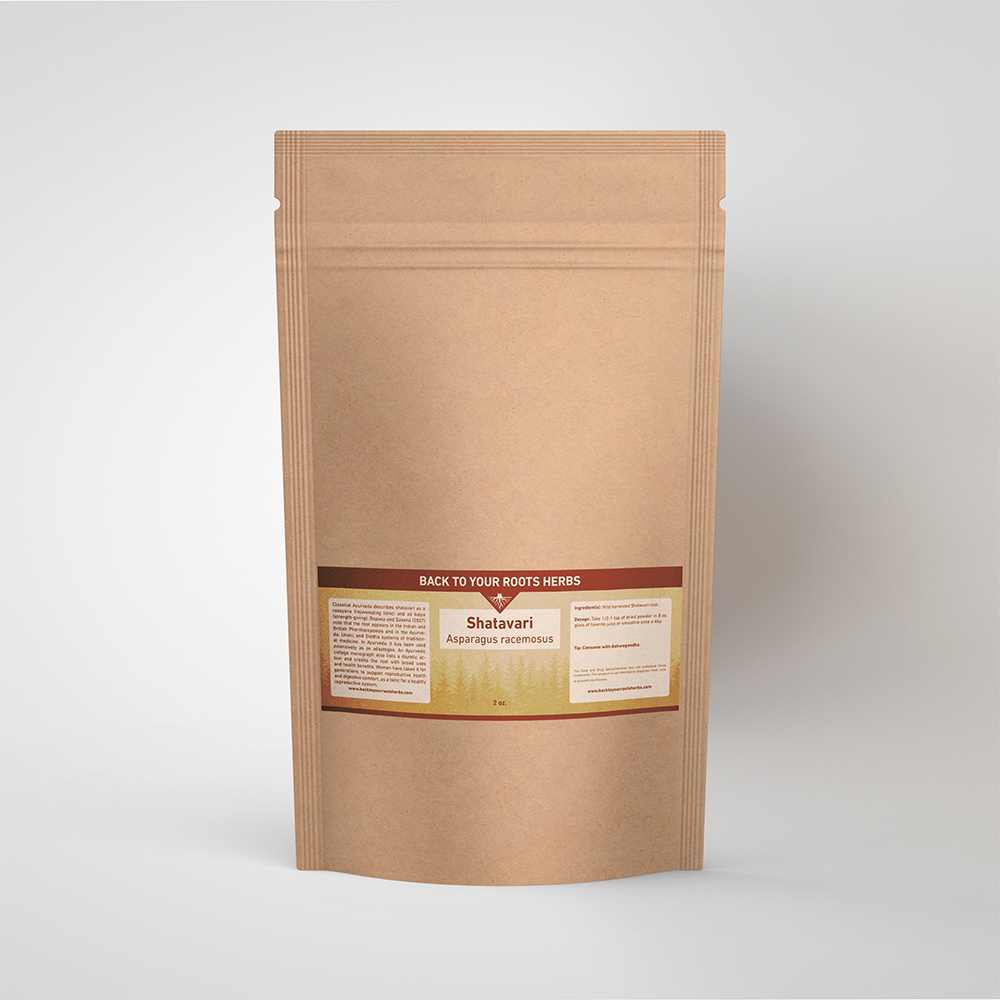
THE VERDICT (INTERNAL QUALITY SCORE):
Grade A shatavari powder. This lot is pure Asparagus racemosus root from Madhya Pradesh in central India (23.4733° N, 77.9480° E), dried and milled whole with nothing added. No extract. No carrier. The heavy metal panel on the lot certificate of analysis reads Pass. The powder is cream colored, fine and faintly sweet, with the soft bitter finish Ayurveda assigns to shatavari. One ingredient, made the way classical shatavari churna was made.
– Back To Your Roots Herbs Research Group
What Is Shatavari Powder?
Shatavari powder is the dried tuberous root of Asparagus racemosus Willd. (family Asparagaceae), milled into a fine powder. Ayurveda ranks shatavari among the rasayana tonics, and the herb is often called the “Queen of Herbs.” This 2-ounce (57 g) package holds one ingredient. It is not garden asparagus, and it is not ashwagandha.
What is the source of shatavari? The Ayurvedic Pharmacopoeia of India names the tuberous root of Asparagus racemosus as its biological source. Its Sanskrit synonyms include Shatamuli, “the one with a hundred roots,” after the pale, finger-like tubers that hang from a single crown. Short on time? Jump to the FAQs about shatavari powder.
Shatavari Root Powder vs Shatavari Root Extract
Shatavari root powder is the whole dried root, milled. It keeps what the root holds: steroidal saponins, mucilage, polysaccharides, and fiber. A shatavari root extract concentrates selected compounds with water or alcohol, is sometimes dried onto a carrier such as maltodextrin, and is sold by saponin percentage. A shatavari extract is stronger per gram but leaves the fiber and much of the mucilage behind. This package holds shatavari powder, not an extract.
Shatavari in Ayurveda and Traditional Medicine
Classical Ayurveda describes shatavari as a rasayana (rejuvenating tonic) and as balya (strength-giving). Bopana and Saxena (2007) note that the root appears in the Indian and British Pharmacopoeias and in the Ayurveda, Unani, and Siddha systems of traditional medicine. In Ayurveda, it has been used extensively as an adaptogen. An Ayurvedic college monograph also lists a diuretic action and credits the root with broad uses and health benefits. Women have taken it for generations to support reproductive health and digestive comfort, as a tonic for a healthy reproductive system.
Ayurvedic Energetics of the Root
Rasa (Taste): Madhura and Tikta
Sweet first, bitter second. That is the order we taste in the raw powder.
Virya, Vipaka and Guna: Cooling, Sweet, Heavy
Sita virya (cooling), madhura vipaka (sweet after digestion), guru and snigdha guna (heavy and unctuous). In Ayurvedic theory, sweet, heavy, and unctuous qualities settle Vata, and sweet, bitter, and cooling qualities settle Pitta. That is why practitioners classify shatavari as Vata- and Pitta-pacifying.
Synonyms of Shatavari: Satavari, Shatamuli and Satavar
What are the synonyms of shatavari? Satavari is a common English spelling, and in Hindi the root is usually written satavar or shatavar. An Ayurvedic college monograph lists more Sanskrit synonyms: Atirasa, Bahusuta, Shatpadi, Shatvirya, Bhiru and Indivari. Whatever the spelling, the label should name Asparagus racemosus.
From Root to Powder: Harvest Time and Supply Chain
Shatavari is a slow crop. Growers lift the roots 12 to 14 months after planting. A hectare yields roughly 12,000 to 14,000 kg of fresh root, which dries down to about 1,000 to 1,200 kg (Vikaspedia, Government of India). That is roughly 10 to 14 kg of fresh root per kilogram dried. Each ounce of shatavari powder starts as about 0.3 to 0.4 kg of fresh root, so this package began as roughly 0.6 to 0.8 kg.
India needs more than 500 tonnes of the roots a year (Vikaspedia), and destructive harvesting and deforestation have left wild stands endangered (Bopana and Saxena 2007). Fresh roots are highly perishable, and drying is one of the two preservation methods reported in the supply chain (Kohli et al. 2023). A 2024 study of wild and cultivated roots from Maharashtra found pesticide residues in both samples (Chakraborty et al. 2024). Ask brands for lot testing that covers both heavy metals and pesticides.
SENSORY ANALYSIS:
- Look: Fine, cream to pale beige shatavari powder with a faint fibrous sheen. It clumps lightly when pressed and breaks apart with a tap.
- Smell: Quiet. Dry earth, raw oats, and a hint of sweet root vegetable. No mustiness.
- Taste: Mildly sweet, then a soft bitter finish. The raw powder feels slightly starchy and turns silky in warm milk as the mucilage hydrates.
Whisk 1 teaspoon into a cup of warm milk, and it disperses in a few strokes, giving the beverage a light body. In cold water, it settles within minutes. Stir before each sip.
HOW DOES SHATAVARI POWDER WORK?
- The Herb: Asparagus racemosus sourced from Madhya Pradesh, India.
- The Mechanism: Acts as a rasayana (rejuvenating) tonic in Ayurvedic practice, traditionally used to support women’s wellness, the female reproductive system, and digestive comfort. Its signature compounds are steroidal saponins and mucilage.
- The Evidence: Research by Hayes et al. (2008) confirmed ten steroidal saponins isolated from the roots, including shatavarins I, IV, and V and five new shatavarins (VI to X).
Steroidal Saponins and Other Phytochemicals in the Root
Saponins are among the main active constituents. Kohli et al. (2023) list the rest of the phytochemical profile: fructo-oligosaccharides, polysaccharides, asparosides, shatavarins, sapogenins, racemosols, isoflavones, glycosides, mucilage and fatty acids. Several are complex carbohydrates. Food scientists also add the root to beverages, bakery goods, and milk products as a functional food and nutraceutical ingredient.
Origin changes the numbers. In the 2024 Maharashtra comparison, wild roots carried more beta-sitosterol, one of the plant phytosterols (20.08 vs 4.628 µg per 100 mg), and scored stronger in a laboratory antioxidant assay (DPPH IC50 400.10 vs 692.56 µg/mL, lower is stronger).
The Active Marker: Shatavarins I to X
- Shatavarin I, also called asparoside B
- Shatavarin IV, also called asparinin B
- Shatavarin V, a known saponin
- Shatavarins VI to X, first described in 2008
We list shatavarins as the active marker class. This shatavari powder is not standardized to a saponin percentage, and the label does not claim one.
Is Shatavari High in Estrogen?
Shatavari powder is a plant root, not an estrogen or hormone supplement. Its saponins and isoflavones have been studied for phytoestrogenic activity, and Bopana and Saxena (2007) describe the plant as “mainly known for its phytoestrogenic properties.” That is the reason anyone with a hormone-sensitive condition, or on hormonal therapy, should check with a provider first.
The Evidence: Are There Proven Health Benefits?
How effective is shatavari, and what are the benefits of shatavari powder in people? Human data are thin, and we say so. Claims about the health benefits of shatavari powder often run ahead of the research. In a 2021 randomized, double-blind trial, 20 postmenopausal women took 1,000 mg of shatavari or a placebo daily for six weeks. Handgrip strength rose slightly with shatavari (+0.7 kg vs -0.4 kg on placebo), while knee extensor strength and bone-turnover markers did not differ from placebo (O’Leary et al. 2021, PMID 34959836). One small study. Encouraging, not conclusive.
CRITICAL USAGE: DOSAGE, SIDE EFFECTS AND DRUG INTERACTIONS
Dosage and contraindications. Read this before the first spoonful.
Recommended Dosage of Shatavari
Start with 1/2 teaspoon (about 1.5 g) once a day for the first week. After that, take 1/2 to 1 level teaspoon (1.5 to 3 grams) once or twice daily, or follow your provider’s advice. RxList notes that no dose range has been scientifically established. One shatavari powder label in the NIH Dietary Supplement Label Database lists a 3 g serving taken one to two times a day, and an Ayurvedic college monograph gives dosages of 3 to 5 g for the classical churna. This 2 oz (57 g) package holds about 19 servings of 3 g.
How Many Times Should You Take It? The Shatavari Churna Tradition
Many people take shatavari churna once or twice a day, often in warm milk.
Once Daily
One 1.5 to 3 g serving with breakfast suits most new users.
Twice Daily
Morning and evening servings of 1.5 to 3 g each give 3 to 6 g a day, close to the classical churna range. Keep the daily total within the label directions.
How to Take Shatavari Powder with Milk, Water or Smoothies
Shatavari powder can be taken with milk, taken with water, or blended into food.
- Warm milk, the Ayurvedic way: Whisk the shatavari powder into a cup (8 oz) of warm dairy or oat milk. Stir in a little honey or ghee once it is off the heat.
- Warm water: Stir shatavari into warm water and drink it while still cloudy. It does not steep like a tea.
- Smoothies and oatmeal: Blend shatavari powder with banana, dates, or cardamom. The sweetness covers the bitter finish and fits vegan diets.
- Capsules: Fill your own capsules if you dislike the taste of the raw powder.
Side Effects and Safety: Who Should Not Take Shatavari?
Safety data are limited. LactMed notes that the safety of shatavari has not been rigorously studied, and RxList rates the evidence as insufficient to call it safe. Small lactation studies reviewed by LactMed reported no side effects in mothers or infants. Shatavari is not a substitute for prescription drugs. Ayurveda calls the root heavy, so in large servings it may sit heavy in the stomach. Stop and contact your provider if you notice rash, swelling, or wheezing.
Precautions when using shatavari. Talk to your healthcare provider first if any of these apply:
- Pregnancy, trying to conceive, or breastfeeding
- A hormone-sensitive condition or hormonal therapy
- Lithium, a diuretic, or other prescription drugs, since shatavari may act like a water pill
- Diabetes medication or other drugs that lower blood sugar
- Allergy to asparagus or related plants
- A chronic illness, or buying for a child
Add shatavari to the list of vitamins and supplements you share with your provider. Side effects and drug interactions are easier to catch that way.
CLINICAL SPECS:
| Spec | Detail |
|---|---|
| Serving Size | 1/2 to 1 level tsp (about 1.5 to 3 g). Net weight 2 oz (57 g), about 19 servings of 3 g |
| Frequency | Once or twice daily, with food or in warm milk |
| Active Marker | Steroidal saponins (shatavarins), naturally occurring, not standardized |
| Processing | Tuberous root dried and milled to a fine powder. No extraction, no carrier |
| Safety | Heavy Metal Tested (Pass) |
| Ingredients | Shatavari (Asparagus racemosus Willd.) dried root |
| Other Ingredients | None |
| Purity | Single ingredient, Non-GMO, Vegan (not certified organic) |
| Free From | No added wheat, gluten, soy, dairy, binders, or fillers |
| Origin | Madhya Pradesh, India (23.4733° N, 77.9480° E) |
| Manufactured | Packed in Virginia Beach, VA, USA. Product of India |
COMPARISON TABLE:
| Feature | BTYRH Shatavari Powder | Generic Shatavari Powder |
|---|---|---|
| Origin | Madhya Pradesh, India, with coordinates published | Unspecified |
| Preparation | Whole tuberous root, dried and milled. No extract, no carrier, no fillers | Often unspecified. May be an extract, a blend, or include flow agents |
| Taste | Mildly sweet with a soft bitter finish, silky in warm milk | Varies with age and storage |
| Safety | Lot certificate of analysis, heavy metal panel: Pass | Unknown/Untested |
Shatavari vs Ashwagandha vs Garden Asparagus
| Feature | Shatavari | Ashwagandha | Garden Asparagus |
|---|---|---|---|
| Latin Name | Asparagus racemosus | Withania somnifera | Asparagus officinalis |
| Part Used | Tuberous root | Root | Young shoot, eaten as food |
| Ayurvedic Taste and Energy | Sweet and bitter, cooling | Bitter and astringent, heating | Not used as an Ayurvedic tonic |
| Traditional Role | Rasayana for women’s wellness and digestive comfort | Adaptogenic rasayana for strength and stamina | Seasonal vegetable |
Pair it with our ashwagandha root powder, or browse shatavari powder and other adaptogens, amla powder, guduchi powder, and our women’s energy herbs.
Shatavari: Frequently Asked Questions
Can Shatavari Powder Be Consumed Daily?
Many people take it daily, as tradition suggests, and one supplement label lists one to two 3 g servings a day. Long-term safety has not been rigorously studied, so stay within the label dosage, watch for side effects, list it with your other vitamins and supplements, and check with your provider if you take any medication.
Does Shatavari Powder Support Digestion?
Ayurveda has long used shatavari to support digestive health, based on its sweet, cooling, mucilage-rich profile. Human trials on digestion are lacking, so treat this as traditional use, not a proven effect.
Is Shatavari Used for Breast Milk and Lactation?
Shatavari has a long history of use in India as a galactagogue, an herb traditionally given to nursing mothers. The NIH LactMed database calls the clinical evidence on breast milk mixed and adds that galactagogues should never replace evaluation and counseling on modifiable factors that affect milk production. RxList advises avoiding use during pregnancy and breastfeeding because safety data are limited. If you are breastfeeding, talk to a lactation consultant or provider first.
Can You Take Shatavari with Ashwagandha?
Ayurvedic practitioners often pair the two roots. Shatavari is sweet and cooling, and ashwagandha is bitter and heating, so they balance each other. Neither is better. If you want both, start each one separately, a week apart.
Does Shatavari Make You Gain Weight?
Unlikely at these servings. A 3 g serving adds only a few calories, mostly carbohydrates, and its vitamins and minerals are minor, so the nutritional value per spoonful is small. We know of no clinical trial showing that shatavari powder changes body weight. As an herbal supplement, it carries a Supplement Facts panel, not a Nutrition Facts panel.
Is This Shatavari Certified Organic?
No. This lot is not certified organic, so we do not sell it as organic shatavari powder. It is a single-ingredient, non-GMO root powder with a heavy metal pass on its certificate of analysis. If you need USDA-certified organic, ask brands for the certificate before you buy.
How Can You Verify the Quality of Shatavari Powder?
Before you buy any herbal product, check four things: the Latin name Asparagus racemosus, a named origin, a single ingredient, and a lot certificate of analysis for heavy metals. Identity matters. Kumeta et al. (2013) report that look-alike Stemona tubers are sometimes mistaken for shatavari roots, and confirmed that true Asparagus racemosus contains no asparagamine A, one of the Stemona alkaloids.
Where Does Shatavari Grow?
Bopana and Saxena (2007) describe shatavari as a medicinal plant of tropical and subtropical India. As a crop, it likes well-drained red loam or lateritic soil and tolerates drought (Vikaspedia). Our shatavari powder comes from roots grown in Madhya Pradesh.
Sources Cited on This Page
- O’Leary et al. 2021, Nutrients: shatavari supplementation trial. PubMed 34959836, PMC8708006
- Hayes et al. 2008, Phytochemistry: steroidal saponins from Asparagus racemosus roots. ScienceDirect, PubMed 17936315
- Bopana and Saxena 2007, J Ethnopharmacol: ethnopharmacology and conservation of Asparagus racemosus. ScienceDirect, PubMed 17240097
- Kumeta et al. 2013, J Nat Med: botanical origin of shatavari products. PubMed 22529051
- Kohli et al. 2023, J Sci Food Agric: nutrition and preservation of the root. DOI
- Chakraborty et al. 2024, J Drug Res Ayurvedic Sci: wild vs cultivated shatavari roots. DOI
- LactMed: Wild Asparagus (Shatavari). NCBI Bookshelf
- NIH Dietary Supplement Label Database: shatavari powder label 203903. DSLD
- Vikaspedia (Government of India): satavari cultivation. PDF
- Shri Dhanwantry Ayurvedic College: shatavari monograph. sdach.ac.in
- RxList: Asparagus racemosus safety monograph. RxList
Back To Your Roots Herbs Shatavari Powder: pure Asparagus racemosus root from Madhya Pradesh, India, milled whole. 2 oz (57 g), one ingredient, heavy metal tested.
DISCLAIMER: These statements have not been evaluated by the Food and Drug Administration. This product is not intended to diagnose, treat, cure, or prevent any disease. The information on this page is educational and does not replace advice from your healthcare provider, especially if you are pregnant, breastfeeding, taking medication, or managing a health condition.
Reviews
There are no reviews yet.