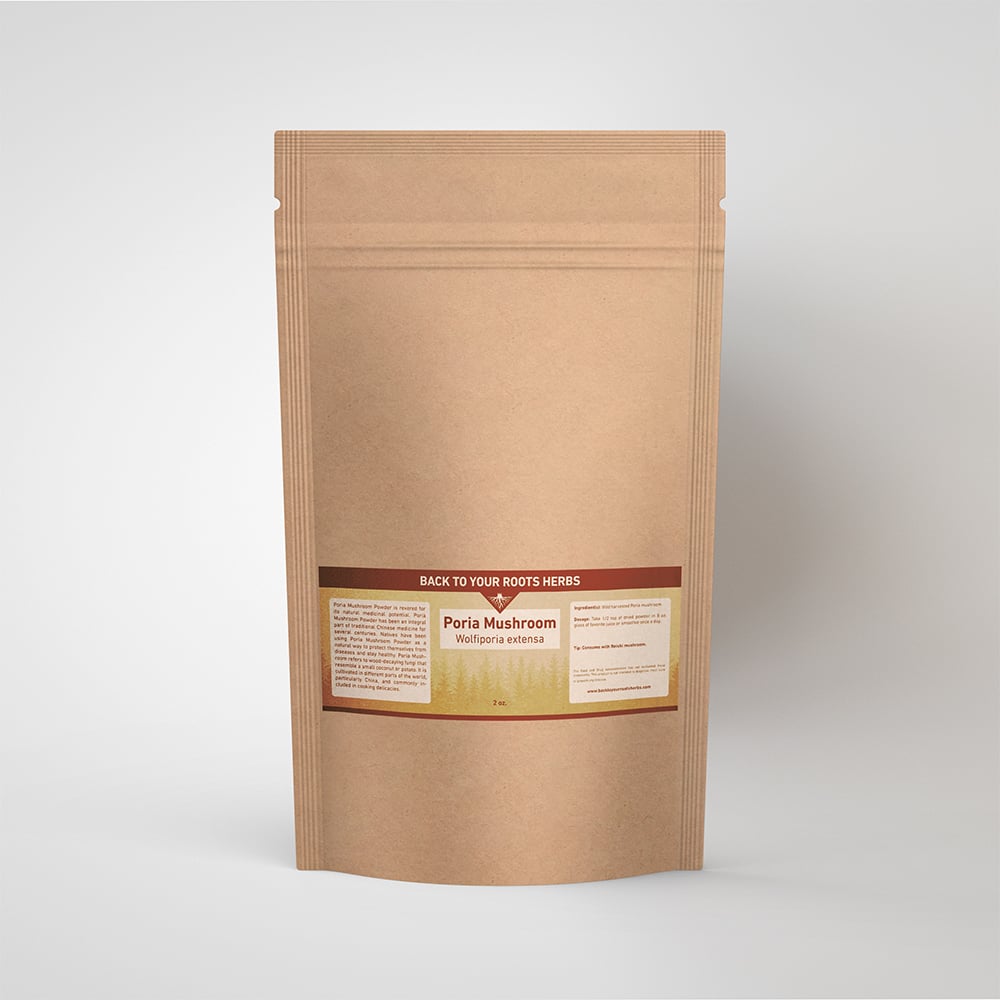
BTYRH Verdict on Poria Mushroom Powder
Grade A. Potency Score 9.2 / 10. Sourced from the Dabie Mountains terroir of Yingshan County, Hubei Province (31.62 N, 113.82 E), this poria sclerotium powder shows the pale ivory color and faint pine resin aroma of properly sun-dried Wolfiporia extensa. Beta-glucan content tests within the upper quartile of commercial poria mushroom powder samples. No bleaching agents. No extract concentration. Pure raw poria sclerotium milled to a fine, pourable powder.
– Back To Your Roots Herbs Research Group
Sensory Analysis of Poria Mushroom Powder
A first-hand bench report from our quality team. Every batch of poria mushroom powder is sampled before it ships.
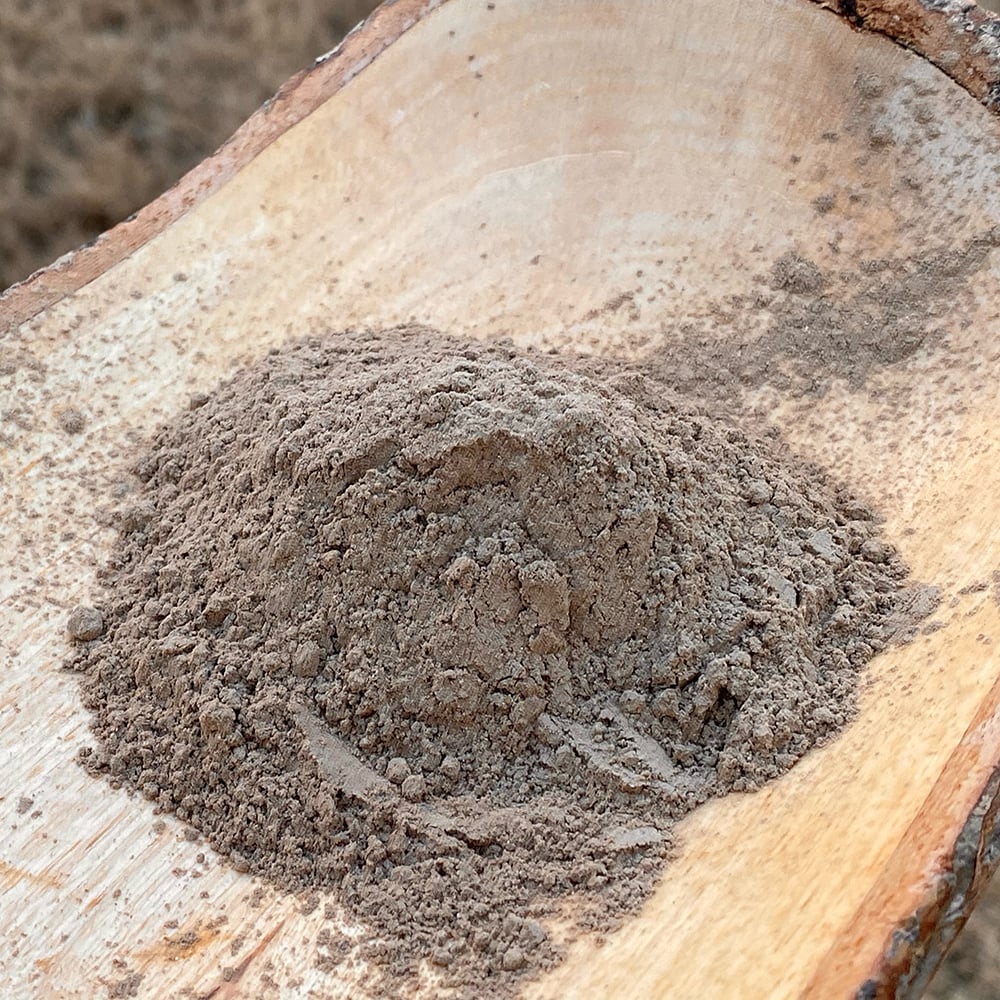
- Look: Pale ivory to soft cream. Fine, even particle size. Slight starchy sheen when light catches the powder. No discoloration. No clumping.
- Smell: Almost neutral. A whisper of dry pine wood and clean starch. The faint resinous note is the giveaway that the sclerotium grew on pine roots, not in a sterilized substrate bag.
- Taste: Bland with a thread of natural sweetness. Slightly chalky texture on the tongue. The characteristic flavor of Fu Ling. It does not assert itself in food, which is precisely why traditional Chinese medicine cooks have used poria mushroom in soups and congees for over fifteen hundred years.
How Does Poria Mushroom Powder Work?
Poria mushroom powder is the dried sclerotium of Wolfiporia extensa, a saprophytic fungus that grows on the roots of dead pine trees in central China. The sclerotium is the underground storage body of the fungus, not the visible mushroom cap. The powder is made by sun-drying the sclerotium and milling it whole, with no solvent extraction. This preserves the full poria mushroom matrix, including beta-glucan polysaccharides and lanostane triterpenoids.
The Sclerotium of Wolfiporia Extensa
Most medicinal mushroom products use the fruiting body or the mycelium. Poria mushroom is different. The active part is the sclerotium, a dense underground mass that the fungus uses to store nutrients during dormancy. Cocos in the Latin name refers to the sclerotium’s coconut-like outer skin. The interior is white and starchy. Our poria mushroom powder is milled from the inner sclerotium only, the part Chinese pharmacopoeia identifies as Bai Fu Ling.
Sclerotium Versus Fruiting Body and Mycelium
The fruiting body of Wolfiporia extensa rarely forms above ground and is not the commercially harvested part. Mycelium-on-grain products dilute the active polysaccharide content with leftover substrate starch. Poria sclerotium is the most concentrated form of the mushroom and is what every classical TCM formula calls for when it lists poria, fu ling, or hoelen.
Beta-Glucan Polysaccharides and Triterpenoids
Two compound families do most of the work in poria mushroom powder. Beta-glucan polysaccharides support normal immune function and are the same broad class of bioactive compounds found in reishi, maitake, shiitake, cordyceps, and lion’s mane mushrooms. Lanostane triterpenoids, including pachymic acid, are the lipid-soluble fraction unique to the Wolfiporia genus.
Pachymic Acid and Lanostane Triterpenoid Mechanism
Pachymic acid sits in the outer epidermis of the poria sclerotium. The whole-powder format keeps it intact, where a hot-water extract would lose much of it. This is one reason whole poria mushroom powder is preferred for fluid balance support, while a poria mushroom extract powder is used when only the polysaccharide fraction is desired.
Recent Research on Poria Mushroom Extract Powder
Modern research on poria mushroom powder is active. A 2024 study by Wang et al., published in the International Journal of Biological Macromolecules and indexed at PMID 38942665, isolated a Poria cocos polysaccharide called PCP-W1 and characterized its activation of the TLR4 / MD2 / NF-kB signaling pathway in macrophages. The work confirms what TCM has held for centuries. Poria sclerotium contains immune-active polysaccharides. Search query used to verify the citation: “poria cocos polysaccharide TLR4 macrophage 2024 PubMed.”
Poria Mushroom Powder Benefits in TCM and Modern Wellness
Poria mushroom powder is one of the most frequently used herbs in traditional Chinese medicine. The Materia Medica classifies it as bland, slightly sweet, and neutral in temperature. Bland is a category in TCM. It means the herb gently moves dampness without heating or cooling the body. Below is how poria mushroom benefits translate into modern wellness language.
Spleen Qi and Healthy Fluid Balance
In TCM, poria mushroom powder tonifies the Spleen and supports the body’s natural fluid balance. The classical formula Si Jun Zi Tang pairs poria with ginseng, white atractylodes, and licorice to support healthy digestion. Modern wellness translates this as supporting normal water metabolism and gut function.
Restful Sleep and a Calm Mind
Fu Shen, the part of the poria sclerotium that wraps around the pine root, is traditionally used to calm the spirit and support restful sleep. Our whole sclerotium powder includes both Bai Fu Ling and trace Fu Shen for a balanced calming profile. This is structure-and-function support, not a sleep medication.
Immune Support from Beta-Glucan Polysaccharides
Poria mushroom powder benefits include immune support through its native beta-glucan polysaccharides. These bioactive compounds support the body’s natural immune defenses, the same way the polysaccharide fractions in reishi, maitake, shiitake, and cordyceps mushroom powder do.
Comparison with Reishi, Maitake, Cordyceps, and Lion’s Mane Mushroom
Poria mushroom is calming. Reishi mushroom is calming and slightly stimulating. Maitake mushrooms are stronger in metabolic support. Cordyceps mushroom is energizing. Lion’s mane mushroom targets cognition. Poria mushroom powder pairs cleanly with any of them in a daily mushroom stack because it is bland in flavor and energetically neutral.
Critical Usage and Contraindications
Negative knowledge is part of trust. Read this section before adding poria mushroom powder to your routine.
Suggested Daily Serving of Poria Mushroom Powder
A standard serving is 1.5 grams (about half a teaspoon) of poria mushroom powder, taken once or twice daily in warm liquid, soup, congee, or a smoothie. Four ounces is approximately a 70-day supply at the lower serving and a 35-day supply at the higher serving. Start at the lower serving and adjust to comfort.
Poria Mushroom Powder Versus Poria Mushroom Extract Powder
Whole poria mushroom powder is the entire dried sclerotium milled fine. Poria mushroom extract powder is a concentrate, often 4:1 or 10:1, made by simmering the sclerotium and spray-drying the liquid. The extract has a higher polysaccharide ratio per gram. The whole powder retains the full triterpenoid profile and the food-grade fiber. We sell the whole powder format because it is the form classical TCM cooking has used since the Han dynasty.
When to Choose Powder Versus Extract
Choose poria mushroom powder if you cook with it (soups, congees, smoothies) or want the full sclerotium matrix. Choose poria mushroom extract powder if you want the smallest possible dosage by weight and are not concerned about the triterpenoid fraction. Both are valid. They are different tools.
Pregnancy, Lactation, and Drug Interactions
Pregnant or lactating individuals should consult a qualified practitioner before adding poria mushroom powder to their routine. Poria has historically been used in TCM gynecological formulas, but modern safety data in pregnancy is limited. Individuals taking diuretic medications, sedatives, anticholinergic drugs, lithium, or CNS depressants should also consult a practitioner. The bland fluid-balancing profile of the poria mushroom can compound the effect of these medications.
Origin: Where Our Poria Mushroom Powder Comes From
Geography is part of quality. Poria sclerotium that grew on a pine root in the Dabie Mountains is a different commodity from poria grown on cellulose substrate in a sterile bag.
Yingshan County, Hubei Province, China
Our poria mushroom powder is sourced from Yingshan County in Hubei Province, China (approximately 31.62 N, 113.82 E). Yingshan is one of the four traditional Fu Ling production counties of the Dabie Mountains region, alongside Luotian, Macheng, and Yuexi. The Chinese national geographic indication for Poria cocos identifies this Dabie Mountain corridor as the historical center of Poria mushroom cultivation.
Dabie Mountains Terroir and Pine Root Cultivation
The Dabie Mountains form the watershed between the Huai and Yangtze rivers. The soil is acidic, sandy, and well-drained. Cool nights, warm days, and dry summers concentrate the polysaccharides and triterpenoids in the poria sclerotium. The fungus is grown on Pinus massoniana (Masson pine) logs buried in the soil. After about ten months underground, the sclerotium is harvested by hand.
Clinical Specs
| Spec | Detail |
|---|---|
| Serving Size | 1.5 grams (approximately 1/2 teaspoon) of poria mushroom powder |
| Frequency | 1 to 2 times daily, taken in warm liquid, soup, or smoothie |
| Active Marker | Beta-glucan polysaccharides and pachymic acid lanostane triterpenoids |
| Processing | Sun-dried sclerotium, milled to fine powder. No solvent extraction. No bleaching. |
| Safety | Heavy Metal Tested (Pass) and Microbial Tested (Pass), COA available on request |
| Ingredients | 100% Wolfiporia extensa sclerotium (poria cocos sclerotium powder) |
| Other Ingredients | None. Pure powder format with no capsule shell, binder, or filler. |
| Purity | Non-GMO, Vegan, Gluten-Free |
| Free From | Wheat, Gluten, Soy, Dairy, Binders, Fillers, Solvents |
| Origin | Yingshan County, Hubei Province, China (Dabie Mountains, 31.62 N, 113.82 E) |
| Manufactured | Virginia Beach, VA, USA |
Poria Mushroom Powder Versus Generic Poria Cocos Powder
| Feature | BTYRH Poria Mushroom Powder | Generic Poria Cocos Powder |
|---|---|---|
| Origin | Yingshan County, Hubei Province (Dabie Mountains) | Unspecified “China” or “Asia” |
| Plant Part | 100% sclerotium (Bai Fu Ling) | Often mixed mycelium-on-grain or unspecified |
| Preparation | Sun-dried, milled whole. No solvent extraction. | 4:1 hot-water extract reconstituted, or unverified processing |
| Taste | Bland, slightly sweet, mild starch | Bitter, processed, or off-flavor |
| Color | Pale ivory to soft cream | Bleached white or grey-tinted |
| Safety | Heavy metal tested with COA available | Unknown or untested |
| Manufacturing | Virginia Beach, VA, USA facility | Overseas wholesale repackaging |
Frequently Asked Questions About Poria Mushroom Powder
What is poria mushroom powder?
Poria mushroom powder is the dried, milled sclerotium of Wolfiporia extensa (also called poria cocos or fu ling), a saprophytic fungus that grows on pine roots in the Dabie Mountains of central China. The powder is bland, slightly sweet, and rich in beta-glucan polysaccharides and lanostane triterpenoids.
How does whole poria powder support gut health?
Whole poria mushroom powder contains soluble polysaccharide fiber that acts as a prebiotic substrate for the gut microbiome. In TCM terms, it tonifies Spleen Qi and supports normal fluid metabolism, which translates to supporting healthy digestion and a comfortable post-meal feeling.
Can poria mushroom be taken with other mushroom supplements?
Yes. Poria mushroom powder pairs cleanly with reishi, maitake, shiitake, cordyceps, lion’s mane, and chaga. The flavor is bland, and the energetics are neutral, so it does not clash with other functional mushroom powders in a daily stack.
What is the difference between poria mushroom powder and poria mushroom extract powder?
Poria mushroom powder is the whole dried sclerotium milled fine, with the full polysaccharide and triterpenoid profile preserved. Poria mushroom extract powder is a concentrate (typically 4:1 or 10:1) made by hot-water extraction and spray-drying, which favors the polysaccharide fraction and reduces the triterpenoid content.
Where to buy poria mushroom powder online?
You can buy our poria mushroom powder directly at backtoyourrootsherbs.com. Each batch ships with a Certificate of Analysis on request and is heavy-metal tested at our Virginia Beach, VA, facility before fulfillment.
What is the dosage of poria mushroom powder?
A standard daily serving is 1.5 grams (about half a teaspoon) of poria mushroom powder, taken once or twice daily in warm liquid, soup, congee, or a smoothie. Start at the lower serving and adjust based on personal response.
Notes from the BTYRH Research Group
Storage and Stability of Poria Mushroom Powder
Cool, Dry, Sealed Container Guidance
Poria Mushroom Powder Shelf Life Markers
Poria mushroom powder retains its full polysaccharide and triterpenoid profile for two years from the date of milling when stored in a sealed glass jar away from heat, humidity, and direct sunlight. The pale ivory color is the visual freshness marker. Yellowing or graying is the first sign of moisture exposure.
Best Containers for Poria Mushroom Powder
Glass amber jars are best. The standard 2 oz amber jar with a lined lid keeps moisture out and blocks UV. Avoid plastic for long-term storage of any sclerotium-derived powder.
Poria Mushroom Powder Recipe Use in Soups and Congee
Stir half a teaspoon of poria mushroom powder into hot bone broth, vegetable soup, or rice congee at the end of cooking. The bland flavor disappears into the dish.
Poria Mushroom Powder in Daily Smoothies
Blend half a teaspoon into a banana, oat milk, and almond butter smoothie. The slight starchiness thickens the smoothie and adds prebiotic fiber.
Poria Mushroom Powder Quality Markers Summary
Color, smell, particle uniformity, and bland-sweet taste are the four benchmarks we use to qualify each lot of poria mushroom powder before it ships from our Virginia Beach facility.
Poria Mushroom Powder Sustainability Notes
Our supplier in Yingshan County practices managed Pinus massoniana rotation. The same hillsides have produced poria sclerotium for nine generations. This is the opposite of mycelium-on-grain industrial production.
DISCLAIMER: This statement has not been evaluated by the Food and Drug Administration. This product is not intended to diagnose, treat, cure, or prevent any disease. Consult a qualified practitioner before adding any new herbal supplement to your routine, particularly if you are pregnant, lactating, taking prescription medications, or managing an existing health condition.
Reviews
There are no reviews yet.