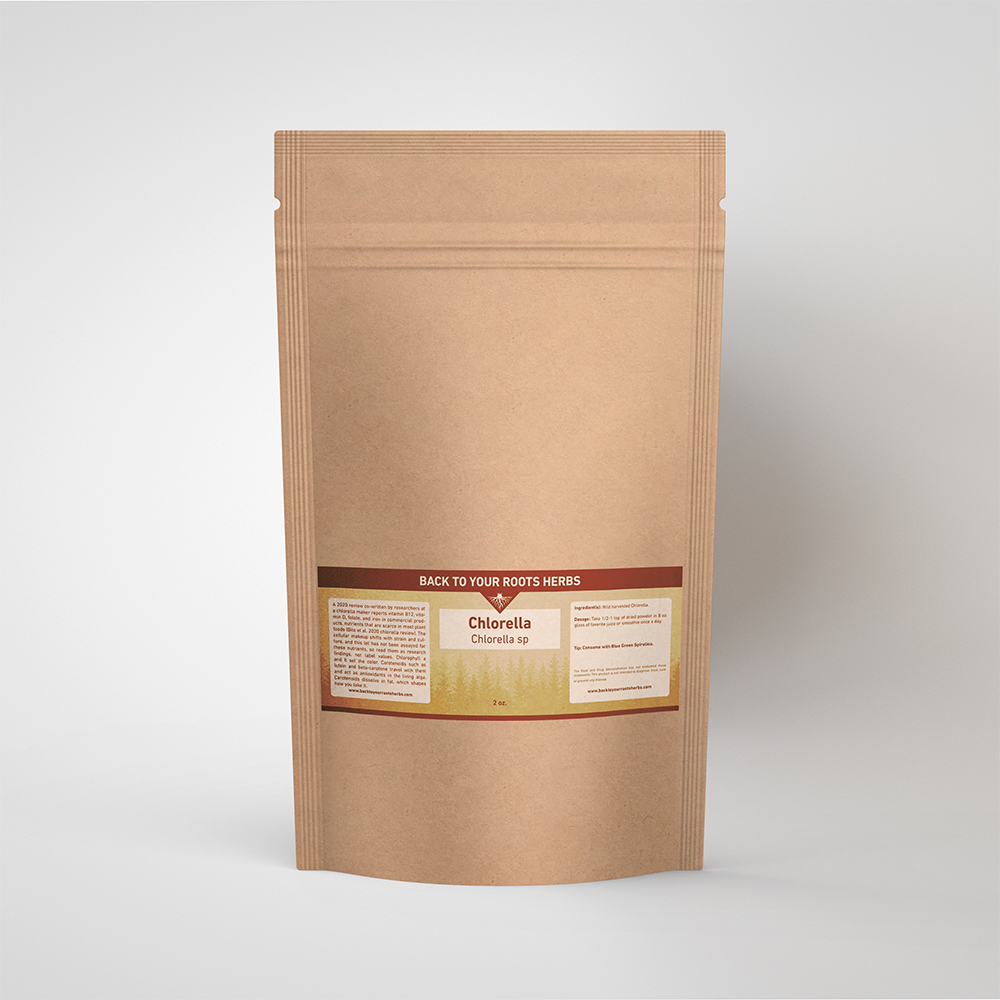
CHLORELLA POWDER VERDICT (INTERNAL QUALITY SCORE):
Grade A. This chlorella cracked cell wall powder is whole Chlorella sp., a single-celled freshwater green micro-algae cultivated in China and packed in Virginia Beach. Its tough outer layer is broken open during processing, so digestive enzymes can reach the protein, chlorophyll and carotenoids inside. The lot reads deep emerald, smells of fresh seaweed and cut grass, and shows no musty or fishy off-notes. One ingredient. No fillers, binders or sweeteners. A 2 ounce pouch for trying it before you buy a bulk tub.
– Back To Your Roots Herbs Research Group
- What it is: whole Chlorella sp. cells, a freshwater green microalgae, opened for digestion.
- Size and origin: a 2 oz pouch of chlorella powder grown in China.
- Taste: grassy, savory, and seaweed-like. Chlorella tastes stronger than spirulina.
- How to take it: 1/2 teaspoon with food at first, then 1 level teaspoon of chlorella powder daily.
- Check first: ask your health care provider before taking any chlorella supplement if you take warfarin or immune-suppressing drugs, or are pregnant or breastfeeding.
SENSORY ANALYSIS:
Bench notes from our team. We open the pouch, look, smell, and taste, then write down what is actually there.
Look: Deep Emerald Algae Powder
Deep emerald, darker than wheatgrass powder or a dried leafy vegetable, and greener than blue-green spirulina. The grain is fine and light. Pinch it, and it packs like soft chalk, then falls apart. No stems, specks, or tan flecks.
Chlorella Shades of Green: Why Lots Vary
Customers ask why one brand or pouch looks greener than the last. Pigment content shifts with the culture, season, and harvest, and light, heat, and air push the color toward olive. A dull, brownish cast usually means age or poor storage.
Smell: Fresh Seaweed and Cut Grass
Fresh seaweed first. Then cut grass and a faint green-tea sweetness. Nothing musty, nothing fishy. A strong fish or pond-water smell is a warning sign in any algae, so we check it first.
Taste: Grassy, Savory, Mildly Bitter
Straight from the spoon, chlorella powder tastes grassy and savory, close to toasted nori, with a bitter finish that lingers. It is stronger than spirulina. Blended with berries, banana, or cacao, it fades to a faint green note.
Mixing Notes for Drinks and Food
Texture
Soft and fine, close to cocoa. No grit.
Dispersion
It floats on cold water for a moment, then wets and turns the glass dark green. A shaker bottle smooths it out in seconds.
Color Throw
It stains. Rinse spoons and blender jars right away.
HOW DOES CHLORELLA CRACKED CELL WALL POWDER WORK?
- The Herb: Chlorella sp. sourced from commercial cultivation in China. The powder starts as whole chlorella cells, and nothing is extracted.
- The Mechanism: Acts as a whole-food pigment and nutrient source whose cell wall has been opened to trigger wider digestive enzyme access to the nutrients stored inside.
- The Evidence: Research by Wang et al. (2020) confirmed that mechanical disruption of the cell wall raised the protein quality scores (PDCAAS) of two species in the genus from 0.63 and 0.64 to 0.77 and 0.81 in a controlled rat feeding study (PMID 33114413).
That is the whole mechanism of action. Open the algae, and digestion can reach what is inside.
What Is Chlorella?
Chlorella is a genus of single-celled freshwater green algae in the family Chlorellaceae, with round cells about 2 to 10 micrometers across. NIH LactMed describes Chlorella sp. as a freshwater green alga containing carotenes, protein, fiber, vitamins, minerals, and chlorophyll (LactMed chlorella monograph). Researchers also study microalgae for food sustainability, since they grow on marginal land with high photosynthetic efficiency (Kumar et al. 2022).
It is not spirulina, a blue-green cyanobacterium with no cellulose layer. It is not liquid chlorophyll, which is usually sodium copper chlorophyllin, and it is not kelp or other seaweeds. Chlorella Growth Factor (CGF) is a hot-water extract sold on its own. This pouch is whole chlorella algae.
Why the Chlorella Cell Wall Matters for Absorption
The wall is rigid, and people lack the enzymes to crack it, so intact algae can pass through with much of their contents locked inside. A 2026 University of Seville study states that carotenoid bioaccessibility from one common species is typically low because of that rigidity (Morón-Ortiz et al. 2026, PMID 42172752). Breaking the layer exposes the cellular contents to digestion and absorption. Some brands sell a fermented version to soften it instead.
Cracked Cell Walls and Protein Digestibility
A 2020 National Research Council of Canada feeding study in rats gives the clearest numbers. Two species carried 50.2 to 53.5 percent crude protein, with amino acid scores of 1.10 and 1.27, enough to meet the reference pattern for every essential amino acid. Digestibility held them back at 59.3 to 64.7 percent. After mechanical disruption, protein quality scores rose from 0.63 and 0.64 to 0.77 and 0.81 (Wang et al. 2020 chlorella protein study). Rat data is not human data. The direction is still clear.
Breakage Rates at Industrial Scale
Food scientists at Nanchang University in Jiangxi, China, ran another species in the genus through an industry-scale microfluidizer at 120 MPa and broke 98 percent of the cells, lifting simulated stomach-phase protein digestibility by 20 percent (Ke et al. 2023, Bioresource Technology). Bead mills are another common route. US Patent 5,330,913, granted in 1994, describes glass beads 500 to 800 micrometers wide spun fast enough to open about 95 percent of the cells in 150 seconds (chlorella patent US 5,330,913). Labels rarely report a breakage rate, so a cracking claim tells you the step happened, not how complete it was.
What Is Inside Each Cell: Protein, Chlorophyll, Vitamins and Minerals
A 2020 review co-written by researchers at a chlorella maker reports vitamin B12, vitamin D, folate, and iron in commercial products, nutrients that are scarce in most plant foods (Bito et al. 2020 chlorella review). The cellular makeup shifts with strain and culture, and this lot has not been assayed for these nutrients, so read them as research findings, not label values.
Protein and Amino Acids
The dried alga is roughly half protein by weight, but it is not a protein powder. At the roughly 50 percent protein reported in research, a level teaspoon of about 2 g would hold about 1 g of protein. Think concentrated whole food, not a scoop of whey.
Chlorophyll and Carotenoids
Chlorophyll a and b set the color. Carotenoids such as lutein and beta-carotene travel with them and act as antioxidants in the living alga. Carotenoids dissolve in fat, which shapes how you take it.
Vitamin B12 Varies Widely Between Brands
A Tottori University team tested 19 dried chlorella supplements and found vitamin B12 from under 0.1 µg to about 415 µg per 100 g, with inactive B12-like compounds in several high-B12 tablets (Bito et al. 2016 chlorella B12 study). The authors traced the B12 to the growth medium or to bacteria growing alongside the algae. We print no B12 number, and vegans should keep a reliable B12 source.
Vitamins and Minerals: Iron, Folate and Vitamin D
Folate, iron, and vitamin D show up in published analyses, but amounts depend on the strain and the culture. Count them as a bonus, not a dose. It does not replace a multivitamin, and its nutritional value varies by lot.
Human Research on Chlorella Supplements
Trials Used Specific Products and Doses
Published human trials tested specific species and products, often in tablet form, at 5 g a day or more (5 g of tablets in a 2012 Korean trial, 9 g a day in a 2015 US study). Their results do not transfer to this powder, and we make no health claim from them.
What the Evidence Does Not Show: Toxin Removal Claims
The alga is widely marketed for flushing toxins and heavy metal removal. Evidence in people is too thin to support any toxin or heavy-metal claim, and we make none. Health benefits claimed online often outrun the data. Think of it as food.
CRITICAL USAGE: Dose, Side Effects and Storage
Before taking chlorella, tell your health care provider about every health condition you have and all medicines, vitamins, and herbal supplements you use. Ask first if you take warfarin, immune-suppressing or sun-sensitizing drugs, or any prescription medicine, because research on its drug interactions is incomplete.
Chlorella Powder Dose, Timing and Mixing
Start With a 1/2 Teaspoon Dose
Take 1/2 level teaspoon (about 1 g) once a day with food for three to five days. If your stomach is comfortable, move to 1 level teaspoon (about 2 g). More is not better. Starting low makes any side effect easy to trace.
Teaspoon Weight and Dose
Across 17 single-ingredient chlorella powder labels from 7 brands in the NIH Dietary Supplement Label Database, 3 g was the most common serving, and most of their teaspoon measures work out to about 1.7 to 2.4 g.
Servings per Pouch
2 ounces (56.7 g) holds about 28 level-teaspoon servings at 2 g each.
When Should You Take It?
With a meal. Breakfast or a midday smoothie suits most routines. If you take prescription medicines, ask your pharmacist whether to space them apart.
Best Carriers: Smoothies, Juices and Yogurt
Blend it into a fruit smoothie with berries and chia seeds, stir it into orange juice or coconut water, or fold it into yogurt or oatmeal. Cacao, pineapple, ginger, and mint cover the seaweed note. For a homemade supergreens mix, pair it with our Barley Grass Powder.
Add a Little Fat
In a 2026 lab digestion study on another species in the genus, adding yogurt with 10 percent fat raised the share of carotenoids that moved into micelles, the form the gut absorbs (Morón-Ortiz et al. 2026). Nut butter or avocado follows the same logic.
Side Effects and Drug Interactions
Common Side Effects
Chlorella is usually well tolerated, but NIH LactMed lists nausea, diarrhea, stomach cramping, gas, and green stools. If you suspect an overdose or have a severe reaction, call Poison Control at 1-800-222-1222 or seek emergency care.
Warfarin and Blood Thinners
This alga contains vitamin K, which works against warfarin. A 1995 case report described a 75-year-old man whose warfarin blood test moved out of the therapeutic range after he started the supplement (Ohkawa et al. 1995). On warfarin, do not start without your prescriber.
Immune System Medicines and Autoimmune Conditions
If you take immunosuppressants, such as after an organ transplant, or live with an autoimmune condition, ask your health care provider first. Research on this alga and the immune system is limited.
Pregnancy and Breastfeeding
NIH LactMed rates maternal intake as probably acceptable during breastfeeding and notes green-tinted breast milk. Pregnancy data is limited, so clear it with your health care provider first.
Sun Sensitivity and Allergies
Five patients who ate chlorella developed swelling and skin lesions on sun-exposed skin, traced to pheophorbide a, a breakdown product in the tablets (Jitsukawa et al. 1984). The specifications in a GRAS notice FDA reviewed for one such powder include a total pheophorbide limit. Allergic reactions, including asthma and anaphylaxis, have also been reported. Stop use and get care right away if you notice a rash, swelling or wheezing.
Storage for Freshness, Color and Nutrients
Press the air out and reseal the pouch after every use. Keep it in a cool, dark cupboard away from the stove and sink. Moisture makes clumps, and light and heat fade the green.
CLINICAL SPECS:
| Spec | Detail |
|---|---|
| Serving Size | 1 level teaspoon (about 2 g). Start with 1/2 teaspoon |
| Frequency | Once daily with a meal |
| Active Marker | Chlorophyll a and b, carotenoids (lutein, beta-carotene) and protein |
| Processing | Cultivated, harvested, cell wall broken open, dried, and milled fine (supplier specification) |
| Safety | Heavy Metal Tested (Pass) |
| Ingredients | Chlorella (Chlorella sp.), whole dried algae |
| Other Ingredients | None |
| Purity | Non-GMO, Vegan |
| Free From | Wheat, Gluten, Soy, Dairy, Binders, Fillers |
| Origin | China (country of cultivation) |
| Manufactured | Packed in Virginia Beach, VA, USA (grown in China) |
COMPARISON TABLE:
| Feature | BTYRH Chlorella Cracked Cell Wall Powder | Generic Chlorella Powder |
|---|---|---|
| Origin | China, named on this page | Often unspecified |
| Preparation | Cell wall broken open, nothing added | Cracking method rarely disclosed |
| Taste | Grassy, savory, and seaweed-green with a mild bitter finish | Can turn musty or fishy when old or poorly dried |
| Safety | Lot COA covering heavy metals and microbes | Unknown/Untested unless the seller shares a COA |
| Species on Label | Chlorella sp., as named by the supplier | Often not named |
| Size | 2 oz first-try pouch | Often sold only in larger tubs or bags |
What to Look For on a Chlorella Label: Ingredients, Testing and Heavy Metals
- A statement that the cell walls were broken open. Intact chlorella cells are hard to digest.
- A named genus or species. Ours reads Chlorella sp., the name the supplier provides.
- A one-item ingredients list. Green blends that hide the chlorella dose cannot be compared with research.
- A lot number on the chlorella powder pouch tied to a certificate of analysis for heavy metals and microbes. In a 2020 study of 10 microalgae food supplements, three contained cyanotoxins, one of them a chlorella tablet, and six contained lead, though intakes at label doses stayed within EU limits (Sánchez-Parra et al. 2020).
- Benchmarks you can check. The specifications in a 2021 GRAS notice FDA reviewed for one chlorella powder include protein of 55 percent or more, lead under 1.0 mg/kg, and a total pheophorbide limit (FDA GRN 986).
Most chlorella powders pass these checks only in part. Ask for the COA before you buy any chlorella supplement, ours included.
Frequently Asked Questions About Chlorella
What does it mean when chlorella has a broken cell wall?
The tough outer layer of each cell was broken open during processing, usually in a bead mill or high-pressure equipment. On a chlorella cracked cell wall powder label, the phrase tells you digestion can reach the nutrients inside.
Is chlorella powder better than tablets or capsules?
The ingredient is the same. Powder adjusts in half-teaspoon steps and needs no binders, but the taste is strong. Tablets, capsules, and pills hide the taste, and some tablets add binders.
Can I put chlorella powder in hot drinks?
Yes, below a boil. Heat turns chlorophyll olive and flattens the flavor, so stir it into warm tea, broth, or a latte.
What should I tell my health care provider before using chlorella?
Every condition and every medicine, especially warfarin, immune-suppressing drugs, autoimmune conditions, past allergic reactions, sun-sensitizing medicines, and pregnancy or breastfeeding.
What are the most common side effects of chlorella?
Nausea, diarrhea, stomach cramping, gas, and green stools, per NIH LactMed. Starting at 1/2 teaspoon with food helps.
Is chlorella powder vegan?
Yes. It is a freshwater microalga with nothing added. Vegans should still keep a reliable B12 source, because B12 in these products varies widely.
What is the difference between chlorella and spirulina?
Chlorella is a single-celled green alga with rigid chlorella cell walls that need breaking. Spirulina is a blue-green cyanobacterium with no cellulose layer, and it tastes more like the sea and pond. Many people take both: compare our Spirulina Algae Powder or read our guide to spirulina and chlorella benefits.
Does chlorella remove toxins from your body?
Not in any proven way. Evidence in people is too thin to support that claim, and your liver and kidneys do that work. We sell this chlorella powder as a whole food, not a toxin remover.
DISCLAIMER: These statements have not been evaluated by the Food and Drug Administration. This product is not intended to diagnose, treat, cure, or prevent any disease. Consult your healthcare provider before use, especially if you are pregnant, nursing, taking medication, or have a medical condition.
Reviews
There are no reviews yet.