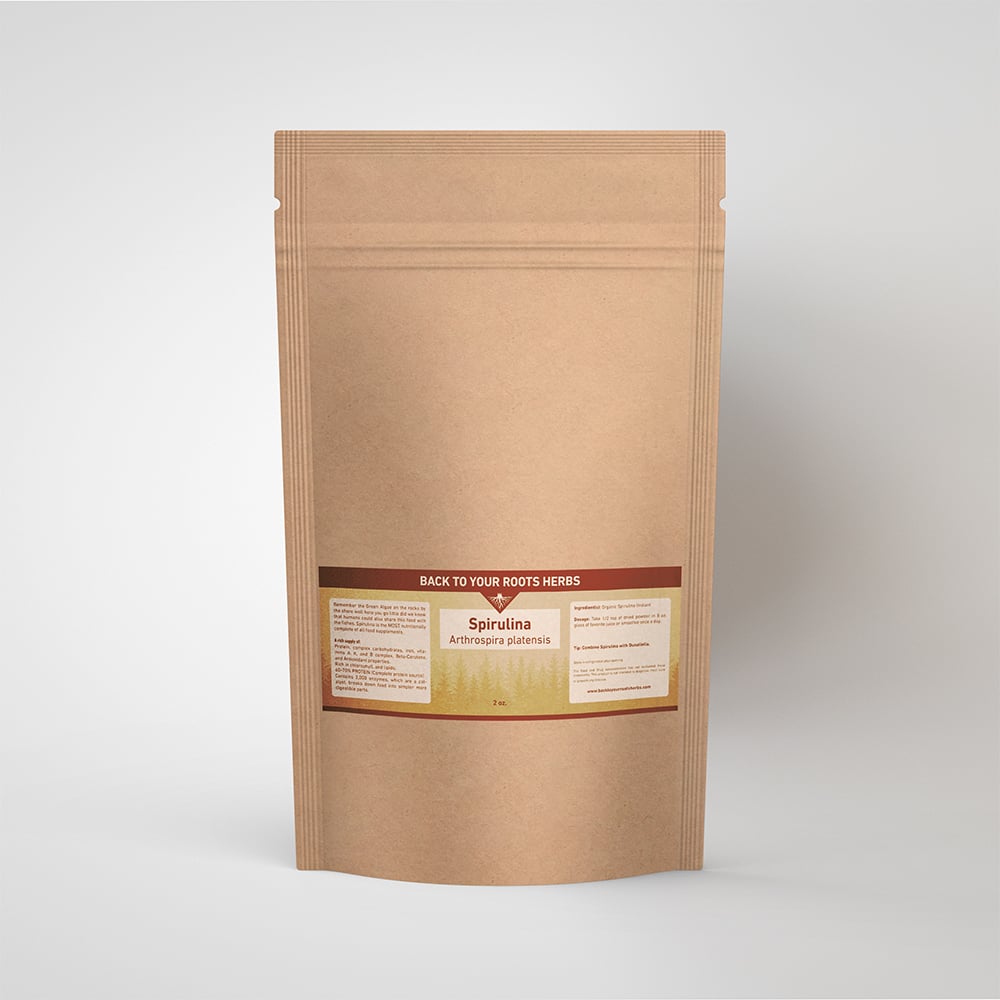
SPIRULINA ALGAE POWDER VERDICT (INTERNAL QUALITY SCORE):
Grade A. Phycocyanin pigment intensity confirmed by visual color-band assay. Pond cultivation in the arid Imperial Valley of southeastern California (33.1253° N, 115.5142° W) gives this lot a tight chlorophyll signature and a deep teal-blue dispersion on hydration. Heavy-metal panel passed at the parts-per-billion threshold for arsenic, lead, mercury, and cadmium. Whole-cell Arthrospira platensis with no extract dilution. Organic spirulina powder ready for daily plant-protein use.
– Back To Your Roots Herbs Research Group
Spirulina Powder Sensory Analysis
First-hand bench notes from our Virginia Beach quality lab. We open the pouch, smell, taste, and write what is actually there.
Look
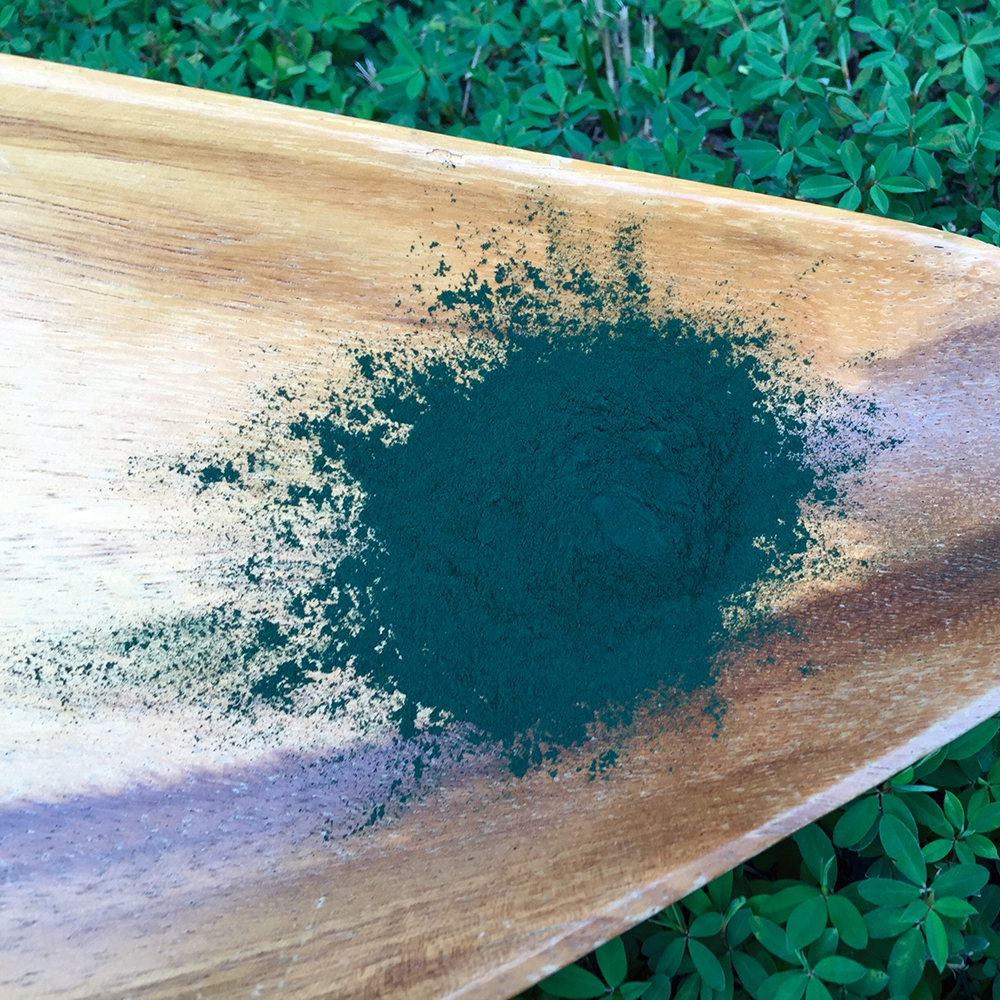
Deep teal-green, almost forest-shadow dark. The powder is fine and dust-cloud light. A pinch on a white plate shows blue-green flecks of concentrated phycocyanin pigment. Reconstituted in cold water, the spirulina powder turns the glass emerald in seconds.
Smell
A clean ocean-pond scent. Wet-stone minerality. No fishy off-notes. Honest, mineral, slightly grassy.
Taste
Earthy and faintly bitter, with a marine finish. Closer to mild seaweed tea than a chalky algae supplement. Mixes flat into smoothies. The mineral aftertaste fades quickly.
Spirulina Algae Powder Mechanism: How Organic Spirulina Powder Works
Organic spirulina powder gives the body a dense food-form payload of nutrition. Three mechanisms drive its reputation as a daily superfood.
- The Herb: Arthrospira platensis sourced from arid Sonoran-Imperial Valley pond cultivation (33.1253° N, 115.5142° W). Sun-rich, low-rainfall pond conditions concentrate phycocyanin, beta-carotene, and complete plant protein in the cell wall.
- The Mechanism: This blue-green algae powder acts as a phycobiliprotein-rich antioxidant carrier. The pigment-protein complex phycocyanin is studied for its role in cellular signaling and antioxidant balance. Spirulina also delivers all nine essential amino acids, beta-carotene (a vitamin A precursor), iron, vitamin B1, vitamin B2, and small amounts of vitamin B12 analogs.
- The Evidence: A randomized double-blind placebo-controlled clinical safety study by Selmi et al. (2016, PMID 27362442) reported that 2.3 g per day of phycocyanin-enriched Arthrospira platensis aqueous extract for two weeks did not adversely affect platelet activation, thrombin time, or fibrinogen activity in healthy adults.
Spirulina Powder Composition (Information-Gain Data)
Independent compositional analyses (Bashir et al., 2016, J Food Sci Tech, open-access PDF) report dietary spirulina at 65 to 70 percent crude protein on a dry-weight basis, with glutamic acid (9.57 g per 100 g) and aspartic acid (7.14 g per 100 g) as the dominant non-essential amino acids. Total essential amino acid contribution measures 27.75 g per 100 g of spirulina powder. This protein density rivals soybean flour and surpasses most plant-protein concentrates on the market.
Critical Usage and Dosage
Start small. One-half teaspoon daily for the first three days. Step up to one teaspoon, then to two heaping teaspoons (5 to 10 grams) as the digestive system acclimates. Mix into water, juice, or a smoothie base. Powdered spirulina also folds into yogurt, oatmeal, energy bites, and salad dressings without changing texture.
Algae Superfood Profile
This algae superfood pairs well with chlorella, a green algae powder with a complementary nutrient profile. Together, the two algae supplements form a nutrient stack many practitioners pair for plant-protein density. Chlorella offers higher chlorophyll. Spirulina offers higher phycocyanin and complete plant protein.
Powdered Spirulina vs Tablets
Powdered spirulina lets you scale the dose to body size and goal. Tablets fix the dose. Powder also costs less per gram of active spirulina protein. Most cost-per-gram comparisons favor the powder over compressed tablets and pressed spirulina capsules.
Heavy Metal Testing
Every batch of our spirulina algae powder undergoes third-party ICP-MS testing for arsenic, lead, mercury, and cadmium. Pond water is screened quarterly. This is the first checkpoint people skip when buying spirulina from low-cost overseas brands. Skip it once, and you can buy heavy metals in a green wrapper.
Contraindications
People with phenylketonuria (PKU) should avoid spirulina because of its phenylalanine content. Those with autoimmune conditions should consult a qualified clinician before adding any spirulina supplement to a daily routine. Spirulina can interact with immune cell signaling, which is helpful for many people but not appropriate for everyone.
Storage
Cool, dry, dark cupboard. Reseal the pouch after each use. Best within 18 months of the printed date.
Texture
Fine particle, no grit. Sieve through a fine-mesh strainer in one pass.
Solubility
Disperses fast in cold water with brief stirring. No clumping when blended into yogurt or nut milk.
Color Throw
Stains lightly. Use a non-porous spoon to keep your countertop clean.
Density
One level teaspoon weighs about 2.5 g. One heaping teaspoon weighs about 5 g.
Source
Pond-cultivated, sun-dried, milled to fine particles. Single-ingredient certified organic spirulina powder.
USDA Certified Organic
Lot-traceable. Inputs verified. No solvent extraction.
CLINICAL SPECS:
| Spec | Detail |
|---|---|
| Serving Size | 1 to 2 heaping teaspoons (5 to 10 grams) |
| Frequency | Once daily, with food or in a smoothie |
| Active Marker | Phycocyanin pigment-protein complex |
| Processing | Pond-cultivated, sun-dried, fine-milled. No extract |
| Safety | Heavy Metal Tested (Pass) |
| Ingredients | 100% Organic Spirulina (Arthrospira platensis) whole powder |
| Other Ingredients | None (single-ingredient powder) |
| Purity | USDA Organic, Non-GMO, Vegan, Gluten-Free |
| Free From | Wheat, Gluten, Soy, Dairy, Shellfish, Binders, Fillers |
| Origin | Imperial Valley pond cultivation, Sonoran Desert region |
| Manufactured | Virginia Beach, VA, USA |
Spirulina Powder Comparison Table
| Feature | BTYRH Spirulina Algae Powder | Generic Spirulina Powder |
|---|---|---|
| Origin | Imperial Valley pond (33.1253N, 115.5142W) | Unspecified Asian co-pack |
| Preparation | Whole-cell, sun-dried, no extract | Spray-dried with carrier agents |
| Taste | Mild marine, mineral, low bitterness | Strong fishy or musty |
| Safety | Third-party ICP-MS heavy-metal panel | Unknown or untested |
Why Choose Our Organic Spirulina Algae Powder Supplement
Most spirulina products on the shelf answer the same question with the same vague language. We sell our spirulina differently. Lot-traceable. Heavy-metal screened. Whole spirulina algae powder, not an extract. No fillers. No flow agents. No fishy smell.
Use this organic spirulina powder for daily plant-protein support, antioxidant intake from phycocyanin pigment, B-vitamin density, and steady iron nutrition. The dietary spirulina category is full of look-alike brands. Read the panel. Read the certificate of analysis. Then come back here.
Spirulina Capsules vs Spirulina Powder
Spirulina capsules deliver a fixed dose. Spirulina powder lets you scale to body size and goal. Powder also costs less per gram of active spirulina protein. Many people keep both: spirulina capsules for travel, spirulina powder for daily kitchen use.
Spirulina Powder Benefits at a Glance
- Complete plant protein (all nine essential amino acids)
- Phycocyanin antioxidant pigment
- Iron, vitamin B1, vitamin B2, beta-carotene
- Single-ingredient organic spirulina powder, no fillers
- Vegan, gluten-free, non-GMO
Frequently Asked Questions about Spirulina
What is the difference between spirulina and chlorella?
Both are algae. Spirulina is a spiral-shaped multicelled cyanobacterium with high plant protein and phycocyanin pigment. Chlorella is a single-celled green alga with a tough cell wall and higher chlorophyll. Spirulina powder typically delivers more iron and complete protein per gram. Chlorella often delivers more chlorophyll and omega-3 fatty acids.
Why use spirulina powder instead of tablets?
Powder is more flexible. You can adjust the daily dose without breaking pills. Powder is also less processed, with no binders or coatings. Most cost-per-gram comparisons favor spirulina powder over compressed tablets.
What are the health benefits of spirulina?
Documented spirulina health benefits include plant-protein density, phycocyanin antioxidant activity, B-vitamin contribution, and dietary iron. Spirulina is a popular dietary supplement choice for vegans and people tracking plant-protein intake.
How much spirulina should I take daily?
Begin with 1 to 3 grams per day (about half a teaspoon to one teaspoon). After two to three weeks, work up to 5 to 10 grams daily as personal needs and tolerance dictate. Always read the product label.
Does your spirulina smell fishy or contain shellfish?
No. A faint ocean-pond smell is normal for whole spirulina algae powder. A strong fish odor is a sign of low-quality storage or oxidation. Our spirulina contains no shellfish, gluten, dairy, or soy.
*DISCLAIMER:* The Food and Drug Administration has not evaluated these statements. This product is not intended to diagnose, treat, cure, or prevent any disease.
Reviews
There are no reviews yet.