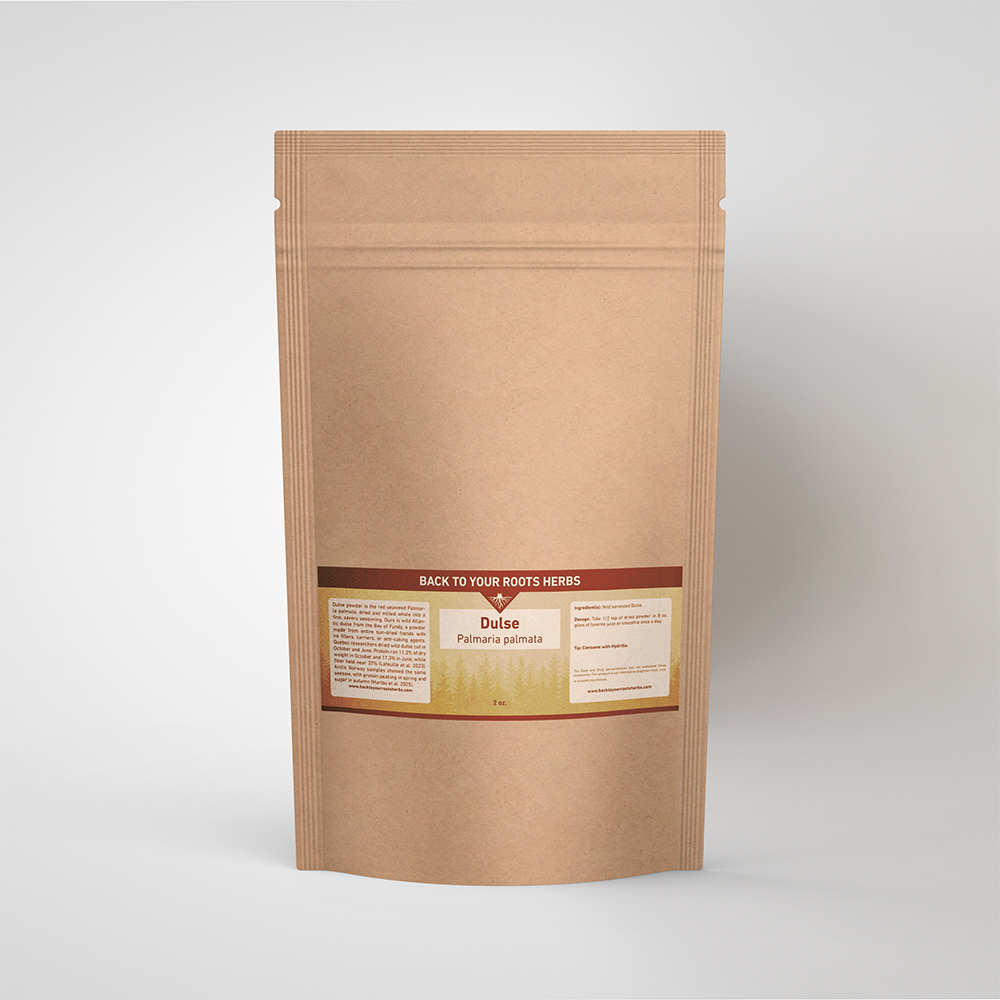
THE VERDICT (INTERNAL QUALITY SCORE): WILD ATLANTIC DULSE SEAWEED
Grade A (BTYRH Internal Score) Sea Vegetable Powder. This dulse powder is milled from whole Palmaria palmata fronds wild-harvested on the Bay of Fundy shore of Atlantic Canada (bay center 45.000°N, 65.750°W), home of the world’s highest tides. The fronds were sun-dried before milling, and the lot passed the heavy metal panel on its certificate of analysis (COA). The COA has no iodine assay, so we print no number. One seaweed species. One origin. Nothing added.
– Back To Your Roots Herbs Research Group
On this page: What is dulse powder? | How to use dulse powder | Iodine | Safety | Specs | Dulse powder FAQ
What Is Dulse Powder?
Dulse powder is the red seaweed Palmaria palmata, dried and milled whole into a fine, savory seasoning. Ours is wild Atlantic dulse from the Bay of Fundy, a powder made from entire sun-dried fronds with no fillers, carriers, or anti-caking agents.
Dulse belongs to the red algae and is one of the oldest sea vegetables in North Atlantic diets, prized for salt, savor, and nutrients. It is not kelp, and it is not a land herb. Think gourmet food pantry meets health supplement shelf: a sea vegetable you measure with a spoon.
Palmaria palmata Common Names and Spellings
Irish coasts call it dillisk or dilsk. You will also see creathnach, red dulse, and söl, its Icelandic name. Search bars add dulce, Spanish for sweet, and dulsepowder typed as one word. Same seaweed every time.
Where Dulse Seaweed Grows: North Atlantic Sea Vegetables
Dulse seaweed grows from the lower shore down to about 20 m, gripping rock with a small holdfast or riding on kelp stipes (MarLIN, Hill 2008). Fronds run 20 to 50 cm long, across the North Atlantic from Arctic Canada to New Jersey and from Arctic Russia to Portugal. It is a perennial, so pickers who leave the holdfast leave next year’s blades behind, the heart of dulse sustainability.
Palmaria palmata Life Cycle
The Palmaria palmata life cycle is odd, even for red algae. Male blades need 9 to 12 months to become fertile, while females are tiny crusts that mature in days. Each fertilized crust grows into a leafy tetrasporophyte that overgrows it. That stage is most of what you see on a Fundy rock at low tide, and most of what goes into a bag of dulse powder.
SENSORY ANALYSIS: POWDERED DULSE STRAIGHT FROM THE BAG
- Look: Matte, brick-to-burgundy dulse powder with a violet cast in daylight. Pinch it, and it holds a loose clump, because the sea salts in dried seaweed pull moisture from the air.
- Smell: Wet stone and cold shoreline, then a toasted warmth close to nori. No fishy or musty note, the first signs of seaweed stored damp.
- Taste: Salt first. Within two seconds, it turns savory, then finishes with a faint sweetness and a lingering smoky edge. This dulse seaweed is milder than any kelp powder we have tasted.
Bench Notes: Four More Checks on This Lot of Dulse
Kitchen Tests We Run on Every Lot of Powdered Dulse
Powder Texture Check
Fine and powdery between the fingers, with soft fibers and no sand on the teeth.
Salt Check
Beside a pinch of sea salt, it tastes far less salty and far more savory.
Broth Check
In hot broth, dulse powder disperses, softens within a minute, and tints the liquid rose-brown.
Pan Check
Half a teaspoon in a dry pan for 30 seconds turns nutty and smoky, and the color drifts toward olive brown.
Lab Note: Why the Red Fades in a Hot Pan
The burgundy comes from R-phycoerythrin, the pigment-protein red algae use to catch light. Heat unravels it, the same reaction that turns nori green when toasted. The color shift is normal, not spoilage.
HOW DOES DULSE POWDER WORK IN FOOD?
- The Herb: Palmaria palmata, one of the red algae (order Palmariales), sourced from the Bay of Fundy, Atlantic Canada.
- The Mechanism: Acts as a whole-food umami seasoning. Sea salts plus glutamic and aspartic acids, the amino acids behind its savory taste (Maribu et al. 2025), trigger salt and umami perception, while the milled dulse seaweed carries protein, fiber, vitamins, and minerals into the dish.
- The Evidence: Research by Lafeuille et al. (2023) confirmed that drying wild Quebec dulse for about 5 hours in a 40 °C dryer caused only small changes in its chemical and mineral makeup, while harvest month moved protein from 11.2% to 17.3% of dry weight (PMID 37504923).
Dulse Powder Nutrition: What Published Studies Measured
These figures come from studies of wild dulse, not a label for this bag, and nutrients in sea vegetables swing with site and season.
Protein and Fiber Change With the Harvest Month
Quebec researchers dried wild dulse cut in October and June. Protein ran 11.2% of dry weight in October and 17.3% in June, while fiber held near 37% (Lafeuille et al. 2023). Arctic Norway samples showed the same seesaw, with protein peaking in spring and sugar in autumn (Maribu et al. 2025).
Potassium, Sodium and Iron in Dried Dulse
Potassium outweighed sodium about 3 to 6 times over in the Quebec samples, and iron jumped from about 29 to 352 mg per 100 g of dried seaweed between the October and June harvests. That spread is why we distrust any single set of nutritional values printed for sea vegetables.
Carotenoids and Vitamin E
June fronds dried at 40 °C held about 535 mcg of carotenoids and 50 mcg of alpha-tocopherol, a form of vitamin E, per gram. Labs study both as antioxidants. That is chemistry, not a promise about your body.
Cell Wall, Xylan and Digestion: Why the Grind Matters
Dulse seaweed protein sits inside cells wrapped in a xylan-rich cell wall. In a lab digestion test, crude dulse protein scored only about 1.5% digestibility. Washed in demineralized water and ground in liquid nitrogen, it reached 58% of the digestibility of casein, a milk protein (Marrion et al. 2003). Kitchen milling is gentler, so treat dulse powder as a seasoning that brings some protein, not a protein food.
The wall is loosely bound and free of lignin (Coelho et al. 2025), which fits what you see at the stove: dulse powder softens in hot liquid instead of turning woody. New to seaweed? Give your digestion a week at a quarter teaspoon.
How to Use Dulse Powder in Cooking
Start with 1/4 teaspoon and taste. A little dulse powder covers a whole pot, which makes it one of the easiest sea vegetables to cook with.
Dulse as a Seasoning and Partial Salt Swap
Replace about a quarter of the salt in a soup, dressing, or pot of beans with dulse powder and the dish stays savory. Dulse still carries sodium, like any seaweed, so it is a flavor swap, not a sodium-free salt. It pairs with herbs and spices such as garlic, smoked paprika, and lemon zest in homemade seasonings.
Soups, Broths and Dulse Seaweed Soup
Stir 1/2 teaspoon into miso, potato or bean soup in the last minute of cooking. For a quick dulse seaweed soup, simmer onion, potato, and stock, blend, then whisk in the dulse powder off the heat.
Smoothies, Dips, Dressings and Snacks
- Dip: 1/4 teaspoon of dulse powder in a cup of sour cream or yogurt with parsley and lemon.
- Popcorn: Melted coconut oil or MCT oil, then a pinch of powdered dulse.
- Eggs and Avocado Toast: A light dusting in place of a second pinch of salt.
- Smoothies: A small pinch of powdered dulse adds salty seaweed depth to a green smoothie.
- Snack Mix: New Brunswick grocers have sold dried dulse as a salty snack since at least the 1850s (Yeomans 2025). Shake dulse powder over roasted nuts for the same bite.
Used this way, dulse fits a plant-based diet and healthy eating patterns built on vegetables, beans, and whole foods.
Iodine in Dulse Seaweed: How Much Is Too Much?
Seaweed is a well-known source of iodine, one of the essential minerals, and dulse is no exception. The trouble is predictability. In the United States, the NIH Office of Dietary Supplements reports commercial seaweeds from 16 to 2,984 mcg per gram, an adult RDA of 150 mcg, and an upper limit of 1,100 mcg a day.
Why This Bag of Dulse Has No Iodine Number
Our lot COA covers heavy metals only, and we will not borrow someone else’s figure. For scale, Food Standards Australia New Zealand measured 100 mg/kg, or 100 mcg per gram, in a retail sample of dulse flakes (FSANZ seaweed survey). Other lots run higher or lower. Arctic dulse from Norway carried enough that Maribu et al. (2025) capped intake at 0.63 to 0.92 g of dried dulse a day for a 70 kg adult, with the highest levels in spring and summer. Atlantic Canada and FSANZ values sit far lower, so we cap our serving at 1/2 teaspoon (about 1 g) a day. This mineral also dissolves into cooking water, so a dulse-seasoned soup keeps it, and it can escape from seaweed stored damp (Teas et al. 2004). Count dulse powder toward your daily total and stay at the label serving.
Dulse vs Kelp, Kombu and Wakame: Iodine per Gram
Red sea vegetables generally carry far less iodine than brown algae such as kelp. The FSANZ survey shows the gap:
- Dulse flakes: 100 mcg per gram, as sold
- Nori, another red seaweed: 9.4 to 20 mcg per gram, dried
- Wakame seaweed: 220 to 280 mcg per gram, dried
- Arame: 540 mcg per gram, dried
- Kombu, a kelp seaweed: 2,100 to 4,300 mcg per gram, dried, with single samples up to 6,800
FSANZ used 1,000 mg/kg as its maximum tolerable level for dried seaweed. The dulse flakes sat at one tenth of it, dried kombu at two to four times over. In a survey of 96 seaweed foods and supplements sold in Norway, oarweed and sugar kelp averaged 7,800 and 4,469 mcg per gram (Aakre et al. 2021), and one sample of kelp granules sold as a salt substitute topped 8,165 mcg per gram (Teas et al. 2004). A spoonful of powdered kelp and a spoonful of dulse powder are not the same dose.
CRITICAL USAGE: DULSE SERVING SIZE AND SAFETY
- Suggested Use: 1/4 to 1/2 teaspoon (about 0.5 to 1 g) of dulse powder a day in food, as a daily supplement serving or spread across meals as a seasoning. Do not exceed 1/2 teaspoon a day.
- First Week: Begin with 1/4 teaspoon. A sudden load of seaweed can upset digestion in people new to it.
- Count All Iodine: Tally dulse with iodized salt, dairy, eggs, multivitamins, other supplements, and other seaweed. The adult upper limit is 1,100 mcg a day.
- Research Note: In a randomized, placebo-controlled trial, healthy adults ate 5 g of dulse a day baked into bread. TSH rose 17.2%, triglycerides 31.9%, and C-reactive protein 16.1% against control, all within normal clinical ranges (Allsopp et al. 2016). That is five times our daily ceiling.
Who Should Not Use Dulse Without Medical Advice?
Thyroid Conditions, Thyroid Medication, Pregnancy and Nursing
Iodine is a building block of thyroid hormones, which help control metabolism, and too much can disturb that system, especially with thyroid disease (NIH Office of Dietary Supplements). With a thyroid disorder or on thyroid medication, ask your prescriber first. Pregnant and nursing women need more (RDAs of 220 and 290 mcg a day), but the upper limit stays at 1,100 mcg for adults 19 and older (900 mcg for ages 14 to 18), so plan any seaweed with your provider.
Shellfish Allergy, Kidney Disease and Blood Thinners
Wild sea vegetables grow among mussels, barnacles and tiny crustaceans, so trace shell fragments are possible. With a shellfish allergy, check with your doctor first. Dulse carries potassium, which matters with kidney disease, and sea vegetables contain vitamin K, which matters on warfarin.
Storage and Shelf Life of Powdered Seaweed
Press the air out, seal the bag, and keep this sea vegetable cool, dry, and dark. Dried seaweed pulls moisture from humid air, so dulse powder that stays dry and powdery was stored well. Clumps that break apart with a fork are fine. A musty smell, mold, or a wet paste means toss it. Keep out of reach of children.
Is Dulse High in Heavy Metals? Seaweed Lab Testing
Seaweed, like all algae, takes up elements from seawater, and dried seaweed keeps them, so every seaweed food or supplement needs lot testing. Across ten northern seaweeds, arsenic was the only heavy metal at levels that might raise concern (Maehre et al. 2014), and Arctic dulse carried more arsenic, cadmium, and lead in winter and spring (Maribu et al. 2025). The Canadian Food Inspection Agency flags hijiki for high inorganic arsenic and reports low readings in dulse seaweed samples.
What Our Certificate of Analysis Covers
This lot of dulse powder cleared the heavy metal panel on its lot COA, and we send lot information on request. We never call a seaweed “heavy metal free,” because no lab can prove a zero, and even an organic dulse powder needs the same test.
CLINICAL SPECS: DULSE POWDER 2 OZ (57 G)
| Spec | Detail |
|---|---|
| Serving Size | 1/2 Teaspoon (About 1 g) | 2 oz (57 g) Bag |
| Frequency | Once Daily With Food (Do Not Exceed 1/2 Teaspoon per Day) |
| Active Marker | Naturally Occurring R-Phycoerythrin, Xylan Fiber, Glutamic Acid, Minerals and Iodine (Amounts Not Listed on the COA) |
| Processing | Wild-Harvested, Sun-Dried, Milled Whole Fronds (Thallus) |
| Safety | Heavy Metal Tested (Pass) |
| Ingredients | 100% Palmaria palmata (Dulse) Whole Thallus Powder |
| Other Ingredients | None (No Capsule, Carrier, or Anti-Caking Agent) |
| Purity | Vegan, Wild-Harvested (Not Certified Organic) |
| Free From | No Added Wheat, Gluten, Soy, Dairy, Binders, or Fillers |
| Origin | Bay of Fundy, Atlantic Canada (Bay Center 45.000°N, 65.750°W) |
| Manufactured | Packed in Virginia Beach, VA, USA (Dulse Harvested in Canada) |
COMPARISON TABLE: BTYRH DULSE vs. GENERIC SEAWEED POWDER
Many seaweed powders on the shelf blend several sea vegetables or never name the shore they came from.
| Feature | BTYRH Dulse Powder | Generic Seaweed Powder |
|---|---|---|
| Origin | Bay of Fundy, Atlantic Canada (45.000°N, 65.750°W) | Unspecified |
| Preparation | Sun-Dried Whole Fronds, Milled, Single Species (Palmaria palmata) | Often Mixed Seaweed Species, Kelp-Heavy or Extract-Based |
| Taste | Salty, Savory Umami With a Faint Smoky Finish | Flat, Fishy or Sharply Salty |
| Safety | Lot COA Heavy Metal Panel (Pass), Iodine Variability Disclosed | Unknown/Untested Unless the Seller Shares a COA |
Dulse Powder vs Dulse Flakes, Granules, Capsules and Extract
Dulse Flakes, Dulse Granules and Whole Leaf Dulse
Same dulse seaweed, different grind. Whole leaf dulse is the dried seaweed frond itself, chewy enough to snack on. Dulse flakes are torn pieces you can see on a salad, and dulse granules are shaker-size crumbs. Dulse seaweed powder is the finest grind, and powdered dulse vanishes into sauces, doughs, and smoothies. Flakes are easy to find in health food and grocery stores. A single-species powder made from whole fronds is not.
This is raw dulse powder in the kitchen sense: sun-dried, milled, and never toasted. For a smoky version, use the pan-check above.
Dulse Capsules, Tablets and Seaweed Extract
Capsules, tablets and pills hide the taste and fix the dose, but you cannot cook with them. A seaweed supplement in capsule form trades flavor for convenience, and unlike an herbal supplement capsule, a powder lets you taste what you bought. A seaweed extract keeps only what its solvent pulls from the frond. This powder is the whole seaweed frond.
Dulse vs Kelp, Sea Moss and Other Sea Vegetables
Dulse vs Kelp Powder, Bladderwrack and Norwegian Kelp
Kelp, bladderwrack (Fucus vesiculosus), and the rockweed Ascophyllum nodosum, often sold as Norwegian kelp, are brown algae. They taste sharper, and most carry far more iodine per gram than dulse. Kelp powders are dried seaweed ground fine too, so the bags look alike on a shelf next to dulse powder. Read the Latin name before you scoop, because sea kelp supplements and dulse powder are not interchangeable.
Sea Moss vs Dulse: Irish Moss and Gigartina
Sea moss vs dulse? Both are red sea vegetables with different jobs. Irish moss (Chondrus crispus) forms a carrageenan gel when soaked, and most seaweeds sold as sea moss gel too, which is why they thicken drinks and desserts. Dulse seaweed forms no gel. It seasons. Reach for our sea moss powder for body and gel, our Gigartina red marine algae powder for a red alga from Patagonia, and dulse powder for flavor.
Dulse vs Spirulina Powder and Chlorella: Algae Powder Basics
Spirulina and chlorella supplements share the green powders aisle, but they are microscopic algae from fresh or alkaline water, not seaweed at all. Spirulina is a cyanobacterium. Chlorella is a single-celled green alga, often sold as “cracked cell wall” powder because its wall is so tough. Both taste grassy and get sold as a superfood. Dulse is a large marine red alga with a salty, savory taste. For a blue-green algae powder, see our spirulina powder and our guide to spirulina and chlorella benefits.
Where to Buy Atlantic Dulse Powder: What to Check First
Dulse seaweed powder brands repeat the same few lines, and many product descriptions copy them word for word. Before you buy any sea vegetables in powder form, check:
- Species: Does the label say Palmaria palmata? A bag marked only seaweed powder could hold anything.
- Origin: Does it name the shore or bay where the seaweed grew?
- Single Ingredient: Dulse powder should be one ingredient, with no fillers or flow agents.
- Certification: A bag sold as organic dulse powder should print its certifier’s name.
- Lab Testing: Will the brand or supplement maker send a heavy metal COA for your lot?
- Iodine Honesty: Does the description print a measured figure, or only “excellent source”?
- Color and Smell: Deep red to burgundy dulse seaweed powder with a clean smell. Gray, brown, or musty powder is old or was stored damp.
Organic Labels vs Lab-Tested Wild Dulse
Is this organic dulse powder? No. Our lot is wild-harvested but does not carry the USDA Organic seal, so we will not call it organic. Organic rules cover harvest and handling, not lab testing, so a certified organic dulse powder still needs a COA. Vegan, kosher, gluten-free, and USDA Organic each mean something specific, so ask which labels a seller can document.
Why We Pack Dulse in 2 oz Bags
Bulk sellers push 4 oz, 8 oz, and 1 lb (454 g) bags. Every opening lets humid air into a fine powder, so we keep it small. At a half-teaspoon serving, one 2-ounce bag of 57 grams lasts weeks and gets finished while this sea vegetable still smells bright. Need more? Buy two 2-ounce bags and keep one sealed.
Bay of Fundy Sea Vegetables: Dulse Tides and Sun-Drying
At the head of the Bay of Fundy, tides can top 16 m (52 ft), against roughly 1 m for the world’s oceans (Bay of Fundy). The lowest tides of each month, which Grand Manan pickers call dulse tides, uncover the beds of Fundy sea vegetables. During a 10-day dulse tide, pickers gather dulse seaweed by hand twice a day for up to four hours per tide, then lay the fronds a single layer thick for about 24 hours, until a thin dust of sea salt forms (MOFGA, Welton 2025).
Dark Harbour, Grand Manan and the New Brunswick Dulse Trade
On Grand Manan, at the mouth of the bay, the roughly 100 m cliffs of Dark Harbour shade the shore until late morning, the low light dulse favors. In the 1920s, the season ran from late June to mid-September, and in 1908 dried dulse sold for 10 to 15 cents a pound (Yeomans 2025). Our COA names the Bay of Fundy rather than a single beach, so we do too.
Frequently Asked Questions About Dulse Powder
What is dulse powder good for?
Flavor and whole-food nutrition. Season soups, beans, eggs, and dips with it, or measure it as a daily supplement serving of whole sea vegetables. Claims about seaweed health benefits often borrow kelp data, so we stick to the food.
What does dulse taste like? Does it taste fishy?
Salty, savory, and slightly smoky, with a faint sweet finish. Well-dried dulse seaweed should not taste fishy, and a fishy or musty note means old or damp dried seaweed.
Does dulse really taste like bacon?
Not straight from the bag. The bacon headlines came from a Pacific-coast dulse strain that Oregon State University researchers first grew as abalone feed and said tasted like bacon when fried (Aquaculture North America, 2015). Toast a pinch of Atlantic dulse powder in a dry pan for a smoky version.
How do you use dulse powder?
Start with 1/4 teaspoon in a finished dish, then stir it into soups, whisk it into dressings, or swap it for part of the salt, up to the 1/2 teaspoon label serving.
Is it safe to eat dulse every day?
Dulse and other sea vegetables have a long food history in Ireland, Iceland, and Atlantic Canada, but daily use needs care because of iodine. Keep to the label serving and ask your healthcare provider first if you have a thyroid condition or kidney disease, take warfarin, or are pregnant or nursing.
What are the side effects of eating too much dulse?
Too much iodine can upset thyroid function, and 5 g a day nudged TSH and triglycerides up within normal ranges in a bread trial (Allsopp et al. 2016). Large servings of seaweed can also cause bloating or loose stools.
Is dulse good for your liver?
We found no human trials testing dulse powder for liver health. With a liver condition, ask your doctor before adding any new seaweed or supplement.
Is this dulse powder organic?
No. It is wild-harvested Bay of Fundy dulse, not certified organic dulse powder, and it passed the heavy metal panel on its lot COA.
Is dulse the same as kelp?
No. Dulse is red algae, and kelp is a brown seaweed that usually carries far more iodine, so check the Latin name on any seaweed product before you swap one for the other.
Last reviewed October 2026 by the Back To Your Roots Herbs Research Group, the team that tests our herbs and botanicals. Questions about this dulse powder, its COA, or using it as a seasoning or supplement? Contact us any time.
DISCLAIMER: These statements have not been evaluated by the Food and Drug Administration. This product is not intended to diagnose, treat, cure, or prevent any disease. As with any dietary supplement, consult your healthcare provider before use if you are pregnant, nursing, taking medication, or managing a medical condition.
Reviews
There are no reviews yet.