Key Takeaways
- Valerian root (Valeriana officinalis) is a traditional sleep herb whose best-studied compound, valerenic acid, acts on specific GABA-A receptor subtypes in the brain.
- Research is mixed: reviews find better self-rated sleep quality after two or more weeks of nightly use, but little change on objective sleep measures.
- Trials used 300 to 600 mg of extract before bed. Next-morning grogginess appeared at 900 mg in one study but not at 600 mg in another.
- Side effects are usually mild, but some people feel restless instead of calm, and stopping abruptly after long-term use has been linked to withdrawal symptoms.
- Valerian does not work like Xanax: valerenic acid acts at a different receptor site, and valerian should never be combined with alcohol or sedating medication.
Valerian root for sleep is one of the oldest herbal traditions still in everyday use, and one of the easiest to misread. People reach for it expecting a gentle sleeping pill. The research describes something slower and more modest.
In our editorial team’s review of the trials, systematic reviews, and regulatory monographs behind this guide, the pattern held steady. Valerian tends to improve how sleep feels after two to four weeks of nightly use. It rarely changes what a sleep lab can measure. And it carries a short list of side effects worth knowing before the first dose.
We include valerian in our own Restless sleep blends, so we have a reason to be enthusiastic. We would rather you know exactly what the evidence supports, including where it falls short.
What Is Valerian Root?
Valerian root is the dried root and rhizome of Valeriana officinalis, a flowering perennial native to Europe and Asia and naturalized in North America. It is traditionally used to support restful sleep and a calm mood. Its characteristic compound, valerenic acid, modulates GABA-A receptors in laboratory studies (Khom et al. (2007), Neuropharmacology, PMID: 17585957).
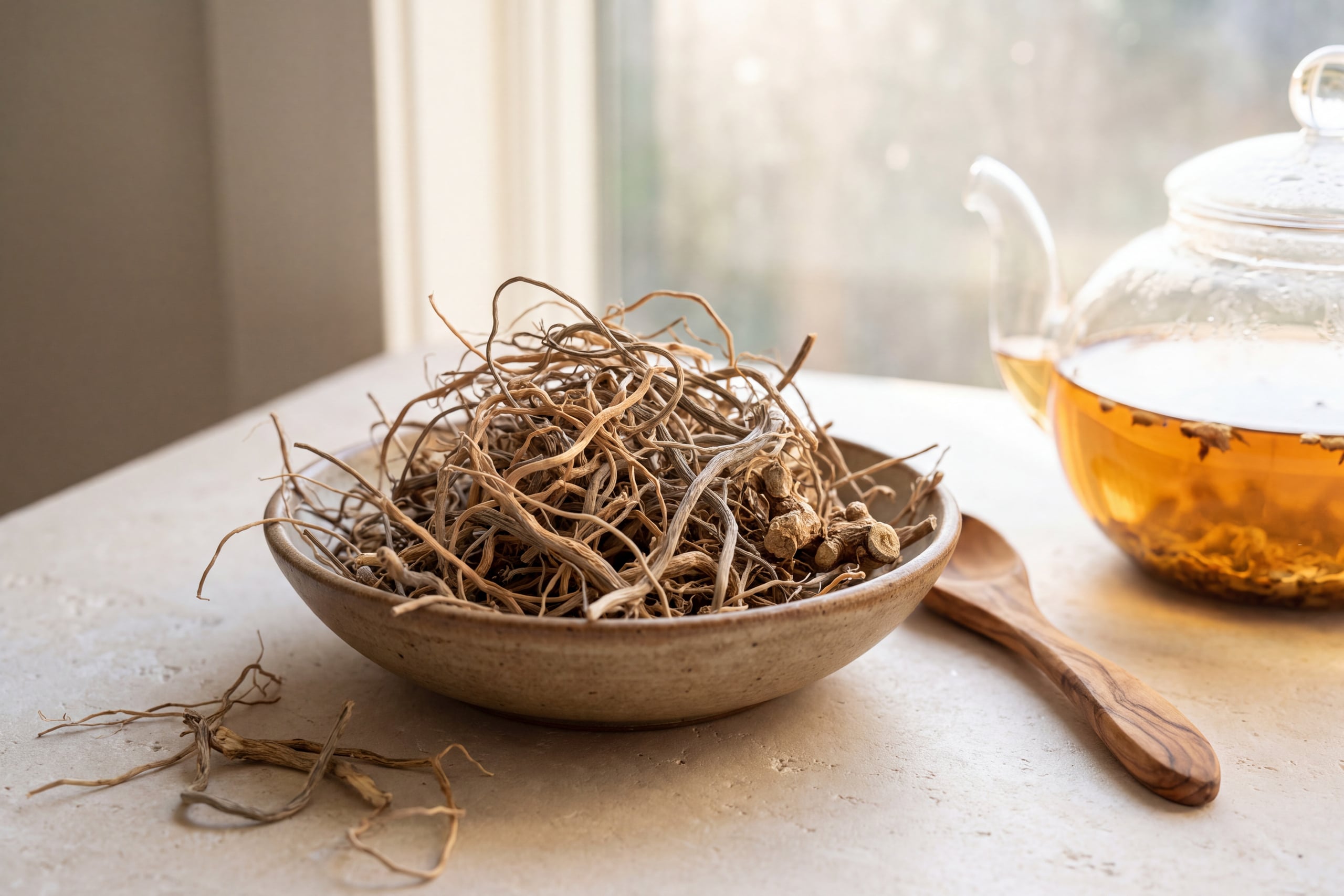
Above ground, the plant carries hollow stems and flat clusters of tiny white to pale pink flowers. The part used in supplements grows underground: a short rhizome crowded with fibrous rootlets. Supplements are made from the roots, rhizomes, and stolons, which are dried and then cut for tea, ground for capsules, or extracted with water or alcohol, according to the NIH Office of Dietary Supplements.
In our experience handling dried valerian root, the smell is unmistakable within seconds of opening the bag. Much of it comes from isovaleric acid, the same short-chain fatty acid behind the aroma of aged cheese. The chemistry beneath that smell is crowded. The volatile oil carries valerenic acid, which is characteristic of the species, along with bornyl acetate and other terpenes. A second group of compounds, the valepotriates, was first isolated in 1966 but breaks down quickly during storage, so many finished products contain little of it (Houghton (1999), Journal of Pharmacy and Pharmacology, PMID: 10411208). Water extracts of the root also contain GABA itself, a detail that matters later in this guide.
The name comes from the Latin valere, meaning to be in good health, as the NIH LiverTox database notes. Hippocrates described the plant, and in the 2nd century the physician Galen recommended it for sleeplessness. By the 16th century, European herbalists used it for nervousness, trembling, headaches, and heart palpitations, and during World War II it was used in England to help people cope with the stress of air raids.
In the United States, valerian is sold as a dietary supplement and is not approved by the FDA before sale. In Europe, the European Medicines Agency herbal monograph for valerian root recognizes it for relief of mild nervous tension and as an aid to sleep.
How Does Valerian Root Work in the Brain? The GABA Mechanism, Explained
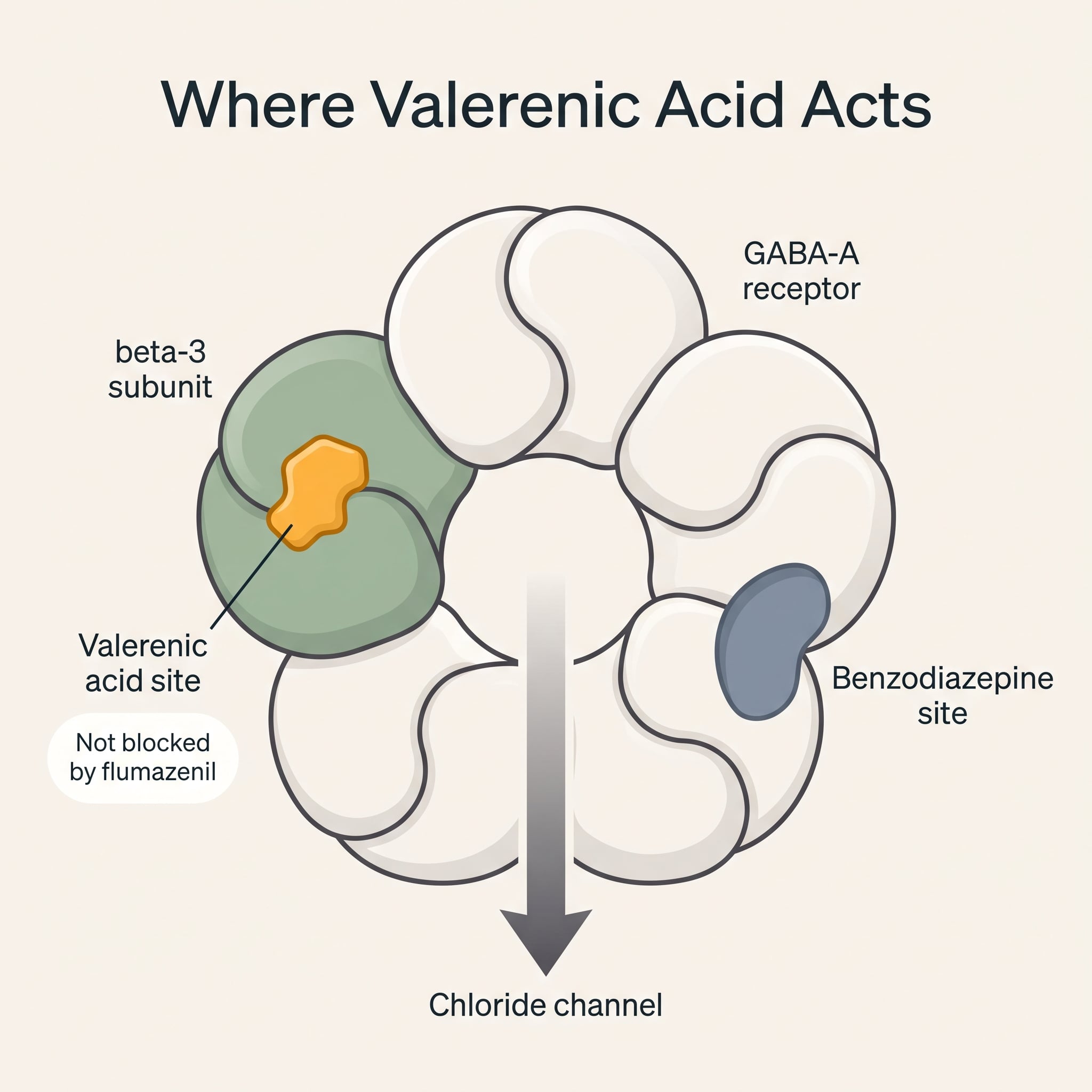
Valerian’s best-studied compound, valerenic acid, is an allosteric modulator of GABA-A receptors, the chloride channels that quiet nerve activity when GABA binds to them. In receptor studies, it only enhanced channels built with beta-2 or beta-3 subunits, and it appears to act at the loreclezole binding pocket rather than the benzodiazepine site (Khom et al. (2007), Neuropharmacology, PMID: 17585957). When mice carried a single mutation in the beta-3 subunit, valerenic acid lost its calming effect entirely (Benke et al. (2009), Neuropharmacology, PMID: 18602406).
Some context helps here. GABA, short for gamma-aminobutyric acid, is the brain’s main inhibitory messenger. When it binds a GABA-A receptor, the channel opens, chloride flows into the neuron, and the cell becomes less likely to fire. Many sleep medications and several calming botanicals act somewhere in this system, which is why the exact site matters.
One detail sets valerenic acid apart. Its effect on the receptor was not blocked by flumazenil, the drug hospitals use to reverse benzodiazepine sedation, and it did not depend on the gamma subunit that benzodiazepines require (Khom et al. (2007)).
Does Valerian Root Raise GABA Levels?
Laboratory work points to more than one route, and none has been confirmed in people. In rat brain tissue, a water extract of valerian caused GABA to be released from nerve endings and slowed its reuptake (Santos et al. (1994), Planta Medica, PMID: 8073095). Older studies reported that valerenic acid slows the enzyme that breaks GABA down (Houghton, 1999)). A 2007 enzyme study found something different: valerian extract increased the activity of glutamic acid decarboxylase, the enzyme that makes GABA, by more than 40 percent at the concentration tested (Awad et al. (2007), Canadian Journal of Physiology and Pharmacology, PMID: 18066140). The NIH Office of Dietary Supplements puts it plainly. There is no scientific agreement on how valerian works, and its effects likely come from several constituents acting together.
This is also why a GABA supplement and valerian root are not interchangeable. Valerian contains some GABA, but whether GABA taken by mouth reaches the brain in meaningful amounts is unknown. Valerenic acid works another way, by changing how the receptor responds to the GABA already there. Stacking the two is a poor idea: a 2021 case report described encephalopathy, a state of confusion and altered consciousness, in a woman who combined valerian root with a GABA supplement (Freitas et al. (2021), Cureus, PMID: 34659971).
What does any of this mean for sleep itself? The most detailed sleep-lab study we found followed 16 adults with long-standing insomnia through eight overnight recordings. A single dose of valerian extract changed nothing. After 14 nights, participants reached slow-wave sleep, the deepest stage, in 13.5 minutes compared with 21.3 minutes on placebo, and slow-wave sleep rose from 8.1 to 9.8 percent of time in bed (Donath et al. (2000), Pharmacopsychiatry, PMID: 10761819). There is a fair amount of caution attached. That was one of 15 measures; the other 14 showed no difference, and chance cannot be ruled out.
Does Valerian Root Actually Work for Sleep? What the Research Shows
Valerian root may improve how well people feel they slept, but controlled trials rarely show a change in objective measures such as how fast people fall asleep. Reviews disagree mainly because the underlying studies are small and short, and they tested very different preparations.
- A 2006 meta-analysis of 16 randomized trials with 1,093 participants found that people taking valerian were 1.8 times as likely to report improved sleep quality, though the authors flagged likely publication bias (Bent et al., 2006, American Journal of Medicine, PMID: 17145239).
- A 2010 meta-analysis of 18 trials found a similar self-rated benefit, yet the difference in time to fall asleep between valerian and placebo was 0.7 minutes, well within the margin of error (Fernández-San-Martín et al. (2010), Sleep Medicine, PMID: 20347389).
- A 2007 systematic review of 37 studies concluded that valerian is safe but that the most rigorous recent trials showed no significant effect on sleep (Taibi et al. (2007), Sleep Medicine Reviews, PMID: 17517355).
- A 2024 umbrella review of eight systematic reviews reached the same split verdict: a good safety record and subjective improvement in sleep quality, without confirmation on objective measures (Valente et al. (2024), European Neuropsychopharmacology, PMID: 38359657).
Expert bodies read that evidence differently. The American Academy of Sleep Medicine suggested in 2017 that clinicians not use valerian for chronic insomnia in adults; a weak recommendation it applied to melatonin as well (Sateia et al. (2017), Journal of Clinical Sleep Medicine, PMID: 27998379). The European Medicines Agency, by contrast, recognizes standardized valerian root extracts for mild nervous tension and mild sleep problems, while stressing that the effect builds gradually.
Why the mixed picture? A 2020 review of 60 studies covering 6,894 participants concluded that inconsistent results were probably driven by variable extract quality, that the whole root and rhizome gave more reliable effects, and that no severe adverse events were reported across the studies reviewed (Shinjyo et al. (2020), Journal of Evidence-Based Integrative Medicine, PMID: 33086877).
Our editorial read: valerian is a reasonable thing to try for occasional sleeplessness if you are patient enough to give it several weeks and willing to judge it by how you feel in the morning. It is not a fix for chronic insomnia. That calls for a conversation with a clinician and, for most adults, cognitive behavioral therapy, which we cover further down.
How Long Does Valerian Root Take to Work for Sleep?
Plan on two to four weeks. The European Medicines Agency describes valerian’s onset as gradual, says it is not suited to acute use, and recommends continued use over two to four weeks for the full effect. A review in American Family Physician reached a similar conclusion from the trials: self-rated sleep improved with nightly use over one to two weeks, while evidence for a single dose was contradictory (Hadley and Petry (2003), American Family Physician, PMID: 12725454). The same European monograph advises checking in with a doctor or pharmacist if sleep has not improved, or has worsened, after two weeks.
How to Take Valerian Root for Sleep: Forms, Dosage, and Timing
The amount that matters depends on the form. Extracts are concentrated, so a capsule of extract and a capsule of plain powdered root are not equivalent milligram for milligram.
Which Form of Valerian Is Best for Sleep?
| Form | What it is | Amount used before bed | Source |
|---|---|---|---|
| Dry extract (capsule or tablet) | Concentrated extract, often standardized to valerenic acids | 400 to 600 mg, 30 to 60 minutes before bed | EMA well-established use |
| Extract, U.S. usage range | Same as above | 300 to 600 mg daily, used with apparent safety for up to six weeks | National Center for Complementary and Integrative Health |
| Herbal tea | Dried, cut root steeped in boiling water | 0.3 to 3 g of dried root in 150 mL (about 5 oz) of boiling water | EMA traditional use |
| Tincture | Alcohol extract of the root | 3 mL of a 1:5 tincture about 30 minutes before bed (one EMA-listed preparation) | EMA traditional use |
| Powdered root capsules | Whole ground root, not concentrated | Varies by product; follow the label | Product label |
| Sources: European Medicines Agency HMPC monograph EMA/HMPC/150848/2015, NIH National Center for Complementary and Integrative Health, Hadley and Petry (2003). | |||
What Is the Best Valerian Root Dosage for Sleep?
Most adults in studies took 300 to 600 mg of extract 30 to 60 minutes before bed. Start at the low end. Two amounts stand out in the trials: 450 mg of a water extract, which shortened time to fall asleep in a small study, and 600 mg of a standardized extract used across several later studies.
Higher is not better. In the same small study, 900 mg did not significantly shorten time to fall asleep and brought more next-morning sleepiness (Leathwood and Chauffard (1985), Planta Medica, PMID: 4034730).
Can You Take Valerian Root Every Night?
Yes, for a limited stretch. Nearly every trial used nightly dosing, typically for two to six weeks, and the effect depends on consistency. What is missing is long-term data: the safety of nightly valerian over months or years is unknown. Our suggestion is to use it in defined blocks of four to six weeks, then pause and see how you sleep without it. If you have used it nightly for more than a few weeks, taper rather than stopping cold, as described below.
Combining Valerian With Other Nervine Herbs
Valerian is often paired with other calming herbs, and the best-designed combination study found that the pairing did something valerian alone did not. In a four-week trial, 500 mg of valerian extract plus 120 mg of hops extract shortened time to fall asleep compared with placebo, while the same valerian dose on its own did not (Koetter et al. (2007), Phytotherapy Research, PMID: 17486686).
- Passionflower (Passiflora incarnata): in a placebo-controlled study, a week of passionflower tea improved self-rated sleep quality in 41 healthy young adults (Ngan and Conduit (2011), Phytotherapy Research, PMID: 21294203). In lab tests, it affects GABA uptake and GABA receptors but, like valerenic acid, not the benzodiazepine site (Appel et al. (2011), Phytotherapy Research, PMID: 21089181).
- Lemon balm (Melissa officinalis): in rat brain tissue, lemon balm was the strongest inhibitor of GABA transaminase, the enzyme that breaks GABA down, and rosmarinic acid was identified as its main active compound (Awad et al. (2009), Phytotherapy Research, PMID: 19165747). Human sleep data for valerian and lemon balm together in adults remain limited.
- Chamomile (Matricaria chamomilla): a common traditional pairing, though a 28-day pilot of chamomile extract alone found no significant sleep-diary benefit (Zick et al. (2011), BMC Complementary and Alternative Medicine, PMID: 21939549).
The 2020 review by Shinjyo and colleagues also concluded that valerian’s benefits may be strongest when it is combined with suitable herbal partners. Two cautions apply to any combination. Each added calming herb stacks on the drowsiness of the last, and the NIH lists kava, St. John’s wort, and melatonin among supplements that may add to valerian’s effects. Add one herb at a time so you can tell what is helping.
If you would rather start with a formula than build one, our Restless Capsules pair valerian root with passionflower and chamomile in one evening blend.
Valerian Root Side Effects: What to Expect, and at What Dose
Most people who take valerian notice no side effects, and in controlled trials the most common complaints appeared at similar rates on placebo, according to the NIH Office of Dietary Supplements. Here are the effects that are reported, with dose context where the research provides it:
- Next-morning grogginess: tied to dose. In 102 volunteers, a single 600 mg dose and 14 nights at 600 mg did not impair next-morning reaction time, alertness, or concentration (Kuhlmann et al., 1999; Pharmacopsychiatry, PMID: 10599933). At 900 mg, next-morning sleepiness increased.
- Headache, dizziness, and itching: the most commonly reported effects in trials, at rates similar to placebo.
- Digestive upset: nausea and abdominal cramps, with frequency unknown, per the European monograph.
- Vivid dreams and mental dullness: listed among valerian’s side effects by NCCIH, with no established dose threshold.
- Excitability or uneasiness: the paradoxical reaction described below.
- Heart palpitations: reported occasionally, and more often in the context of stopping after long-term use.
Paradoxical Reactions: When Valerian Makes You More Alert
A paradoxical reaction to valerian means feeling restless, uneasy, or overstimulated after a dose instead of calm. NCCIH lists excitability and uneasiness among valerian’s known side effects. No reliable figure exists for how often it happens. If you feel wired rather than tired after taking valerian at bedtime, stop rather than raising the dose.
The reaction is not new. In the mid-19th century, physicians regarded valerian as a stimulant that caused some of the very complaints it was meant to relieve, according to the history compiled by the NIH Office of Dietary Supplements. Why some people respond this way is not understood. Do not take a second dose to push through it. Note what form and amount you took, and mention it to your healthcare provider.
Heart Palpitations and Cardiac Effects
Heart palpitations are an uncommon report with valerian. Memorial Sloan Kettering Cancer Center lists them among occasional or possibly related effects, and NCCIH names heart disturbances as a possible withdrawal symptom when valerian is stopped abruptly after long-term use.
The most serious published example involved stopping, not starting. A 1998 case report in JAMA described a man who developed delirium and cardiac complications that his physicians attributed to valerian root withdrawal (Garges et al., 1998, JAMA, PMID: 9820254). There is an irony in the history here, since 16th-century herbalists used valerian for palpitations. If you have a heart rhythm condition or take heart medication, talk with your provider before using valerian. Seek care promptly for chest pain, fainting, or a racing heartbeat that does not settle.
Can You Take Too Much Valerian Root?
Yes, though serious overdose is rare. The European monograph records that about 20 grams of valerian root caused fatigue, abdominal cramps, chest tightness, light-headedness, hand tremor, and dilated pupils, all of which resolved within 24 hours. Combinations raise the stakes more than the dose alone, as the GABA supplement case above shows. If someone has taken a large amount or seems confused or hard to wake, call Poison Control (1-800-222-1222 in the U.S.) or emergency services.
Is Valerian Root Safe for Your Liver?
Liver injury linked to valerian is very rare. The LiverTox database rates valerian a probable rare cause of clinically apparent liver injury and notes that most published cases involved blends with other herbs such as skullcap or black cohosh. Onset ran 3 to 12 weeks after starting, with recovery typically within 2 to 4 months of stopping. Memorial Sloan Kettering advises people with liver or pancreatic disease to avoid valerian. Stop and contact a clinician if you notice dark urine, yellowing of the skin or eyes, or unusual fatigue.
Stopping Valerian: Rebound Insomnia, Withdrawal, and How to Taper
Most people who use valerian for a few weeks at standard amounts can stop without trouble. The risk sits with long-term, regular use. NCCIH notes that stopping abruptly after chronic use may bring anxiety, irritability, heart disturbances, sleeplessness, and, in rare cases, hallucinations. After extended nightly use, a gradual taper is the cautious way to stop.
Does Valerian Cause Rebound Insomnia?
There is no good evidence that it does after short-term use at standard amounts. No controlled trial we found measured rebound sleeplessness after stopping valerian, and the reports of withdrawal problems involve long-term use. It helps to separate two things. Rebound means sleep becoming worse than it was before you started. Returning to your old baseline once the herb is gone is not rebound, even if it is disappointing.
Is Valerian Rebound Different From Benzodiazepine Rebound?
Yes, in scale and in documentation. For benzodiazepines, the FDA requires a boxed warning because physical dependence can develop over days to weeks even at prescribed doses, and stopping abruptly can cause withdrawal reactions including seizures (FDA Drug Safety Communication, September 2020). Valerian withdrawal appears in a handful of case reports, mostly after long-term use. The difference is real, but it is not a reason to be casual about stopping valerian after months of nightly use.
How Long Does Valerian Withdrawal Last?
There is no published figure. The case reports do not establish a typical timeline, and we would be wary of any source that gives you one. As a practical guide, a few nights of unsettled sleep are common after any change to a bedtime routine. Symptoms such as a racing heart, confusion, hallucinations, or severe agitation are not something to wait out. Contact a clinician promptly.
How to Taper Off Valerian Safely
No valerian-specific taper has been studied. The steps below are a conservative general approach, not medical advice, and anyone who has taken high amounts for months should plan the taper with a clinician.
- Check how long and how much. If you have taken standard amounts for less than two to three weeks, most people can simply stop.
- Reduce gradually after longer use. Cut the nightly amount by about a quarter, hold it there for five to seven days, and repeat until you reach zero.
- Keep your sleep routine steady. Hold your wake time and wind-down habits constant so the taper is the only thing changing.
- Watch for warning signs. Palpitations, confusion, hallucinations, or severe agitation mean you should contact a clinician rather than continue on your own.
- Leave prescriptions alone. If you take prescribed sleep or anxiety medication, do not change it without your prescriber.
Valerian vs. Benzodiazepines: Why the Xanax Comparison Is Misleading
Valerian does not act like Xanax. Both involve the GABA-A receptor, but they act at different sites on it, work with very different strength, and sit under different rules. Treating valerian as a natural Xanax sets up the wrong expectations and can lead to unsafe combinations.
Benzodiazepines such as alprazolam (Xanax) and diazepam (Valium) bind where the receptor’s alpha and gamma-2 subunits meet, and flumazenil reverses them. Valerenic acid needs a beta-2 or beta-3 subunit, does not need the gamma subunit, and is not blocked by flumazenil. Different doors, different keys. Benzodiazepines are prescription drugs and federally controlled substances. Valerian is sold as a dietary supplement.
The practical concern is combining them. The NIH lists benzodiazepines, including Xanax, Valium, Ativan, and Halcion, among medications whose sedating effects valerian may add to. There is also a measurable drug-level effect: after 14 nights of 1,000 mg of valerian, peak blood levels of alprazolam rose from 25 to 31 ng/mL in healthy volunteers, although the researchers judged typical valerian doses unlikely to cause clinically significant changes for drugs cleared through that pathway (Donovan et al. (2004), Drug Metabolism and Disposition, PMID: 15328251).
People often search for the closest natural thing to Xanax. There isn’t one, and any product marketed that way deserves suspicion. If you take a benzodiazepine, never stop it or swap it for an herb on your own. Benzodiazepine withdrawal can cause seizures, and any change needs a plan from your prescriber.
Who Should Avoid Valerian Root?
Valerian is generally well tolerated by healthy adults in short-term use, but several groups should skip it or check with a clinician first:
- Pregnant or breastfeeding women: safety has not been established, and the European monograph does not recommend use.
- Children under 12: the European monograph does not recommend valerian at this age because of limited data. This guide is written for adults.
- Anyone scheduled for surgery: stop at least one week beforehand because valerian may interact with anesthesia, per Memorial Sloan Kettering. Your surgical team may ask for longer.
- People with liver or pancreatic disease: avoid it, given the rare case reports.
- Anyone who drinks alcohol or takes sedating medication: including benzodiazepines, barbiturates, opioid pain medicines, and other sleep aids, because the effects may add together.
- Anyone who needs to drive: do not drive or operate machinery after a dose.
If you take any prescription medication, bring your supplement list to a pharmacist. It takes five minutes and catches interactions that are easy to miss.
Older Adults: Extra Caution
Older adults can use valerian, but next-morning grogginess matters more after 65 because it raises the risk of falls. A 2016 review of sleep medicines in older adults concluded that valerian has a small effect on how quickly people fall asleep and can cause residual sedation (Schroeck et al. (2016), Clinical Therapeutics, PMID: 27751669).
Direct testing is somewhat reassuring. In 14 healthy adults aged 65 to 89, single doses of 400 and 800 mg of valerian did not differ from placebo on any measure of psychomotor performance or sedation, while the study’s temazepam and diphenhydramine arms did produce measurable effects (Glass et al. (2003), Journal of Clinical Psychopharmacology, PMID: 12826988). That was one small single-dose study, so start at the low end and take it only on nights when you can sleep a full night.
If you are comparing over-the-counter options, read the label. Many nighttime products contain diphenhydramine, which the same 2016 review says should be avoided in older adults. A pharmacist can review your full medication list in one visit.
Herbal Sleep Aids Compared: Valerian, Passionflower, Lemon Balm, Chamomile, Hops, and Melatonin
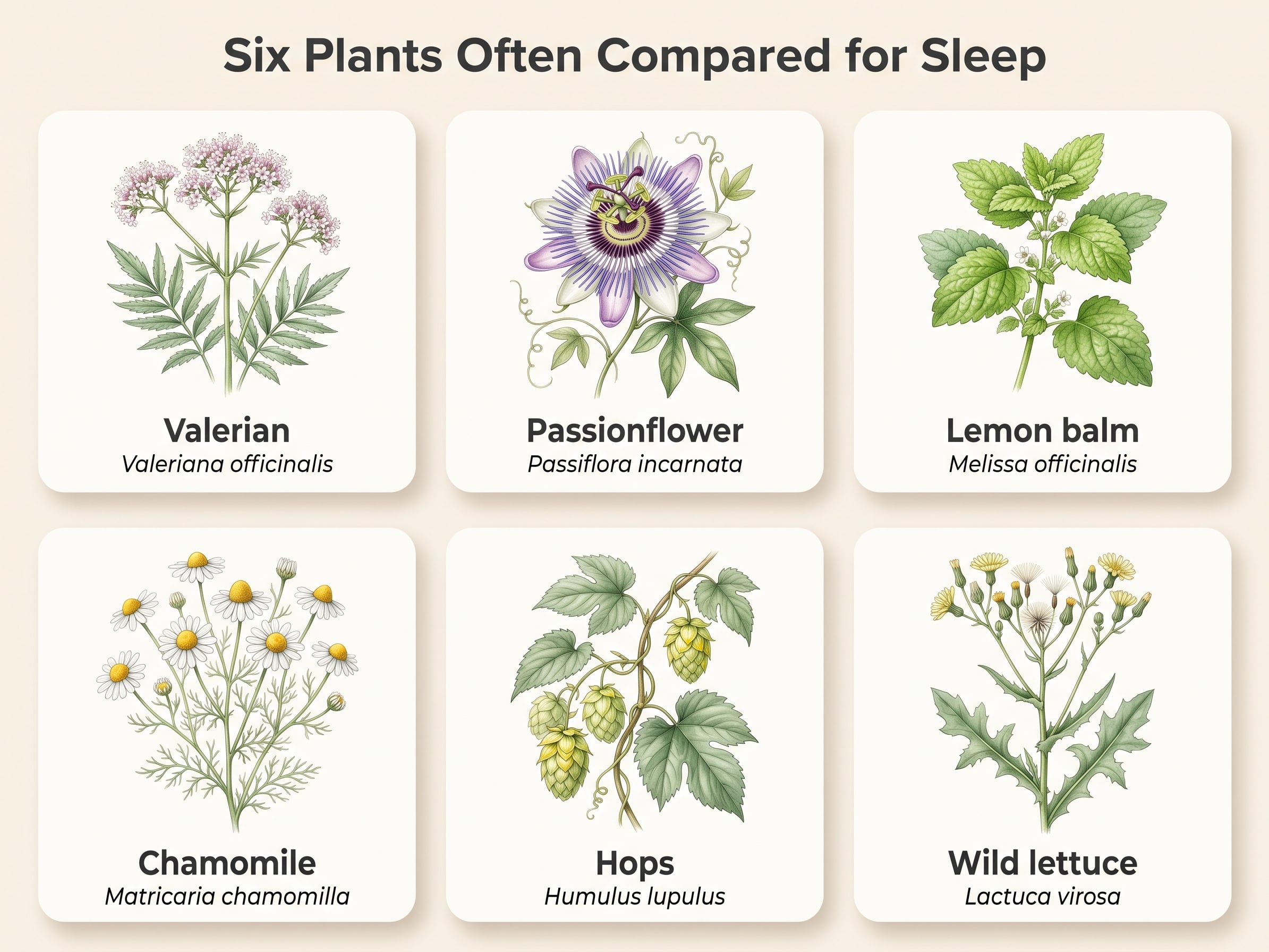
Valerian has the longest research record of the calming herbs, but none of them has strong evidence on objective sleep measures. The table sets them side by side, with wild lettuce added because readers often ask about it.
| Sleep aid | Key compound | How it may act | Amount used in studies | What human studies show | Main caution |
|---|---|---|---|---|---|
| Valerian (Valeriana officinalis) | Valerenic acid | Modulates GABA-A receptors with beta-2 or beta-3 subunits | 300 to 600 mg extract before bed | Better self-rated sleep quality after 2+ weeks, little objective change | Grogginess at higher doses, withdrawal after long-term use |
| Passionflower (Passiflora incarnata) | Flavonoids such as vitexin | Affects GABA uptake and receptors in lab tests, not the benzodiazepine site | One cup of tea nightly for a week | Better self-rated sleep quality in healthy young adults | Adds to drowsiness from other calming agents |
| Lemon balm (Melissa officinalis) | Rosmarinic acid | Inhibits GABA transaminase in lab tests | Not well established for sleep | Limited adult sleep data | Adds to drowsiness |
| Chamomile (Matricaria chamomilla) | Apigenin | Not established in people | 270 mg extract twice daily | No significant sleep-diary benefit in a 28-day pilot | Allergy risk for people sensitive to ragweed-family plants |
| Hops (Humulus lupulus) | Bitter acids | Not well established in people | 120 mg extract with 500 mg valerian | The valerian and hops pairing shortened time to fall asleep | Adds to drowsiness |
| Wild lettuce (Lactuca virosa) | Lactucin, lactucopicrin | Not established | No studied sleep amount | We found no controlled human sleep trials | Limited safety data |
| Melatonin | Melatonin (a hormone) | Signals the body clock, not the GABA system | Varies widely | Used mainly for sleep-timing problems such as jet lag | Adds to valerian’s effects when combined |
| Sources: Khom et al. (2007), Ngan and Conduit (2011), Appel et al. (2011), Awad et al. (2009), Zick et al. (2011), Koetter et al. (2007), Sateia et al. (2017), NIH Office of Dietary Supplements. Lab findings are not proof of an effect in people. | |||||
Valerian vs. Melatonin: Which Is Better for Sleep?
They work on different systems, so the better choice depends on the problem. Melatonin is a hormone that tells your body clock it is night, which is why it is used mainly for timing problems. Valerian acts on the GABA system and builds over weeks. The American Academy of Sleep Medicine suggested that clinicians not use either one for chronic insomnia. Taking both together adds drowsiness, so if you want to try both, introduce one at a time and talk with your provider first.

Sleep Foundations That Work Without Any Supplement
For ongoing sleep trouble, the first-line approach in medical guidelines is not a supplement. It is cognitive behavioral therapy for insomnia, or CBT-I. The American College of Physicians recommends CBT-I as the initial treatment for chronic insomnia in adults (Qaseem et al. (2016), Annals of Internal Medicine, PMID: 27136449), and the American Academy of Sleep Medicine’s 2021 behavioral treatment guideline gives it a strong recommendation (Edinger et al. (2021), Journal of Clinical Sleep Medicine, PMID: 33164742).
That same guideline makes a point many sleep articles skip: basic sleep hygiene on its own is not enough for chronic insomnia. The habits below still matter, and they give any herb a fair test.
- Keep one wake time seven days a week, even after a poor night.
- Use the bed for sleep. If you lie awake and frustrated for a long stretch, get up, do something quiet in dim light, and return when sleepy.
- Stop caffeine by early afternoon and skip alcohol near bedtime, which matters doubly because alcohol and valerian should not be combined.
- Dim the lights and screens in the last hour before bed.
- Build a wind-down routine. If you use valerian tea, it fits here, 30 to 60 minutes before bed.
For a fuller guide to habits, techniques, and supplements side by side, see our evidence review of natural sleep remedies.
See a doctor if sleep trouble happens three or more nights a week for three months or longer, if someone notices loud snoring or pauses in your breathing, if your legs feel restless at night, or if you feel sleepy while driving. Those can signal conditions that no supplement will address.
Frequently Asked Questions
How long does valerian take to make you sleepy?
Most people need two to four weeks of nightly use to judge it. The European Medicines Agency describes valerian’s onset as gradual, and studies found little effect from a single dose.
Can I take valerian root every night?
Nightly use for two to six weeks is how valerian was studied, and NCCIH notes apparent safety at 300 to 600 mg daily for up to six weeks. Long-term safety is unknown, so use it in blocks and pause to reassess. After extended nightly use, taper rather than stopping abruptly.
Will valerian root make me groggy the next morning?
At studied amounts, it usually does not. In 102 volunteers, 600 mg of valerian extract did not impair next-morning reaction time, alertness, or concentration. Next-morning sleepiness increased at 900 mg in an earlier study, so more is not better.
Is valerian root addictive?
Valerian is not a controlled substance and is not considered addictive in the way benzodiazepines are. Withdrawal symptoms, including anxiety, irritability, and heart disturbances, have been reported when valerian was stopped abruptly after long-term use, so taper after extended nightly use.
Can I take valerian root with melatonin or other sleep supplements?
Combining them adds drowsiness. The NIH lists melatonin, kava, and St. John’s wort among supplements that may add to valerian’s effects, so add one product at a time and check with your healthcare provider if you take any medication.
Can you drink alcohol with valerian root?
No. Alcohol and valerian may add to each other’s sedating effects, and NCCIH advises against taking valerian with alcohol or sedatives.
Does valerian root help with stress?
Valerian has been traditionally used to support a calm mood during stressful periods, and the European Medicines Agency recognizes it for relief of mild nervous tension. Evidence in people is limited, and NCCIH states there is not enough evidence to draw conclusions about stress or anxiety.
Why does valerian root smell so bad?
The smell comes mainly from isovaleric acid and related compounds in the root’s volatile oil. A strong odor is normal for valerian and does not mean the root has gone bad. Capsules hide most of it, and tea brings it out.
Related Reading
Continue with our evidence review of natural sleep remedies, our collection of sleep herbs, and our separate look at valerian root for ADD, which covers the attention-related research on its own.
Important: This article is for educational and informational purposes. The statements have not been evaluated by the Food and Drug Administration. The herbs and herbal products discussed are not intended to diagnose, treat, cure, or prevent any disease, including insomnia or any other sleep disorder. Information presented here is not a substitute for professional medical advice, diagnosis, or treatment. Always consult a qualified healthcare provider for medical guidance specific to your circumstances. Do not delay seeking medical care because of information you have read on this site.