Key Takeaways
- Shilajit does not contain collagen. In an 8-week randomized trial, it was associated with higher serum levels of a type I collagen synthesis marker.
- The one human trial on shilajit and skin measured microperfusion, not wrinkles. At 250 mg twice daily for 14 weeks, skin perfusion improved against placebo.
- Fulvic acid is the carrier compound. Its low molecular weight is why shilajit is discussed as a delivery vehicle rather than a single active ingredient.
- Acne is the one area where shilajit cuts both ways. Its anti-inflammatory activity is documented, and its influence on testosterone may aggravate hormonal breakouts in some people.
- Purity decides safety. Unpurified material carries heavy metal risk, and in cell culture, concentrations above 4 mg/mL became cytotoxic.
Most articles about shilajit and skin cite the same handful of claims without ever naming a study. We went looking for the actual human data, and what we found reshaped how our editorial team talks about this material. There are two randomized controlled trials that matter here, one in vitro study that is routinely quoted with its most important finding removed, and a great deal of published research on shilajit that has nothing to do with skin at all.
This article covers what shilajit is at the compound level, what the collagen and microperfusion trials actually measured, how it compares to a collagen supplement, where the acne question gets complicated, what dose was studied, and how to judge purity before any of the rest of it matters. Where the evidence is thin, we say so.
What Is Shilajit, And What Makes It Relevant To Skin?
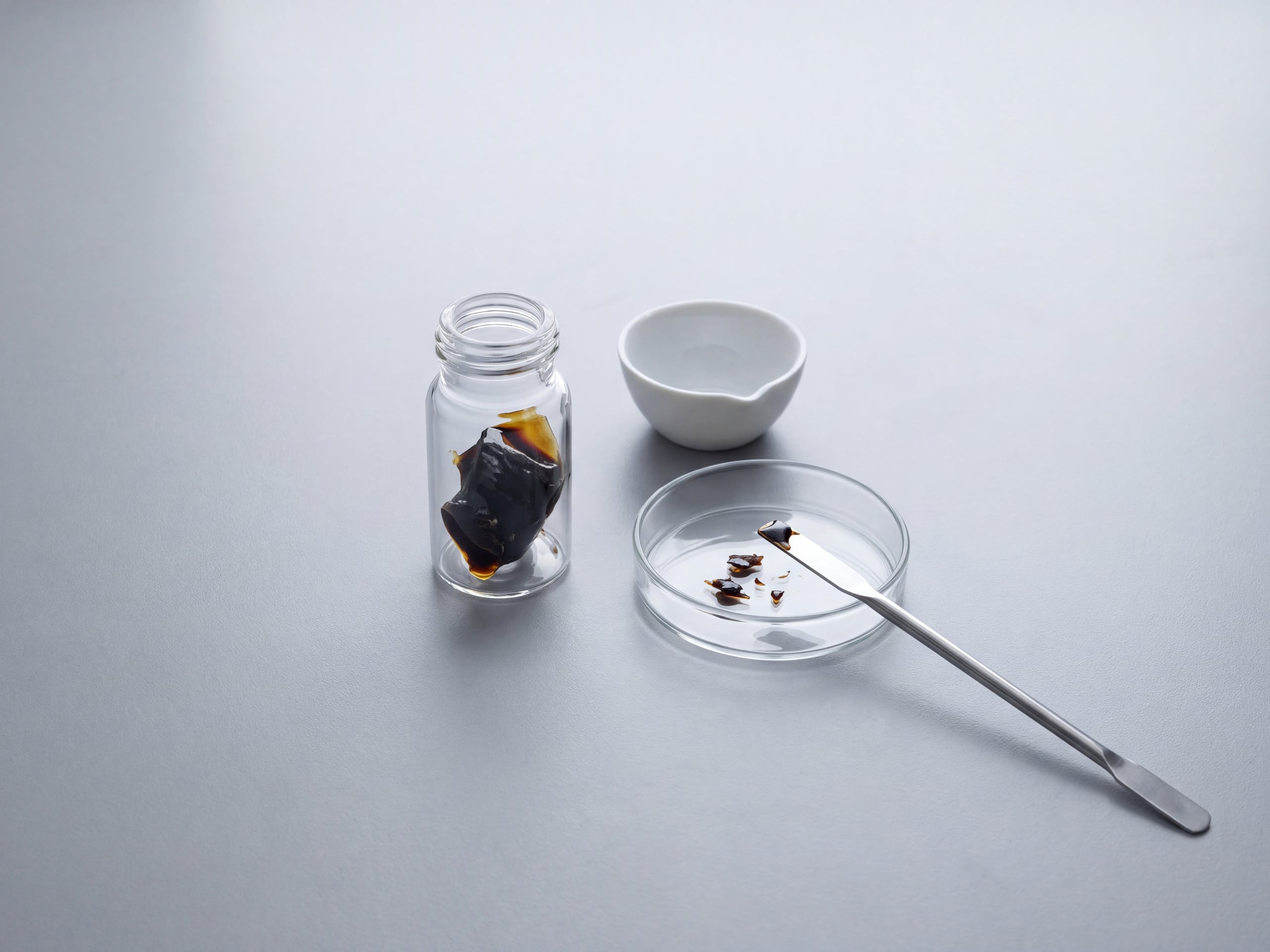
Shilajit is a mineral pitch, known in materia medica as Asphaltum punjabianum and regionally as mumiyo or momiai. It seeps from rock strata in high-altitude ranges, most prominently the Himalaya, and forms across centuries as plant matter and microbial residue compress and decompose within the rock. What emerges is not a plant extract. It is a humic substance, and that distinction is the reason the skin conversation is structured differently than it would be for an herb.
The dominant bioactive fraction is fulvic acid, a low molecular weight humic compound. Molecular size is the operative detail. Fulvic acid molecules are small enough to move across cell membranes and to bind and carry mineral ions with them, which is why the literature describes shilajit as a carrier system rather than a single active ingredient. Alongside fulvic acid sit dibenzo-alpha-pyrones, trace minerals, and a set of diterpenoids. Kiren et al. (2013), Journal of Natural Medicines, PMID: 23609027, isolated five previously undescribed diterpenoids from mumiyo and named them mumic acids A through E, which gives some sense of how incompletely characterized this material still is.
In our sourcing work, the practical consequence of that chemistry shows up in grading. Two samples labeled the same way can differ substantially in fulvic acid percentage and in the mineral profile riding along with it, because both depend on the rock and the altitude the material came from.

Can Shilajit Improve Collagen Production?
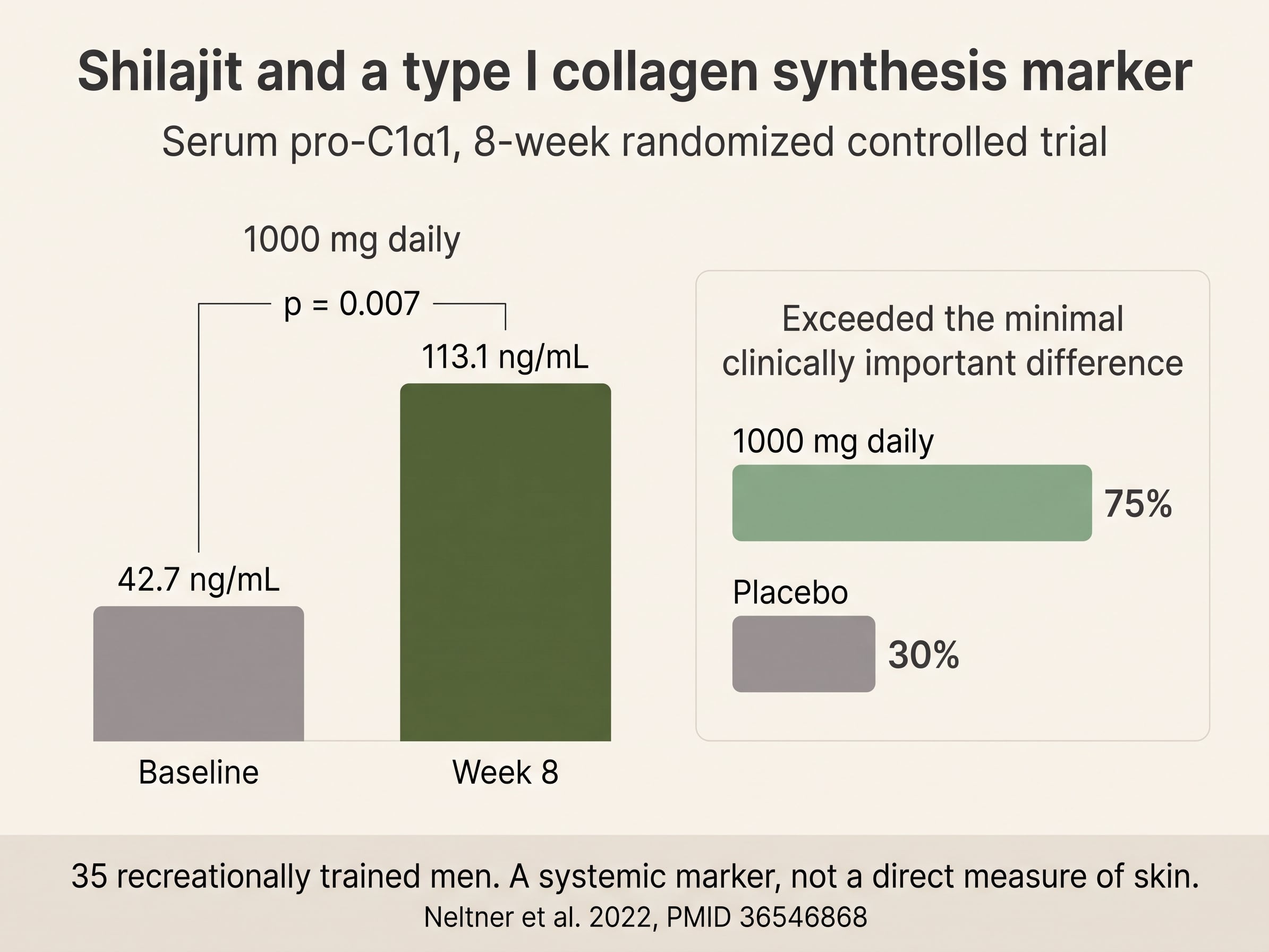
Shilajit contains no collagen. In an 8-week randomized controlled trial, it was associated with increased type I collagen synthesis, measured through serum pro-C1α1, a circulating biomarker of collagen production rather than a measure of skin itself. Neltner et al. (2022), Journal of Dietary Supplements, PMID: 36546868, reported that serum pro-C1α1 rose from 42.7 nanograms per milliliter to 113.1 nanograms per milliliter in the 1000 mg daily group across eight weeks, a statistically significant change at p equals 0.007.
The individual response data are arguably more useful than the group average. Seventy-five percent of participants in the high-dose group exceeded the minimal clinically important difference, against thirty percent on placebo. The lower dose group at 500 mg daily also rose significantly from baseline, though it did not separate cleanly from placebo on the individual-response comparison.
One qualification belongs in the same breath as the finding. That trial enrolled 35 recreationally trained men. It was not a study of women; it was not a study of skin, and pro-C1α1 is a systemic marker that reflects collagen synthesis across bone, tendon, ligament, and skin without distinguishing between them. A rise in circulating pro-C1α1 is a reasonable signal that collagen synthesis increased somewhere in the body. It is not evidence that facial skin gained collagen.
Anyone specifically interested in the collagen pathway will find a fuller treatment of plant-based collagen support, including the retinoid X receptor mechanism, in our article on Bidens pilosa for collagen production.
How Does Oral Shilajit Reach The Skin?
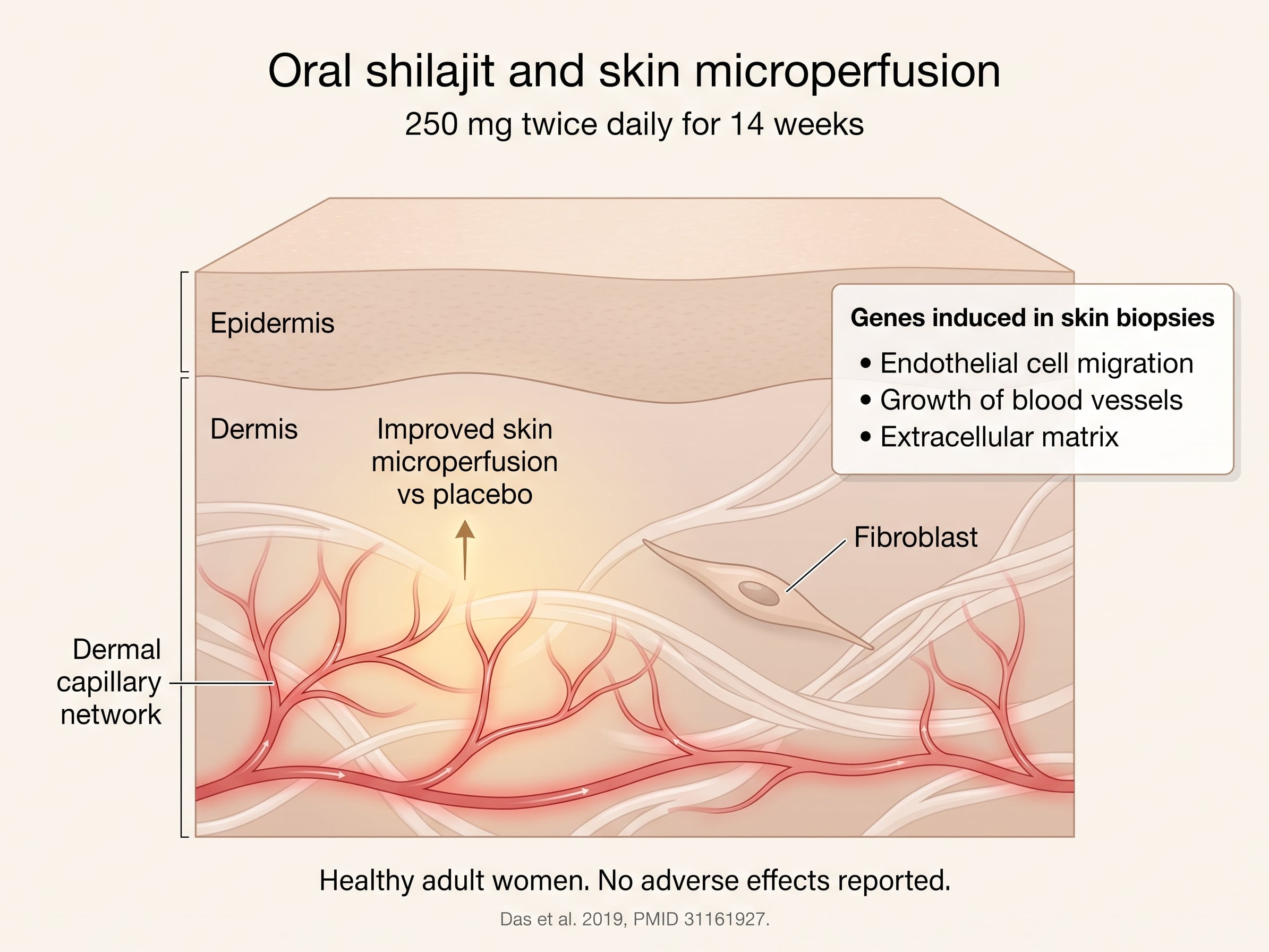
Through blood flow, according to the only randomized controlled trial to examine shilajit and human skin directly. Das et al. (2019), Journal of the American College of Nutrition, PMID: 31161927, supplemented healthy adult women with 125 mg or 250 mg twice daily for 14 weeks and took skin biopsies from the inner upper arm at baseline and at the end. At the 250 mg twice-daily dose, skin perfusion improved compared with baseline and placebo. Gene expression analysis identified upregulated pathways for endothelial cell migration, growth of blood vessels, and extracellular matrix, verified by real-time PCR. No adverse effects were reported across the 14-week period. The trial was registered as NCT02762032.
Microperfusion is an unglamorous endpoint, and it is the one that changes how the rest of this topic should be read. Skin is supplied by a dense dermal capillary network, and every nutrient reaching a fibroblast arrives through it. A material that improves perfusion is acting upstream of collagen, hydration, and repair rather than substituting for any of them. This also explains why the shilajit skin literature keeps circling back to extracellular matrix genes. The same research group had previously observed shilajit upregulating extracellular matrix genes in skeletal muscle, and the skin study extended that line of inquiry to dermal tissue.
We treat this study as the anchor for the entire topic, because it is the only one that measured shilajit in human skin under placebo control. It is also, notably, a study of 14 weeks. Nothing in it speaks to what happens at six months or two years.
Is Shilajit Better Than Collagen Supplements For Skin?
They are not substitutes for each other, and the honest comparison favors collagen peptides on volume of skin-specific evidence. Shilajit supplies minerals and fulvic acid and is associated with increased collagen synthesis and improved dermal perfusion. Hydrolyzed collagen peptides supply the amino acid substrate that collagen is built from and carry a considerably larger body of skin-specific human trials. The table below sets out what each one actually contributes.
| Comparison point | Shilajit | Hydrolyzed collagen peptides |
|---|---|---|
| What it supplies | Fulvic acid, dibenzo-alpha-pyrones, trace minerals including zinc, copper, and magnesium | Glycine, proline, and hydroxyproline, the amino acid substrate of collagen |
| Proposed mechanism | Upregulates extracellular matrix and blood vessel genes, improves dermal microperfusion, supplies mineral cofactors | Provides raw material and signaling peptides that stimulate fibroblast activity |
| Human evidence on skin | One 14-week randomized controlled trial with a perfusion endpoint (PMID: 31161927), plus one 8-week collagen-biomarker trial in men (PMID: 36546868) | A substantially larger base of skin-specific randomized trials measuring elasticity and hydration |
| Doses used in studies | 125 mg or 250 mg twice daily for perfusion, 500 mg or 1000 mg daily for the collagen marker | Typically 2.5 g to 10 g daily depending on the trial |
| Best suited to | Someone seeking mineral and circulatory support alongside general vitality | Someone targeting skin elasticity and hydration with the most direct evidence base |
| Sources: Das et al. (2019), PMID: 31161927. Neltner et al. (2022), PMID: 36546868. | ||
How Does Shilajit Compare To Retinol And Vitamin C?
It does not compete with either one on the same axis. Retinol acts on keratinocyte turnover and dermal remodeling through nuclear receptor signaling. Topical vitamin C functions as an antioxidant and as a cofactor for the hydroxylase enzymes that stabilize collagen. Shilajit, as studied, is an oral mineral and humic complex acting on perfusion and matrix gene expression. Someone using a retinoid is not choosing between it and shilajit, and stacking them addresses different steps. Our article on Bidens pilosa for collagen production covers the plant-based retinoid alternative question in depth for readers who want that comparison.
Is Shilajit Good For Acne-Prone Skin?
This is the one part of the topic where shilajit cuts in two directions at once, and any answer that runs only one way is incomplete.
- Shilajit has documented anti-inflammatory activity, and inflammation is a central feature of acne lesions. This is the basis of the supportive case.
- Shilajit has also been associated with increased testosterone levels. Cleveland Clinic notes this as a consideration, particularly for women, and androgen activity is a recognized driver of sebum production.
- The practical implication is that shilajit may aggravate hormonally driven breakouts in some people while calming inflammatory redness in others. Which effect dominates is individual and is not currently predictable from the literature.
- No randomized controlled trial has tested shilajit against acne as an outcome. Everything above is inference from mechanism and from adjacent findings, not from a trial designed to answer this question.
- If breakouts are hormonally patterned, along the jawline or synchronized with cycle phase, this is a conversation to have with a dermatologist before adding shilajit rather than after.
We have deliberately stopped short of a recommendation here. In our editorial review of this topic, the acne question is where the gap between what is claimed online and what has been tested is widest.
Does Shilajit Reduce Fine Lines And Wrinkles?
No trial has measured wrinkle depth or fine line count after shilajit supplementation. What exists is a chain of upstream findings: improved dermal perfusion in a 14-week trial, upregulated extracellular matrix gene expression in the same trial, and increased serum pro-C1α1 in a separate 8-week trial in men. Each of those sits on the pathway that produces skin firmness. None of them is a measurement of the visible outcome.
Oxidative stress is the other half of the standard explanation. Fulvic and humic acids act as antioxidants, and reactive oxygen species generated by ultraviolet exposure and pollution contribute to collagen breakdown over time. That mechanism is well established in general terms. Its specific magnitude for shilajit in human skin has not been quantified. Our article on shilajit for women covers the broader antioxidant and regeneration picture for readers who want that background.
How Do I Use Shilajit For Skin Safely?
Start by deciding whether you are treating this as an internal supplement or a topical preparation, because the evidence supports those two routes very unevenly.
- Oral. This is where the human trial evidence sits. Both randomized controlled trials discussed above used oral supplementation. If your interest is perfusion, matrix support, or the collagen biomarker, oral is the route that has been tested.
- Topical. No human trial has tested topical shilajit on facial skin. The topical case rests on in vitro cell work and on traditional practice. It is not unreasonable, but it is a different evidence tier and should be described as one.
- Both. Nothing in the literature indicates a conflict between the two routes. There is also nothing establishing an additive benefit.
What Dose Of Shilajit Was Actually Studied?
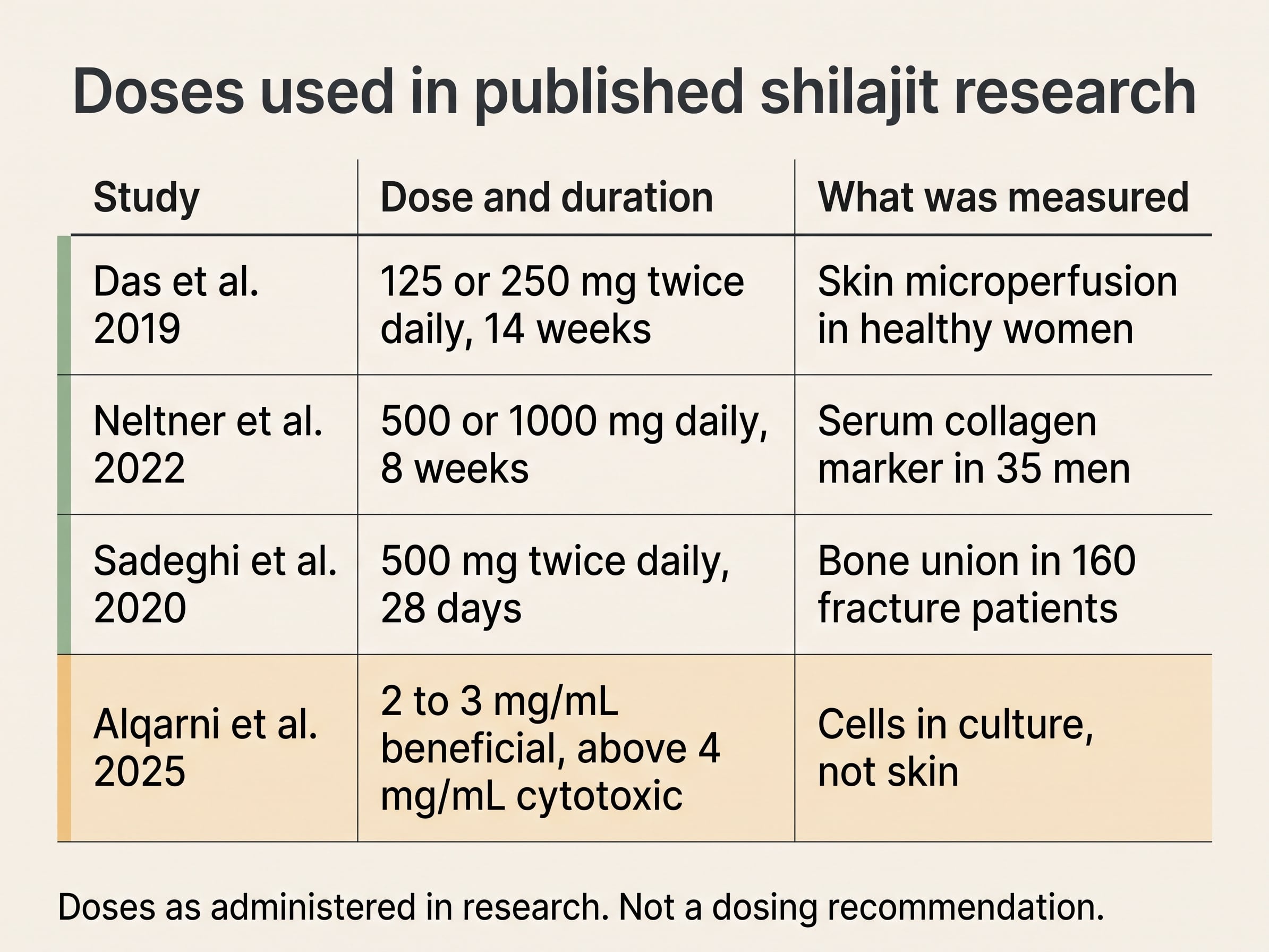
| Study | Dose | Duration | Population and endpoint |
|---|---|---|---|
| Das et al. (2019), PMID: 31161927 | 125 mg or 250 mg twice daily, oral | 14 weeks | Healthy adult women. Skin microperfusion and skin gene expression |
| Neltner et al. (2022), PMID: 36546868 | 500 mg or 1000 mg daily, oral | 8 weeks | 35 recreationally trained men. Serum pro-C1α1 collagen marker |
| Alqarni et al. (2025), PMID: 40057709 | 2 to 3 mg per mL beneficial, above 4 mg per mL cytotoxic | 24 hours | In vitro human periodontal ligament cells. Wound closure and COL1A1 |
| Sadeghi et al. (2020), PMID: 32310691 | 500 mg twice daily, oral | 28 days | 160 tibia fracture patients. Bone union time, not skin |
| Doses reflect what was administered in the cited research. They are not a recommendation, and they are not adjusted for the concentration of any particular product. | |||
The 600 mg per serving in our shilajit extract capsules sits inside the range these trials used. Anyone preparing a topical paste generally starts from the resin or from purified shilajit powder rather than from a capsule.
Can You Put Shilajit Directly On Your Face?
Purified shilajit can be applied topically, diluted, after a patch test. Dissolve a small amount in filtered water to a thin paste rather than applying resin neat. Apply to the inner forearm first, leave it for 24 hours, and check for redness or irritation before it goes anywhere near your face. For a facial application, 10 to 15 minutes followed by a thorough rinse is the conventional approach. Raw, unprocessed material should not be used on skin at all, which is a purity issue rather than a technique issue.
How Do You Read A Shilajit Certificate Of Analysis?
Three lines on the certificate carry most of the weight. The heavy metals panel should report lead, arsenic, mercury, and cadmium individually with figures, not a pass or fail stamp. The fulvic acid percentage should be stated as a measured value rather than a marketing range. The purification method should be described, because the difference between raw and purified material is exactly where the heavy metal risk lives. A certificate that omits the testing laboratory or carries no date is not doing the job a certificate exists to do. In our own quality process, third-party heavy metals testing is the gate that material passes before anything else about it matters.
What Are The Side Effects Of Shilajit On Skin?
Purified shilajit from a tested source is generally well tolerated, and the 14-week trial reported no adverse effects over its study period. The meaningful risks cluster around purity, dose, and individual susceptibility rather than around the material itself.
Heavy metal contamination. Unpurified shilajit can carry lead, arsenic, and mercury from the rock it forms in. This is the single largest safety consideration, and the reason purification and third-party testing are not optional details.
Concentration matters in cell work. Alqarni et al. (2025), BMC Complementary Medicine and Therapies, PMID: 40057709, found that shilajit at 2 to 3 mg per milliliter accelerated cell migration and wound closure in human periodontal ligament cells and upregulated COL1A1, the gene encoding the type I collagen alpha-1 chain. Above 4 mg per milliliter, cell viability dropped significantly. That upper bound is frequently omitted when the favorable half of this study gets quoted. This was cells in culture, not human skin, and the concentrations do not translate directly to a topical paste, but the shape of the finding is worth carrying: more was not better.
Hormonal effects. Shilajit has been associated with increased testosterone, which Cleveland Clinic flags as a consideration for women in particular. This is the same mechanism discussed in the acne section above.
Iron and blood conditions. Shilajit is not recommended for people with hemochromatosis, sickle cell anemia, or thalassemia, given its mineral and iron content.
Allergic response. Individual sensitivity reactions occur, which is the reason for the patch test rather than an argument against topical use.
Consult your healthcare provider before starting shilajit, particularly if you are pregnant, nursing, taking prescription medication, or managing a diagnosed condition.
What The Evidence Does And Does Not Show
Reading the shilajit skin literature as a body rather than as a claim list produces a more useful picture than either the enthusiastic or the dismissive version.
What is reasonably supported. Oral shilajit at 250 mg twice daily improved skin microperfusion against placebo across 14 weeks in healthy women, with corresponding gene expression changes. Oral shilajit at 1000 mg daily was associated with increased serum type I collagen synthesis markers across 8 weeks in men. Both are randomized controlled trials with placebo arms.
What is mechanistically plausible but untested in humans. Topical application for skin appearance. Anti-acne effects. Wrinkle reduction. Improvement in hydration. Each of these has a pathway argument behind it and no trial measuring the outcome directly.
What the sample sizes permit. These are small trials. The collagen study enrolled 35 people. The skin study was larger in ambition than in numbers and ran for a single 14-week window. Kim et al. (2021), Biomedicines, PMID: 33922346, identified ferulic acid as a bioactive contributor to shilajit-induced wound closure through keratin 6-alpha induction and Nrf2 activation, which is mechanistically informative and was conducted in skin explant and animal models rather than in a human clinical trial.
Where the tissue distinction matters. Sadeghi et al. (2020), Journal of Alternative and Complementary Medicine, PMID: 32310691, ran a double-blind placebo-controlled trial in 160 tibia fracture patients and found mean bone union at 129 days against 153 days on placebo. That is a real human finding about tissue repair, and it is bone, not skin. It belongs in the picture as supporting context and not as skin evidence.
Our position after reviewing this material is that shilajit has a narrow but genuine human evidence base for skin, centered on perfusion and matrix gene expression, and a much wider set of claims attached to it that outrun what has been measured.
Common Questions Answered
How long does it take for shilajit to work on skin?
The perfusion trial ran 14 weeks, and the collagen marker trial ran 8 weeks, so the published windows are measured in months rather than days. Skin cell turnover alone takes roughly a month, which sets a floor on how quickly any structural change could become visible. Anecdotal reports of an immediate glow are more plausibly circulation-related than structural.
Can you put shilajit directly on your face?
Purified shilajit can be applied topically once diluted in filtered water to a thin paste and once a 24-hour patch test on the inner forearm has come back clear. Apply for ten to fifteen minutes, then rinse. Raw, unprocessed material should not be applied to skin.
Does shilajit increase collagen?
Shilajit contains no collagen. In an 8-week randomized trial in 35 men, 1000 mg daily was associated with serum pro-C1α1 rising from 42.7 to 113.1 nanograms per milliliter, indicating increased type I collagen synthesis somewhere in the body. That marker does not distinguish skin from bone, tendon, or ligament.
Is shilajit better than collagen for skin?
They work differently, and collagen peptides carry more skin-specific human evidence. Collagen peptides supply amino acid substrate. Shilajit supplies minerals and fulvic acid and acts on perfusion and matrix gene expression. Neither replaces the other.
What dose of shilajit was used in the skin study?
Das et al. (2019), PMID: 31161927, used 125 mg or 250 mg twice daily for 14 weeks. The improvement in skin perfusion against placebo appeared at the 250 mg twice daily dose.
Is shilajit good for acne-prone skin?
The evidence points both ways. Its anti-inflammatory activity is supportive, and its association with increased testosterone may aggravate hormonally driven breakouts in some people. No trial has tested shilajit against acne as an outcome. If your breakouts follow a hormonal pattern, discuss it with a dermatologist first.
Is shilajit safe for sensitive skin?
Patch test on the inner forearm and wait 24 hours before any facial application. Sensitivity reactions are individual. Purity is the larger variable, since unpurified material is the source of most reported problems.
What are the negative effects of shilajit?
Heavy metal contamination in unpurified material is the main risk. Shilajit is not recommended for people with hemochromatosis, sickle cell anemia, or thalassemia. Its testosterone association is a consideration for women. In cell culture, concentrations above 4 mg per milliliter reduced viability, which argues against the assumption that more is better.
Related Reading
Continue exploring this topic with our related articles on shilajit for women, astaxanthin for skin, and Bidens pilosa for collagen production.
These statements have not been evaluated by the Food and Drug Administration. This product is not intended to diagnose, treat, cure, or prevent any disease. Consult your healthcare provider before use.