Key Takeaways
- No completed clinical trial has established that Rhodiola rosea changes the core symptoms of ADHD, and the two trials registered to study exactly that question have never posted results.
- Those trials sit on ClinicalTrials.gov under NCT02737033 and NCT02737020, both from Hospital de Clínicas de Porto Alegre, both in adults, testing 800 mg as a single dose and 200 mg up to four times daily against placebo.
- The closest attention-relevant human data comes from a different population entirely. Olsson et al. (2008), Planta Medica, PMID: 19016404, measured 576 mg per day of the SHR-5 extract in 60 adults with stress-related fatigue and found changes on Conners’ Continuous Performance Test II.
- A systematic review of 11 rhodiola fatigue trials found that every included study carried a high or unclear risk of bias, which is the honest ceiling on what any of this evidence can support.
- Both registered trials enrolled adults aged 18 and over. No pediatric rhodiola ADHD trial exists in the registry, so no evidence base exists for use in children.
- Rhodiola has stimulating properties and documented interaction concerns with antidepressants, blood thinners, and blood pressure medication, which makes a conversation with a prescribing clinician the first step rather than the last.
Search for rhodiola and attention, and you will find two versions of the same story. One says an Arctic root sharpens focus. The other says there is no evidence for any of it. Neither is useful, because both skip the part that answers the question: what has been measured, in whom, at what dose, and what happened.
Our editorial team went to the primary sources for this article rather than the secondary coverage. That means the trial registry entries themselves, the published fatigue and cognition trials with their PubMed identifiers, and the position statements from the National Center for Complementary and Integrative Health. What follows is what those records contain, including the parts that do not favor rhodiola. Rhodiola rosea is a member of the Crassulaceae family that grows in Arctic and alpine terrain, and we source ours from the Altai Mountain region of Siberia near 50.0 degrees North, 87.0 degrees East, where cold, high-elevation growing conditions are associated with the plant’s characteristic constituent profile.
What Do the Actual Rhodiola ADHD Trials Show?
Two clinical trials have been registered specifically to study Rhodiola rosea in adults with Attention-Deficit/Hyperactivity Disorder. Neither has posted results. That absence is the single most important fact on this page, and almost no article covering this topic states it, because almost no article covering this topic reads the registry entries.
Both were registered by Hospital de Clínicas de Porto Alegre in Brazil, and they test two different dosing approaches. Reading them side by side changes what the frequently repeated figure of 800 mg actually means.
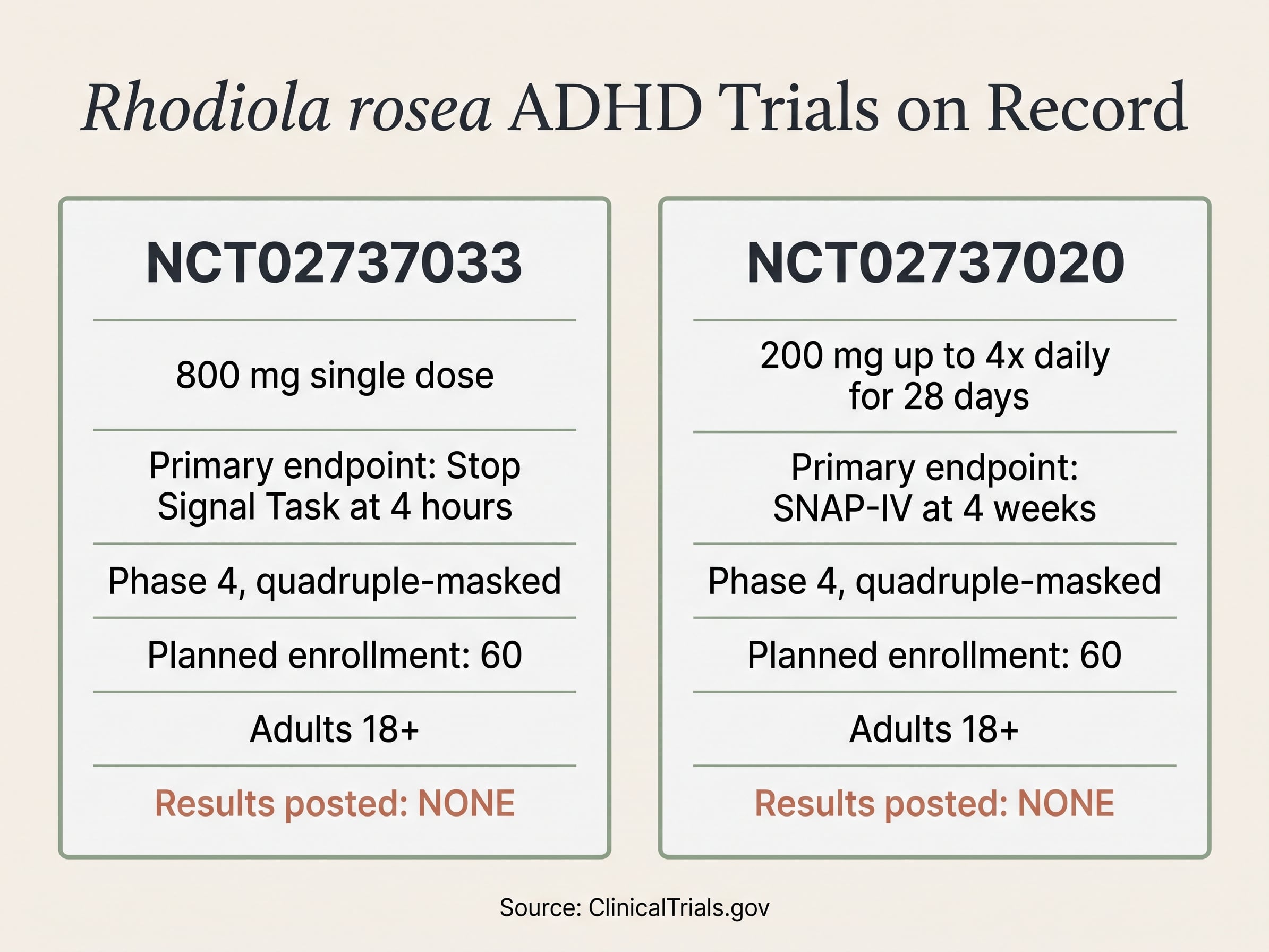
| Registry field | NCT02737033 | NCT02737020 |
|---|---|---|
| Dose design | 800 mg as a single dose | 200 mg up to four times daily for 28 days |
| Comparator | Matched placebo | Matched placebo |
| Primary endpoint | Change in Stop Signal Task, baseline to 4 hours | Change in SNAP-IV adapted for adults, baseline to 4 weeks |
| Design | Phase 4, randomized, parallel, quadruple-masked | Phase 4, randomized, parallel, quadruple-masked |
| Estimated enrollment | 60 participants | 60 participants |
| Age eligibility | 18 years and older | 18 years and older |
| Results posted | None. Status listed as unknown | None. Status listed as unknown |
| Source: ClinicalTrials.gov registry records NCT02737033 and NCT02737020, sponsor Hospital de Clínicas de Porto Alegre. Record data retrieved September 2026. | ||
Three details deserve attention. First, NCT02737033 was not a daily-dosing efficacy study. It gave 800 mg once and measured the Stop Signal Task four hours later, making it an acute pharmacological challenge examining response inhibition rather than a test of whether taking rhodiola over weeks changes daily functioning. Second, NCT02737020 was the efficacy trial. It planned 28 days of dosing measured against the Swanson, Nolan and Pelham Rating Scale (SNAP-IV) adapted for adults, with the Adult Self-Report Scale as a secondary measure, which are exactly the instruments that would answer the question this page is about. Third, both trials listed a completion date of March 2021, both used quadruple masking, and both still read as status unknown with no posted results.
What this means in practice: when a source tells you rhodiola was studied at 800 mg per day for ADHD, the registry does not support that description. One trial used 800 mg once. The other used 200 mg up to four times daily for 28 days. Neither reported an outcome.
How Rhodiola Interacts with Brain Chemistry
ADHD is closely associated with the function of dopamine and norepinephrine, two catecholamine neurotransmitters involved in regulating attention, motivation, and executive function. This is the mechanistic reason rhodiola appears in the conversation at all.
Rhodiola is classified as an adaptogen, a category defined in mid-twentieth-century Soviet pharmacology by Lazarev and later refined by Brekhman to describe substances that raise nonspecific resistance to stressors. Rather than pushing a system in one direction, an adaptogen is proposed to modulate the stress response toward baseline. The root contains two principal constituent groups: salidroside, a phenylpropanoid glycoside, and the rosavins, which include rosavin, rosarin, and rosin. Laboratory work indicates these compounds can influence monoamine activity, including dopamine, norepinephrine, and serotonin.
Worth stating plainly: mechanism is not outcome. A plausible pathway explains why researchers became interested. It does not substitute for a completed trial, and in our reading of this literature the gap between mechanistic plausibility and demonstrated clinical effect is where most confusion about rhodiola originates.
Rhodiola, Cortisol, and the Stress-Attention Link
The adaptogen framing and the attention question connect through cortisol and the hypothalamic-pituitary-adrenal axis. Sustained stress load degrades sustained attention in anyone, diagnosis or not, and this is the route through which rhodiola is most often proposed to matter for focus.
There is measured human data on this specific point. Olsson et al. (2008), Planta Medica, PMID: 19016404 tracked the salivary cortisol response to awakening in 60 adults with stress-related fatigue across 28 days and reported that pre-treatment to post-treatment cortisol responses differed significantly in the rhodiola group compared with control. The authors framed the result as an anti-fatigue effect that raised mental performance, particularly the ability to concentrate, alongside a decreased cortisol awakening response in patients experiencing burnout with fatigue syndrome.
The population matters. These were adults with stress-related fatigue, not adults with ADHD. The finding supports a stress-and-fatigue pathway. It does not transfer automatically to a neurodevelopmental condition with different underlying biology.
What the Research Has Actually Measured
Setting aside the unreported ADHD trials, four published human studies carry the most relevance to attention. We have read each one, and we present the disconfirming result alongside the supportive ones because a source that only reports findings in one direction is not a source worth trusting.
Olsson et al. (2008), Planta Medica, PMID: 19016404. A Phase III randomized, double-blind, placebo-controlled parallel-group study. Sixty adults with stress-related fatigue received the standardized SHR-5 extract at 576 mg per day or placebo across 28 days. The measurement that matters here is Conners’ Continuous Performance Test II, a standard objective attention instrument used widely in ADHD assessment. Compared with placebo, the rhodiola group showed significant differences on the CPT-II indices for omissions, Hit RT standard error, and variability. Omissions reflect inattention errors, and Hit RT standard error captures response-time variability, one of the most consistently reported objective markers in ADHD research. To our knowledge, no other page covering rhodiola and attention names this instrument or these indices, and it is the most attention-relevant human data that currently exists.
Ishaque et al. (2012), BMC Complementary and Alternative Medicine, PMID: 22643043. A systematic review that screened 206 articles and included 11 controlled trials of rhodiola for physical and mental fatigue. Three of the five randomized trials evaluating mental fatigue reported rhodiola to be effective. That is the supportive half. The other half is that every included study exhibited either a high risk of bias or reporting flaws serious enough to obscure its true validity, and the authors concluded that a rigorously designed, well-reported trial is still needed. This is the honest denominator for every rhodiola claim, including the favorable ones above.
Darbinyan et al. (2000), Phytomedicine, PMID: 11081987. A double-blind crossover study in 56 healthy physicians working night duty, using a repeated low-dose SHR-5 regimen. Mental performance was measured as a Fatigue Index derived from five tests covering associative thinking, short-term memory, calculation, concentration, and speed of audio-visual perception. A statistically significant improvement appeared in the treatment group during the first two-week period, with no side effects reported for either arm.
Cropley et al. (2015), Phytotherapy Research, PMID: 26502953. Eighty mildly anxious participants took 200 mg twice daily or served as an untreated control across 14 days. Self-reported anxiety, stress, anger, confusion, and depression all improved, and total mood improved. Cognitive performance did not. In the authors’ own words, no relevant differences in cognitive performance between the groups were observed. The trial also lacked a placebo control, which limits it further. We include it because it cuts against the simple version of the rhodiola story, and leaving it out would make this page less accurate rather than more persuasive.
Read together, these four studies point in a consistent direction. Rhodiola has repeatedly been associated with reduced fatigue and improved subjective mood under stress. Its effect on objective cognitive performance is inconsistent across trials, and none of this body of work was conducted in a diagnosed ADHD population.
How Does Rhodiola Compare With Ginseng, Ginkgo, and Bacopa for Attention?
People rarely evaluate rhodiola in isolation. The practical question is usually which botanical or nutrient has the better evidence behind it, so here is that comparison written honestly, including where the honest answer is that the trials have not been done.
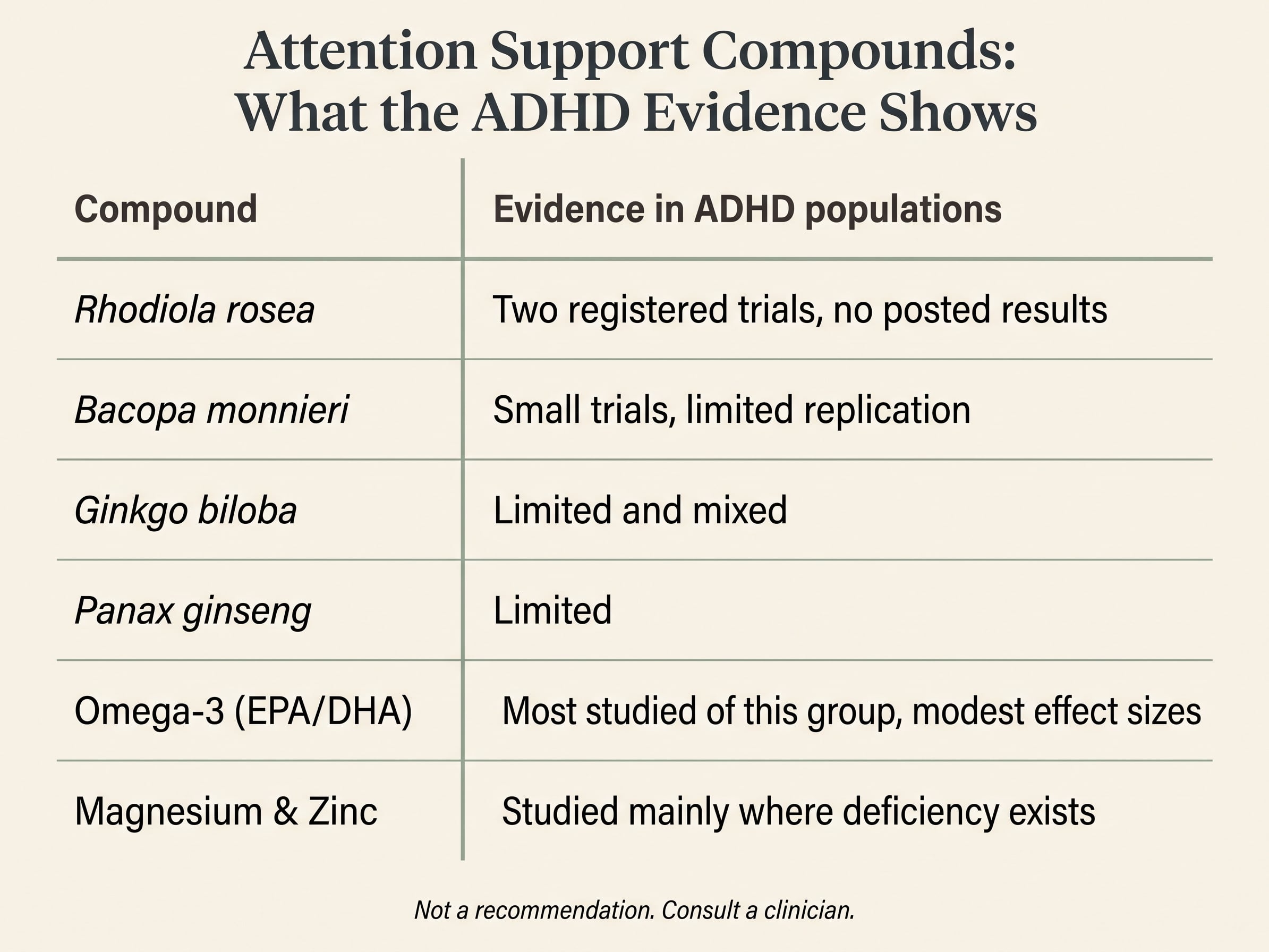
| Compound | Primarily studied for | Evidence in ADHD populations | Key caution |
|---|---|---|---|
| Rhodiola rosea | Stress-related fatigue, mental work capacity | Two registered trials, no posted results | Stimulating. Sleep disruption if taken late in the day |
| Bacopa monnieri | Memory consolidation, learning rate | Small trials exist, larger replication limited | Digestive upset common at higher intakes |
| Ginkgo biloba | Cerebral blood flow, age-related memory | Limited and mixed | Interacts with anticoagulant medication |
| Panax ginseng | Fatigue, subjective mental performance | Limited | Stimulating. Blood sugar and blood pressure effects |
| Omega-3 (EPA and DHA) | Neuronal membrane composition | The most studied of this group in ADHD, effect sizes modest | Anticoagulant interaction at high intakes |
| Magnesium and zinc | Enzymatic cofactors in neurotransmitter synthesis | Studied mainly where a deficiency exists | Excess zinc interferes with copper absorption |
| This table describes the state of published research. It is not a recommendation, and no entry should be read as a substitute for a clinician’s assessment. | |||
The pattern across the whole table is worth naming. Of the six entries, the one with the most direct trial evidence in diagnosed ADHD populations is omega-3 fatty acids, and even there the reported effect sizes are modest. No botanical in this group has a strong, replicated evidence base in ADHD specifically. Any source presenting one as clearly superior is describing marketing rather than data.
Rhodiola in the Context of Other Options
Prescription stimulant and non-stimulant medications remain the treatments with the strongest evidence for ADHD symptom control, and clinical guidance reflects that. The National Institute for Health and Care Excellence guideline NG87 recommends medication for adults when symptoms continue to cause significant impairment after environmental modifications have been tried. Structured behavioral approaches carry substantial evidence as well.
| Feature | Rhodiola rosea | Prescription stimulants |
|---|---|---|
| Mechanism | Proposed modulation of the stress response and monoamine activity | Increases dopamine and norepinephrine availability |
| Category | Herbal dietary supplement | Pharmaceutical medication |
| Regulation | Regulated as a dietary supplement | FDA-approved prescription drug |
| Evidence in ADHD | Two registered trials, no results posted | Extensive randomized trial evidence |
| Reported side effects | Insomnia, dizziness, headache, dry mouth | Appetite loss, sleep disturbance, raised heart rate |
Rhodiola sits in a different category with a different evidence standard behind it. Reading the two columns as competing options misreads what each one is.
Is Rhodiola Safe for Children With ADHD?
There is no evidence base to answer this question, and that absence should be treated as the answer.
- Both registered rhodiola ADHD trials, NCT02737033 and NCT02737020, set age eligibility at 18 years and older. Neither enrolled anyone under 18.
- No pediatric trial of Rhodiola rosea for ADHD appears in the ClinicalTrials.gov registry, which means no pediatric dosing, safety, or duration data have been generated to evaluate.
- Rhodiola has central nervous system stimulating properties, and clinicians note it can produce agitation, jitteriness, or sleep disruption. Those effects warrant particular caution in children.
- The published trials described earlier in this article enrolled adults exclusively, so none of that data extends to a pediatric population.
- Any decision involving a supplement and a child with ADHD belongs with a pediatrician or the child’s prescribing clinician, before the supplement is purchased rather than after.
We are deliberately not publishing pediatric dosing guidance in this section. No trial has established one, and supplying a number in the absence of evidence would create a false impression of certainty. Parents researching this question are better served by an accurate statement that the research does not exist than by an estimate presented as guidance.
Safe and Practical Usage Guidelines
For adults who have discussed rhodiola with a clinician and want to understand the practical considerations, several points come out of the trial literature consistently.
Timing is the one most people get wrong. Rhodiola has mildly stimulating properties, which is why trials and clinical sources place it in the morning. Taken later in the day, it is associated with difficulty sleeping, and disrupted sleep works directly against the attention outcomes anyone taking it is hoping to support.
What a Quality Standardized Extract Contains
Extract quality varies widely across the retail market, and this is where the research literature offers a practical benchmark. Trials generally use extracts standardized to a defined constituent ratio rather than raw powder of unknown composition. The conventional research standard is 3 percent rosavins and 1 percent salidroside, a ratio chosen to approximate the naturally occurring proportion in high-quality Rhodiola rosea root.
The SHR-5 extract used in the Olsson and Darbinyan trials is a specific standardized preparation, which is part of why those results are interpretable at all. In our sourcing work, species substitution is the more common problem in this category. Rhodiola crenulata is sometimes supplied in place of Rhodiola rosea, and it has a different constituent profile. That distinction is not academic. Chiu et al. (2013), BMC Complementary and Alternative Medicine, PMID: 24176010, tested Rhodiola crenulata at 800 mg in 102 participants and found no effect on its measured endpoint, a reminder that results from one species do not carry over to another. Our own rhodiola root powder is sourced from the Altai region and tested for species identity, which is the specific failure point we watch for in this botanical.
How Long Should Rhodiola Be Taken?
The published trials ran for defined and relatively short periods. Olsson ran 28 days. Cropley ran 14 days. Darbinyan used two-week treatment periods within a crossover design. The single-dose ADHD trial measured an outcome at four hours, and the 28-day ADHD trial never reported.
No trial has generated long-duration safety data in an ADHD population, so there is no evidence-based answer to how long rhodiola can be taken continuously by someone managing an ADHD diagnosis. Anyone considering extended use should be doing so under clinical supervision rather than relying on the trial literature, which does not extend that far.
Who Should Be Cautious
Several groups should avoid rhodiola or use it only under close medical supervision.
- People with bipolar disorder. Rhodiola’s stimulating properties raise a concern about triggering manic episodes, and this contraindication is noted specifically in clinical sources.
- People who are pregnant or breastfeeding.
- People with autoimmune conditions.
- People taking antidepressants, including monoamine oxidase inhibitors.
- People taking blood thinners or blood pressure medication, both of which appear in documented rhodiola interaction concerns.
- People taking prescription stimulants, where an additive effect could raise the risk of anxiety or increased heart rate.
Our editorial team treats this list as the starting point of a conversation with a prescribing clinician rather than a self-screening checklist.
Frequently Asked Questions
Is rhodiola effective for ADHD symptoms?
No completed trial has established that it changes the core symptoms of ADHD. Two trials were registered to study exactly this question in adults, and neither has posted results. The supportive human evidence that does exist was generated in people with stress-related fatigue and burnout rather than in people with an ADHD diagnosis, and the most rigorous systematic review of that literature found every included trial carried a high or unclear risk of bias.
What rhodiola dosage was used in studies?
It depends on which study. The registered ADHD trials used 800 mg as a single dose in NCT02737033 and 200 mg up to four times daily in NCT02737020. The published fatigue and mood trials used 576 mg per day of SHR-5 extract across 28 days in Olsson et al. (2008), PMID: 19016404, and 200 mg twice daily across 14 days in Cropley et al. (2015), PMID: 26502953. The widely repeated figure of 800 mg per day does not match either registry record.
Is rhodiola safe for children with ADHD?
There is no evidence base to answer this. Both registered rhodiola ADHD trials set eligibility at 18 years and older, and no pediatric trial for this use appears in the registry. Rhodiola has stimulating properties that warrant particular caution in children. Any decision involving a child should be made with a pediatrician or the child’s prescribing clinician before a supplement is purchased.
How does rhodiola compare with ginseng for ADHD?
Both have limited evidence in diagnosed ADHD populations, and neither has a strong replicated trial base for this use. Rhodiola has been studied more for stress-related fatigue and mental work capacity, while Panax ginseng has been studied more for fatigue and subjective mental performance. Both have stimulating properties, and ginseng carries additional considerations around blood sugar and blood pressure. Of the compounds commonly compared in this category, omega-3 fatty acids have the most direct ADHD trial evidence, with modest reported effect sizes.
Can rhodiola interact with ADHD medications?
It can, and this is a question for a prescriber or pharmacist rather than a search engine. Rhodiola and prescription stimulants both have stimulating properties, raising the possibility of an additive effect that increases anxiety or heart rate. Interaction concerns are also documented with antidepressants, including monoamine oxidase inhibitors, with blood thinners, and with blood pressure medication. Supplement and drug interactions are possible and should be reviewed before combining anything.
What are the negative side effects of rhodiola?
The commonly documented effects are insomnia, dizziness, headache, and dry mouth. Jitteriness and agitation are also reported. Insomnia is particularly relevant for anyone already managing ADHD-related sleep difficulty, since disrupted sleep undermines the daytime attention that people taking rhodiola are usually trying to support. Taking it in the morning rather than later in the day is the standard way this is handled.
How long does it take for rhodiola to work for focus?
Effects reported in trials were not immediate. Darbinyan et al. (2000), PMID: 11081987, found significant change during a first two-week period, and Olsson et al. (2008), PMID: 19016404, measured outcomes across 28 days. The pattern in the literature is gradual change over weeks rather than an acute effect, with the exception of the single-dose ADHD trial that measured an endpoint at four hours and never published what it found.
What is the best adaptogen for attention support?
The research does not identify one. Individual responses vary, and the trial evidence across adaptogens for objective attention measures is thin and inconsistent. Rhodiola has been studied most for fatigue and mental work capacity, ashwagandha more for stress and anxiety, and Bacopa monnieri more for memory and learning rate. Anyone told that a single adaptogen is definitively best for attention is being sold something rather than informed.
Related Reading
Continue exploring this topic with our related articles on bacopa and ADHD, herbs for clarity and focus, and the full profile of rhodiola rosea benefits, uses, and safety.
Important: This article is for educational and informational purposes. The statements have not been evaluated by the Food and Drug Administration. The herbs and herbal products discussed are not intended to diagnose, treat, cure, or prevent any disease, including Attention-Deficit/Hyperactivity Disorder. Information presented here is not a substitute for professional medical advice, diagnosis, or treatment. Always consult a qualified healthcare provider for medical guidance specific to your circumstances. Do not delay seeking medical care because of information you have read on this site.