Key Takeaways
- Valerian root is a calming botanical rather than a stimulant, and the research signal sits in restlessness and sleep rather than in attention itself.
- In a 2014 observational study of 169 primary school children, strong or very strong hyperactivity fell from 61 percent to 13 percent across seven weeks.
- Those 169 children did not meet ADHD diagnostic criteria, a detail most articles on this topic leave out entirely.
- Both pediatric studies most often cited here tested valerian combined with lemon balm, at 640 mg and 320 mg of standardized extract daily, not valerian alone.
- A 2023 systematic review of 15 herbal ADHD trials concluded that no definitive recommendation is possible from the current evidence base.
Attention-Deficit/Hyperactivity Disorder, still called ADD when hyperactivity is less prominent, sends a lot of families looking at traditional plants. Valerian root comes up constantly in that search, usually attached to a claim about focus that the underlying research does not actually make.
Our editorial team went back to the primary literature for this article rather than to the secondary coverage. What we found is that two separate pediatric trials, published eight years apart with different populations and different endpoints, get blended together across almost every page discussing this topic. Reading them separately changes the answer.
What follows is the evidence on valerian root for ADD as it actually stands, including the amounts used in the studies, how long the effects took to appear, where valerian sits against melatonin in an ADD context, and the safety questions that matter most for children.
Does Valerian Root Help ADD and ADHD?
Valerian root, from Valeriana officinalis, is a sedative botanical and not a stimulant, and it is not shown to sharpen attention directly. In the pediatric research, the measurable signal sits in restlessness, impulsiveness, and sleep. Gromball et al. (2014), Phytomedicine, PMID: 24837472, recorded strong or very strong hyperactivity falling from 61 percent of children to 13 percent across seven weeks.
That distinction matters more than it sounds. A plant that lowers nervous tension and a plant that improves executive function are two different propositions, and valerian belongs firmly in the first category. Anyone reading a headline that promises focus from a sedative herb should treat it with suspicion.
Valerian and Inattention: What the Evidence Actually Shows
Valeriana officinalis is not a cognitive enhancer and has never been characterized as one in the clinical literature. Where concentration appears to improve in the pediatric data, it travels alongside reductions in restlessness and better sleep rather than arriving as a direct effect on attention regulation.
The mechanism reasoning is straightforward. When an inability to concentrate is being driven by internal agitation or by short, broken sleep, calming the agitation and restoring the sleep can change what focus looks like the next day. That is an indirect pathway, and it only applies to the subset of people whose attention problems are actually downstream of those two things. Direct evidence that this plant alters the neurobiology of attention regulation in diagnosed ADHD does not exist.
Valerian, Hyperactivity, and Impulsiveness
The sedative properties of Valeriana officinalis line up more naturally with hyperactivity than with inattention. By lowering nervous system excitability, it may reduce restlessness and the drive toward constant movement. Impulsiveness responds less predictably, and the effect appears to be general dampening of excitability rather than a targeted change in the executive function deficits underlying ADHD-related impulsivity.
One caveat belongs here rather than buried in a safety footnote. A minority of people, and children more often than adults, respond to valerian with paradoxical excitability instead of calm. That means agitation, restlessness, or difficulty settling after taking it. We cover what to do about that in the safety section below.
Valerian, Sleep Disturbances, and ADHD
Sleep problems are extremely common alongside ADHD across every age group, children included. Trouble falling asleep, trouble staying asleep, and sleep that does not restore all worsen daytime symptoms, producing more irritability, poorer concentration, and heightened impulsivity by afternoon.
Valeriana officinalis has been studied far more extensively for insomnia than for anything related to attention, and reduced sleep latency is among its better-documented effects. Typical adult amounts studied for sleep fall between 300 mg and 600 mg of extract. If valerian improves sleep in someone with ADHD, better daytime function may follow, but that is a consequence of the sleep change rather than an effect on ADHD itself.
Valerian, Anxiety, and ADHD
Anxiety disorders co-occur with ADHD frequently, and the two amplify each other. Worry, nervousness, and physical tension all make it harder to concentrate or stay seated. Valeriana officinalis has a long-standing reputation as an anxiolytic, and reducing co-occurring anxiety can make ADHD symptoms more manageable in practice without touching the underlying condition at all.
What Does the Research Actually Say? Two Trials, Constantly Confused
This is where most coverage of valerian and ADD goes wrong. Two pediatric studies dominate the citation trail; they are frequently merged into a single vague claim about “studies on children,” and they examined different populations with different endpoints. Here they are separately.
Gromball 2014: 169 School Children Who Did Not Meet ADHD Criteria
Gromball et al. (2014), Phytomedicine 21(8-9):1098-103, PMID: 24837472, followed 169 primary school children with hyperactivity and concentration difficulties. This was an observational study run by 27 office-based pediatricians, with assessment at baseline, week two, and week seven using standardized questionnaires completed by both pediatricians and parents.
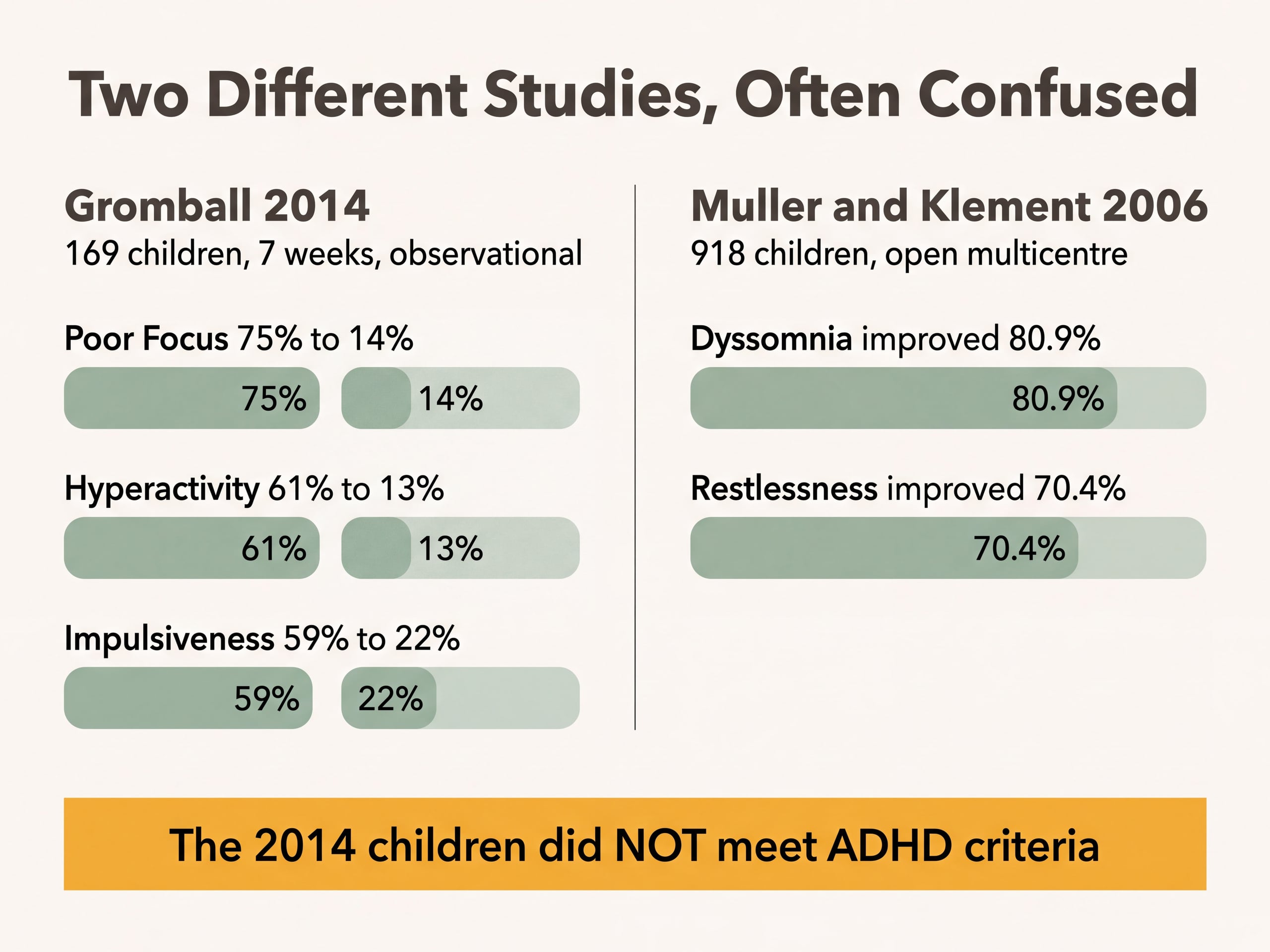
The recorded changes in the fraction of children with strong or very strong symptoms were substantial. Poor ability to focus fell from 75 percent to 14 percent. Hyperactivity fell from 61 percent to 13 percent. Impulsiveness fell from 59 percent to 22 percent. Only two children showed mild transient adverse reactions.
Now the part almost nobody reports. Those 169 children did not meet ADHD diagnostic criteria. The study population was children with subsyndromal symptoms, meaning restlessness and concentration difficulties that fell short of a clinical diagnosis. The study was also observational rather than placebo-controlled, so improvement over seven weeks cannot be separated from natural variation, parental expectation, or the attention of a regular pediatrician visit. In our reading of the secondary coverage, this qualifier is missing from essentially every consumer article citing the trial.
Muller and Klement 2006: 918 Children With Restlessness and Dyssomnia
The second study is older and larger. Muller and Klement (2006), Phytomedicine 13(6):383-7, PMID: 16487692, was an open multicentre study of 918 children under 12 with restlessness and dyssomnia, dosed individually by the investigators.
Dyssomnia improved in 80.9 percent of patients and restlessness improved clearly in 70.4 percent. Tolerability was rated good or very good in 96.7 percent of cases, with no study-medication-related adverse events reported. The endpoints here were sleep and restlessness. Attention was not the subject of the study, and this trial says nothing about focus, concentration, or ADHD.
Both trials tested a fixed combination of valerian root and lemon balm, Melissa officinalis. Neither tested valerian on its own. Any claim that valerian alone produced these numbers is not supported by either paper.
What the 2023 Systematic Review Concluded
Golsorkhi et al. (2023), Avicenna Journal of Phytomedicine 13(4):338-353, PMID: 37663386 reviewed the herbal medicine evidence for pediatric ADHD across international databases. Fifteen studies met the inclusion criteria. The authors concluded that while several herbal preparations appear relatively safe and show potential, the shortage of adequate randomized controlled trials means no definitive recommendations can be made.
That is the honest ceiling on this entire subject, and it applies to valerian as much as to anything else in the category.
Remaining Gaps in Valerian and ADHD Research
The central gap is the absence of well-designed, placebo-controlled trials in diagnosed ADHD populations. Useful future work would need to:
- Use standardized Valeriana officinalis extracts with disclosed valerenic acid content
- Recruit participants who meet current ADHD diagnostic criteria rather than subsyndromal populations
- Employ validated ADHD assessment tools
- Separate valerian from lemon balm so the contribution of each is measurable
- Measure core symptoms alongside emotional regulation and executive function
- Include placebo control and, ideally, comparison against established treatments
- Evaluate long-duration safety in children
What Dose of Valerian Root Was Used in the Children’s Studies?
The 2014 study used a recommended daily amount of 640 mg of valerian root extract WS 1014 combined with 320 mg of lemon balm extract WS 1303. These were specific standardized pharmaceutical extracts, not generic powdered root, and the amounts refer to extract weight rather than raw herb weight.
The 640 mg and 320 mg Combination Used in the 2014 Study
Those two numbers are the most concrete data points available on this topic, which is exactly why they are worth stating precisely. The 2006 study dosed children individually at investigator discretion and did not publish a fixed protocol amount, so it offers no comparable figure.
Neither number is a recommendation. They describe what was administered to a specific pediatric population, under pediatrician supervision, using named proprietary extracts that most retail products do not contain.
Why Extract Standardization Changes What a Milligram Means
A milligram of standardized extract and a milligram of powdered root are not interchangeable, and this is where most dosing confusion on herbal forums originates. Extracts concentrate constituents at ratios that vary by manufacturer and by extraction solvent. A 640 mg figure attached to WS 1014 carries meaning only in reference to that preparation.
From our hands-on assessment of the retail category, products standardized to a stated valerenic acid percentage are the minority, and batch-to-batch variation within a single brand is common. Comparing your bottle to a study number without knowing both extraction ratios is guesswork.
Why We Do Not Publish a Children’s Dose
Pediatric amounts for Valeriana officinalis are not well established in the general literature, and children are not scaled-down adults where sedative botanicals are concerned. The American Academy of Pediatrics advises caution with herbal supplements in children generally, citing thin research and inconsistent product regulation.
Anyone considering this for a child needs a pediatrician or a clinician trained in pediatric herbal medicine involved from the start. That is not a liability sentence. It reflects that the paradoxical excitability risk is higher in children and that interactions with ADHD medication are genuinely unpredictable.

Valerian and the Stimulant Rebound Window
Stimulant rebound is the return of restlessness, irritability, and emotional reactivity as an ADHD medication clears, usually in the late afternoon or early evening. Valerian root is discussed for this window because it is sedating rather than activating. No controlled trial has tested Valeriana officinalis specifically against rebound symptoms, so this remains a clinical observation rather than an evidence-based use.
What the Late-Afternoon Rebound Window Is
Rebound is not the same as the original symptoms returning to baseline. It describes a period where symptoms can present more intensely than they did before the medication was started, as blood levels fall. Families often describe it as the hardest 90 minutes of the day. It is a well-recognized pattern among prescribers and a common reason people go looking for something calming for the evening.
Why the Evening Rather Than the School Day
Any daytime use of a sedative botanical works against the goal. Valerian’s own side effect profile includes drowsiness and grogginess, which is the opposite of what a school day or a work day requires. The evening framing exists because that is the only window where sedation is not counterproductive.
Why Timing Near a Stimulant Dose Is a Prescriber Conversation
Layering a sedative herb onto a stimulant regimen is not a neutral act. It can mask the wearing-off signal a prescriber uses to judge whether the medication timing is right, and it can complicate the assessment of whether a dose adjustment is needed. Anyone considering valerian in this window should raise it with the prescribing clinician before starting rather than after.

How Long Does Valerian Root Take to Work?
Valerian root does not produce a same-day effect on attention the way a stimulant does. Sedative effects from a single dose are generally reported within one to two hours. In Gromball et al. (2014), PMID: 24837472, children were assessed at two weeks and at seven weeks, and the larger recorded changes appeared at the seven-week mark rather than the two-week mark.
Single-Dose Response Versus Cumulative Response
These are two different questions that get asked as one. A single evening dose may produce noticeable drowsiness within a couple of hours. A change in baseline restlessness across weeks is a separate phenomenon and appears to build gradually. The sleep literature on valerian describes a similar pattern, with benefits accumulating over two to four weeks of consistent use rather than arriving immediately.
The Two-Week and Seven-Week Assessment Points
The 2014 study’s measurement schedule is informative on its own. Assessing at baseline, week two, and week seven implies the investigators expected a gradual trajectory, and the results were consistent with that expectation. Anyone evaluating this over three days is working on the wrong timescale.
What It Means When the First Night Changes Nothing
A single night without an obvious effect is not evidence of anything. It could reflect the cumulative-response pattern above, an extract with low or unlisted valerenic acid content, or simply a non-response, which is common with this plant. What it should not trigger is escalating the amount, which raises the odds of grogginess and paradoxical reactions without a corresponding benefit.
Valerian Root vs Melatonin for ADD-Related Sleep Problems
These two get compared constantly in the ADD context because both are reached for when a child or adult with attention difficulties cannot settle at night. They work differently, and the pediatric evidence behind them covers different ground.
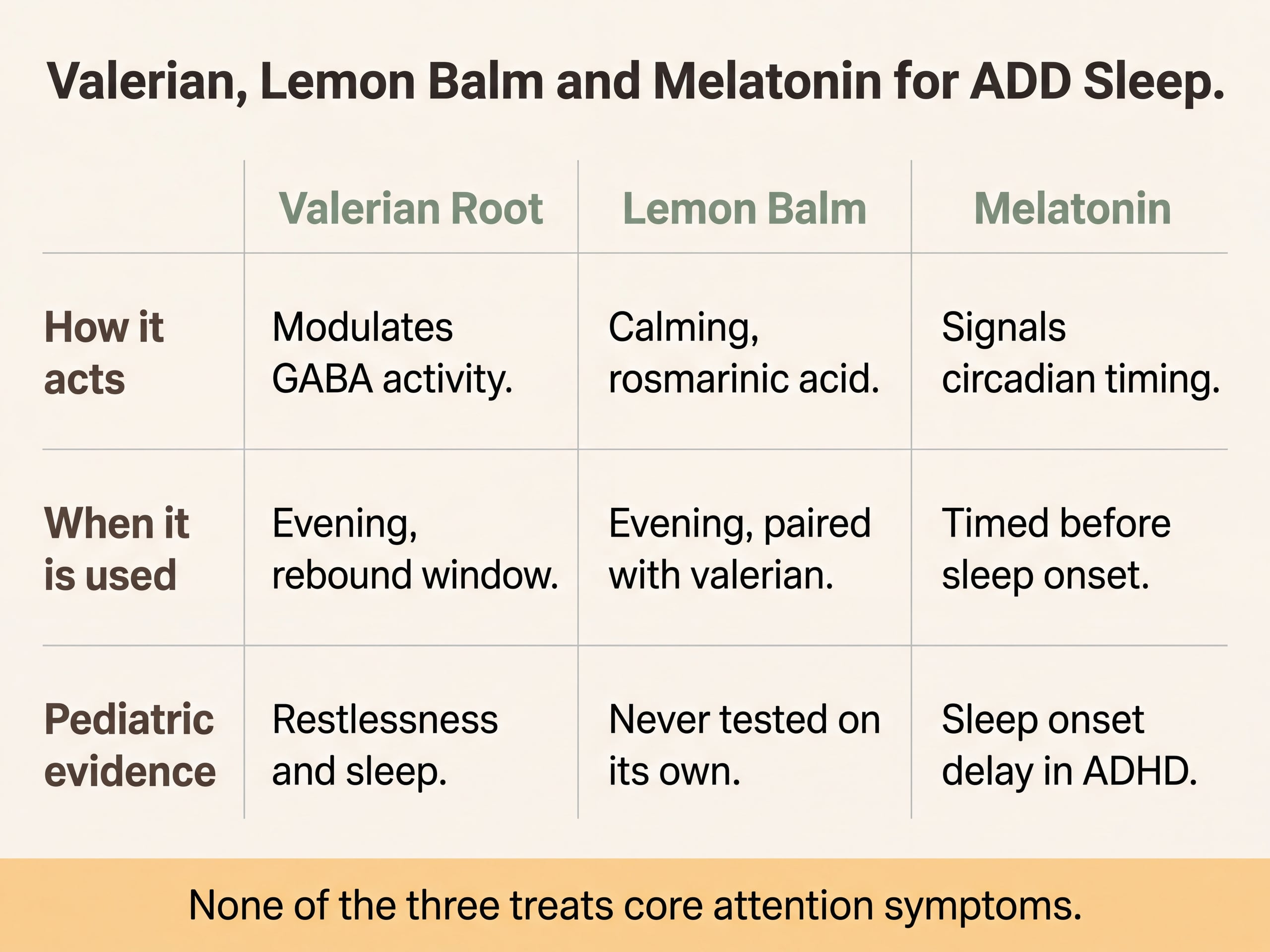
| What it is | How it is understood to act | Timing discussed in the ADD context | What the pediatric evidence covers | Key caution |
|---|---|---|---|---|
| Valerian root, Valeriana officinalis | Modulates GABAergic activity, mainly via valerenic acid at the GABA-A receptor | Evening, including the post-stimulant rebound window | Restlessness, hyperactivity, impulsiveness, and sleep, always tested in combination with lemon balm | Paradoxical excitability, more frequently reported in children |
| Lemon balm, Melissa officinalis | Calming activity attributed to rosmarinic acid and related constituents | Evening, as the paired component in both cited trials | Never isolated from valerian in either pediatric study, so its independent contribution is unmeasured | Its separate effect cannot be determined from the combination data |
| Melatonin | A hormone that signals circadian timing rather than a sedative | Timed to circadian phase, typically well before intended sleep onset | Studied specifically for sleep-onset delay in children with ADHD, a different endpoint than restlessness | A hormone rather than a botanical, and pediatric use belongs with a clinician |
| Sources: Gromball et al. (2014), PMID: 24837472. Muller and Klement (2006), PMID: 16487692. NIH Office of Dietary Supplements valerian fact sheet. | ||||
The practical distinction is that melatonin addresses when the body thinks it should sleep, while valerian addresses how activated the nervous system is. Someone whose child lies in bed calm but wide awake at 11 p.m. has a different problem than someone whose child cannot stop moving at 8 p.m. Those two problems point to different tools.
Valerian, GABA, and Other Calming Botanicals for Focus
The GABA Connection: Valerenic Acid and Neurotransmitters
Valerenic acid, a compound unique to Valeriana officinalis, appears to act on the GABA-A receptor, the same receptor family targeted by benzodiazepine drugs, though with a considerably milder effect. GABA, gamma-aminobutyric acid, is the central nervous system’s primary inhibitory neurotransmitter, and raising its activity lowers neuronal excitability.
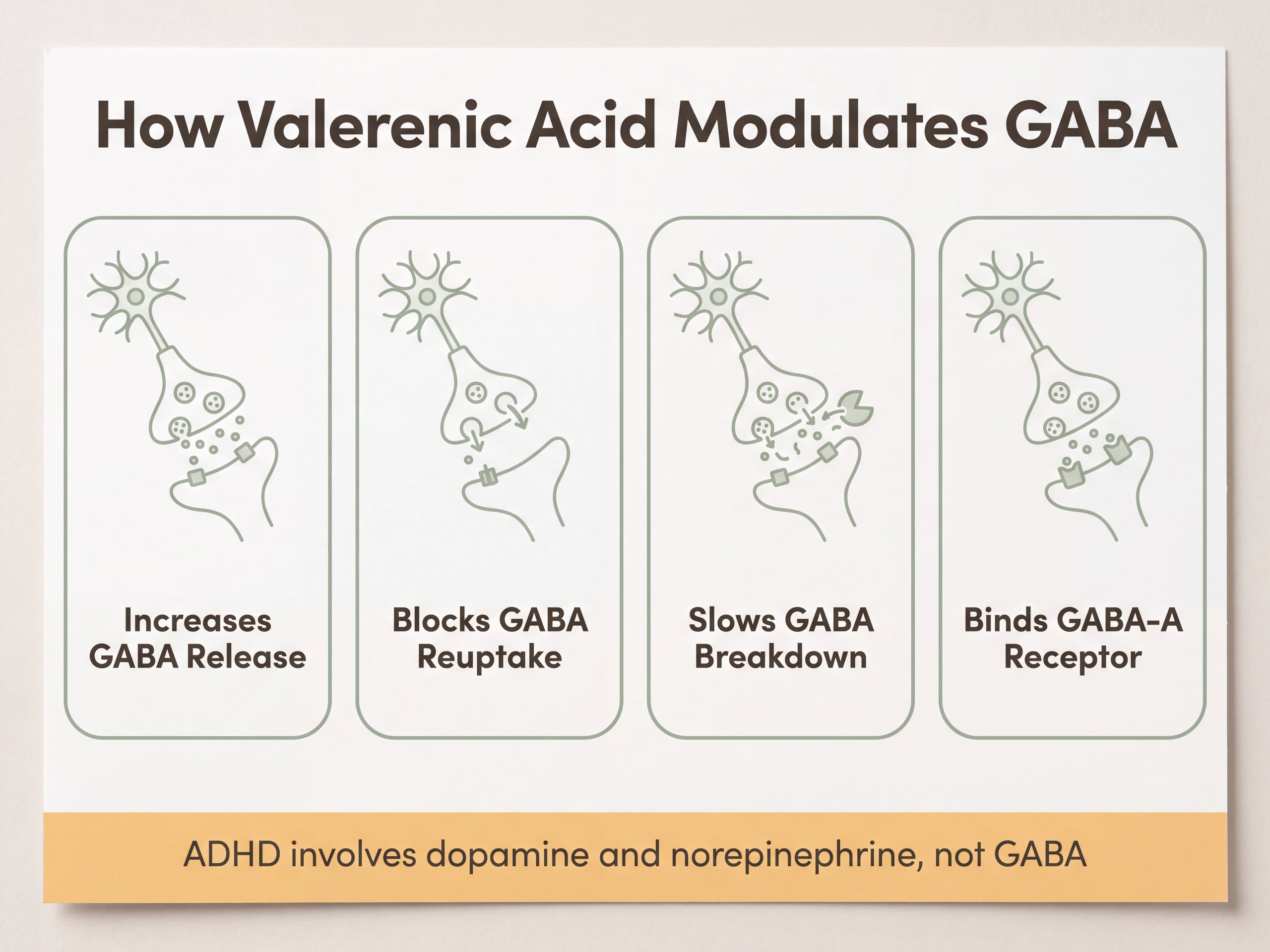
The proposed actions of valerian constituents include increasing GABA release from nerve endings, inhibiting GABA reuptake, inhibiting the enzyme that breaks GABA down, and binding directly at GABA-A receptors. Valepotriates were once considered the primary actives but are unstable and frequently absent from commercial products. Flavonoids including hesperidin and linarin may contribute additional calming activity.
How this maps onto ADHD is the unresolved part. ADHD involves dysregulation of dopamine and norepinephrine signaling, not GABA, so reducing general neural excitability is not the same as correcting the systems implicated in the condition.
Why Oral GABA and Valerian Are Not the Same Proposition
This question comes up often enough to deserve a direct answer. Taking GABA as a supplement and taking a plant that modulates GABA signaling are mechanistically different things. Oral GABA faces a well-documented problem crossing the blood-brain barrier in meaningful quantities, which is why its central effects remain debated. Valerian does not supply GABA. It appears to change how the existing GABA system behaves, which sidesteps the absorption question entirely.
Where Lemon Balm, Passionflower, and Chamomile Sit in the Evidence
Lemon balm, Melissa officinalis, has the strongest claim of the three in this specific context, purely because it was the paired component in both pediatric trials. Its independent contribution has never been isolated.
Passionflower, Passiflora incarnata, has been examined for anxiety and restlessness in the general literature but is not part of the valerian pediatric dataset. It is the calming botanical we stock as a single-herb preparation, our passion flower powder, sourced and third-party tested to the same standard as the rest of our catalog. We do not carry valerian root or lemon balm, and we are not going to pretend otherwise in an article about valerian.
Chamomile, Matricaria chamomilla, sits in traditional use territory with limited controlled pediatric data. Worth noting that chamomile, hops, and lemon balm all carry the same additive sedation caution as valerian when combined with it.
Other Biological Pathways
Beyond GABA, several mechanisms may contribute. Some valerian constituents interact with serotonin receptors involved in mood and sleep regulation. Adenosine pathways, which promote sleep pressure, may also be influenced. Reduced cortisol has been proposed as a downstream effect of lowered stress, though this is less directly evidenced. These remain active areas of investigation rather than settled findings.
What Is the Downside of Valerian Root?
The honest downside list has four items: it makes you drowsy when you may not want to be, a minority of people react paradoxically, it interacts with a long list of central nervous system substances, and product quality is inconsistent across the retail category.
Common Side Effects and Tolerability
Valeriana officinalis is generally well tolerated in adults at studied amounts. Reported side effects are usually mild and include headache, dizziness or lightheadedness, upset stomach, nausea or diarrhea, dry mouth, vivid dreams, and morning drowsiness or grogginess, which is more likely at higher amounts and can impair driving or operating machinery.
The pediatric tolerability figures from the two cited trials are the reassuring part of this picture. Only two of 169 children in the 2014 study had mild transient adverse reactions, and tolerability was rated good or very good in 96.7 percent of the 918 children in the 2006 study, with no study-medication-related adverse events. Short-duration tolerability in those supervised settings was good.
Paradoxical Excitability
A minority of people respond to valerian with the opposite of sedation. This presents as agitation, restlessness, increased excitability, or difficulty settling, and it is reported more often in children than in adults. It is also more likely with prolonged use or higher amounts.
What to do about it is simple. If the response to a calming herb is agitation, that is a signal to stop rather than a signal to adjust the amount. In an ADD context specifically, paradoxical excitability can be misread as worsening symptoms rather than as a reaction to the supplement, which is a good reason to introduce anything new one variable at a time.
Is Valerian Root Okay to Take Every Night?
Long-duration safety data for Valeriana officinalis is limited, and that limitation is the honest answer to this question. Most clinical studies have run for weeks rather than months or years, so nightly indefinite use sits outside what has been formally evaluated. The NIH Office of Dietary Supplements notes this gap in its valerian fact sheet.
Two practical considerations follow. Paradoxical reactions appear more frequently with prolonged use, and continuous use of any sleep aid can obscure an underlying sleep problem that deserves direct attention. Nightly long-term use is a decision to make with a clinician rather than by default.
Valerian Root and Cardiovascular Concerns
Searches connecting valerian root to heart problems circulate widely, so it is worth addressing directly. Valerian is not established as a cardiotoxic herb, and the NIH Office of Dietary Supplements does not list cardiac events among its recognized adverse effects. Reported side effects center on the central nervous system and the digestive tract.
The legitimate cardiovascular-adjacent considerations are narrower. Valerian may increase the effects of anesthesia, and discontinuing it at least two weeks before scheduled surgery is generally advised. Anyone taking cardiac medication should treat valerian the same as any other supplement and disclose it to their prescriber, because the concern is interaction rather than any direct effect on the heart.
Specific Precautions for Children
Use in children warrants particular caution beyond what applies to adults. Professional guidance should come first, and valerian should not be given to a child without a pediatrician or a qualified pediatric herbal clinician involved. Amounts for children are not well established outside the specific extracts used in the published trials. Children appear more susceptible to paradoxical excitability. A proper ADHD assessment should also come before any supplement decision, because attention difficulties have a long differential that includes sleep disorders, anxiety, and hearing or vision problems.
Interactions With ADHD Medications, Supplements, and Other Substances
This is the most clinically important section of the article. Valeriana officinalis is sedating and interacts with a wide range of substances acting on the central nervous system.
- Stimulant ADHD medications such as methylphenidate and amphetamine formulations. Direct interactions are not extensively documented, but combining a sedative herb with a stimulant can produce unpredictable effects and can mask the effectiveness or side effect profile of the medication.
- Non-stimulant ADHD medications such as atomoxetine, particularly where the medication carries its own sedative properties.
- Other sedatives and CNS depressants including alcohol, benzodiazepines, barbiturates, prescription sleep medications, and sedating herbs such as hops, chamomile, lemon balm, and kava. These combinations potentiate drowsiness.
- Other supplements, most relevantly melatonin and other sleep-directed products. Stacking multiple calming agents is a common and under-recognized route to excessive next-day grogginess.
- Antidepressants, particularly those with sedative effects.
- Anesthesia. Discontinue at least two weeks before scheduled surgery.
Tell your doctor and your pharmacist about every medication, supplement, and herb in use. Pharmacists in particular are underused for exactly this question.
Quality and Standardization
Active compound concentration varies widely between products and between batches from the same manufacturer. Dietary supplements are not reviewed by the FDA before sale the way prescription drugs are. Where possible, choose products standardized to a stated valerenic acid percentage, produced under Good Manufacturing Practice conditions, and third-party tested by an organization such as USP or NSF International. In our sourcing experience, the willingness of a supplier to share batch-level testing documentation is the single most reliable quality signal in this category.
Using Valerian Responsibly Alongside ADHD Care
Complementary, Not Primary
Current evidence does not support Valeriana officinalis as a standalone or primary approach to the core symptoms of ADHD. Where it is used at all, it belongs as a supporting measure aimed at associated sleep difficulty or anxiety, under clinical guidance, and never as a replacement for established care.
Who to Consult
Before starting valerian or any herbal supplement, particularly for a child or alongside existing medication, speak with a primary care doctor or pediatrician, a psychiatrist or neurologist specializing in ADHD, or a qualified naturopathic doctor or clinical herbalist able to advise on interactions. Any of the three can assess suitability and monitor for effects.
Integrating Into a Full Management Plan
ADHD care works best as a combination of behavioral strategies, educational or occupational support, lifestyle adjustments covering sleep hygiene, exercise, and diet, and medication where indicated. A calming botanical is a small optional component within that structure rather than a substitute for any part of it.
Frequently Asked Questions
Does valerian root help ADHD symptoms or just sleep?
The pediatric evidence points primarily at restlessness, hyperactivity, impulsiveness, and sleep rather than at attention. Gromball et al. (2014), PMID: 24837472, recorded improvements across all four, but in children who did not meet ADHD diagnostic criteria and using a valerian and lemon balm combination. Valerian is not shown to improve concentration directly.
What is the right valerian root dosage for ADD?
No established ADD-specific amount exists. The 2014 pediatric study used 640 mg of valerian root extract WS 1014 with 320 mg of lemon balm extract WS 1303 daily, which describes a study protocol rather than a recommendation. Adult sleep studies commonly use 300 mg to 600 mg of extract. Amounts for children require clinical supervision.
Is valerian root safe for children with ADD?
Short-duration tolerability in the two published pediatric trials was good, with only two mild transient reactions among 169 children in 2014 and 96.7 percent good or very good tolerability among 918 children in 2006. That said, pediatric amounts are not well established; children appear more prone to paradoxical excitability, and the American Academy of Pediatrics advises caution with herbal supplements in children. Involve a pediatrician first.
How does valerian root compare with melatonin for ADD?
Melatonin signals circadian timing while valerian lowers nervous system activation, so they address different problems. Melatonin has been studied specifically for sleep-onset delay in children with ADHD. Valerian, always paired with lemon balm in the pediatric data, was studied for restlessness and sleep quality. Neither is a treatment for core ADHD symptoms.
How long does valerian root take to work?
Sedative effects from a single dose are typically reported within one to two hours. Changes in baseline restlessness appear cumulative, and in the 2014 study the larger recorded improvements appeared at seven weeks rather than at the two-week assessment. A few days is not a fair trial period.
Which is better, GABA or valerian root?
They are not equivalent options. Oral GABA supplements face a well-documented difficulty crossing the blood-brain barrier in meaningful amounts. Valerian does not supply GABA at all. Its constituents, chiefly valerenic acid, appear to modulate the activity of the GABA system already present, which is a different mechanism rather than a stronger version of the same one.
Is valerian root okay to take every night?
Long-duration safety data is limited, since most studies have run for weeks rather than months. Paradoxical reactions appear more often with prolonged use, and continuous use of any sleep aid can mask an underlying sleep problem. Ongoing nightly use is a conversation to have with a clinician.
Can valerian root cause heart problems?
Valerian is not established as a cardiotoxic herb, and the NIH Office of Dietary Supplements does not list cardiac events among its recognized adverse effects. Reported side effects center on the central nervous system and digestive tract. The real considerations are that valerian may increase the effects of anesthesia, warranting discontinuation two weeks before surgery, and that anyone on cardiac medication should disclose supplement use to their prescriber.
Related Reading
Continue with our articles on ashwagandha for ADD, rhodiola and ADHD, bacopa and ADHD, and herbs for clarity and focus.
Important: This article is for educational and informational purposes. The statements have not been evaluated by the Food and Drug Administration. The herbs and herbal products discussed are not intended to diagnose, treat, cure, or prevent any disease, including ADHD or attention deficit disorder. Information presented here is not a substitute for professional medical advice, diagnosis, or treatment. Always consult a qualified healthcare provider for medical guidance specific to your circumstances. Do not delay seeking medical care because of information you have read on this site.