Key Takeaways
- Human trials do not show that Tribulus terrestris raises testosterone in healthy men, and a 2025 meta-analysis of eight randomized trials found no significant difference in total testosterone against placebo.
- The same 2025 meta-analysis did find a significant improvement in erectile function scores, which points to a pathway other than hormone elevation.
- Clinical trials have used daily doses from 450 mg to 1,500 mg of extract, and the milligram figure means little without the saponin standardization behind it.
- In a 5-week trial in elite athletes, tribulus did not change the urinary testosterone to epitestosterone ratio used in anti-doping screening.
- Findings differ by population. One randomized trial in premenopausal women reported increases in free and bioavailable testosterone that male trials have not reproduced.
Tribulus terrestris has been sold as a testosterone booster for roughly three decades, and the marketing has aged far better than the evidence has. Our editorial team reviewed the human clinical literature on this plant, and the pattern that emerges is narrower and more interesting than either the sales copy or the debunking articles suggest.
This article covers what the controlled human trials actually measured, the doses those trials used, why the milligram number on a label is close to meaningless on its own, how tribulus compares with the other herbs sold for the same purpose, and where the safety and product quality questions sit. Every claim below carries its primary citation.
What Is Tribulus Terrestris?
Tribulus terrestris is a low-growing annual in the Zygophyllaceae family, recognizable by its pinnate leaves and hard, spined fruit. It appears in Ayurveda under the name gokshura and in Traditional Chinese Medicine as bai ji li, where the historical applications centered on urinary function and general vitality rather than on hormones as modern chemistry understands them.
The plant’s pharmacology is attributed primarily to a group of steroidal saponins, of which protodioscin is the most studied. The word “steroidal” in that phrase describes molecular architecture, not activity. These compounds share a carbon skeleton with steroid hormones without behaving like them in the body, and that distinction is the source of most of the confusion surrounding this herb.
Different plant parts carry different saponin concentrations. Fruit, aerial parts, and root are not interchangeable raw materials, and in our sourcing experience, the plant part is one of the most commonly omitted details on a tribulus label.
Does Tribulus Terrestris Increase Testosterone?
No. Human clinical trials do not support the claim that Tribulus terrestris raises testosterone in healthy men. A 2025 systematic review and meta-analysis of eight randomized trials found no significant difference in total testosterone between tribulus and placebo, while the same analysis reported a significant improvement of 3.23 points on the IIEF-5 erectile function score, 95% confidence interval 1.89 to 4.58 (Suharyani et al. 2025, International Journal of Impotence Research, PMID: 40360723). The effect is real. The mechanism is not hormonal.
How Was Tribulus Supposed to Raise Testosterone?
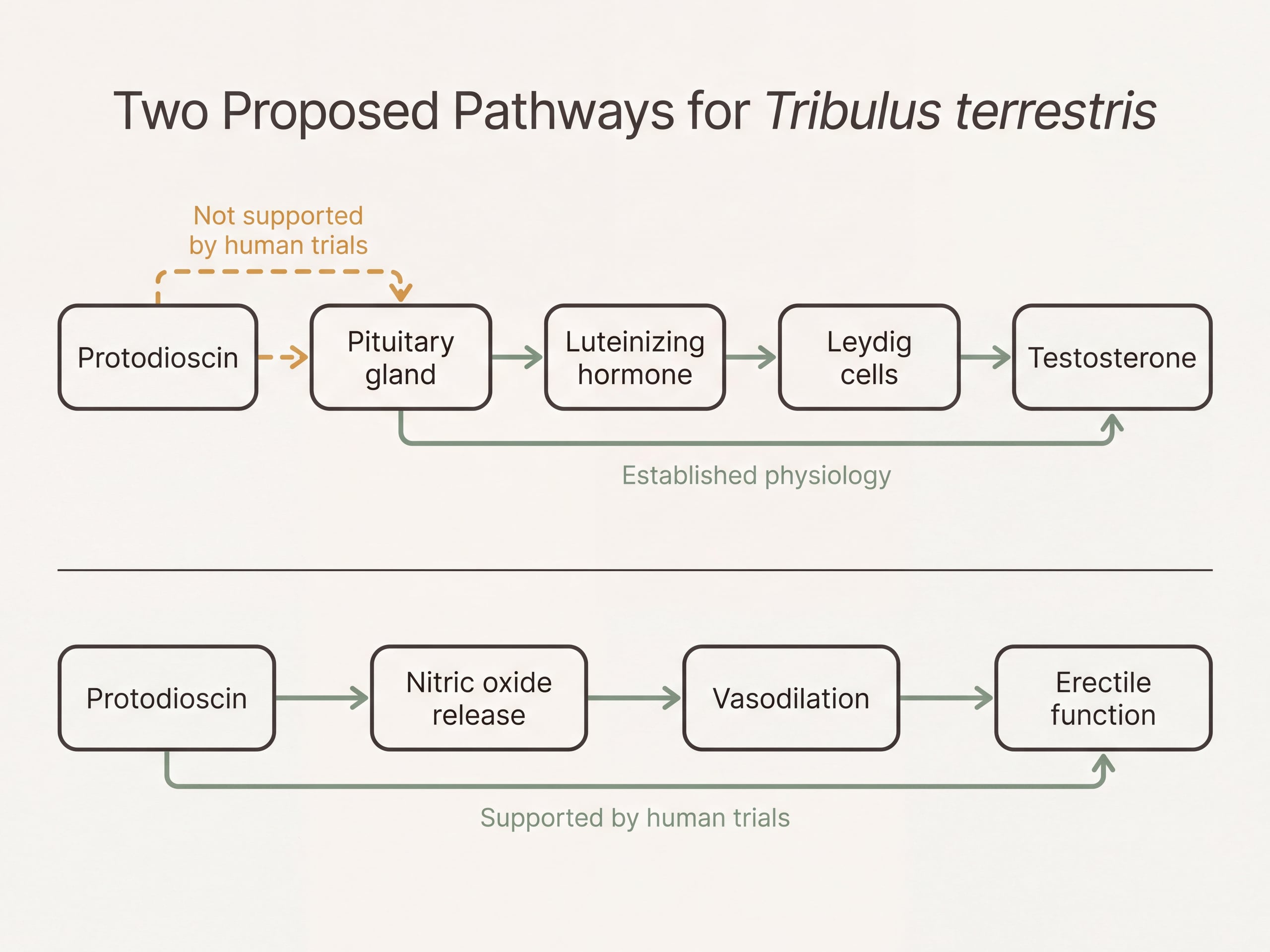
The original hypothesis ran through luteinizing hormone. LH is released by the pituitary gland and signals the Leydig cells of the testes to produce testosterone. Protodioscin was proposed to increase LH release, which would in turn raise testosterone downstream. It is a clean mechanism on paper, and human data has not supported it. A systematic review of eleven studies concluded that tribulus is ineffective for increasing testosterone in humans and that marketing claims to the contrary are unsubstantiated (Qureshi, Naughton and Petroczi 2014, Journal of Dietary Supplements, PMID: 24559105).
That same review proposed the alternative that has held up better. The authors suggested nitric oxide release as a plausible explanation for the physiological responses observed with tribulus, independent of testosterone. Nitric oxide drives vasodilation, which is the same pathway that pharmaceutical erectile function drugs act on from a different direction. A secondary hypothesis involving neurosteroid signalling in the central nervous system remains under investigation and is not settled.
What Do Human Clinical Trials Show?
Well-controlled trials in healthy and active men consistently report no meaningful testosterone difference against placebo. In a randomized trial of 30 male CrossFit athletes taking 770 mg daily for six weeks, tribulus produced no improvement in body mass, fat mass, or performance across five standard workouts (Fernandez-Lazaro et al. 2021, Nutrients, PMID: 34836225).
The picture is not uniformly negative across every population, and that nuance is worth stating plainly rather than flattening. Trials in older men have used tribulus inside multi-ingredient formulas, where attribution to tribulus alone is not possible. In one such study, 70 men averaging 67 years old received a compound containing 396 mg of tribulus alongside Ecklonia bicyclis and glucosamine, and serum total testosterone rose from 230 to 671 ng/dl over two months (Iacono et al. 2012, BMC Surgery, PMID: 23173697). A combination product cannot tell you what the tribulus did. It can tell you that a blanket negative overstates the case for every population and every formulation.
Why Did Animal Studies Create Confusion?
Early enthusiasm came from rodent and primate work. Several animal studies reported increases in androgen receptor expression or in sexual behavior after tribulus administration. Those results have not been reproduced in human trials. Differences in absorption, hepatic metabolism, and endocrine regulation between species mean an effect in a rat model frequently does not carry across to people, and tribulus is a clear example of that gap.
Does Tribulus Affect Testosterone Differently in Women?
The female data diverges from the male data, which is the strongest argument against stating the negative as universal. In a randomized double-blind placebo-controlled trial of 40 premenopausal women with hypoactive sexual desire disorder, participants receiving tribulus showed increases in free testosterone, p equals 0.046, and bioavailable testosterone, p less than 0.048, alongside improvements across every Female Sexual Function Index domain (Vale et al. 2017, Gynecological Endocrinology, PMID: 29172782). Our full treatment of the female evidence, including fertility research and dosing, sits in our dedicated guide to Tribulus terrestris and women’s health.
How Much Tribulus Terrestris Do Studies Actually Use?
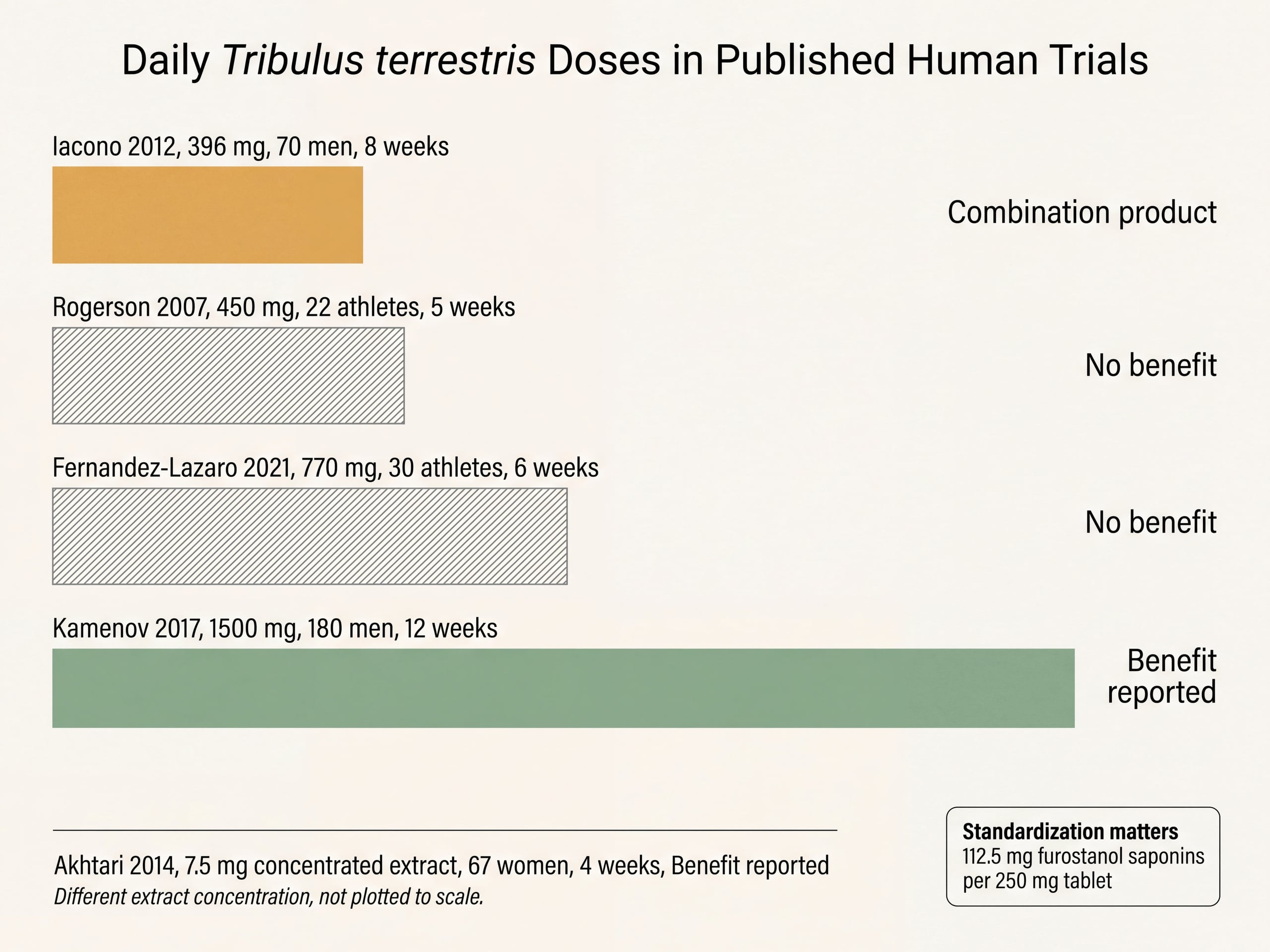
Clinical trials of Tribulus terrestris have used daily doses between 450 mg and 1,500 mg of extract, most often divided across two or three servings taken with food. That range is where nearly every published protocol falls, but the milligram figure alone does not describe the dose. What determines potency is the saponin content behind those milligrams, and most sources that quote a dose range never mention it.
What Doses Have Clinical Trials Tested?
| Trial | Population | Daily dose | Duration | Reported outcome |
|---|---|---|---|---|
| Kamenov 2017 (PMID: 28364864) | 180 men, mild to moderate erectile dysfunction | 1,500 mg (250 mg x 6 tablets) | 12 weeks | IIEF improved 2.70 points over placebo, 95% CI 1.40 to 4.01 |
| Fernandez-Lazaro 2021 (PMID: 34836225) | 30 male CrossFit athletes | 770 mg | 6 weeks | No change in body composition or performance |
| Rogerson 2007 (PMID: 17530942) | 22 elite rugby league players | 450 mg | 5 weeks | No strength or fat-free mass gain over placebo |
| Akhtari 2014 (PMID: 24773615) | 67 women, low sexual desire | 7.5 mg concentrated extract | 4 weeks | FSFI total score improved, p less than 0.001 |
| Iacono 2012 (PMID: 23173697) | 70 men, average age 67 | 396 mg within a combination formula | 8 weeks | Total testosterone rose; attribution to tribulus alone not possible |
| Source: PubMed-indexed randomized controlled trials, compiled by the Back To Your Roots Herbs Editorial Team, August 2026. | ||||
The spread in that table is the point. A 7.5 mg concentrated extract and a 1,500 mg tablet protocol are both defensible published doses, because they are not measuring the same material.
Why Milligrams Alone Do Not Tell You the Dose
The most rigorously specified protocol in the human literature is worth examining closely. The Kamenov trial used Tribestan, a Bulgarian preparation from Sopharma, dosed as 250 mg tablets standardized to not less than 112.5 mg furostanol saponins per tablet, taken as two tablets three times daily after meals for twelve weeks (PMID: 28364864). That standardization figure, roughly 45 percent saponins by weight, is what makes the dose reproducible.
Compare that with an unstandardized product. A 1,000 mg capsule of ground tribulus fruit might carry 3 percent saponins, or 20 percent, or an amount nobody measured. Two products with identical milligram claims can differ by an order of magnitude in the compounds that matter. From our hands-on assessment of this category, saponin standardization is disclosed on a minority of tribulus labels, which makes most published dose ranges impossible to apply accurately to a given bottle.
Quick reference for reading a label:
- Extract ratio or standardization percentage. Look for a stated saponin or protodioscin percentage. Without one, the milligram figure is not comparable to trial doses.
- Plant part. Fruit, aerial parts, and root carry different saponin profiles and are not interchangeable.
- Divided dosing. Trial protocols almost universally split the daily amount across two or three servings taken with food rather than as a single dose.
- Study duration. Published protocols ran four to twelve weeks. Effects were measured on that timescale, not in days.
Does Powder or Capsule Form Change the Dose?
Form affects dosing accuracy more than it affects absorption. Capsules deliver a fixed, repeatable amount, which is why every clinical protocol above used a tablet or capsule. Bulk powder allows dose adjustment and blending into other preparations but depends on the user weighing accurately, and volumetric measurement by spoon introduces meaningful variance. Neither form has been shown superior for uptake in a head-to-head human trial. We carry Tribulus terrestris in both capsule and powder form, and the choice between them is a practical one about dosing precision rather than a pharmacological one.
How Does Tribulus Compare to Other Herbs Marketed for Testosterone?
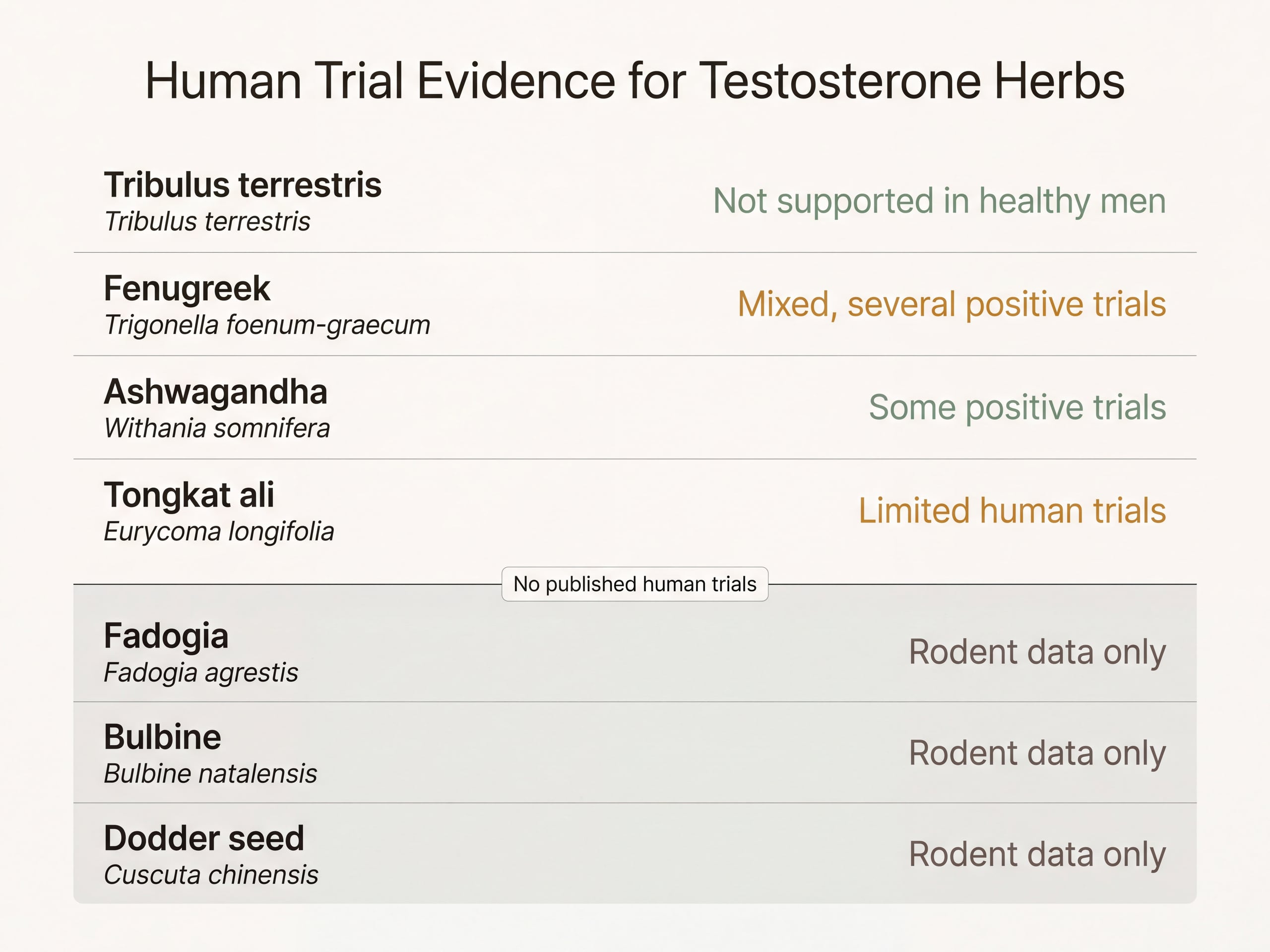
Tribulus is one entry in a crowded category, and the herbs sold alongside it have very different evidence profiles. The comparison below is a rough summary. Each herb has its own dedicated review with the full evidence base.
| Herb | Human evidence for raising testosterone | Typical studied dose | Summary |
|---|---|---|---|
| Tribulus terrestris | Not supported in healthy men | 450 to 1,500 mg | Sexual function signal without hormonal change |
| Fenugreek (Trigonella foenum-graecum) | Mixed, several positive trials | 500 to 600 mg | Stronger human dataset than tribulus |
| Ashwagandha (Withania somnifera) | Some positive trials, often stress-mediated | 300 to 600 mg | Best-evidenced adaptogen in the group |
| Tongkat ali (Eurycoma longifolia) | Limited but present in human trials | 200 to 400 mg | Most studied of the newer entrants |
| Fadogia agrestis | No published human trials | Not established in humans | Rodent data only, safety questions open |
| Bulbine natalensis | No published human trials | Not established in humans | Rodent data only, hepatic and renal signals reported |
| Dodder seed (Cuscuta chinensis) | No published human trials | Not established in humans | Traditional Chinese Medicine kidney-yang tonic |
| Routing summary. See each herb’s dedicated review for the full evidence base and citations. | |||
The general reading across the category is that human-trial evidence thins out quickly as you move down that list, and the herbs with the loudest current marketing tend to be the ones with the least human data behind them. Our guide to natural testosterone support covers the category as a whole.
What Benefits Does Human Research Support?
Setting the testosterone question aside, the research identifies a narrower set of effects that hold up under controlled conditions.
| Area | What the trials reported | Proposed mechanism |
|---|---|---|
| Sexual desire | Improved desire and satisfaction scores versus placebo in randomized trials of men and women reporting low desire (PMID: 28364864, PMID: 29172782, PMID: 24773615) | Central pathways, not testosterone elevation in men |
| Erectile function | IIEF-5 improved 3.23 points over placebo across eight pooled trials (PMID: 40360723) | Nitric oxide release and vasodilation (PMID: 24559105) |
| Athletic performance | No advantage in strength, fat-free mass, or body composition (PMID: 17530942, PMID: 34836225) | No hormonal change to drive an ergogenic effect |
Our detailed review of the libido research, including the trials in women and the effect sizes by population, is covered separately in our evidence review of tribulus and sex drive.
Is Tribulus Terrestris Safe?
Across the randomized trials pooled in the 2025 meta-analysis, researchers observed no difference in the incidence of adverse events between tribulus and placebo (PMID: 40360723). Reported side effects in the trial literature are mild and mostly digestive, and the studied durations ran up to twelve weeks. Long-term continuous use has not been well characterized in controlled research.
What Are the Side Effects?
Reported effects are typically mild and uncommon:
- Stomach cramps and general digestive upset
- Diarrhea
- Nausea
- Changes in sleep patterns, reported less frequently than the digestive effects
What Medications and Supplements Interact With Tribulus?
Tribulus has documented interaction considerations that a generic caution does not cover. Discuss use with your prescriber if you take any of the following:
- Blood pressure medications. The vasodilatory activity that may underlie the erectile function findings can compound antihypertensive effects.
- Diabetes medications. Tribulus may influence blood glucose, which can require monitoring alongside glucose-lowering drugs.
- Diuretics. The plant has a traditional diuretic reputation, and the combination warrants medical oversight.
- Lithium. Diuretic activity can alter lithium clearance, which has a narrow therapeutic window.
- Other supplements in a stack. Multi-ingredient formulas make it impossible to attribute either a benefit or an adverse effect to any single component, as the combination-product research above shows.
Who Should Avoid Tribulus?
- Pregnant or breastfeeding women. Safety has not been established in these populations.
- People with hormone-sensitive conditions. Discuss with your oncologist or specialist before use.
- People managing blood sugar. Medication adjustments may be needed under medical supervision.
- Anyone scheduled for surgery. Discontinue well ahead of a procedure and tell your surgical team, given the blood pressure and glucose considerations.
How Do You Know a Tribulus Supplement Is Not Adulterated?
This is the question the category deserves more attention on. Tribulus products have been among those found to contain undeclared steroids or banned substances, a risk the United States Department of Defense flags through its Operation Supplement Safety program. Herbal supplements are not reviewed for purity before sale, which puts identity and contaminant verification on the buyer and the brand.
Criteria worth applying to any tribulus product:
- Species verified as Tribulus terrestris. Related Zygophyllaceae species are substituted in the raw material trade, and only botanical identity testing catches it.
- Plant part disclosed. Fruit, aerial parts, and root should be named, not left ambiguous.
- Saponin standardization stated. A percentage on the label, not just a milligram total.
- Third-party testing for identity and contaminants. Heavy metals, microbial load, and undeclared compounds.
- No proprietary blend concealment. A blend that hides individual amounts makes the dose unverifiable against any published protocol.
- Manufacturing under cGMP conditions. A baseline expectation rather than a differentiator.
We apply species verification and third-party testing to the tribulus we source, and we publish the plant part and standardization on the label because the published dose ranges are unusable without them.
How to Use Tribulus Terrestris
Published protocols point to a consistent practical pattern. Daily amounts fall between 450 mg and 1,500 mg of standardized extract, divided across two or three servings and taken with meals. Trials measured outcomes over four to twelve weeks, so that is the realistic window for assessment rather than days. Because the male evidence does not support a testosterone effect, expectations should be set around sexual function rather than around hormone levels or training adaptations.
Our Tribulus terrestris capsules suit anyone who wants a fixed repeatable serving, and our Tribulus terrestris powder suits those blending it into a larger formulation. Start at the lower end of the studied range, and confirm with your healthcare provider before beginning if you take medication or manage a health condition.
Frequently Asked Questions
How long does it take for tribulus to work?
Published trials measured outcomes at four weeks (Akhtari 2014), five weeks (Rogerson 2007), six weeks (Fernandez-Lazaro 2021), and twelve weeks (Kamenov 2017). The trials reporting sexual function improvements ran four to twelve weeks, so that is the appropriate assessment window. Because human evidence does not support a testosterone effect in men, hormone-related changes should not be expected on any timeline.
What is the recommended dosage of tribulus?
Clinical trials have used 450 mg to 1,500 mg of extract daily, divided across two or three servings with food. The most precisely specified protocol used 250 mg tablets standardized to not less than 112.5 mg furostanol saponins, six tablets daily for twelve weeks (PMID: 28364864). Without a stated saponin percentage, a milligram figure on a label cannot be matched to these protocols.
Will tribulus cause a failed drug test?
Tribulus itself did not affect anti-doping screening in the one trial that measured it directly. In 22 elite rugby league players taking 450 mg daily for five weeks, the urinary testosterone to epitestosterone ratio was unchanged and stayed within the World Anti-Doping Agency limit of 4:1 (Rogerson et al. 2007, Journal of Strength and Conditioning Research, PMID: 17530942). The separate and real risk is product adulteration with undeclared substances, which is a manufacturing issue rather than a property of the plant.
Does tribulus help with muscle growth or athletic performance?
Controlled trials say no. Five weeks at 450 mg in elite rugby players produced no strength or fat-free mass advantage over placebo (PMID: 17530942), and six weeks at 770 mg in CrossFit athletes produced no body composition or performance advantage (PMID: 34836225). Without a testosterone change, there is no mechanism to drive an ergogenic effect.
Does tribulus affect estrogen or DHT?
Current human research does not show a significant effect of Tribulus terrestris on estrogen or dihydrotestosterone levels in men. The trials that measured androgens most carefully found no change in total testosterone against placebo, and downstream conversion products have not shown movement either.
Is taking tribulus every day safe?
Daily use was well tolerated in trials running up to twelve weeks, with no difference in adverse event incidence versus placebo in the pooled 2025 analysis (PMID: 40360723). The safety of continuous daily use beyond that window has not been well established in controlled research. Periodic reassessment with a healthcare provider is sensible for any ongoing regimen.
Is tribulus a type of steroid?
No. Tribulus terrestris is a plant extract, not an anabolic steroid. It contains steroidal saponins, a term describing the molecules’ carbon skeleton rather than their activity. These compounds do not function as anabolic steroids in the human body and do not produce comparable effects or side effects, which is consistent with the unchanged anti-doping ratio observed in athletes.
Can women take tribulus?
Randomized trials in women exist and report different findings from the male literature. In premenopausal women with low sexual desire, tribulus improved Female Sexual Function Index scores and was associated with increases in free and bioavailable testosterone (PMID: 29172782), and a separate trial in 67 women at 7.5 mg extract over four weeks reported similar functional improvements (PMID: 24773615). Women who are pregnant or breastfeeding should avoid it.
Related Reading
Continue with our evidence review of tribulus and sex drive, our scientific guide to Tribulus terrestris, our guide to Tribulus terrestris and women’s health, and our overview of natural testosterone support.
Important: This article is for educational and informational purposes. The statements have not been evaluated by the Food and Drug Administration. The herbs and herbal products discussed are not intended to diagnose, treat, cure, or prevent any disease, including erectile dysfunction or low testosterone. Information presented here is not a substitute for professional medical advice, diagnosis, or treatment. Always consult a qualified healthcare provider for medical guidance specific to your circumstances. Do not delay seeking medical care because of information you have read on this site.