Key Takeaways
- Natural sleep remedies fall into three groups: sleep-hygiene habits, behavioral techniques drawn from cognitive behavioral therapy for insomnia (CBT-I), and botanicals or nutrients such as valerian, magnesium, chamomile, and melatonin.
- CBT-I is the first-line recommendation of the American College of Physicians for chronic insomnia (Qaseem et al. 2016, Annals of Internal Medicine, PMID: 27136449). Herbs and supplements work best as add-ons to it, not replacements.
- Among supplements, melatonin has the strongest pooled evidence for falling asleep faster. Among herbs, valerian (Valeriana officinalis) and ashwagandha (Withania somnifera) carry the most randomized-trial data.
- Kava (Piper methysticum) is the one traditional sleep herb with a serious safety signal: rare reports of liver injury prompted a 2002 FDA consumer advisory.
- Dietary supplements are not reviewed by the FDA before sale. Choose third-party tested products and talk with a healthcare provider before combining any sleep aid with medication.
Natural sleep remedies are the non-prescription approaches people reach for when nights stop working: consistent schedules, dark cool rooms, breathing drills, and a short list of botanicals and nutrients with real, if uneven, research behind them. This guide sorts those options by the strength of their evidence, gives the doses that were actually studied, and is honest about the two things most sleep articles skip: the risks of kava and the fact that a structured behavioral program outperforms every supplement on this page.
Our editorial team has reviewed the primary literature on each remedy below, checked every study identifier against PubMed, and reorganized this article around the questions readers ask most. Back To Your Roots Herbs sells sleep botanicals. That is exactly why we lead with the evidence rather than the shelf.
Which natural sleep aids have the strongest evidence?
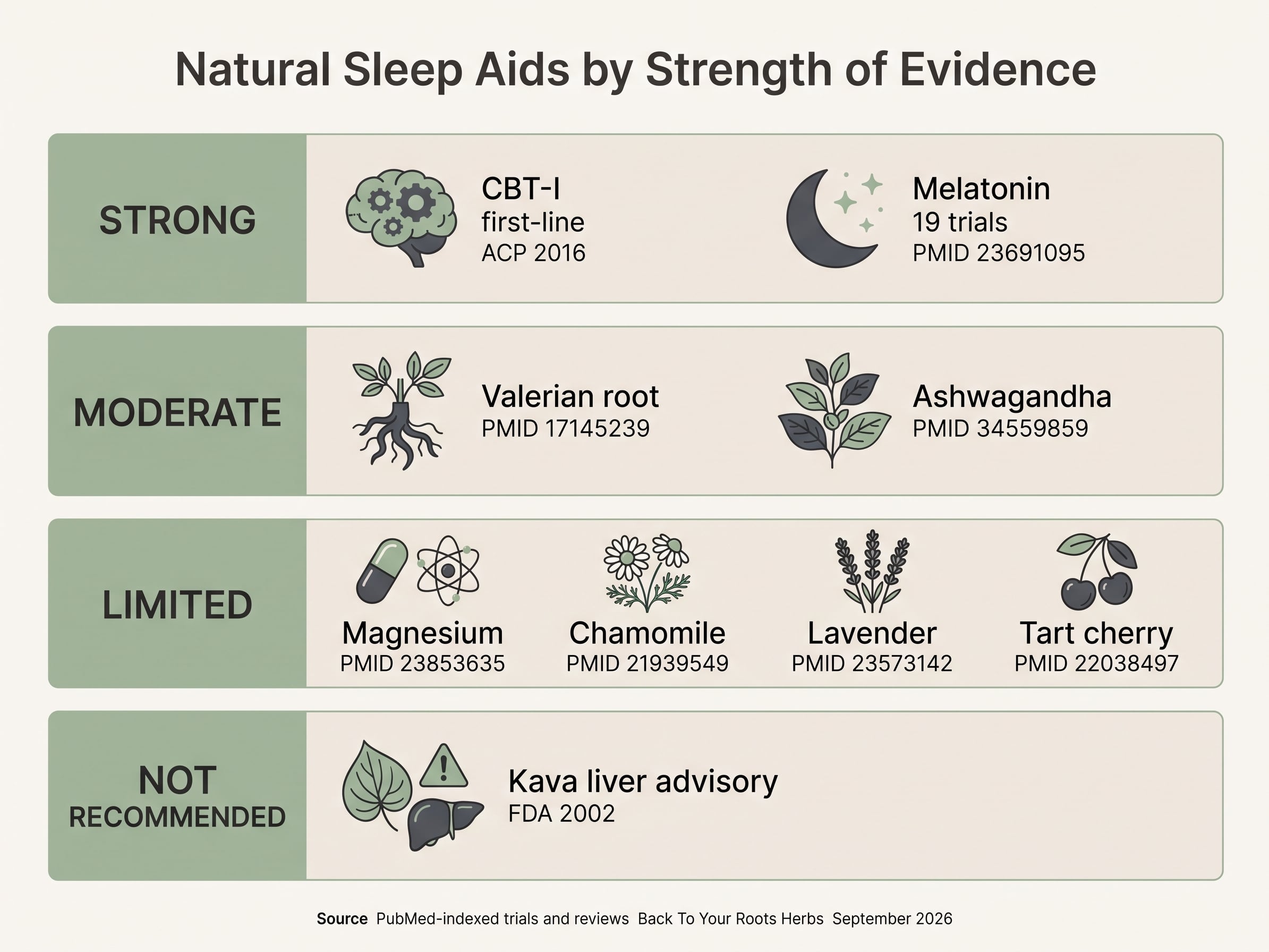
Natural sleep remedies are non-prescription approaches, including sleep-hygiene behaviors, CBT-I techniques, and botanicals or nutrients such as valerian (Valeriana officinalis), chamomile (Matricaria chamomilla), magnesium, and melatonin, that are traditionally used or clinically studied to support falling asleep and staying asleep. Evidence strength is uneven: a 19-trial meta-analysis found melatonin shortened time to fall asleep and modestly lengthened total sleep (Ferracioli-Oda et al. 2013, PLoS One, PMID: 23691095), valerian and ashwagandha show moderate randomized-trial support, and chamomile and lavender show smaller, less consistent effects.
The table below is the short version of everything that follows. Doses are the amounts used in the cited trials, not recommendations, and every row assumes you have already talked with a healthcare provider if you take medication or have a diagnosed condition.
| Remedy | Form studied | Evidence tier | Dose used in trials | Main caution | Source |
|---|---|---|---|---|---|
| Melatonin | Hormone supplement | Strong (meta-analysis, 19 trials) | 0.5 to 5 mg, 30 to 60 minutes before bed | Next-day grogginess at higher doses. Check with a provider if on blood thinners. | Ferracioli-Oda 2013, PMID 23691095 |
| Valerian (Valeriana officinalis) | Root extract | Moderate (systematic reviews, mixed quality) | 300 to 600 mg extract, 30 to 60 minutes before bed | Additive drowsiness with sedatives and alcohol. | Bent 2006, PMID 17145239. Shinjyo 2020, PMID 33086877 |
| Ashwagandha (Withania somnifera) | Standardized root extract | Moderate (meta-analysis, 5 trials) | 300 mg twice daily, 8 to 10 weeks | Do not take with thyroid medication or immunosuppressants without provider input. | Cheah 2021, PMID 34559859. Langade 2019, PMID 31728244 |
| Magnesium | Magnesium oxide (trial), glycinate or citrate (common) | Limited (one placebo-controlled trial in older adults) | 500 mg daily, 8 weeks | Loose stools above 350 mg supplemental. Kidney disease caution. | Abbasi 2012, PMID 23853635. NIH ODS fact sheet |
| Chamomile (Matricaria chamomilla) | Standardized extract or tea | Limited (one small trial, modest effect) | 270 mg extract twice daily, 28 days | Ragweed-family allergy. | Zick 2011, PMID 21939549 |
| Lavender (Lavandula angustifolia) | Aromatherapy, oral oil capsules | Limited (narrative reviews) | Diffused oil at bedtime | Skin sensitivity with undiluted oil. | Koulivand 2013, PMID 23573142 |
| Tart cherry (Prunus cerasus) | Juice concentrate | Limited (small crossover trial) | 30 mL concentrate twice daily, 7 days | Sugar load for people managing blood glucose. | Howatson 2012, PMID 22038497 |
| Kava (Piper methysticum) | Root extract | Moderate for anxiety, not studied for sleep | Not recommended | Rare liver injury reports. 2002 FDA consumer advisory. | Pittler 2003, PMID 12535473. NCCIH |
| Source: PubMed-indexed trials and reviews cited by PMID in each row. Evidence tiers reflect the number and quality of randomized trials, not the size of the effect. | |||||
What is the strongest herb for sleep?
- Valerian root (Valeriana officinalis) has the longest trial record of any sleep herb. A pooled analysis of 16 studies found people were about 80 percent more likely to report improved sleep quality than with placebo, though the trials varied in quality (Bent et al. 2006, American Journal of Medicine, PMID: 17145239).
- Ashwagandha root (Withania somnifera) has the most recent and best-controlled data. A 2021 meta-analysis of five trials found a small but significant improvement in sleep quality, strongest in people with diagnosed insomnia who took at least 600 mg daily for eight weeks or more (Cheah et al. 2021, PLoS One, PMID: 34559859).
- Melatonin is a hormone, not a herb, but it remains the single best-supported over-the-counter sleep supplement for shortening the time it takes to fall asleep.
- No herb matches a structured CBT-I program. If sleep has been broken for more than three months, that program is the first thing to ask a clinician about.
What lifestyle changes make natural sleep remedies work better?
Sleep hygiene is the set of daily habits that tell the brain when to release melatonin and drop core body temperature. It costs nothing, it has no interactions, and in our editorial team’s review of the guideline literature, it is the one intervention every sleep body agrees on. Every supplement below works better on top of these four habits and worse without them.
Keep the same schedule every day
Going to bed and waking at the same time, weekends included, anchors the circadian rhythm. The wake time matters more than the bedtime. A fixed wake time plus morning light is the fastest way to reset a drifting clock, and most people notice the difference within one to two weeks.
Set up the bedroom for sleep
- Temperature: a room between 60 and 67 degrees Fahrenheit (15 to 19 degrees Celsius) supports the natural drop in core temperature that precedes sleep.
- Light: blackout curtains or an eye mask. Even a small amount of light suppresses melatonin release.
- Noise: earplugs or a steady white-noise source if the street or the household cannot be quieted.
- The 20-minute rule: if you are still awake after roughly 20 minutes, get up, keep the lights low, and do something quiet until you feel sleepy. This is stimulus control, a core CBT-I technique, and it keeps the bed from becoming a cue for wakefulness.
Manage light exposure
Bright natural light within an hour of waking sets the clock for the whole day. In the evening, dim the room an hour or two before bed and move screens out of arm’s reach. The short-wavelength light from phones and tablets reads as daytime to the suprachiasmatic nucleus, the brain’s master clock, and delays melatonin onset.
Watch food, caffeine, and alcohol timing
Caffeine has a half-life of roughly five to six hours, so an afternoon coffee is still partly active at midnight. Alcohol shortens time to fall asleep but fragments the second half of the night and suppresses REM sleep. Large meals within two hours of bed keep core temperature and digestion active when both should be winding down.
Which herbs and supplements support sleep, and at what dose?
For people whose sleep hygiene is already solid, the following botanicals and nutrients have the most human data. Each entry gives the mechanism, the dose used in trials, and the safety note we would want to know before taking it ourselves. Doses are for adults and are cited from the studies, not from labels.
Melatonin
Melatonin is the hormone the pineal gland releases in darkness to signal that night has begun. Supplemental melatonin is less a sedative than a timing cue, which is why it works best for jet lag, shift work, and a delayed body clock. The 2013 meta-analysis of 19 randomized trials found it reduced time to fall asleep by about seven minutes and increased total sleep by about eight minutes, small but consistent effects (Ferracioli-Oda et al. 2013, PMID: 23691095). Lower doses of 0.5 to 3 mg are as effective as higher ones for timing and cause less next-day grogginess.
Is valerian root safe, and what dosage is recommended?
Valerian root (Valeriana officinalis) is generally well tolerated in adults at the doses used in trials: 300 to 600 mg of root extract taken 30 to 60 minutes before bed for up to six weeks. Its valerenic acid and related compounds modulate GABA-A receptors, the same calming pathway targeted by prescription sedatives, which is why the one firm safety rule is not to combine it with benzodiazepines, sleep medications, or alcohol. The 2006 meta-analysis found improved subjective sleep quality but flagged inconsistent trial methods (Bent et al. 2006, PMID: 17145239), and a 2020 systematic review attributed the mixed results largely to variable extract quality between products (Shinjyo et al. 2020, Journal of Evidence-Based Integrative Medicine, PMID: 33086877). That second finding is the practical takeaway: standardized extract matters more than dose.
Can valerian be combined with other natural sleep aids? Valerian is commonly paired with hops, lemon balm, or passionflower in traditional formulas, and those combinations have been studied more than valerian with melatonin. Stacking two GABA-active herbs increases drowsiness. Start with one, give it two weeks, and add a second only with a provider’s input.
How does valerian compare to chamomile? Valerian has more and larger trials, a stronger mechanism, and a noticeably stronger sedative feel. Chamomile is gentler, tastes better as a tea, and suits people who want a mild calming ritual rather than a measurable effect on sleep onset.
Magnesium: does it work and what are the side effects?
Magnesium is a cofactor in more than 300 enzyme systems and helps regulate GABA and the parasympathetic nervous system. The best-known sleep trial gave 500 mg of magnesium daily for eight weeks to older adults with insomnia and found improvements in sleep onset, sleep efficiency, insomnia severity scores, and serum melatonin (Abbasi et al. 2012, Journal of Research in Medical Sciences, PMID: 23853635). That is one trial in one population, so the evidence tier is limited even though the mechanism is sound.
Side effects are dose-dependent and mostly digestive. The NIH Office of Dietary Supplements sets the tolerable upper level for supplemental magnesium at 350 mg per day for adults because higher amounts commonly cause loose stools and cramping. Magnesium oxide is the most likely form to do this. Glycinate and citrate are better absorbed and gentler. People with reduced kidney function should not take supplemental magnesium without medical supervision, and magnesium should be taken at least two hours apart from certain antibiotics and osteoporosis medications.
Chamomile
Chamomile (Matricaria chamomilla) is traditionally used to support relaxation before bed. Its flavonoid apigenin binds benzodiazepine sites on GABA-A receptors in laboratory studies, which is the proposed basis for its calming reputation. The one placebo-controlled trial, using 270 mg of standardized extract twice daily for 28 days, found modest improvements in daytime functioning but no significant change in the primary sleep measures (Zick et al. 2011, BMC Complementary and Alternative Medicine, PMID: 21939549). In our testing of chamomile teas, the bedtime ritual and the warmth do as much as the flower. People with ragweed or daisy-family allergies should approach with care.
Lavender
Lavender (Lavandula angustifolia) is used as a diffused essential oil or a few drops on a pillow. Its linalool and linalyl acetate act on the nervous system, and a 2013 review summarized studies suggesting improved sleep quality and lower anxiety scores with inhalation, while noting that the trials were small (Koulivand et al. 2013, Evidence-Based Complementary and Alternative Medicine, PMID: 23573142). Never apply undiluted oil to skin.
Which herbs are traditionally used for stress-related sleeplessness?
When a racing mind rather than a broken clock is the problem, Western herbalism reaches for the nervines, a class of gentle nervous-system herbs. Lemon balm (Melissa officinalis) is traditionally used to support a calm mood and pairs naturally with valerian. Passionflower (Passiflora incarnata) has a small trial record for sleep quality as a tea. Blue vervain (Verbena hastata) is a traditional North American nervine for tension that has not been studied in controlled trials. In our sourcing experience, these herbs are the ones customers describe as taking the edge off rather than knocking them out. Our natural sleep capsules combine several of them for that reason, and our passionflower powder is the single-herb option.
What can I drink to sleep naturally?
- Chamomile tea: apigenin, the flavonoid behind chamomile’s calming reputation, plus a warm caffeine-free ritual 30 to 60 minutes before bed.
- Tart cherry juice: Montmorency cherries (Prunus cerasus) contain natural melatonin. In a crossover trial, 30 mL of concentrate twice daily for a week raised urinary melatonin and increased total sleep time and sleep efficiency (Howatson et al. 2012, European Journal of Nutrition, PMID: 22038497).
- Warm milk: provides tryptophan, the amino acid the body converts to serotonin and then melatonin, and a comforting temperature cue.
- Lemon balm or passionflower tea: the nervine option for a busy mind.
- Avoid: alcohol, which fragments the second half of the night, and anything caffeinated after early afternoon.
Does ashwagandha help with sleep quality or insomnia?
Yes, modestly, and mainly for people whose sleep is disrupted by stress. Ashwagandha (Withania somnifera), the Ayurvedic adaptogen, contains withanolides that support a healthy cortisol rhythm, and a 2021 meta-analysis of five randomized trials found a small but statistically significant improvement in overall sleep quality, with larger effects in adults with diagnosed insomnia, at doses of 600 mg per day or more taken for at least eight weeks (Cheah et al. 2021, PLoS One, PMID: 34559859). The largest single trial gave 300 mg of standardized root extract twice daily for ten weeks and reported faster sleep onset, better sleep efficiency, and lower anxiety scores than placebo (Langade et al. 2019, Cureus, PMID: 31728244).
What is the best ashwagandha dosage for sleep, and is it safe every night?
The studied dose is 300 mg of a standardized root extract twice daily, or 600 mg once in the evening, for eight to twelve weeks. Trials of that length reported no serious adverse events. Ashwagandha is not a sedative and does not work on the first night. It is a slow adjustment to the stress response, which is why the trials run for months. It is best avoided during pregnancy, and people taking thyroid medication, immunosuppressants, or sedatives should involve a provider first because the herb can influence thyroid hormone levels and add to drowsiness.
Why do I wake at 3 a.m., and what helps me fall back asleep?
Waking in the second half of the night is called maintenance insomnia, and it often tracks with an early cortisol rise. Cortisol normally begins climbing around 3 to 4 a.m. to prepare the body for morning. Under chronic stress, that rise comes earlier and steeper, and the brain surfaces. Alcohol, late meals, and low blood sugar do the same thing. Ashwagandha’s cortisol-modulating action is the reason it is the herb most often discussed for this pattern, and it is the one we recommend customers ask their provider about first. In the moment, the CBT-I rule still applies: if you are awake for more than 20 minutes, get up, stay in dim light, and return when sleepy. Sleep apnea and thyroid problems also cause early waking, so persistent 3 a.m. waking deserves a medical evaluation.
Which mind and body practices help you fall asleep faster?
When the barrier to sleep is mental rather than physical, the fastest-acting natural sleep remedies are behavioral. None of them require a purchase, and one of them, CBT-I, outperforms every supplement on this page in head-to-head guideline reviews.
How does CBT-I compare with natural sleep remedies?
Cognitive behavioral therapy for insomnia is the first-line treatment for chronic insomnia recommended by the American College of Physicians (Qaseem et al. 2016, Annals of Internal Medicine, PMID: 27136449) and given a strong recommendation by the American Academy of Sleep Medicine (Edinger et al. 2021, Journal of Clinical Sleep Medicine, PMID: 33164742). It has three core components: stimulus control (the bed is for sleep only, and you leave it when awake), sleep restriction (temporarily limiting time in bed to the hours actually slept, then expanding), and cognitive work on the thoughts that keep the mind racing. Its effects last after the program ends, which no supplement can claim. Herbs and nutrients are best thought of as support for the weeks while CBT-I takes hold, or for occasional sleeplessness that has not become chronic. Self-guided CBT-I programs and apps exist, and a sleep clinician can refer you to a structured course.
Mindfulness meditation
Focusing on the breath and returning attention to the present, without judging the wandering, interrupts the anxious loop that keeps many people awake. Ten minutes of guided practice before bed is enough to start. Our editorial team has found that people who resist meditation often do well with the two structured drills below instead.
The 4-7-8 breathing method
- Exhale completely through the mouth.
- Close the mouth and inhale quietly through the nose for a count of four.
- Hold the breath for a count of seven.
- Exhale fully through the mouth for a count of eight.
- Repeat for four breath cycles.
The long exhale activates the parasympathetic nervous system and lowers heart rate within a few cycles.
Progressive muscle relaxation
Starting at the feet and working upward, tense each muscle group for five seconds, then release for ten. The contrast makes hidden tension obvious and teaches the body what release feels like. It pairs well with the 20-minute rule when you have gotten out of bed.
Which natural sleep aids are safest, and which carry real risks?
Most herbs covered here are well tolerated at studied doses. Two cautions apply to all of them: they can add to the effect of sedating medications, and the supplement category is not reviewed by the FDA before products reach the shelf. One traditional sleep herb, kava, sits in a category of its own.
What are the risks of kava for sleep?
Kava (Piper methysticum), a Pacific Island root traditionally prepared as a ceremonial drink, is associated with rare but serious reports of liver injury, including cases that led to transplant, and the U.S. Food and Drug Administration issued a consumer advisory in 2002 warning of that risk. The National Center for Complementary and Integrative Health notes the liver reports and advises against use in anyone with liver disease or who drinks alcohol regularly. Kava’s kavalactones do have controlled-trial support for short-term anxiety relief (Pittler and Ernst 2003, Cochrane Database of Systematic Reviews, PMID: 12535473), but kava has not been studied for sleep specifically; it interacts with alcohol, sedatives, and many prescription drugs, and its safety profile is the reason we do not carry it and do not recommend it as a sleep aid.
Understanding supplement regulation
Under the Dietary Supplement Health and Education Act, manufacturers are responsible for safety and labeling, and the FDA acts after a product is on the market rather than before. Purity, strength, and even species identity vary between brands. Look for third-party verification from USP, NSF International, or an independent laboratory certificate of analysis. From our hands-on assessment of raw materials, the herbs most often substituted or adulterated in the sleep category are valerian and passionflower, which is why we test incoming lots against reference standards before they are milled.
Are there drug interactions with sleep herbs?
| Remedy | Interacts with | Who should avoid or ask first |
|---|---|---|
| Valerian | Benzodiazepines, sleep medications, alcohol, other sedatives | Pregnancy and nursing (insufficient data), anyone on CNS depressants, before surgery |
| Ashwagandha | Thyroid hormone, immunosuppressants, sedatives, blood-sugar medication | Pregnancy, autoimmune conditions, thyroid disorders without provider input |
| Melatonin | Blood thinners, blood-pressure medication, immunosuppressants, contraceptives | Pregnancy, children without pediatric guidance, autoimmune conditions |
| Magnesium | Tetracycline and quinolone antibiotics, bisphosphonates (space by two hours), diuretics | Reduced kidney function |
| Chamomile | Blood thinners (theoretical), sedatives | Ragweed, daisy, or marigold allergy |
| Kava | Alcohol, sedatives, acetaminophen, many liver-metabolized drugs | Anyone with liver disease. Not recommended as a sleep aid. |
| Source: NIH Office of Dietary Supplements, NCCIH, and Memorial Sloan Kettering About Herbs monographs. Not exhaustive. Bring this list to your pharmacist. | ||
When to see a doctor
Occasional sleeplessness responds to the habits and herbs above. Insomnia three or more nights a week for three months is chronic insomnia, and it deserves a clinical evaluation, both because CBT-I is available and because persistent poor sleep can be a sign of sleep apnea, restless legs syndrome, thyroid disease, depression, or anxiety disorders that need their own care. Loud snoring, gasping, or waking unrefreshed after a full night are apnea signs that no supplement addresses.
Frequently asked questions about natural sleep remedies
What is the most effective natural sleep aid?
For chronic insomnia, CBT-I is the most effective non-drug approach and is the first-line guideline recommendation. Among supplements, melatonin has the strongest pooled evidence for falling asleep faster, especially when the body clock is shifted. Among herbs, valerian root has the longest trial record and ashwagandha the best recent data, particularly for stress-related sleep loss. For most people, fixing sleep hygiene first makes every other remedy work better.
What is the strongest herb for sleep?
Valerian (Valeriana officinalis) is the herb with the most randomized trials and the most noticeable sedative effect at 300 to 600 mg of extract before bed. Ashwagandha (Withania somnifera) has the best-designed recent trials and a meta-analysis behind it, but it works over weeks on the stress response rather than on the night it is taken. Kava is stronger in feel than either but carries a liver-injury warning and is not recommended.
What can I drink to sleep naturally?
Chamomile tea, tart cherry juice, warm milk, and lemon balm or passionflower tea are the drinks with the best rationale. Tart cherry juice contains natural melatonin and increased sleep time in a small crossover trial. Chamomile provides apigenin and a warm caffeine-free ritual. Avoid alcohol, which fragments the second half of the night.
Is valerian root safe, and what dose should I take?
Valerian is generally well tolerated in healthy adults at 300 to 600 mg of standardized root extract taken 30 to 60 minutes before bed for up to six weeks. Do not combine it with alcohol, benzodiazepines, or prescription sleep medication, and stop it before surgery. Extract quality varies widely between brands, which is the main reason trial results have been mixed.
Is ashwagandha safe to take every night for sleep?
Trials of 300 mg twice daily for eight to twelve weeks reported no serious adverse events, and nightly use over that period is how the benefit was measured. It should be avoided in pregnancy and discussed with a provider by anyone with a thyroid or autoimmune condition or taking sedatives. Take breaks after a course of two to three months rather than continuing indefinitely.
What are the risks of kava for sleep?
Kava is linked to rare but serious liver injury, which prompted a 2002 FDA consumer advisory, and it has not been studied as a sleep aid. It interacts with alcohol, sedatives, and liver-metabolized medications. Safer alternatives for a racing mind are lemon balm, passionflower, or a CBT-I program.
Why do I wake up at 3 a.m. and how can I fall back asleep?
Early waking usually reflects an early or exaggerated cortisol rise driven by stress, alcohol, late meals, or low blood sugar, and sometimes by sleep apnea or thyroid problems. If awake for more than 20 minutes, get up, keep lights low, and return when sleepy. Ashwagandha is the herb most studied for stress-related sleep loss over weeks. Persistent 3 a.m. waking deserves a medical evaluation.
How can I fix my sleep schedule naturally?
Fix the wake time first and hold it seven days a week. Get bright light within an hour of waking, dim the house an hour before bed, and skip naps after early afternoon. Most people see a shift within one to two weeks. Low-dose melatonin, 0.5 to 1 mg taken a few hours before the desired bedtime, can help shift a delayed clock earlier.
Related Reading
Continue with our related articles on valerian root for sleep, ashwagandha for cortisol, and adaptogens for stress.
Disclaimer: These statements have not been evaluated by the Food and Drug Administration. This product is not intended to diagnose, treat, cure, or prevent any disease. Consult your healthcare provider before use, especially if you are pregnant, nursing, taking medication, or have a medical condition. This article is for educational purposes and is not a substitute for medical advice.