Key Takeaways
- Cordyceps is an endurance supplement rather than a strength supplement. The measured effects sit in time to exhaustion, ventilatory threshold, and VO2 max, not in muscle size or maximal strength.
- Human exercise trials have used 1 to 3 grams per day, with one high-intensity study using 4 grams daily. Published reviews describe a wider 1 to 12 gram range across different preparations.
- The effect builds over weeks. Cordyceps is not a stimulant, so daily consistency matters more than taking a dose 30 minutes before training.
- Results look strongest in untrained and older adults. A 5-week trial in endurance-trained cyclists found no benefit at all (Parcell et al. 2004, PMID: 15118196).
- A 2025 meta-analysis of 14 randomized trials in 528 athletes reported significant gains in endurance performance, ventilatory threshold, and VO2 peak for Cordyceps sinensis, while calling the evidence base modest.
Cordyceps for working out sits in an unusual place. It is one of the few functional mushrooms with randomized human trials behind it, and it is also one of the most oversold products on the supplement shelf. Both of those things are true at the same time.
You have hit that point. The last rep on the bar feels a hundred pounds heavier than it is. The final mile stretches out in front of you. High-altitude communities across the Tibetan Plateau reached for this fungus for exactly that reason, centuries before anyone measured a ventilatory threshold in a lab.
Our editorial team has read the primary literature on cordyceps and exercise, checked every study identifier against PubMed, and rebuilt this guide around the questions readers actually ask. Back To Your Roots Herbs sells cordyceps. That is precisely why we lead with the trials rather than the marketing, including the trial that found nothing.
What is cordyceps, and how does it affect workout performance?
Cordyceps is a genus of entomopathogenic fungi long used in Traditional Chinese Medicine, sold today as Cordyceps militaris fruiting body or as Cs-4, a cultivated strain of Ophiocordyceps sinensis. Its cordycepin and adenosine content is thought to support mitochondrial ATP resynthesis and oxygen use during hard effort. In one randomized trial, 4 grams daily for three weeks raised VO2 max by 4.8 ml/kg/min (Hirsch et al. 2017, Journal of Dietary Supplements, PMID: 27408987).
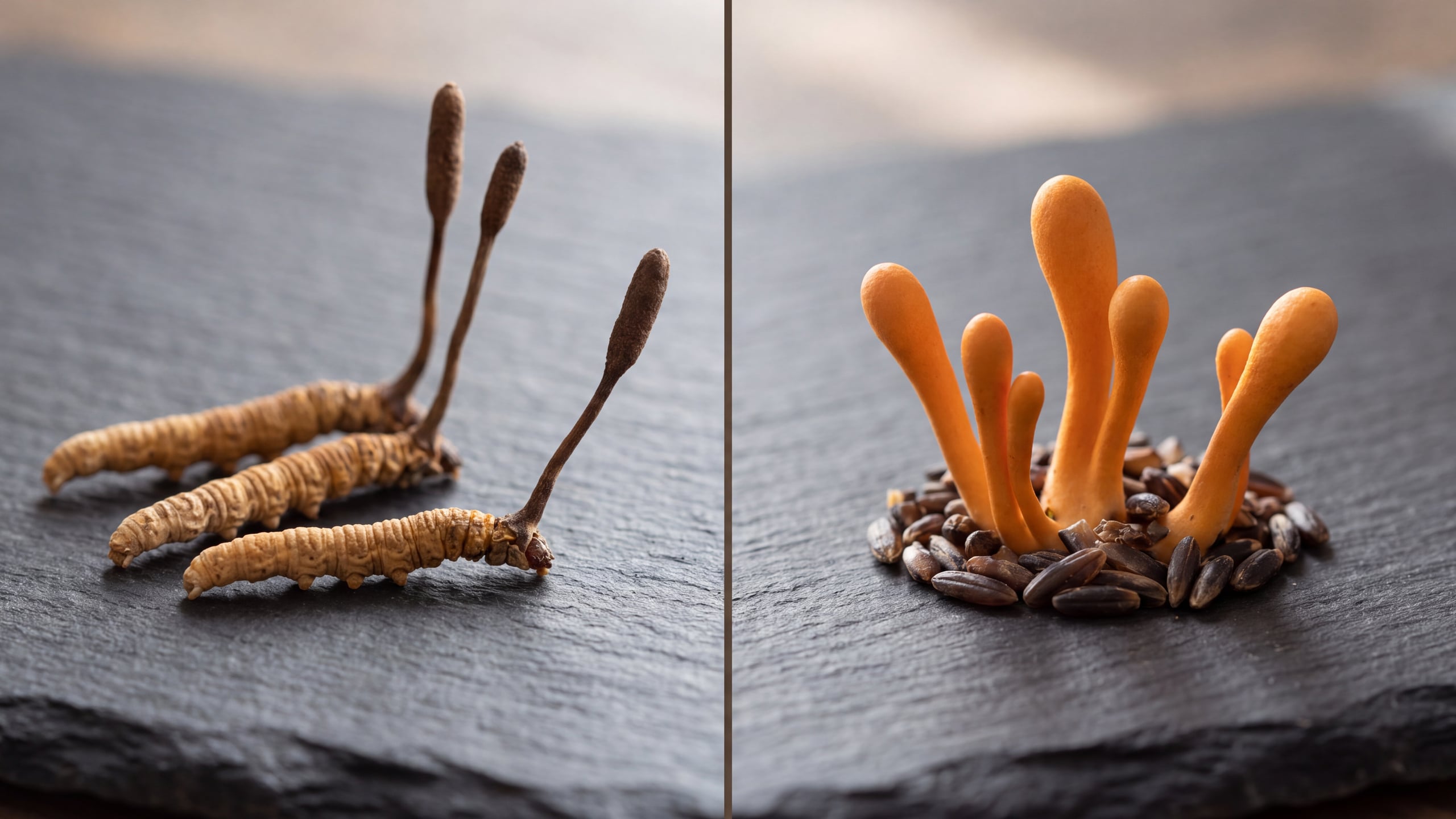
The wild form grows on insect larvae, which is where the folk name caterpillar fungus comes from. Almost nothing sold in the United States is wild. Modern supplements are cultivated, and the cultivation method is the single biggest reason two cordyceps products can behave differently.
Cordyceps militaris vs Cordyceps sinensis (Cs-4): which one do the studies use?
Both appear in the exercise literature, and they are not interchangeable. Ophiocordyceps sinensis is the rare, expensive, wild-harvested species. What reaches the market under that name is nearly always Cs-4, a fermented mycelial strain grown in tanks. Cordyceps militaris is easier to cultivate as a true fruiting body and carries higher concentrations of cordycepin, the 3-deoxyadenosine compound tied to most of the mechanistic research.
The split matters when you read a study. The two trials that found threshold improvements used Cs-4 in older adults, and a C. militaris blend in young adults. The trial that found nothing also used Cs-4 in trained cyclists. Species alone does not predict the outcome. Training status does more of the work, which is covered further down.
What to look for on a cordyceps label
In our sourcing experience, three label details separate a serious cordyceps product from a filler-heavy one.
- Fruiting body or mycelium. Mycelium grown on grain leaves starch in the finished powder. A fruiting body product states so plainly. Neither is disqualifying, but the labels should not be vague about which you are buying.
- Quantified actives. Look for a stated cordycepin percentage, a beta-glucan percentage, or both. A product that lists only total polysaccharides is measuring starch alongside the compounds you want.
- Third-party testing. Mushrooms accumulate heavy metals from their substrate. A current certificate of analysis from an independent lab, alongside cGMP manufacturing, is the baseline we hold our own material to.
How does cordyceps work during a workout?
The proposed mechanisms all point to the same bottleneck, which is how fast your cells can make and spend energy while oxygen is in short supply. Three pathways come up repeatedly in the research.
Does cordyceps increase ATP production?
Adenosine triphosphate is the molecule that powers every muscular contraction, and cordyceps contains adenosine along with cordycepin, a close structural analogue. Laboratory and animal work indicates these compounds raise the activity of enzymes in the mitochondrial ATP synthesis pathway. That is a cell-level finding rather than a human performance finding. The honest framing is that this mechanism explains why researchers keep testing cordyceps, not that it proves an effect in your training session.
Does cordyceps improve VO2 max and oxygen utilization?
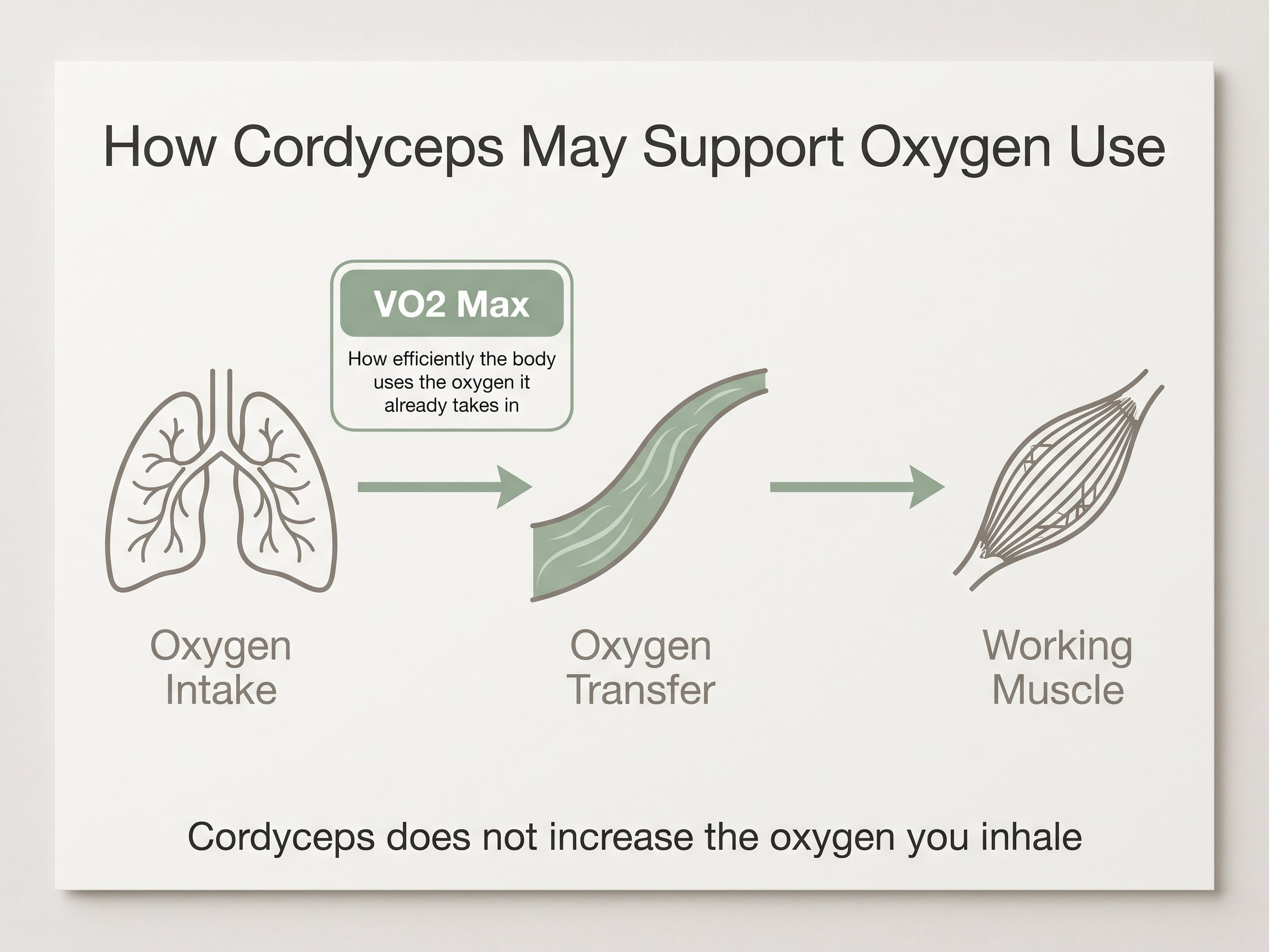
VO2 max measures the maximum volume of oxygen your body can use during intense exercise, and it is the outcome with the most supporting data. In the Hirsch trial, three weeks of supplementation raised VO2 max by 4.8 ml/kg/min while placebo moved 0.9 ml/kg/min (PMID: 27408987). The 2025 pooled analysis of athlete trials found VO2 peak favored Cordyceps sinensis at p = 0.04. Cordyceps does not increase the oxygen you inhale. It appears to change how efficiently your body uses what it already takes in, partly through vasodilation and improved blood flow to working muscle.
Does cordyceps reduce lactic acid and delay fatigue?
Ventilatory threshold is the intensity at which breathing becomes labored, and pushing it higher means holding a hard pace longer before the wheels come off. Hirsch reported a 0.7 l/min rise in ventilatory threshold at three weeks, and the 2025 meta-analysis found ventilatory threshold favored cordyceps at p = 0.03. Time to exhaustion is the most consistent finding across the whole literature. A 2025 review in Current Nutrition Reports concluded that 2 to 16 weeks of supplementation improved aerobic performance in a dose-dependent way, measured as longer time to exhaustion, while effects on aerobic fitness stayed inconsistent (Dewi and Khemtong 2025, PMID: 40768109).
Does cordyceps help muscle recovery after training?
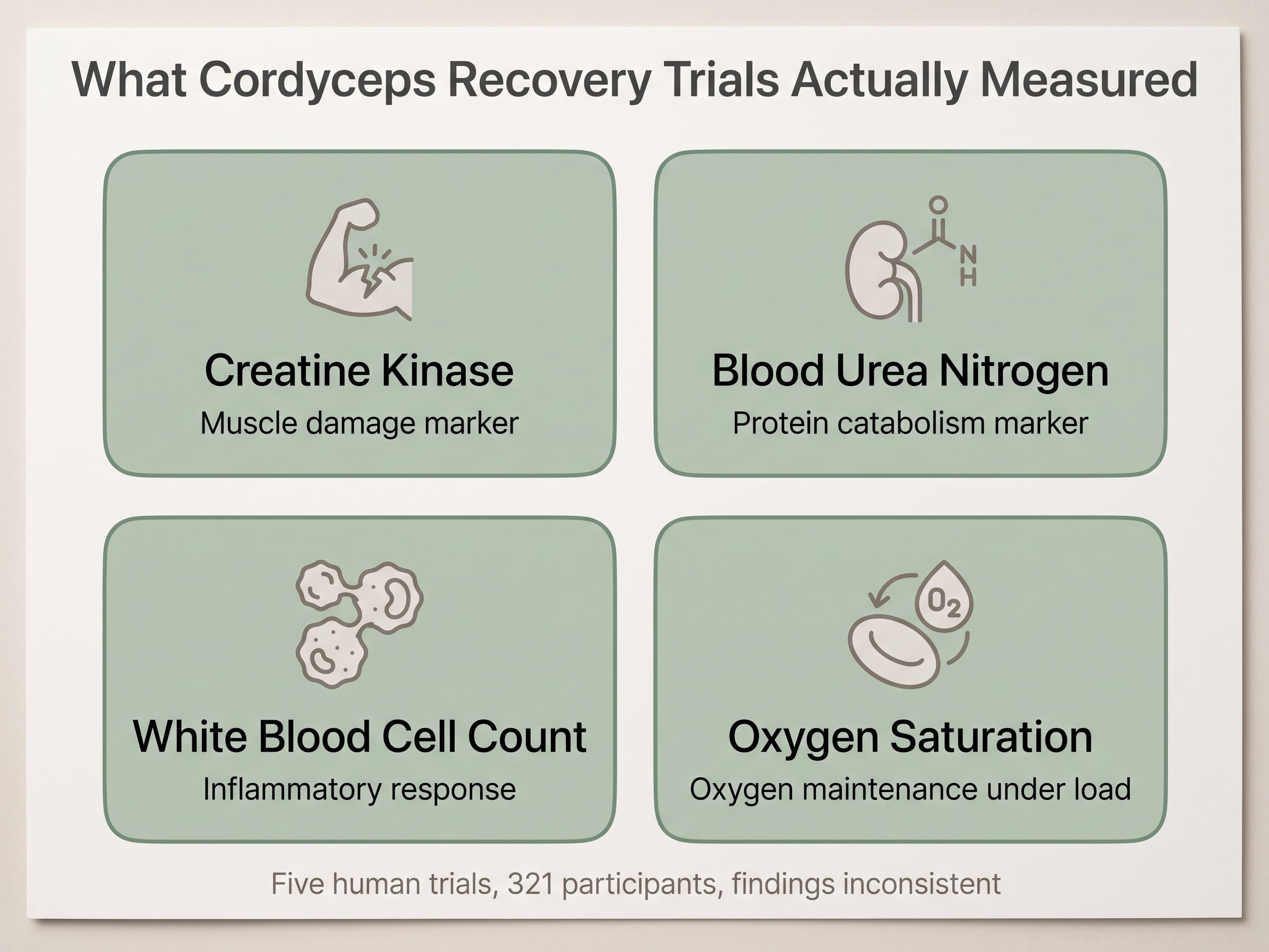
The recovery evidence is early and thinner than the endurance evidence. A 2026 narrative review in Nutrients examined five human intervention studies published between 2017 and 2024, covering 321 participants aged 16 to 35, and found the recovery findings inconsistent across trials (Jedrejko et al. 2026, PMID: 41829950). Here is what those studies actually measured.
- Creatine kinase. The standard blood marker of exercise-induced muscle damage. Several trials tracked it after strenuous sessions, with mixed results across preparations and doses.
- Blood urea nitrogen. Used as a marker of protein catabolism under training load. Included in the same review’s outcome set.
- White blood cell counts. Tracked as an index of the inflammatory response to hard exercise, since cordycepin shows anti-inflammatory activity in laboratory models.
- Peripheral oxygen saturation. Maintenance of SpO2 during high-intensity work, which links recovery capacity back to the oxygen-use mechanism.
- The reviewers’ verdict. Small samples, varied protocols, non-standardized preparations, and multi-ingredient formulas mean the certainty of the recovery evidence remains low.
From our hands-on assessment of the literature, recovery is the most plausible secondary benefit and the least proven one. Treat it as a reason to keep watching the research rather than a reason to buy.
What do the human studies actually show?
Animal studies are plentiful. Human studies are what matter for a training decision, and there are not many of them. The table below lists the trials most often cited in this area, with the identifiers so you can read them yourself.
| Study focus | Participants | Preparation and dose | Key findings | Source |
|---|---|---|---|---|
| High-intensity exercise tolerance | 28 healthy adults, average age 23 | Mushroom blend containing C. militaris, 4 g/day, 1 and 3 weeks | No significant change at 1 week. At 3 weeks, VO2 max rose by 4.8 ml/kg/min, and ventilatory threshold rose by 0.7 l/min. Time to exhaustion rose by 28.1 seconds at 1 week and 69.8 seconds at 3 weeks. | Hirsch et al. 2017, J Diet Suppl, PMID: 27408987 |
| Endurance performance in trained athletes | 22 endurance-trained male cyclists | Cs-4, 3 g/day, 5 weeks | No change in VO2 peak, ventilatory threshold, or work-based time trial versus placebo. | Parcell et al. 2004, Int J Sport Nutr Exerc Metab, PMID: 15118196 |
| Aerobic performance in older adults | Healthy older subjects | Cs-4, 3 g/day, 12 weeks | Improvements in metabolic and ventilatory threshold measures during incremental exercise testing versus placebo. | Chen et al. 2010, J Altern Complement Med, PMID: 20804368 |
| Pooled athlete data | 528 athletes across 14 randomized trials, 8 trials pooled (n = 288) | Various fungal supplements, including Cordyceps | Cordyceps sinensis significantly improved endurance performance (p = 0.05), ventilatory threshold (p = 0.03), and VO2 peak (p = 0.04), with low heterogeneity. | Frontiers in Nutrition 2025 systematic review and meta-analysis |
| Sources verified against PubMed and the published abstracts, September 2026. | ||||
Does cordyceps build muscle or strength?
No. The human evidence supports endurance outcomes, not hypertrophy or maximal strength, and no trial to date shows a meaningful gain in muscle size or one-rep max from cordyceps. The 2026 Nutrients review of five human trials assessed aerobic capacity, time to exhaustion, power output, running performance, and oxygen saturation, with no strength or hypertrophy endpoint reaching a confident conclusion (PMID: 41829950). Claims about raw strength trace back to animal and cell-culture work, most often grip-strength models in mice, which do not translate directly to a loaded barbell.
If added muscle is the goal, creatine monohydrate and total protein intake carry evidence that cordyceps does not approach. We have observed in our own testing that customers who buy cordyceps expecting a strength effect are usually disappointed, while those training for distance events tend to stay with it.
Does cordyceps work for trained athletes or only untrained people?
Training status is the sharpest dividing line in this literature. The positive results cluster in untrained young adults and in healthy older subjects, populations with room to move on aerobic markers. The clearest null result came in endurance-trained cyclists with a baseline VO2 peak near 60 ml/kg/min, where five weeks of Cs-4 changed nothing (PMID: 15118196). The 2025 review noted the same pattern and flagged the ergogenic potential in aging and sedentary populations as under-studied rather than disproven.
The practical read is straightforward. The closer you are to your aerobic ceiling, the less likely a fungus is to move it.
Cordyceps vs creatine, caffeine, and beta-alanine
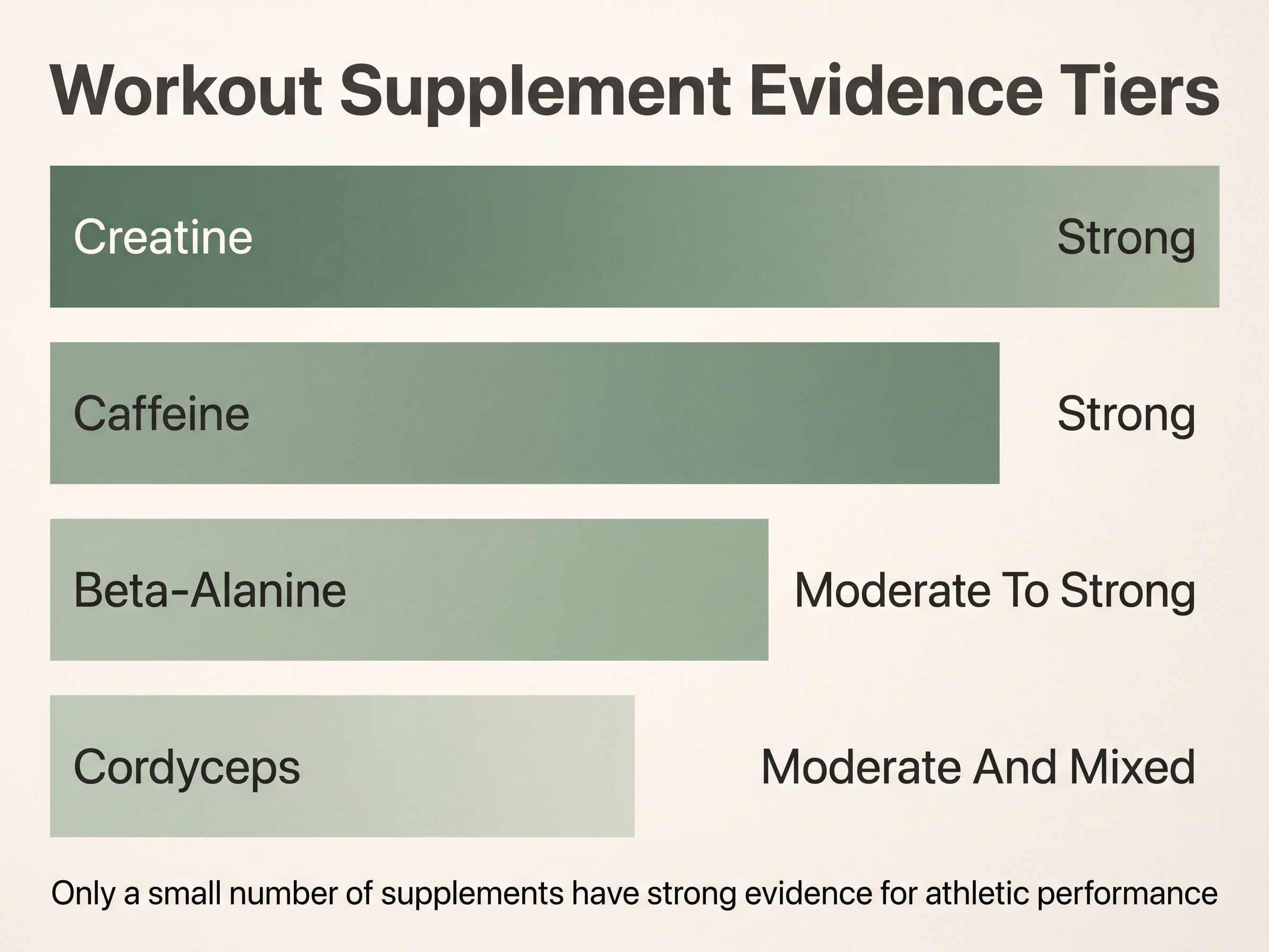
Cordyceps is a supporting player, not a foundation. Placed next to the ergogenic aids with the deepest evidence bases, it occupies a narrow lane: aerobic threshold work, over weeks, without stimulation.
| Supplement | Primary effect | Best supported for | Dose used in studies | Evidence strength | Stimulant |
|---|---|---|---|---|---|
| Cordyceps (C. militaris or Cs-4) | Oxygen utilization and aerobic threshold | Time to exhaustion, ventilatory threshold, VO2 peak | 1 to 4 g daily, 2 to 16 weeks | Moderate and mixed | No |
| Creatine monohydrate | Phosphocreatine resynthesis | Strength, power, repeated sprints, lean mass | 3 to 5 g daily | Strong | No |
| Caffeine | Central nervous system stimulation | Endurance, perceived exertion, power output | 2 to 6 mg per kg body weight, 30 to 60 minutes before | Strong | Yes |
| Beta-alanine | Muscle carnosine buffering | Sustained efforts of roughly 1 to 4 minutes | 4 to 6 g daily for 4 weeks or longer | Moderate to strong | No |
| Evidence tiers drawn from the NIH Office of Dietary Supplements fact sheet on dietary supplements for exercise and athletic performance, and Dewi and Khemtong 2025, PMID: 40768109. | |||||
The NIH Office of Dietary Supplements makes the same point in plainer terms: only a small number of supplements have strong evidence for athletic performance. Cordyceps is not on that short list. It is a reasonable addition on top of sleep, protein, and structured training, and a poor substitute for any of them.
How do you use cordyceps for working out?
What dose of cordyceps is used in sports studies?
Human exercise trials have used 1 to 3 grams per day, with the C. militaris high-intensity trial using 4 grams daily, and published reviews describe a 1 to 12 gram range once you account for every preparation studied. Benefits emerged over 2 to 16 weeks and appeared dose-dependent for time to exhaustion (Dewi and Khemtong 2025, PMID: 40768109). No optimal dose has been established. Start at the lower end, hold it steady, and talk with your healthcare provider before adding it to an existing regimen.
How long before exercise should you take cordyceps?
Thirty to sixty minutes before training is the common practice, but the measured benefits come from consistent daily use rather than the timing of any single dose. Hirsch found no significant effect after one week and a 69.8-second gain in time to exhaustion after three (PMID: 27408987). Cordyceps is not caffeine. Nothing is going to hit fifteen minutes in. Taking it with breakfast every day beats taking it perfectly timed three days a week.
What forms does cordyceps come in for athletes?
Cordyceps is sold as powder, capsules, tea, and concentrated extract, and the choice is mostly about how you prefer to take it rather than about potency. Powder mixes into a protein shake, smoothie, or coffee and makes it easy to adjust the amount. Capsules remove the earthy taste and fix the dose per serving. What matters more than format is whether the label states the extraction and quantifies the actives, as covered earlier.
We stock both formats. Our cordyceps mushroom powder suits people already blending a morning shake, and our cordyceps capsules suit people who would rather not taste it. Either way, the same 1 to 3 gram daily range applies.
Can you take cordyceps with caffeine or a pre-workout?
There is no documented pharmacological interaction between cordyceps and caffeine, and the two work through unrelated pathways. Cordyceps is generally well tolerated, and stacking it with a caffeinated pre-workout is common practice. Two cautions apply. Cordyceps has mild vasodilatory activity and can relax blood vessels, so anyone who already runs low blood pressure should watch for lightheadedness when combining it with other circulatory-acting ingredients. And because pre-workout blends are proprietary, the interaction risk sits with the other twelve ingredients rather than with the mushroom. Check with your healthcare provider if you take blood pressure medication, blood thinners, or diabetes medication.
Stacking with creatine for strength work or beta-alanine for muscular endurance is straightforward, since none of the three compete for the same mechanism.
What are the side effects and safety considerations?
Cordyceps is generally well tolerated by healthy adults at the doses used in research. The most common complaints are mild digestive upset, nausea, and dry mouth. The NCBI LiverTox database lists cordyceps among herbal products with no established pattern of liver injury at typical supplement doses, which is a meaningfully better safety record than several other traditional performance herbs.
Specific groups should take more care.
- Autoimmune conditions. Cordyceps has immunomodulatory activity and has been shown to stimulate cytokine synthesis in human peripheral blood. Anyone managing lupus, rheumatoid arthritis, or a similar condition, or taking immunosuppressants, should speak with their provider first.
- Blood thinners and diabetes medication. Mild effects on clotting and blood sugar have been reported, so combining cordyceps with anticoagulants or glucose-lowering drugs warrants medical supervision.
- Low blood pressure. Because cordyceps can relax blood vessels and increase circulation, people who already run hypotensive occasionally report mild dizziness.
- Pregnancy and breastfeeding. There is insufficient safety data in these populations. The conservative course is to avoid it.
- Product quality. Dietary supplements are not reviewed by the FDA before sale, and potency varies widely between brands. Third-party testing is the practical safeguard.
Frequently asked questions
Does cordyceps actually improve workout endurance?
Modestly, and inconsistently. The most reliable finding is longer time to exhaustion, supported across trials from 2 to 16 weeks. Ventilatory threshold and VO2 peak also favored cordyceps in the 2025 pooled analysis of 528 athletes. The effect is real but small, and it largely disappears in already well-trained athletes.
What dose of cordyceps is used in sports studies?
Most trials used 1 to 3 grams daily. The Cordyceps militaris high-intensity trial used 4 grams daily, and reviews describe a 1 to 12 gram range across all preparations studied. There is no established optimal dose, so starting low and staying consistent is the sensible approach.
How long before exercise should I take cordyceps?
Thirty to sixty minutes before a session is the common habit, but timing is secondary. The benefits recorded in trials came from daily supplementation over one to three weeks or longer, not from a single pre-workout dose.
Is cordyceps safe to take with pre-workout or caffeine?
No pharmacological interaction between cordyceps and caffeine has been documented, and the combination is common. Because cordyceps can mildly relax blood vessels, people with low blood pressure should introduce it carefully. Anyone on blood pressure, blood-thinning, or diabetes medication should consult a healthcare provider first.
Does cordyceps help muscle recovery after training?
Possibly, but the evidence is early. Human trials have measured creatine kinase, blood urea nitrogen, and white blood cell counts after strenuous exercise, with inconsistent results across five studies covering 321 participants (PMID: 41829950). Recovery is the most plausible unproven benefit rather than an established one.
How long does it take for cordyceps to work?
Most trials that found an effect ran three weeks or longer, and the 2025 review covered protocols from 2 to 16 weeks. Nothing about cordyceps is acute. Expect to give it a month before judging it.
Does cordyceps really increase oxygen?
It does not increase the oxygen you inhale. The research points to more efficient use of the oxygen already available, reflected in VO2 max and ventilatory threshold measurements, partly through improved blood flow to working muscle.
What are the negative effects of cordyceps?
At standard doses, most people report nothing more than mild digestive upset or dry mouth. Caution is warranted for those with autoimmune conditions, those on anticoagulant or diabetes medication, those with low blood pressure, and anyone pregnant or breastfeeding.
The bottom line
Cordyceps is a modest, slow-acting endurance aid with real randomized-trial support and clear limits. If you run, cycle, ruck, or train at altitude, and you are not already near your aerobic ceiling, 1 to 3 grams daily for a month is a low-risk thing to try. If you lift for size or strength, the evidence does not support the purchase.
The most useful thing about this literature is how ordinary the effect sizes are. Roughly five milliliters per kilogram per minute of VO2 max and about a minute of extra time to exhaustion, after three weeks of daily use, in people who were not trained to begin with. That is worth knowing before you spend anything.
Related reading
Continue with our related articles on cordyceps for women, cordyceps and erectile dysfunction, natural athletic performance enhancers, and ashwagandha and bodybuilding.
Important: This article is for educational and informational purposes. These statements have not been evaluated by the Food and Drug Administration. The herbs and herbal products discussed are not intended to diagnose, treat, cure, or prevent any disease. Information presented here is not a substitute for professional medical advice, diagnosis, or treatment. Speak with a qualified healthcare provider before starting any new herbal regimen, especially if you are pregnant, nursing, taking medication, or managing a health condition.