Editorial and safety note. This article is educational and reflects traditional use and published research. These statements have not been evaluated by the Food and Drug Administration. This product is not intended to diagnose, treat, cure, or prevent any disease. Fatigue, low energy, and sexual concerns can have medical causes, so consult your healthcare provider before starting any herb, especially if you take prescription medication or manage a health condition.
Siberian ginseng benefits for men center on one idea, which is resilience under stress. This herb is best known as an adaptogen, a plant traditionally used to help the body cope with physical and mental demands. Men often look at it for steady energy, stress management, stamina, and the knock-on effects those have on vitality. In our sourcing experience, it helps to separate what the research supports from what tradition suggests, so this guide walks through both, along with honest safety information.
Understanding Siberian Ginseng
Native to the forests of northeastern Asia, Siberian ginseng is valued for its adaptogenic qualities, which help the body manage stress and maintain balance. The herb contains a range of bioactive compounds, particularly eleutherosides, which are believed to contribute to its supportive effects. Unlike true ginseng, Eleutherococcus senticosus is noted for its association with physical and mental performance during demanding periods.
Siberian ginseng has held a place in Eastern herbal traditions for centuries. Practitioners often turned to it for maintaining stamina during long days of physically demanding work, and there are historical references to men using it to support vitality. Although many of these accounts are traditional rather than clinical, researchers have examined how its constituents might support men’s energy, stress response, and overall well-being.
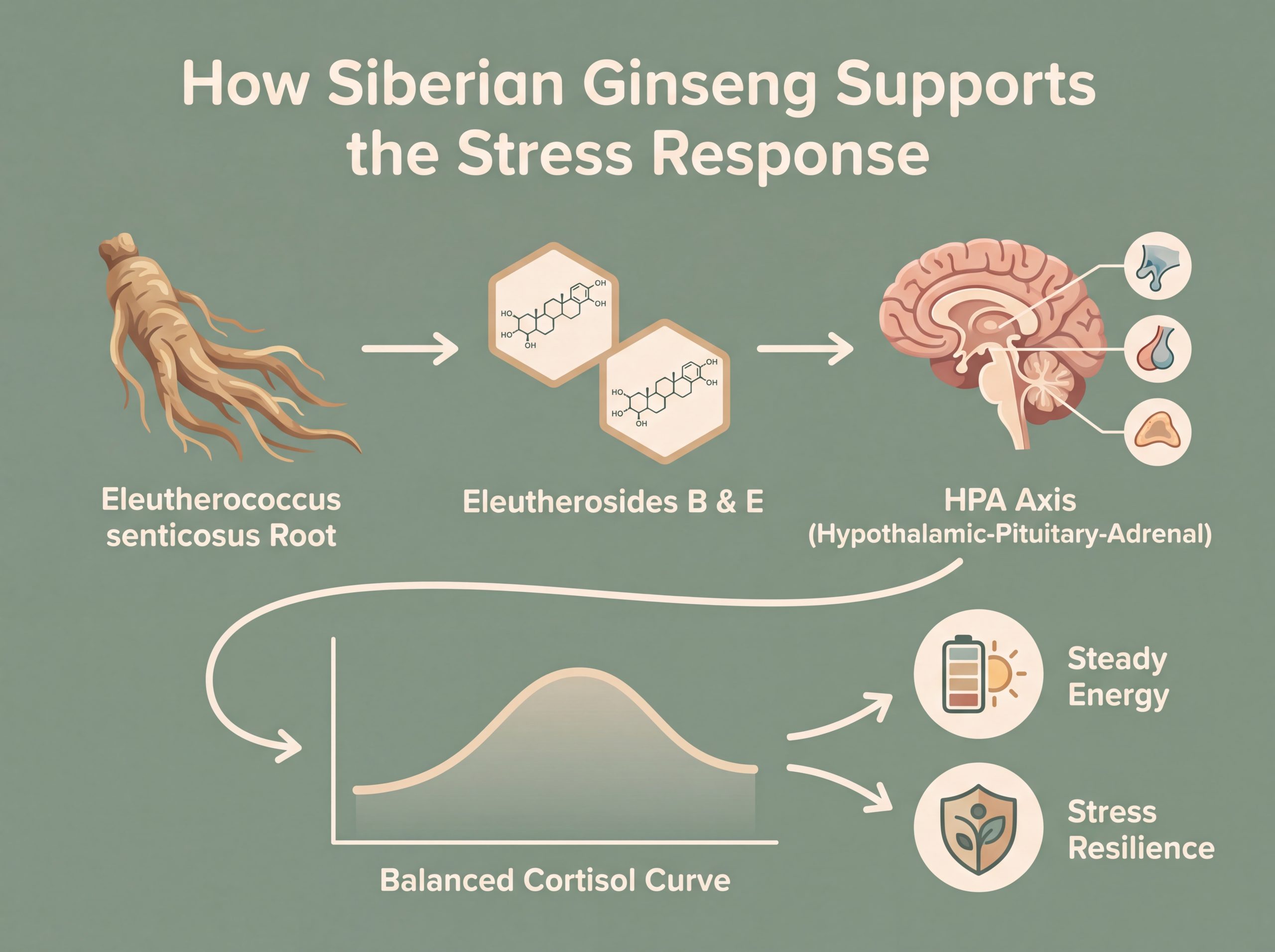
Precision matters with this plant. Siberian ginseng is Eleutherococcus senticosus (Rupr. and Maxim.) Maxim., historically also called Acanthopanax senticosus, a woody shrub in the Araliaceae family native to Siberia, northern China, Korea, and Japan. It is not a true ginseng and shares no active compounds with Panax ginseng. Its characteristic constituents are eleutherosides, most notably eleutheroside B and eleutheroside E, along with supportive polysaccharides. These compounds are studied as adaptogenic agents, meaning they are traditionally used to help the body maintain balance during stress. The proposed pathway runs through the hypothalamic-pituitary-adrenal axis, the system that governs the cortisol response. By supporting a steadier stress response rather than acting as a stimulant, eleuthero is traditionally associated with sustained energy and endurance rather than a sharp lift.
Siberian Ginseng vs. Panax Ginseng (Korean Red, American) for Men’s Health
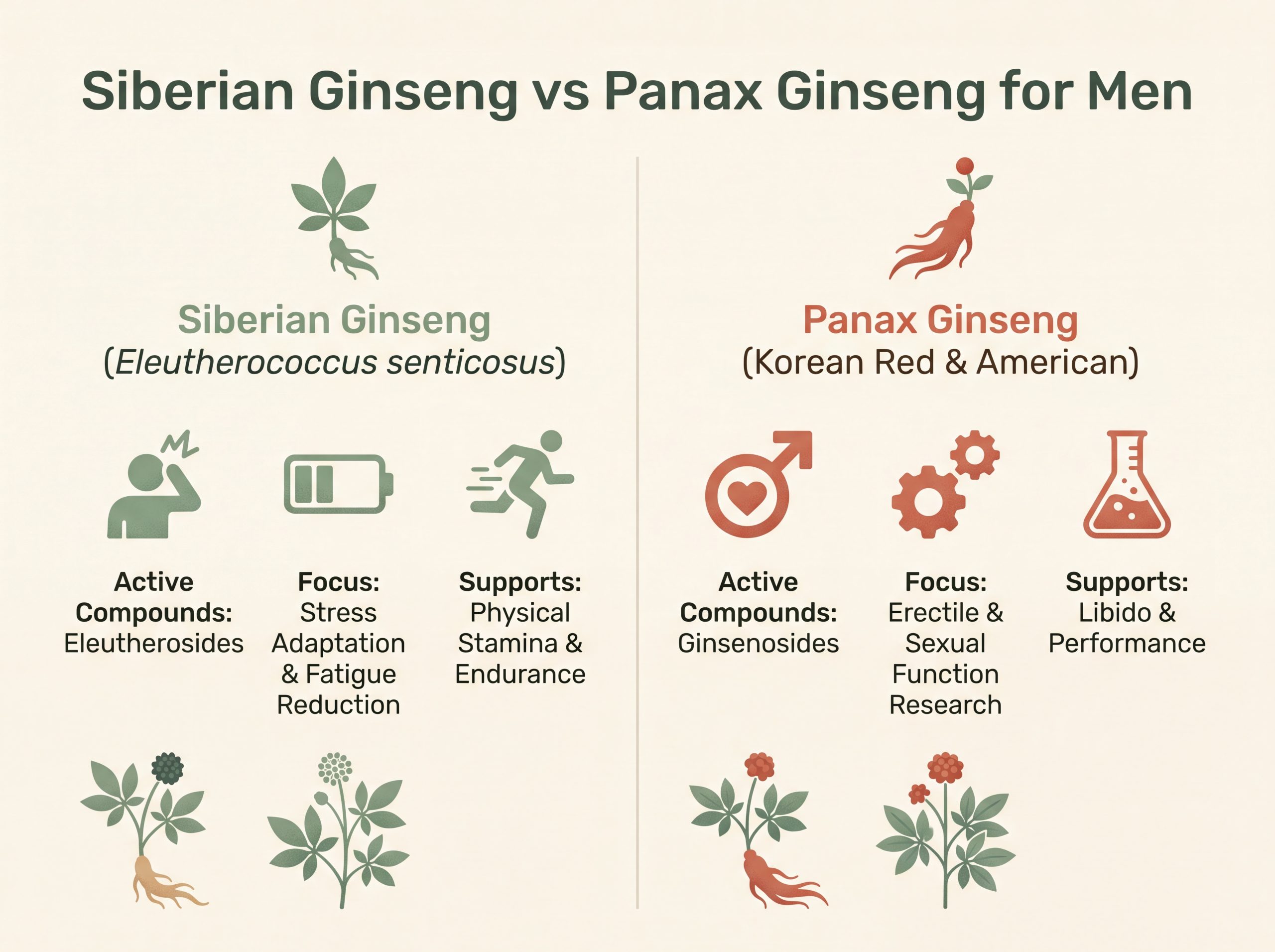
It helps to separate Siberian ginseng from the Panax ginseng varieties. Although they share the ginseng name, they are different plants with different active compounds and different effects, especially for men’s health.
| Herb | Active compounds | Main focus for men |
|---|---|---|
| Siberian ginseng (Eleutherococcus senticosus) | Eleutherosides | Stress management, steady energy, stamina, and overall vitality. Less direct evidence for testosterone or erectile function than Panax. |
| Korean red / Asian ginseng (Panax ginseng) | Ginsenosides | The strongest research record for erectile function and libido, and the most studied for male sexual health. |
| American ginseng (Panax quinquefolius) | Ginsenosides | Milder than Korean red, with some support for energy and stress and less research on male sexual health. |
The practical difference comes down to chemistry and evidence. Panax ginseng C.A. Meyer, sold as Korean red ginseng once steamed and dried, works through ginsenosides and carries the strongest clinical record for male sexual health, particularly erectile function. Siberian ginseng works through eleutherosides and has been studied mainly for stress, fatigue, and general vitality rather than for direct sexual performance. From our hands-on assessment, men who want the adaptogenic stress-and-stamina profile reach for eleuthero, while those specifically researching erectile support tend to look at true ginseng. If the second group describes you, our Korean red ginseng capsules are the Panax option, and the two herbs can be understood as complementary rather than interchangeable.
Key Health Benefits for Men
Here are the areas where Siberian ginseng is most often used by men, framed around its adaptogenic, structural, and functional roles.
| Benefit area | What it means |
|---|---|
| Stress resilience | Traditionally used to support a steadier response to physical and mental stress through the HPA axis. |
| Steady energy | Associated with sustained daytime energy rather than a stimulant-style spike. |
| Stamina and endurance | A long traditional use during physically demanding work. |
| Immune and general wellness | Studied within the broader adaptogen class for immune support and recovery. |
Here is the honest evidence picture, because it is what builds trust. Human research on eleuthero is modest and mixed, and the clearest signals are for stress-related fatigue and quality of life rather than for hormones or sexual performance. A review of plant adaptogens that includes Eleutherococcus senticosus concluded that this class may help with chronic fatigue, cognitive function, and immune support (Todorova et al., 2021; Nutrients, PMID: 34445021). A double-blind randomized trial gave older adults 300 mg of eleuthero extract daily and reported improved scores for social functioning and mental health at four weeks, with the effect softening by eight weeks and no adverse events (Cicero et al. (2004), Archives of Gerontology and Geriatrics, PMID: 15207399). Two careful trials temper the enthusiasm. A randomized controlled trial in people with chronic fatigue did not show an overall benefit, though it hinted at possible help for those with more moderate fatigue (Hartz et al. (2004), Psychological Medicine, PMID: 14971626), and a stress-management trial that measured the cortisol awakening response found that adding eleuthero produced negligible extra benefit while remaining well tolerated (Schaffler et al. (2013), Pharmacopsychiatry, PMID: 23740477). Our editorial team reads this as a plant traditionally used to support energy and stress resilience, with real but limited clinical backing, rather than a proven performance enhancer. For primary sources, see the PubMed record for the eleuthero quality-of-life trial and the National Center for Complementary and Integrative Health overview of ginseng and related adaptogens.
How Does Siberian Ginseng Compare to Other Adaptogens?
Men researching adaptogens usually weigh three plants against each other, and each has a different center of gravity. Siberian ginseng leans toward physical stamina and stress endurance during demanding schedules. Rhodiola rosea is studied more for mental fatigue and acute stress performance, and you can read our profile of Rhodiola rosea and its adaptogenic role for that angle. Ashwagandha (Withania somnifera) is the one most connected in research to the cortisol response and relaxation, which we cover in our guide to ashwagandha and cortisol. In our sourcing experience, the choice is less about which herb is strongest and more about which stress pattern you are trying to support, and some men rotate or combine them under professional guidance rather than picking only one.
Siberian Ginseng and Men’s Sexual Health: Examining the Potential
The link between Siberian ginseng and sexual health is best understood as indirect. The herb is not a direct treatment for any sexual condition. Its traditional value is in supporting the foundations, meaning energy, stress tolerance, and stamina.
- Stress and sexual function. Chronic stress is a common contributor to low desire and performance worry in men. Elevated cortisol can weigh on testosterone and overall function. As an adaptogen, Siberian ginseng is traditionally used to help the body manage stress, which may indirectly ease these effects.
- Blood flow and circulation. Healthy circulation matters for erectile health. Siberian ginseng is not primarily associated with nitric oxide the way Panax ginseng is, but its traditional energy and stress support may indirectly favor a healthier overall environment.
- Energy and libido. Fatigue and low energy can dampen sex drive. By supporting steadier energy, eleuthero may indirectly support a healthier libido.
- Fertility, limited evidence. Research specifically on Siberian ginseng and male fertility is limited. Some general adaptogen research points to possible benefits for sperm quality, but more study is needed for Eleutherococcus senticosus specifically.
To keep expectations honest, there is no strong body of randomized trials showing that eleuthero directly improves erections or ejaculatory control. If you are specifically researching erectile function, the direct clinical evidence points to true Panax ginseng, and you may also find our articles on cordyceps and erectile function and shilajit for libido useful for comparison.
Siberian Ginseng and Testosterone: Understanding the Indirect Connection
It is worth stating plainly that there is no reliable scientific evidence that Siberian ginseng directly increases testosterone production in men. Its adaptogenic properties may support a healthier hormonal environment indirectly, through a few mechanisms.
- The stress-hormone axis. Chronic stress and elevated cortisol can suppress testosterone. By helping the body manage stress and regulate cortisol, Siberian ginseng may support a more favorable environment for the body’s own testosterone.
- The HPG axis. The hypothalamic-pituitary-gonadal axis governs testosterone production, and stress can disrupt it. It is plausible that eleuthero’s stress-supporting role could indirectly help this system stay steadier, though this is a reasoned inference rather than a proven effect and needs more research.
The word to hold onto here is indirect. Current human research does not show that Siberian ginseng raises testosterone directly, and any honest men’s-health resource should say so. A healthy lifestyle, including a balanced diet, regular exercise, adequate sleep, and stress management, remains the foundation for healthy testosterone. Siberian ginseng is best seen as a supportive element within that broader approach, not a testosterone treatment, and men focused on hormones should work with a healthcare provider who can measure their levels.
How to Incorporate Siberian Ginseng
Siberian ginseng comes in several forms, which makes it easy to fit into a daily routine.
- Capsules. A convenient option for consistent amounts. Follow the label, which commonly ranges from 300 to 600 mg per day for general wellness. Consult your healthcare provider before going higher.
- Powder. Eleuthero powder can be added to smoothies or beverages, which allows flexibility as long as you measure carefully.
- Tea. Made by steeping the dried root in hot water for 10 to 15 minutes, a traditional and relaxing way to take it.
- Tinctures. Liquid extracts can be added to water or juice for another simple option.
On amounts, the human studies offer a useful reference range. Trials have used standardized eleuthero extracts at roughly 120 to 300 mg per day, standardized to eleutheroside B and eleutheroside E, while traditional preparations use larger amounts of dried root, often around 2 to 3 grams daily. Because eleuthero can feel mildly energizing for some people, taking it earlier in the day tends to suit most users. Many traditional practitioners also suggest cycling, such as six to eight weeks of use followed by a two to four-week break. These are general reference points from the literature and traditional practice, not a prescription, so confirm a specific amount and schedule with your healthcare provider.
How Long Before Siberian Ginseng Works?
Patience is part of using any adaptogen. In the clinical trials, eleuthero was taken daily for about eight weeks, and where researchers saw early changes, those appeared around the four-week mark (Cicero et al. (2004), Archives of Gerontology and Geriatrics, PMID: 15207399). Effects reported in the stress research were subtle rather than dramatic (Schaffler et al. (2013), Pharmacopsychiatry, PMID: 23740477). From our hands-on assessment, a fair trial means consistent daily use across roughly one to two months rather than a single dose before a workout or an event. Responses vary, and some men notice steadier energy while others feel little change, which is a realistic expectation to set upfront.
Potential Side Effects and Considerations
Siberian ginseng is generally well tolerated for most healthy adults, but it is worth knowing the possible side effects and interactions.
- Possible side effects. Because it can be mildly stimulating, it may cause difficulty sleeping if taken late in the day. Some people report headaches, digestive upset, a faster heart rate, or feeling more irritable or restless, especially at higher amounts.
- Blood thinners such as warfarin or clopidogrel. Eleuthero may affect bleeding risk, so medical guidance is important.
- Diabetes medication such as insulin or metformin. It may influence blood sugar, which can call for closer monitoring.
- Stimulants such as caffeine. Its mild stimulating effect may add to theirs.
- Immunosuppressants. Because it may support immune activity, it could work against these medicines.
- Blood pressure medication. It may affect blood pressure, so caution is sensible.
Other precautions apply. Siberian ginseng is generally not recommended during pregnancy or breastfeeding because of limited safety data, and it is not typically used for children. People with autoimmune conditions such as rheumatoid arthritis, lupus, or Crohn’s disease should check with their provider first, since it may stimulate the immune system. Talk with your doctor before long-term use. Always consult your healthcare provider before starting Siberian ginseng, especially if you have a health condition, take medication, or are pregnant or breastfeeding.
Pros and Cons
A quick, honest summary for men weighing Siberian ginseng.
| Pros | Cons |
|---|---|
| Traditionally used adaptogen for stress and steady energy | Direct evidence for testosterone and erectile function is limited |
| Long history of use for stamina and endurance | Human research is modest and mixed, with some null results |
| Generally well tolerated in studies | Can be mildly stimulating and may disturb sleep if taken late |
| Available in capsules, powder, tea, and tinctures | May interact with blood thinners, diabetes, and blood pressure medication |
Frequently Asked Questions (FAQ)
Does Siberian ginseng directly increase testosterone in men?
No reliable human evidence shows that Siberian ginseng directly raises testosterone. Its traditional role is adaptogenic, meaning it is used to support a steadier response to stress. Because chronically high cortisol is linked with a less favorable hormonal balance, any influence on testosterone is best understood as indirect and supportive rather than a direct increase.
Can Siberian ginseng help with erectile concerns?
Any benefit is indirect. Eleuthero is traditionally used to support energy and stress resilience, and reducing fatigue and stress may indirectly help sexual well-being. It is not a direct erectile treatment, and the direct clinical evidence for erectile function belongs to true Panax ginseng. A broader approach that includes exercise, diet, and stress management, guided by a healthcare provider, tends to serve men best.
How quickly can a man notice benefits from Siberian ginseng?
Individual responses vary. Some users report feeling more energetic and focused within a few weeks, and in the trials early changes appeared around four weeks. For any effect tied to energy and stress, consistent use across a month or more is usually needed.
Is Siberian ginseng safe to take with prescription medications?
Interactions are possible, especially with medicines that affect blood pressure, blood sugar, bleeding risk, or the immune system. Consult a medical professional before combining it with any prescription to ensure safety.
What is the difference between eleutherosides and ginsenosides?
Eleutherosides are the active compounds in Siberian ginseng, Eleutherococcus senticosus. Ginsenosides are the active compounds in true Panax ginseng. The two plants are different species with different chemistry and different research profiles, which is why Siberian ginseng is not considered a true ginseng.
Is Siberian ginseng a good alternative to Viagra or other ED medications?
No. Siberian ginseng is not a substitute for prescription erectile dysfunction medication, and it should not replace a treatment your doctor has prescribed. Eleuthero is traditionally used to support energy and stress resilience, and any effect on sexual well-being is indirect. If erectile concerns are ongoing, they can signal an underlying medical issue, so speak with your healthcare provider.
Can I take Siberian ginseng with testosterone replacement therapy?
If you are on testosterone replacement therapy or any hormone treatment, talk with the provider who manages that therapy before adding Siberian ginseng. Eleuthero is not a hormone and is not a substitute for medical treatment, and your provider can advise on your specific situation.
What is the best form of Siberian ginseng to take?
Standardized extracts with a stated, standardized percentage of eleutherosides are generally preferred for consistency. Traditional preparations use larger amounts of dried root. Whichever form you choose, take it earlier in the day since it can feel mildly energizing, and confirm your amount with your healthcare provider.
Related Reading
Continue exploring men’s vitality and adaptogens with these related articles from our team:
- Ginseng and premature ejaculation: what the research shows
- Black maca for men and its traditional uses
- Tribulus and sex drive: a closer look
- Rhodiola rosea and its role in weight management