Shilajit, a substance revered in traditional medicine systems like Ayurveda, emerges from the high-altitude rocks of mountains, particularly the Himalayas. This natural resinous material, formed over centuries from decomposing plant matter, is rich in minerals and unique organic compounds. It has long been associated with vitality and rejuvenation.
However, questions arise regarding its suitability for everyone, specifically concerning its interaction with the body’s metabolic processes, including the management of uric acid. Understanding the connection between shilajit and uric acid is essential for making informed decisions about its use.
This article provides a detailed examination of Shilajit, uric acid, their potential relationship, and the implications for health, particularly concerning conditions like gout. As an editorial team of herbalists and researchers, our goal is to present a balanced perspective grounded in traditional understanding and available scientific insights, prioritizing accuracy and reader safety.
It is always recommended to consult with a qualified healthcare professional before adding any new supplements to your regimen, especially if you have underlying health conditions or are taking medications.
What is Shilajit? Understanding the Mountain Resin
Shilajit is not a typical herb but a complex mineral pitch or biomass. It forms over extended periods through the decomposition of plant materials compressed by rock layers in mountainous environments. This natural process yields a dense, tar-like substance.
Its composition is intricate and variable depending on the source location, but key components generally include:
- Fulvic Acid: Often considered the primary bioactive component, fulvic acid is known for its antioxidant properties and its potential ability to facilitate the transport of minerals into cells.
- Humic Substances: Including humic acid, these contribute to Shilajit’s profile and are thought to possess antioxidant and anti-inflammatory effects.
- Minerals and Trace Elements: Shilajit resin is notably dense in minerals, containing over 80 different types in ionic form. These include iron, selenium, zinc, copper, magnesium, and potassium, essential for numerous bodily functions.
- Dibenzo-α-pyrones (DBPs): These organic compounds, along with related metabolites, are studied for their antioxidant capabilities and potential role in supporting cellular energy production.
In Ayurveda, Shilajit is classified as a Rasayana, a substance believed to promote longevity and vitality. Its traditional use spans various applications aimed at enhancing overall health and resilience.
Shilajit carries the botanical designation Asphaltum punjabianum, and it is not a plant in the ordinary sense. It is a phytomineral exudate that seeps from rock strata across the Himalaya, Altai, Caucasus, and Tibetan ranges, formed over centuries as compressed plant matter breaks down under the action of soil microorganisms. In our sourcing work, we treat that distinction as the starting point for every quality conversation, because a substance produced by geology and microbial action behaves differently from a root or a leaf.
Two families of compounds account for most of the characterized activity. The first is fulvic acid, a low-molecular-weight carrier compound. The second is the dibenzo-alpha-pyrones, a class of small aromatic molecules largely specific to shilajit. A 2014 review in Phytotherapy Research identified these two groups as the constituents responsible for the effects reported across the literature (Stohs, 2014, Phytotherapy Research, PMID: 23733436). A 2012 analysis in the International Journal of Alzheimer’s Disease reached the same conclusion about fulvic acid as the primary active principle (Carrasco-Gallardo et al., 2012, International Journal of Alzheimer’s Disease, PMID: 22482077).
Neither compound family is a purine. That single chemical fact sits underneath the entire uric acid question, and we come back to it below.
Understanding Uric Acid in the Body
To appreciate the concerns surrounding Shilajit and uric acid, it’s necessary first to understand what uric acid is and its role in the body.
What is Uric Acid?
Uric acid is a natural chemical compound produced in the body during the metabolic breakdown of purines. Purines are organic compounds found in many foods (especially red meat, organ meats, certain seafood, and yeast-containing products like beer) and are also synthesized within our own cells. When cells die and are broken down, their genetic material (DNA and RNA) releases purines, which are then metabolized into uric acid.
How the Body Manages Uric Acid
Typically, uric acid dissolves in the blood, travels to the kidneys, and is excreted from the body primarily through urine, with a smaller amount eliminated via the gut. The body maintains a balance between uric acid production and excretion. Interestingly, in moderate levels, uric acid also functions as an antioxidant, helping to protect cells from certain types of damage.
Hyperuricemia: When Uric Acid Levels Are Too High
Hyperuricemia is the medical term for having abnormally high uric acid levels in the blood. This condition occurs when the body either produces too much uric acid or, more commonly, when the kidneys cannot eliminate it efficiently enough. Chronically elevated levels can lead to significant health problems.
The Connection Between High Uric Acid and Gout
The most well-known consequence of persistent hyperuricemia is gout. Gout is a painful form of inflammatory arthritis that develops when excess uric acid crystallizes out of the blood and forms needle-like sodium urate crystals. These crystals tend to deposit in joints, tendons, and surrounding tissues.
The accumulation of these crystals triggers an intense inflammatory response from the immune system, resulting in:
- Sudden and severe joint pain (often starting in the big toe)
- Swelling and redness
- Warmth in the affected joint
- Limited range of motion
While hyperuricemia doesn’t guarantee gout will develop, it is the single most important risk factor. Managing uric acid levels is central to preventing and treating gout attacks. Other complications of high uric acid levels can include the formation of kidney stones (uric acid stones) and, over time, potential kidney damage.
Does Shilajit Increase Uric Acid Levels? Examining the Evidence
A common precaution found in literature and product warnings regarding Shilajit is that individuals with gout or high uric acid levels should avoid its use. This naturally leads to the question: does Shilajit increase uric acid?
The concern stems primarily from the potential risk of worsening hyperuricemia or triggering gout attacks. However, the scientific evidence directly linking Shilajit consumption to increased uric acid levels in humans is notably lacking.
Potential Mechanisms: Fact vs. Theory
Let’s analyze the potential ways Shilajit might influence uric acid levels, critically evaluating the basis for these ideas:
- Purine Content: Could Shilajit itself be high in purines, directly adding to the body’s uric acid load? This is unlikely. Purines are abundant in cellular materials (like meat or yeast). Shilajit, being a geological exudate formed from decomposed plant matter and microbial metabolites, is primarily mineral and complex organic compound-based, not cellular tissue. Its direct purine contribution is expected to be negligible.
- Metabolic Interference: Could components of Shilajit interfere with the enzymes involved in purine metabolism, such as xanthine oxidase (which produces uric acid), or enzymes involved in its breakdown? There is currently no specific scientific evidence to suggest that fulvic acid or other major components of Shilajit significantly alter these enzymatic pathways in a way that would increase uric acid levels.
- Kidney Function: Could Shilajit impact the kidneys’ ability to filter and excrete uric acid? While some traditional uses suggest Shilajit supports urinary tract health, there’s no direct research indicating it specifically hinders or enhances uric acid excretion. Some substances can compete for excretion pathways in the kidneys, but whether Shilajit does this with uric acid is unknown.
- Mineral Content Influence: Could the high mineral content affect blood or urine pH or solubility factors in a way that influences uric acid crystallization or excretion? This is highly speculative, and no established mechanism links Shilajit’s mineral profile directly to increased serum uric acid levels.
Uric acid is the terminal product of purine metabolism. The enzyme xanthine oxidase catalyzes the final two steps, converting hypoxanthine to xanthine and then xanthine to uric acid. Any substance that raises uric acid has to do it through one of two routes. It either supplies purines for the body to metabolize, or it changes the rate at which uric acid is produced or cleared.
Measured against those two routes, the case against shilajit is thinner than its reputation suggests.
On the purine route. Shilajit is a mineral-humic exudate. Its characterized constituents are fulvic acid and dibenzo-alpha-pyrones, not nucleotides. It is not a purine-dense food in the way that organ meats, anchovies, sardines, or beer are, and a typical serving is measured in a few hundred milligrams rather than in grams of tissue. We will be straight with you about the limit of that reasoning: there is no published purine assay of shilajit that would let anyone state its purine load with real confidence. We are not going to invent one.
On the xanthine oxidase route. The research usually cited here is not shilajit research at all. It is fulvic acid work drawn from water chemistry and environmental toxicology, where fulvic acids from different origins have shown both radical-scavenging and pro-oxidant behavior depending on their source material. Reasoning from a fulvic acid isolated from weathered coal or river water to a purified shilajit supplement taken by a person is a long leap. The studies that would justify that leap have not been done.
So the mechanism most often invoked against shilajit is a theoretical pathway rather than a measured one. That does not make it false. It makes it untested, and the difference matters.
The Critical Lack of Direct Human Studies
The most significant point is the absence of rigorous human clinical trials specifically designed to measure the effects of Shilajit supplementation on blood uric acid levels and the incidence of gout attacks. Without such studies, the assertion that Shilajit definitively raises uric acid levels remains largely unproven in a clinical context. The relationship between shilajit and uric acid requires more dedicated investigation.
Our editorial team ran the primary literature on this question directly rather than repeating what other supplement pages say about it. Searching PubMed for shilajit, including its alternate index terms mumie, mumijo, and Asphaltum punjabianum, crossed against uric acid, hyperuricemia, gout, and xanthine oxidase, returns a very small set of records. Once that set is filtered for actual relevance, it very nearly collapses.
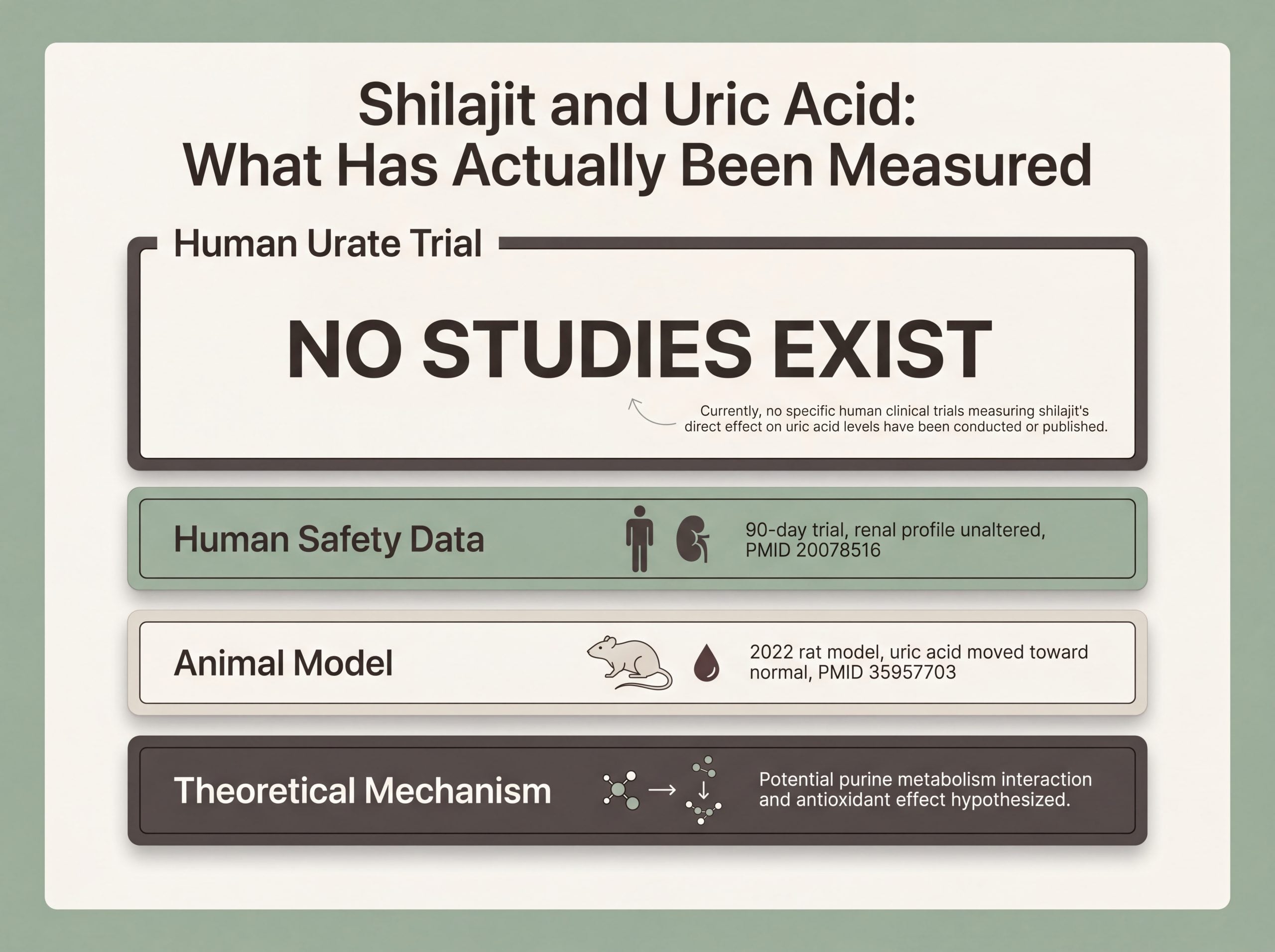
Here is what does not exist. There is no randomized controlled trial of shilajit in people with hyperuricemia. There is no cohort study tracking serum uric acid in shilajit users over time. There is no dose-response study of shilajit on urate handling in humans. Not one. That is the state of the PubMed record as of July 2026.
Anyone who tells you with confidence that shilajit raises uric acid is not reading you a study. They are repeating a caution.
We want to be exact about what that does and does not mean, because this is the point where health writing usually goes wrong in one direction or the other. Absence of evidence is not evidence of safety. What follows is not an argument for taking shilajit if you have gout. It is an argument for being honest about what has actually been measured.
What the Research Actually Measured: Shilajit and Renal Markers
Two studies have put shilajit and a uric acid measurement inside the same experiment. Neither was designed to answer the gout question. Both need to be read for exactly what they are and nothing more.
The first is a rat study. In a 2022 osteosarcoma model published in the Saudi Journal of Biological Sciences, animals with metastatic disease showed dysregulated liver and kidney markers, serum uric acid and creatinine among them. Shilajit given alongside a chemotherapy drug combination moved those markers, including uric acid, back toward near-normal values (Jambi and Alshubaily, 2022, Saudi Journal of Biological Sciences, PMID: 35957703). Read that carefully before doing anything with it. It is an animal model. The animals had cancer. The uric acid elevation being corrected was disease-driven, not diet-driven or metabolic in the ordinary sense. It tells us nothing reliable about what shilajit does to uric acid in a healthy person, and nobody should carry it into a decision about gout. What it does establish is narrow and worth stating plainly: the one experiment on record that measured uric acid alongside shilajit found movement in the opposite direction from the folk claim.
The second is a 90-day human trial. A clinical study of processed shilajit in men with oligospermia tracked biochemical safety parameters across three months of twice-daily dosing and reported unaltered hepatic and renal profiles at the doses used (Biswas et al., 2010, Andrologia, PMID: 20078516). A renal profile is not a targeted urate panel, and the participants were not selected for hyperuricemia, so this is not the study anyone actually wants. But it is human, it ran for 90 days, and it did not find kidney function deteriorating.
Alongside those sits a 2014 review. Its author concluded that shilajit’s safety is reasonably well documented across the animal and human studies conducted to date (Stohs, 2014, Phytotherapy Research, PMID: 23733436). A review synthesizes existing work rather than producing new measurements, and that same author noted plainly that well-controlled human studies on shilajit remain few.
The honest summary. The widely repeated warning that shilajit raises uric acid rests on a theoretical mechanism, not on direct human measurement. The scarce data that does exist either points the other way or shows no renal effect at all. And none of that is remotely sufficient to clear shilajit for a person with gout, because the studies that would answer that question have simply not been run.
So the precaution in the next section stands. It stands as a precaution, which is a different thing from a finding, and you deserve to know which of the two you are being handed.
Traditional Wisdom vs. Scientific Verification
It’s possible that the cautionary advice originated from traditional Ayurvedic observations or theoretical risk assessments rather than modern scientific validation. Traditional systems often operate on principles and observations accumulated over centuries, which may not always align perfectly with findings from controlled clinical trials. The caution might be a “better safe than sorry” approach based on Shilajit’s potent nature and its broad metabolic influences.
Shilajit and Gout: Why Caution is Advised
Despite the lack of definitive proof that Shilajit directly raises uric acid, the consistent recommendation for individuals with gout or known hyperuricemia to avoid it should be taken seriously.
The reasoning is based on potential risk:
- Unknown Interactions: Given Shilajit’s complex composition and its influence on various metabolic processes (like energy metabolism), there’s a theoretical possibility of unforeseen interactions that could negatively impact uric acid balance in susceptible individuals.
- Exacerbation Risk: For someone already struggling with high uric acid levels or gout, even a minor, unproven increase or interference with excretion could potentially trigger a painful gout attack or worsen their condition.
- Precautionary Principle: In the absence of clear safety data for this specific population, the standard medical and herbalist approach is to err on the side of caution. Introducing a complex substance like Shilajit into a delicate metabolic balance (like that found in gout patients) carries potential risks that may outweigh any perceived benefits.
Therefore, anyone with a history of gout or diagnosed hyperuricemia should consult their physician or a qualified healthcare provider before considering Shilajit supplements. Self-treating or ignoring this precaution is not advisable.
Shilajit Compared With Other Botanicals People Ask About for Uric Acid
When people research uric acid, a short list of botanicals comes up repeatedly, and shilajit gets grouped in with them. The grouping is misleading, because the botanicals on that list sit at very different places on the evidence curve. The table below compares what has actually been studied in humans. It does not compare how well anything works, because for most of this list that question has not been answered.
| Botanical | Latin binomial | Human trials measuring serum urate? | What the evidence base actually looks like |
|---|---|---|---|
| Tart cherry | Prunus cerasus | Yes, several | The most studied item on this list. Human trials have directly measured serum urate and gout flare frequency, with mixed and modest results. This is what a real evidence base looks like, and it is still not conclusive. |
| Celery seed | Apium graveolens | Very limited | Long traditional use in Western herbalism for joint complaints. Human data on urate specifically is sparse, and most claims trace to tradition and preclinical work. |
| Stinging nettle | Urtica dioica | Very limited | Traditional use as a diuretic and for joint discomfort. Preclinical signals exist. Controlled human urate data is not there. |
| Shilajit | Asphaltum punjabianum | None | No human trial has measured serum urate in shilajit users. The caution against it is traditional and precautionary rather than evidence-derived, and it still applies. |
| Shilajit row sourced to the PubMed search described in the section above, current as of July 2026. This table compares the maturity of each evidence base, not the effectiveness of any botanical. None of these are treatments for gout. | |||
The point of the table is not to rank these. It is to show that shilajit is the only item on the list where the human evidence on urate is a blank. In our editorial view, a blank should be reported as a blank rather than filled in with confident language in either direction. For general background on how gout and hyperuricemia are understood clinically, the National Institute of Arthritis and Musculoskeletal and Skin Diseases maintains a clear public resource on gout.
General Health Benefits and Properties of Shilajit
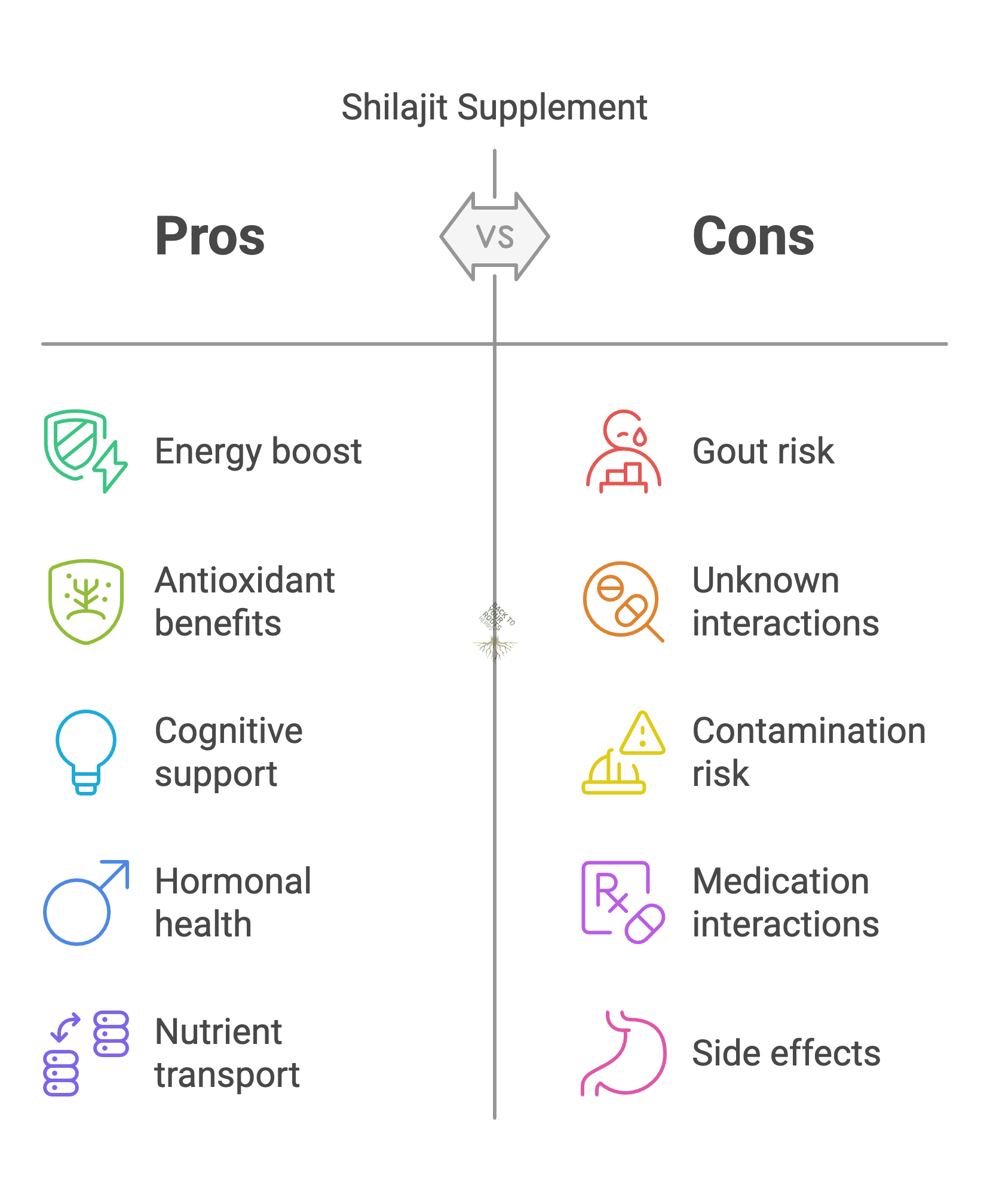
While caution is necessary regarding uric acid, it’s useful to acknowledge the potential health benefits of shilajit investigated in other contexts. These shilajit benefits do not apply to treating gout, but provide context for why people use the supplement:
- Energy Metabolism: Research suggests Shilajit may support mitochondrial function, potentially enhancing cellular energy (ATP) production. This is linked to fulvic acid, potentially aiding mineral transport for energy processes.
- Antioxidant Activity: Fulvic acid and other compounds possess antioxidant properties, helping to neutralize free radicals.
- Cognitive Support: Some preliminary studies indicate potential neuroprotective effects and support for cognitive functions.
- Male Hormonal Health: Certain studies have observed potential support for testosterone levels in healthy men.
- Nutrient Transport: Fulvic acid is thought to enhance the bioavailability and transport of minerals and other nutrients into cells.
These potential health benefits of Shilajit are explored for general wellness but do not override the specific precautions related to gout and uric acid levels.
Because this page is about a caution, we want the benefit claims held to the same standard as the risk claims. Here is what is actually behind them.
- Testosterone. A randomized, double-blind, placebo-controlled human trial in men aged 45 to 55 found that purified shilajit at 250 mg twice daily for 90 days significantly increased total and free testosterone against placebo (Pandit et al., 2015, Andrologia, PMID: 26395129).
- Muscle strength retention. An 8-week randomized controlled trial in 63 recreationally active men found that a standardized shilajit product at 500 mg daily helped retain maximal muscular strength following a fatiguing protocol (Keller et al., 2019, Journal of the International Society of Sports Nutrition, PMID: 30728074).
- Cognitive interest. A 2012 analysis in the International Journal of Alzheimer’s Disease reviewed fulvic acid’s activity on tau aggregation and framed shilajit as a candidate worth further study, while stating clearly that clinical trials were still needed (Carrasco-Gallardo et al., 2012, PMID: 22482077).
Note what these studies have in common. They were conducted in healthy or generally healthy participants. None of them enrolled people with gout or hyperuricemia, and none of them measured urate as an endpoint. A benefit demonstrated in one population is not a safety clearance for a different one.
Important Safety Considerations and Side Effects of Shilajit
Using Shilajit safely requires attention to quality, individual health status, and potential side effects. The concern regarding uric acid is one aspect of its overall safety profile.
Purity is Paramount
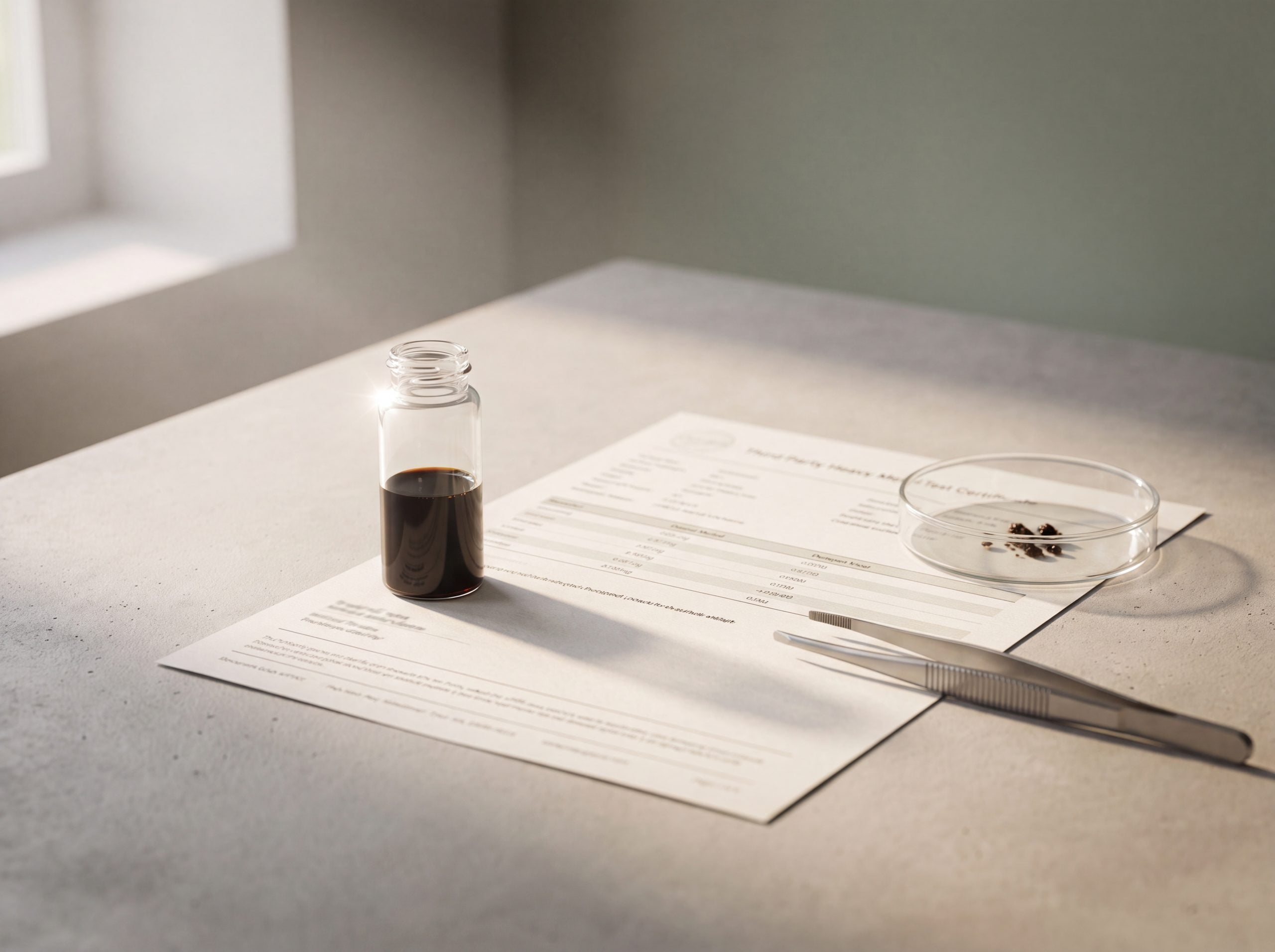
- Contamination Risk: Raw, unpurified Shilajit can contain heavy metals (like lead, mercury, arsenic), fungal contaminants, and other harmful substances due to its original source. Consuming impure Shilajit is dangerous.
- Third-Party Testing: Always choose Shilajit products from reputable suppliers who provide Certificates of Analysis (CoA) from independent third-party laboratories. These tests should verify purity and confirm low levels of heavy metals and other contaminants.
The contamination concern is not hypothetical, and it is not a marketing angle. The National Center for Complementary and Integrative Health has documented heavy metal contamination in a meaningful share of Ayurvedic products sold in the United States, and raw unpurified shilajit is exactly the category where that risk concentrates. Lead, arsenic, and mercury are the metals of concern. Purification is not an optional refinement of raw shilajit. It is the difference between a supplement and a liability.
This is also where the uric acid question quietly connects to the purity question. If a raw shilajit product carries a heavy metal load, the kidneys are the organ system that pays for it, and impaired renal function is itself a driver of elevated uric acid. In our own sourcing and testing work, the single variable that separates a shilajit worth taking from one worth avoiding is verified purification with third-party heavy metal testing behind it. The 2014 safety review makes the same distinction, tying its safety conclusions to purified and standardized preparations rather than to raw material (Stohs, 2014, Phytotherapy Research, PMID: 23733436).
For readers who have discussed shilajit with their provider and been cleared to use it, our purified shilajit extract capsules are standardized and third-party tested for heavy metals, and we publish what the testing covers. For general guidance on evaluating any supplement’s quality claims, the NIH Office of Dietary Supplements is the reference we point people to first.
Specific Contraindications and Precautions
Beyond gout/high uric acid, certain individuals should avoid or use Shilajit with extreme caution:
- Hemochromatosis: Shilajit can increase iron absorption and levels. Individuals with iron overload disorders must avoid it.
- Wilson’s Disease: Due to its copper content, caution may be warranted for those with copper metabolism disorders (rare).
- Pregnancy and Breastfeeding: Due to insufficient safety data, avoidance is recommended.
Potential Side Effects
While generally well-tolerated when pure and used appropriately, potential side effects can include:
- Digestive upset (nausea, diarrhea, stomach ache)
- Allergic reactions (rash, itching – rare; discontinue use)
- Potential lowering of blood pressure
- Potential lowering of blood sugar levels
On the general side effect profile, the 2014 review of the shilajit literature characterized purified shilajit as well tolerated across the animal and human studies conducted to that point, while noting that the number of well-controlled human trials remained small (Stohs, 2014, Phytotherapy Research, PMID: 23733436). The 90-day human trial referenced earlier also tracked safety biochemistry and reported no deterioration in hepatic or renal parameters at the doses studied (Biswas et al., 2010, Andrologia, PMID: 20078516).
Neither of those studies enrolled anyone with gout. That is the gap this whole page exists to be honest about. A tolerability record built in participants without hyperuricemia does not transfer to a person who has it, and we are not going to present it as though it does.
Interactions with Medications
Shilajit may interact with certain medications. Consult your doctor if you take:
- Blood Pressure Medications: Potential additive lowering effect.
- Diabetes Medications: Potential additive lowering effect on blood sugar.
- Blood Thinners (Anticoagulants/Antiplatelets): Theoretical potential to affect clotting.
- Immunosuppressants: Potential immune-modulating effects.
- Thyroid Medications: Potential influence on thyroid function requires caution.
If You Take Gout Medication: What to Discuss With Your Provider
If you are managing gout or hyperuricemia, you are most likely on one of a small set of medications. Urate-lowering drugs such as allopurinol and febuxostat work by inhibiting xanthine oxidase, the same enzyme discussed earlier on this page. Probenecid works differently, increasing urate excretion through the kidney. Colchicine and anti-inflammatories are used for acute flares. Thiazide diuretics, often prescribed for blood pressure rather than for gout, can raise uric acid as a side effect.
Here is what we can tell you about shilajit and those drugs, and we are going to say it plainly because the honest answer is uncomfortable and the dishonest answers are everywhere.
No interaction studies exist. Not for shilajit with allopurinol. Not with febuxostat, probenecid, colchicine, or thiazide diuretics. There is no published pharmacokinetic work examining whether shilajit affects the absorption, metabolism, or clearance of any of them.
People sometimes read a statement like that as reassurance. It is the opposite. An absence of interaction studies is not a clean bill of health. It means nobody has looked. When a substance has a theoretical relationship to the same enzyme pathway that your medication deliberately targets, and nobody has studied what happens when the two are combined, that is precisely the situation that calls for your prescriber to be in the loop rather than out of it.
What to bring to that conversation:
- The specific product you are considering, including its standardization and its third-party heavy metal testing status.
- Your current uric acid numbers and how long you have been at them.
- Your full medication list, including the blood pressure medications, because thiazides are an easy thing to forget to mention.
- Any history of kidney stones or reduced kidney function.
- A direct question about whether baseline and follow-up urate testing makes sense if you do proceed.
Our editorial position on this has not moved. If you have gout or diagnosed hyperuricemia, the absence of evidence cuts against experimenting on yourself, and shilajit is not a supplement to start without your provider’s knowledge.
Starting Dose and Consultation
- Start Low: Begin with the smallest recommended dose (often around 100-250 mg of purified shilajit resin or equivalent) to assess tolerance.
- Professional Advice: Always consult a healthcare professional before starting Shilajit, especially if you have any pre-existing health conditions or are taking any medications.
Frequently Asked Questions: Shilajit and Uric Acid
Does shilajit raise uric acid levels?
No human study has ever measured it. The warning is widely repeated, but it rests on a theoretical mechanism rather than on direct measurement in people. The only study on record that measured uric acid alongside shilajit was a 2022 rat model of osteosarcoma, in which shilajit moved disease-elevated uric acid back toward normal (PMID: 35957703). That is an animal disease model, and it does not clear shilajit for anyone with gout.
Is there any human study on shilajit and uric acid?
No. There is no randomized controlled trial, no cohort study, and no dose-response study of shilajit on urate handling in humans as of July 2026. A 90-day human trial of processed shilajit did track broader safety and biochemistry and reported unaltered renal profiles at the doses used (PMID: 20078516), but a renal profile is not a targeted urate panel, and the participants did not have hyperuricemia.
Can I take shilajit if I have gout?
Not without talking to your provider first, and our editorial position is that the precaution stands. The caution against shilajit in gout is precautionary and traditional rather than evidence-derived, but an untested question is not a settled one. Absence of evidence is not evidence of safety, and gout flares are painful enough that erring toward caution is the reasonable call.
Can I take shilajit with allopurinol or other gout medication?
No interaction studies exist between shilajit and allopurinol, febuxostat, probenecid, colchicine, or thiazide diuretics. Nobody has looked. Because allopurinol and febuxostat act on xanthine oxidase, the same enzyme pathway theoretically implicated in the shilajit question, this is a combination your prescriber needs to know about rather than one to try on your own.
Does shilajit contain purines?
Shilajit is a mineral-humic exudate whose characterized constituents are fulvic acid and dibenzo-alpha-pyrones, not nucleotides, so it is not a purine-dense substance in the way organ meats, anchovies, or beer are. A typical serving is a few hundred milligrams. We will be honest about the limit here: no published purine assay of shilajit exists, so nobody can state its purine load with real precision.
Is shilajit safe for the kidneys?
A 90-day human trial of processed shilajit reported unaltered renal profiles at the doses studied (PMID: 20078516), and a 2014 review characterized purified shilajit as reasonably well tolerated across the studies conducted to date (PMID: 23733436). The bigger kidney risk with shilajit is not the shilajit itself but contamination. Raw, unpurified material can carry lead, arsenic, and mercury, and the kidneys are what pay for that.
How do I know if my shilajit is pure?
Look for verified purification and third-party heavy metal testing, and look for a company willing to tell you what the testing actually covers. The National Center for Complementary and Integrative Health has documented heavy metal contamination in a meaningful share of Ayurvedic products sold in the United States. Raw, unpurified shilajit sold cheaply is the category where that risk concentrates.
Related Reading
Continue with these related articles from our editorial team:
- The 90-day placebo-controlled trial on shilajit and testosterone
- How shilajit interacts with female hormone health
- What the research says about shilajit and skin
- Pure Himalayan shilajit powder, standardized and tested
Making Informed Decisions About Shilajit Supplements
The relationship between Shilajit and uric acid levels is complex and not fully elucidated by current scientific research. While Shilajit offers potential health benefits attributed to its rich mineral and fulvic acid content, a significant and consistent precaution exists regarding its use by individuals with high uric acid levels or a history of gout.
The lack of direct human studies proving that Shilajit raises uric acid does not negate the validity of this caution. Given the potential risks associated with exacerbating hyperuricemia or triggering painful gout attacks, the precautionary principle applies. Safety must be the priority.
If you are considering Shilajit supplements and have concerns about uric acid, gout, kidney health, or if you are taking any medications, the most responsible step is to discuss it thoroughly with your physician or a qualified healthcare provider. They can help you weigh the potential risks and benefits based on your individual health status and medical history, ensuring you make the safest and most appropriate choice for your well-being.
Disclaimer
These statements have not been evaluated by the Food and Drug Administration. This product is not intended to diagnose, treat, cure, or prevent any disease. Consult your healthcare provider before use, particularly if you have gout, hyperuricemia, kidney disease, or any diagnosed medical condition, or if you take prescription medication.