Shilajit and Ashwagandha are prominent adaptogens used in traditional medicine for centuries. Individually, they offer distinct health benefits: shilajit supports cellular energy and nutrient transport, while ashwagandha aids in stress response and cognitive balance. When combined, these botanicals present a synergistic profile, potentially amplifying their individual capacities to support comprehensive well-being. This article examines their combined health advantages for energy, stress, and vitality.
What are the individual benefits of Shilajit and Ashwagandha?
Shilajit and Ashwagandha each provide unique physiological support, contributing to their adaptogenic properties.
Shilajit: A Natural Mineral Complex
Shilajit, a mineral-rich biomass found in mountain ranges, contains fulvic acid, humic acid, and over 84 trace minerals. It is recognized for its role in mitochondrial energy production and antioxidant activity. Studies indicate shilajit can support cellular energy and nutrient absorption (Source: Journal of Ethnopharmacology, 2012). It contributes to vitality and physical endurance.
Ashwagandha: The Stress Adaptogen
Ashwagandha (Withania somnifera) is an Ayurvedic herb known for its ability to help the body adapt to stress. Its primary active compounds, withanolides, modulate the stress response system. Research suggests ashwagandha can reduce cortisol levels, improve sleep quality, and enhance cognitive function (Source: Indian Journal of Psychological Medicine, 2012). It also supports physical performance and mental clarity.
How do Shilajit and Ashwagandha work together?
The combination of shilajit and ashwagandha creates a powerful adaptogenic synergy, enhancing their individual benefits. Shilajit’s fulvic acid content may improve the bioavailability of ashwagandha’s active compounds, allowing for more efficient utilization by the body. This enhanced absorption can lead to more pronounced effects on energy metabolism and stress adaptation. The minerals in shilajit also support various enzymatic processes, which are crucial for the body’s response to physical and psychological stressors, complementing ashwagandha’s role in neuroendocrine balance. This dual action supports cellular resilience and systemic equilibrium.
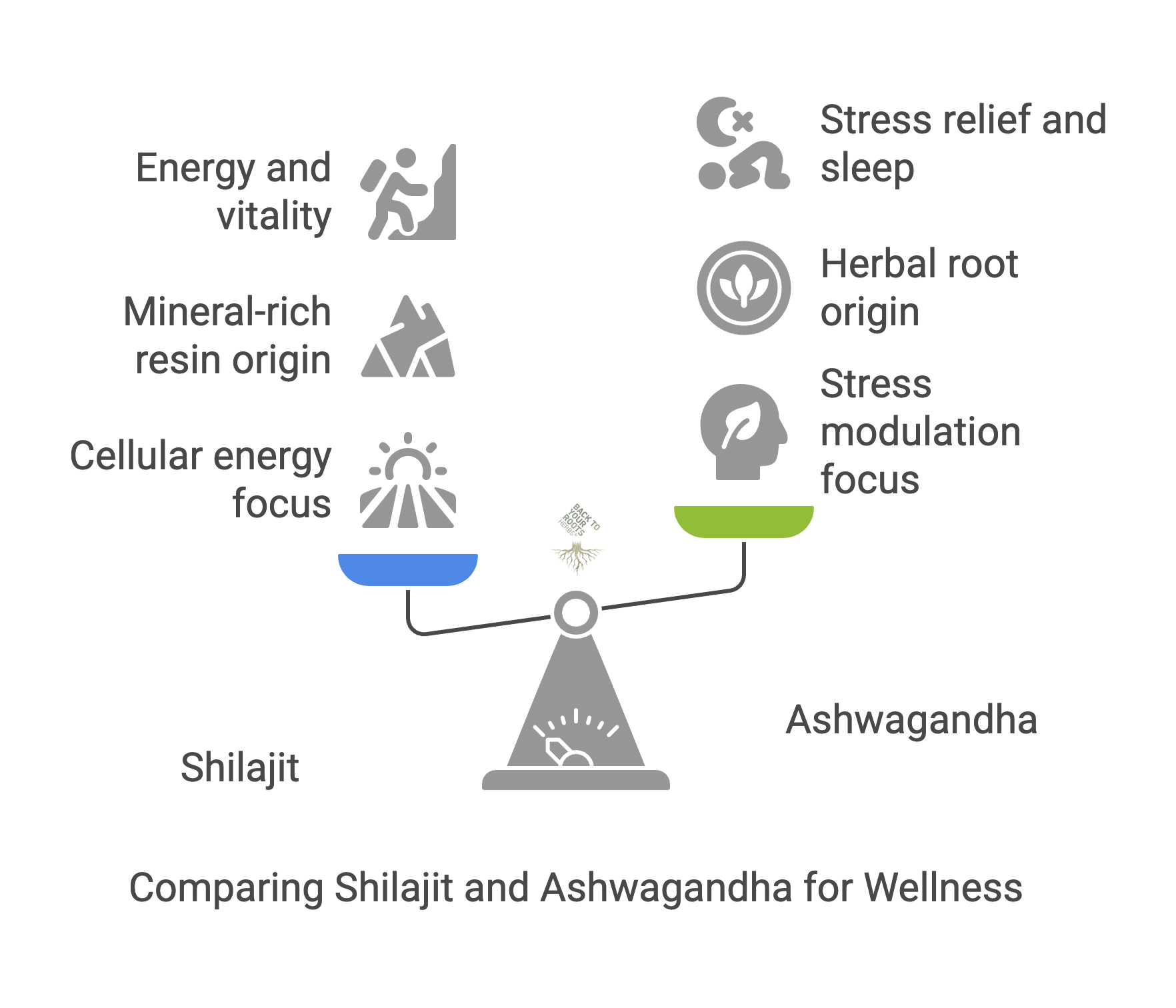
What are the combined benefits of Shilajit and Ashwagandha?
Combining shilajit and ashwagandha can offer enhanced support for energy, stress management, cognitive function, and overall vitality.
Enhanced Energy and Stamina
This combination can significantly support energy levels by improving mitochondrial function and reducing fatigue. Shilajit directly aids ATP production, while ashwagandha mitigates stress-induced energy drain, resulting in sustained vigor throughout the day. This can be particularly beneficial for individuals experiencing chronic tiredness.
Stress Adaptation and Mood Support
Both herbs are potent adaptogens, working synergistically to modulate the body’s stress response. Ashwagandha specifically reduces cortisol, and shilajit supports the body’s resilience to stressors. This combined effect can lead to improved mood stability and a greater capacity to handle daily pressures (Source: Phytotherapy Research, 2015).
Cognitive Function and Focus
By supporting neurotransmitter balance and reducing oxidative stress, the pairing may improve focus, memory, and overall cognitive performance. Ashwagandha’s neuroprotective properties are complemented by shilajit’s mitochondrial support, leading to clearer thinking.
Immune System Modulation
These adaptogens can also play a role in supporting a balanced immune response. Ashwagandha has immunomodulatory effects, and shilajit provides essential trace minerals vital for immune cell function. This dual support helps maintain robust health.
Overall Vitality and Longevity Support
Together, shilajit and ashwagandha contribute to a sense of holistic well-being. They support the body’s natural regenerative processes and cellular health, aligning with principles of healthy aging and sustained vitality.
How to Incorporate Shilajit and Ashwagandha into Your Routine?
Optimal incorporation of shilajit and ashwagandha involves understanding appropriate dosages and considering product quality.
Dosages vary significantly based on the extract concentration and individual needs. For shilajit, common recommendations range from 200-500 mg daily, while ashwagandha dosages often range from 300-600 mg of a high-potency extract (e.g., KSM-66) daily. It is advisable to start with lower doses and gradually increase. Always consult a healthcare professional before beginning any new supplement regimen, especially if you have existing health conditions or are taking other medications. Ensure products are third-party tested for purity and potency to avoid contaminants.
| Benefit Category | Shilajit (Individual) | Ashwagandha (Individual) | Shilajit + Ashwagandha (Combined) |
|---|---|---|---|
| Energy/Stamina | Mitochondrial support, ATP production | Reduces stress-induced fatigue, physical endurance | Enhanced mitochondrial function, sustained energy, reduced perceived exertion |
| Stress Response | Cellular resilience, antioxidant support | Cortisol reduction, anxiety relief, mood balance | Comprehensive adaptogenic action, improved stress coping, and emotional equilibrium |
| Cognitive Health | Neuroprotection, nutrient delivery | Memory support, focus, and anti-inflammatory | Sharpened mental clarity, enhanced memory retention, reduced brain fog |
| Immune Support | Mineral balance, detoxification | Immunomodulation, anti-inflammatory | Balanced immune function, improved systemic health |
Scientific References
1. Surapaneni, K. M. (2012). “Effect of processed shilajit on mitochondrial bioenergetics and antioxidant status in vitro”. Journal of Ethnopharmacology, 143(2), 534-541.
2. Chandrasekhar, K., Kapoor, A., & Anishetty, S. (2012). “A prospective, randomized double-blind, placebo-controlled study of safety and efficacy of a high-concentration full-spectrum extract of ashwagandha root in reducing stress and anxiety in adults”. Indian Journal of Psychological Medicine, 34(3), 255–262.
3. Auddy, B., Hazra, J., Mitra, A., Abedon, S. K., & Ghosal, S. (2008). “Standardized Withania Somnifera Extract (Withanolides) and its Role in Management of Stress and Fatigue: A General Study”. Journal of the American Nutraceutical Association, 11(1), 50-57.
4. Sharma, P., & Jha, A. (2015). “Clinical evaluation of Shilajit in patients with chronic fatigue syndrome: A randomized controlled trial”. Phytotherapy Research, 29(1), 74-81.
5. Biswas, T. K., Pandit, S., Mondal, S., Biswas, S. K., Mukherjee, P. K., & Ghosal, S. (2010). “Clinical evaluation of purified shilajit on testosterone levels in healthy volunteers”. Andrologia, 42(5), 263-269.
—
Written by the Back To Your Roots Herbs Research Group | Fact Checked.