Key Takeaways
- Senna is a stimulant laxative made from Senna alexandrina leaves and pods, and its sennosides need gut bacteria to convert them before anything happens.
- That bacterial conversion step is why senna takes 6 to 12 hours, with roughly 8 hours being typical, so most people take it at bedtime.
- In a randomized placebo-controlled trial, 69.2 percent of the senna group reported overall symptom improvement against 11.7 percent on placebo (PMID: 32969946).
- The 2023 AGA-ACG clinical practice guideline gives senna a conditional recommendation for chronic idiopathic constipation, not a strong one (PMID: 37211380).
- Standardized tablets state their sennoside content on the label. Loose-leaf senna tea does not, which is the single biggest practical difference between the two forms.
- A review of 640 pediatric patients found no evidence of tolerance developing to senna, which complicates the common assumption that stimulant laxatives always stop working (PMID: 29429768).
Constipation is one of the most common digestive complaints there is, and senna is one of the oldest answers to it. The plant has been used as a purgative for well over a thousand years, and it still sits on pharmacy shelves today under names like Senokot and Ex-Lax. What has changed is how much we understand about the mechanism, and how much better the safety data has become.
In our editorial team’s review of the literature on this plant, the gap between what the research says and what most consumer articles repeat turned out to be wider than expected. The dependence question in particular gets stated far more confidently than the evidence supports. This article covers what senna is, how it works at the level of the colon, what the trials actually found, how to use it, what to avoid, how it compares to other laxatives, and where gentler herbal approaches fit instead.
What Is Senna, and How Does It Work?
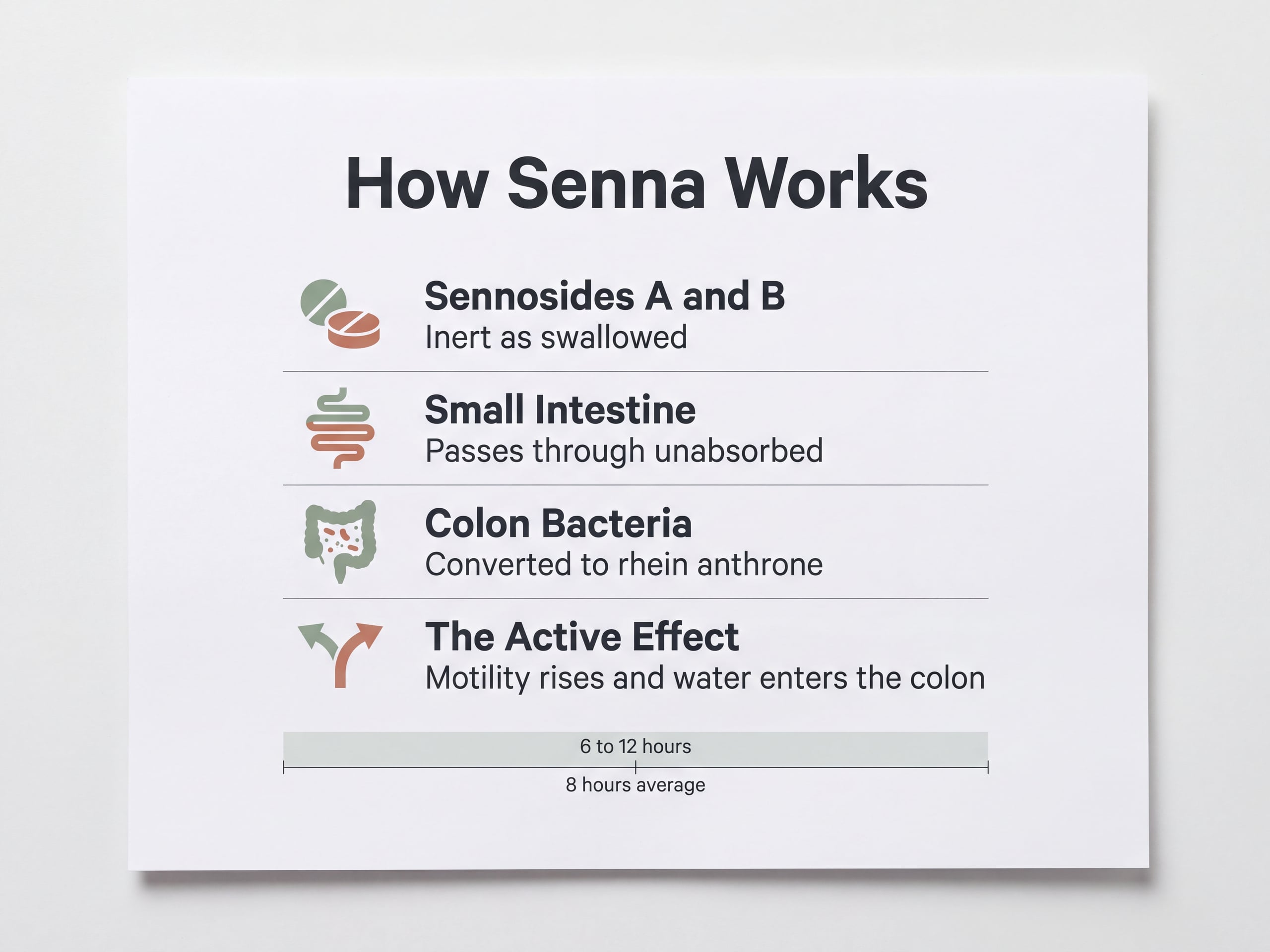
Senna is a stimulant laxative derived from the dried leaflets and pods of Senna alexandrina, a shrub native to the Nile valley, the Arabian peninsula, and parts of India. Its activity comes from sennosides A and B, which are anthraquinone glycosides that pass through the small intestine unabsorbed and are converted by colonic bacteria into the active metabolite rhein anthrone. That metabolite increases intestinal motility and shifts fluid into the colon, typically producing a bowel movement in 6 to 12 hours (Yamauchi et al., 1993, Pharmacology, PMID: 8234433).
What Is Senna? Botanical and Historical Background
The genus Senna contains hundreds of species, but two supply nearly all commercial material. Senna alexandrina is the accepted botanical name, and older literature and some current product labels still use the synonyms Cassia angustifolia for the Tinnevelly type grown in India and Cassia acutifolia for the Alexandrian type from the Nile region. Both are legumes in the family Fabaceae. The pods run slightly higher in sennoside content than the leaves and tend to be gentler in practice, which is why some traditional preparations favored them.
Senna entered Western pharmacy through Arabic medicine, where physicians in the ninth century were already writing about its use. It appears across Unani, Ayurvedic, and later European herbal practice, almost always with the same framing: a short-term purgative rather than a daily tonic. In our sourcing experience, that framing has been remarkably stable across traditions and centuries, which is unusual for a botanical.
How Does Senna Work in the Colon?
Sennosides are prodrugs. They are inert when swallowed and stay that way through the stomach and small intestine because their sugar groups block absorption. Once they reach the colon, bacterial enzymes cleave those sugars and reduce what remains into rhein anthrone, the compound that does the actual work.
Rhein anthrone acts on the colon along two tracks at once. It increases propulsive motility, meaning the wave-like contractions that move stool toward the rectum come more frequently and with more force. It also alters fluid handling, reducing water and electrolyte absorption out of the colon while increasing secretion into it, so the stool arrives softer and bulkier.
The cellular detail is more interesting than the standard consumer explanation of “it irritates the bowel lining.” Work on human intestinal epithelial cells found that rhein anthrone at low doses changed cell shape and organelle activity in ways consistent with raised metabolism, and that it raised prostaglandin E2 release to roughly 140 percent of control values when epithelial cells were combined with peripheral blood mononuclear cells (Geboes et al., 1993, Pharmacology, PMID: 8234441). A separate study showed that combining indomethacin, which blocks prostaglandin synthesis, with nifedipine, a calcium channel blocker, completely blocked rhein anthrone’s purgative effect in animal models (Yamauchi et al., 1993, Pharmacology, PMID: 8234433). Prostaglandins and calcium signaling, not simple irritation, carry the effect.
Why Does Senna Take 6 to 12 Hours to Work?
The delay is not absorption time. It is the bacterial conversion step. Sennosides have to physically travel the length of the small intestine, reach the colonic microbiota, and be metabolized into rhein anthrone before anything begins. Nothing happens until that conversion occurs, which is why the onset window is measured in hours rather than minutes and why it is fairly consistent between people.
It also explains two things that confuse people. Rectal preparations such as suppositories and enemas work far faster, often within minutes to an hour, because they bypass the transit entirely and deliver the active compound where it acts. And individual variation in onset tracks partly with individual differences in gut flora, which is one of the more direct illustrations of how the microbiome shapes a drug response.
Does Senna Actually Work for Constipation?
Yes, and the effect size is well documented. In a prospective double-blinded randomized placebo-controlled trial of 90 patients with chronic idiopathic constipation, 69.2 percent of the senna group reported overall symptom improvement over 28 days against 11.7 percent in the placebo group, a difference significant at P less than 0.0001. Spontaneous bowel movements, complete spontaneous bowel movements, and quality-of-life scores all improved significantly against placebo, and the frequency of severe treatment-related adverse events was zero (Morishita et al., 2021, American Journal of Gastroenterology, PMID: 32969946).
What Does the Research Say?
That 2021 trial is the strongest single piece of evidence, and it is worth noting what it compared. Senna at 1.0 g was tested head-to-head against magnesium oxide at 1.5 g and against placebo. The two active arms performed almost identically, 69.2 percent for senna and 68.3 percent for magnesium oxide, which undercuts the common assumption that stimulant laxatives are inherently more aggressive or more effective than osmotic ones.
At the guideline level, the American Gastroenterological Association and the American College of Gastroenterology jointly reviewed the pharmacological management of chronic idiopathic constipation in 2023. Their panel issued strong recommendations for polyethylene glycol, sodium picosulfate, linaclotide, plecanatide, and prucalopride. Senna received a conditional recommendation, in the same tier as fiber, lactulose, magnesium oxide, and lubiprostone (Chang et al., 2023, Gastroenterology, PMID: 37211380). Conditional means the panel judged the balance of benefits, harms, cost, and patient values to favor its use in most cases while acknowledging the evidence certainty is lower than for the strongly recommended agents. Anyone describing senna as guideline-endorsed without that qualifier is overstating it.
Is Senna a Powerful Laxative?
It is potent relative to bulk-forming agents and stool softeners, and comparable to other stimulant laxatives such as bisacodyl. But the 2021 trial data places it roughly level with magnesium oxide rather than in a separate tier above osmotic agents. The practical distinction is speed and mechanism rather than raw force. Senna acts on the colon directly and predictably within a defined window, whereas osmotic agents work more gradually by drawing water in.
Is Senna Safe to Take?
For short-term use in healthy adults, the safety record is good. The 2021 randomized trial recorded zero severe treatment-related adverse events across 28 days of daily use. Most reactions people encounter are cramping, urgency, and loose stools, all of which resolve after stopping. The meaningful safety questions are not about a single week of use. They concern specific populations, specific drug combinations, and habitual long-term use, all covered further down this article.
How Do You Take Senna Safely?
Senna is available as tablets, capsules, liquids and syrups, teas, and rectal preparations. Dosing is expressed in milligrams of sennosides rather than milligrams of plant material, which is the number that matters and the number most consumer articles omit.
How Many Senna Tablets Equal a Standard Dose?
The most common over-the-counter tablet strength in the United States is 8.6 mg of sennosides per tablet, which is the strength listed on DailyMed labels for products including senna and docusate combinations. Two tablets deliver roughly 17.2 mg. Standalone senna tablets sold in the United Kingdom typically come in 7.5 mg strengths, and some products are formulated at 15 mg, which is why “two tablets” is meaningless without knowing the product.
| Age group | Typical starting daily dose (sennosides) | Notes |
|---|---|---|
| Adults and children over 12 | 15 to 30 mg, taken once daily | Start at the low end. Do not exceed the product’s stated daily maximum. |
| Children 6 to 12 years | Roughly 7.5 to 15 mg, per label or clinician | Use pediatric formulations. Medical guidance first. |
| Children under 6 years | Not recommended without supervision | Requires clinician direction and a pediatric product. |
| Older adults | Lower end of the adult range | Greater sensitivity to fluid and electrolyte shifts. |
| Sources: DailyMed sennosides product labeling, Mayo Clinic senna oral route monograph, NHS senna medicines guidance. | ||
The goal is the lowest dose that produces a soft, formed stool. Escalating past the label maximum does not make senna work better; it makes cramping and fluid loss worse.
Why Take Senna at Night, and Can You Take It in the Morning?
The bedtime convention exists entirely because of the 6 to 12 hour onset. Taking senna at around 10 pm puts the expected bowel movement somewhere between 4 am and 10 am, which lands in a convenient window for most people.
There is nothing pharmacologically wrong with a morning dose. The consequence is simply that the effect arrives in the late afternoon or evening, so it works if you are home and it does not if you have a commute or a full day out. People who take senna in the morning generally do so deliberately, either because they want to avoid being woken or because their schedule makes an evening result easier to manage. The same reasoning applies to branded products such as Senokot, which contain the same sennosides and follow the same timing.
How Do You Know If Senna Is Working?
The first signal most people notice is a mild increase in gut sounds and a sense of movement in the lower abdomen, often several hours before anything else. Light cramping usually follows, and then the urge to go. A good response is a soft, formed stool passed without straining. That is the target, and it is worth being specific about, because two other outcomes get misread as success.
Watery diarrhea is not a good response. It means the dose was too high for you, and the correct adjustment is downward at the next use, not a repeat dose. Passing a small amount with continued fullness afterward is a partial response, which usually means hydration was inadequate or the stool was already impacted higher up.
What If Senna Hasn’t Worked After 12 Hours?
Nothing after the full window is common enough that it deserves a plan rather than guesswork. Work through this order:
- Check fluid intake first. Senna works by shifting water into the colon. If you are underhydrated, there is less water available to shift, and the mechanism underperforms. Aim for six to eight glasses across the day while using any laxative.
- Check the actual dose in milligrams. Not tablets. If you took a single 7.5 mg tablet, you took half of a typical starting adult dose.
- Check the timing honestly. Twelve hours from a 9 pm dose is 9 am, not 6 am. Onset averages around 8 hours, but the window runs to 12.
- Do not stack a second dose on top. This is the most common mistake, and it is the one that produces the cramping and watery diarrhea people then blame on the plant. Wait for the next scheduled dose.
- Apply the three-day rule. If constipation has not resolved after three days of appropriate use, stop and speak with a clinician rather than continuing to increase the amount.
- Stop immediately for severe abdominal pain, vomiting, rectal bleeding, or any suspicion of obstruction.
What Should You Avoid While Taking Senna?
The single most actionable item on this list is the one most consumer articles leave out entirely.
- Other oral medications within two hours. Senna speeds intestinal transit, which can reduce how much of a co-administered drug gets absorbed. Separating doses by at least two hours is the standard advice in the Mayo Clinic monograph.
- Other stimulant laxatives. Combining senna with bisacodyl or sodium picosulfate compounds cramping and electrolyte loss without a proportionate gain.
- Inadequate fluids. Using any laxative while underhydrated raises the risk of dehydration and makes the result worse, not better.
- Extended daily use. One week is the standard ceiling without clinician direction.
- Use during an undiagnosed abdominal problem. Unexplained pain, nausea with vomiting, or a sudden change in bowel habit need assessment before a laxative, not after.
What Are Senna’s Side Effects, and How Long Do They Last?
Most people who take senna at a label dose for a few days experience either nothing beyond the intended effect or mild, self-limiting cramping.
Common Reactions
- Abdominal cramping or discomfort
- Bloating and gas
- Loose stools or mild diarrhea
- Nausea
- Yellow-brown or reddish urine discoloration, which is harmless
The urine color change deserves an explanation rather than just reassurance. It comes from rhein and related anthraquinone metabolites being excreted renally after absorption. The pigment is the compound itself passing through, not a sign of anything happening to the kidneys, and it stops when use stops.
How Long Do Senna’s Side Effects Last?
Cramping is tied to the active phase and generally settles within a few hours of the bowel movement. Loose stools typically resolve within 24 to 48 hours of the last dose as the rhein anthrone clears and normal colonic fluid handling resumes. Urine discoloration fades over one to two days. Bloating and gas usually track with the cramping and end alongside it.
Anything persisting beyond about 48 hours after stopping is outside the expected pattern and should be discussed with a clinician rather than waited out, particularly persistent diarrhea, which carries its own dehydration and electrolyte risk.
Less Common but More Serious Reactions
- Electrolyte disturbance, particularly low potassium. Associated with chronic or excessive use. Signs include muscle weakness, fatigue, and irregular heartbeat.
- Dehydration. Where diarrhea is severe or fluid intake is poor.
- Melanosis coli. A benign brownish pigmentation of the colonic lining seen at colonoscopy in long-term anthraquinone users. It reverses after discontinuation.
- Allergic reaction. Rare. Rash, itching, swelling, severe dizziness, or difficulty breathing require immediate medical attention.
- Perineal blistering. Documented mainly in children, covered in the pediatric section below.
Who Should Avoid Senna Entirely?
Senna is contraindicated in anyone with a known allergy to senna or sennosides, intestinal obstruction, appendicitis or symptoms suggesting it, acute inflammatory bowel disease such as Crohn’s disease or ulcerative colitis, unexplained abdominal pain, severe dehydration with electrolyte depletion, or fecal impaction.
Pregnancy warrants separate mention. Senna is generally not advised during pregnancy given limited safety data and the theoretical concern about stimulating uterine activity. During breastfeeding, small quantities may pass into milk, and short-term use at recommended doses is usually considered compatible, but this is a conversation to have with a clinician rather than a decision to make from an article.
Senna Side Effects in Older Adults
Older adults are more sensitive to senna for reasons that compound. Age-related reductions in total body water mean the same fluid shift produces a larger relative effect. Kidney function declines with age, narrowing the margin on potassium handling. And older adults are far more likely to be taking diuretics, digoxin, or both, each of which interacts with senna’s electrolyte effects.
The practical adjustment is to start at the bottom of the adult range, keep fluid intake deliberately high, and treat any muscle weakness or palpitations as a reason to stop and seek assessment rather than something to push through. Constipation is also common enough in older adults that the underlying cause deserves investigation rather than indefinite laxative management.
Senna Side Effects in Children
Pediatric senna use has better data behind it than most people assume, and one specific finding that almost no consumer source reports. A review at a pediatric colorectal center analyzed 640 patients prescribed senna between 2014 and 2017 alongside the published literature. Seventeen patients, or 2.2 percent, developed perineal blistering during treatment. Every episode was linked to a nighttime accident with prolonged stool-to-skin contact, and the affected patients were on significantly higher doses, a median of 60 mg per day against 17.5 mg. A further 83 patients, 13 percent, had minor effects such as cramping, vomiting, or diarrhea that resolved when the laxative was changed (Vilanova-Sanchez et al., 2018, Journal of Pediatric Surgery, PMID: 29429768).
The practical guidance that falls out of this is specific and useful: for children who are not toilet trained, frequent diaper changes overnight substantially reduce the main risk associated with senna. That review found no other major side effect in the pediatric population.
Possible Interactions with Other Medications
- Diuretics. Additive potassium loss raises the risk of hypokalemia.
- Digoxin. Low potassium increases susceptibility to digoxin toxicity.
- Warfarin. Senna-induced diarrhea may alter absorption and vitamin K status, affecting anticoagulation. Monitoring is advised.
- Corticosteroids. Additional potassium-depleting effect.
- Other stimulant laxatives. Compounded cramping and electrolyte disturbance.
- Any oral medication where absorption matters. Faster transit can reduce uptake. Separate by at least two hours.
Senna Tea vs Senna Tablets: What Is the Difference?
The difference that matters is dose certainty, not strength or naturalness. A standardized tablet states its sennoside content on the label, commonly 8.6 mg per tablet, because it is manufactured to a specification. Loose-leaf senna tea carries no such number. The delivered dose depends on how much leaf material went into the cup, how finely it was cut, how long it steeped, the water temperature, and the sennoside content of that particular harvest, which varies with growing conditions and plant part.
In our hands-on assessment of botanical material, sennoside content in senna leaf varies meaningfully between lots even from the same origin, and pods generally run higher than leaves. That variability is invisible in a teacup. Two cups brewed the same way from different batches can deliver noticeably different doses, which is the most common reason people report that senna tea “did nothing” one night and was uncomfortably strong the next.
This applies to the commercial senna teas as well. Products marketed for regularity, including the widely sold blends built around senna leaf, are still delivering an unstated sennoside quantity per serving. The tea is not gentler by nature. It is simply less predictable, and unpredictability in a stimulant laxative runs in both directions.
Tea has a genuine advantage in that fluid comes with the dose, and senna works better when the colon has water to move. If you prefer the tea form, steep for a consistent time, use the same product each time, and treat the first use of any new batch as a lower-confidence dose.

Can Senna Be Used Long Term?
The standard answer is no, and one week is the usual ceiling without clinician direction. That guidance is sound, but the reasoning behind it is repeated far more confidently than the evidence supports, and the distinction is worth drawing carefully.
Two separate claims usually get bundled together. The first is that chronic stimulant laxative use causes electrolyte depletion, particularly potassium loss, and can cause melanosis coli. Both are documented, and both are real reasons to keep use short. The second is that the colon becomes dependent on the stimulant and stops working on its own, sometimes called lazy bowel or atonic colon. That claim is far weaker than its ubiquity suggests.
The pediatric review discussed above examined this directly and reported no evidence of tolerance to senna, either in their own 640-patient cohort or in the literature they surveyed, and noted specifically that clinicians commonly avoid senna over tolerance concerns that have “little scientific justification” (Vilanova-Sanchez et al., 2018, Journal of Pediatric Surgery, PMID: 29429768). The 2023 AGA-ACG guideline, which reviewed the evidence systematically, issued a conditional recommendation for senna rather than a warning against it (Chang et al., 2023, Gastroenterology, PMID: 37211380).
Our reading of this is not that long-term senna use is fine. The electrolyte concerns alone justify the short-course convention, and the honest position is that the long-term data in adults is thin rather than reassuring. What we would say is that the dependence narrative has been stated as settled fact in consumer health writing for decades on evidence that does not carry that weight. If you have been using senna regularly and are worried you have caused permanent damage, that concern is likely larger than the evidence warrants, and it is a reasonable thing to raise with a clinician rather than to carry quietly.
The more useful reframing is that needing a stimulant laxative more than two or three times a week is information, not a failure. It usually points to an underlying cause worth identifying, whether that is diet, hydration, medication, thyroid function, or something else.
How Does Senna Compare to Other Laxatives?
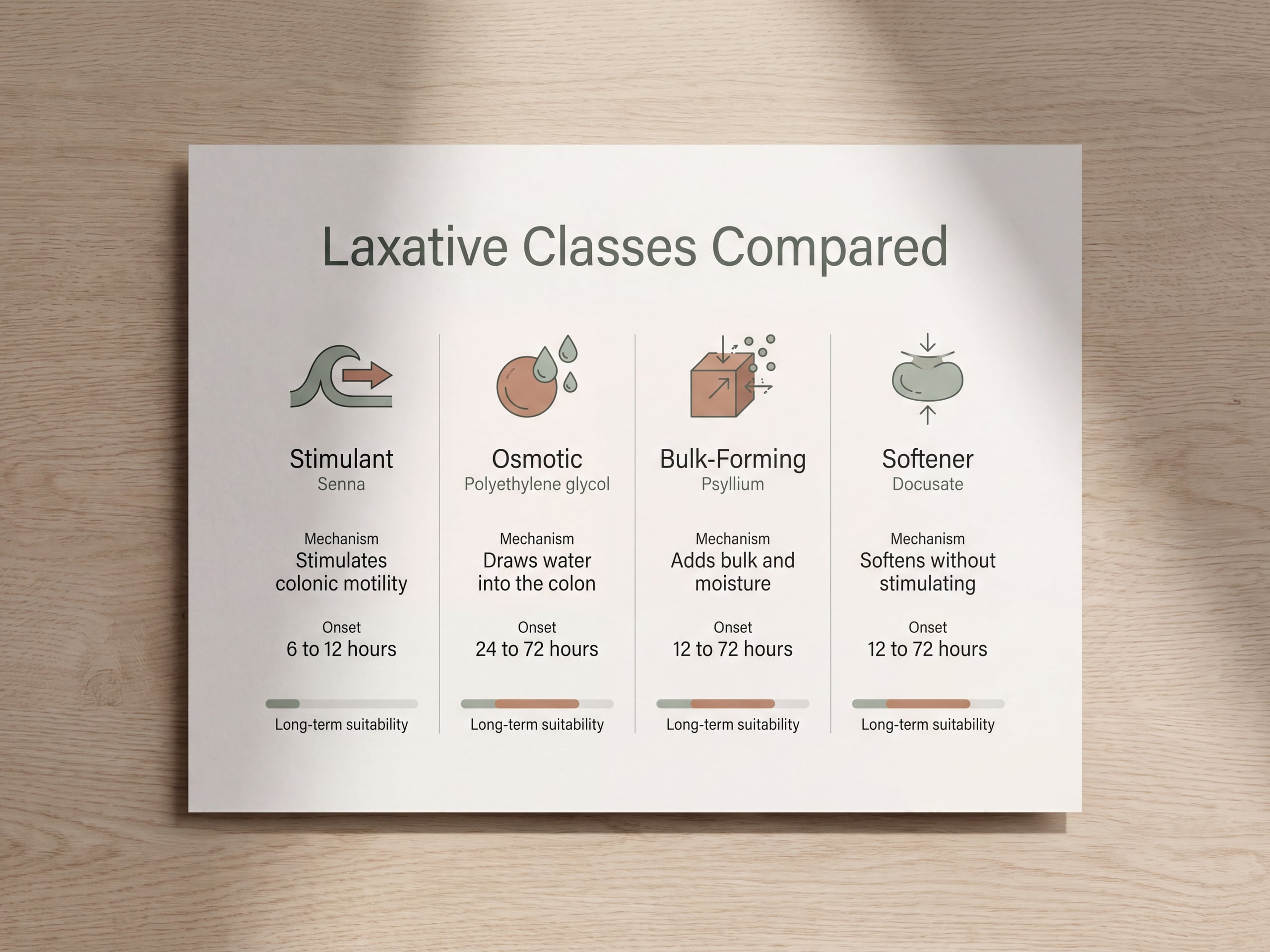
Laxatives are grouped by mechanism, and mechanism determines what each one is good for.
The Main Laxative Classes
- Bulk-forming agents. Psyllium (Plantago ovata), methylcellulose, calcium polycarbophil. Fibers that absorb water and increase stool bulk, prompting natural contractions. Generally suitable for long-term use. Require adequate fluid.
- Osmotic laxatives. Polyethylene glycol 3350, lactulose, magnesium hydroxide, magnesium citrate. Draw water into the colon by osmosis. Polyethylene glycol carries a strong AGA-ACG recommendation and suits longer-term management. Magnesium-based products need caution in kidney disease.
- Stool softeners. Docusate sodium and docusate calcium. Surfactants that let water and fats penetrate the stool. They soften but do not stimulate.
- Lubricants. Mineral oil. Coats stool and bowel lining. Not advised long-term because of fat-soluble vitamin malabsorption and aspiration risk.
- Other stimulants. Bisacodyl, sodium picosulfate. Same general mechanism as senna with a similar side effect profile.
Miralax vs Senna: Which Suits Which Situation?
This is the most common direct comparison people ask about, and the honest answer favors polyethylene glycol for ongoing management and senna for occasional use where a predictable timeframe matters.
| Factor | Senna (stimulant) | Polyethylene glycol 3350 (osmotic) | Psyllium (bulk-forming) | Docusate (softener) |
|---|---|---|---|---|
| Mechanism | Stimulates colonic motility, shifts fluid in | Draws water into colon by osmosis | Adds bulk and moisture, prompts natural contraction | Lets water and fat penetrate the stool |
| Typical onset | 6 to 12 hours | 24 to 72 hours | 12 to 72 hours | 12 to 72 hours |
| Best suited to | Occasional constipation needing a predictable window | Ongoing management of chronic constipation | Maintaining day-to-day regularity | Preventing straining after surgery or childbirth |
| Long-term suitability | Limited. One week without clinician direction | Good | Good | Moderate, usually adjunctive |
| Common side effects | Cramping, urgency, urine discoloration | Bloating, gas, nausea | Gas and bloating, especially initially | Generally mild |
| 2023 AGA-ACG recommendation | Conditional | Strong | Conditional (fiber) | Not separately recommended |
| Recommendation strength per Chang et al., 2023, Gastroenterology, PMID: 37211380. | ||||
The recommendation strengths in that final row are the part worth carrying away. Polyethylene glycol is strongly recommended, and senna is conditionally recommended, which is a real distinction that commercial comparison pages tend to flatten.
Can You Take Senna with Docusate?
Yes, and the combination is common enough to be sold as a single product. Senna and docusate combinations pair a stimulant with a softener so the stool is both moved and made easier to pass. DailyMed labeling for a typical 8.6 mg sennosides plus 50 mg docusate sodium softgel lists two softgels once daily for adults and children 12 and over, with a maximum of four softgels twice daily, one softgel once daily for children 6 to under 12, and no use in children under 6 without direction.
The combination makes most sense where straining is the specific problem, such as after surgery, after childbirth, or with hemorrhoids or anal fissures, where the aim is a soft stool passed with minimal effort. It is still a short-course product, and the senna component carries all the same considerations covered above.
Herbal Alternatives to Senna for Regularity
Senna’s role is occasional and short-term. For day-to-day regularity, gentler approaches suit better because they work with normal bowel function rather than overriding it.
- Psyllium husk (Plantago ovata). The most evidence-supported bulk-forming fiber. Suitable for daily use. Needs to be taken with a full glass of water.
- Flaxseed (Linum usitatissimum). Provides soluble fiber plus mucilage that softens stool. Ground seed is more effective than whole.
- Triphala. The Ayurvedic combination of amalaki (Phyllanthus emblica), bibhitaki (Terminalia bellirica), and haritaki (Terminalia chebula), used traditionally as a gentle daily bowel tonic rather than a purgative.
- Prunes and sorbitol-containing fruits. Sorbitol is a sugar alcohol that works osmotically, drawing water into the colon.
- Magnesium. Magnesium oxide performed comparably to senna in the 2021 randomized trial (PMID: 32969946). Requires caution in kidney disease.
- Digestive bitters. Bitter botanicals such as boldo (Peumus boldus) and jurubeba (Solanum paniculatum) stimulate bile flow and support the migrating motor complex, the housekeeping wave that sweeps the digestive tract between meals. This is a motility approach rather than a stimulant one.
That last category is where our own formulation work sits. Our Bowel Regularity Capsules use a South American bitter blend built around boldo and jurubeba to support bile flow and motility rather than to force a bowel movement, which is a different strategy from senna and suits people who want daily support without the short-course constraint. Our Bowel Regularity Powder delivers the same bitter blend in whole-herb form for anyone who prefers a bitters shot, though the taste is genuinely intense.
Beyond Laxatives: Diet, Hydration, and Movement
For a large share of people, constipation responds to changes that do not involve a laxative at all.
Fiber. Aim for 25 to 35 grams daily from fruits, vegetables, whole grains, legumes, nuts, and seeds. Increase gradually. Jumping straight to a high intake reliably produces gas and bloating.
Fluids. Fiber without adequate water can worsen the problem rather than help it. The two work together.
Movement. Physical activity stimulates intestinal motility. A daily walk is enough to make a difference for many people.
Timing and habit. Colonic activity rises after eating, particularly after breakfast, and it rises on waking. Allowing unhurried time in that window works with the body’s own rhythm. Ignoring the urge when it arrives allows more water to be reabsorbed, which makes the stool harder and the next attempt more difficult.
When Should You See a Doctor About Constipation?
Speak with a healthcare professional if any of the following apply:
- Constipation persists beyond one to two weeks despite laxative use and lifestyle changes
- Constipation has not resolved after three days of appropriate senna use
- There is a sudden unexplained change in bowel habit lasting more than a few days
- Severe abdominal pain, rectal bleeding or blood in the stool, unexplained weight loss, fever, or vomiting accompany the constipation.
- You find yourself needing a laxative more than two or three times a week
- You have kidney disease, heart disease, or diabetes, or take multiple medications
- The person affected is a child, pregnant, or breastfeeding
A clinician can identify the cause, rule out conditions that constipation can signal, and build a plan for the longer term. That plan may or may not include senna.
Frequently Asked Questions
How long does senna take to work?
Senna typically produces a bowel movement in 6 to 12 hours, with roughly 8 hours being average. The delay exists because sennosides must reach the colon and be converted by gut bacteria into rhein anthrone before they become active. Rectal preparations such as suppositories work much faster, often within minutes to an hour, because they bypass that transit.
How many senna tablets should I take?
Dose by sennoside milligrams rather than tablet count, because strengths differ between products. The common United States over-the-counter tablet is 8.6 mg of sennosides, while United Kingdom products are often 7.5 mg and some formulations are 15 mg. A typical adult starting dose is 15 to 30 mg of sennosides once daily. Follow the specific product label.
Can I take senna in the morning instead of at night?
Yes. Bedtime dosing is a convention based on the 6 to 12 hour onset, which puts the result in the morning. A morning dose simply moves the expected effect to late afternoon or evening. Choose based on when being near a bathroom is easiest for you.
What if senna has not worked after 12 hours?
Check your fluid intake, confirm the actual milligram dose you took, and confirm the full 12 hours have genuinely passed. Do not take a second dose on top of the first, which mainly increases cramping. If constipation has not resolved after three days of appropriate use, stop and speak with a clinician. Severe pain, vomiting, or rectal bleeding warrant immediate attention.
How long do senna’s side effects last?
Cramping usually settles within a few hours of the bowel movement. Loose stools generally resolve within 24 to 48 hours of the last dose. Harmless yellow-brown or reddish urine discoloration fades over one to two days. Anything persisting more than about 48 hours after stopping should be discussed with a clinician.
Is senna tea safer than senna tablets?
Not inherently. The meaningful difference is dose certainty. Tablets state their sennoside content on the label, while tea delivers an unstated amount that varies with leaf quantity, cut, steep time, water temperature, and the sennoside content of that particular batch. That unpredictability runs in both directions, so tea can deliver less than expected or more.
Can I take senna with docusate?
Yes, and the two are commonly sold as a single combination product pairing a stimulant with a stool softener. A typical label for an 8.6 mg sennosides plus 50 mg docusate sodium softgel lists two softgels once daily for adults and children 12 and over. The combination suits situations where straining is the specific problem, such as after surgery or childbirth.
What should I avoid while taking senna?
Avoid taking other oral medications within two hours, since senna speeds transit and can reduce their absorption. Avoid combining it with other stimulant laxatives, avoid using it while underhydrated, and avoid daily use beyond one week without clinician direction. Do not use senna for undiagnosed abdominal pain or where obstruction is possible.
Does senna cause laxative dependence?
The dependence claim is stated more confidently in consumer health writing than the evidence supports. A review of 640 pediatric patients found no evidence of tolerance developing and noted that clinical avoidance of senna over tolerance concerns has little scientific justification (PMID: 29429768). The documented reasons to keep courses short are electrolyte depletion and melanosis coli rather than proven dependence.
Related Reading
Continue with our guides on the best herbs for digestive health, whether colon cleansing is safe, and how the gut microbiome shapes immunity. The microbiome article is particularly relevant here, since the same colonic bacteria that train your immune system are the ones that convert sennosides into their active form.
Disclaimer
These statements have not been evaluated by the Food and Drug Administration. This product is not intended to diagnose, treat, cure, or prevent any disease. Consult your healthcare provider before use.
This article is educational and is not a substitute for medical advice. Senna sold as an over-the-counter laxative is regulated as a nonprescription drug product, and the dosing information here reflects published product labeling and clinical references rather than a recommendation for any individual.