Key Takeaways
- No herbal supplement has been shown to be both safe and effective for erectile dysfunction, according to the National Institutes of Health.
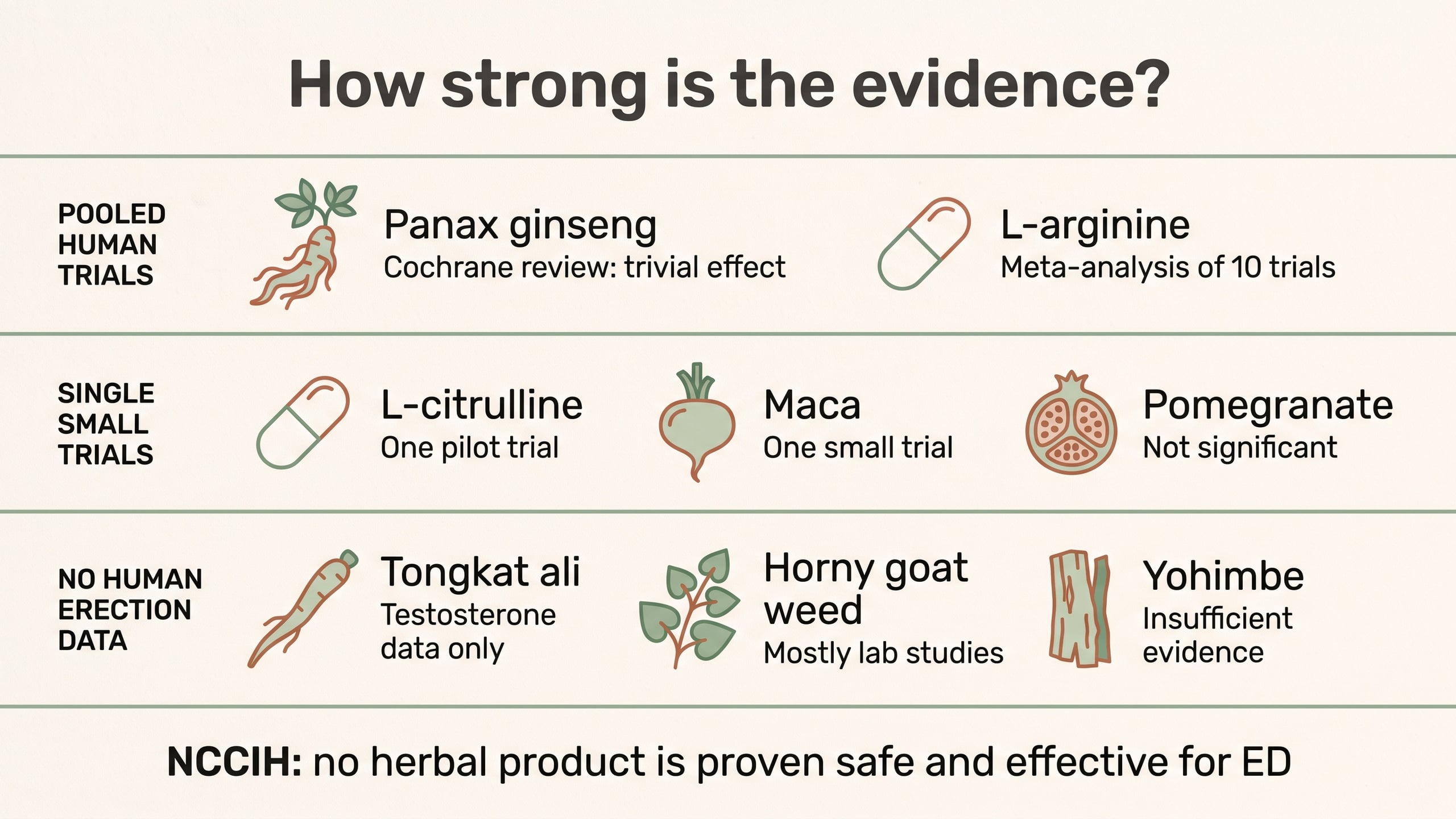
- Panax ginseng is the best-studied herb for erections, yet a Cochrane review of nine trials rated its effect as trivial.
- The biggest danger is hidden drugs: 45.5% of adulterated supplements flagged by the FDA from 2007 to 2016 were sold for sexual enhancement.
- A natural pill promising results within 30 to 40 minutes matches an FDA warning sign for products containing undeclared prescription drugs.
- Erectile dysfunction can be an early sign of heart disease or diabetes, and urologists advise that lifestyle changes may improve erectile function.
Natural erection pills are among the most searched supplements online, and among the most misrepresented. As many as 30 million American men have erectile dysfunction (ED), according to the National Center for Complementary and Integrative Health (NCCIH), and many try an over-the-counter product before they ever speak with a doctor. Our editorial team reviewed the clinical trials, the Cochrane evidence, the 2018 American Urological Association guideline, and FDA enforcement data to answer a plain question: what is actually in these pills, and does any of it work?
The short version: the research on most herbal ingredients is small, short, and inconsistent, and the most serious risk isn’t the herbs at all. It’s prescription drug ingredients that never appear on the label. Below, we grade each common ingredient, explain the safety problems, and cover the steps that have better support.
What are natural erection pills, and are they regulated?
Natural erection pills are over-the-counter dietary supplements, usually blends of herbs, amino acids, and minerals, sold with claims about erections or sexual performance. Unlike prescription ED medications, they reach store shelves without FDA review for safety or effectiveness, and NCCIH states there is no definite evidence that any herbal product is safe or effective for ED.
That regulatory gap has practical consequences. Supplement makers are responsible for the safety and labeling of their own products, and the FDA does not approve a supplement before it goes on sale. Quality, dose, and purity can vary between brands and even between batches of the same product. NCCIH also notes that much of the research on herbs for ED has been done in animals rather than people.
What does the research actually show about herbal supplements for ED?
The largest recent meta-analysis pooled 14 randomized trials involving 1,227 men with ED and found that herbal supplements improved erectile-function scores over placebo (standardized mean difference 1.20). Saffron and ginseng showed measurable benefit, while the evidence for maca and other agents was rated insufficient (Ho et al. 2025, Journal of Traditional and Complementary Medicine, PMID: 41696741).
The Cochrane review of ginseng reached a more cautious verdict. Cochrane reviews use some of the strictest methods in medical research, and this one included nine randomized trials with 587 men who had mild to moderate ED, all comparing ginseng with placebo for up to 12 weeks. Ginseng raised the erectile-function score on the International Index of Erectile Function (IIEF-15) by 3.52 points, short of the 4-point change considered the smallest difference patients are likely to notice. The reviewers rated the effect trivial, at low certainty (Lee et al. 2021, Cochrane Database of Systematic Reviews, PMID: 33871063).
How can both findings be true?
They measure different things. A meta-analysis asks whether an effect is statistically distinguishable from placebo. Cochrane’s grading asks whether that effect is large enough for a man to notice in daily life. A supplement can clear the first bar and still miss the second. Pooling also mixes different herbs, doses, and trial lengths, so one combined number can’t tell you how a specific product will perform.
From our review of these trials, two patterns repeat: they’re small, and they’re short. NCCIH notes that most ginseng trials have had fewer than 200 participants and lasted less than three months. When a label says an herb is “clinically proven” for erections, the gap between a statistical change and a meaningful one is usually where the claim stretches.
Which ingredients are in natural erection pills, and what did the trials find?
Most products combine a handful of the same ingredients. Here is what the human research shows for each, starting with the best-studied.

Does Korean red ginseng help erections?
Panax ginseng C.A. Meyer, the Korean red ginseng often marketed as “herbal Viagra,” is the most studied herb for erectile function. Its main compounds, the ginsenosides, have been studied for effects on nitric oxide signaling, the pathway that relaxes smooth muscle so blood can fill erectile tissue. In human trials, the average benefit was small. Cochrane rated it trivial on the IIEF scales, although men taking ginseng were more likely to report being able to have intercourse (risk ratio 2.55, low certainty).
NCCIH’s Asian ginseng fact sheet says short-term use of up to six months appears to be safe for most people. Insomnia is the most common side effect; ginseng may lower blood sugar, and it may interfere with blood clotting, so anyone taking diabetes medication or blood thinners should check with a clinician first. It may also be unsafe during pregnancy. Siberian ginseng (Eleutherococcus senticosus) is a different plant altogether, as our comparison of Siberian ginseng and Panax ginseng explains.
What dose of L-arginine has been studied for ED?
Trials of L-arginine for mild to moderate ED used 1,500 to 5,000 mg a day. A 2019 meta-analysis of 10 randomized trials in 540 men found better odds of improvement than placebo (odds ratio 3.37), with side effects in 8.3% of men versus 2.3% on placebo, none of them severe (Rhim et al. 2019, Journal of Sexual Medicine, PMID: 30770070).
L-arginine is the amino acid the body uses to make nitric oxide. The catch is absorption: taken by mouth, much of it is broken down before it reaches general circulation, which may help explain why trial results vary. Because it widens blood vessels, it may add to the effect of blood pressure medications and nitrates. The 2018 AUA guideline doesn’t list arginine, or any other supplement, among its options.
Is L-citrulline better absorbed than L-arginine?
L-citrulline largely avoids that early breakdown and is converted to arginine inside the body. In a small single-blind pilot study, 24 men with mild ED took 1.5 g a day for one month. Erection hardness improved from a score of 3 to 4 in 50% of the men while on citrulline, compared with 8.3% while on placebo (Cormio et al. 2011, Urology, PMID: 21195829). The authors described it as worth further research, not an established therapy. Watermelon, especially the rind, is a well-known food source of citrulline, but the trial used purified citrulline, not fruit.
Is horny goat weed safe to take with Viagra or Cialis?
Horny goat weed (Epimedium species) contains icariin, a flavonoid that inhibits the PDE5 enzyme in laboratory studies. That’s the same enzyme targeted by prescription ED drugs such as sildenafil and tadalafil, so combining them is a question for your prescriber, not a way to stack effects. Icariin content is rarely standardized on supplement labels, and human trial data are limited. Our full review of icariin and erectile function covers the chemistry, dosing, and research in depth.
Why is yohimbe the riskiest ingredient?
Yohimbe (Pausinystalia yohimbe) is a central and western African tree whose bark contains the alkaloid yohimbine. NCCIH’s yohimbe fact sheet reports there isn’t enough evidence to judge yohimbe’s effectiveness for any condition, including ED, and links yohimbine to irregular heartbeat, blood pressure problems, heart attacks, and seizures.
Labels are a second problem. The amount of yohimbine in supplements varies; some products contain very little, and yohimbe sold as a supplement may not work like the prescription medication that contains yohimbine. NCCIH also notes that it is illegal in the United States to market an over-the-counter product containing yohimbine as a treatment for ED without FDA approval, and that yohimbe supplements are restricted or banned in many countries. Don’t combine it with MAOIs or tricyclic antidepressants.
An update to earlier versions of this guide: the American Urological Association’s current guideline on ED, published in 2018, does not list yohimbine or any herbal supplement among its treatment options.
Does maca help with erections?
Maca (Lepidium meyenii), an Andean root in the mustard family, has one small trial in men with mild ED. Fifty men taking 2,400 mg of dry extract for 12 weeks gained 1.6 points on the IIEF-5 questionnaire, compared with 0.5 points on placebo, an effect the researchers called small (Zenico et al. 2009, Andrologia, PMID: 19260845). Most other maca trials measured sexual desire or well-being rather than erections (Shin et al. 2010, BMC Complementary and Alternative Medicine, PMID: 20691074). Our guide to black maca for men covers forms, dosing, and quality.
Is tongkat ali an erection supplement?
Tongkat ali (Eurycoma longifolia) is a Southeast Asian root studied mainly for testosterone, not erections. Extracts are often standardized to eurycomanone, one of its marker compounds. A 2022 meta-analysis of five randomized trials found higher total testosterone with supplementation, including in men with low baseline levels (Leisegang et al. 2022, Medicina, PMID: 36013514). Testosterone and erectile function are related, but a testosterone result doesn’t show better erections, particularly in men whose levels are already normal. Our review of tongkat ali trials goes further.
What about DHEA?
Dehydroepiandrosterone (DHEA) is a hormone made by the adrenal glands that the body can convert into testosterone and estrogen. It may be relevant for men with clinically diagnosed low hormone levels, but it’s a hormone, not an herb, and Mayo Clinic notes that long-term or heavy use of DHEA may be linked with some cancers. Take it only with a clinician’s guidance and blood testing.
Do fenugreek, pomegranate, or creatine help?
Fenugreek (Trigonella foenum-graecum). A 2026 meta-analysis of 13 studies found only a small, very low certainty effect on total testosterone, and the authors concluded the evidence does not support claims that it raises testosterone (Yang et al. 2026, Frontiers in Nutrition, PMID: 42688439). Our fenugreek and testosterone review has the details.
Pomegranate (Punica granatum). A 2007 crossover trial of pomegranate juice in 53 men with mild to moderate ED did not reach statistical significance (P = 0.058) (Forest et al. 2007, International Journal of Impotence Research, PMID: 17568759). Pomegranate belongs in a heart-healthy diet, not in a claim about erections.
Creatine. We found no trials testing creatine supplements for erectile function. The FAQ below explains what our search turned up.
Ingredient comparison at a glance
This table summarizes the human evidence for the ingredients found most often in erection supplements.
| Ingredient | Proposed mechanism | Evidence grade | Main safety caution |
|---|---|---|---|
| Panax ginseng (Panax ginseng) | Ginsenosides and nitric oxide signaling | Cochrane review of 9 trials: trivial effect | Insomnia, may lower blood sugar, may affect clotting |
| L-arginine | Building block for nitric oxide | Meta-analysis of 10 trials in 540 men | May add to blood pressure medication and nitrates |
| L-citrulline | Converted to arginine in the body | One small pilot trial (24 men) | Limited long-term data |
| Horny goat weed (Epimedium) | Icariin, a PDE5 inhibitor in lab studies | Mostly laboratory and animal data | Do not combine with ED drugs without a prescriber |
| Yohimbe (Pausinystalia yohimbe) | The alkaloid yohimbine | Insufficient evidence (NCCIH) | Irregular heartbeat, blood pressure problems, seizures |
| Maca (Lepidium meyenii) | Not established | One small trial in mild ED | Short trials only |
| Tongkat ali (Eurycoma longifolia) | Testosterone pathways | Testosterone data only (5 trials) | Limited long-term safety data |
| DHEA | Hormone precursor | Relevant only to diagnosed low hormone levels | Hormone effects, possible cancer link with heavy use |
| Fenugreek (Trigonella foenum-graecum) | Proposed hormone effects | Very low certainty (13 studies) | No erection-specific trials |
| Pomegranate (Punica granatum) | Polyphenols and blood vessel function | One trial, not statistically significant | Studied as juice, not capsules |
| Sources: Lee et al. 2021 (PMID 33871063), Rhim et al. 2019 (PMID 30770070), Cormio et al. 2011 (PMID 21195829), Zenico et al. 2009 (PMID 19260845), Leisegang et al. 2022 (PMID 36013514), Yang et al. 2026 (PMID 42688439), Forest et al. 2007 (PMID 17568759), NCCIH fact sheets. | |||
What is the biggest risk of natural erection pills?
The biggest documented risk isn’t the herbs. It’s undeclared prescription drugs. Of 776 adulterated supplements the FDA identified between 2007 and 2016, 353 (45.5%) were marketed for sexual enhancement, and sildenafil, the active ingredient in Viagra, was the most common hidden drug in that group, found in 166 of them (Tucker et al. 2018, JAMA Network Open, PMID: 30646238).
Shelf testing tells the same story. Researchers analyzed 91 samples of “herbal” or “all natural” sexual enhancement products, most bought at gas stations and convenience stores in two U.S. metropolitan areas. Although none listed a synthetic ingredient, 74 samples (81%) contained PDE5-inhibitor drugs or close chemical analogs, and 18 samples held more than 110% of the highest approved prescription dose. Only 14 samples warned against use with nitrates. The study was coordinated by Pfizer’s global security team, a disclosure worth knowing, and the samples were analyzed by liquid chromatography and mass spectrometry (Campbell et al. 2013, Journal of Sexual Medicine, PMID: 23634714).
These hidden drugs matter most for men with heart conditions. NCCIH’s guidance on supplements marketed for sexual enhancement warns that the drug ingredients can interact with nitrate medications and cause a dangerous drop in blood pressure. Men with diabetes, high blood pressure, high cholesterol, or heart disease often take nitrates, and they frequently have ED. Because these ingredients never appear on the label, the FDA’s public list of tainted sexual enhancement products is worth checking before you buy anything in this category.
What is the best pill for getting an erection quickly?
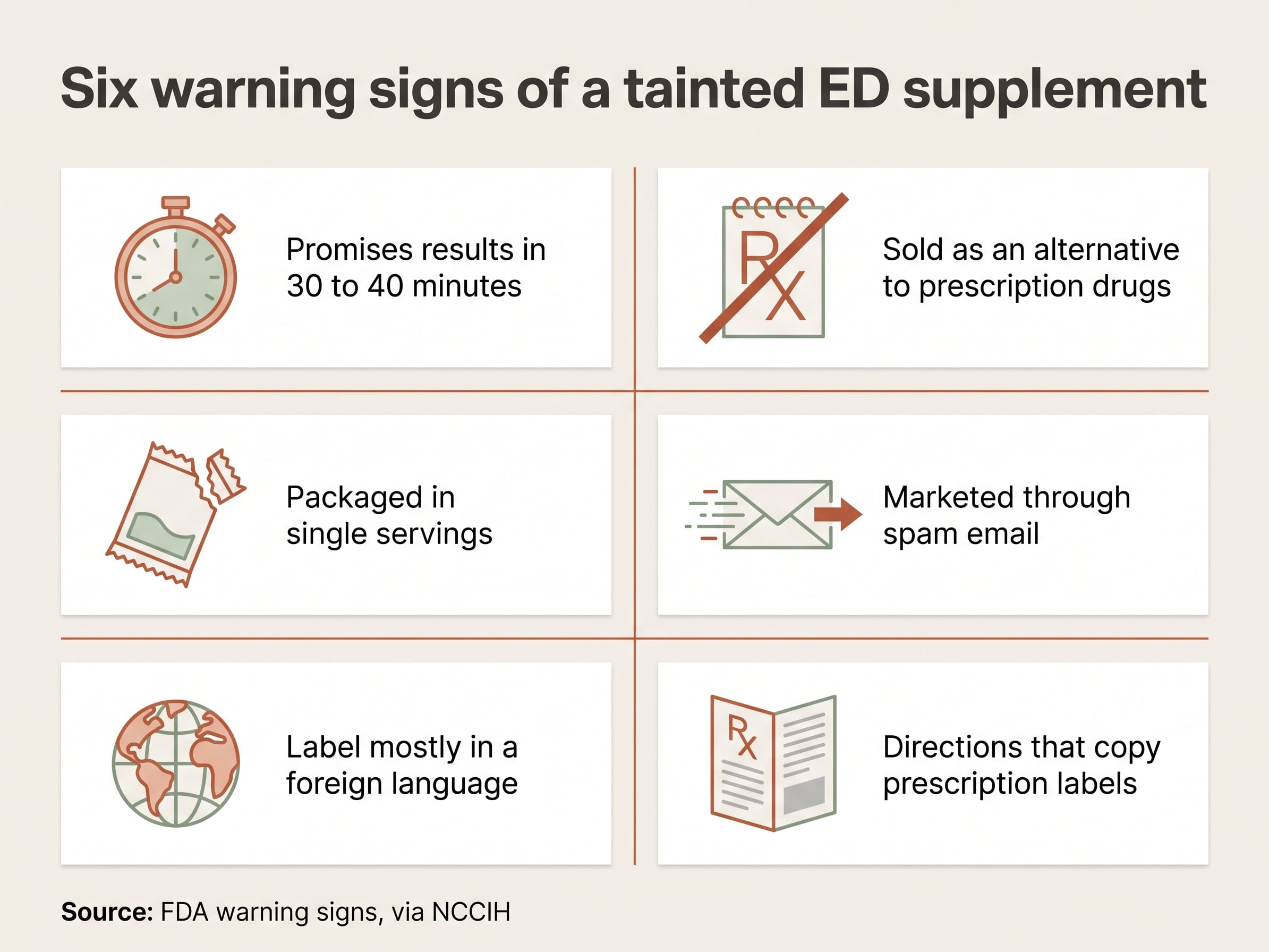
No dietary supplement has been shown to work on demand. The FDA warns consumers to beware of sexual enhancement products that promise results within 30 to 40 minutes, and a supplement that acts that fast is behaving like a drug, which is exactly what FDA testing keeps finding inside these bottles. Fast-acting ED medications do exist, but they require a prescription and a clinician’s review of your heart health and other medicines.
The FDA’s warning signs for ED and sexual enhancement products, as summarized by NCCIH:
- Promise quick results, within 30 to 40 minutes
- Are advertised as alternatives to FDA-approved prescription drugs
- Are sold in single servings
- Are advertised through spam or unsolicited email
- Have labels written mainly in a foreign language
- Have directions and warnings that mimic FDA-approved products
What ingredients in natural erection pills should you avoid?
- Undeclared drug ingredients. You can’t avoid what isn’t listed, so skip products that show the warning signs above and check the FDA’s list before buying.
- Yohimbe or yohimbine, especially if you have heart disease or high blood pressure, or take MAOIs or tricyclic antidepressants.
- DHEA and other hormones taken without blood testing and medical supervision.
- Proprietary blends that list ingredients without amounts, which makes it impossible to know the dose you’re taking.
Can natural erection pills be combined with Viagra or other ED medication?
Not without your prescriber’s input. Several supplement ingredients act on the same systems as prescription ED drugs, and hidden drug ingredients can stack on top of a prescribed dose without your knowledge. The most dangerous combination involves nitrate heart medications, which can drop blood pressure to dangerous levels when taken with PDE5-type drugs. Prescribing information for sildenafil and tadalafil also cautions about alpha-blockers, used for blood pressure and prostate symptoms, because the pairing can lower blood pressure.
The ingredient cautions from earlier sections apply here too: icariin inhibits the same PDE5 enzyme in laboratory studies, yohimbine can raise blood pressure and heart rate, and ginseng may lower blood sugar and interfere with clotting. Our standing advice is simple. Bring the actual bottle to your appointment so your clinician can read every ingredient.
Could erectile dysfunction be a sign of another health problem?
Yes. The American Urological Association guideline advises clinicians to counsel men that ED is a risk marker for underlying cardiovascular disease, and NCCIH lists clogged blood vessels and nerve damage from diabetes as examples of problems ED can signal. That makes a medical evaluation more useful than any supplement, because it can uncover a condition that needs care in its own right.
Expect a medical, sexual, and psychosocial history, a physical exam, and selected blood tests. According to the AUA guideline, the tests most likely to change management are morning testosterone, blood glucose or hemoglobin A1c and, in some men, cholesterol. NCCIH puts the broader point plainly: effective medical treatment for ED is available only through a health care provider.
Which lifestyle changes improve erectile function most?
The AUA guideline advises clinicians to tell men with ED and related health conditions that changes in diet and physical activity improve overall health and may improve erectile function. The habits that protect your heart also protect erections, because both depend on healthy blood vessels.
- Regular aerobic activity. Aim for about 30 minutes of moderate exercise, such as brisk walking, cycling, or swimming, on most days.
- A Mediterranean-style eating pattern. Build meals around vegetables, fruit, legumes, whole grains, fish, nuts, and olive oil, and limit processed foods and added sugar.
- A healthy weight. Excess body fat is tied to diabetes and heart disease, two common drivers of ED.
- No tobacco. The AUA lists tobacco use among the common risk factors for ED.
- Sleep and stress. Chronic stress and short sleep can disrupt hormone levels and sexual function, so aim for seven to eight hours a night.

Do pelvic floor (Kegel) exercises help erections?
They can. In a randomized trial of 55 men with ED, those who did pelvic floor exercises with biofeedback plus lifestyle advice improved their IIEF erectile-function score by 6.74 points at three months, compared with men who received lifestyle advice alone. After the comparison group also switched to the exercises, 40% of all participants had regained normal erectile function by six months, and another 34.5% had improved, while 25.5% did not improve (Dorey et al. 2004, British Journal of General Practice, PMID: 15527607).
The trial taught the technique under professional supervision, and that detail matters. A 2026 case report described muscle breakdown (rhabdomyolysis) in a healthy 36-year-old who began an unsupervised routine of repetitive pelvic floor contractions and glute exercises from online videos (Kelly et al. 2026, Cureus, PMID: 42548911). It’s rare, but it’s a good reason to start gently and, ideally, learn from a pelvic health physical therapist. The basic pattern looks like this:
- Find the right muscles: the ones you would use to stop the flow of urine or hold back gas. Use this only to identify them, not as a routine exercise.
- Tighten them for three to five seconds without clenching your buttocks, thighs, or stomach.
- Relax fully for the same length of time.
- Repeat about 10 times per set, a few sets a day, breathing normally throughout.
- Build up gradually over several weeks rather than all at once.
How long does it take to see results?
No supplement has an established timeline for improving erections, and any product promising results in minutes matches the FDA’s first warning sign. The trials described here ran from one month (citrulline) to 12 weeks (ginseng and maca), so that’s the window in which researchers looked for change. Pelvic floor training showed measurable gains at three months with further improvement by six, and lifestyle changes generally take weeks to months to affect blood vessel health.
How do you choose a safer supplement?
If you and your clinician decide a supplement is worth trying, you can lower the risk. Third-party programs such as the USP Dietary Supplement Verification Program and NSF certification test voluntarily submitted products against published quality standards, including FDA current good manufacturing practices. Verification doesn’t mean a product works. It means the label matches what’s inside and the product isn’t contaminated.
When we evaluate a supplement label, these are the checks we run:
- The species is named with its Latin binomial, along with the plant part used.
- Every ingredient has a stated amount, with no proprietary blends.
- The package carries a lot number and an expiration date.
- Each batch is tested for heavy metals and microbes, and the brand will answer questions about the results.
- The marketing makes no promise of fast results and no comparison with prescription drugs.
We hold our own shelves to the same list. Our Red Ginseng Capsules, for example, name the species (Panax ginseng C.A. Meyer), the plant part (six-year main root) and the growing region (Geumsan-gun, South Korea), and every batch is tested for heavy metals and microbes. We don’t sell them, or anything else we carry, as a treatment for erectile dysfunction. The safest path is still to address the underlying causes of ED with a clinician.
Frequently asked questions about natural erection pills
What can I take naturally for erectile dysfunction?
The best-supported natural steps aren’t pills: regular aerobic exercise, a Mediterranean-style diet, weight management, quitting tobacco, and pelvic floor training. Among supplements, ginseng and L-arginine have the most trial data, but the effects are modest, and NCCIH says there is no definite evidence that any herbal product is safe or effective for ED. Talk with a clinician before trying one.
Is there a natural Viagra?
No supplement is an approved substitute for prescription ED medication. “Herbal Viagra” is a marketing nickname, most often attached to Panax ginseng, and NCCIH notes that many products sold under that label have been found to contain hidden drug ingredients. The Cochrane review found no trials comparing ginseng with prescription ED drugs.
Do over-the-counter ED pills really work?
The evidence is weak for most products, and the bigger concern is what’s inside them. In one analysis of 91 samples, most bought at gas stations and convenience stores, 81% contained prescription drug ingredients or close analogs. Some of these pills may seem to work only because they contain undeclared drugs, which is a safety problem, not a benefit.
Are natural erection pills safe to take every day?
Long-term safety data are thin. Most trials lasted 12 weeks or less, and NCCIH describes short-term ginseng use of up to six months as appearing safe for most people while noting open questions about long-term use. Yohimbe carries cardiac and seizure risks, and hormones such as DHEA need medical supervision.
Can creatine affect erectile dysfunction?
There is no trial evidence either way. When we searched PubMed in September 2026, none of the 14 records pairing creatine with erectile dysfunction tested creatine supplements. They concerned creatine kinase, a blood marker of muscle damage, or other laboratory measurements.
How can I tell if an ED supplement contains hidden drugs?
You can’t tell from the label, because hidden ingredients aren’t listed. Watch for the FDA warning signs, such as promised results within 30 to 40 minutes or claims to replace prescription drugs; check the FDA’s list of tainted products; and choose brands with third-party verification.
Should I see a doctor about erectile dysfunction?
Yes. ED can be an early sign of heart disease, diabetes, or other conditions that need care, and the AUA recommends a medical, sexual, and psychosocial history, a physical exam, and selected lab tests for men with ED. Effective medical treatments are available through a clinician, and the evaluation itself can protect your long-term health.
Related Reading
For more on specific herbs and topics in this area, see our guides to cordyceps for erectile dysfunction, natural libido-enhancing botanicals, and natural testosterone support.
Important: This article is for educational and informational purposes. The statements have not been evaluated by the Food and Drug Administration. The herbs and herbal products discussed are not intended to diagnose, treat, cure, or prevent any disease, including erectile dysfunction. Information presented here is not a substitute for professional medical advice, diagnosis, or treatment. Always consult a qualified healthcare provider for medical guidance specific to your circumstances. Do not delay seeking medical care because of information you have read on this site.
Regulatory and supplement industry information is subject to change. The most current FDA guidance on dietary supplements is available at fda.gov/food/dietary-supplements. This article reflects research and regulatory status as of its Last Reviewed date.