Key Takeaways
- The human hair evidence for milk thistle comes from a topical Silybum marianum flower extract, not from oral seed capsules or seed powder.
- A shampoo containing that flower extract significantly increased hair density and total hair count at 16 and 24 weeks compared with placebo (You et al., 2023, Journal of Cosmetic Dermatology, PMID: 37675655).
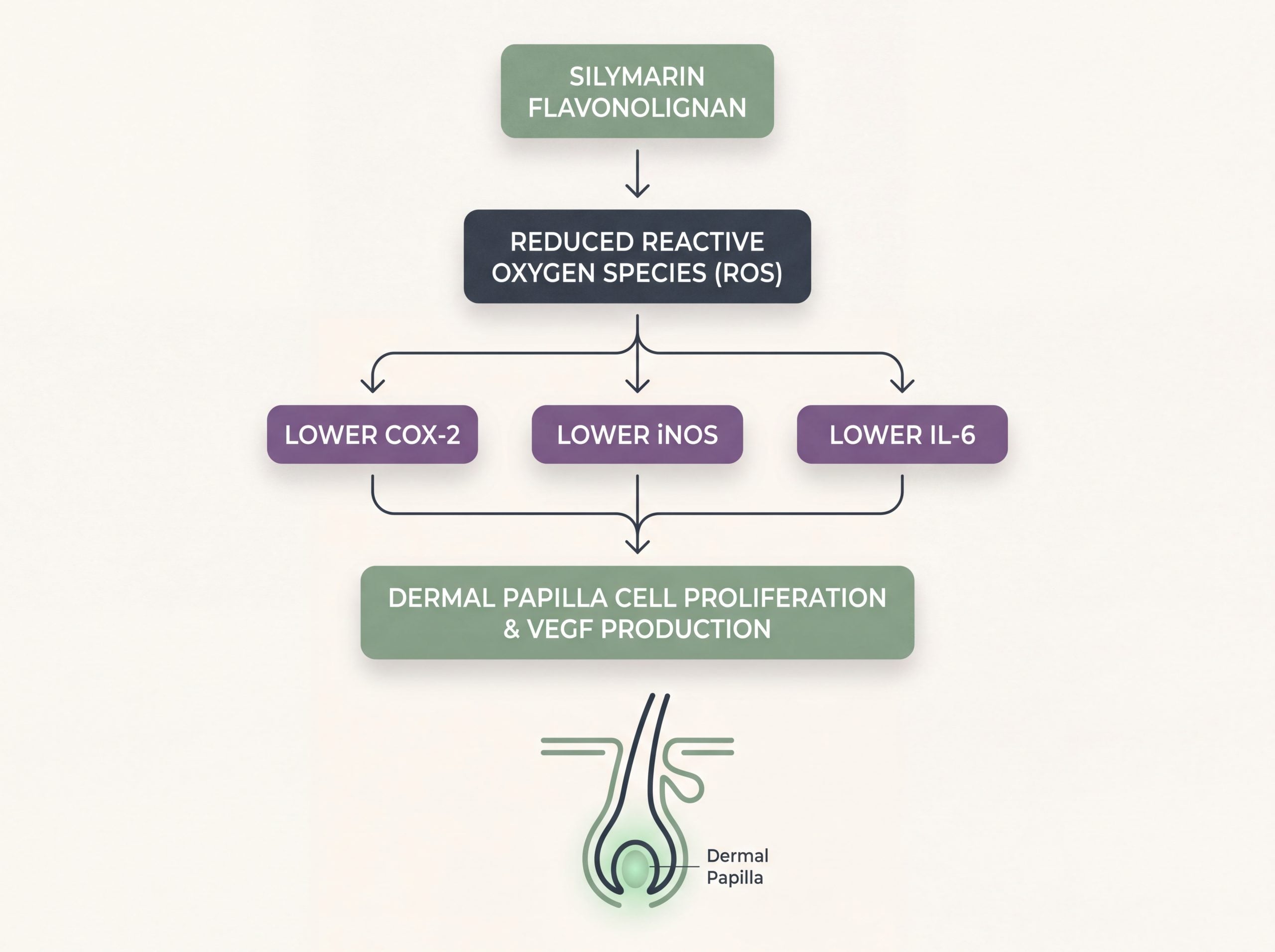
- In dermal papilla cells isolated from the human scalp, silymarin raised total antioxidant capacity and lowered ROS, COX-2, and iNOS. In that same study, vitamin C stimulated those cells more effectively than silymarin did (Ahmadi Ashtiani et al., 2020, International Journal of Trichology, PMID: 33376286).
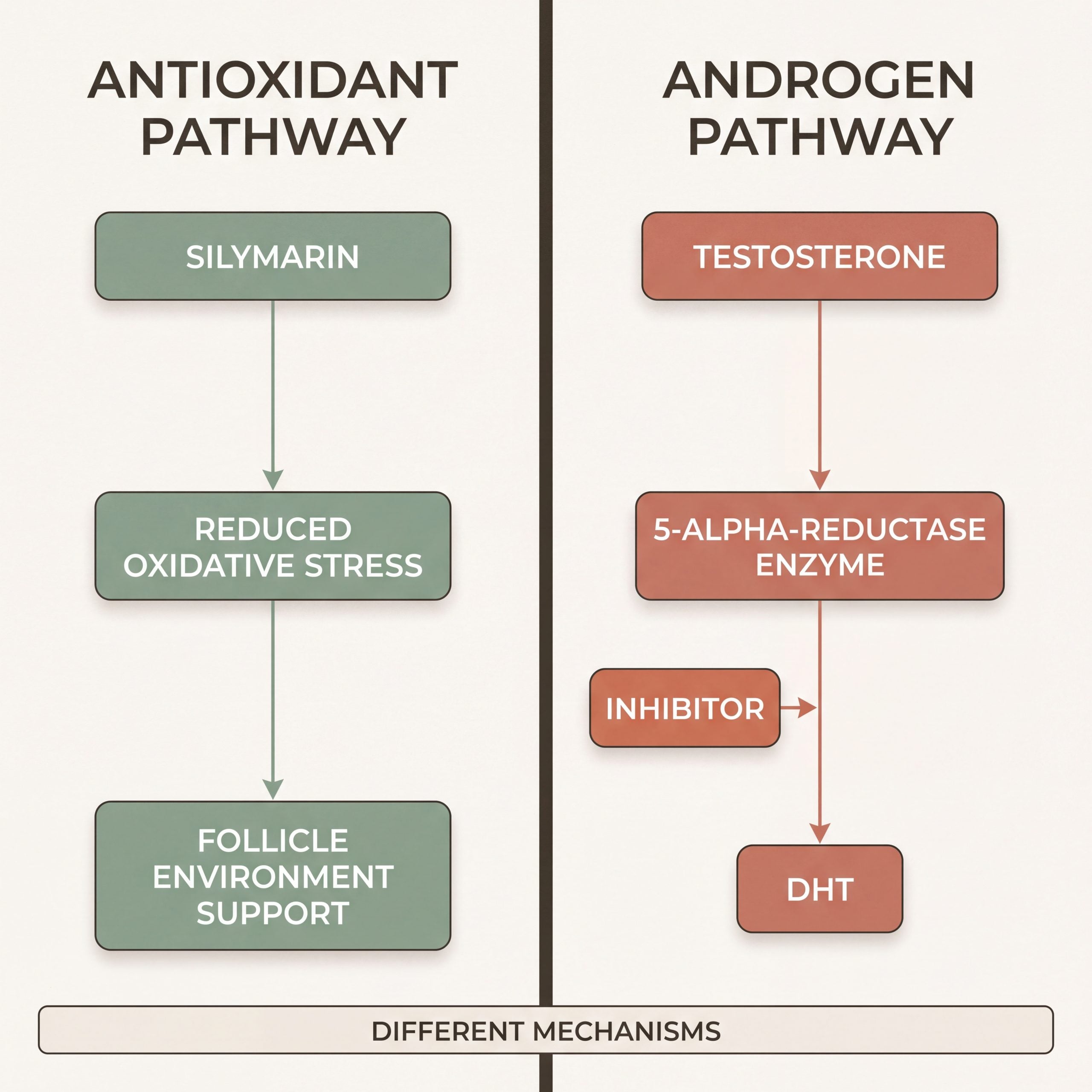
- Silymarin’s documented activity is antioxidant and anti-inflammatory. It is not a 5-alpha-reductase inhibitor, so it does not act on the DHT pathway the way saw palmetto and finasteride are described as acting.
- No randomized controlled trial has tested oral milk thistle with hair growth as a measured endpoint. Sources claiming otherwise are describing a topical study.
Many people look for herbal options to support healthy hair, and milk thistle keeps appearing in those conversations. Known mainly for its liver-supporting reputation, Silybum marianum now shows up in shampoos, scalp serums, and hair supplement stacks. The question our editorial team kept running into is a narrow one. Does the research actually support any of that, and if so, which form of the plant does it support?
The short answer is that something real is happening in the laboratory data; the one controlled human trial that exists used a topical flower extract rather than an oral capsule, and the gap between those two facts is where nearly all of the confusion on this topic lives. This article walks through the mechanisms, the primary studies with their PMIDs, the difference between seed and flower preparations, the DHT question, and where milk thistle honestly sits next to better-studied options.
What is milk thistle (Silybum marianum)?
Milk thistle, scientifically named Silybum marianum, is a flowering plant in the Asteraceae family alongside daisies, ragweed, and sunflowers. It is recognizable by its purple flower heads and the milky white veining on its leaves that gives the plant its common name. Its documented use runs through traditional European herbal medicine, primarily for liver and gallbladder support, across several centuries.
The silymarin complex
The active fraction behind most of the research on this plant is a group of flavonolignans collectively called silymarin, concentrated mainly in the seeds. Silymarin is not one molecule. It is a mixture, and the proportions vary by plant material and extraction method. The main constituents are:
- Silybin (also written silibinin), usually the most abundant and most biologically active component
- Silychristin
- Silydianin
- Isosilybin A and B
The plant’s flower material carries a different phytochemical profile than the seed. Apigenin, a flavone, is among the constituents identified in flower extract research. This distinction matters more than most articles on this subject acknowledge, and we return to it below.
Established biological activities
Silymarin’s reputation rests on three well-documented activities:
- Antioxidant action. Silymarin scavenges free radicals and supports the body’s own antioxidant systems, including glutathione.
- Anti-inflammatory effects. A 2024 systematic review and meta-analysis of 15 randomized controlled trials reported that silymarin consumption was associated with reductions in C-reactive protein of 0.50 mg/L, malondialdehyde of 1.19 nmol/mL, and interleukin-6 of 0.44 pg/mL. The same analysis found no significant effect on IL-10, total antioxidant capacity, or glutathione (Bahari et al., 2024, Inflammopharmacology, PMID: 38372848).
- Liver support. The most traditional and most researched application, and the reason most people encounter this plant in the first place.
Those three properties are the entire basis for investigating milk thistle and hair. Nothing about the plant was ever designed around follicles.
Does milk thistle help hair growth?
The honest answer is qualified. A topical Silybum marianum flower extract has controlled human data showing increased hair density and total hair count at 16 and 24 weeks against placebo (PMID: 37675655). Oral milk thistle seed capsules and powder have no randomized trial with hair as a measured endpoint. Silymarin’s mechanism is antioxidant and anti-inflammatory rather than hormonal, so it addresses the follicle environment rather than androgen signalling.
That single distinction resolves most of the contradictory claims circulating on this topic. When a supplier page states that milk thistle supports hair growth and a dermatology source states there is no evidence, both are frequently describing different preparations of the same plant without saying so.
What did the cell studies actually find?
In dermal papilla cells isolated from the human scalp, silymarin increased cell proliferation and total antioxidant capacity while reducing reactive oxygen species, COX-2 and inducible nitric oxide synthase. The study tested silymarin at 50 and 100 micromolar against vitamin C at 100 micromolar on days 2, 7 and 14 (Ahmadi Ashtiani et al., 2020, International Journal of Trichology, PMID: 33376286).
Dermal papilla cells, VEGF and cellular senescence
Dermal papilla cells sit at the base of the hair follicle and act as its signalling control point. They are the cell type most hair growth research targets, which is why the milk thistle work on them matters more than generic antioxidant claims.
The flower extract study is the more informative of the two. Silybum marianum flower extract increased both proliferation and vascular endothelial growth factor production in human hair follicle dermal papilla cells. VEGF is relevant to hair because it relates to the microvascular supply feeding the follicle. The same extract suppressed cellular senescence in those cells and reduced IL-6 production, tested in both a replicative senescence model and a hydrogen-peroxide-induced oxidative senescence model (You et al., 2023, Journal of Cosmetic Dermatology, PMID: 37675655).
Senescent dermal papilla cells are a recognized feature of aging follicles. An ingredient that reduces senescence markers in that specific cell population is doing something more targeted than general antioxidant activity, though a cell culture result is still a long way from a head of hair.
The vitamin C comparison nobody quotes
Here is a finding we have not seen reproduced anywhere else in the popular coverage of this topic. In the dermal papilla study that most milk thistle hair content cites, the authors directly compared silymarin against vitamin C and concluded that vitamin C was more effective at stimulating dermal papilla cells in culture (PMID: 33376286). Silymarin’s contribution was attributed principally to its antioxidant activity.
Sources that cite this study as proof that silymarin helps hair are quoting half of it. The proliferation and antioxidant capacity results are real. So is the comparator result. Our editorial team includes it because a page that reports only the favourable half of a study it cites is not a page worth trusting on the rest.
Silibinin and follicular signalling
Beyond the antioxidant story, silibinin has been examined for effects on hair-inductive properties through Akt and Wnt/beta-catenin related signalling, pathways involved in driving follicles into and through the anagen growth phase. This work sits in cell and molecular biology rather than clinical dermatology. It is a reason to keep studying the compound, not a reason to expect a result in the mirror.
Topical or oral milk thistle: which form has the evidence?
Topical has the human hair data. Oral does not. The controlled trial that produced increased hair density and total hair count used a shampoo containing Silybum marianum flower extract, measured at 16 and 24 weeks against a placebo group (PMID: 37675655). No equivalent trial exists for swallowed milk thistle with hair as an endpoint.
- Topical flower extract has controlled human hair density and hair count data at 16 and 24 weeks.
- Oral seed extract, commonly standardized to 70 to 80 percent silymarin, has extensive liver and inflammatory-marker research but no hair-endpoint randomized trial.
- Whole-seed powder and whole-seed capsules deliver naturally occurring silymarin along with the seed’s fatty acids and fiber, at a lower silymarin concentration than a standardized extract. There is no hair trial on this form either.
- Seed and flower preparations are not interchangeable. They come from different plant parts with different constituent profiles.
- Speak with a healthcare provider before combining any of these with prescribed hair loss medication.
Seed extract versus flower extract
Almost every milk thistle product on the market, ours included, is a seed preparation. That is where silymarin concentrates, and it is what the liver research studied. The hair trial used flower extract. When an article states that milk thistle increased hair density in a clinical study without naming the plant part, it has quietly swapped one preparation for another.
In our sourcing experience, this is the single most common error in botanical content. Plant part, extraction solvent, and standardization percentage each change what is actually in the jar. A whole-seed powder and an 80 percent silymarin extract are not the same input even though both are labelled milk thistle.
What a whole-seed preparation is and is not
Our own milk thistle capsules and milk thistle seed powder are cold-milled whole seed with naturally occurring silymarin. They are not standardized extracts, and they are not flower extracts. We stock them for the traditional liver and digestive context that whole-seed milk thistle has been used for, and we are not going to tell you they reproduce a topical flower extract shampoo trial. They do not, and the study design says so plainly.
Does milk thistle block DHT?
There is no primary evidence that silymarin inhibits 5-alpha-reductase, the enzyme that converts testosterone into dihydrotestosterone. Silymarin’s documented activity in follicle-relevant research is antioxidant and anti-inflammatory. That is a different mechanism from androgen pathway modification, and the distinction matters for anyone dealing with pattern hair loss.
DHT-blocking claims for milk thistle circulate widely on ingredient supplier pages and beauty blogs. We looked for the underlying citation and did not find one in the primary literature. What does exist is a body of work on other botanicals. Saw palmetto (Serenoa repens) has been reviewed systematically for antiandrogenic activity in alopecia, with five randomized clinical trials and two prospective cohort studies reporting outcomes including a 27 percent improvement in total hair count and increased hair density in 83.3 percent of patients across various topical and oral preparations at 100 to 320 mg (Evron et al., 2020, Skin Appendage Disorders, PMID: 33313047). The authors were explicit that high-quality data are still lacking and that trials isolating saw palmetto’s sole contribution are needed.
If DHT is the mechanism you are targeting, milk thistle is not the plant that mechanism points to. Our separate articles on saw palmetto and on pygeum cover the antiandrogenic botanicals in more depth.
How could milk thistle affect hair? The proposed mechanisms
Direct evidence linking Silybum marianum to hair growth in humans remains limited to the topical flower extract work. Its established biological actions do suggest several plausible indirect pathways, and each one has a literature behind it.
Combating oxidative stress
Hair follicles are vulnerable to oxidative damage. Excess reactive oxygen species can interfere with follicular signalling, promote inflammation and senescence, and contribute to premature transition out of the anagen growth phase. A 2024 review in the Journal of Cellular and Molecular Medicine catalogued the signalling pathways through which oxidative stress affects hair follicle development and hair growth, and surveyed natural antioxidants studied as interventions (Du et al., 2024, PMID: 38923380). A 2021 review in the International Journal of Cosmetic Science examined oxidative stress specifically across skin, scalp and hair, and framed scalp oxidative stress as a mechanism by which an unhealthy scalp produces downstream consequences for hair elongation, retention and replacement (Trüeb, 2021, PMID: 34424547).
The connection. Silymarin’s antioxidant activity is documented at the marker level rather than the marketing level. In scalp dermal papilla cells, it lowered ROS, COX-2 and iNOS while raising total antioxidant capacity (PMID: 33376286). Systemically, oral silymarin was associated with reductions in MDA, CRP, and IL-6 across 15 randomized trials, though none of those trials measured hair (PMID: 38372848). The plausibility is real. The hair-specific proof is not there for the oral route.
Reducing scalp inflammation
Inflammation on the scalp works against healthy hair cycling. Conditions ranging from seborrheic dermatitis through to inflammatory hair loss patterns create an environment that disrupts the growth cycle and, in some presentations, drives follicle miniaturization.
The connection. The specific inflammatory mediators silymarin has been shown to move in follicle-relevant tissue are COX-2, iNOS, and IL-6. Naming them is the point. Generic anti-inflammatory language is what most sources on this topic offer, and it is not testable. A reduction in IL-6 production by dermal papilla cells under oxidative senescence conditions is a specific, checkable finding (PMID: 37675655).
The liver health hypothesis (indirect link)
Traditional systems often connect hair vitality to the state of internal organs, the liver in particular. The liver metabolizes hormones, processes nutrients used in building tissue including hair keratin, and handles detoxification.
The connection. The theory holds that supporting liver function improves nutrient availability and waste clearance, indirectly benefiting hair. This link is considerably harder to substantiate than the antioxidant and anti-inflammatory pathways. Optimal liver function matters for overall health. Attributing hair outcomes to it through a single herb requires evidence that does not currently exist.
Evaluating the scientific evidence for hair benefits
Assessing this topic requires separating plausible mechanisms from demonstrated outcomes, and separating the two preparations of the plant.
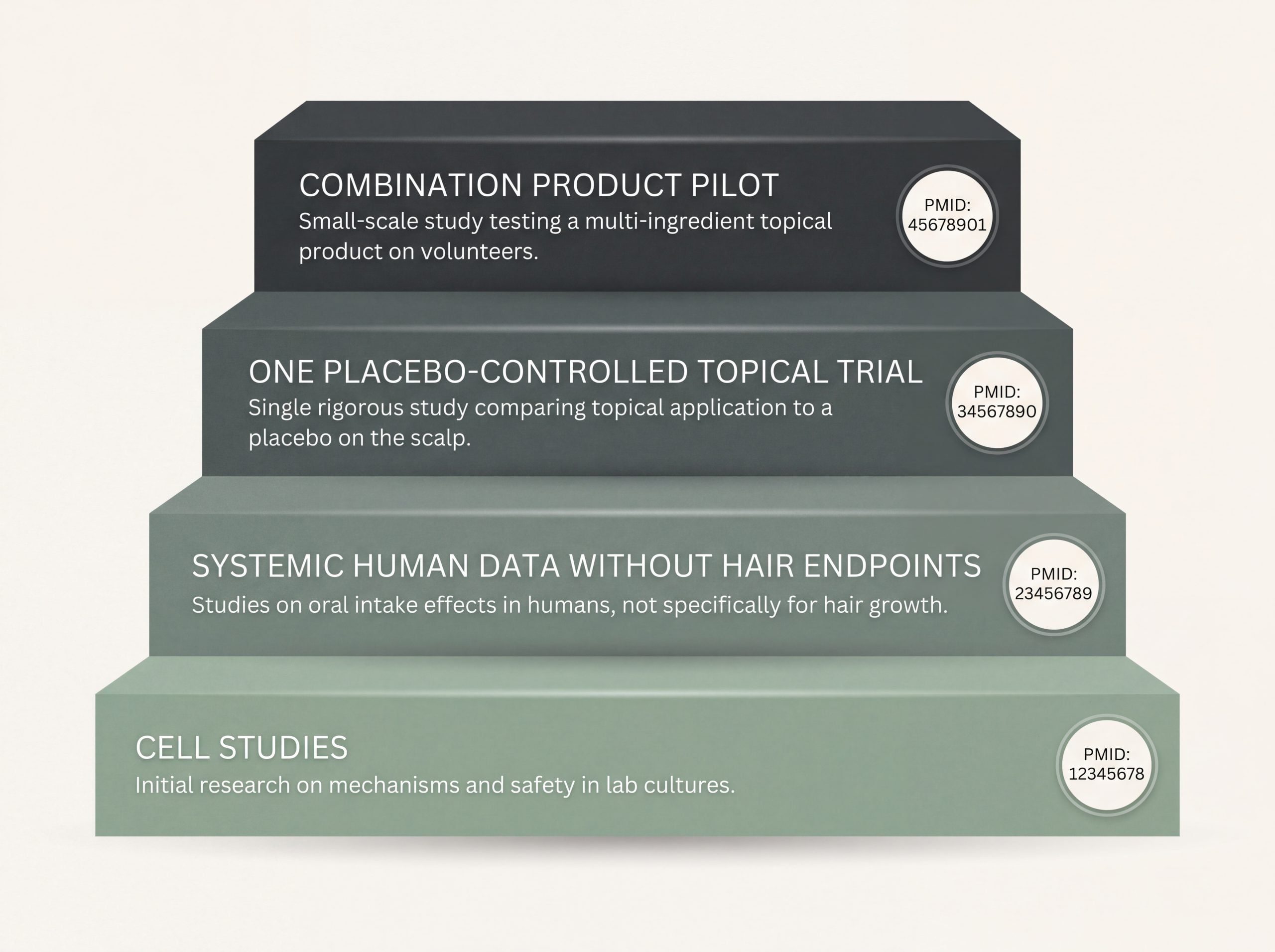
Current state of research: the evidence ladder
The literature stacks in four tiers, and being explicit about which tier a claim sits on is the whole discipline here.
- Cell studies. Silymarin in human scalp dermal papilla cells: proliferation and total antioxidant capacity up, ROS, COX-2 and iNOS down, with vitamin C outperforming it as a stimulant (PMID: 33376286). Silybum marianum flower extract in the same cell type: proliferation and VEGF up, senescence and IL-6 down (PMID: 37675655). Silymarin protects human keratinocytes against UVA-induced oxidative damage at 0.7 to 34 mg/L, reducing ROS generation, lipid peroxidation, DNA single-strand breaks and caspase-3 activation (Svobodová et al., 2007, Journal of Dermatological Science, PMID: 17289350). Silymarin and its flavonolignans protect keratinocytes and fibroblasts against hydrogen peroxide damage, with dehydrosilybin and quercetin the strongest protectants (Svobodová et al., 2006, Burns, PMID: 17011711).
- Systemic human data without hair endpoints. The 15-trial meta-analysis on inflammatory and oxidative markers (PMID: 38372848).
- Controlled human hair data, topical only. The flower extract shampoo trial showing significantly increased hair density and total hair count at 16 and 24 weeks against placebo (PMID: 37675655).
- Combination product trials. The 2026 post-transplant serum study described below.
The 2026 post-transplant serum trial
The newest entry in this literature is a one-year exploratory randomized controlled multicentric pilot study of an anti-hair-loss serum containing Silybum marianum extract, manganese PCA, and Lespedeza capitata extract, applied to the recipient area following hair transplantation in men with androgenetic alopecia (Ortega Quijano et al., 2026, Frontiers in Medicine, PMID: 42359057).
Thirty men participated, 15 per group, median age 40. Investigators reported more pronounced and more rapid improvement in the global aspect of the scalp from month 1 through month 12, and in hair growth from month 6 through month 12, compared with the shampoo-only control group. Tolerance and acceptability were rated excellent.
What this study cannot tell you. It enrolled 30 men. It tested three actives together, so milk thistle’s individual contribution cannot be isolated. It studied a post-surgical recipient area, not ordinary hair thinning. The authors framed it as a first pilot suggesting a dermocosmetic adjuvant role. Read as anything more than that, it is being misused.
What the evidence doesn’t show (yet)
The current literature does not show that taking Silybum marianum supplements orally produces significant hair regrowth, meaningfully thicker hair, or reliable slowing of androgenetic alopecia. Specifically, the following do not exist:
- A randomized controlled trial of oral milk thistle with hair count, hair density, or shedding as a primary endpoint
- A head-to-head comparison of milk thistle against minoxidil or any established option
- Primary data showing 5-alpha-reductase inhibition by silymarin
- Any trial isolating milk thistle from the other actives in the 2026 combination serum
Claims beyond that require substantiation through dedicated trials measuring hair parameters. We would like to see them run. They have not been.
Beyond growth: other hair and scalp considerations
Growth stimulation is one question. Scalp condition is another, and the evidence sits differently there.
Silymarin and the scalp skin barrier
The scalp is skin, and silymarin has a longer dermatological research record on skin than on hair. Treatment of UVA-irradiated human keratinocytes with silymarin produced concentration-dependent reductions in oxidative stress across every parameter measured, including glutathione depletion, ROS production and membrane lipid peroxidation (PMID: 17289350). Against hydrogen-peroxide-induced damage in keratinocytes and fibroblasts, silymarin performed comparably to silybin, its main component (PMID: 17011711).
This is cell-level dermatology, not a clinical scalp outcome. It does support the position that the scalp-condition argument for silymarin is better grounded than the hair-growth argument.
Silymarin alongside hair follicle transplantation
One adjacent finding is worth noting for completeness. A double-blind randomized controlled trial of 20 patients with refractory vitiligo compared hair follicle transplantation plus oral silymarin against follicle transplantation alone over three months, and reported greater perifollicular repigmentation in the silymarin group (Feily et al., 2024, Journal of Cosmetic Dermatology, PMID: 39161267). The endpoint was pigmentation, not hair growth, and the condition was vitiligo. It tells us oral silymarin was studied in a follicle-transplantation context and tolerated. It tells us nothing about hair density.
Forms and usage considerations
Silybum marianum reaches the market in several forms, nearly all seed-derived:
- Standardized extract capsules or tablets. Commonly standardized to 70 to 80 percent silymarin. The 80 percent figure on a label refers to the silymarin content of the extract, not of the raw seed, and it is the form most liver research has used.
- Whole-seed capsules and powder. Cold-milled seed carrying naturally occurring silymarin along with the seed’s fatty acid and fiber fraction, at a lower silymarin concentration than an extract. Our milk thistle capsules and milk thistle seed powder are both this type.
- Tinctures and liquid extracts. Alcohol- or glycerin-based.
- Teas. Made from crushed seed. Silymarin is poorly water-soluble, so extraction into a water infusion is limited and inconsistent.
- Topical shampoos and scalp serums. The category the hair evidence actually belongs to. The trial preparation used flower extract.
There is no established dosage for hair. Doses in the liver and inflammatory-marker literature vary widely and were selected for those endpoints. The topical trial measured a shampoo formulation over 16 and 24 weeks, which is a use pattern, not an oral dose. Self-prescribing against a hair goal has no dosing basis to work from. Speak with a qualified healthcare provider about whether this herb suits your situation.
Safety profile, side effects, and interactions
Silybum marianum is generally well tolerated by most adults when used appropriately. Both the National Center for Complementary and Integrative Health and Mayo Clinic maintain current monographs on milk thistle safety, and we recommend reading them alongside this section.
Potential side effects
Most reported effects are mild and gastrointestinal:
- Diarrhea
- Nausea
- Bloating or gas
- Indigestion
- Loss of appetite
- Headache
Allergies
People allergic to other Asteraceae or Compositae plants, including ragweed, chrysanthemums, marigolds and daisies, may react to Silybum marianum. Reactions range from mild skin rash to rare anaphylaxis. This is the single most predictable adverse response to this plant and the one worth checking before a first dose.
Drug interactions
Silymarin may affect liver enzymes involved in drug metabolism, particularly the cytochrome P450 system, which creates theoretical interaction potential:
- Diabetes medications. May affect blood sugar levels. Caution is warranted for anyone on glucose-lowering drugs.
- CYP450 substrates. Certain statins, anti-anxiety medications, allergy drugs, and blood thinners.
- Raloxifene. Interaction reported.
Milk thistle and hair loss medications
This question comes up constantly and rarely gets a direct answer. Several hair loss drugs are CYP3A4 substrates, which is where the theoretical concern originates. In practice, human studies with milk thistle have not shown meaningful changes in the clearance of comparable CYP3A4 substrates, and the interaction is generally rated as minor and unlikely rather than clinically significant.
Rated minor is not the same as ruled out, and none of this replaces a conversation with the prescriber who is managing your treatment. If you are on finasteride, oral minoxidil, a JAK inhibitor, or any prescribed therapy for hair loss, raise the supplement with that clinician before adding it.
Contraindications and precautions
- Pregnancy and breastfeeding. Safety data are insufficient. Use is generally not recommended.
- Hormone-sensitive conditions. Including breast, uterine or ovarian cancer, endometriosis, and uterine fibroids. Mild estrogenic activity has been discussed for some silymarin constituents, though this is debated. Consultation with a specialist is essential.
Where milk thistle sits among hair supplements
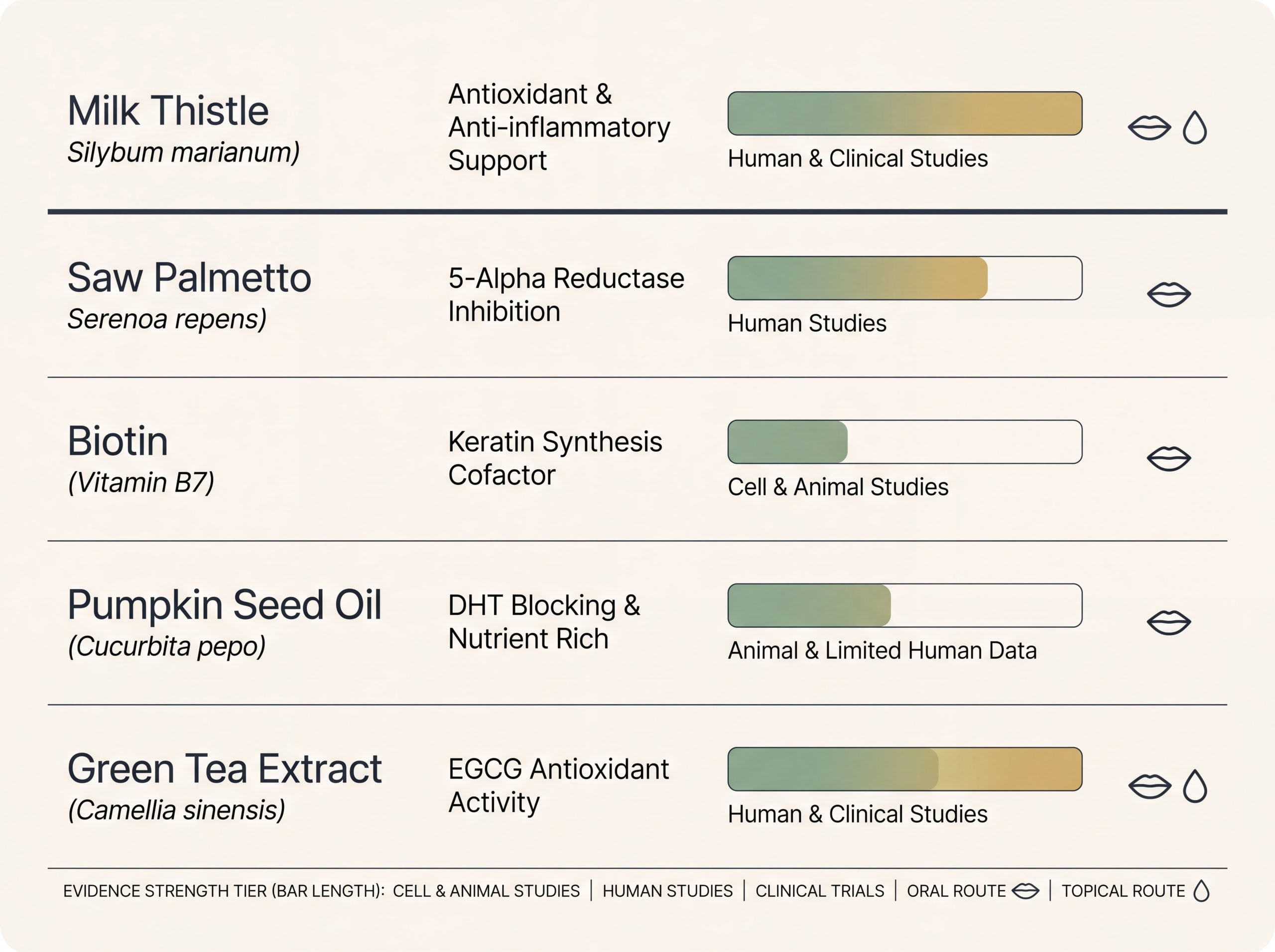
Placing this plant honestly against the alternatives is more useful than arguing for it. The table below is organized by evidence tier rather than by popularity.
| Botanical / nutrient | Proposed mechanism | Strongest evidence tier for hair | Route the evidence covers | Key citation |
|---|---|---|---|---|
| Silybum marianum (milk thistle) | Antioxidant, anti-inflammatory, dermal papilla VEGF and senescence effects | One placebo-controlled topical trial plus cell studies | Topical flower extract only | PMID: 37675655 |
| Serenoa repens (saw palmetto) | Antiandrogenic, discussed as 5-alpha-reductase related | Systematic review of 5 RCTs and 2 cohorts | Both oral and topical | PMID: 33313047 |
| Biotin | Keratin substrate cofactor | Case reports in deficiency states, no RCT in non-deficient people | Oral | Reviewed in PMID: 33313047 context |
| General antioxidants for scalp | Reduce follicular oxidative stress | Mechanistic reviews, no single-agent RCT | Mixed | PMID: 38923380, PMID: 34424547 |
| Nutritional status (iron, zinc, vitamin D) | Correcting a deficiency that is driving shedding | Clinically established where a deficiency is documented | Oral | Assess with a clinician before supplementing |
| Sources verified via PubMed, August 2026. Evidence tier reflects the strongest published design, not the size of the effect. | ||||
Read across that table, and the pattern is clear. Milk thistle is not the weakest option listed, and it is not the strongest. It occupies a specific position: real mechanistic work in the right cell type, one controlled human trial, and that trial on the topical route with a plant part most products do not contain.
Frequently asked questions
Does milk thistle block DHT or affect hair follicles?
There is no primary evidence that silymarin inhibits 5-alpha-reductase or lowers DHT. Its documented follicle-relevant activity is antioxidant and anti-inflammatory, shown in dermal papilla cells as reduced ROS, COX-2, iNOS, and IL-6 alongside increased proliferation and VEGF production (PMID: 33376286, PMID: 37675655). Those are follicle effects, but they are not androgen pathway effects.
Are there any studies on milk thistle for alopecia?
One controlled human study exists, and it used a topical shampoo containing Silybum marianum flower extract, reporting significantly increased hair density and total hair count at 16 and 24 weeks versus placebo (PMID: 37675655). A 2026 pilot randomized trial in 30 men tested a serum combining milk thistle extract with manganese PCA and Lespedeza capitata after hair transplantation, and reported improved hair growth from month 6 to month 12 against controls (PMID: 42359057). Neither study tested oral milk thistle alone.
Can milk thistle interact with hair loss medications?
Theoretically, because silymarin may influence cytochrome P450 enzymes and several hair loss drugs are CYP3A4 substrates. In practice, human studies have not shown meaningful changes in clearance of comparable CYP3A4 substrates, and the interaction is generally rated minor and unlikely. Discuss it with the clinician managing your treatment before combining them.
Is topical or oral milk thistle better for hair?
Topical is the only form with controlled human hair data, and specifically topical flower extract. Oral seed extract has substantial research on liver and inflammatory markers but no randomized trial measuring hair outcomes. Oral whole-seed preparations have no hair trial either. Anyone presenting oral capsules as clinically supported for hair is applying a topical study to a different product.
How long did the hair density changes take in the milk thistle study?
Hair density and total hair count were measured at 16 and 24 weeks of shampoo use, with both timepoints showing significant increases compared with the placebo group (PMID: 37675655). That is a four- to six-month observation window, consistent with hair cycle timeframes generally.
How much milk thistle should I take for hair?
No dosage has been established for hair. Doses in the published literature were selected for liver and inflammatory endpoints, and the one hair trial measured a topical shampoo rather than an oral dose. Without a dosing basis, this is a question for a qualified healthcare provider who knows your medications and health history.
Related reading
Continue with our related articles on milk thistle for liver support, finasteride and saw palmetto for pattern hair loss, eclipta alba for hair, and boswellia and hair loss.
Final thoughts on Silybum marianum and hair
Silybum marianum and its silymarin complex carry well-documented antioxidant and anti-inflammatory activity. In the follicle’s own cell population, that activity is measurable at the marker level rather than the marketing level. One placebo-controlled trial reported real hair density and hair count gains, and it used a topical flower extract.
The realistic position is narrower than most pages on this subject will tell you. There is no randomized trial of oral milk thistle with hair as an endpoint. There is no evidence of DHT pathway activity. In the one study that compared them directly, vitamin C stimulated dermal papilla cells more effectively than silymarin did. Milk thistle should not be treated as a standalone solution for hair loss or as a route to dramatic regrowth.
If you are seeing thinning or shedding, the highest-value step is a conversation with a healthcare provider or dermatologist who can identify what is actually driving it. Different causes call for different responses, and a supplement chosen before the cause is known is a guess. If you are considering Silybum marianum, raise it with your provider first, particularly given the Asteraceae allergy risk and the interaction profile.
Important: This article is for educational and informational purposes. The statements have not been evaluated by the Food and Drug Administration. The herbs and herbal products discussed are not intended to diagnose, treat, cure, or prevent any disease, including androgenetic alopecia or any other form of hair loss. Information presented here is not a substitute for professional medical advice, diagnosis, or treatment. Always consult a qualified healthcare provider for medical guidance specific to your circumstances. Do not delay seeking medical care because of information you have read on this site.