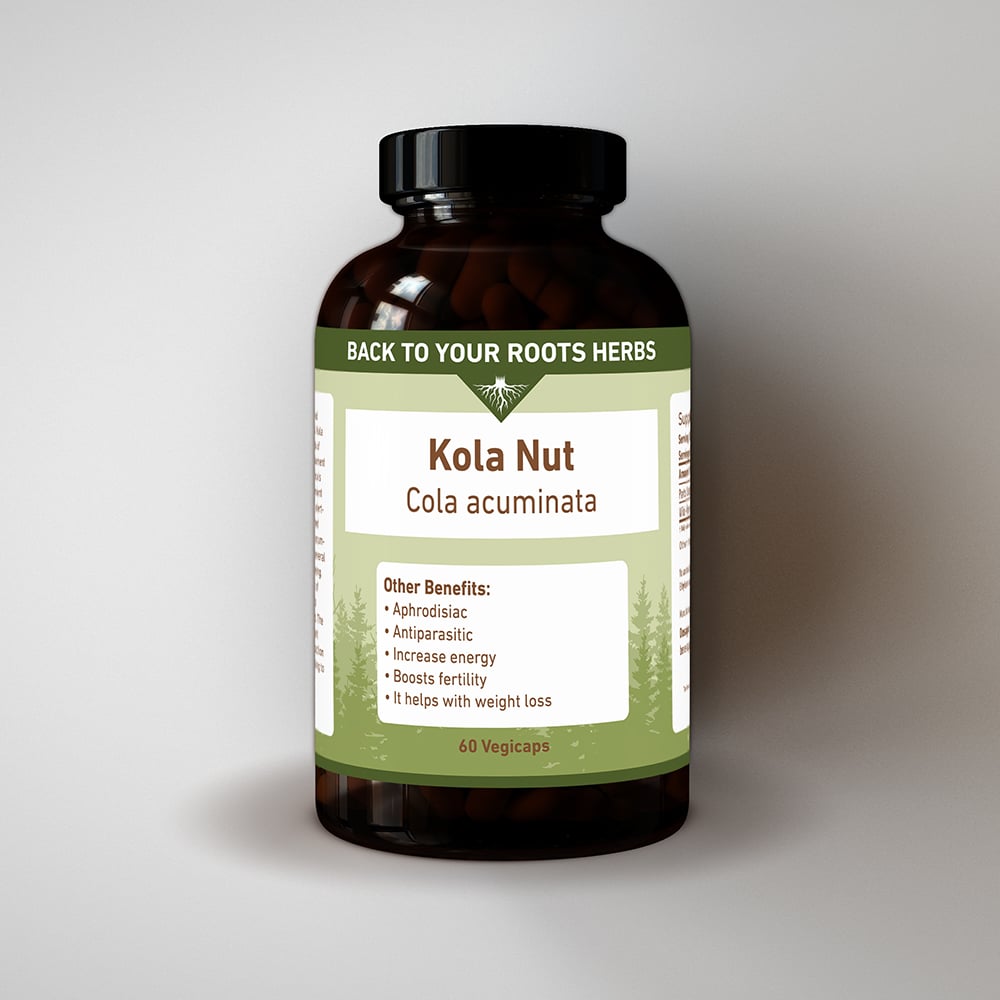
Kola nut capsules are the oldest documented form of portable botanical stimulation on the African continent. Our kola nut capsules contain nothing but sun-dried, stone-milled seed powder from wild Cola acuminata trees growing in the evergreen rainforest band of southern Nigeria near the Cross River National Park (5.4167 N, 8.5833 E). One bottle holds 60 vegan kola nut capsules. Each capsule holds 500 mg of raw kola nut powder with naturally present caffeine at approximately 1.5 percent, theobromine at roughly 0.04 percent, and supporting catechin and kolanin content. No synthetic caffeine. No filler botanicals. No extraction solvents. The product exists so that people who want the original West African kola experience can take it in a clean, measured, swallow-and-go form that matches modern supplement labeling.
THE VERDICT (INTERNAL QUALITY SCORE):
Grade A Wild Cola acuminata. Cross River National Park origin at 5.4167 N, 8.5833 E in the Oban Division buffer zone. Single-ingredient whole-seed powder, no extract, no fillers. 500 mg per capsule, 60 vegan kola nut capsules per bottle. Naturally present caffeine at approximately 1.5 percent, theobromine at roughly 0.04 percent, catechin at 27 to 37 g/kg of whole seed. Stone-milled at low temperature to preserve the catechin fraction. Verified by thin-layer chromatography and DNA barcoding against reference Cola acuminata voucher material. Heavy-metal tested. Vegan HPMC shell. Zero excipients.
– Back To Your Roots Herbs Research Group
SENSORY ANALYSIS:
- Look: Uniform tan to russet-brown powder inside a clear vegan HPMC capsule. No fibrous specks. No yellow oxidation bands typical of old or adulterated kola powder. Color ranges from ivory to deep red, depending on the cultivar and the oxidation stage of the harvest lot.
- Smell: Faint cacao note (the Cola genus sits in the Malvaceae family alongside Theobroma cacao), slightly woody, with a light malty undertone from the native sugars in the dried cotyledon.
- Taste: Opening a kola nut capsule and placing a small amount on the tongue, the profile is slightly sweet on first contact, then a clean bitter finish from the catechin and tannin fraction. No sourness, no musty notes, no roasted cocoa husk off-flavor that signals adulteration.
HOW DO KOLA NUT CAPSULES WORK?
- The Herb: Cola acuminata (Pal. Beauv.) Schott and Endl., family Malvaceae, sourced from the Cross River forest, Oban Division, Nigeria (5.4167 N, 8.5833 E).
- The Mechanism: Acts as a naturally matrix-bound xanthine source (caffeine, theobromine, trace theophylline) to trigger slow-release alertness moderated by the catechin and tannin fraction of the whole seed. The caffeine is bound in the seed matrix and released gradually through digestion rather than hitting the bloodstream as a synthetic caffeine spike.
- The Evidence: Research by Atawodi et al. (2007) (PMID 17979235) quantified caffeine at 18 to 24 g/kg and catechin at 27 to 37 g/kg of whole Cola acuminata seed, confirming the lower-caffeine, higher-catechin profile of acuminata versus nitida. Ethnobotanical work by Starin (2013) (PMID 24158941) documented more than 1,000 years of continuous kola nut trade across West Africa for portable stimulation and ceremonial hospitality.
What Is Kola Nut? The West African Botanical Behind the Original Cola Beverage
The kola nut is the caffeine-bearing seed of trees in the genus Cola, family Malvaceae, native to the tropical forest belt of West and Central Africa. Two species account for almost all commercial trade: Cola acuminata and Cola nitida. Both are chewed fresh in ceremonies across Nigeria, Ghana, Cameroon, Sierra Leone, and the Ivory Coast. Dried kola nut powder has been exported globally for more than 140 years. In 1886, in Atlanta, pharmacist John Pemberton combined coca leaf extract and kola nut extract with sweetener and carbonated water to produce the first commercial cola beverage, which is why the word “cola” in the modern soft drink category traces directly to this single African seed.
The Cola Genus in the Malvaceae Family
The genus Cola belongs to the same plant family as cacao (Theobroma cacao) and cotton. Like cacao, it produces large pods with several large seeds. Unlike cacao, the seed itself is consumed directly rather than fermented. A mature Cola acuminata tree grows to 12 to 20 meters, produces pink to yellow flowers, and sets pods that contain four to ten red, pink, or off-white nuts. Each nut is the cotyledon of the seed. There is no shell to crack. The nut is eaten or dried whole.
About Our Wild Cola acuminata Kola Nut Capsules
Back To Your Roots Herbs sources kola nut from small-lot harvesters in Cross River State who work directly with the forest rather than with industrial plantations. Harvested pods are split by hand. The nuts are washed, then sun-dried on raised wooden racks for 10 to 14 days until the moisture drops below 10 percent. The dried nuts are milled on a stone plate grinder at low temperature to preserve the volatile catechin fraction, then encapsulated in vegetable cellulose shells (HPMC) at 500 mg per capsule. Sixty kola nut capsules fill each amber glass bottle. No binders, no flowing agents, no anti-caking additives, no titanium dioxide, no magnesium stearate.
Identifying Authentic Wild Kola Nut
An authentic kola nut is firm, slightly sweet when first bitten, then bitter on the finish. The color ranges from ivory to deep red, depending on the cultivar and the oxidation stage. Ground kola nut powder is a uniform tan color with no fibrous specks. Counterfeit or adulterated kola powder is often cut with bitter kola (Garcinia kola, a different genus and family entirely) or with roasted cocoa husk. Our kola nut capsules are verified by thin-layer chromatography before encapsulation to confirm the caffeine-catechin fingerprint of true Cola acuminata.
Species Distinction: Cola acuminata vs. Cola nitida
The two commercial kola species look similar but differ in chemistry. Cola acuminata carries approximately 1.11 percent caffeine and about 0.04 percent theobromine. Cola nitida runs higher at approximately 1.38 percent caffeine with slightly less theobromine (Atawodi et al., 2007, PMID 17979235). Cola acuminata has four cotyledons per seed and is preferred for ceremonial use in Yoruba and Igbo traditions. Cola nitida has two cotyledons per seed and is the workhorse of the commercial cola flavoring trade. We chose acuminata because the lower caffeine and higher catechin ratio produce a more even alertness curve when the dried powder is encapsulated at a fixed 500 mg dose.
Kola Nut vs. Bitter Kola (Garcinia kola)
A common confusion in online kola nut capsule listings is the substitution of bitter kola (Garcinia kola) for true kola nut. Bitter kola is a different species from a different family (Clusiaceae), contains negligible caffeine, and has a completely different phytochemical profile dominated by garcinoic acid and kolaviron. Our kola nut capsules never contain Garcinia kola. Every batch is DNA-screened against reference material to rule out interspecies substitution.
Active Compound Profile in Each Kola Nut Capsule
Each 500 mg kola nut capsule is a whole-seed powder, not an extract. The active compound profile mirrors the native profile of the dried seed. Because we do not concentrate or isolate, the ratios stay balanced, and the bitter catechin fraction moderates the caffeine release in a way that standardized caffeine pills cannot replicate.
Caffeine (approximately 1.5%)
Caffeine is the principal xanthine alkaloid in the kola nut. At a 500 mg kola nut capsule dose, naturally present caffeine is in the range of 7 to 8 mg per capsule, so two kola nut capsules deliver roughly 15 mg of whole-seed caffeine, far less than a cup of coffee, and released more slowly because it is bound in the seed matrix.
Theobromine (approximately 0.04%)
Theobromine is the same alkaloid that gives dark chocolate its gentle lift. In kola nut capsules, it contributes a long, smooth background tone to the caffeine peak.
Theophylline (trace)
Theophylline is present in trace amounts. It is the third xanthine in the cacao and cola complex and rounds out the natural stimulant triad.
Kolanin
Kolanin is a kola-specific glycoside first isolated from Cola acuminata. It is considered a characteristic marker compound of the genus.
Catechin (27 to 37 g/kg whole seed)
Catechin is a polyphenol found at 27 to 37 grams per kilogram of whole kola seed (Atawodi 2007). Catechin contributes the characteristic bitterness and acts as an antioxidant in the seed matrix.
Tannins
Condensed tannins give the bite on the finish and have been used traditionally as astringent support.
Betaine
Betaine is a minor constituent in the nut fraction and contributes to the native nutritional profile.
Glucose
Free sugars are present in low but detectable amounts in the fresh nut and carry through into the dried kola nut powder at a reduced level.
Third-Party Lab COA Available on Request
A current Certificate of Analysis for each batch of kola nut capsules, including caffeine quantitation, heavy metal screen (lead, arsenic, cadmium, mercury), microbial counts, and botanical identity, is available by emailing [email protected].
Traditional Uses of Kola Nut in West African Ethnobotany
Kola nut has been chewed for more than 1,000 years across West Africa. The ethnobotanist Dorothy Starin documented the continuity of the kola trade from the Bight of Benin through Mali and into the Sahelian caravan routes (Starin 2013, PMID 24158941). The dried nut was one of the earliest long-distance trade commodities on the continent and passed between the rainforest producers and the savanna consumers for centuries.
Hospitality and Ceremonial Use
In Yoruba, Igbo, Hausa, and Akan traditions, the kola nut is presented at weddings, funerals, chieftaincy installations, and visitor welcomes. The nut is split, distributed, and chewed together. The act of sharing kola is the act of sealing an agreement.
Historical Role in the 1886 Coca-Cola Formula
Pemberton’s original 1886 formula combined a coca leaf decoction with a kola nut tincture as the caffeine-bearing botanical. By the early twentieth century, the coca component was removed, but the kola component remained as the source of the “cola” in the cola soft drink category. Every modern cola beverage traces its name, if no longer its chemistry, to this single West African seed.
CRITICAL USAGE:
Dosage and Contraindications (Negative Knowledge for Trust).
Take 1 to 2 kola nut capsules with 8 ounces of water. First dose early in the morning or before focused work. Do not exceed 4 kola nut capsules in any 24-hour period. Because the caffeine in kola nut is slow-release compared to synthetic caffeine, avoid taking kola nut capsules after 3:00 PM to protect sleep. Excessive intake can cause insomnia, jitters, and gastrointestinal upset.
Contraindications: Pregnant or nursing women should avoid caffeine-containing supplements, including kola nut capsules. Individuals with high blood pressure, heart rhythm disorders, anxiety disorders, or documented caffeine sensitivity should consult a healthcare provider. Do not combine kola nut capsules with other caffeine-rich products such as coffee, energy drinks, guarana, yerba mate, or synthetic caffeine pills. Keep kola nut capsules out of reach of children and pets.
CYP1A2 Drug Interactions: The CYP1A2 hepatic enzyme pathway metabolizes caffeine, theophylline, clozapine, and several other xanthine-adjacent compounds. Any botanical with native caffeine, including kola nut, can compete for CYP1A2 and therefore shift the clearance time of concurrent medications. If you take clozapine, fluvoxamine, ciprofloxacin, certain oral contraceptives, monoamine oxidase inhibitors, or another CYP1A2 substrate, consult your physician before adding kola nut capsules.
CLINICAL SPECS:
| Spec | Detail |
|---|---|
| Serving Size | 1 capsule (500 mg) to 2 capsules (1,000 mg) of wild Cola acuminata whole-seed powder |
| Frequency | 1 to 2 capsules in the morning or before focused work. Do not exceed 4 kola nut capsules in 24 hours. Avoid after 3:00 PM. |
| Active Marker | Caffeine ~1.5% w/w (approx. 7.5 mg per capsule), Theobromine ~0.04% w/w, Theophylline trace, Catechin 27 to 37 g/kg whole seed |
| Processing | Sun-dried for 10 to 14 days below 10% moisture, stone-milled at low temperature to preserve catechin fraction, whole-seed powder (no extract, no solvent). Encapsulated under FDA 21 CFR 111 (cGMP). |
| Safety | Heavy Metal Tested (Pass) – lead, arsenic, cadmium, mercury by ICP-MS against California Proposition 65 thresholds. Microbial and botanical identity tested. |
| Ingredients | Wild Cola acuminata (Pal. Beauv.) Schott and Endl. dried seed cotyledon powder, family Malvaceae – 500 mg per capsule |
| Other Ingredients | Vegetable Cellulose (Capsule) |
| Purity | Non-GMO, Vegan, Wild-Harvested, Single Ingredient |
| Free From | Wheat, Gluten, Soy, Dairy, Corn, Binders, Fillers, Magnesium Stearate, Silicon Dioxide, Titanium Dioxide, Gelatin, Synthetic Caffeine |
| Origin | Cross River National Park, Oban Division, Nigeria (Specified Terroir – 5.4167 N, 8.5833 E) |
| Manufactured | Virginia Beach, VA, USA |
Additional specifications (preserved from original draft): Capsules per bottle: 60. Capsule shell: Vegetable cellulose (HPMC), vegan. Excipients: None. Allergens: None (no gluten, soy, dairy, corn, nuts, eggs). Shelf life: 24 months from manufacture in a sealed bottle. Storage: Cool, dry, away from direct sunlight. Testing methods: TLC, DNA barcoding, ICP-MS heavy metals, microbial counts (total plate, yeast and mold, coliform, E. coli, Salmonella), HPLC caffeine assay (target 1.3 to 1.7 percent w/w).
COMPARISON TABLE:
| Feature | BTYRH Kola Nut Capsules | Generic Kola Nut Capsules |
|---|---|---|
| Origin | Cross River National Park, Nigeria (5.4167 N, 8.5833 E), coordinates published | Unspecified commodity lot or mixed origin |
| Preparation | Wild Cola acuminata whole-seed powder, stone-milled at low temperature, raw, no extract, TLC, and DNA verified | Unverified species or blended Cola, seed powder, or standardized extract, often blended with catuaba and guarana |
| Taste | Slightly sweet on first contact, clean bitter finish from catechin and tannin, faint cacao note | Generic bitter or masked by added flavorings, possible roasted cocoa husk off-flavor from adulteration |
| Safety | Heavy metal tested (ICP-MS), microbial tested, TLC, and DNA species verification per batch, COA on request | Unknown or Untested. Species verification is rare. Often contains magnesium stearate, silicon dioxide, and gelatin shell. |
| Species | Wild Cola acuminata (four-cotyledon, ~1.11% caffeine), never Cola nitida, never bitter kola (Garcinia kola) | Unspecified or blended Cola, sometimes substituted with bitter kola (Garcinia kola), which is a different plant family |
| Dose and Count | 500 mg per capsule, 60 kola nut capsules per bottle | 450 to 600 mg per capsule, blended products run 500 to 1,000 mg per capsule |
| Caffeine Source | Native to the kola nut only, matrix-bound for slow release | Native, added, or stacked from guarana plus kola |
| Excipients and Capsule Shell | None. Vegetable Cellulose (HPMC) shell | Often magnesium stearate, silicon dioxide, rice flour. Often gelatin shell. |
Sourcing and Harvest: Cross River National Park, Nigeria
The evergreen rainforest of Cross River State holds some of the last continuous stands of wild Cola acuminata in West Africa. We work with family harvesters in the Oban Division of the park buffer zone at approximately 5.4167 N latitude and 8.5833 E longitude. Pods are collected from mature trees, never from saplings. The nuts are dried in the open air on wooden racks, then consolidated into food-grade jute sacks for transport. No fumigation, no heat kilning, no irradiation. The dried nuts travel to our USDA-registered processing partner, where they are finish-dried, milled, encapsulated, and sealed into amber glass bottles as 60-count kola nut capsules.
Manufacturing Standards
Encapsulation is performed in a cGMP-audited facility in the United States under FDA 21 CFR 111 requirements for dietary supplements. Every lot of kola nut capsules receives a unique lot number, a tamper-evident seal, and an expiration date printed on the base of the bottle.
Suggested Use and Serving Size
Take 1 to 2 kola nut capsules with 8 ounces of water. We suggest a first dose early in the morning or before focused work. Do not exceed 4 kola nut capsules in any 24-hour period. Because the caffeine in kola nut is slow-release compared to synthetic caffeine, avoid taking kola nut capsules after 3:00 PM to protect sleep.
Serving Size and Capsule Count
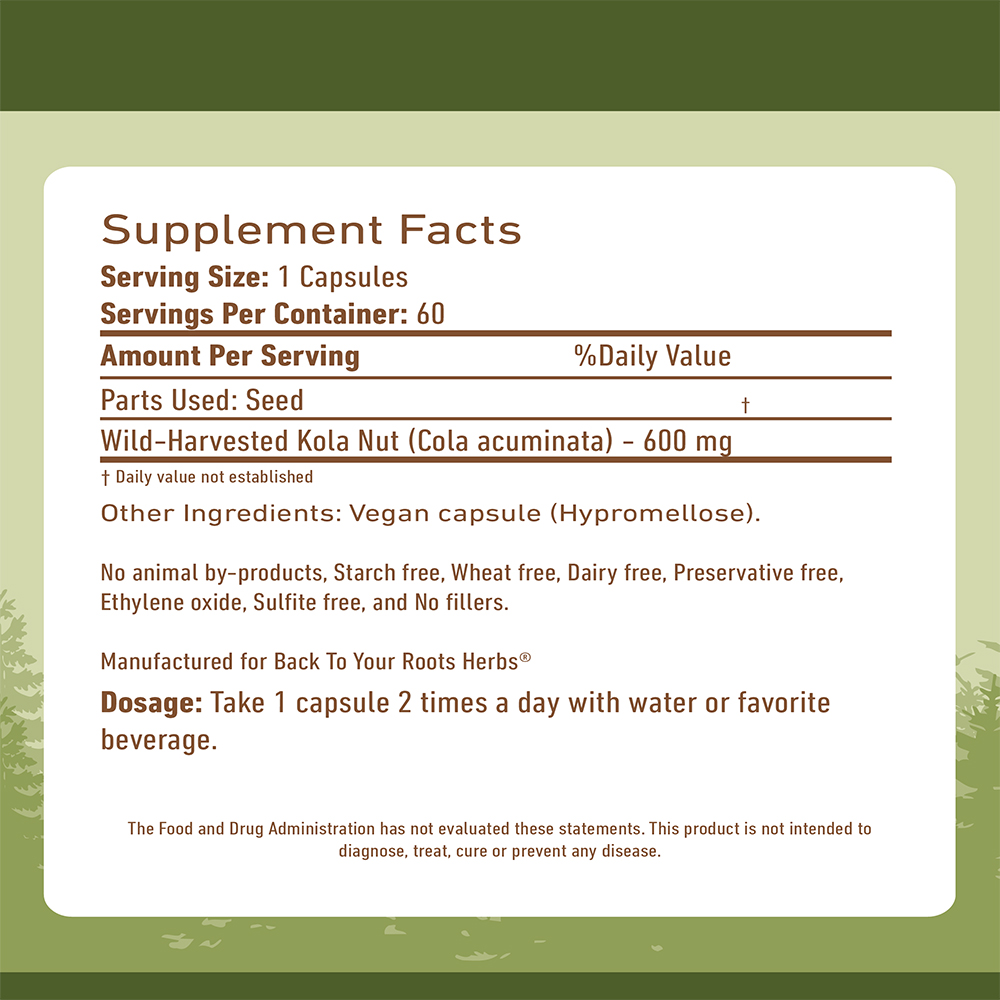
Serving size is 1 capsule. Servings per container is 60 at the 1-capsule serving level, 30 at the 2-capsule serving level.
Storage and Shelf Life
Store kola nut capsules in a cool, dry cabinet away from direct sunlight and humidity. The sealed bottle is stable for 24 months. After opening, use within 12 months for best freshness.
Vegan Certification and Allergen Statement
Our kola nut capsules are 100 percent plant-based. The HPMC capsule shell is derived from wood pulp cellulose. Manufactured in a facility that also processes tree nuts as an ingredient class unrelated to kola. Kola nut itself is not classified as a tree nut under FDA allergen labeling because it is a seed cotyledon, not a botanical nut.
Quality Testing and Third-Party Verification
Every lot of kola nut capsules is tested for identity (thin-layer chromatography and DNA barcoding against a reference Cola acuminata voucher), heavy metals (lead, arsenic, cadmium, mercury by ICP-MS against California Proposition 65 thresholds), microbial counts (total plate, yeast and mold, coliform, E. coli, Salmonella), and caffeine assay (HPLC, target 1.3 to 1.7 percent w/w). Results are archived by lot number and released on request.
Potential Side Effects and Interactions With Medications
Because kola nut capsules contain naturally occurring caffeine and theophylline, they share the general interaction profile of caffeine-containing botanicals. Excessive intake can cause insomnia, jitters, and gastrointestinal upset. People metabolizing caffeine via the CYP1A2 pathway should be aware of documented interactions with fluvoxamine, clozapine, ciprofloxacin, certain oral contraceptives, and monoamine oxidase inhibitors. Kola nut capsules can reduce the clearance of caffeine-like drugs when consumed concurrently.
Drug Interactions With CYP1A2 Metabolism
The CYP1A2 hepatic enzyme pathway metabolizes caffeine, theophylline, clozapine, and several other xanthine-adjacent compounds. Any botanical with native caffeine, including kola nut, can compete for CYP1A2 and therefore shift the clearance time of concurrent medications. If you take clozapine, fluvoxamine, ciprofloxacin, or another CYP1A2 substrate, consult your physician before adding kola nut capsules.
Who Should Avoid Kola Nut Capsules
Pregnant or nursing women should avoid caffeine-containing supplements, including kola nut capsules. Individuals with high blood pressure, heart rhythm disorders, anxiety disorders, or documented caffeine sensitivity should consult a healthcare provider. Do not combine kola nut capsules with other caffeine-rich products such as coffee, energy drinks, guarana, yerba mate, or synthetic caffeine pills. Keep kola nut capsules out of reach of children and pets.
Capsule Shell and Excipient Disclosure
The capsule shell is vegetable cellulose (hypromellose, HPMC). No gelatin. No titanium dioxide. No magnesium stearate. No silicon dioxide. The contents of every kola nut capsule are 100 percent raw Cola acuminata seed powder and nothing else.
Frequently Asked Questions About Kola Nut Capsules
How much caffeine is in one kola nut capsule?
Each 500 mg kola nut capsule contains approximately 7.5 mg of naturally occurring caffeine at the 1.5 percent target. Two capsules deliver roughly 15 mg of caffeine, less than a single cup of brewed coffee.
What is the difference between Cola acuminata and Cola nitida?
Both species produce the commercial kola nut. Cola acuminata has four cotyledons per seed and runs approximately 1.11 percent caffeine. Cola nitida has two cotyledons and runs approximately 1.38 percent caffeine. We use Cola acuminata for its balanced alertness profile.
Are these kola nut capsules the same as bitter kola?
No. Bitter kola (Garcinia kola) is a different species from a different plant family and contains essentially no caffeine. Our kola nut capsules are true kola, Cola acuminata, verified by chromatography.
Can I take kola nut capsules if I have dietary restrictions or allergies?
Our kola nut capsules are gluten-free, soy-free, dairy-free, corn-free, non-GMO, and vegan. They are suitable for almost all common dietary patterns. If you have a specific medical allergy, review the Clinical Specifications table above or contact us for a full ingredient statement.
What are the potential side effects of kola nut capsules?
Side effects are those associated with low-dose natural caffeine and include possible jitteriness, sleep disruption if taken late in the day, elevated heart rate, and mild gastrointestinal upset. Start with 1 capsule to assess personal tolerance.
Shipping, Storage, and Satisfaction Guarantee
Every order of kola nut capsules ships from our United States fulfillment center in sealed amber glass with tamper-evident caps. Domestic orders generally arrive within 2 to 5 business days. We stand behind every bottle. If your kola nut capsules arrive damaged or do not meet your expectations, contact us within 30 days for a replacement or refund.
Return Policy
Unopened kola nut capsules may be returned within 30 days for a full refund. Opened bottles are eligible for store credit at our discretion. Shipping costs are non-refundable.
DISCLAIMER:
These statements have not been evaluated by the Food and Drug Administration. This product is not intended to diagnose, treat, cure, or prevent any disease. Consult your healthcare provider before use, especially if pregnant, nursing, taking medication, or managing a medical condition.
References: Starin D (2013). Kola nut: so much more than just a nut. Journal of the Royal Society of Medicine 106(12), 510-512. PMID 24158941. | Atawodi SE, Pfundstein B, Haubner R, Spiegelhalder B, Bartsch H, Owen RW (2007). Content of polyphenolic compounds in the Nigerian stimulants Cola nitida ssp. Alba, Cola nitida ssp. rubra, and Cola acuminata. Journal of Agricultural and Food Chemistry 55(24), 9824-9828. PMID 17979235. | Niemenak N, Onomo PE, Fotso, Lieberei R, Ndoumou DO (2008). Purine alkaloids and phenolic compounds in three Cola species and Garcinia kola grown in Cameroon. South African Journal of Botany 74, 629-638.
Reviews
There are no reviews yet.