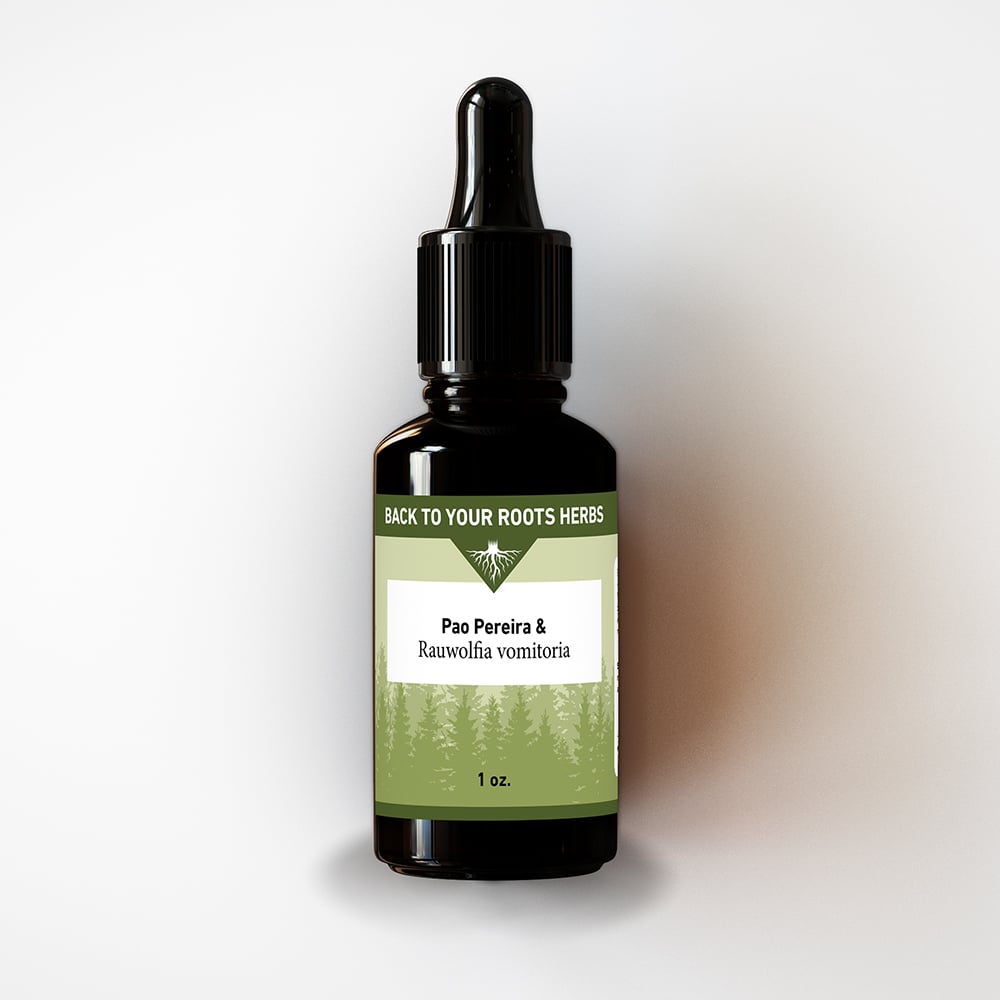
THE VERDICT (INTERNAL QUALITY SCORE):
Grade A. Potency verified via alkaloid density. Sourced from the Amazon Basin (3.1190° S) and West African tropics (6.5244° N). This dual-herb preparation avoids the heat degradation common in mass-market extracts.
– Back To Your Roots Herbs Research Group
SENSORY ANALYSIS:
Upon dispensing the liquid, we observed a dark, translucent amber hue. The tincture clings slightly to the glass. This indicates a high concentration of dissolved solids. The scent is sharp and medicinal. It carries notes of damp earth and bitter wood. On the tongue, the bitterness is immediate and persistent. It is an alkaloid-heavy profile. It lacks the sweetness of commercial glycerin-based products. The finish is clean but astringent.
HOW DOES PAO PEREIRA & RAUWOLFIA WORK?
This tincture pairs two traditional bitter barks. Each carries its own alkaloid family. Here is what is in the bottle and how each plant has been used.
- The Herb: Geissospermum vellosii (Pao Pereira), wild-harvested from the Amazon Basin.
- The Compounds: Pao Pereira bark is rich in beta-carboline indole alkaloids, most notably flavopereirine and pereirine.
- Traditional Use: Amazonian herbalists have used the bitter bark as a digestive bitter and general wellness tonic.
- The Herb: Rauwolfia vomitoria (African snakeroot), wild-harvested from the West African tropics.
- The Compounds: Rauwolfia root bark carries indole alkaloids including reserpine, alstonine, yohimbine, and ajmaline.
- Traditional Use: West African herbalists have used Rauwolfia as a calming tonic, traditionally associated with supporting a sense of calm and blood pressure already within a normal range.
Research note: Laboratory and animal research has examined both barks, but human clinical trials have not been conducted. Memorial Sloan Kettering’s About Herbs database notes that human studies are lacking. Nothing on this page is a treatment claim.
Why These Two Barks Are Traditionally Paired
The combination is often called the “Beljanski duo.” The two barks bring complementary bitter-alkaloid profiles. One follows the digestive-bitter tradition of the Amazon. The other follows the calming-tonic tradition of West Africa. Together they form a full-spectrum bitter preparation.
What Is the Beljanski Approach to These Two Herbs?
Mirko Beljanski was a mid-20th-century biologist who studied plant extracts in the laboratory. He examined flavopereirine from Pao Pereira and the alkaloids of Rauwolfia. His work is the reason the two barks are commonly sold as a pair. This is research history and a traditional pairing. It is not a statement that the tincture treats any condition. For an independent summary, see Memorial Sloan Kettering’s About Herbs entry on Pao Pereira.
Traditional Uses of Rauwolfia Vomitoria
Rauwolfia vomitoria is native to West and Central Africa. Traditional herbalists prepared a decoction of the root for occasional restlessness and used it as a calming tonic. The root is the original botanical source of reserpine, the alkaloid that became the first modern medicine for blood pressure in the 1950s (Cochrane review, PMID 27997978). The root bark also contains alstonine, yohimbine, and ajmaline (PMID 905421, PMID 13198035). On this product, the plant is offered as a traditional bitter tonic. It is not a substitute for blood-pressure medication.
How Pao Pereira Compares to Other Bitter Herbs
Pao Pereira sits in the bitter-tonic family alongside herbs like gentian and quassia. What sets it apart is its beta-carboline alkaloid profile and its Amazonian terroir.
| Bitter Herb | Origin | Bitter Class | Traditional Role |
|---|---|---|---|
| Pao Pereira | Amazon Basin | Beta-carboline alkaloids (flavopereirine) | Digestive bitter, wellness tonic |
| Gentian | European mountains | Secoiridoid glycosides (gentiopicroside) | Classic digestive bitter |
| Quassia | Tropical America | Quassinoids (quassin) | Bitter tonic, traditional |
CRITICAL USAGE:
Shake the bottle vigorously before each use. Take 15 to 30 drops in 2 ounces of water. Do this twice daily on an empty stomach. Do not take this product if you have a history of depression or gallstones. Rauwolfia alkaloids can lower blood pressure. Monitor your levels if you take antihypertensive medication. Avoid taking this tincture at the same time as silica supplements. Silica may interfere with the alkaloid absorption.
Side Effects & Who Should Avoid This Tincture
- Low blood pressure or antihypertensive medication: Rauwolfia alkaloids can lower blood pressure. Monitor your levels and talk with your provider.
- History of depression: Do not use. Reserpine-type alkaloids have been associated with low mood.
- Gallstones: Do not use.
- Pregnancy or nursing: Avoid.
- Silica or zeolite supplements: Space them several hours apart. They can bind the alkaloids and reduce absorption.
Stop use and consult your provider if you notice nasal congestion, unusual drowsiness, or mood changes.
Is This Tincture Safe for Long-Term Use?
Bitters are traditionally cycled rather than taken without breaks. Because Rauwolfia alkaloids can lower blood pressure, extended daily use deserves care. A 2025 toxicology paper cautioned specifically about long-term use of Rauwolfia vomitoria root extract (PMID 41031253). Take periodic breaks. Talk with your healthcare provider before extended use, especially if you take antihypertensive medication or have a history of depression.
CLINICAL SPECS:
| Spec | Detail |
|---|---|
| Serving Size | 0.5 ml (Approx. 15-30 drops) |
| Frequency | 1-2 Times Daily |
| Active Marker | Flavopereirine, Alstonine & Reserpine |
| Processing | Cold Maceration (6 Weeks) |
| Safety | Third-Party Lab Tested (Pass) |
COMPARISON TABLE:
| Feature | BTYRH Tincture | Generic Capsules |
|---|---|---|
| Bioavailability | High (Sublingual/Liquid) | Low (Requires Digestion) |
| Alkaloid Profile | Full Spectrum | Often Isolated/Standardized |
| Origin | Wild-Harvested (Native) | Farm-Grown (Varying Quality) |
| Heat Exposure | Zero (Cold Process) | High (Spray Drying) |
AUTHORITATIVE REFERENCES:
- Memorial Sloan Kettering Cancer Center, About Herbs: Pao Pereira. mskcc.org
- Root alkaloids of Rauwolfia vomitoria Afz. PMID 905421. pubmed.ncbi.nlm.nih.gov/905421
- Pharmacology of Rauwolfia alkaloids, including reserpine. PMID 13198035.
- Blood pressure-lowering efficacy of reserpine for primary hypertension (Cochrane Review). PMID 27997978.
- Long-term use caution, Rauwolfia vomitoria root extract (2025). PMID 41031253.
- U.S. NIH Office of Dietary Supplements. ods.od.nih.gov
Reviewed by the Back To Your Roots Herbs Editorial Team. Last Reviewed: June 2026.
DISCLAIMER:
The Food and Drug Administration has not evaluated these statements. This product is not intended to diagnose, treat, cure, or prevent any disease.
Reviews
There are no reviews yet.