Key Takeaways
- Hoodia gordonii is a spiny, leafless stem succulent in the Apocynaceae family, native to the Kalahari Desert, and traditionally chewed by the San people to blunt hunger and thirst on long hunts.
- Its proposed active molecule, P57, is an oxypregnane steroidal glycoside. The appetite hypothesis rests on rat brain-injection studies, not on oral human data.
- The only randomized, double-blind, placebo-controlled human trial (Blom et al. 2011, American Journal of Clinical Nutrition, PMID: 21993434) found no meaningful change in energy intake or body weight after 15 days, plus more nausea, vomiting, skin sensations, and rises in blood pressure and heart rate.
- Hoodia is listed on CITES Appendix II. Slow growth and permit-limited trade make genuine raw material scarce, which is why independent testing has repeatedly found products with little or no hoodia in them.
- No validated human dose exists. Anyone considering hoodia should talk with a healthcare provider first, particularly people with heart, blood pressure, or blood sugar concerns.
Hoodia for appetite suppression is one of the most-searched herbal weight-loss topics of the last twenty years, and one of the least supported by human evidence. This article examines what Hoodia gordonii is, what the P57 molecule is supposed to do, what the single controlled human trial actually measured, why the product market is flooded with counterfeits, and how hoodia stacks up against fiber, thermogenic, and prescription appetite options. Our editorial team has reviewed the primary literature, the NCCIH fact sheet, the LiverTox monograph, and the CITES trade record so that you can weigh the plant on its merits rather than on its marketing.
Our position has not changed since we first published this piece in 2024. The traditional story is real. The commercial claims are not backed by controlled data. We sell a hoodia capsule, and we would rather you read this page before buying it than after.
What is Hoodia gordonii?
Hoodia gordonii is a leafless, spiny stem succulent in the Apocynaceae (dogbane) family that grows in the Kalahari Desert across Namibia, Botswana, and the Northern Cape of South Africa. It is often called Kalahari cactus or Bushman’s hat, but it is not a cactus. Cacti belong to the Cactaceae family and are native to the Americas. Hoodia’s leafless, ribbed, grey-green stems and large pale tan, foul-smelling flowers place it firmly with the stapeliads, a group of Old World succulents pollinated by flies.
The San people of the Kalahari, sometimes called Bushmen, have chewed peeled sections of the bitter stem for generations to reduce hunger and thirst during multi-day hunting trips. That ethnobotanical record is well documented and is the origin of every modern hoodia product. It is also the origin of a landmark benefit-sharing agreement. In 2003, South Africa’s Council for Scientific and Industrial Research (CSIR) signed an agreement with the South African San Council to share royalties from any commercial hoodia development, one of the first such agreements under the spirit of the Convention on Biological Diversity.
From our sourcing experience, the plant’s scarcity is the single most important fact about it. Hoodia gordonii grows slowly, takes years to reach harvestable size, and is protected under CITES Appendix II, which means international trade in wild-harvested material requires export permits. Those constraints shape everything that follows, from the price of authentic raw material to the prevalence of fakes.
Does hoodia actually suppress appetite? What the one human trial found
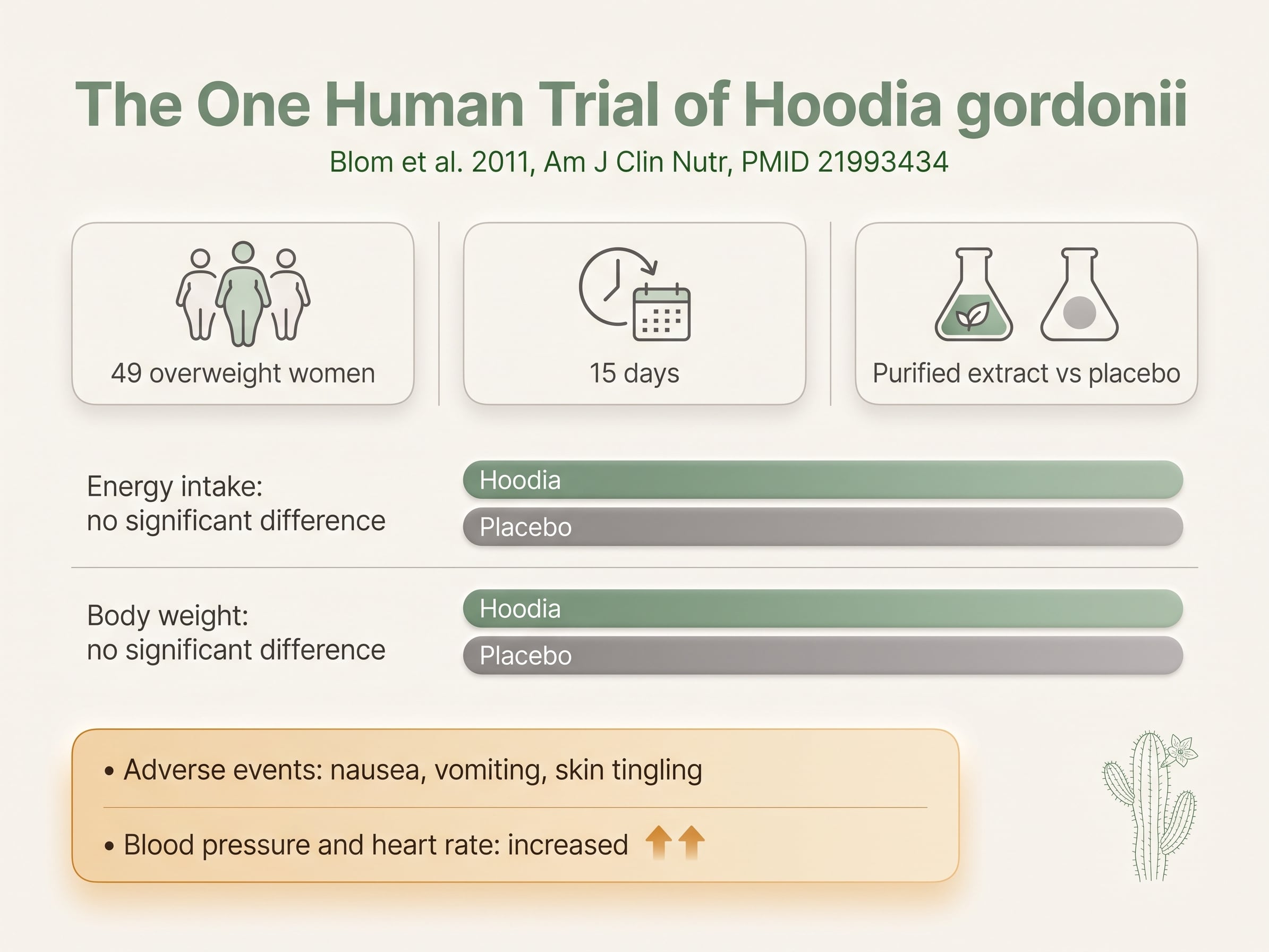
No, not according to the only controlled human trial. Blom and colleagues (2011), writing in the American Journal of Clinical Nutrition (PMID: 21993434), ran a randomized, double-blind, placebo-controlled study in 49 healthy overweight women who took purified Hoodia gordonii extract or placebo for 15 days. Ad libitum energy intake and body weight did not differ significantly between the groups. The hoodia group did report more nausea, vomiting, and unusual skin sensations, and the researchers recorded increases in blood pressure, pulse, and heart rate that they described as clinically concerning.
- Design: randomized, double-blind, placebo-controlled, 15 days, 49 overweight women, purified extract taken twice daily.
- What was measured: daily energy intake at ad libitum meals, body weight, blood chemistry, vital signs.
- What changed: nothing meaningful in intake or weight compared with placebo.
- What went wrong: more gastrointestinal and skin adverse events, plus higher blood pressure and heart rate, in the hoodia group.
The National Center for Complementary and Integrative Health (NCCIH) summarizes the state of the evidence in a single sentence: only one small study has been done on hoodia supplements in people, and those who took hoodia did not lose more weight than those on placebo. The corporate research history says the same thing in a different way. Phytopharm licensed the P57 program to Pfizer in 1998, Pfizer returned the rights in 2003, and Unilever, which had planned a hoodia-based food product, abandoned the program in 2008 after its own safety and efficacy work. That is not the trajectory of a compound that works as advertised.
We have observed in our own reading of the literature that the phrase “studies show hoodia suppresses appetite” almost always traces back to animal or cell data. When a page cites a human trial, it is this one, and it was negative.
What is P57 and how is it supposed to work?
P57, more precisely P57AS3, is an oxypregnane steroidal glycoside isolated from Hoodia gordonii and first characterized by researchers working with the CSIR (van Heerden et al. 2007, Phytochemistry). The working hypothesis is that P57 raises adenosine triphosphate (ATP) levels in hypothalamic neurons, mimicking the “fed” signal that glucose normally sends, so the brain registers fullness even when the stomach is empty. MacLean and Luo (2004), publishing in Brain Research, injected P57 directly into the brains of rats and recorded a rise in hypothalamic ATP content along with reduced food intake.
Three problems sit between that rat data and a capsule on a shelf. First, the rats received P57 by intracerebroventricular injection, straight into the brain. Nobody has shown that orally swallowed P57 survives digestion, crosses the blood-brain barrier, and reaches the hypothalamus at a meaningful concentration in humans. Second, steroidal glycosides of this class are large, polar molecules with poor expected oral bioavailability. Third, the one trial that tested purified extract in people, described above, did not find the appetite effect the mechanism predicts.
The mechanism is plausible on paper. It has simply never been demonstrated in a human being who swallowed the plant.
What are the side effects of hoodia?
The adverse-event list comes almost entirely from the Blom trial (PMID: 21993434) and from the NCCIH summary of it. Participants taking hoodia reported nausea, vomiting, dizziness, headache, and paresthesia, the odd tingling or crawling skin sensations that several volunteers described. Blood pressure, pulse, and heart rate rose in the hoodia group, and bilirubin and alkaline phosphatase, two liver-related blood markers, shifted as well.
Cardiovascular concerns
The blood pressure and heart-rate signals are the findings that most concern us editorially. An appetite suppressant that raises cardiovascular load in healthy women over two weeks is a poor candidate for anyone with hypertension, arrhythmia, or established heart disease. The trial was too short to say what happens over months.
Liver effects
The LiverTox monograph maintained by the National Institute of Diabetes and Digestive and Kidney Diseases (NCBI Bookshelf NBK548704) reviews hoodia and notes the laboratory shifts seen in the controlled trial, while recording no convincing published cases of clinically apparent liver injury attributed to hoodia itself. That is reassuring only up to a point, because so few people have taken verified hoodia under observation. Adulterated products carrying undeclared stimulants or pharmaceuticals are a separate and real liver risk, addressed below.
Long-term safety data
There is none. Fifteen days is the longest anyone has studied hoodia in a controlled setting. A 2019 review of herbal weight-loss preparations (Farrington et al., Journal of Integrative Medicine, PMID: 30738773) and a 2022 review of dietary supplements for obesity (Bonetti et al., Journal of Preventive Medicine and Hygiene, PMID: 36479472) both place hoodia among the agents with insufficient evidence of either efficacy or safety.
Undernourishment
Any agent that genuinely blunts appetite carries a risk of inadequate nutrient intake if it is used to skip meals rather than to moderate them. This is a general caution about appetite suppressants of every kind.
Can hoodia be combined with other supplements or medications?
No interaction study has ever been published for hoodia. That absence is the answer, not a reassurance. Given the blood pressure and heart-rate rises recorded in the Blom trial, the most sensible caution applies to antihypertensive medication, stimulant medications, caffeine-heavy fat burners, and thermogenic blends such as those built on synephrine or yohimbine. Because P57 is a glycoside and the trial recorded shifts in liver markers, we would also be cautious about combining hoodia with any other agent known to load the liver.
Stacking hoodia with a second weight-loss supplement has never been tested in any study, animal or human. From our hands-on assessment of the category, most “hoodia blends” on the market pair it with caffeine or green tea extract, which means any appetite effect a user notices is more plausibly the stimulant than the succulent. If you take medication for blood pressure, heart rhythm, diabetes, or thyroid function, talk with your healthcare provider before adding hoodia in any form.

Why are so many hoodia products fake, and how can you verify one?
Hoodia is faked more often than almost any other herb because the economics push in that direction. Hoodia gordonii is a slow-growing, CITES Appendix II succulent. International trade in wild-harvested stems requires an export permit issued by the source country, cultivation is limited, and demand peaked in the mid-2000s at a level the wild population could never supply. Genuine raw material is therefore expensive, and a capsule labeled “hoodia” that contains cheap filler, a different Hoodia species, or an undeclared stimulant costs a fraction to produce. Independent laboratory testing has repeatedly found commercial products with little or no Hoodia gordonii, and the U.S. Food and Drug Administration has issued warning letters to marketers over unapproved weight-loss claims on hoodia products.
In our sourcing experience, five checks separate a credible hoodia product from a speculative one:
- CITES documentation or cultivated-source records. A legitimate supplier can show the permit chain for wild material or documentation that the plant was farmed under license.
- A third-party certificate of analysis that identifies the species and, ideally, quantifies a marker compound such as P57 or its aglycone, hoodigogenin A.
- Latin binomial and plant part on the label. “Hoodia gordonii stem” is a claim that can be tested. “Hoodia extract” is not.
- No undeclared stimulants. A hoodia product that produces a noticeable buzz is telling you something about what is really in it.
- A price that makes sense. Authentic hoodia cannot be cheap. If a bottle is priced like a generic herb, it probably is one.
Our editorial team has reviewed supplier documentation for our own hoodia capsule against these five points, and we publish the plant part and species on the label for exactly this reason. That does not change the evidence picture above. It only means the capsule contains what it says.
Is hoodia sustainable? CITES Appendix II and the San benefit-sharing agreement
Hoodia species were added to CITES Appendix II at the 13th Conference of the Parties in 2004, with the listing effective in January 2005. Appendix II does not ban trade. It requires that international shipments of wild-collected material carry export permits confirming the harvest was legal and not detrimental to the survival of the species. Namibia and South Africa manage that permitting, and both have encouraged licensed cultivation to take pressure off wild populations.
The sustainability story is also an ethics story. The 2003 CSIR and South African San Council agreement committed a share of milestone payments and royalties from hoodia commercialization to the San, recognizing that the appetite knowledge came from them. When the corporate P57 programs collapsed, so did most of the anticipated income, but the agreement remains a reference point for access and benefit-sharing under the Convention on Biological Diversity and the later Nagoya Protocol. A Hoodia product that cannot explain where its raw material came from cannot explain whether any of that benefit ever reached the people who discovered the plant.
How does hoodia compare to other appetite suppressants?
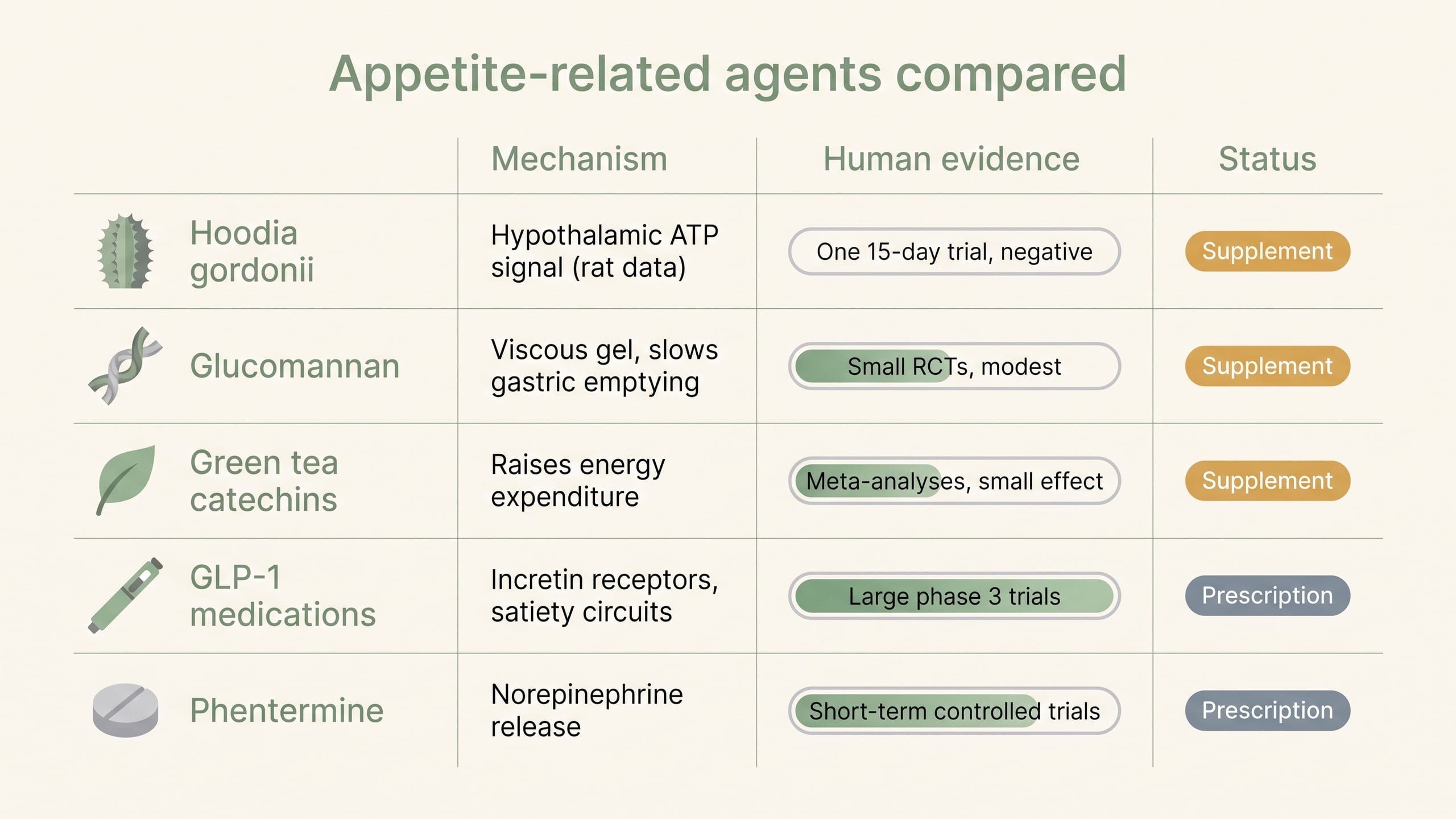
Hoodia is the only agent in the table below whose single controlled human trial was negative. Fiber and thermogenic options have modest but repeated positive findings. GLP-1 and dual-agonist medications have large phase 3 programs behind them and are available by prescription only. The comparison is descriptive. It is not a recommendation to use any of these agents, and dosing is deliberately left out.
| Agent | Type | Proposed mechanism | Human evidence tier | Regulatory status |
|---|---|---|---|---|
| Hoodia gordonii (P57) | Botanical supplement | Hypothalamic ATP rise mimicking a fed signal (rat data) | One 15-day RCT, negative for intake and weight | Dietary supplement, CITES Appendix II plant |
| Glucomannan (konjac root) | Soluble fiber supplement | Forms a viscous gel in the stomach, slows gastric emptying | Multiple small RCTs, modest and inconsistent effect | Dietary supplement |
| Green tea catechins with caffeine | Thermogenic botanical | Increases energy expenditure and fat oxidation | Meta-analyses show a small effect on weight | Dietary supplement |
| Semaglutide, tirzepatide, mazdutide | GLP-1 and dual incretin receptor agonists | Slows gastric emptying and acts on central satiety circuits | Large phase 3 trials with substantial weight change | Prescription medication, physician supervision |
| Phentermine | Sympathomimetic amine | Increases norepinephrine release, reduces appetite | Established short-term efficacy in controlled trials | Prescription medication, short-term use |
| Sources: Blom et al. 2011 (PMID: 21993434), Bonetti et al. 2022 (PMID: 36479472), Farrington et al. 2019 (PMID: 30738773), NCCIH hoodia fact sheet. | ||||
Hoodia versus GLP-1 medications
The two are not comparable in kind. Hoodia is a plant with a hypothesized central mechanism that has never been demonstrated orally in humans. Semaglutide, tirzepatide, and the newer dual agonist mazdutide are engineered peptides that act on well-characterized incretin receptors and have been tested in trials enrolling thousands of participants. They are prescription-only, carry their own side-effect profiles, and are managed by a clinician. Anyone reading about hoodia because they are weighing it against a GLP-1 prescription should have that conversation with a physician, not with a supplement label.
Is there an established dose of hoodia?
No validated human dose exists. The only controlled trial used 1,110 mg of purified Hoodia gordonii extract twice daily for 15 days, and that is the dose at which the adverse effects described above appeared. Commercial capsules typically contain 400 to 1,000 mg of dried stem powder, a quantity chosen by manufacturers rather than derived from clinical data, and dried powder is not the same material as a purified extract. We do not publish a dosing recommendation for hoodia on this site, and we would be skeptical of any source that does.
How long does it take to see results from hoodia?
The honest answer is that the one human trial ran for 15 days and saw no result. There is no published human data suggesting a later onset of effect, and the corporate development programs that would have run longer trials were shut down before doing so. Users who report an appetite effect within days are more often taking a blended product whose caffeine or other stimulant content explains the experience. Fifteen days without a measurable change in intake or weight, in a controlled setting, is the only timeline the evidence supports.
Who should avoid hoodia?
Based on the trial findings and the absence of safety data, we would steer the following groups away from hoodia entirely: people with high blood pressure, heart disease, or arrhythmia; people taking medication for diabetes or thyroid conditions; anyone who is pregnant or breastfeeding; and anyone with a history of disordered eating, for whom an appetite suppressant of any kind is inappropriate. Everyone else should treat hoodia as an ethnobotanical curiosity with an unproven benefit, not as a weight-management tool, and should speak with a healthcare provider before trying it.
If you decide to try the plant anyway, choose a product that names the species and plant part, can document its sourcing, and does not hide a stimulant behind the hoodia label. Our hoodia capsule is sold on those terms, with the same caveats you have just read.
Frequently asked questions about hoodia
Does hoodia suppress appetite?
Not in the only controlled human trial. Blom et al. (2011), PMID: 21993434, found no significant difference in energy intake or body weight between overweight women taking purified Hoodia gordonii extract and those taking placebo over 15 days. The appetite hypothesis is based on rat brain-injection studies of the P57 glycoside.
Is Hoodia gordonii a cactus?
No. Hoodia gordonii is a stem succulent in the Apocynaceae family, related to stapeliads, and native to the Kalahari Desert of southern Africa. True cacti belong to the Cactaceae family and are native to the Americas. The “Kalahari cactus” nickname describes the look, not the botany.
What are the side effects of hoodia capsules?
The controlled trial recorded nausea, vomiting, dizziness, headache, and skin tingling, along with increases in blood pressure, pulse, and heart rate and shifts in liver-related blood markers. No long-term safety data exist. Adulterated products carrying undeclared stimulants add further risk.
Is hoodia safe for weight loss?
Safety has not been established. NCCIH states that little is known about hoodia’s safety and that the one human study raised concerns about blood pressure and heart measures. People with cardiovascular, blood sugar, or thyroid conditions, and anyone pregnant or breastfeeding, should avoid it.
How long does it take for hoodia to work?
The only human trial ran for 15 days and found no effect on appetite or weight. No published data suggest a later onset. Users who feel an effect within days are usually taking a blend whose caffeine or other stimulant content accounts for the experience.
Can hoodia be combined with other weight loss supplements?
No combination has ever been studied. Because hoodia raised blood pressure and heart rate in the controlled trial, combining it with caffeine-heavy fat burners, synephrine, yohimbine, or stimulant medications is a particular concern. Talk with a healthcare provider before stacking it with anything.
Where can I buy authentic hoodia?
Look for a supplier that names Hoodia gordonii and the stem on the label, can show CITES or licensed-cultivation documentation, provides a third-party certificate of analysis, and charges a price consistent with a scarce, permit-controlled plant. Very cheap hoodia is almost never real hoodia.
Related Reading
Continue exploring this topic with our articles on herbs for extreme weight loss, nopal cactus and weight loss, and how ashwagandha, cortisol, and weight loss relate.
Important: This article is for educational and informational purposes. The statements have not been evaluated by the Food and Drug Administration. The herbs and herbal products discussed are not intended to diagnose, treat, cure, or prevent any disease, including obesity. Information presented here is not a substitute for professional medical advice, diagnosis, or treatment. Always consult a qualified healthcare provider for medical guidance specific to your circumstances. Do not delay seeking medical care because of information you have read on this site.