Key Takeaways
- Finasteride is an FDA-approved prescription drug that strongly lowers DHT, and in head-to-head studies it outperforms saw palmetto for regrowing hair.
- Saw palmetto is a traditional botanical that gently supports normal DHT balance, with a more modest effect and a gentler side-effect profile.
- In a two-year comparison, 68 percent of men improved on finasteride versus 38 percent on saw palmetto.
- Saw palmetto works slowly, so judge it over three to six months, and it is often paired with pygeum, nettle root, and pumpkin seed.
- Neither option is appropriate for women who are or may become pregnant, so a provider conversation comes first.
Hair loss, specifically androgenetic alopecia (male or female pattern balding), is a common concern that affects a large share of the population. Many people weighing their options run into the same two names: finasteride, an FDA-approved prescription medication, and saw palmetto (Serenoa repens), a naturally derived supplement. Both aim to slow thinning hair by influencing dihydrotestosterone (DHT), the androgen most implicated in hair-follicle miniaturization. Real differences separate them across mechanism, proven effectiveness, side effects, and the weight of scientific evidence. Our editorial team has reviewed the clinical literature on both to give you an honest comparison you can take to your healthcare provider.
Mechanism of Action: How Finasteride and Saw Palmetto Work
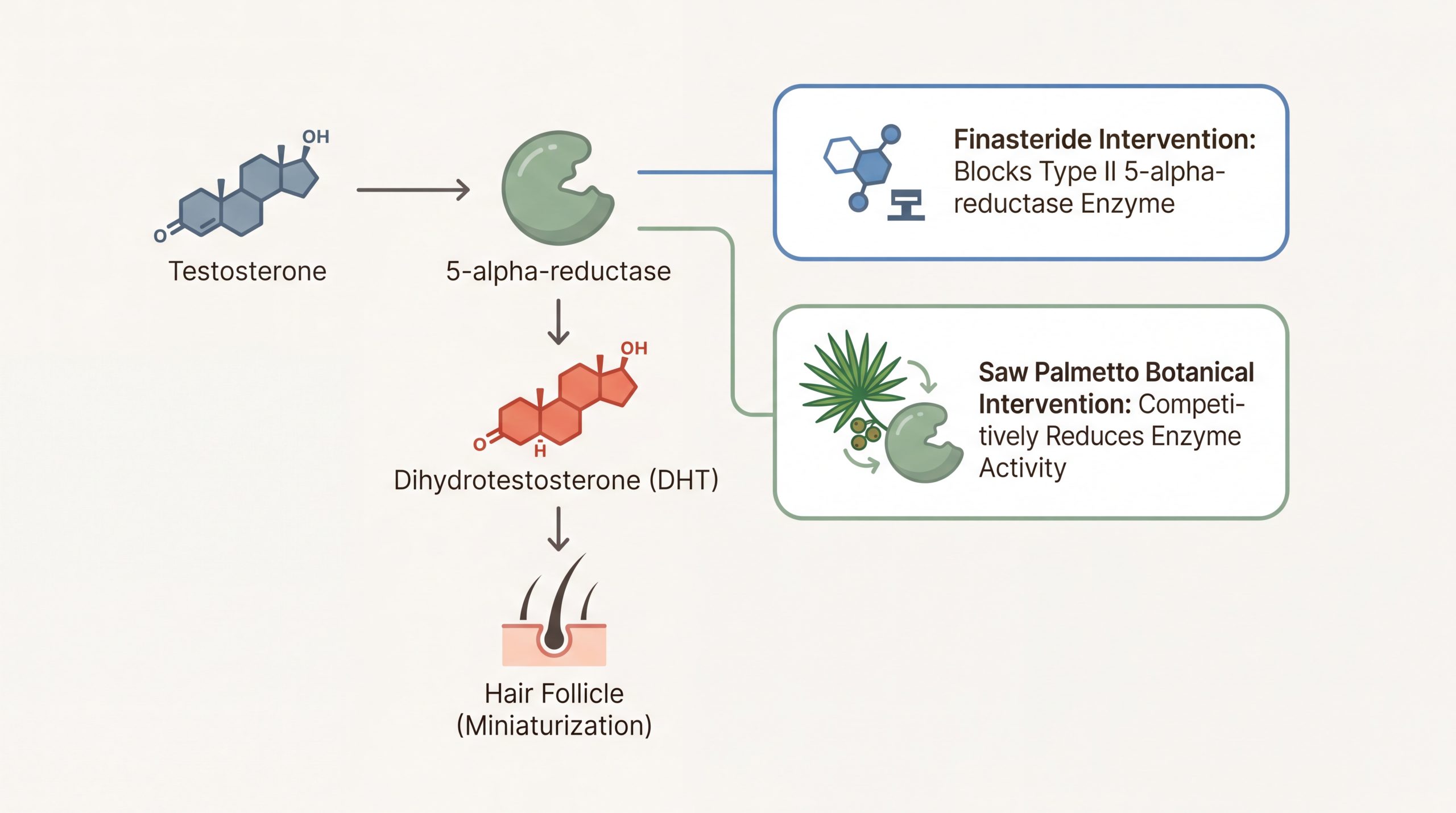
Both finasteride and saw palmetto are believed to act by inhibiting the enzyme 5-alpha-reductase, which converts testosterone into DHT. When DHT levels in the scalp rise, DHT binds to androgen receptors inside hair follicles and triggers miniaturization, so follicles shrink over time and produce shorter, thinner shafts until new growth stalls.
Finasteride’s Approach
Finasteride is a potent synthetic inhibitor of 5-alpha-reductase. It primarily targets the type II form of the enzyme, which produces a substantial reduction in DHT in both the scalp and the bloodstream. That drop can slow, stop, or partially reverse follicle miniaturization. Finasteride is available in oral form, typically a 1 mg dose for hair loss under brand names such as Propecia and in generic versions, and less commonly as a topical solution.
Saw Palmetto’s Approach
Saw palmetto (Serenoa repens) is a natural extract from the berries of a small palm tree. Its action on 5-alpha-reductase is milder, and while the precise mechanism is not fully mapped, research suggests it may also have anti-inflammatory properties that could support overall scalp health. It is sold over the counter as capsules, tablets, and liquid extracts, and it sometimes appears in shampoos and hair lotions.
The two approaches differ at the enzyme level. Finasteride selectively inhibits type II (and type III) 5-alpha-reductase, the isoenzyme most active in the scalp and prostate, which is why it produces a large and sustained drop in DHT. Saw palmetto works more broadly and far more gently. Its liposterolic fraction, rich in free fatty acids and phytosterols such as beta-sitosterol, competitively and reversibly dampens 5-alpha-reductase rather than shutting it down. In our reading of the preclinical literature, a liposterolic saw palmetto extract lowered prostatic DHT in an animal model, which supports 5-alpha-reductase inhibition as a plausible mechanism while stopping well short of the pharmaceutical-grade suppression finasteride delivers (Wadsworth et al., 2007, The Prostate, PMID 17342743).
Comparing Effectiveness: Scientific Evidence for Finasteride and Saw Palmetto
The sharpest distinction between the two is the amount and quality of the evidence behind each for hair loss.
Finasteride: Strong Clinical Evidence
Finasteride carries a large body of clinical trial data for male pattern baldness.
- Key studies: A widely cited trial showed that 1 mg finasteride daily increased hair count and improved hair appearance against placebo over two years. In a five-year multinational study of 1,553 men, finasteride produced durable scalp-hair improvement and slowed further loss, and it was generally well tolerated (finasteride 5-year study, Eur J Dermatol, PMID 11809594).
- Where it works: Finasteride tends to help both the crown (vertex) and, to a somewhat lesser degree, the frontal hairline.
- Quantifiable results: In a two-year comparison, 68 percent of men on finasteride showed hair regrowth (Rossi et al., 2012, PMID 23298508).
- Onset of action: Noticeable change usually appears after 3 to 6 months of consistent use, with fuller effects after about 12 months.
- Finasteride in women: Finasteride is generally not approved for women, especially premenopausal women, because of the risk to a developing male fetus. It is not a first-line treatment for female pattern hair loss.
Saw Palmetto: Limited and Less Consistent Evidence
The evidence for saw palmetto is considerably weaker. Studies tend to be smaller, shorter, and sometimes lack rigorous controls such as placebo groups.
- Key studies: A two-year study comparing 320 mg daily saw palmetto to 1 mg daily finasteride found 38 percent of the saw palmetto group improved versus 68 percent for finasteride (Rossi et al., 2012, PMID 23298508). Smaller studies report some gains in density and quality, but the results are less consistent.
- Where it works: Some research suggests saw palmetto may do more at the vertex than at the frontal scalp.
- Onset of action: Because the research is limited, the timeframe is less defined, though several months of use is a common starting expectation.
| Evidence point | Finasteride | Saw palmetto |
|---|---|---|
| Hair regrowth, 24-month head-to-head | Improvement in 68 percent of men | Improvement in 38 percent of men |
| Area of scalp responding | Front (hairline) and vertex (crown) | Mainly the vertex (crown) |
| Prostate (BPH) urinary symptoms | Established clinical benefit | No better than placebo in pooled Cochrane data |
| Long-term hair data | Durable improvement across 5 years | Short trials only, less consistent |
| Sources: Rossi et al. 2012 (PMID 23298508), MacDonald and Tacklind et al. 2012 (PMID 22551330), and the finasteride 5-year study (PMID 11809594). | ||
The most direct comparison we could locate was a two-year study of 100 men that put saw palmetto 320 mg per day against finasteride 1 mg per day. Finasteride produced hair-growth improvement in 68 percent of men versus 38 percent for saw palmetto, and it worked across both the hairline and the crown while saw palmetto acted mainly at the crown (Rossi et al., 2012, Int J Immunopathol Pharmacol, PMID 23298508). For prostate symptoms, an updated Cochrane systematic review of 17 trials found Serenoa repens was no better than placebo, even at double and triple the usual dose (MacDonald and Tacklind et al., 2012, BJU Int, PMID 22551330). One nuance worth noting from our review is that a standardized hexanic extract performed comparably to short-term finasteride on urinary symptom scores in a separate meta-analysis, which suggests extract standardization matters a great deal when comparing botanical results (Novara et al., 2016, Eur Urol Focus, PMID 28723522).
Side-by-Side Comparison: Finasteride vs. Saw Palmetto
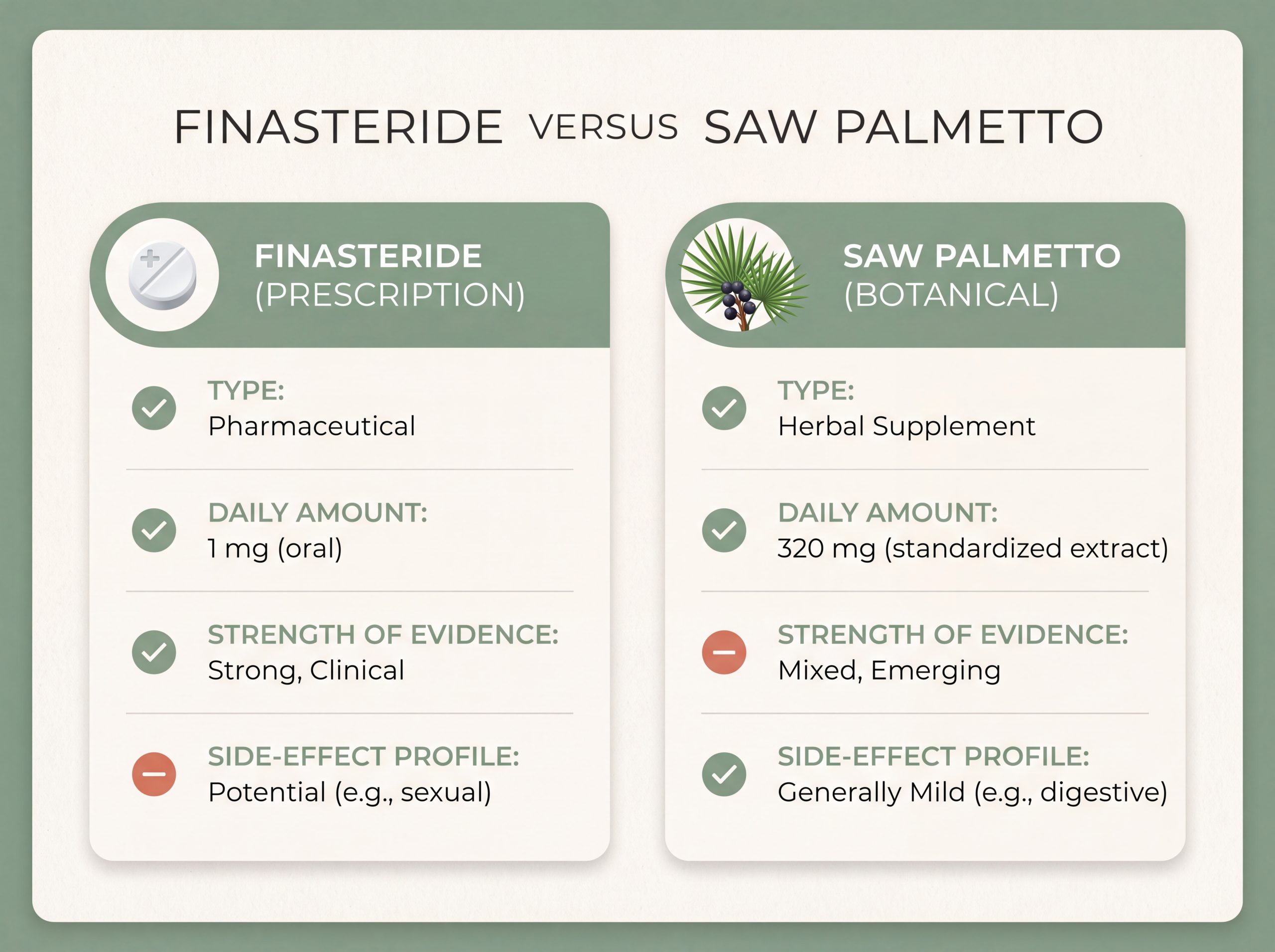
The following table provides a direct comparison of key features.
| Feature | Finasteride | Saw Palmetto |
|---|---|---|
| Mechanism | Potent 5-alpha-reductase inhibitor (primarily type II) | Believed to inhibit 5-alpha-reductase (milder effect) |
| Evidence | Strong, from numerous large controlled trials | Limited, from smaller and less consistent studies |
| Effectiveness | High, with significant regrowth in many men | Moderate, with some improvement in some people |
| Side effects | Sexual dysfunction (low percentage), potential for post-finasteride syndrome | Mild GI upset, headache, or dizziness (rare), possible interaction with blood thinners |
| Form | Prescription pill (typically 1 mg for hair loss), topical available | Over-the-counter supplement (various forms) |
| Onset of action | 3 to 6 months for noticeable change, 12 months or more for full results | Less clear, potentially several months |
| Use in women | Generally not recommended, especially premenopausal women | Sometimes used, but the evidence is limited |
Potential Side Effects and Safety Considerations
Finasteride: Understanding the Risks
- Sexual side effects: The most frequently reported effects involve sexual function, including decreased libido, erectile dysfunction, and problems with ejaculation. These occur in a small percentage of men, generally around 2 to 4 percent in clinical trials.
- Post-finasteride syndrome (PFS): This is a debated and not fully understood condition involving persistent sexual, neurological, and physical effects that may continue after stopping the drug. It is not universally recognized, but it is a real concern for some men. Reported symptoms include persistent erectile dysfunction, reduced libido, depression, anxiety, and cognitive difficulty.
- Impact on PSA levels: Finasteride lowers prostate-specific antigen (PSA), a marker used in prostate cancer screening, which can make PSA results harder to interpret. Tell your physician you take finasteride before a PSA test.
- Gynecomastia: A very small risk of breast enlargement has been observed in some cases.
- Shedding: Finasteride may cause initial temporary shedding.
Saw Palmetto: A Generally Safer Profile
- Good tolerability: Saw palmetto is generally considered well tolerated, with fewer reported effects than finasteride.
- Mild effects: Some people notice mild gastrointestinal discomfort such as nausea or stomach upset, headache, or dizziness.
- Interactions: Saw palmetto may interact with blood-thinning medications such as warfarin, aspirin, and clopidogrel, and it may interfere with iron absorption and with hormonal therapies. Discuss use with your provider if this applies to you.
The long-term tolerability data back this up. In the updated Cochrane review of 17 trials, adverse events from saw palmetto were few, mild, and not statistically different from placebo, with study withdrawals of roughly 10 percent in both groups (MacDonald and Tacklind et al., 2012, PMID 22551330). Independent NIH guidance likewise describes saw palmetto as well tolerated by most users, with mild effects such as stomach discomfort being the most common (NCCIH, Saw Palmetto). The trade-off is the mirror image of finasteride, a gentler side-effect profile paired with a more modest and less consistent effect.
Saw Palmetto and Finasteride: Safety for Women and During Pregnancy
This section carries the most important safety message on the page. Finasteride is not for use by women, and the caution is serious. Because it lowers DHT, finasteride can interfere with the normal genital development of a male fetus, so women who are or may become pregnant should not take it and should not handle crushed or broken tablets, since the drug can be absorbed through the skin (MedlinePlus, Finasteride). Intact tablets are film-coated to reduce this risk, but broken ones remove that protection.
Saw palmetto is a hormonally active botanical, so we do not recommend it during pregnancy or nursing, and anyone on hormone-sensitive medication or hormonal contraception should check with a provider first. For women experiencing hair thinning, the takeaway is that neither of these two options is a casual choice, and the safest path is a conversation with a clinician about approaches validated for female-pattern hair loss. Nothing on this page is a substitute for that individual medical advice.
Using Finasteride and Saw Palmetto Together: What You Need to Know
A common question is whether finasteride and saw palmetto can be used together. There is very limited research on the safety and effectiveness of this combination.
- The theory: Some people reason that combining the two might add up to more complete DHT support, or might let a lower finasteride dose do the job with fewer side effects.
- The evidence: There is no strong scientific evidence to support these claims.
- The risks: Combining the two could raise the chance of side effects from either one, and the interaction between them is not well characterized. Saw palmetto can also interact with blood thinners, iron absorption, and hormonal therapies.
- The recommendation: Do not combine finasteride and saw palmetto without the explicit guidance and ongoing monitoring of a qualified healthcare professional, who can weigh your individual risk factors.
How Long Does Saw Palmetto Take to Work for Hair Loss?
This is the question we hear most, and the honest answer is that botanical support for hair works slowly. Hair follicles cycle over months rather than weeks, so any 5-alpha-reductase influence needs time to show at the scalp. In the clinical work we reviewed, saw palmetto was evaluated over periods of 24 weeks and longer, and the head-to-head hair study ran a full 24 months before scoring results (Rossi et al., 2012, PMID 23298508). A practical expectation is a three-to-six month evaluation window before judging whether a saw palmetto routine is doing anything for you, with more meaningful assessment closer to the one-year mark.
Two points set realistic expectations. First, consistency matters more than dose-chasing, because the effect depends on steady daily intake rather than occasional use. Second, saw palmetto is best understood as a gentle, traditional support for normal DHT balance and scalp health, not a rapid regrowth agent. If maintaining and supporting the hair you have is the goal, patience is part of the protocol. For a standardized option, our team stocks saw palmetto capsules and saw palmetto powder.
Stacking Saw Palmetto With Other Natural DHT Support Herbs
People rarely use saw palmetto in isolation. In traditional men’s-health formulas, it is usually paired with other botanicals studied for the same 5-alpha-reductase pathway, on the theory that several gentle inputs may support normal DHT balance better than one. From our sourcing and formulation experience, three companions come up again and again.
- Pygeum (Prunus africana), an African evergreen bark long used in European phytotherapy for prostate and urinary comfort, and frequently combined with saw palmetto. Explore our Pygeum Africanum capsules.
- Nettle root (Urtica dioica). The root, not the leaf, is the part traditionally paired with saw palmetto and pygeum in men’s formulas for its interaction with sex-hormone binding. See our Nettle Root capsules.
- Pumpkin seed, whose phytosterols are a common addition to natural DHT-support blends and which stacks comfortably with the two above.
For those approaching thinning hair from the traditional-tonic angle rather than the DHT angle, He Shou Wu capsules are a classic Traditional Chinese Medicine hair and vitality herb our customers ask about. As always, combining several actives means combining several safety profiles, so talk with your healthcare provider before stacking, especially alongside a prescription such as finasteride.
Dosage Information
- Finasteride: For male pattern hair loss, the standard dose is 1 mg per day, taken orally. Topical formulations exist and may carry a lower risk of systemic effects. Higher doses such as 5 mg are used for benign prostatic hyperplasia, not for hair loss.
- Saw palmetto: Studies have used 160 mg to 320 mg per day, usually of a standardized extract. Choose a high-quality supplement from a reputable brand for potency and purity.
For saw palmetto specifically, the dose used across most clinical work is 320 mg per day of a standardized liposterolic (fat-soluble) extract, taken either once daily or as two 160 mg servings (Rossi et al., 2012, PMID 23298508). Because the active fraction is fat-soluble, we suggest taking saw palmetto with a meal that contains some fat to support absorption. Standardization is the detail most shoppers miss. Pooled data on generic extracts were disappointing, while a standardized hexanic extract performed far better in trials, so the quality and preparation of the extract matter as much as the milligram number (Novara et al., 2016, PMID 28723522). Capsules deliver a consistent standardized dose, while powder offers flexibility for those who prefer to blend it into food.
Disclaimer: These are typical dosage ranges found in studies and general use. Your individual dosage should always be set by a healthcare professional based on your needs and health status.
Alternative Treatments for Hair Loss
Several other options exist for addressing hair loss.
- Minoxidil (Rogaine): A topical solution or foam that supports hair growth by improving blood flow to the scalp. It is available over the counter in 2 percent and 5 percent strengths for both men and women.
- Low-level laser therapy (LLLT): Uses red light to stimulate follicles through combs, helmets, or caps. The evidence is mixed, though some studies are encouraging.
- Platelet-rich plasma (PRP) therapy: Injects concentrated platelets from your own blood into the scalp to support hair growth.
- Hair transplantation: A surgical procedure that moves follicles from a donor area to balding regions.
- Other supplements: Biotin, vitamin D, zinc, and iron are often marketed for hair, though evidence that they reverse androgenetic alopecia is limited unless a deficiency is present.
- Ketoconazole shampoo: Sometimes used alongside finasteride.
Consult your healthcare professional for an informed decision on the right treatment for you.
Frequently Asked Questions: Finasteride and Saw Palmetto
Can saw palmetto help with hair loss?
Saw palmetto is traditionally used to support normal DHT balance, and a two-year study found hair-growth improvement in 38 percent of men taking 320 mg per day, compared with 68 percent for finasteride (Rossi et al., 2012, PMID 23298508). It may offer gentle support, but the evidence places it well below finasteride for regrowth.
How effective is saw palmetto compared to finasteride?
In direct comparison, finasteride is meaningfully more effective for hair loss and works across both the hairline and crown, while saw palmetto acts mainly at the crown. For prostate symptoms, pooled Cochrane data found saw palmetto no better than placebo (PMID 22551330).
How long does saw palmetto take to work for hair loss?
Plan on a three-to-six month evaluation window, with a clearer read near one year. Hair cycles slowly, and the clinical studies ran for 24 weeks to 24 months. Daily consistency matters more than a high dose.
Is saw palmetto safe for women to take?
Saw palmetto is hormonally active, so we do not recommend it during pregnancy or nursing, and women on hormone-sensitive medication should consult a provider first. Finasteride is not for use by women at all, and women who are or may become pregnant should not even handle broken tablets.
What is the recommended saw palmetto dosage?
Most studies use 320 mg per day of a standardized liposterolic extract, taken with food because the active fraction is fat-soluble. Extract standardization strongly affects results.
Can I take saw palmetto and finasteride together?
Some people do, but because both act on the same DHT pathway, you should only combine them under the guidance of your healthcare provider, who can weigh the benefit against added side-effect risk.
Can saw palmetto be combined with other natural DHT support herbs?
Yes. It is traditionally paired with pygeum, nettle root, and pumpkin seed in men’s-health formulas. Combining actives also combines their safety profiles, so check with a provider before stacking.
Related Reading
Continue exploring natural men’s-health support with these from our team:
- Pygeum Africanum for prostate and hair support
- Nettle Root and the DHT pathway
- He Shou Wu, a traditional hair tonic herb
Disclaimer: These statements have not been evaluated by the Food and Drug Administration. This product is not intended to diagnose, treat, cure, or prevent any disease. Finasteride is a prescription medication and is discussed here for educational comparison only. Consult your healthcare provider before use, especially if you are pregnant, nursing, taking medication, or have a medical condition.