Key Takeaways
- Current evidence on Ginkgo biloba and female fertility points toward caution rather than benefit, and no human trial has shown improved conception or live birth rates.
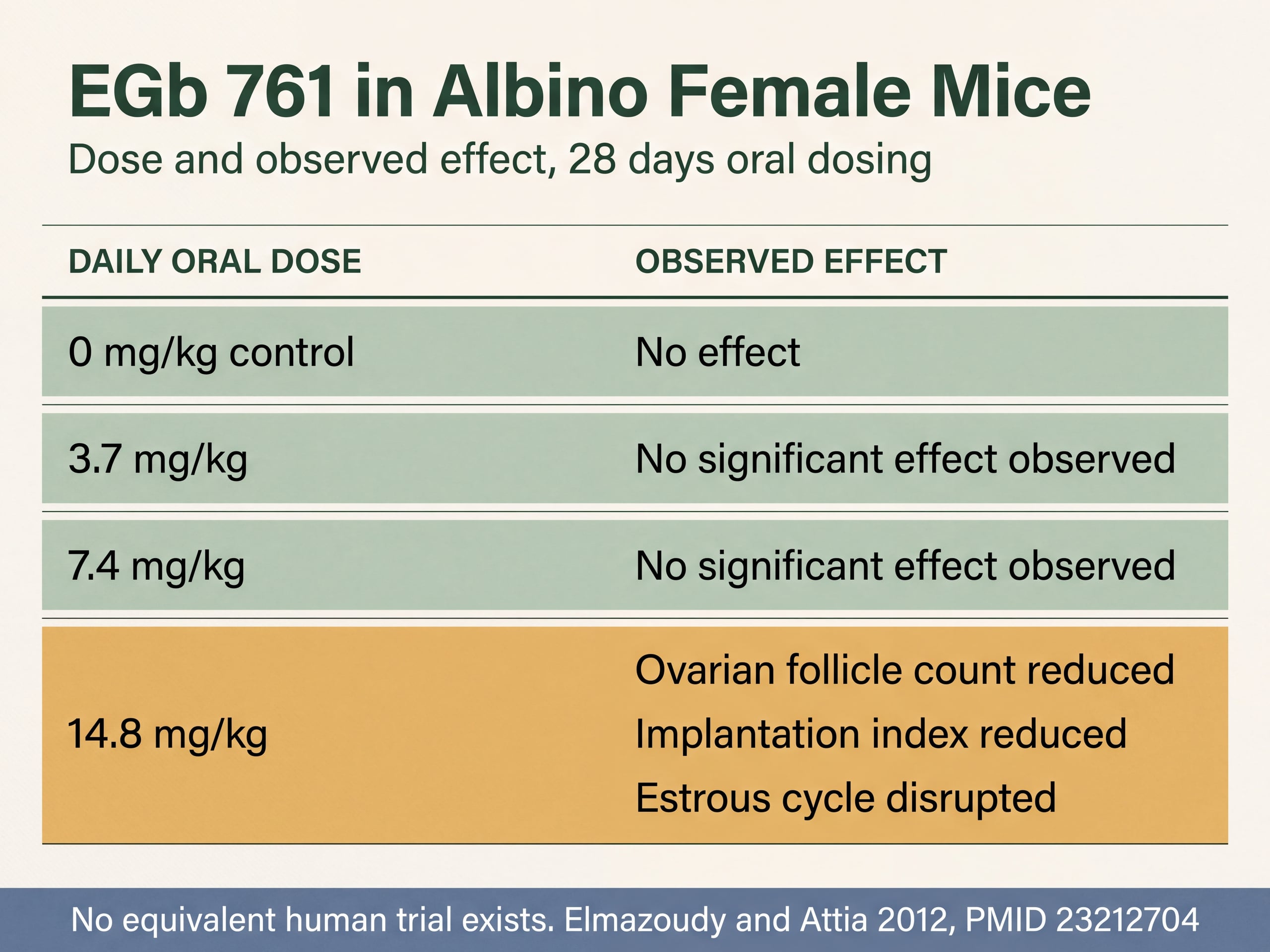
- In albino female mice, the standardized extract EGb 761 at 14.8 mg/kg body weight per day for 28 days reduced ovarian follicle counts and showed anti-implantation and abortifacient effects, while lower doses of 3.7 and 7.4 mg/kg did not.
- Ginkgo inhibits platelet aggregation, which is the reason most fertility clinics ask patients to stop herbal supplements before egg retrieval and embryo transfer.
- A 2006 systematic review found ginkgo leaf may act as an emmenagogue with hormonal properties, and flagged past ginkgo products adulterated with colchicine.
- If you are trying to conceive or in an assisted reproduction cycle, bring the actual bottle to your clinic rather than deciding on your own.
Ginkgo biloba is one of the most widely sold botanical supplements in the United States, and it is also one of the few whose research record on female fertility runs mostly in the wrong direction. Our editorial team reviewed the primary literature on this question because the consumer coverage of it is unusually thin. Most of what ranks is either a paywalled journal abstract written for researchers or a general wellness post that never mentions a dose.
This article sets out what the studies actually measured, at what doses, in which species, and what that means for someone who is trying to conceive or preparing for an assisted reproduction cycle. We sell ginkgo. We are still going to tell you that the preconception evidence does not support taking it, because that is what the record shows.
Does Ginkgo Biloba Help or Harm Female Fertility?
Ginkgo biloba L. is a leaf extract whose current research record points more toward reproductive caution than reproductive benefit for women trying to conceive. Its flavone glycosides and terpene lactones produce vasodilation and antiplatelet activity, which is the basis of the circulation rationale, but the same extract reduces ovarian follicle counts and suppresses ovarian hormone release in animal models. In albino female mice, standardized EGb 761 showed anti-implantation effects at 14.8 mg/kg body weight per day, per Elmazoudy and Attia (2012), Birth Defects Research Part B, PMID: 23212704.
That is the short answer, and it is worth sitting with the shape of it. The mechanism that makes ginkgo attractive for fertility and the mechanism that makes it risky are the same mechanism. Improved perfusion of the uterus and ovaries is a genuine pharmacological property of the extract. So is inhibition of platelet aggregation. So is the effect on ovarian steroidogenesis. You do not get to select one.
Alexander Sirotkin’s 2021 minireview in Reproductive Biology, PMID: 34656881, states the position plainly after surveying the literature: ginkgo extract mainly suppresses ovarian function, even though isolated constituents such as quercetin and kaempferol can promote it. The review names ginkgolide B and allopregnanolone as the likely anti-reproductive constituents, both of which promote ovarian cell apoptosis and suppress follicullogenesis and oogenesis. Whole-leaf extract is not the sum of its most favorable molecules.
In our experience reviewing herbal literature for this catalog, this is an unusually clean example of a pattern that recurs across botanicals. A constituent-level finding gets marketed as an extract-level benefit, and the extract-level data says something different.
How Does Ginkgo Biloba Affect Ovulation and Reproductive Hormones?
Ginkgo biloba affects ovulation through several measured pathways in animal and cell models. It promotes ovarian granulosa cell apoptosis, reduces granulosa cell proliferation, and lowers the release of ovarian hormones including progesterone. In albino female mice given EGb 761 at 14.8 mg/kg body weight per day for 28 days, the estrous cycle was disrupted outright, per PMID: 23212704.
The Sirotkin review, PMID: 34656881, maps the candidate mechanisms: action on brain function, ovarian steroidogenesis, oxidative processes, intracellular regulators of ovarian cell proliferation and apoptosis, and GABA receptors. That is a wide mechanistic net, and the honest reading is that researchers do not yet know which pathway dominates in humans.
Two things follow from that. First, the finding is real and reproducible enough to appear across multiple independent groups. Second, it has not been quantified in women, because no one has run the trial. There is no human study measuring ginkgo’s effect on ovulation, follicle count, or menstrual cycle length. Anyone telling you the human effect size is either large or negligible is filling a gap in the record with an opinion.
What Does Ginkgo Do to Uterine Blood Flow?
Ginkgo produces vasodilation partly through nitric oxide signaling, and improved perfusion of the endometrium is the rationale behind the small body of assisted reproduction interest in this herb. A Cochrane review examining vasodilators in women with infertility found the evidence insufficient to support their use for improving live birth rates. Better blood flow to the endometrium is a plausible mechanism. It has not translated into a measured outcome.
What Are the Documented Reproductive Risks of Ginkgo Biloba?
The documented risks cluster into four findings, and each one carries a species and a dose. Reading them without those qualifiers produces a scarier picture than the data supports, and reading them without the findings at all produces a falsely reassuring one.
Dose-dependent ovarian toxicity. Elmazoudy and Attia administered EGb 761 orally to albino female mice at 0, 3.7, 7.4, and 14.8 mg/kg body weight per day for 28 days before mating, PMID: 23212704. Ovarian follicle counts, implantation index, and fetal viability were significantly reduced at the 14.8 mg/kg dose. The two lower doses did not produce these effects. The authors described the ovarian toxicity as dose-dependent, and concluded that EGb 761 at 14.8 mg/kg body weight per day in mice exhibits toxic effects on cyclicity and could have anti-implantation and abortifacient properties.
Suppression of ovarian function at the extract level. Per the 2021 Sirotkin minireview, PMID: 34656881, ginkgo extract affects ovarian folliculo- and oogenesis and embryogenesis, promotes granulosa cell apoptosis, and reduces the release of ovarian hormones. These are cell and animal model findings.
Antiplatelet activity and bleeding time. Dugoua and colleagues (2006), Canadian Journal of Clinical Pharmacology, PMID: 17085776, conducted a systematic review of ginkgo in pregnancy and lactation across seven electronic databases. They found weak animal and in vitro evidence of antiplatelet activity that could prolong bleeding time, and flagged it as a specific concern around labor. They also found low-level evidence, based on expert opinion, that ginkgo leaf may act as an emmenagogue and have hormonal properties.
Product adulteration. The same 2006 review warned that patients and clinicians should be aware of past reports of ginkgo products adulterated with colchicine. Colchicine is an antimitotic compound with well-established reproductive toxicity. This is a supply-chain risk rather than a property of the plant, which makes it the one risk on this list a buyer can actually control.
What is missing from all four: a human trial. Every finding above comes from mice, cell culture, or expert consensus. That does not make them irrelevant. Reproductive toxicology relies on animal models precisely because the human experiment is not ethical to run. It does mean the honest framing is caution under uncertainty, not proven harm in women.
Should You Stop Taking Ginkgo Biloba Before an Embryo Transfer or Fertility Treatment?
Most fertility clinics ask patients to discontinue herbal supplements, including ginkgo, before egg retrieval and embryo transfer, and ginkgo’s antiplatelet activity is the specific reason. Egg retrieval is a needle-aspiration procedure, and anything that prolongs bleeding time is a procedural consideration. Your clinic sets the actual timing, and their instruction supersedes anything written here.
- Bleeding risk is the clinical driver. Ginkgo inhibits platelet aggregation, per the 2006 systematic review by Dugoua and colleagues, PMID: 17085776. This is the same property behind the standard advice to stop ginkgo roughly two weeks before scheduled surgery.
- Ask about timing rather than assuming it. A two-week window is the common surgical convention, but retrieval, transfer, and stimulation-phase timing differ between protocols and between clinics. Your reproductive endocrinologist decides this, not a supplement label.
- The implantation-window data is animal data, and it is still worth raising. Anti-implantation effects appeared in albino female mice at 14.8 mg/kg body weight per day of EGb 761, PMID: 23212704. No equivalent human measurement exists, which is itself a reason to raise it with your clinician rather than resolve it yourself.
- Disclose everything, not just ginkgo. Herbal products are frequently omitted from medication lists because patients do not classify them as medication. Your care team cannot account for an interaction they do not know about.
- Bring the bottle. Extract ratio, standardization percentage, and per-capsule milligrams vary widely between products, and the label answers questions a product name cannot. This is the single most useful thing you can do at that appointment.
Can Ginkgo Biloba Interact With Fertility Medications, Birth Control, or Estradiol?
Ginkgo has documented and theoretical interactions with several medication classes relevant to reproductive care, and the strength of the evidence differs sharply between them. The National Center for Complementary and Integrative Health maintains an active clinical digest on herb-drug interactions that covers this territory in more detail than a supplement label ever will.
| Medication class | Mechanism of concern | Strength of evidence |
|---|---|---|
| Anticoagulants and antiplatelet drugs | Additive inhibition of platelet aggregation | Well documented, major interaction |
| Hormonal contraceptives, estradiol, progestins | Theoretical alteration of hepatic hormone clearance | Weak. Most studies show ginkgo does not meaningfully alter CYP3A4 |
| Gonadotropins and ovarian stimulation protocols | No direct interaction study exists | Absent. Clinic policy is precautionary, not evidence-driven |
| Anticonvulsants | Possible lowering of seizure threshold | Case reports, relevant to preconception planning |
| SSRIs and MAOIs | Serotonergic and hypertensive concerns | Limited, mostly theoretical |
| Sources: Dugoua et al. (2006), PMID: 17085776, and the NCCIH herb-drug interactions clinical digest. This table is not a substitute for a pharmacist review of your specific regimen. | ||
The hormonal contraceptive row deserves a note, because it is where consumer content most often overstates the case. The theoretical concern is that ginkgo induces hepatic enzymes and clears ethinyl estradiol faster, which would reduce contraceptive reliability. The available pharmacokinetic work does not support a meaningful CYP3A4 effect. We include the row because pregnancy prevention is a consequential outcome and a weak signal still warrants a conversation with your pharmacist, not because the evidence is strong.

Is Ginkgo Biloba Safe During IVF, and What Supplements Should You Avoid?
The effect of ginkgo biloba on IVF outcomes has not been established in humans, and most reproductive endocrinology practices ask patients to discontinue non-prescribed herbal supplements for the duration of a cycle. The reasoning is precautionary rather than data-driven. There is no trial showing ginkgo harms IVF outcomes, and there is no trial showing it helps them.
One study examined standardized EGb 761 in a rat model of ovarian hyperstimulation syndrome, a potential complication of ovarian stimulation, and reported some effects on vascular permeability and hormone levels. That is a rodent model of a specific complication. It does not translate to improved IVF success in women, and it should not be cited as though it does.
Which Supplement Categories Do Fertility Clinics Commonly Restrict?
Clinic policies vary, and yours governs. The categories that recur across practice guidance are these. Antiplatelet and anticoagulant botanicals, including ginkgo, high-dose fish oil, and garlic extract, because of procedural bleeding considerations. High-dose antioxidants, because the redox environment of the developing follicle is not straightforwardly improved by more antioxidants. Botanicals with known or suspected hormonal activity, because they introduce an uncontrolled variable into a carefully titrated protocol. Any product whose full ingredient list is unavailable, including proprietary blends.
The umbrella review by Pandey and colleagues (2024), Nutrients, PMID: 39796491, examined nutrient supplements for female infertility across four meta-analyses and concluded the available evidence is insufficient to recommend nutrient supplementation to improve female infertility in women trying to conceive naturally or using medically assisted reproduction. The certainty of evidence was rated very low throughout. The authors did note no indication that these nutrients pose significant harm. That is a meaningfully different statement from evidence of benefit.
Can You Take Ginkgo Biloba During Your Period?
Ginkgo biloba inhibits platelet aggregation, and that property can increase menstrual flow volume in some people. If you already experience heavy periods, adding an antiplatelet botanical works against you. The 2006 systematic review by Dugoua and colleagues, PMID: 17085776, also found low-level evidence that ginkgo leaf may act as an emmenagogue, meaning a substance that stimulates menstrual flow.
Two practical points follow. If you have been diagnosed with heavy menstrual bleeding, menorrhagia, or a bleeding disorder, ginkgo is a poor fit regardless of your fertility goals. And if you started ginkgo and noticed a change in cycle length or flow, that is worth reporting to your provider rather than filing away, because the animal data on estrous cycle disruption gives the observation a plausible mechanism.
What Dose of Ginkgo Biloba Has Been Studied, and Where Do the Risks Begin?
Human trials of ginkgo for cognitive and circulatory outcomes have generally used 120 to 240 mg per day of standardized extract, divided into two or three doses. No dose has been established for fertility purposes, because no human fertility trial exists. Common label conventions are 40 mg three times daily or 80 mg twice daily, and intakes above 240 mg per day are generally not recommended because of side effect frequency.
The dose question that matters for this article is a different one, and it is where most coverage goes quiet. The reproductive toxicity findings in mice occurred at 14.8 mg/kg body weight per day and did not occur at 3.7 or 7.4 mg/kg, per PMID: 23212704. Translating rodent milligram-per-kilogram doses to human equivalents requires allometric scaling and produces a range rather than a number, and we are not going to invent a conversion for you. The defensible statement is narrower and more useful: the effect was dose-dependent, it had a threshold, and the threshold sat above the two lower doses tested.
That single fact reconciles most of the apparent contradiction in this literature. Reproductive and developmental toxicity work on the special extract has reported no effect on female fertility, pregnancy, or embryonic development at regulated dose levels, while other studies report clear toxicity. Both can be true when the effect has a threshold. Dose is the variable doing the work, and coverage that quotes one result without the dose is not reporting the finding.
What Herbs and Supplements Are Traditionally Used for Female Reproductive Support Instead of Ginkgo?
This is the section where most supplement retailers would pivot to a product recommendation. We are going to give you the evidence picture instead, because it does not support that pivot.
Hyun and colleagues (2023), Journal of Ethnopharmacology, PMID: 37778518, ran a systematic review and meta-analysis of herbal medicine for female infertility covering 18 randomized controlled trials and 2,662 participants. The pooled analysis found herbal medicine associated with significantly increased pregnancy rates compared with placebo, and adverse events were generally mild and infrequent. The same paper reported that the methodological quality of the included trials, assessed against CONSORT extension guidelines, was poor. A positive pooled result built on poorly reported trials is a reason to run better trials, not a reason to buy.
| Botanical | Traditional use context | Named constituent class | Preconception caution |
|---|---|---|---|
| Ginkgo biloba L. | Traditional Chinese Medicine, circulation | Flavone glycosides, terpene lactones | Antiplatelet activity, animal-model ovarian and implantation effects |
| Angelica sinensis | Traditional Chinese Medicine, women’s tonic | Coumarins, ferulic acid | Also antiplatelet. Commonly avoided in pregnancy. Not a lower-risk substitute |
| Withania somnifera | Ayurveda, rasayana tonic | Withanolides | Human safety data in pregnancy is absent. Precautionary avoidance is standard |
| Cuscuta chinensis | Traditional East Asian formulas for fertility | Flavonoids, lignans | Most-used herb in the reviewed trials, but trial reporting quality was poor |
| Sources: PMID 37778518, PMID 17085776, PMID 34656881. Traditional use is historical context and is not a clinical recommendation. | |||
Here is the honest summary of that table. The popular herbal alternatives to ginkgo for preconception carry comparable or less-characterized cautions, and several share the exact antiplatelet property that makes ginkgo a clinical concern. Swapping one botanical for another does not resolve the underlying problem, which is that the human evidence base for herbal fertility support is thin across the board.
The interventions with the strongest supporting literature in this space are nutritional and clinical rather than botanical, and they belong to your care team. Folate status before conception, vitamin D repletion where deficiency exists, thyroid function, and treatment of the specific etiology behind an individual case of subfertility. Even there, the Pandey umbrella review, PMID: 39796491, rated the certainty of evidence very low. A field where the best-supported interventions rest on very low certainty evidence is not a field where a botanical with animal-model implantation findings deserves the benefit of the doubt.
Does Ginkgo Biloba Affect Male Fertility?
The male fertility picture is genuinely mixed, and it matters here because conception involves both partners and clinic supplement policies usually apply to both. Some laboratory testing on human gametes has reported that concentrated ginkgo extracts can reduce sperm viability or impair fertilization capacity in vitro. Other animal safety work using the special extract at regulated dose levels reported no effect on male fertility or on mating performance.
Those results are less contradictory than they look. In vitro exposure of gametes to a concentrated extract is not the same experimental question as oral dosing in a living animal, and the two designs measure different things. What can be said is that the male data does not establish a benefit for conception, and that a partner in an active fertility cycle should be disclosing supplements to the clinic on the same basis.
Ginkgo’s circulatory effects on sexual function are a separate topic with a separate evidence base, and we cover that ground in our article on ginkgo biloba and libido rather than duplicating it here.

What Side Effects and Contraindications Should You Know About?
Ginkgo biloba is generally well tolerated in healthy adults at commonly studied doses of 120 to 240 mg per day, and it still carries a specific contraindication list that matters more than usual in a preconception context. Consult your healthcare provider before use.
Common side effects include digestive discomfort such as nausea, diarrhea, and stomach pain, along with headache, dizziness, and allergic skin reactions including rash and itching.
The serious concerns are narrower. Increased bleeding risk follows from platelet aggregation inhibition and is the most consequential of them, particularly alongside anticoagulant medication. Rare seizure reports exist, primarily in people with a history of epilepsy or seizure disorders.
Contraindications relevant to this article:
- Pregnancy. Ginkgo is generally considered unsafe during pregnancy given bleeding risk and the emmenagogue signal identified in PMID: 17085776.
- Breastfeeding. Safety during lactation is unknown. The 2006 review recommended avoidance until high-quality human studies exist.
- Trying to conceive. Discuss with your provider. The animal-model implantation data is the reason this belongs on the list rather than in a footnote.
- Bleeding disorders. Avoid. This includes hemophilia and any diagnosed platelet disorder.
- Upcoming surgery or procedure. Discontinue at least two weeks before, and tell the surgical team you were taking it.
- Seizure disorders. Use with caution or avoid.
- G6PD deficiency. Use cautiously, given reports of hemolytic response.
How Do You Judge the Quality of a Ginkgo Biloba Supplement?
Ginkgo supplement quality is judged primarily by standardization percentage and third-party verification, and the colchicine adulteration history makes this more than a general best practice. Because dietary supplements are not reviewed by the Food and Drug Administration before sale in the way prescription medications are, the burden of verification sits with the buyer.
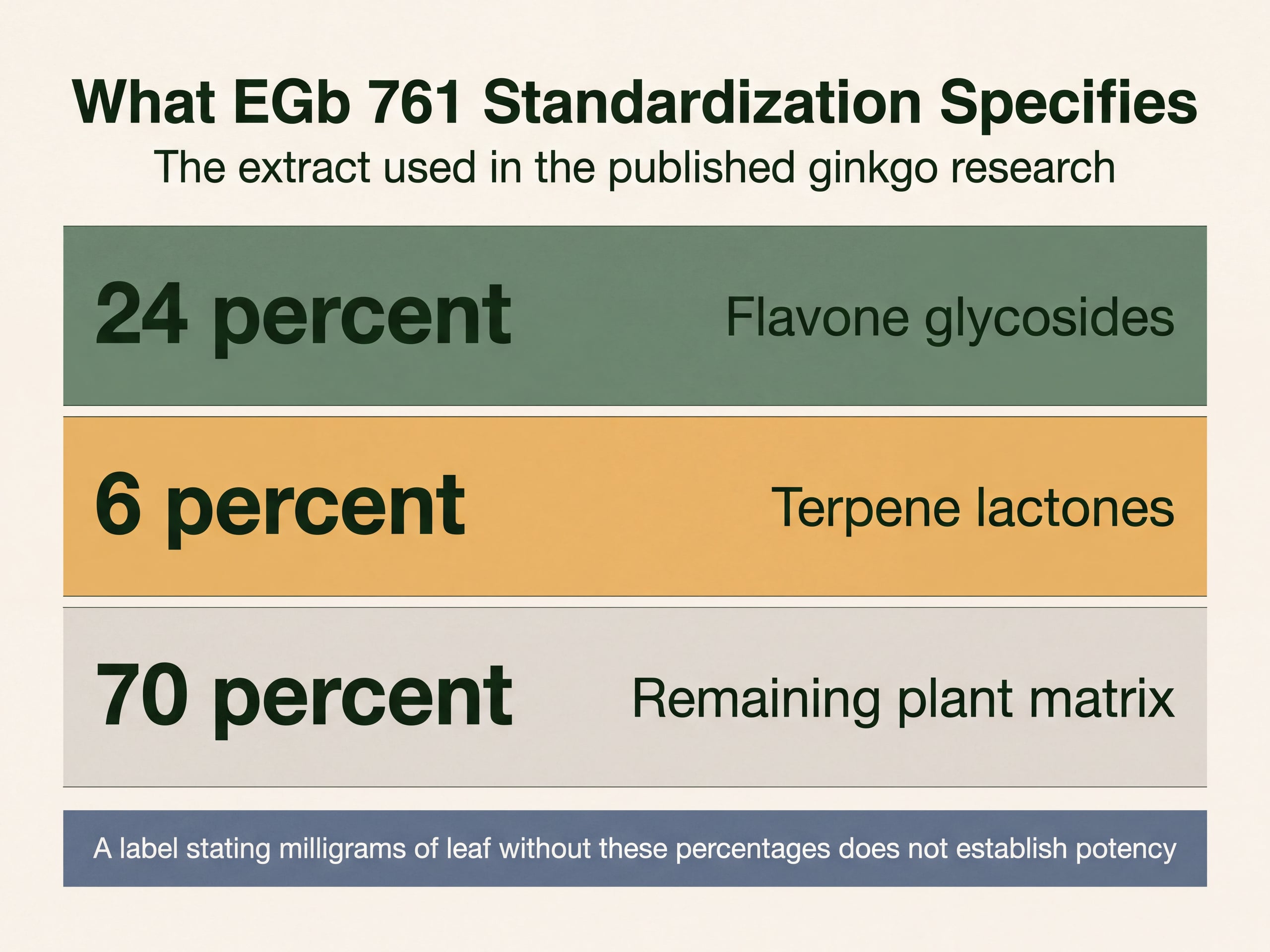
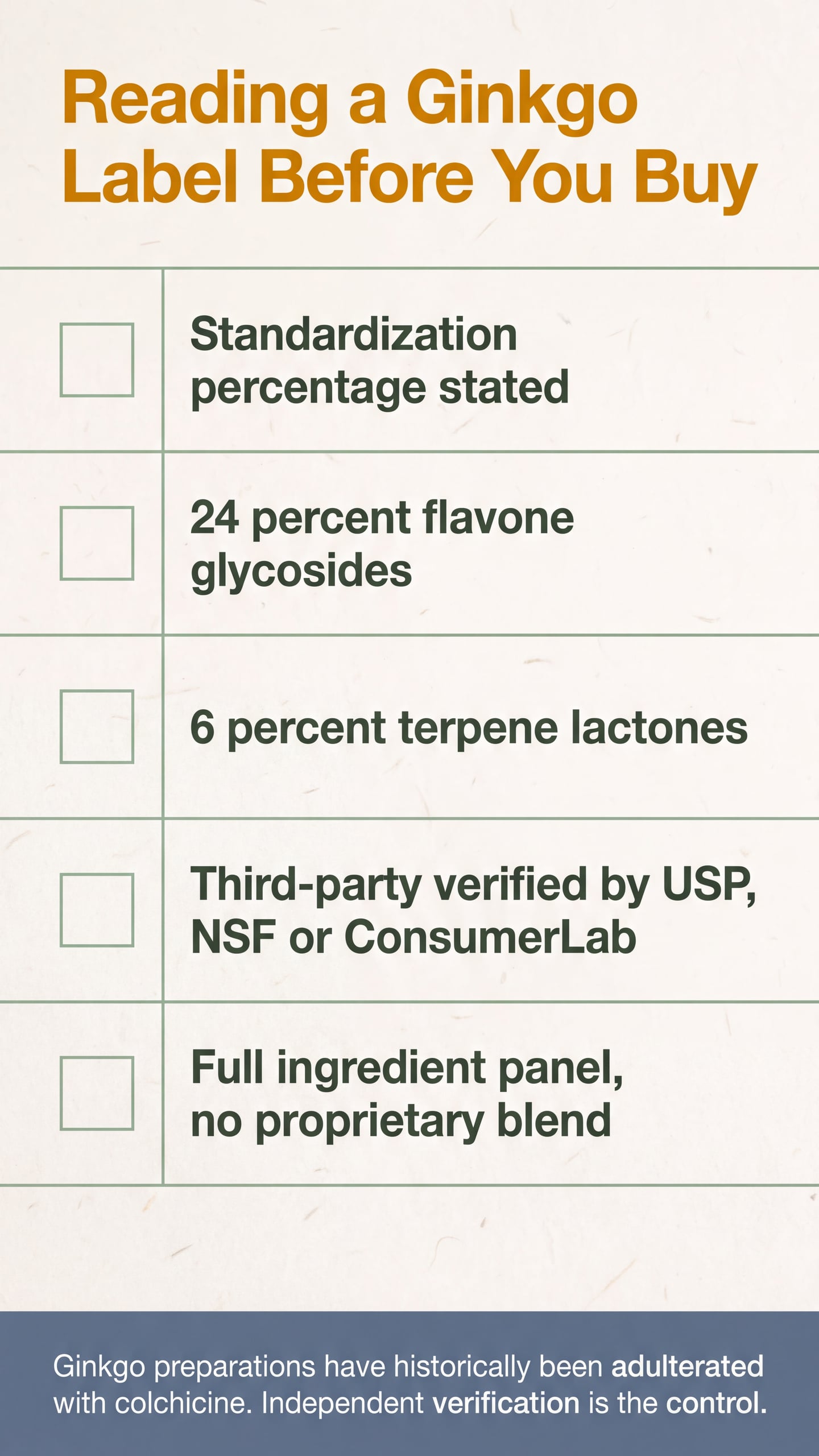
Look for standardization to 24 percent flavone glycosides and 6 percent terpene lactones. This is the specification behind EGb 761, the extract used in most of the research cited throughout this article, and it is the only way to know that a given capsule bears any relationship to a studied product. A label that states milligrams of leaf without a standardization percentage is not telling you what is in it.
Third-party certification by United States Pharmacopeia, NSF International, or ConsumerLab verifies identity, purity, and potency independently of the manufacturer. Given the documented history of ginkgo preparations adulterated with colchicine noted in PMID: 17085776, independent verification is the specific control for the specific risk. Read the full ingredient panel for fillers and allergens, and treat proprietary blends that withhold per-ingredient amounts as unverifiable.
In our sourcing work across this catalog, standardization percentage is the fastest single signal for separating a characterized extract from ground leaf sold at an extract price. It is printed on the label, or it is not.
Frequently Asked Questions
Can ginkgo biloba improve fertility?
No human trial has demonstrated that ginkgo biloba improves conception rates, live birth rates, or any measured fertility outcome in women. The circulation rationale is mechanistically plausible, but the extract-level animal data show suppression of ovarian function rather than support of it, per PMID: 34656881. Treat any claim of fertility benefit as unsupported.
Can ginkgo biloba cause miscarriage?
Anti-implantation and abortifacient effects were observed in albino female mice given EGb 761 at 14.8 mg/kg body weight per day, and were not observed at 3.7 or 7.4 mg/kg, per PMID: 23212704. No equivalent human data exists. The finding is a legitimate reason for caution during preconception and early pregnancy, and it is not evidence that ginkgo causes miscarriage in women.
Does ginkgo biloba delay your period?
Estrous cycle disruption was documented in mice at the highest tested dose of EGb 761, and a 2006 systematic review found low-level evidence that ginkgo leaf may act as an emmenagogue, PMID: 17085776. Human cycle-length data does not exist. If you notice a change in cycle timing or flow after starting ginkgo, report it to your provider.
Who should avoid taking ginkgo biloba?
People who are pregnant, breastfeeding, or trying to conceive, along with anyone with a bleeding disorder, an upcoming surgery, a seizure disorder, or G6PD deficiency. Anyone taking anticoagulant or antiplatelet medication should not combine it with ginkgo without physician supervision.
Should I stop ginkgo before embryo transfer?
Most fertility clinics ask patients to discontinue herbal supplements including ginkgo before retrieval and transfer, primarily because of antiplatelet activity. The specific timing is set by your clinic and varies by protocol. Bring the product bottle to your appointment so your team can see the extract ratio and per-dose milligrams.
Is ginkgo biloba good for pregnancy?
Ginkgo is generally considered unsafe during pregnancy. The 2006 systematic review by Dugoua and colleagues, PMID: 17085776, identified antiplatelet activity as a concern around labor and found expert-opinion evidence of emmenagogue and hormonal properties. Safety during lactation is unknown.
Can I take ginkgo biloba during menstruation?
Ginkgo inhibits platelet aggregation and may increase menstrual flow volume. If you experience heavy periods or have been diagnosed with menorrhagia, ginkgo works against you regardless of your other goals. Discuss it with your provider before continuing.
What supplements should I avoid during IVF?
Clinic policies vary, and yours governs, but the categories that recur are antiplatelet botanicals including ginkgo, high-dose antioxidants, botanicals with hormonal activity, and any product with an undisclosed proprietary blend. Give your clinic a complete list including everything you would not normally think of as medication.
Related Reading
Continue with our related articles on ginkgo biloba and libido, herbs to stop menstrual bleeding, dong quai and black cohosh for women, and ashwagandha and PCOS.
Important: This article is for educational and informational purposes. The statements have not been evaluated by the Food and Drug Administration. The herbs and herbal products discussed are not intended to diagnose, treat, cure, or prevent any disease, including infertility. Information presented here is not a substitute for professional medical advice, diagnosis, or treatment. Always consult a qualified healthcare provider for medical guidance specific to your circumstances, and do not delay seeking medical care because of information you have read on this site.