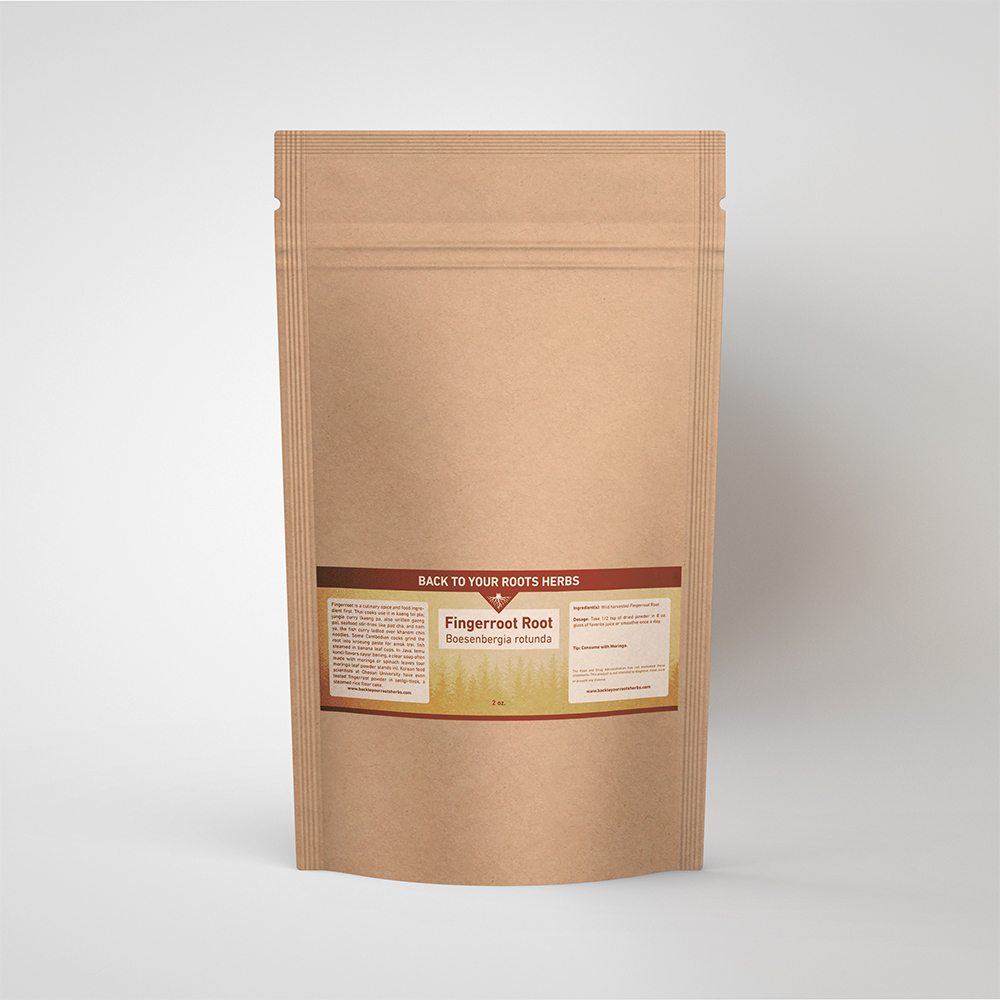
Fingerroot root powder is the dried, finely milled rhizome of Boesenbergia rotunda, a ginger-family aromatic herb that Thai cooks call krachai and Indonesian cooks call temu kunci. Our finger root powder holds one ingredient, Thai-grown fingerroot, in a 2-ounce (57 g) pouch. It is not ordinary ginger, galangal, or black ginger.
Jump to a section:
- Fingerroot root powder verdict
- What is fingerroot powder?
- Fingerroot root powder sensory notes
- How fingerroot works
- Cooking with fingerroot
- Fingerroot vs ginger, galangal and turmeric
- Fingerroot powder dosage and safety
- Fingerroot powder specs
- Root powder comparison table
- How to choose fingerroot powder
- Where fingerroot grows
- Fingerroot FAQ
Fingerroot Root Powder Verdict (Internal Quality Score)
Grade A. One ingredient, one species, one country: whole Boesenbergia rotunda rhizome from Thailand, the same krachai root Thai cooks pound into curry paste. No carriers, no flow agents, no solvent extraction, so pinostrobin, pinocembrin and panduratin A stay in the plant’s own matrix. Each lot is screened for heavy metals, because ginger-family rhizomes accumulate arsenic from soil. A good pouch smells camphor-bright the moment it opens, proof the volatile oil survived drying.
– Back To Your Roots Herbs Research Group
What Is Fingerroot? Boesenbergia rotunda, the Chinese Ginger of Southeast Asia
Fingerroot is a leafy plant in the Zingiberaceae, the family of ginger, galangal, and turmeric. The useful part grows underground: slender, light brown fingers sprouting from a small central piece, yellow inside. Dry and mill those fingers and you have fingerroot powder. Despite the name, it is not arrowroot, the starchy thickener.
Outside Southeast Asia, fresh krachai root is rare, so most cooks buy it frozen, pickled, or dried and powdered. The USDA GRIN record for fingerroot lists its economic use as a food flavoring.
What Botanists Call the Fingers
Botanists call the fingers rhizomes. Cooks and grocers call them roots. In trade, root powder and rhizome powder name one product, and Thai pharmacopoeia researchers describe the dried herb as rhizomes and roots: cylindrical, light brown outside, yellow inside (Pattamadilok et al., 2022). Potency still follows the rhizome. Across 32 Thai samples, it carried more pinocembrin, pinostrobin, and panduratin A than the roots (Monton et al., 2025), so this fingerroot powder is milled from the fingerroot rhizome itself.
Krachai, Temu Kunci, Chinese Keys and Chinese Ginger: Names by Country
- Thailand: krachai (กระชาย).
- Cambodia: khchiey or kcheay (ខ្ជាយ), used in some Khmer kroeung pastes.
- Indonesia and Java: temu kunci, or simply kunci.
- Korea: 핑거루트, a Korean transliteration of fingerroot.
- English: fingerroot, finger root, Chinese keys, Chinese ginger and, loosely, lesser galangal, a name shared with Alpinia officinarum. Check the Latin name.
From Curcuma rotunda to Boesenbergia rotunda: Taxonomical Classification
Linnaeus described the plant in 1753 as Curcuma rotunda, beside turmeric. Rudolf Mansfeld moved it to Boesenbergia in 1958. Older papers use Boesenbergia pandurata and Kaempferia pandurata, and panduratin A still carries that old name. ITIS, NCBI Taxonomy, Kew’s Plants of the World Online and the Encyclopedia of Life all accept Boesenbergia rotunda (L.) Mansf.
Sensory Analysis: How Fingerroot Looks, Smells and Tastes
We open incoming lots on the bench before they reach the shelf. A good lot of fingerroot powder shows this:
- Look: Fine and light, pale gold to light tan, flecked with darker bits of rhizome skin. Not the hard orange of turmeric powder. Not the purple-gray of black ginger.
- Smell: Earthy and peppery, then a cool camphor note and a faint citrus lift from the volatile oil. It reaches you before the pouch is fully open.
- Taste: An earthy flavor first, then gentle pepper, then a slightly bitter, quietly sweet finish. Far less burn than ginger root or galangal. Thai traditional medicine describes krachai root as a medicinal herb with a hot-pungent, bitter taste (Pattamadilok et al., 2022), and both notes come through.
- Texture: Dry and faintly fibrous. In hot water, it clouds pale yellow and settles because whole root powder keeps its fiber. Extracts dissolve. This does not.
How Does Fingerroot Root Powder Work?
- The Herb: Boesenbergia rotunda rhizome sourced from Thailand, milled whole so flavonoids, volatile oil, and fiber stay together.
- The Mechanism: Acts as a warming aromatic bitter, traditionally used to support healthy appetite and digestive comfort, reflecting the role Thai kitchens have long given the krachai root.
- The Evidence: Research by Monton et al. (2025) confirmed that fingerroot rhizomes carry more pinocembrin, pinostrobin, and panduratin A than the roots across 32 Thai samples.
Fingerroot Phytochemical Profile: Pinostrobin, Pinocembrin and Panduratin A
Three flavonoids define fingerroot chemistry, led by pinostrobin. In 33 Thai samples tested by HPLC, pinostrobin made up 0.20 to 1.49% of dried weight and about two-thirds of the measured flavonoid signal (Charoenchai et al., 2025). Pinocembrin and panduratin A follow, and a volatile oil carries the aroma. After oral dosing in rats, panduratin A stayed mostly in the digestive tract, with the highest tissue-to-plasma ratio in the stomach, and about 6% of an extract dose reached the bloodstream (Kongratanapasert et al., 2024). A whole fingerroot powder keeps them all in the root’s own ratio.
How Thai Province and Plant Part Change Flavonoids
Origin matters more than most labels admit. Pinostrobin varied about 7.5-fold across those 33 sources, and panduratin A took its largest share of the flavonoid signal in northeastern samples. A separate cluster analysis named Surat Thani, Nong Bua Lamphu, Kalasin and Sisaket as high-flavonoid provinces (Monton et al., 2025). Ask any seller where their fingerroot powder was grown.
Quality Limits Proposed by Thai Researchers
Writing in the Journal of Thai Traditional and Alternative Medicine, researchers tested 17 dried samples and proposed pharmacopoeia limits: moisture no more than 9.0%, total ash (the mineral fraction) no more than 7.0%, acid-insoluble ash no more than 1.0%, and volatile oil no less than 2.0% (Pattamadilok et al., 2022). Samples were dried at 50 °C and sieved through a No. 180 mesh. Those numbers make a fair yardstick for any fingerroot powder, ours included.
Arsenic in Krachai Compared With Ginger and Turmeric
The krachai root pulls more arsenic from soil than most of its cousins. Across 96 samples of six Thai ginger-family rhizomes, Mahidol University chemists measured 103.5 ng/g total arsenic in krachai, against 69.3 in ginger and 61.7 in turmeric, all far below Thai FDA limits (Ubonnuch et al., 2013). That gap is why a heavy metal panel comes with every fingerroot lot we sell.
Southeast Asian Cooking: Thai Curries, Seafood Dishes and Sauces
Fingerroot is a culinary spice and food ingredient first. Thai cooks use it in kaeng tai pla, jungle curry (kaeng pa, also written gaeng pa), seafood stir-fries like pad cha, and nam ya, the fish curry ladled over khanom chin noodles. Some Cambodian cooks grind the root into kroeung paste for amok trei, fish steamed in banana leaf cups. In Java, temu kunci flavors sayur bening, a clear soup often made with moringa or spinach leaves (our moringa leaf powder stands in). Korean food scientists at Chosun University have even tested fingerroot powder in seolgi-tteok, a steamed rice flour cake.
How to Use It: Curries, Soups, Marinades and Sauces
- Curry paste: Work 1/2 to 1 teaspoon of fingerroot powder into red or jungle curry paste for four, with lemongrass, galangal, makrut lime leaves and chiles.
- Seafood dishes and soups: Dust fish or prawns with a pinch of fingerroot powder before a coconut milk braise, or stir a pinch into soups and gravies at the end.
- Marinades: Whisk 1/4 teaspoon of the root powder with garlic, soy sauce, honey, lime, and a little salt.
- Sauces and seasoning: A pinch lifts Pad Thai sauce, peanut sauce, or mango salsa. As a seasoning rub, pair it with Thai basil and black pepper.
- Infused oils: Warm a teaspoon in neutral oil, steep, strain, and drizzle.
Start small and adjust to taste. Dried root powder is more concentrated than fresh fingers, and most recipes need less than you expect.
Fingerroot Tea, Drinks and Smoothies
For a simple herbal tea, stir 1/4 to 1/2 teaspoon of fingerroot powder into hot water, steep for five minutes, and add honey as a sweetener or a squeeze of lime. The cup turns cloudy gold with sediment at the bottom. That is fiber, not a flaw. The powder also suits smoothies and cold drinks with banana, mango, or coconut water, and sweet-sour beverages in general.
Substitutes and Swaps
No other root copies fingerroot exactly. Galangal brings more pine and sharpness. Ginger brings more heat. If a recipe calls for krachai and the pantry has none, galangal with a pinch of ground ginger comes closest, but the camphor and citrus note will be missing.
Fingerroot vs Ginger, Galangal, Turmeric and Black Ginger
Five ginger-family roots get mixed up on store shelves. The Latin name settles it.
| Herb | Latin Name | Thai Name | Flesh Color | Flavor | Signature Compound |
|---|---|---|---|---|---|
| Fingerroot (this powder) | Boesenbergia rotunda | krachai | Yellow | Earthy, peppery, camphor and citrus, mild heat | Pinostrobin, panduratin A |
| Ginger | Zingiber officinale | khing | Pale yellow | Hot, sharp, sweet and spicy | Gingerols |
| Galangal | Alpinia galanga | kha | Creamy white | Piney, citrusy, sharp | 1′-Acetoxychavicol acetate |
| Turmeric (haldi) | Curcuma longa | khamin chan | Deep orange | Earthy, bitter, musky | Curcumin |
| Black ginger | Kaempferia parviflora | krachai dam | Purple to near black | Bitter, earthy | Methoxyflavones |
Prefer the sharper, piney profile? See our galangal root. Looking for krachai dam? That is black ginger powder, a different plant with different chemistry.
Whole Herb vs Extract: What’s the Difference?
Whole fingerroot powder and fingerroot extract are not interchangeable by weight. In one Thai tablet study, 120 mg of solvent extract carried 23.00 mg of pinostrobin, about 19% by weight (Monton et al., 2025). Whole Thai fingerroot samples run 0.20 to 1.49%. A gram of extract and a gram of whole root powder are very different things. Whole powder tastes like food, cooks like a spice, and involves no solvent.
Critical Usage: Dosage, Interactions and Safety
Serving: 1/2 teaspoon of fingerroot powder (about 1 gram) once daily in food, tea, or a smoothie. In cooking, use it to taste. As a daily herbal supplement, do not exceed the label serving. A 2 oz pouch holds about 57 servings.
Timing: With a meal. Fingerroot sits best with food, the way Thai kitchens have always used it.
Who Should Skip This Herb
Skip fingerroot powder, or clear it with a professional first, if you:
- are pregnant, trying to conceive, or breastfeeding (beyond ordinary food amounts).
- take a blood thinner, a glucose-lowering medicine, or another daily prescription.
- are allergic to ginger, galangal, turmeric, or other Zingiberaceae plants.
- have surgery scheduled within two weeks.
Keep it out of reach of children unless a healthcare provider advises otherwise.
What Safety Research Shows
The longest safety data come from animals. In a 90-day Mahidol University study, rats given a rhizome extract formulation (29% panduratin A, 32% pinostrobin) at 25, 50, or 100 mg/kg daily showed no deaths and no clinical signs of toxicity, and the authors set the no-observed-adverse-effect level at 100 mg/kg/day (Techapichetvanich et al., 2024). Human data remain limited. Handle the root like any potent kitchen herb.
Pregnancy, Breastfeeding and Surgery
There is not enough reliable human research on concentrated fingerroot use in pregnancy or breastfeeding. A pinch in a family curry differs from a daily spoonful, so let your midwife or physician decide. Stop supplemental use two weeks before surgery and tell your surgical team.
Clinical Specs: Serving Size, Origin and Ingredients
| Spec | Detail |
|---|---|
| Serving Size | 1/2 Teaspoon of fingerroot powder (about 1 gram) |
| Frequency | Once daily with a meal, or to taste in cooking |
| Active Marker | Pinostrobin, Pinocembrin, Panduratin A (naturally occurring, not standardized). Thai fingerroot samples: 0.20 to 1.49% pinostrobin |
| Processing | Whole rhizome, dried and finely milled. No solvent extraction, no solvent residue. |
| Safety | Heavy Metal Tested (Pass) |
| Ingredients | Fingerroot (Boesenbergia rotunda) Rhizome Powder |
| Other Ingredients | None. No carriers, cornstarch, flow agents, or fillers |
| Purity | Non-GMO, Vegan, Single Ingredient |
| Free From | Wheat, Gluten, Soy, Dairy, Binders, Fillers, Preservatives |
| Origin | Thailand (Thai-grown Boesenbergia rotunda rhizome, province listed on the lot COA). View origin map |
| Manufactured | Virginia Beach, VA, USA |
Comparison Table: BTYRH vs Generic Krachai
| Feature | BTYRH Fingerroot Root Powder | Generic Fingerroot Powder |
|---|---|---|
| Origin | Thailand, single-species Boesenbergia rotunda rhizome, province on the lot COA | Unspecified |
| Preparation | Whole rhizome, dried and finely milled. Nothing added, nothing extracted | Plant part and drying method rarely stated |
| Taste | Earthy and peppery with a cool camphor and citrus lift, mild heat | Flat or dusty when stale |
| Safety | Heavy metal panel on every lot | Unknown/Untested |
| Label | Latin name Boesenbergia rotunda printed on the pouch | Common name only, easily confused with galangal or black ginger |
How to Choose Krachai: A Buyer’s Checklist
Five checks separate real fingerroot powder from mislabeled dust:
Plenty of sellers call any dried krachai a premium fingerroot powder. These checks show whether it earns the word.
Storage: Light, Air, and Moisture
Organic fingerroot powder or conventional, every powdered root fades the same way, aroma first. Seal the pouch with the air pressed out and store it cool and dark, away from the stove. For daily use, decant a week’s worth into a small amber glass bottle. If the powder clumps, moisture got in. Use it within 12 months of opening for the brightest flavor.
Where Fingerroot Grows: Southeast Asian Geography and Cultivation
USDA GRIN records fingerroot as native to Yunnan in China, Indochina, Laos, Thailand, and the Malay Peninsula, and cultivated beyond that range. Kew lists it as a rhizomatous geophyte of the wet tropical biome. The plant stands 60 to 90 cm tall, with leaves near 50 cm long, red leaf sheaths, and white to pale pink flowers. Growers propagate it by rooting rhizome pieces in loose, moist soil and lifting the root clusters once the leaves die back. Thai researchers sampled the crop from 33 sources across six regions.
Fingerroot FAQ: Buying, Ginger Swaps and Herb Pairings
Fingerroot root powder: where can I buy it?
Right here. Back To Your Roots Herbs® packs this powder in Virginia Beach, Virginia, and ships it across the United States. Wherever you shop, check three things: Boesenbergia rotunda on the label, a named origin, and a heavy metal result for the lot.
Is it the same as ginger or galangal?
No. Ginger powder comes from Zingiber officinale. Fingerroot powder comes from Boesenbergia rotunda, a different genus in the same family, and galangal is a third plant, Alpinia galanga. Ginger tastes hotter and sharper. Fingerroot is earthier and milder, with a cool camphor finish. Swap one for the other and the dish changes.
Can it be combined with other herbs?
In the kitchen, yes. Fingerroot powder was made for company: lemongrass, galangal, makrut lime, garlic, and Thai basil in curry paste, or turmeric and black pepper in a spice blend. Javanese jamu, the traditional herbal tonics, blend temu kunci with other roots and rhizomes. For supplement use, add one new herb at a time and ask your provider before stacking botanicals.
Fingerroot powder facts on this page were reviewed in October 2026 by the Back To Your Roots Herbs Research Group, using USDA GRIN, NCBI PubMed, ITIS, Kew, and EOL. Questions about a fingerroot powder lot? Send us the lot number from your pouch.
DISCLAIMER: These statements have not been evaluated by the Food and Drug Administration. This product is not intended to diagnose, treat, cure, or prevent any disease. Consult your healthcare provider before use, especially if you are pregnant, nursing, taking medication, or have a medical condition.
Reviews
There are no reviews yet.