Key Takeaways
- Bhringraj (Eclipta prostrata), the Ayurvedic “King of Hair,” is traditionally used to support hair growth, scalp comfort, and natural color.
- Animal studies report follicle-stimulating activity for Eclipta extracts, while rigorous human trials are still limited.
- The herb is used both topically, as oils, masks, and rinses, and internally, as traditional powders and capsules.
- Hair follows a slow growth cycle, so traditional Bhringraj routines are measured in months of consistent use rather than days.
- Internal use and long-term use are best guided by a qualified practitioner, especially with liver conditions, pregnancy, or medications.
Bhringraj in Context: Comparison with Other Hair Care Herbs
Eclipta prostrata is a standout herb, but it exists within a rich tradition of plant-based hair care. Understanding how it compares to other popular herbs can help tailor natural hair care routines.
| Feature | Bhringraj (Eclipta prostrata) | Amla (Emblica officinalis) | Fenugreek (Trigonella foenum-graecum) | Rosemary (Rosmarinus officinalis) |
|---|---|---|---|---|
| Primary Focus | Hair growth, scalp health, delaying graying | Conditioning, Vitamin C, strengthening, shine | Conditioning (slip), protein, moisture | Scalp circulation, potential growth aid |
| Key Actions | Stimulates follicles, anti-inflammatory, darkening | High antioxidant, strengthens roots, conditions | High mucilage (slip), conditioning | Stimulates blood flow, antioxidant |
| Best For | General hair health, growth support, scalp issues | Dry/dull hair, strengthening, adding volume | Detangling, softening, moisturizing | Oily scalp, stimulating circulation |
| Overlap | Strengthening, conditioning, and growth support | Strengthening, conditioning, and growth support | Conditioning, strengthening | Growth support via circulation |
| Unique Aspect | Strong Ayurvedic link to liver & Pitta balance | Extremely high Vitamin C content | High protein & lecithin, mucilage | Potent circulatory stimulant |
Note: This table provides a simplified comparison based on traditional uses and common understanding. Individual results can vary.
Synergies in Formulations
It’s common in Ayurvedic practice to combine several beneficial herbs. For instance, Bhringraj is often mixed with Amla for enhanced conditioning and strengthening, or with Neem for potent antimicrobial action on the scalp. These combinations aim to provide broader benefits by leveraging the unique properties of each plant. Many traditional hair oil recipes feature a blend of these ingredients.
How Bhringraj Compares with Other Hair-Growth Supplements
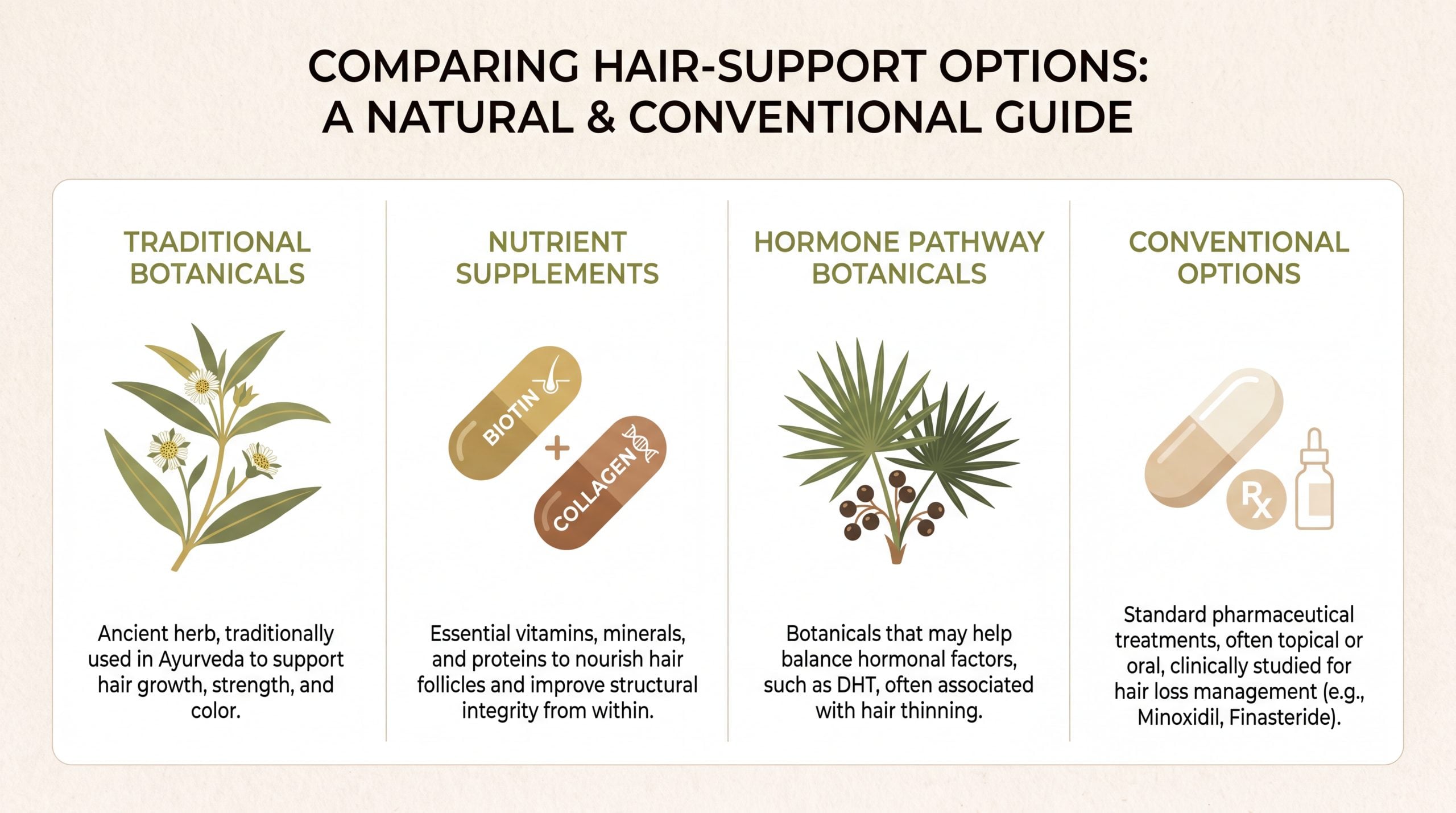
People weighing Bhringraj against the wider shelf of hair supplements are usually comparing two different categories. Bhringraj (Eclipta prostrata) is a traditional whole-plant botanical valued in Ayurveda for scalp and hair support. Products like biotin, collagen peptides, and marine complexes are nutrient supplements that supply building blocks such as B-vitamins or amino acids, while saw palmetto (Serenoa repens) is a botanical more often associated with hormone-pathway support in pattern hair loss.
The categories are not rivals so much as different tools. Conventional prescription options sit in yet another category, and a 2022 review lays out how oral drug treatments for androgenetic alopecia differ from one another in mechanism and side-effect profile (Gupta et al., 2022, Journal of Dermatological Treatment, PMID: 35920739, DOI). Bhringraj’s appeal is its traditional, whole-plant nature and its dual use as both a topical and an internal herb. For readers deciding where a traditional botanical fits, the useful question is not which single product wins, but which approach matches their goals, their tolerance, and the guidance of their practitioner. For deeper background on supplement safety, the NIH Office of Dietary Supplements and NCCIH both publish plain-language resources.
A Look at the Scientific Evidence
Modern laboratory work has started to test the traditional claims around Bhringraj. In vitro studies confirm the antioxidant, anti-inflammatory, and antimicrobial activity of Eclipta prostrata extracts, which supports its long use for scalp comfort. A 2021 review in Biomolecules catalogues the plant’s coumestan chemistry, including wedelolactone, and summarizes its reported hair-growth activity (Timalsina and Devkota, 2021, Biomolecules, PMID: 34827736, DOI).
The animal evidence is the most direct. In male albino rats, a petroleum-ether extract of Eclipta alba shortened the time to hair-growth initiation and increased the share of follicles in the active anagen phase, performing comparably to 2 percent minoxidil in that rat model (Roy, Thakur, and Dixit, 2008, Archives of Dermatological Research, PMID: 18478241, DOI). A separate study in C57BL/6 mice found that a methanol extract shifted follicles from the resting telogen phase toward anagen, alongside changes in follicular signaling markers such as FGF-7 and Sonic hedgehog (Datta et al., 2009, Journal of Ethnopharmacology, PMID: 19481595, DOI). Traditional multi-herb blends that include Eclipta have shown similar follicle effects (Roy, Thakur, and Dixit, 2007, Journal of Cosmetic Dermatology, PMID: 17524127, DOI).
We read these findings with care. Results in rats and mice do not always carry over to people, and there is still a shortage of large human trials on Eclipta prostrata for androgenetic alopecia or diffuse shedding. The comparison to minoxidil above belongs to the animal models only and is not a claim about results in humans. For anyone weighing herbal and conventional options, that distinction matters.
Safety Profile and Quality Considerations
Eclipta prostrata is generally considered safe for topical use, but certain precautions are advisable.
Patch Testing for Topical Use
Before applying any new preparation extensively, especially if you have sensitive skin, perform a patch test. Apply a small amount of the prepared oil or paste (using pure ingredients) to a discrete area of skin, like the inner elbow, and wait 24-48 hours to check for any signs of redness, itching, or irritation.
Potential Reactions
While rare, allergic reactions or skin sensitivity can occur. If irritation develops, discontinue use immediately. Internal use should only be undertaken with professional guidance, as it may interact with certain conditions or medications.
Topical Versus Internal Use: Different Safety Considerations
The safety picture for Bhringraj depends heavily on how it is used. Topical oils, masks, and rinses are generally well tolerated by most people, and the main precaution is the patch test described above, since skin sensitivity or an allergic reaction can occur in a small number of users.
Internal use requires more caution. Because traditional texts tie Bhringraj closely to liver function, anyone with a liver condition should speak with a healthcare provider before taking it internally. The same applies during pregnancy and breastfeeding, and for anyone taking prescription medicines, since herb-drug interactions are possible and have not been fully mapped in the research. Internal Bhringraj is generally well tolerated in traditional use, but it is not suitable for everyone, and professional guidance is the safe default rather than the exception.
Importance of Sourcing
The quality and purity of the herb are important. Look for reputable suppliers who provide unadulterated Eclipta prostrata powder or dried herb. Sourcing medicinal-grade wild organic bhringraj eclipta or organic bhringraj eclipta alba might offer assurance against contaminants like pesticides or heavy metals, although certifications should be verified.
When to Seek Professional Advice
It is always recommended to consult with a healthcare professional or a qualified Ayurvedic practitioner before starting any new herbal treatment, particularly if you are pregnant, breastfeeding, have underlying health conditions (especially liver-related, given the herb’s traditional use), or are taking other medications. They can provide personalized advice regarding suitability and safe usage.
Final Thoughts on Eclipta prostrata for Hair Wellness
Eclipta prostrata, or Bhringraj, stands as a significant herb in the world of natural hair care, backed by centuries of Ayurvedic tradition and supported by emerging scientific interest. Its potential to support hair growth, maintain scalp health, delay graying, and improve hair texture makes it a versatile addition to hair care routines. From nourishing oil infusions and deep-conditioning masks to simple hair rinses, this plant offers various ways to use its benefits.
While it shows promise, particularly for strengthening hair and nurturing the scalp environment conducive to healthy hair development, it’s valuable to view it as part of a holistic approach to hair wellness. Understanding its properties alongside other beneficial herbs allows for informed choices. As research continues, a clearer picture of its specific mechanisms and efficacy in humans will likely emerge, further illuminating the wisdom held within this ancient “King of Hair.”
Disclaimer
These statements have not been evaluated by the Food and Drug Administration. This product is not intended to diagnose, treat, cure, or prevent any disease. Consult your healthcare provider before use, especially if you are pregnant, breastfeeding, have a health condition, or take medication.