Key Takeaways
- Dong quai (Angelica sinensis) and black cohosh (Actaea racemosa) come from different plant families, different continents, and different herbal traditions.
- Black cohosh is the far better-studied of the two for hot flashes and night sweats, with mixed but substantial clinical trial evidence behind it.
- Dong quai tested on its own performed no better than placebo for menopausal symptoms in a 24-week randomized trial of 71 women.
- Black cohosh does not appear to behave as a plant estrogen. Current thinking points toward activity at serotonin receptors instead.
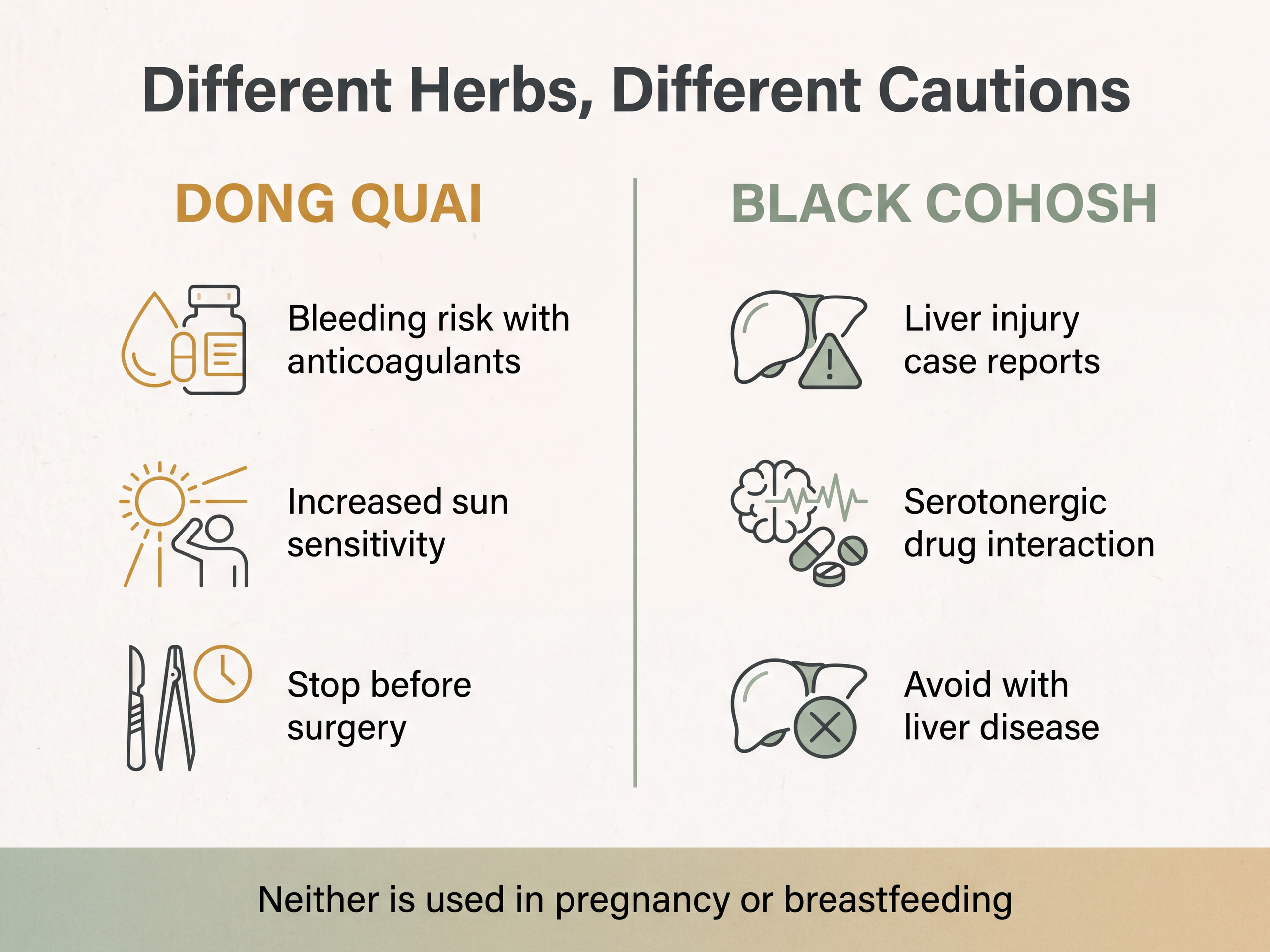
- Their cautions differ completely. Black cohosh carries liver and serotonergic considerations. Dong quai carries bleeding and sun-sensitivity considerations.
Ask which of these two herbs is better, and you will get a different answer depending on who you ask and what you actually want help with. That is not evasion. It is the honest shape of the evidence. Dong quai and black cohosh get sold side by side, blended into the same capsules, and discussed as though they were interchangeable, when in practice they are two unrelated plants doing two different jobs with two very different research records behind them.
Our editorial team read the primary trials on both roots rather than the summaries of them, and the picture that comes back is clearer than the marketing suggests. This guide compares them directly: what each one is, what the research actually found, how their safety profiles diverge, and how to think about choosing between them.
Dong Quai vs Black Cohosh: What Is the Difference?
Dong quai and black cohosh are botanically unrelated. Dong quai is Angelica sinensis, a member of the Apiaceae family (the same family as celery and carrot) native to the high-altitude regions of China, used in Traditional Chinese Medicine as a blood tonic. Black cohosh is Actaea racemosa, formerly classified as Cimicifuga racemosa, a Ranunculaceae woodland plant native to eastern North America, used by Native American and later Western herbalists for the menopausal transition specifically.
That difference in origin turns into a difference in purpose. Dong quai belongs to a tradition that treats the whole menstrual cycle as one system to be supported over time. Black cohosh belongs to a tradition that aimed at a narrower target: the vasomotor symptoms of menopause, meaning hot flashes and night sweats.
| Feature | Dong Quai | Black Cohosh |
|---|---|---|
| Botanical name and family | Angelica sinensis, Apiaceae | Actaea racemosa (syn. Cimicifuga racemosa), Ranunculaceae |
| Origin and tradition | China, Korea, Japan. Traditional Chinese Medicine, where it is called dang gui | Eastern North American woodlands. Native American, then Western herbalism |
| Traditional focus | Whole-cycle support, circulation, blood building | Vasomotor symptoms of the menopausal transition |
| Proposed mechanism | Attributed to volatile oils and organic acids including Z-ligustilide and ferulic acid | Attributed to triterpene glycosides. Serotonergic activity rather than estrogenic activity |
| Clinical evidence level | Low as a standalone. Studied mainly inside multi-herb formulas | Moderate. Multiple randomized trials with mixed results |
| Primary caution | Bleeding risk with anticoagulants. Sun sensitivity | Liver considerations. Interaction with serotonergic medications |
| Sources: NIH Office of Dietary Supplements black cohosh fact sheet, Memorial Sloan Kettering Cancer Center dong quai monograph, and the primary trials cited throughout this article. | ||
Which One Is Studied for Hot Flashes?
Black cohosh, and the gap is not closed. If hot flashes and night sweats are the reason you are reading this, black cohosh is the herb with a real clinical file behind it. Dong quai has almost no standalone evidence for that specific symptom.
What the black cohosh research shows
Black cohosh has been through multiple randomized controlled trials for menopausal symptoms. The results are genuinely mixed. Some trials show meaningful reduction in hot flash frequency and intensity compared with baseline, and some show no clear separation from placebo. Fritz and colleagues (2013), Integrative Cancer Therapies, PMID: 23439657, reviewed 26 studies including 14 randomized controlled trials and described the efficacy evidence for hot flashes as divided, with benefit visible against baseline but not consistently against placebo.
Reviewing the same body of work from a different angle, Geller and Studee (2007), Menopause, PMID: 17194961, found black cohosh reduced measures of mood disturbance and anxiety across every study they assessed in menopausal women. That secondary finding gets far less attention than the hot flash question and may be part of why reported experience varies so widely.
The NIH Office of Dietary Supplements and the National Center for Complementary and Integrative Health both summarize the position the same way: some evidence of modest benefit, inconsistent across trials, with the American College of Obstetricians and Gynecologists having concluded in its clinical guidance that the data do not establish efficacy for vasomotor symptoms.
What happened when dong quai was tested on its own
This is the finding most articles on this pairing skip, and it is the most useful thing on this page. Hirata and colleagues (1997), Fertility and Sterility, PMID: 9418683, ran a double-blind, randomized, placebo-controlled trial of dong quai in 71 postmenopausal women over 24 weeks. They measured endometrial thickness by transvaginal ultrasound, vaginal cell maturation, the Kupperman index, and a diary of vasomotor flushes. There were no statistically significant differences between the dong quai group and the placebo group on any of those measures.
Two conclusions come out of that trial. Used alone, dong quai did not relieve menopausal symptoms better than placebo. And, separately, it produced no estrogen-like response in endometrial or vaginal tissue, which is worth holding onto given how routinely it is described as a plant estrogen.
A smaller trial pointed the same direction in a different population. Al-Bareeq and colleagues (2010), Canadian Urological Association Journal, PMID: 20165579, tested dong quai against placebo for hot flashes in 22 men receiving androgen deprivation therapy for prostate cancer over three months and found no significant difference in the frequency, severity, or duration of hot flashes.
None of this makes dong quai useless. It makes it a poor solo choice for hot flashes specifically. Traditional practice almost never used it alone, and the research reflects that: the herb is studied inside multi-herb formulas because that is how it has always been given.
How Does Black Cohosh Work, and Is It a Phytoestrogen?
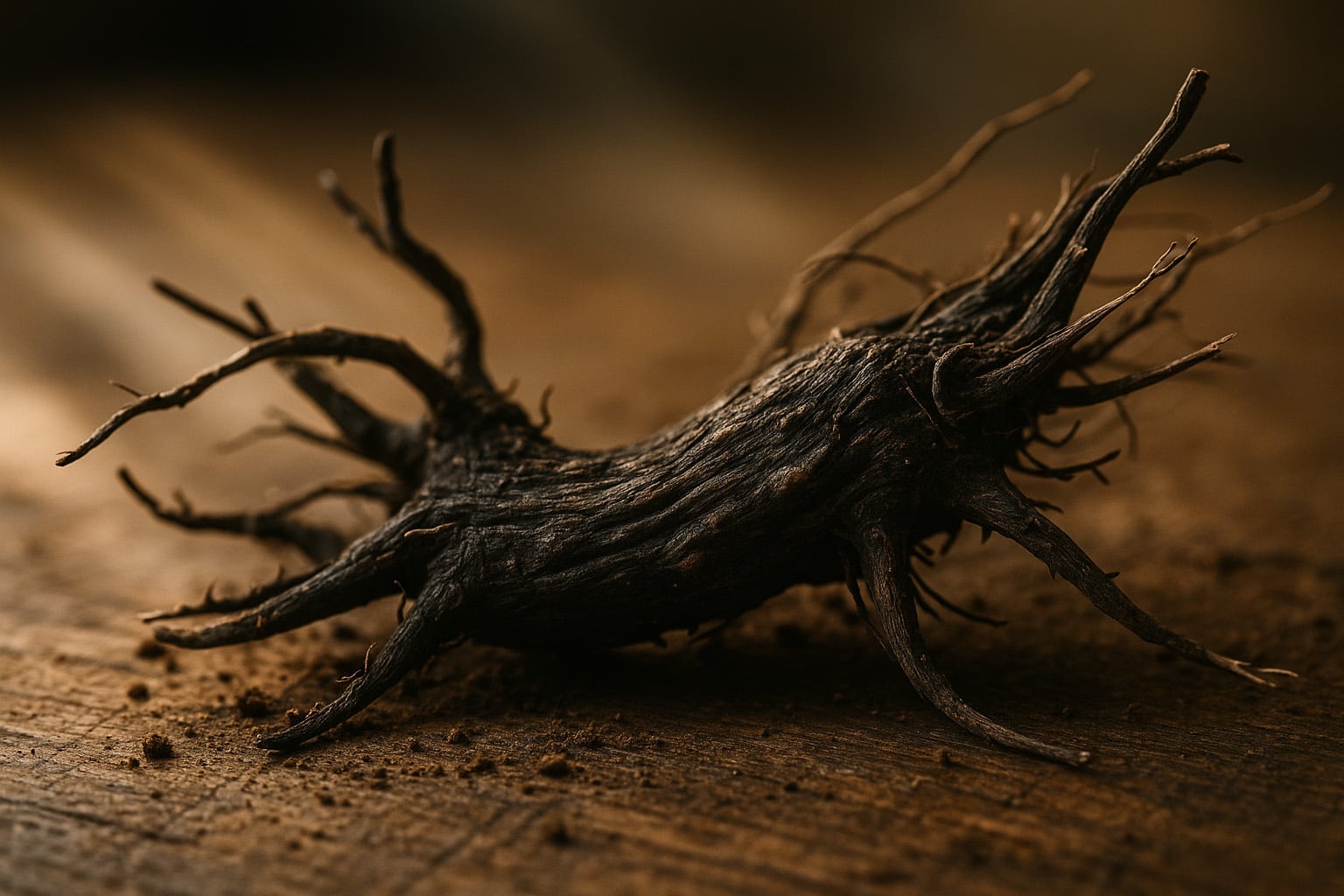
Black cohosh is not thought to act as a phytoestrogen. Despite decades of being described that way, the current reading of the evidence points toward activity at serotonin receptors rather than at estrogen receptors. The triterpene glycosides in Actaea racemosa, including actein, are the constituent group most often credited with its activity.
The evidence for the non-estrogenic position is reasonably direct. In the Fritz systematic review (PMID: 23439657), 17 trials showed no significant impact on circulating hormone levels or on proliferation in estrogen-responsive tissues. That is a substantial body of negative findings on the estrogen question, and it is the reason the framing has shifted.
The serotonergic reading has clinical consequences, which is the strongest argument that it is more than theory. Dernbach and colleagues (2024), Journal of Emergency Medicine, PMID: 38556373, published a case report of a middle-aged woman who developed serotonin toxicity and rhabdomyolysis shortly after starting black cohosh while on long-term dual antidepressant therapy. Both resolved after the offending agents were stopped. The authors described the case as consistent with the known serotonergic properties of the herb.
We flag that report specifically because it is recent, it is rarely cited in consumer-facing writing on this topic, and it converts an abstract mechanism into a practical question worth raising with a prescriber.
How Does Dong Quai Work? Ligustilide, Ferulic Acid, and Coumarins
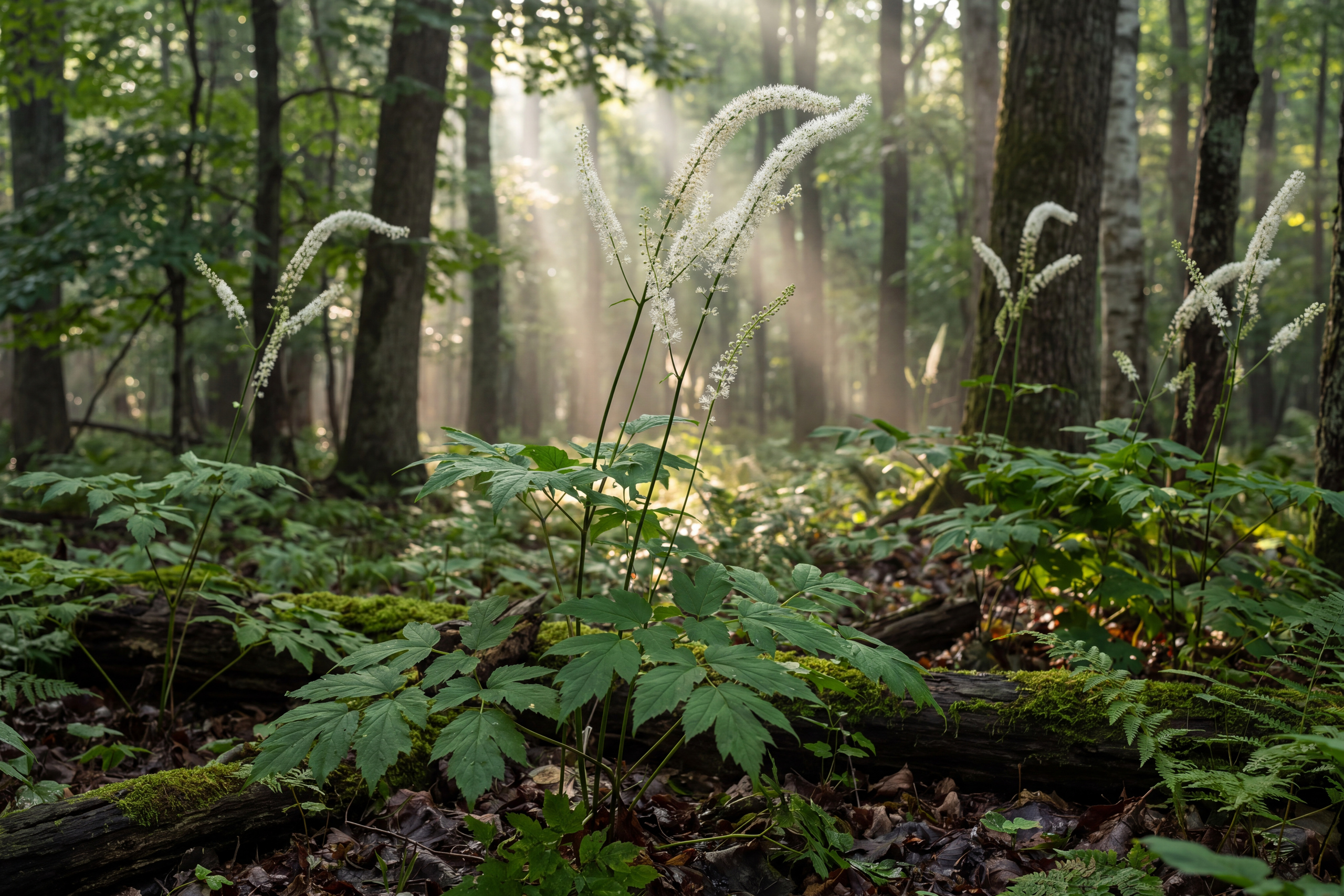
Dong quai’s activity is attributed to a different chemistry entirely, and that is what explains why its cautions look nothing like black cohosh’s. A 2026 review by Zhang and colleagues in the American Journal of Chinese Medicine, PMID: 42366516, catalogued more than 290 identified constituents in Angelica sinensis, grouped into volatile oils, organic acids, polysaccharides, phenylpropanoids, and flavonoids. Z-ligustilide and ferulic acid are the two compounds most consistently credited with its biological activity.
The coumarin content is the part that matters most for safety. Coumarins are the structural reason dong quai is associated with slowed blood clotting, and it is why the herb sits on interaction lists alongside warfarin and aspirin while black cohosh does not. Same category of product on the shelf, completely different reason to be careful.
In our sourcing work with Angelica sinensis from Gansu Province, the aromatic intensity of the root is the first thing you notice, and that volatile oil fraction is where much of the described activity is thought to sit. It is also why storage practice matters more for this root than for many others.
Can You Take Dong Quai and Black Cohosh Together?
Yes, and they are frequently combined in both traditional formulas and commercial supplements. The pairing itself is long-established. The considerations are less about the two herbs interacting with each other and more about each one interacting with what else you may be taking.
- The combination appears throughout traditional formulas and modern blends, so the pairing itself is not unusual.
- Dong quai’s coumarin constituents mean anyone on anticoagulant or antiplatelet medication should speak with a clinician before starting.
- Neither herb is used during pregnancy or breastfeeding.
- Anyone on hormone therapy, hormonal contraception, or with a hormone-sensitive condition should get clinician input before combining them.
Huntley (2004), Journal of the British Menopause Society, PMID: 15667753, reviewed drug interactions across the herbs most used for menopause and found the profiles vary widely between them, with some carrying little interaction concern and others carrying significant and well-documented ones. Treating a blend as a single ingredient with a single safety profile is an error worth avoiding.
How Their Safety Profiles Differ
This is where treating the two herbs as one product breaks down completely. Their cautions barely overlap.
Where the caution sits with black cohosh
Two areas. The first is liver-related. Case reports of liver injury associated with black cohosh preparations have been published over the years, and regulatory bodies in several countries have added label warnings in response. Patel and colleagues (2021), Case Reports in Gastrointestinal Medicine, PMID: 33532101, described acute liver injury in a 40-year-old woman taking Cimicifuga racemosa alongside Thuja occidentalis, assessed for causality using the updated RUCAM scale, with complete resolution of symptoms and marked improvement in transaminases after both products were discontinued.
The honest framing matters here. These are case reports rather than trial findings; causality is often difficult to establish, product adulteration cannot be ruled out in many of them, and the events are rare relative to how widely the herb is used. That is not a reason to dismiss the signal. It is the reason people with existing liver conditions are advised to avoid the herb, and why anyone using it long-term is generally advised to keep a clinician informed.
The second is the serotonergic interaction discussed above, which is relevant to anyone taking antidepressants or other serotonergic medications.
Where the caution sits with dong quai
Bleeding and sunlight. The Memorial Sloan Kettering Cancer Center monograph on dong quai notes increased bleeding risk and advises speaking with a healthcare provider before use alongside blood thinners such as warfarin, and it advises against use in pregnancy. Photosensitivity is the second commonly reported effect, meaning skin may burn more readily than usual.
Because of the bleeding consideration, dong quai is also typically stopped in advance of any scheduled surgery. That is a conversation to have with a surgical team rather than a decision to make alone.
Who should avoid either herb?
- Anyone pregnant or breastfeeding.
- Anyone with a hormone-sensitive condition, including a history of breast or uterine cancer, without clinician guidance.
- Anyone with existing liver disease, in the case of black cohosh.
- Anyone taking anticoagulant or antiplatelet medication, in the case of dong quai.
- Anyone taking serotonergic medication, in the case of black cohosh.
- Anyone with a scheduled surgical procedure.
How the Dosing Evidence Differs
The two herbs are not on equal footing here either, and the difference is itself informative. Black cohosh has been studied using standardized extracts at defined amounts across multiple trials, which is why product labels in that category tend to cite a specific extract standardization. Dong quai has no comparable standalone dosing literature for menopausal symptoms, because as the trial record shows, it has rarely been studied by itself.
The Zhang review (PMID: 42366516) names this directly as an open problem for Angelica sinensis: insufficient standardization of cultivation practice, limited high-quality clinical evidence, and no internationally recognized quality standards. When a herb lacks agreed standards, comparing one product’s amount against another’s becomes considerably less meaningful.
Practical reading of that difference: with black cohosh, you can reasonably ask whether a product matches what trials used. With dong quai, that question has no settled answer, and traditional preparation practice carries more weight than any label figure. Amounts described in research are descriptions of what was studied, not recommendations for personal use. Any actual regimen belongs in a conversation with a qualified practitioner who knows your history and your medication list.
Choosing Between Them: A Practical Guide
Set the marketing aside, and the decision gets simpler.
If hot flashes and night sweats are the specific concern, black cohosh is the herb with the research file, and the honest caveat is that the trials disagree with each other. If the interest is broader cycle support, circulation, and the traditional blood-building role within a Chinese herbal framework, dong quai is the herb built for that job, and it is best understood inside a formula rather than alone. If you take anticoagulants, dong quai is the one to raise with your prescriber. If you take antidepressants or have liver concerns, black cohosh is the one to raise.
Quality is the other axis, and it is one we take seriously. Species identity is a live issue for black cohosh specifically, because related Asian Actaea species have been documented as substitutes in the commercial supply chain, and a product carrying the right common name does not guarantee the right plant. For dong quai, the questions we hold suppliers to are provenance and the condition of the volatile oil fraction. Our own Angelica sinensis is sourced from Gansu Province, and we assess each lot by aromatic profile before it goes anywhere near a shelf, because the aroma of the root is the fastest, honest signal of how it was dried and stored. Our dong quai root powder and dong quai capsules both come from that sourcing line.
What we do not sell is black cohosh, which is worth saying plainly on a page that compares the two. This comparison is not steering you toward a product we stock. It is what the evidence says.
Frequently Asked Questions
Are dong quai and black cohosh safe to take together?
They are commonly combined in traditional formulas and commercial blends, and the pairing itself is well-established. The considerations come from each herb separately rather than from an interaction between them. Dong quai raises bleeding-risk questions for anyone on anticoagulants, and black cohosh raises liver and serotonergic questions. Neither is used in pregnancy or breastfeeding. Speak with a healthcare provider before combining them, particularly if you take prescription medication.
Is black cohosh better than dong quai for hot flashes?
Black cohosh has substantially more clinical research behind it for hot flashes, though the trials disagree among themselves. Dong quai tested on its own performed no better than placebo across a 24-week randomized controlled trial in 71 postmenopausal women (Hirata et al., 1997, PMID: 9418683). For that specific symptom, black cohosh is the better-evidenced of the two.
Do dong quai or black cohosh raise estrogen?
Current evidence points away from that for both. The Hirata trial found dong quai produced no estrogen-like response in endometrial thickness or vaginal maturation. For black cohosh, 17 trials reviewed by Fritz and colleagues (2013, PMID: 23439657) showed no significant impact on circulating hormone levels or on proliferation in estrogen-responsive tissues. The phytoestrogen description applied to both herbs is not well supported.
Can I take dong quai or black cohosh with hormone therapy?
This is a question for your prescriber rather than a label. Guidance from several national health services advises against combining these herbs with hormone replacement therapy without medical input, and anyone with a hormone-sensitive condition is generally advised to avoid both unless a clinician has said otherwise. Bring the specific product and its full ingredient list to the appointment.
What are the side effects of dong quai?
The two most commonly reported are increased bleeding tendency, which is why it appears on interaction lists with warfarin and aspirin, and photosensitivity, meaning skin that burns more easily in sunlight. Digestive upset is also reported. It is avoided in pregnancy and typically stopped ahead of scheduled surgery.
Has black cohosh been linked to liver problems?
Case reports of liver injury associated with black cohosh products have been published, and several regulatory bodies have responded with label warnings. One 2021 case report assessed causality using the updated RUCAM scale and documented full resolution after the products were stopped (Patel et al., PMID: 33532101). These reports are rare relative to how widely the herb is used; causality is often hard to establish, and product quality is a confounding factor. People with existing liver conditions are advised to avoid it.
How long does black cohosh take to have an effect?
Trials in this area typically ran for eight to twelve weeks before assessing outcomes, which gives a rough sense of the window researchers considered reasonable. Monograph guidance has commonly framed routine use in terms of months rather than years, with longer use warranting clinician oversight. Individual response varies considerably, which the trial disagreements reflect.
Why is dong quai almost always sold in a blend?
Because that is how it has been used for roughly two thousand years and how it has been studied; traditional Chinese Medicine treats dang gui as a component of composed formulas rather than a solo agent, and the clinical literature followed that practice. Reviews consistently note it is most frequently blended with other herbs rather than used alone, which is also the most plausible explanation for why the solo trials came back flat.
Related Reading
Continue with our detailed guide to dong quai and black cohosh for women, our review of herbs that regulate hormones, and our guide to relieving hot flashes naturally.
These statements have not been evaluated by the Food and Drug Administration. This product is not intended to diagnose, treat, cure, or prevent any disease. Consult your healthcare provider before use.