The natural world offers a vast array of potent remedies and health-promoting agents. Among these, Cistanche deserticola or Cistanche tubulosa, and Tongkat Ali (Eurycoma longifolia) stand out for their remarkable, and respective health benefits. These two herbs have gained significant attention in the wellness community. This article examines the potential of using Cistanche and Tongkat Ali together.
Understanding Cistanche
Cistanche, a revered tonic herb in traditional Chinese medicine (TCM), has been used for centuries. Known as “Rou Cong Rong” in TCM, this desert plant is traditionally celebrated for its adaptogenic and anti-aging properties, and is also well-known to increase testosterone, contributing to enhanced vitality and physical performance.
Cistanche deserticola vs. Cistanche tubulosa
Our introduction above mentions both Cistanche deserticola and Cistanche tubulosa side by side, and that is intentional but worth explaining. Both are desert-dwelling, parasitic plants in the Orobanchaceae family that attach to the roots of host shrubs in arid regions of northern China and Mongolia, and both are recognized in traditional Chinese medicine under the name Rou Cong Rong. They are closely related species with overlapping constituent profiles, particularly the phenylethanoid glycosides echinacoside and acteoside discussed throughout this guide.
In practice, most commercial extracts and the research behind them do not consistently distinguish between the two species, and study authors sometimes use the names interchangeably or report on Cistanche tubulosa specifically since it has been the more frequently studied species in recent testosterone and reproductive-health research. When shopping for a Cistanche supplement, the species name matters less than verifying the extract is standardized to a specific echinacoside and acteoside percentage, such as the standardized Cistanche extract we carry, since those compounds, not the species label alone, are what the research actually measures.

The Science Behind Cistanche
The effects of Cistanche are linked to its unique composition. Cistanche tubulosa contains distinct compounds that contribute to its reported health benefits. Scientific research has clarified how these compounds interact with the human body.
Central to Cistanche tubulosa’s potential are echinacoside and acteoside, two phenylethanoid glycosides recognized for their antioxidant and anti-inflammatory properties. These compounds combat oxidative stress, a significant factor in aging and degenerative disease.
Research also indicates the herb’s potential in modulating the immune system. The adaptogenic properties of Cistanche tubulosa and its ability to help the body manage stress are particularly relevant.
Cistanche appears to influence the Hypothalamic-Pituitary-Gonadal (HPG) axis, the hormonal pathway that regulates testosterone production.
- Hypothalamus: The process begins in the hypothalamus, which releases Gonadotropin-Releasing Hormone (GnRH).
- Pituitary Gland: GnRH travels to the pituitary gland. This stimulates the pituitary to release Luteinizing Hormone (LH) and Follicle-stimulating hormone (FSH).
- Testes: LH travels through the bloodstream to the testes, acting on Leydig cells.
- Leydig Cells: These cells are responsible for testosterone production. LH stimulates them to synthesize and secrete testosterone.
Cistanche and its key active compounds appear to influence this pathway. The compounds may work by directly impacting the enzymes within the Leydig cells that synthesize testosterone. These enzymes include:
- StAR (Steroidogenic Acute Regulatory Protein): Essential for transporting cholesterol into the mitochondria of Leydig cells. Cholesterol is the precursor molecule for all steroid hormones, including testosterone.
- CYP11A1 (Cholesterol Side-Chain Cleavage Enzyme): Also known as P450scc, catalyzes the conversion of cholesterol to pregnenolone. This is a rate-limiting step in testosterone synthesis.
- CYP17A1 (17α-hydroxylase/17,20-lyase): Involved in converting pregnenolone to other intermediate molecules on the way to testosterone.
- HSD17β3 (17β-Hydroxysteroid Dehydrogenase Type 3): Catalyzes one of the final steps, converting androstenedione to testosterone.
Research supporting these mechanisms comes primarily from animal studies, and we think that distinction is worth stating plainly rather than glossing over. A rat study found that Cistanche extract increased expression of the steroidogenic enzymes StAR, CYP11A1, CYP17A1, and HSD17β3, the same enzymes described above (Effect of Cistanche Tubulosa Extracts on Male Reproductive Function in Diabetic Rats, PMC6213239), and a related study found that echinacoside specifically helped protect testicular tissue from chemical damage through this same steroidogenic pathway (Echinacoside and Cistanche tubulosa ameliorate testicular damage via steroidogenic enzymes, PubMed 27422164). Beyond the testosterone pathway, animal research has also examined Cistanche’s effect on bone metabolism (desertliving Cistanche and osteoporosis in ovariectomized rats, PMC11225217), on neurological recovery after induced brain injury (Total Glycosides of Cistanche deserticola and neurological recovery in rats, PMC7089931), and on immune markers in aging mice (Cistanche deserticola extracts and immunosenescence in SAM-P8 mice, PMC3913196). None of this research has yet been replicated in human clinical trials specific to these three areas, so we present it as a preclinical foundation rather than a settled human outcome.
Potential Health Benefits of Cistanche
Cistanche offers a range of potential health benefits:
- Hormonal Balance: Cistanche tubulosa may support hormonal balance, particularly beneficial for those experiencing hormonal fluctuations.
- Cognitive Function and Brain Health: Cistanche shows potential for supporting brain health, acting as a cognitive enhancer. Its neuroprotective properties may improve memory and focus.
- Immune System Modulation: The immune-modulating properties of Cistanche are well-recognized.
- Skin Health and Anti-Aging: Cistanche also offers potential benefits for skin health. Its antioxidant properties may combat signs of aging.
- Energy and Vitality: The energy-supporting effects of Cistanche are significant, providing a non-stimulant option for sustained vitality.
- Bone Health: Cistanche has shown promise in promoting bone formation.
- Fertility and Reproductive Health: Cistanche has a history of traditional use in supporting reproductive health, though more research is needed, especially on women’s fertility.
Understanding Tongkat Ali
Tongkat Ali (Eurycoma longifolia), a potent herb native to Southeast Asia, is known as “Malaysian ginseng.” It has been traditionally used to improve energy levels, enhance muscle strength, and support male fertility.
The Science Behind Tongkat Ali
Modern research supports some of these traditional uses. A key active component of Tongkat Ali is eurycomanone, a quassinoid compound. Eurycomanone is thought to contribute to Tongkat Ali’s effects on testosterone production.
Tongkat Ali may influence the HPG axis, similar to Cistanche. It may stimulate the release of LH, leading to increased testosterone synthesis in the Leydig cells. Additionally, Tongkat Ali may have effects on cortisol, the stress hormone, potentially reducing its levels and promoting an anabolic (muscle-building) environment.
Human clinical evidence for Tongkat Ali’s testosterone effect is stronger than what exists for Cistanche, and our editorial team thinks that distinction is worth drawing clearly rather than treating both herbs as equally studied. A randomized, placebo-controlled study of a standardized water-soluble Tongkat Ali extract found meaningful testosterone improvements in men with late-onset hypogonadism (Tambi et al., Standardised water-soluble extract of Eurycoma longifolia as testosterone booster, Andrologia, PubMed 21671978), and a more recent systematic review and meta-analysis pooling multiple clinical trials confirmed the same pattern of improved serum total testosterone across studies (Eurycoma longifolia Improves Serum Total Testosterone in Men: Systematic Review and Meta-Analysis, PMC9415500). The herb also shows promise for supporting aspects of male fertility, including sperm quality and motility, a finding summarized in a broader traditional-use and pharmacology review (Review on Eurycoma longifolia: Traditional Uses, Chemistry, Pharmacology and Toxicology, PMC6274257).
Potential Health Benefits of Tongkat Ali
Tongkat Ali offers several potential health benefits:
- Testosterone Support: Tongkat Ali is well-regarded for its potential to support healthy testosterone levels.
- Enhanced Libido and Sexual Function: Traditionally used as an aphrodisiac, Tongkat Ali may improve libido and sexual function.
- Improved Athletic Performance: By potentially influencing testosterone and cortisol, Tongkat Ali may contribute to improved muscle strength, endurance, and recovery.
- Stress Reduction: Tongkat Ali exhibits adaptogenic properties, potentially helping the body manage stress more effectively.
- Male Fertility Support: Research suggests Tongkat Ali may positively impact sperm quality and motility.
Cistanche and Tongkat Ali: Combined Benefits
Combining Cistanche and Tongkat Ali may lead to synergistic effects. Both herbs have the potential to support testosterone levels, but they may do so through slightly different, yet complementary, mechanisms. Cistanche may primarily enhance LH production, while Tongkat Ali may improve the responsiveness of Leydig cells to LH, and also affect cortisol levels.
Potential Synergistic Effects
- Enhanced Testosterone Support: The combination may provide a more comprehensive approach to supporting healthy testosterone levels than either herb alone.
- Improved Athletic Performance: The combined effects on testosterone, cortisol, and potentially energy production may lead to greater improvements in strength, endurance, and recovery.
- Greater Libido Enhancement: Both herbs have traditional uses as aphrodisiacs, and their combined effects may lead to more significant improvements in libido and sexual function.
- Enhanced Stress Resilience: The adaptogenic properties of both herbs may work together to help the body manage stress more effectively.
- Potential Benefits for Women: While research is more extensive on men, women may also experience benefits from this combination, particularly in areas like energy, libido, and hormonal balance during menopause. However, caution is advised for women with hormone-sensitive conditions.
Dosage and Administration
Cistanche Dosage
- Standardized Extracts: Look for extracts standardized to a specific percentage of echinacoside and acteoside (e.g., at least 10% echinacosides and 1% acteoside).
- General Health/Vitality: A daily dose of 500mg to 1000mg of Cistanche extract is often recommended.
- Testosterone Support: Studies have used dosages ranging from 1000mg to 3000mg of Cistanche extract per day.
- Cognitive Support: Studies targeting cognitive function have used dosages around 300mg/day.
Tongkat Ali Dosage
- Standardized Extracts: Look for extracts standardized to a specific percentage of eurycomanone (e.g., 1-3%).
- General Health/Vitality: A daily dose of 200mg to 400mg of Tongkat Ali extract is often recommended.
- Testosterone Support: Studies have used dosages ranging from 200mg to 600mg of Tongkat Ali extract per day.
Combined Dosage
When combining Cistanche and Tongkat Ali, it’s generally recommended to start with a lower dose of each herb to assess tolerance. A possible starting point could be:
- Cistanche extract: 500mg per day
- Tongkat Ali extract: 200mg per day
Dosages can be gradually increased as needed, under the guidance of a healthcare professional. It is often recommended to take these herbs with meals to improve absorption and minimize potential digestive discomfort.
Cycling is worth planning for rather than treating as an afterthought. A common approach some users follow is five days on and two days off each week, which gives the body a brief recovery window between doses. Others prefer a longer pattern, such as eight weeks on followed by two to four weeks off, particularly at higher combined doses. In our experience reviewing customer feedback, starting with the shorter weekly cycle and only moving to a longer on and off pattern if higher doses are needed tends to be the more conservative path. Whichever pattern is used, tracking how you feel from cycle to cycle is more useful than following a fixed schedule without paying attention to your own response.
Stacking with Maca and L-Citrulline
Readers sometimes ask our editorial team whether Cistanche and Tongkat Ali can be combined with other popular supplements, most often maca root (Lepidium meyenii) or L-citrulline. The three work through different pathways. Maca is not considered a hormonal herb in the way Cistanche and Tongkat Ali are, and its traditional use centers on energy and stamina rather than testosterone support, so combining it does not appear to duplicate either herb’s mechanism. L-citrulline is an amino acid that supports nitric oxide production and blood flow, a separate pathway from the hormonal one described throughout this guide (see our deeper look at whether Cistanche increases testosterone for more on that mechanism).
We are not aware of published human research testing Cistanche, Tongkat Ali, maca, and L-citrulline together as a four-way combination, so any stacking decision should stay conservative. Introduce one new supplement at a time, watch for at least a week before adding the next, and keep the same start-low approach recommended above. Anyone taking medication, especially blood pressure medication given L-citrulline’s effect on blood flow, should confirm the combination with a healthcare provider first.
Potential Side Effects and Contraindications
Cistanche Side Effects
Cistanche is generally considered safe, with a long history of use in TCM. However, potential side effects, although typically mild, can include:
- Digestive discomfort (gas, bloating, diarrhea)
- Allergic reactions (rare)
Tongkat Ali Side Effects
Tongkat Ali is also generally considered safe, but potential side effects can include:
- Insomnia (if taken too late in the day)
- Restlessness or anxiety (in some individuals)
- Increased body temperature
- Digestive upset (less common than with Cistanche)
- Changes in blood pressure or heart rate: some users report a mild increase in blood pressure or heart rate, particularly at higher doses. This effect appears to be uncommon and typically resolves when the dose is lowered or discontinued.
Tongkat Ali, DHT, and Hair Loss
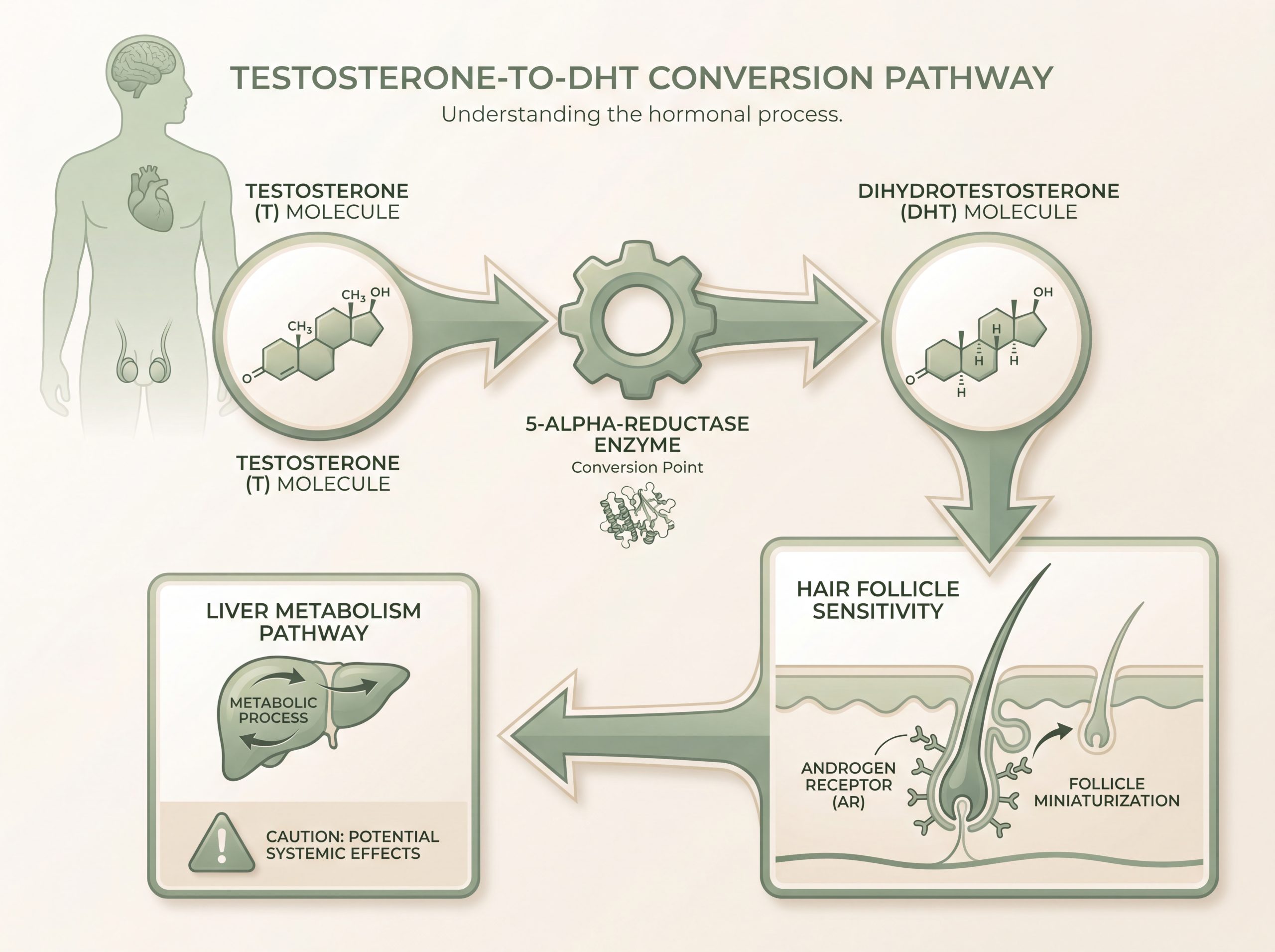
One of the most common questions our editorial team receives about Tongkat Ali involves its relationship to DHT (dihydrotestosterone) and hair loss. The concern is rooted in basic endocrinology rather than a specific finding about this herb. Testosterone converts to DHT through the enzyme 5-alpha-reductase, and DHT is the hormone most closely tied to androgenetic alopecia in people with a genetic sensitivity to it (Eurycoma longifolia: Medicinal Plant in the Prevention and Treatment of Diverse Diseases, PMC3403331). Because Tongkat Ali may support healthy testosterone levels, it is reasonable to ask whether that support extends to DHT as well.
We have not found a clinical study that directly measures Tongkat Ali’s effect on DHT or documents hair loss as a reported outcome in human trials. The connection is a plausible mechanism, not a demonstrated one. In our view, this distinction matters. People already prone to androgenetic alopecia, or with a strong family history of it, may want to raise this question with a healthcare provider before adding any testosterone-supporting herb to their routine, while those without that predisposition have less reason for concern based on what has actually been studied.
Tongkat Ali and Liver Safety
Liver safety is another area where we think readers deserve a direct answer instead of a vague reassurance. The National Institutes of Health’s LiverTox database, a reference our team checks regularly when evaluating herb safety profiles, lists Tongkat Ali as having rare associations with liver injury (LiverTox: Tongkat Ali, NCBI Bookshelf NBK609015). A 2024 case report documented a single instance of liver injury linked to Tongkat Ali use, though the affected individual recovered after discontinuing the supplement (A Rare Case of Tongkat Ali-Induced Liver Injury, PubMed 38646387).
One case report does not establish that Tongkat Ali is commonly hepatotoxic, and the herb has a long traditional-use history in Southeast Asia without widespread reports of liver problems. Still, anyone with existing liver disease, anyone taking medications metabolized by the liver, or anyone who notices symptoms like unusual fatigue, abdominal pain, or yellowing of the skin or eyes after starting Tongkat Ali should stop use and talk to a healthcare provider promptly.
Contraindications
Both Cistanche and Tongkat Ali should be avoided by:
- Pregnant and breastfeeding women: Due to a lack of safety data.
- Individuals with hormone-sensitive conditions: Such as breast cancer, prostate cancer, endometriosis, or uterine fibroids. The hormonal effects of these herbs could potentially worsen these conditions.
- People taking medications that affect hormone levels or the immune system: Potential interactions could occur.
- People with certain medical conditions: Those with pre-existing kidney disease or heart disease conditions need to talk to their doctor before using.
- Tongkat Ali may lower blood sugar: Individuals taking blood sugar-lowering medications should use caution and monitor their blood sugar levels closely.
Interactions
Both herbs carry a real potential for interaction with several medication categories. Anyone taking hormone therapies, including birth control, hormone replacement therapy, or medications for prostate or breast cancer, should talk with a healthcare provider before combining either herb with their treatment, since both Cistanche and Tongkat Ali may influence hormone levels. The same caution applies to blood sugar medications, since Tongkat Ali may lower blood sugar on its own. Anyone taking blood pressure medication should also mention Tongkat Ali specifically, given the occasional blood pressure changes noted above. As with any supplement, we recommend bringing your full medication list to the conversation rather than asking about the herbs in isolation.
Quality and Sourcing
Choosing high-quality, well-sourced supplements is crucial for both safety and efficacy. Look for:
- Standardized Extracts: Ensure the products are standardized to contain specific percentages of active compounds (echinacoside and acteoside for Cistanche; eurycomanone for Tongkat Ali).
- Third-Party Testing: Choose products that have been tested by an independent laboratory for purity, potency, and the absence of contaminants (heavy metals, pesticides).
- Reputable Brands: Select supplements from reputable companies with transparent sourcing and manufacturing practices.
Other Considerations
- Consult a Healthcare Professional: Before starting any new supplement regimen, especially if you have underlying health conditions or are taking medications, it’s essential to consult with a qualified healthcare professional.
- Start Low and Go Slow: Begin with a lower dose of both herbs and gradually increase as needed, paying close attention to your body’s response.
- Monitor for Side Effects: Be aware of potential side effects and discontinue use if any adverse reactions occur.
- Long-Term Use: The long-term use effects are not fully studied.
These statements have not been evaluated by the Food and Drug Administration. This product is not intended to diagnose, treat, cure, or prevent any disease. Consult your healthcare provider before use, especially if you are pregnant, nursing, taking medication, or have a medical condition.