What is Eucommia Bark?
Eucommia bark comes from the Eucommia ulmoides tree, a medium-sized tree native to China sometimes referred to as the “hardy rubber tree.” Its bark is rich in various components that have been linked to health benefits. These chemical compounds include lignans, iridoids, phenolics, and flavonoids. Among these, pinoresinol diglucoside has received attention for its potential testosterone-related properties. Other notable components are chlorogenic acid and geniposidic acid. The plant part used significantly affects the concentration of these compounds, with the bark generally considered more potent than the leaf in traditional applications.
Eucommia Bark and Testosterone: The Scientific Evidence
Testosterone, the primary sex hormone in men, plays a vital role in male fertility, muscle growth, fat distribution, and overall health. Factors like aging, stress, and certain health conditions can lead to reduced testosterone levels, impacting these aspects of well-being. This is where Eucommia ulmoides has garnered scientific interest.
Several studies suggest that Eucommia bark may influence testosterone levels through multiple mechanisms. Importantly, much of the current research is preclinical, meaning it has been conducted on cells (in vitro) or animals, not humans. While these studies offer valuable insights, their results don’t guarantee the same effects in humans. Further clinical trials are needed to confirm these findings.
Mechanisms of Action: How Eucommia May Influence Testosterone
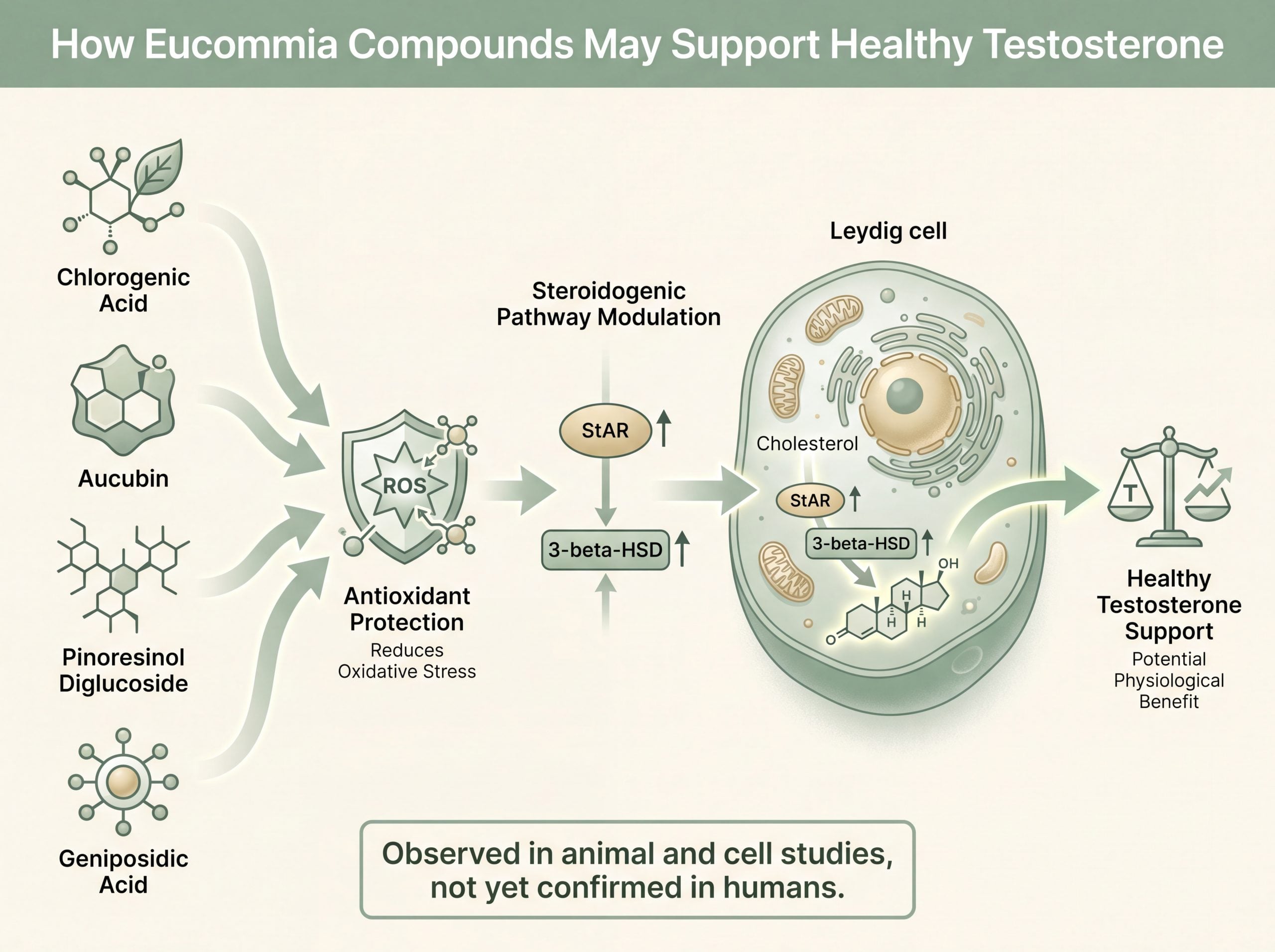
Research indicates that Eucommia ulmoides may support testosterone production through the steroidogenic pathway. A key study, “Testosterone promotion effect of Eucommia ulmoides staminate flower via the steroidogenic pathway and potential hormonal mechanism” (2022), showed that Eucommia ulmoides flower (EUF) extract, kaempferol, and geniposidic acid increased testosterone secretion in Leydig cells (the cells responsible for testosterone production in the testes).
This study linked the effect to the upregulation of specific enzymes and proteins involved in testosterone synthesis, including:
- StAR (Steroidogenic Acute Regulatory Protein): Facilitates the transport of cholesterol into the mitochondria, a crucial step in steroid hormone synthesis.
- HSD3B1 (3β-Hydroxysteroid Dehydrogenase Type 1): Catalyzes the conversion of pregnenolone to progesterone, another step in the pathway.
- CYP17A1 (Cytochrome P450 17A1): Plays a role in converting pregnenolone and progesterone to androgens.
- NR5A1 (Nuclear Receptor Subfamily 5 Group A Member 1): A transcription factor that regulates the expression of genes involved in steroidogenesis.
The researchers also found that blocking PKA (protein kinase A) and adenylyl cyclase with inhibitors (H89 and SQ22536, respectively) reduced the testosterone-promoting effects of EUF. This suggests that the PKA signaling pathway and adenylyl cyclase are involved in Eucommia’s mechanism.
Further supporting the androgen connection, “Androgenic activity of eucommia ulmoides extracts” (Google Patents) describes the activity and potentiation of gene expression with a ligand (e.g., DHT), indicating hormonal effects.
Another in vitro study, “Effects of the Mixture of Eucommia ulmoides Oliver and Achyranthes japonica Nakai Extracts (KGC08EA) on Testosterone Synthesis in Late-Onset Hypogonadism (LOH) in vitro Models,” also provides evidence of testosterone synthesis support.
Recent preclinical work helps explain how compounds in Eucommia ulmoides may interact with the body’s own testosterone machinery. In one cell and animal study, an extract of the Eucommia staminate flower, along with the flavonoid kaempferol and the iridoid geniposidic acid, increased testosterone output in Leydig cells by acting on the steroidogenic pathway and raising expression of the StAR, Hsd3b1, and Nr5a1 genes that govern hormone synthesis (Sci Rep, 2022, PMID: 36335171). Separate research reported that chlorogenic acid, one of the most abundant phenolics in eucommia, supported Leydig-cell testosterone secretion through SHP2 signaling and improved sperm measures in mice (Front Pharmacol, 2022, PMID: 35392568). The iridoid aucubin has also been shown to help protect testicular steroidogenesis against chemical-induced oxidative damage in rats (Sci Rep, 2022, PMID: 35962184). In our editorial review of this literature, the recurring theme is antioxidant protection of the hormone-producing cells rather than a direct hormonal stimulant effect.
Human vs. Animal Studies
It’s essential to reiterate that many of the studies on Eucommia and testosterone are preclinical. While promising, they don’t guarantee the same effects in humans. More clinical trials are needed to confirm these findings and determine optimal dosages and long-term safety in humans.
To be clear about where the evidence stands, the testosterone findings above come from cell cultures and rodent models, not from controlled trials in people. We have not located a published human clinical trial measuring serum testosterone after eucommia bark supplementation. A meaningful human study would need to be randomized and placebo-controlled, use a standardized bark extract with a known compound profile, and track total and free testosterone alongside symptoms over at least eight to twelve weeks. Until that work exists, the responsible reading is that eucommia shows biological plausibility for supporting healthy testosterone, while the human-level proof remains open (Heliyon, 2024, PMID: 38312592).
Eucommia Bark, Libido, and Male Vitality
In Traditional Chinese Medicine, eucommia bark (Du Zhong) is classified as a kidney-yang tonic, a category long associated with male vitality, stamina, and reproductive wellness. That traditional framing is the historical reason the herb appears in conversations about libido. From the modern research side, the link is indirect. The same antioxidant and steroidogenic-support mechanisms discussed above are the plausible bridge, because healthy testosterone signaling and good circulation both contribute to normal sexual function.
We want to set expectations honestly here. Eucommia bark is not a treatment for erectile dysfunction or any medical condition, and the human evidence for a libido effect is limited. People exploring eucommia for vitality are working primarily from its traditional reputation and its general antioxidant and cardiovascular-support profile rather than from clinical trials on sexual performance. Anyone experiencing persistent changes in libido or erectile function should speak with a healthcare provider, since those changes can signal an underlying issue that an herb will not address.
Eucommia Bark vs. Other Testosterone-Supporting Herbs
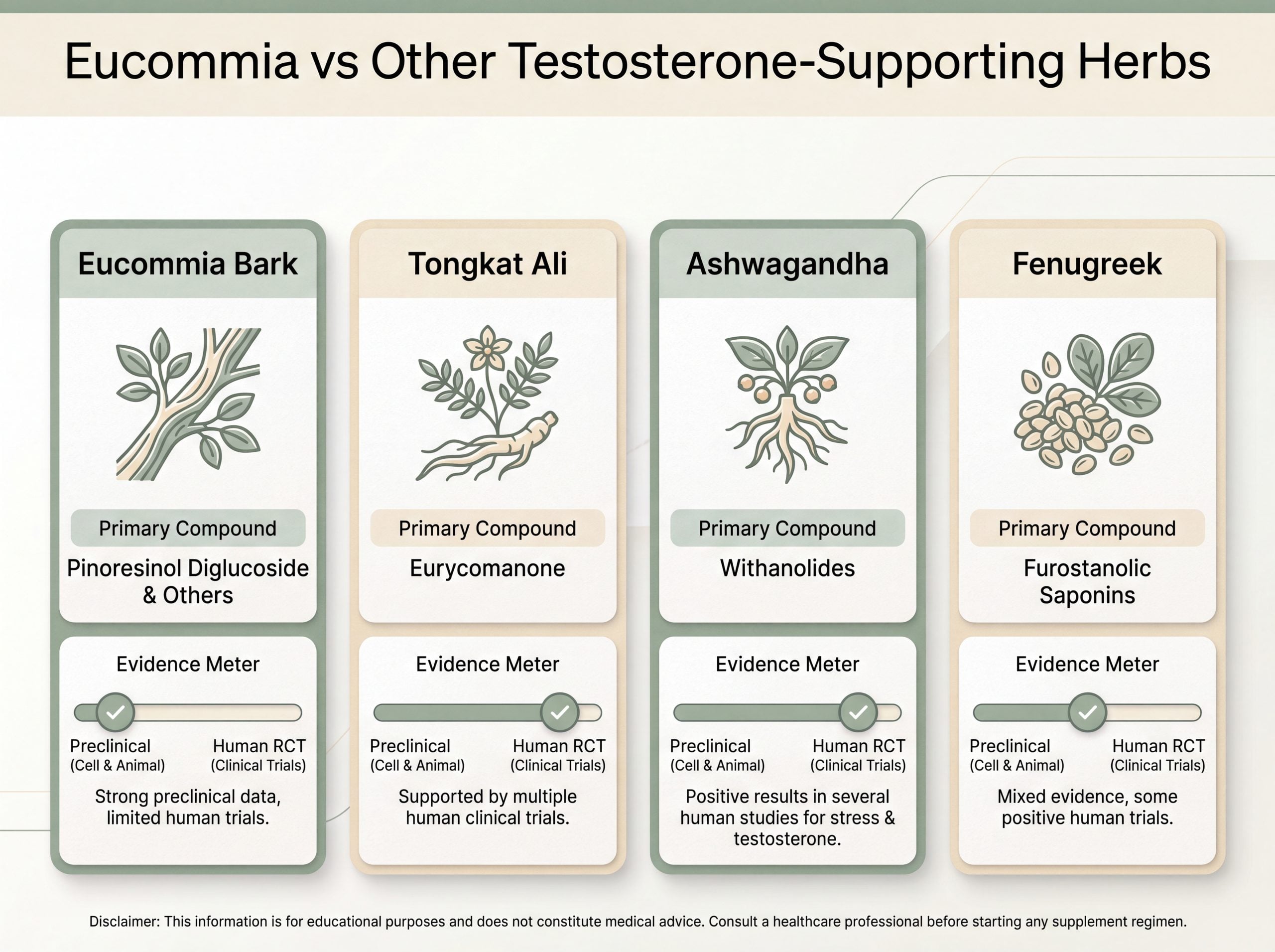
Eucommia is one of several botanicals people consider for healthy testosterone, and it helps to see where it sits next to the better-studied options. The honest distinction is the depth of human evidence. Tongkat ali and ashwagandha both have randomized controlled trials in people. Eucommia’s testosterone data, by contrast, is still preclinical. We have laid out the comparison below so the trade-offs are clear.
| Herb | Primary compounds | Human evidence on testosterone | Traditional role |
|---|---|---|---|
| Eucommia bark (Eucommia ulmoides) | Chlorogenic acid, aucubin, pinoresinol diglucoside, geniposidic acid | Preclinical only (cell and animal studies). No human testosterone trial located. | TCM kidney-yang tonic for vitality, bone, and circulation |
| Tongkat ali (Eurycoma longifolia) | Quassinoids (eurycomanone) | Meta-analysis of RCTs reports increased total testosterone in men (Medicina, 2022, PMID: 36013514) | Southeast Asian tonic for energy and male wellness |
| Ashwagandha (Withania somnifera) | Withanolides | RCTs report higher testosterone and improved well-being in men (Health Sci Rep, 2022, PMID: 35873404) | Ayurvedic rasayana for stress resilience and vigor |
| Fenugreek (Trigonella foenum-graecum) | Furostanol saponins | Mixed RCT results (saliva testosterone rose versus placebo, plasma did not) (2024, PMID: 39288153) | Culinary and tonic herb across several traditions |
| Sources: linked PubMed records above. Evidence maturity differs by herb. None of these is a treatment for any medical condition. | |||
From our editorial vantage point, the takeaway is not that eucommia is weaker, but that it is earlier in its research story. Its appeal is a broad antioxidant, bone, and cardiovascular-support profile with a long traditional record, where tongkat ali and ashwagandha offer narrower but human-tested testosterone data. Many people interested in vitality look at these herbs as complements rather than substitutes.
Beyond Testosterone: Other Health Benefits of Eucommia ulmoides
Eucommia ulmoides offers a range of potential health benefits beyond its possible effects on testosterone. These benefits are rooted in its traditional use and are increasingly supported by scientific research.
Kidney and Liver Support
In Traditional Chinese Medicine (TCM), Eucommia bark is highly regarded for its ability to tonify the kidneys and liver. It’s considered a Yang Jing herb, believed to strengthen the body’s vital energy and support overall vitality. This traditional use aligns with modern research suggesting benefits for kidney and liver function.
Bone and Joint Health
Eucommia bark is traditionally used to strengthen bones, tendons, and ligaments. This is particularly relevant for supporting joint health, managing lower back and knee pain, and promoting overall musculoskeletal well-being. This traditional application is supported by studies indicating that Eucommia ulmoides extract may promote the growth of bone-forming cells, offering potential benefits for conditions like osteoporosis.
Cardiovascular Health
Studies have investigated Eucommia bark’s effects on blood pressure and cardiovascular health. Some research indicates that extracts from Eucommia bark may possess antihypertensive properties, helping to lower high blood pressure. This effect is attributed to the bark’s potential to promote vascular health and improve blood circulation. The review “Health-Promoting Properties of Eucommia ulmoides: A Review” (2016) provides a comprehensive overview of these cardiovascular benefits.
Adaptogenic Properties
Eucommia bark is considered an adaptogen, meaning it may help the body adapt to various stressors, both physical and mental. By supporting the body’s stress response, Eucommia can indirectly contribute to hormonal balance, including healthy testosterone levels. High-stress levels can negatively impact testosterone production.
Anti-inflammatory and Antioxidant Effects
Eucommia bark possesses antioxidant and anti-inflammatory properties. “Health-Promoting Properties of Eucommia ulmoides: A Review” (2016) highlights these properties, noting their potential to combat oxidative stress and inflammation, which are key contributors to many chronic diseases.
Metabolic Benefits
Research also suggests that Eucommia may have metabolic benefits. For example, the study “Eucommia Bark/Leaf Extract Improves Lipid Metabolism Disorders by Affecting Intestinal Microbiota and Microbiome–Host Interaction in HFD Mice” (2023) found that Eucommia leaf extract could improve lipid metabolism in mice fed a high-fat diet.
Safety, Side Effects, and Precautions
While Eucommia ulmoides is generally considered safe, especially when used in traditionally recommended amounts, it’s important to be aware of potential side effects and precautions.
Latex Allergy
Individuals with a known allergy to latex must exercise caution with Eucommia bark. The Eucommia ulmoides tree contains naturally occurring latex, and allergic reactions are possible. Symptoms of a latex allergy can range from mild skin irritation to severe anaphylaxis.
Specific Side Effects
Some individuals may experience mild side effects, such as:
- Moderately severe headache
- Dizziness
- Edema (swelling)
- Bloating
- Loose stools
Medication Interactions
Eucommia bark may interact with certain medications, including:
- Anticoagulant and antiplatelet medications
- Low-molecular-weight heparins
- Thrombolytic medications
- Medications for diabetes
- Medications for high blood pressure
- Medications for weight reduction.
If you are taking any of these medications, it’s crucial to consult your healthcare provider before using Eucommia bark.
Because eucommia bark has traditionally been associated with blood-pressure support, the most discussed caution is combining it with blood-pressure or diuretic medications, where effects could stack. Reasonable additional caution applies to blood-thinning or antiplatelet medications and to medications for blood sugar, since many botanicals can influence these systems. This is general guidance, not a complete list. If you take any prescription medication, or you are managing a chronic condition, talk with your healthcare provider or pharmacist before adding eucommia bark so they can check it against your specific regimen.
Estrogen-Dependent Cancers
Eucommia ulmoides may be contraindicated in individuals with estrogen-dependent cancers. Consult with an oncologist or healthcare professional before using.
Pregnancy and Breastfeeding
Information regarding the safety and efficacy of Eucommia bark during pregnancy and breastfeeding is lacking. It’s best to avoid use during these periods unless specifically recommended by a healthcare provider.
Long-Term Use
While generally considered safe, long-term, high-dose administration of Eucommia ulmoides extract may lead to reversible nephrotoxicity (kidney damage). More research is needed to fully understand the long-term effects of Eucommia use.
Dosage and Usage
There is no standard recommended dose of Eucommia bark. Dosages used in studies vary, and it’s always best to start with a low dose and gradually increase it under the guidance of a qualified healthcare professional, such as a licensed acupuncturist or a doctor specializing in TCM. Eucommia is available in various forms, including:
- Tea: Steeping the bark in hot water.
- Powder: Can be added to smoothies, juices, or other beverages.
- Capsules: A convenient form for consistent dosing.
- Tinctures: Liquid extracts.
The bark is traditionally considered more potent than the leaf, although leaf extracts are sometimes used for sustainability reasons.
How Long Until Eucommia Bark Shows Effects? Onset and Timing
Herbal tonics like eucommia are traditionally taken consistently over weeks rather than as a quick fix, and that is the realistic frame for expectations. In traditional use, Du Zhong is a slow-and-steady kidney-yang tonic, not a stimulant with a same-day effect. Most people who use eucommia for general vitality or bone and circulation support give it a sustained trial of several weeks, taken daily with food, before judging how it fits their routine.
We avoid promising a specific timeline because no human trial has measured an onset window for testosterone or vitality outcomes. Individual factors such as age, baseline health, diet, sleep, and the specific extract all influence what a person notices. If you track anything, track how you feel over a consistent multi-week period rather than day to day, and pair the herb with the lifestyle basics that genuinely move testosterone, including resistance training, adequate sleep, and a nutrient-dense diet.
Stacking Eucommia Bark With Other Supportive Herbs
People who use eucommia as part of a vitality routine often pair it with other traditional tonics rather than relying on it alone. Common companions discussed in the herbal community include ashwagandha for stress resilience, tongkat ali for its human-tested testosterone profile, and mineral-rich whole foods that supply zinc and magnesium, two nutrients tied to normal hormone function. The logic of pairing is to cover complementary roles, such as antioxidant support from eucommia alongside an adaptogen for the stress axis.
A few practical cautions matter when combining anything. Introduce one herb at a time so you can tell what is doing what. Keep the total picture in view if several supplements affect blood pressure or blood sugar, since those effects can add up. And space eucommia away from blood-pressure medication dosing unless your provider has cleared the combination. As always, run a planned stack past your healthcare provider or pharmacist, especially if you take prescription medication or have a medical condition.
Eucommia Bark in Traditional Chinese Medicine
In TCM, Eucommia bark (Du Zhong) is a highly valued herb, often used in combination with other herbs in formulas tailored to specific health conditions. This synergistic approach is believed to enhance its effectiveness. It is classified as a Yang tonic, believed to strengthen the Kidneys and Liver, which in TCM are associated with bone health, vital energy, and overall well-being.
Conclusion
Eucommia ulmoides is a traditional herb with a growing body of scientific research supporting its potential health benefits, including a possible role in supporting healthy testosterone levels. However, it’s crucial to approach its use with a balanced perspective, recognizing the limitations of current research and the importance of consulting a healthcare professional, especially if you have any underlying health conditions, are taking medications, or have allergies. Prioritizing safety and informed decision-making is key when incorporating any herbal supplement into your health regimen.
Disclaimer: These statements have not been evaluated by the Food and Drug Administration. This product is not intended to diagnose, treat, cure, or prevent any disease. Consult your healthcare provider before use, especially if you are pregnant, nursing, taking medication, or have a medical condition.