CHLORELLA SUPPLEMENT VERDICT (INTERNAL QUALITY SCORE):
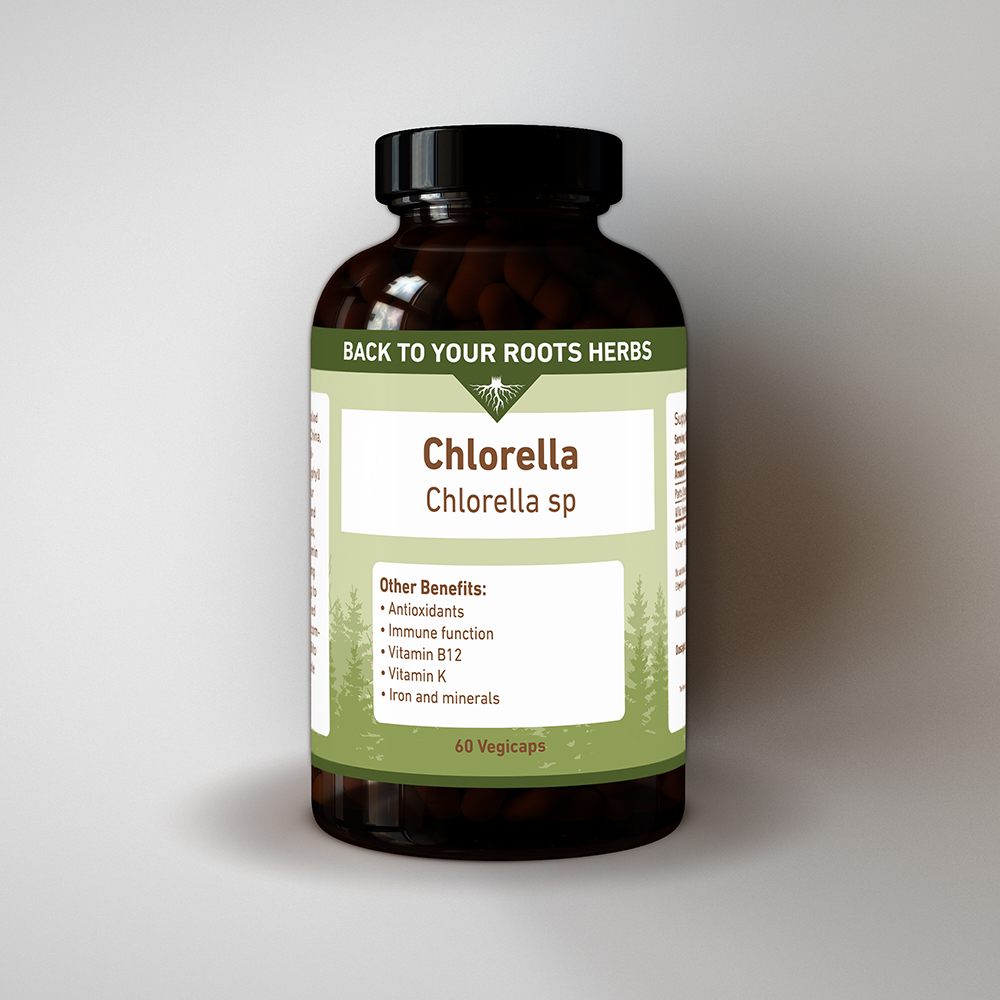
Grade A. Whole Chlorella sp. cells, a single-celled freshwater green alga cultivated in China, with the tough cell wall cracked so digestion can reach the protein, chlorophyll and carotenoids inside. Opened on our bench, the powder is deep emerald and smells of fresh seaweed and cut grass, with no musty or fishy off-notes. The lot COA passes heavy metals and microbial limits and is microcystin tested. One ingredient fills every shell. Two veg caps give 1 g a day, a modest serving next to the 6 chlorella tablets a day the typical tablet label asks for.
– Back To Your Roots Herbs Research Group
- What it is: whole cells of a freshwater green alga; cell wall cracked, nothing extracted
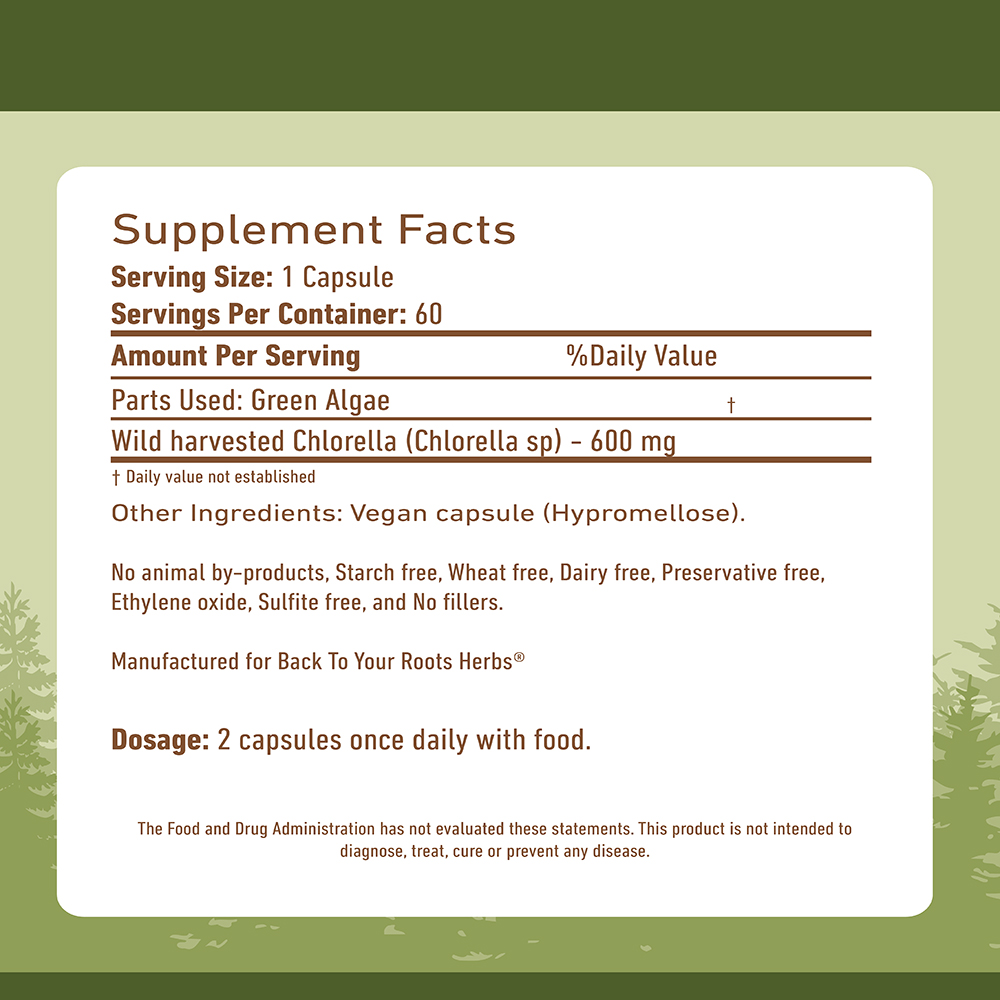
- Strength: 500 mg each, 1,000 mg (1 g) per serving of 2, 60 caps per bottle
- Origin: grown in China, bottled in Virginia Beach, VA
- Lot testing: heavy metals Pass, microbial Pass, microcystin tested
- Ask first if you take warfarin or other medicines, or are pregnant or breastfeeding
SENSORY ANALYSIS:
Notes from a freshly opened bottle. We pull a few shells apart over a white plate, then look, smell, and taste. The fill is the same chlorella powder we sell loose.
- Look: fine, loose, and deep emerald, darker than wheatgrass and greener than the blue cast of spirulina. It packs like soft chalk between two fingers. No stems or tan flecks.
- Smell: a faint sea-air note as the bottle opens, then fresh seaweed and cut grass once a shell is opened. Nothing musty. Nothing fishy.
- Taste: none, if you swallow the shell whole with water. That is the point of this form. A pinch of the opened powder tastes grassy and savory, close to toasted nori, with a lingering bitter edge.
Empty one shell of chlorella into cool water. The powder floats, then wets and clouds the glass dark green. It never dissolves, because these are whole cells, not an extract.
HOW DOES THIS CHLORELLA SUPPLEMENT WORK?
- The Herb: Chlorella sp. (family Chlorellaceae) sourced from commercial freshwater cultivation in China, dried as whole cells and sealed in vegetable cellulose shells.
- The Mechanism: Acts as a whole-cell source of protein, chlorophyll, and carotenoid antioxidants, with its cellulose wall mechanically cracked to trigger wider digestive enzyme access to the nutrients inside each cell.
- The Evidence: Research by Bito et al. (2020) confirmed in a review that people cannot digest intact cells of this alga because the walls are cellulose, which is why most supplements break them, and that labels of 13 commercial products list about 59 percent protein by dry weight (PMID 32825362).
So chlorella’s mechanism of action is physical. Crack the cell, and digestion gets in.
What Is Chlorella? Green Algae, Not Spirulina
The freshwater green algae chlorella is a genus of single-celled organisms, first described in 1890, with more than 20 species on record. The species long sold as C. pyrenoidosa is now classed as C. sorokiniana (Bito et al. 2020 chlorella review). Our supplier labels this lot Chlorella sp., genus only, so we claim no species. NIH LactMed lists carotenes, protein, fiber, vitamins, minerals, and chlorophyll in the genus (LactMed chlorella entry).
Spirulina is a different organism from chlorella, a blue-green cyanobacterium with no cellulose wall. Microalgae matter for sustainability because they grow on marginal land with non-potable water, yet reviewers name their poor taste as a barrier to food use (Kumar et al. 2022). A capsule removes that barrier.
Why the Cell Wall Is Cracked
Each chlorella cell wraps itself in a rigid, cellulose-rich wall that human enzymes cannot break, so intact cells can pass through with part of their contents still locked inside. More than 65 percent of the carbohydrate in commercial products is dietary fiber, which Bito’s team attributes to that wall.
Cracked Walls and Protein Digestibility
A National Research Council of Canada study in rats found true digestibility of only 64.7 and 59.3 percent for two intact species. Mechanical disruption raised their protein quality scores (PDCAAS) from 0.63 and 0.64 to 0.77 and 0.81 (Wang et al. 2020 protein study). Rats are not people. The direction still holds.
What That Means for 1 g
At 50 to 59 percent protein, your 2-a-day serving holds about half a gram. A nutritious whole food in a small dose, not a protein shake.
Chlorella Supplementation Research: Doses Used in People
Human trials have mostly given 5 to 10 g a day, often as chlorella tablets, five to ten times our serving. Their results describe those products and dosages, not this bottle.
- Antioxidants and oxidative stress: in a 6-week double-blind trial of 52 Korean male smokers, 6.3 g of chlorella a day raised plasma vitamin C 44.4 percent and vitamin E 15.7 percent, and two antioxidant enzymes grew more active (Lee et al. 2010).
- Normal immune function: In an 8-week Yonsei University trial of 51 healthy adults, 5 g of chlorella tablets a day raised natural killer cell activity, while placebo did not (Kwak et al. 2012). Small and short. Early support for the immune system, nothing more.
- Vitamin B12: A Tottori University team, working with a maker, measured under 0.1 µg to about 415 µg per 100 g across 19 dried supplements, with inactive B12-like compounds in several chlorella tablets (Bito et al. 2016). Vegans need a dependable B12 source.
- Vitamin K: chlorella labels list 0.3 to 3.5 mg per 100 g, roughly 3 to 35 µg in 1 g (Bito et al. 2020). We have not assayed this lot, so we print no number.
- Iron and minerals: label iron spans 10 to 1,600 mg per 100 g and magnesium 23 to 420 mg, with smaller amounts of folate and B vitamins. Algal iron is nonheme, and NIH notes vitamin C improves its bioavailability, so orange juice with breakfast helps (NIH iron fact sheet). No substitute for a balanced diet rich in essential vitamins and minerals.
Chlorella pills are also sold with big promises about clearing unwanted substances from the body. Human evidence is too thin for them, and we make none. Health benefits promised online often outrun the research.
CRITICAL USAGE: How to Take Chlorella Pills Safely
Before any new supplement, give your health care provider the full list of medicines, vitamins, and herbal supplements you take. Research on drug interactions with chlorella is incomplete.
Dose and Timing: Two a Day With Food
- Label serving: 2 caps (1,000 mg) once daily with a meal and a full glass of water.
- Sensitive stomach: take 1 a day for the first 3 to 5 days, then move to 2.
- Space it from medicines: Health Canada’s monograph for C. vulgaris says products with 250 mg or more a day should be taken a few hours before or after other medications.
- Upper limit: that monograph caps adults at 6 g a day. Stay at our label serving.
When to Take Chlorella: Breakfast or Lunch
Take it with a meal that has some fat. In a lab digestion study, yogurt with 10 percent fat raised the share of alpha- and beta-carotene moving into micelles, the form the gut absorbs (Morón-Ortiz et al. 2026). No caffeine, so expect no energy jolt.
Servings per Bottle
60 at 2 a day last 30 days.
Storage and Shelf Life
Close the lid tightly, store cool, dry, and away from light, and use by the expiration date on the label.
Who Should Not Take It Without Advice
Warfarin, Blood Thinners and Vitamin K
Chlorella is a vitamin K-rich food, and vitamin K works against warfarin. A 1995 case report from Japan described a 75-year-old man whose thrombotest value rose above its target range after he started chlorella, a sign the warfarin was working less well (Ohkawa et al. 1995). Health Canada requires licensed C. vulgaris products to carry a blood-thinner warning at 250 mg a day or 6 µg of vitamin K, and 1 g may hold 3 to 35 µg. On warfarin, start only with your prescriber.
Pregnancy, Breastfeeding, Kids and Allergies
Health Canada’s label wording tells pregnant and breastfeeding adults to consult a health care practitioner first, and LactMed notes green-tinted breast milk. These caps are for adults. Green algae allergy has been reported among children (Tiberg et al. 1995), so keep the bottle away from kids.
LactMed lists allergic reactions, including asthma and anaphylaxis, in people taking chlorella and in people preparing chlorella tablets. A 1984 report traced swelling and lesions on the sun-exposed skin of five patients to pheophorbide a in the chlorella tablets they ate (Jitsukawa et al. 1984). If you take immunosuppressants, have an autoimmune condition, or react to any algae allergen, ask first. Stop use and get care for a rash, swelling, or wheezing.
Side Effects of Chlorella in the First Week
LactMed lists nausea, diarrhea, cramping, gas, and green stools, the color coming from chlorophyll. If digestive symptoms last more than a few days, stop and call your provider.
Accidental Overdose
For any suspected overdose, call Poison Control at 1-800-222-1222, or seek emergency care if symptoms are severe.
CLINICAL SPECS:
| Spec | Detail |
|---|---|
| Serving Size | 2 Capsules (1,000 mg) |
| Frequency | Once daily with food |
| Active Marker | Chlorophyll a and b, carotenoids (beta-carotene, lutein), and protein. Not standardized. |
| Processing | Cultivated, harvested, cell wall cracked, dried, milled, and encapsulated (supplier specification) |
| Safety | Heavy Metal Tested (Pass). Microbial (Pass). Microcystin Tested. |
| Ingredients | Chlorella (Chlorella sp.), whole dried cells with cracked cell walls, 500 mg per capsule |
| Other Ingredients | Vegetable Cellulose (Capsule) |
| Purity | Non-GMO, Vegan |
| Free From | Wheat, Gluten, Soy, Dairy, Binders, Fillers |
| Origin | China (country of cultivation on the supplier label, province not stated) |
| Manufactured | Virginia Beach, VA, USA (grown in China) |
COMPARISON TABLE:
| Feature | BTYRH Chlorella Capsules | Generic Chlorella Tablets |
|---|---|---|
| Origin | China, as named on this page | Often unstated |
| Preparation | Cracked cell wall powder, loose in a vegetable shell, nothing pressed or added | Chlorella tablets are pressed, often with binders or flow agents |
| Taste | None when swallowed. Opened: grassy, savory, nori-like | Varies. Old or poorly dried algae can turn fishy or musty |
| Safety | Lot COA: heavy metals Pass, microbial Pass, microcystin tested | Unknown/Untested unless the seller shares a COA |
| Daily Count | 2 a day (1 g) | Often 6 or more chlorella tablets a day |
| Species on Label | Chlorella sp., as the supplier names it | Often not named |
Which Form Fits: Tablets, Capsules or Loose Powder?
- Capsules: loose powder in a vegetable shell, no taste, fixed 500 mg steps.
- Chlorella tablets: pressed powder, often 200 to 1,000 mg each. Across 59 single-ingredient chlorella tablets in the NIH database, the median label calls for 6 a day, and 10 or 15 a day is common.
- Chlorella powder: the most flexible dose and the strongest taste. Try our chlorella powder, the same material, loose in a pouch.
What 37 Supplement Labels Show
We pulled every single-ingredient chlorella label sold in caps from the NIH Dietary Supplement Label Database in October 2026, merged duplicate images, and left out chlorella spirulina blends.
- 37 products from 32 brands, 28 still on the market
- A median of 500 mg each (range 300 to 1,000 mg), with 60 and 100 the most common counts
- 27 of the 36 with a stated strength call for more than 1,000 mg a day at the top of their directions (median top dose 1,425 mg)
- 23 vegetable or plant shells, 4 gelatin, 10 unstated
- 4 list a flow agent such as magnesium stearate, silicon dioxide, or rice flour
- 28 mention a broken or cracked cell wall, and 12 of the 32 brands name a species, most often C. vulgaris
- Source: NIH label data on chlorella capsules, searched October 2026
Many chlorella powders and pills sold online as health supplements never appear there, so read this as a snapshot. It still shows where our 1 g serving sits: at the low end, on purpose.
Reading a COA: Heavy Metals, Microbes and Microcystin
An algology lab at the University of Murcia, Spain, tested 10 microalgae supplements. Microcystin turned up in 3, including a chlorella tablet where it was confirmed below the quantification limit alongside anatoxin-a. Lead appeared in 6, including a powdered chlorella grown in China. Intakes at label doses stayed within EU limits, though the authors called some lead levels high and note that most products do not disclose how their algae were grown (Sánchez-Parra et al. 2020).
- Microcystin: the Health Canada chlorella monograph sets a 1 ppm tolerance for raw material in licensed products. Our lot is microcystin-tested.
- Heavy metals: testing laboratories should report lead, cadmium, arsenic, and mercury in mg/kg. Our lot passes.
- Microbial: a full panel covers total plate count, yeast and mold, E. coli, and Salmonella. Our lot passes.
- Organic: USDA Organic is a farming certification, not a test for contaminants. This lot is not certified organic, so we do not call it organic.
- Your copy: request the chlorella capsules COA for your lot number
Ask for the COA before you buy any chlorella supplement, ours included. A brand that will not share one is selling marketing, not information.
FREQUENTLY ASKED QUESTIONS:
Q: What are chlorella capsules good for?
A: A daily serving of chlorella, a whole green alga that is about half protein by dry weight and rich in chlorophyll, with carotenoid antioxidants, vitamins, and minerals that vary by lot. Health Canada’s monograph lets licensed Canadian C. vulgaris products say they are a source of antioxidants that help protect cells against free radicals.
Q: How do I take chlorella capsules?
A: Swallow 2 once daily with a meal and water. Start with 1 if your stomach is sensitive, and keep it a few hours apart from other medicines.
Q: Is it safe to take chlorella every day?
A: Trials have given chlorella daily for up to about four months, and LactMed calls it usually well tolerated. Daily use still carries some risk for certain people: vitamin K with warfarin, allergies, sun sensitivity, and stomach upset. Ask your health care provider first.
Q: Who should not take chlorella tablets or capsules?
A: Get medical advice first if you take warfarin or immune-suppressing drugs, have an autoimmune condition or an algae allergy, or are pregnant or breastfeeding. Do not give it to children.
Q: Does chlorella interact with foods or drinks?
A: We found no documented food or drink interaction. The concern is vitamin K: on warfarin, chlorella adds to the vitamin K in leafy greens and natto, so keep intake steady and tell your prescriber.
Q: Does your chlorella smell fishy or contain shellfish?
A: No. It smells of fresh seaweed and cut grass, and it belongs to the freshwater algae, with no shellfish ingredients. A fishy smell in any algae product signals age or poor drying.
Q: Can I take chlorella and spirulina together?
A: Many people do. A chlorella spirulina routine works best as two separate products, so each dose stays clear. See our Spirulina Capsules and our guide to spirulina and chlorella benefits.
Q: Is this chlorella vegan and organic?
A: Vegan and non-GMO, in a vegetable cellulose shell. It is not certified organic, so we do not label it organic.
Q: What do chlorella tablets do that capsules do not?
A: Nothing different in the algae. Chlorella tablets press the powder into pills, often with binders, and labels commonly call for 6 or more a day. Our caps hold loose powder with no taste, and chlorella powder gives you the most control. Tablets, capsules, or powder, it is the same alga: chlorella.
Facts on these chlorella pills were last reviewed in October 2026 by the Back To Your Roots Herbs® Research Group.
DISCLAIMER: These statements have not been evaluated by the Food and Drug Administration. This product is not intended to diagnose, treat, cure, or prevent any disease. Consult your healthcare provider before use, especially if you are pregnant, nursing, taking medication, or have a medical condition.
Reviews
There are no reviews yet.