Key Takeaways
- In the most-cited trial, 8 weeks of 300 mg ashwagandha root extract twice daily alongside resistance training produced a 46.0 kg bench press increase against 26.4 kg for placebo (Wankhede et al., 2015, J Int Soc Sports Nutr, PMID: 26609282).
- That same 57-man trial recorded a 96.2 ng/dL rise in serum testosterone against 18.0 ng/dL for placebo, alongside greater stabilization of creatine kinase, a marker of exercise-induced muscle damage.
- A 2026 three-level meta-analysis of 13 trials and 599 participants reported an overall exercise-performance effect of Hedges’ g = 0.47, with aerobic endurance the most consistent outcome and strength effects positive but less certain (Li et al., 2026, Nutrients, PMID: 42356302).
- Across the published trial literature, 300 to 600 mg per day of a standardized root extract, taken for 8 to 12 weeks, is the range with the most supporting data.
- Ashwagandha and creatine act on unrelated pathways. Creatine restores phosphocreatine for repeated power output. Ashwagandha acts on the stress axis and recovery markers.
Ashwagandha and bodybuilding get discussed together constantly, and almost always without numbers. Our editorial team went back to the primary literature for this update, pulled the five trials and reviews that the search engines themselves cite most often, and rebuilt this article around what those studies actually measured. The result is less flattering than the usual supplement copy and considerably more useful. There is a real, repeatable effect on strength and recovery in resistance-trained subjects. There is also a 2026 meta-analysis showing that effect is smaller and less uniform than the enthusiasm around it suggests, and that the most consistent benefit is in endurance rather than raw hypertrophy. Both things are true. Here is the evidence, with the doses, the durations, and the effect sizes attached.
What Does Ashwagandha Actually Do for Bodybuilding?
Ashwagandha, botanically Withania somnifera, is an adaptogenic shrub in the Solanaceae family whose root contains a class of steroidal lactones called withanolides. In a training context, it acts primarily on the hypothalamic-pituitary-adrenal axis rather than on muscle tissue directly, lowering circulating cortisol. In an 8-week randomized controlled trial of 57 resistance-training men, 300 mg of root extract twice daily was associated with a 46.0 kg bench press 1-RM increase against 26.4 kg for placebo (Wankhede et al., 2015, PMID: 26609282).
What Is This Adaptogenic Herb?
An adaptogen behaves less like a stimulant and more like a thermostat for the stress response. Rather than pushing a system up or down, it supports the body’s capacity to return to baseline after a stressor. For a lifter, whose training is a deliberate, repeated physiological stressor, that regulatory role is where the interest lies. The withanolides are the constituent class most trials standardize against, and the extracts used in the strength research are typically standardized to above 5 percent withanolides by weight.
A Brief History in Ayurvedic Practice
For roughly 3,000 years, ashwagandha has held a place in Ayurveda as a rasayana, a rejuvenating tonic. Its Sanskrit name translates to “smell of the horse,” a reference both to the root’s distinctive aroma and to the strength traditionally associated with it. That long record of traditional use is context, not evidence of a training effect. What follows is the clinical record.
How Does Ashwagandha Work in a Training Context?
Cortisol Reduction and Muscle Preservation
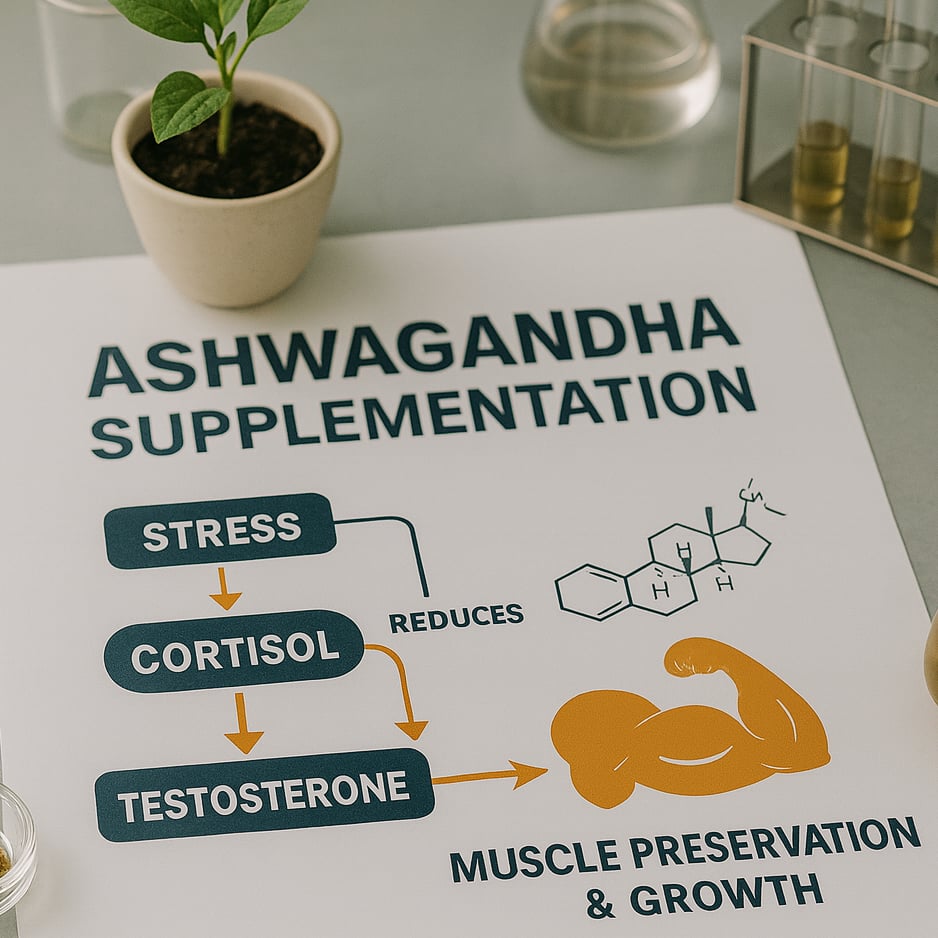
Cortisol is a glucocorticoid released by the adrenal cortex in response to stress, including training stress. Sustained elevation shifts the body toward a catabolic state, in which protein breakdown outpaces synthesis. The proposed mechanism for ashwagandha’s effect on body composition runs through this pathway: in the trials cited here, participants taking standardized root extract alongside resistance training showed greater reductions in body fat percentage than placebo groups, 3.5 percent against 1.5 percent in the Wankhede cohort. The herb does not build tissue. The argument is that a lower-cortisol environment is a more favorable one for the training itself to work in.
Why the Hormonal Shift Matters for Hypertrophy and Strength
Testosterone drives muscle protein synthesis, so any shift in it has downstream relevance for lifters. In the Wankhede trial, the ashwagandha group’s serum testosterone rose by 96.2 ng/dL against 18.0 ng/dL in the placebo group (p = 0.004), and that group also recorded the larger strength and size changes. The mechanism is generally described as indirect, running through cortisol suppression rather than through direct androgen stimulation. For a fuller treatment of the hormonal research on its own terms, including who the effect has and has not been demonstrated in, we cover that separately in our article on ashwagandha for testosterone. Here the point is narrower: the hormonal shift is one input into a training outcome, not the outcome itself.
Increasing Power Output and Physical Performance
A separate 8-week randomized, double-blind, placebo-controlled trial of 80 physically active men and women used 300 mg twice daily of a root extract standardized to above 5 percent withanolides. It reported greater improvements in bench press, leg press, and cardiorespiratory endurance measured as VO2 max in both male and female participants, with no adverse events recorded (Verma et al., 2024, F1000Research, PMID: 38988644). That trial matters for two reasons. It is one of the few with a meaningful female cohort, and its endurance finding anticipates what the later meta-analysis would identify as the most reliable effect.
Aiding Recovery and Soothing Muscle Soreness
Creatine kinase leaks from damaged muscle fibers, which makes serum levels a practical marker of exercise-induced muscle damage. Wankhede’s cohort showed significantly greater stabilization of serum creatine kinase in the ashwagandha group (p = 0.03). In practical terms, this is the recovery claim, and it is the one with the most direct biochemical support. Less measured damage between sessions means training frequency is easier to hold, and consistency is what actually accumulates into progress.
Ashwagandha vs Creatine: Which Is Better for Muscle Gain?
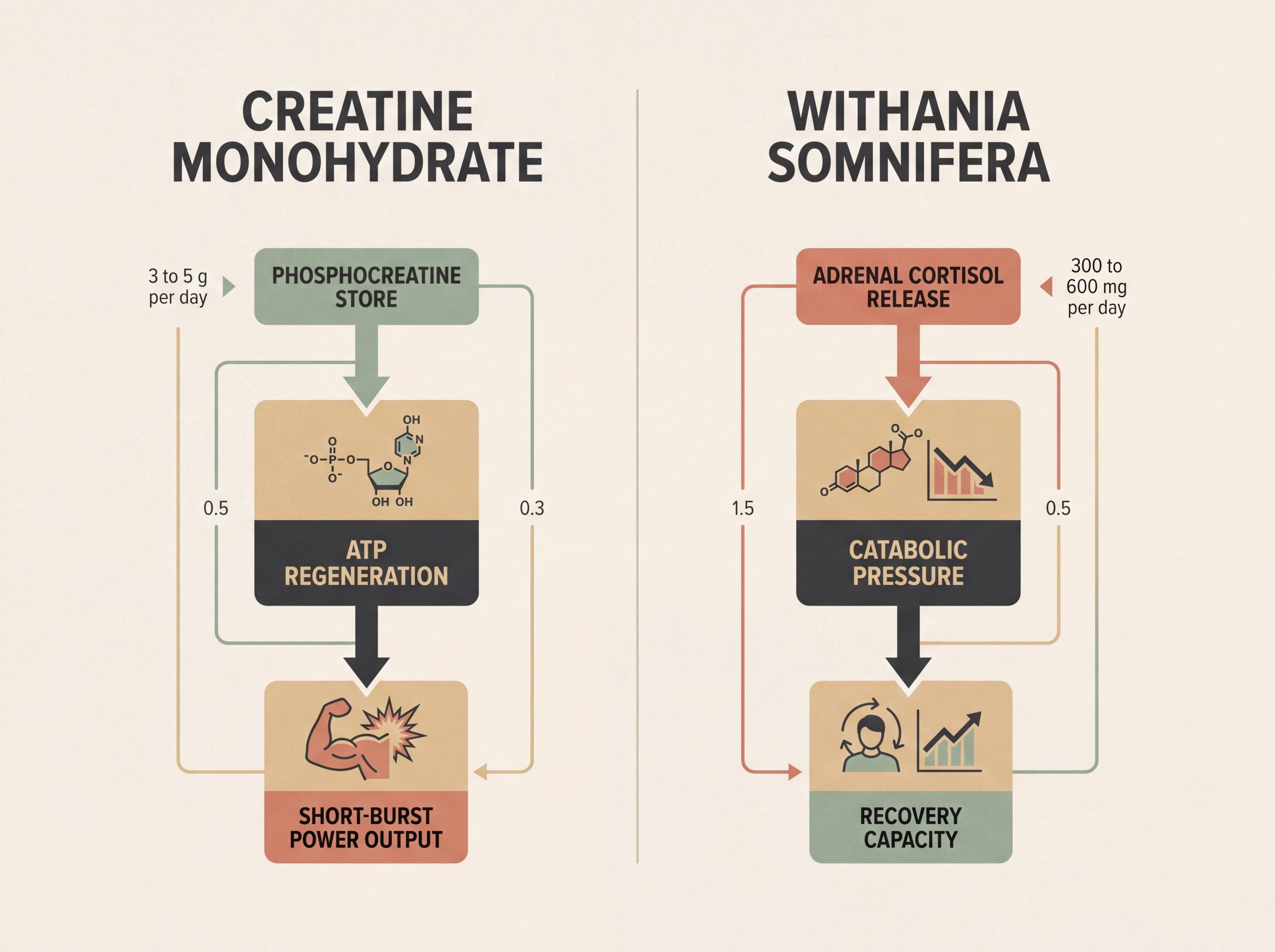
Neither is better because they are not doing the same job. Creatine restores phosphocreatine stores to regenerate adenosine triphosphate during short, high-intensity efforts, and it has the deeper evidence base for lean mass and maximal strength. Ashwagandha acts on the stress axis and on recovery markers. They operate through unrelated pathways, which is why they are commonly used together rather than chosen between.
| Factor | Ashwagandha (Withania somnifera) | Creatine monohydrate |
|---|---|---|
| Primary mechanism | Modulates the hypothalamic-pituitary-adrenal axis, lowering circulating cortisol | Replenishes intramuscular phosphocreatine to regenerate ATP during short efforts |
| Best-supported outcome | Aerobic endurance, then recovery markers, then strength (Li et al., 2026) | Maximal strength, lean body mass, repeated high-intensity output |
| Dose used in trials | 300 to 600 mg per day of standardized root extract | 3 to 5 g per day of creatine monohydrate |
| Time to measured effect | 8 to 12 weeks in the published trials | Days to weeks depending on loading protocol |
| Evidence volume | 13 trials, 599 participants in the 2026 meta-analysis | Hundreds of trials, the most-studied ergogenic aid in sports nutrition |
| Typical reason to use | High training stress, poor sleep, slow recovery between sessions | Direct performance in the 0 to 10 second power range |
| Ashwagandha figures from Wankhede et al. 2015 (PMID: 26609282) and Li et al. 2026 (PMID: 42356302). Creatine dosing per the International Society of Sports Nutrition position stand. | ||
Does Ashwagandha Improve Muscle Growth, or Just Strength?
The honest answer is that the strength and endurance signals are cleaner than the hypertrophy signal. Wankhede’s cohort did record greater size changes, 8.6 cm2 against 5.3 cm2 at the arm and 3.3 cm against 1.4 cm at the chest, but that is one trial in untrained-to-lightly-trained men, the population in which almost any intervention produces measurable change. The 2026 meta-analysis, pooling across the field, found strength effects positive but uncertain, and power and muscular endurance evidence sparse. Anyone selling this as a mass-builder is going beyond the data.
Can You Take Creatine and Ashwagandha Together?
Yes, and the pathway argument is why. Phosphocreatine resynthesis and cortisol regulation do not compete for the same substrate or receptor, so there is no mechanistic reason for interference. This is the most common pairing we see among the lifters who buy from us, typically creatine taken daily without regard to timing and ashwagandha taken on a fixed schedule for a defined 8 – to 12-week block.
What Do the 2015-to-2026 Studies Actually Show?
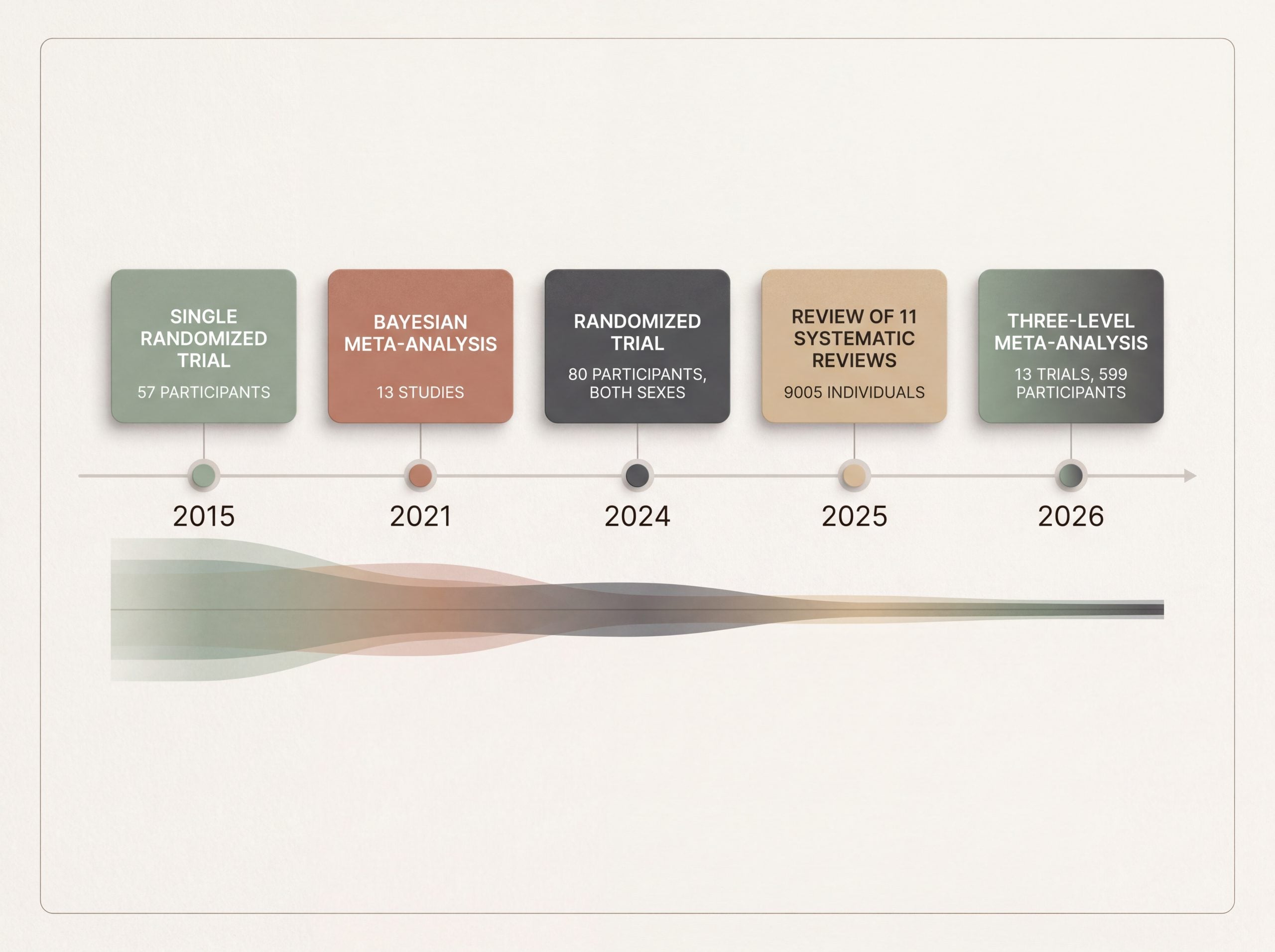
The evidence base has matured considerably, and the direction it matured in is worth knowing before you spend money. The picture moved from a single striking trial toward a pooled estimate that is positive, modest, and uneven across outcomes.
- 2015, the anchor trial. Wankhede et al., 57 men, 8 weeks, 300 mg twice daily. Significant advantages on bench press, leg extension, arm and chest size, testosterone, creatine kinase, and body fat percentage. J Int Soc Sports Nutr, PMID: 26609282.
- 2021, first pooled look. Bonilla et al. ran a Bayesian meta-analysis across 13 studies and concluded supplementation was more efficacious than placebo for physical performance in healthy men and women, while noting a low-to-moderate overall risk of bias. J Funct Morphol Kinesiol, PMID: 33670194.
- 2024, the sex-balanced endurance trial. Verma et al., 80 participants, both sexes, 600 mg daily standardized to above 5 percent withanolides. Gains in strength, muscle girth, and VO2 max, no adverse events. F1000Research, PMID: 38988644.
- 2025, the review of reviews. Ferreira et al. assessed 11 systematic reviews covering 151 original studies and 9,005 individuals, finding likely benefit for endurance and muscular strength while calling the underlying evidence limited and sometimes inconsistent. Muscles, PMID: 40843911.
- 2026, the most rigorous synthesis to date. Li et al. pooled 13 trials, 599 participants, and 79 effect sizes into a three-level random-effects model. Overall performance effect Hedges’ g = 0.47 (95 percent CI 0.25 to 0.69, p < 0.001), but the 95 percent prediction interval ran from -0.40 to 1.33, crossing zero. Aerobic endurance was the clearest moderator at g = 0.54. Nutrients, PMID: 42356302.
That prediction interval is the detail almost no article on this topic reports, and it is the one worth understanding. A confidence interval that excludes zero says the average effect across these trials is real. A prediction interval that includes zero says the next trial, in a different population with a different formulation, could plausibly find nothing. Average benefit, unreliable individual benefit. That is a more accurate summary of ashwagandha for lifters than anything in the marketing.
What Changes Can You Expect, and How Long Does It Take?
Set expectations against the trial data rather than against transformation photos. In the studies that measured it, the timeline to a detectable change in strength or size was 8 weeks minimum, and the interventions ran alongside a structured resistance training program in every case. Nothing in the literature supports an effect in the absence of training.
- Weeks 1 to 2. Subjective changes in sleep quality and perceived stress are what participants report earliest across the stress literature. Nothing measurable in the weight room yet.
- Weeks 4 to 6. Recovery markers are where the biochemical evidence sits. Wankhede measured creatine kinase stabilization over the 8-week window rather than at intervals, so a precise onset point is not established.
- Weeks 8 to 12. This is where every trial that found strength and size differences measured them. The 2026 meta-regression on duration was described by its own authors as hypothesis-generating rather than conclusive.
- Magnitude. In the anchor trial, the ashwagandha group’s bench press advantage over placebo was roughly 19.6 kg across 8 weeks. Both groups improved. The herb widened a gap; it did not create the gain.
How to Use Ashwagandha Effectively
What Dose Did the Strength Trials Use?
- The anchor strength trial used 300 mg of standardized root extract twice daily, for a total of 600 mg per day, across 8 weeks (Wankhede et al., 2015, PMID: 26609282).
- The 2026 meta-analysis identified 500 to 600 mg per day as the most evidence-supported extract-dose range across the 13 pooled trials (PMID: 42356302).
- The 2024 endurance trial standardized its extract to above 5 percent withanolides, which is the concentration figure to look for on a label (PMID: 38988644).
- Every trial that measured strength or size outcomes ran for 8 weeks or longer before endpoints were assessed.
- The review of 11 systematic reviews reported the most commonly used doses across the wider literature as 500 to 1,000 mg per day (PMID: 40843911).
These are the doses researchers administered under supervision in controlled trials, reported here as published figures. They are not a recommendation for your circumstances. What is appropriate for you is a conversation with your healthcare provider.
Should You Take It Before or After Workouts?
The trials did not time dosing around training. In the studies that produced the strength and endurance findings, participants took a fixed daily schedule, typically one dose in the morning and one in the evening, independent of when they trained. That design detail is itself the answer: the measured effects came from steady daily intake over weeks, not from acute pre-workout timing. If evening dosing suits you because of the herb’s association with sleep quality, nothing in the trial designs argues against it.
How Do KSM-66 and Sensoril Differ?
Both are patented, standardized extracts, and they are not interchangeable. KSM-66 is a root-only extract standardized to a higher withanolide percentage, and it is the preparation used in most of the strength and performance trials, including the anchor study. Sensoril is produced from root and leaf, carries a different withanolide profile, and appears more often in research on stress and sleep endpoints. When a label names neither and gives no withanolide percentage, you have no way to map that product onto any published trial. In our own sourcing work, the withanolide figure is the first thing we ask a supplier for and the first thing we verify independently.
Is Ashwagandha Allowed for Drug-Tested Athletes?
Withania somnifera does not appear on the World Anti-Doping Agency Prohibited List. The practical risk for a tested athlete is not the herb; it is what else ends up in a poorly controlled supplement. Botanical products have a documented history of adulteration and species substitution, which is why athletes under testing protocols generally restrict themselves to products carrying third-party certification such as NSF Certified for Sport or Informed Sport. If you compete under an anti-doping code, verify current status with your governing body rather than relying on any article, including this one.
What the Published Tolerability Record Reports
In the controlled trials at 300 to 600 mg per day over 8 to 12 weeks, ashwagandha was generally well tolerated, and the 2024 endurance trial specifically reported no adverse events across its 80 participants. The NIH Office of Dietary Supplements maintains a fact sheet summarizing what is and is not established about its safety profile, and the National Center for Complementary and Integrative Health publishes a parallel summary. Ashwagandha is not appropriate during pregnancy. If you are nursing, taking prescription medication, or managing any health condition, including thyroid conditions, speak with your healthcare provider before starting it.
Quality and Sourcing Considerations
Most of what separates a product that resembles the trial material from one that does not is visible on the label before you ever open the container. We look for the plant part named explicitly, root rather than an unspecified aerial blend, a stated withanolide percentage, and a certificate of analysis the supplier will actually produce on request. Our organic ashwagandha root powder is whole-root and USDA certified, and the ashwagandha root capsules cover the same material for anyone who would rather not measure. For lifters building a broader stack, our athletic muscle growth formula pairs several of the traditional performance botanicals in one preparation.
From our hands-on assessment across suppliers, the most common quality failure is not adulteration; it is dilution: root material blended with lower-cost stem or leaf, sold at a withanolide concentration well under what the research used. A product at 1 percent withanolides is not a weaker version of the trial extract. It is a different product.
Common Questions About Ashwagandha and Bodybuilding
Is ashwagandha or creatine better for muscle gain?
They are not comparable because they act on unrelated pathways. Creatine restores phosphocreatine for repeated high-intensity output and carries the deeper evidence base for lean mass and maximal strength. Ashwagandha acts on the stress axis and on recovery markers. Most lifters who use both take them together rather than choosing.
What dose of ashwagandha was used in the strength studies?
The anchor trial used 300 mg of standardized root extract twice daily for 8 weeks (PMID: 26609282). The 2026 meta-analysis identified 500 to 600 mg per day as the most evidence-supported range across 13 pooled trials. These are published trial figures, not personal dosing guidance.
Does ashwagandha actually improve muscle growth, or just strength?
The endurance and strength signals are more consistent than the hypertrophy signal. One trial recorded greater arm and chest size increases, but the 2026 pooled analysis found strength effects positive yet uncertain, and power and muscular endurance evidence sparse. Aerobic endurance was the clearest effect at Hedges’ g = 0.54.
How long does ashwagandha take to work for training?
Every trial that measured strength or size outcomes ran 8 weeks or longer before assessing endpoints. Changes in sleep quality and perceived stress are what participants report earliest, typically within the first couple of weeks, but those are subjective measures rather than performance data.
Should ashwagandha be taken before or after a workout?
The trials did not time dosing around training sessions. Participants took a fixed daily schedule, usually split morning and evening, regardless of when they trained. The measured effects came from consistent daily intake across weeks rather than from acute pre-workout timing.
Can women use ashwagandha for fitness?
Yes. The 2024 randomized trial of 80 participants included a female cohort and reported improvements in bench press, leg press, and VO2 max in women as well as men (PMID: 38988644). The underlying mechanisms of stress adaptation and muscle repair are not sex-specific, though the older testosterone-focused research was conducted in men.
Can you take creatine and ashwagandha together?
Yes. Phosphocreatine resynthesis and cortisol regulation do not compete for the same substrate or receptor, so there is no mechanistic basis for interference. This pairing is common among the resistance-training customers we hear from.
What does the published tolerability record say about ashwagandha?
In controlled trials at 300 to 600 mg per day over 8 to 12 weeks, it was generally well tolerated, and the 2024 endurance trial reported no adverse events across 80 participants. It is not appropriate during pregnancy. Speak with your healthcare provider before use if you are nursing, taking medication, or managing a health condition.
Related Reading
Continue with our companion articles on ashwagandha for testosterone, ashwagandha for cortisol, the best herbs for muscle growth, and natural athletic performance enhancers.
Important: This article is for educational and informational purposes. The statements have not been evaluated by the Food and Drug Administration. The herbs and herbal products discussed are not intended to diagnose, treat, cure, or prevent any disease. Speak with a qualified healthcare provider before starting any new herbal regimen, especially if you are pregnant, nursing, taking medication, or managing a health condition.