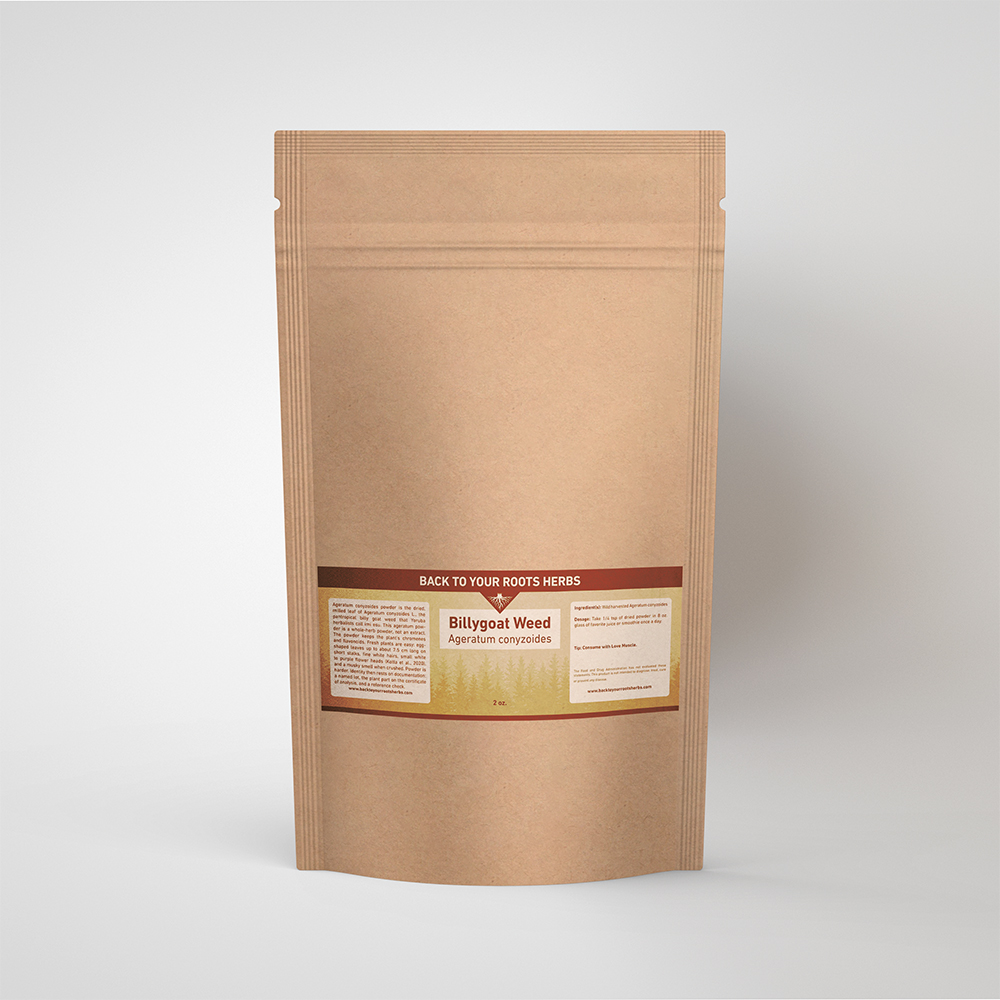
Ageratum conyzoides powder is the dried, milled leaf of Ageratum conyzoides L., the pantropical billy goat weed that Yoruba herbalists call imi esu. This ageratum powder is a whole-herb powder, not an extract. The powder keeps the plant’s chromenes and flavonoids. The species can also carry pyrrolizidine alkaloids (PAs), compounds the FDA calls liver toxins in animals, so every lot of this botanical powder is tested for them and released only when none are detected.
- Identity: Ageratum conyzoides L., daisy family (Asteraceae).
- Form: 100% leaf from Ghana as a fine dried powder. No fillers.
- Safety: Every lot of Ageratum conyzoides powder is tested for PAs. Not for pregnancy, nursing, liver conditions, or anyone under 18.
- Use: About 1/4 teaspoon of the powder (600 mg) once a day with food, in courses of up to 4 weeks.
The Verdict: Internal Quality Score for Ageratum Powder
Grade A for botanical identity and whole-herb integrity: 100% Ageratum conyzoides leaf from the Ashanti Region of Ghana, a sun-loving annual of open fields and roadsides, milled whole with nothing added. We release a lot only when its certificate of analysis shows heavy metals within limits and pyrrolizidine alkaloids not detected by LC-MS/MS. – Back To Your Roots Herbs Research Group
What Is Ageratum Conyzoides (Billy Goat Weed)?
Ageratum conyzoides is an erect, slightly aromatic annual about 1 m tall, native to tropical America (USDA APHIS weed risk assessment for Ageratum conyzoides). Kotta et al. (2020) trace its English names, billygoat weed and goat weed, to its goat-like smell.
It is also a serious weed in agriculture. Kato-Noguchi and Kato (2024) report infestations that suppressed more than 30 crops in over 40 countries, and the Global Invasive Species Database entry for Ageratum conyzoides notes an established invasion in the Himalayas.
Ageratum Conyzoides Taxonomy and Scientific Name
Scientific name: Ageratum conyzoides L. Family: Asteraceae. Tribe: Eupatorieae (Bosi et al., 2013). Kew’s Plants of the World Online lists Ageratum conyzoides as an annual or subshrub of the seasonally dry tropics. Ageratum comes from the Greek a geras, ageless, and conyzoides from konyza, an old Greek plant name (Kotta et al., 2020).
Local Names: Imi Esu, Bandotan, Mentrasto and Kakkoazami
In Nigeria, it is imi esu to the Yoruba. Ula ujula is a name recorded among the Igbo, and Hausa and Igede communities have their own names. Indonesia says bandotan, Brazil mentrasto, and Japan kakkoazami. Brazil’s health regulator, ANVISA, lists it among its medicinal crude drugs (Bosi et al., 2013).
Horny Goat Weed vs Ageratum Conyzoides
The goat names cause mix-ups. Horny goat weed is Epimedium, a barberry-family plant from East Asia. Ageratum conyzoides is a daisy-family weed from the Americas. Looking for Epimedium? See our Epimedium Sagittatum Powder and our horny goat weed (Epimedium) guide.
Sensory Analysis: Leaf Color, Goat-Like Aroma and Texture
We grade each lot by eye, nose, hand, and tongue before packing.
- Look: Fine sage-to-olive green powder, flecked paler where the hairy leaves were milled. Even grind.
- Smell: Sharp, musky, and green. The goat-like note that named the plant hits hardest when the pouch of powder opens.
- Texture: Light, slightly fibrous powder that stirs evenly into water or juice.
- Taste: The raw powder hits bitter first, turns slightly astringent, then leaves an herbal musk at the back of the tongue.
That bitterness is why most people stir the powder into juice or a smoothie rather than plain water.
How to Identify the Real Plant
Fresh plants are easy: egg-shaped leaves up to about 7.5 cm long on short stalks, fine white hairs, small white to purple flower heads (Kotta et al., 2020), and a musky smell when crushed. Powder is harder. Identity then rests on documentation: a named lot, the plant part on the certificate of analysis, and a reference check. That paperwork separates our Ageratum conyzoides herb powder from an anonymous bag.
The Floss Flower Look-Alike (A. houstonianum)
Garden floss flower, Ageratum houstonianum, is the species most often confused with A. conyzoides. It has larger, showier flower heads and also contains pyrrolizidine alkaloids (Wiedenfeld and Andrade-Cetto, 2001). Never substitute one for the other.
How Does Ageratum Conyzoides Herb Powder Work?
We answer this as plant chemistry, not as a health promise. No mechanism of action in people has been established for the whole leaf, and we claim none.
- The Herb: Ageratum conyzoides L. leaf sourced from Kumasi, Ashanti Region, Ghana, milled into a whole powder.
- The Mechanism: Acts as a chemical defense system in the living plant to trigger deterrence of insects, fungi, and rival plants (Kato-Noguchi and Kato, 2024).
- The Evidence: Research by Kotta et al. (2020) confirmed terpenoids, sterols, flavonoids, chromenes, pyrrolizidine alkaloids, coumarins, and lignans in the plant, the profile this herb powder carries before lot testing.
What Compounds Are in Ageratum Conyzoides?
A whole herb powder carries three groups of active compounds. Two shape its aroma and taste. The third sets the safety rules.
Secondary Metabolites: Chromenes, Flavonoids and Alkaloids
Chromenes lead the essential oil, chiefly precocene I and precocene II (Kotta et al., 2020). In organic chemistry terms, they are benzopyrans, and entomologists named the precocenes for the premature metamorphosis they trigger in insects. Methoxylated flavonoids complete the phenolic profile (Bosi et al., 2013). Lab studies of extracts report antioxidant activity (Galati et al., 2001) and antifungal activity of interest for crop protection (Chahal et al., 2021), results we do not claim for this powder.
Pyrrolizidine Alkaloids and Liver Toxicity
Pyrrolizidine alkaloids are defense compounds made by thousands of plant species, mostly in the daisy, borage, and legume families (Wiedenfeld, 2011). The liver converts them into reactive metabolites that can injure it with repeated intake. The FDA’s July 6, 2001 letter to industry called them “firmly established to be hepatotoxins in animals.”
Lycopsamine, Echinatine and Their N-Oxides
Kato-Noguchi and Kato (2024) list lycopsamine and echinatine among this plant’s PAs. Bosi et al. (2013) brewed teas from commercial, flowering, and non-flowering Brazilian samples and found lycopsamine, dihydrolycopsamine, and acetyl-lycopsamine, plus their N-oxides. Lycopsamine is a known liver toxin. Hot water carried the alkaloids into the cup, which is why every lot of our powder is tested before release.
Research: Extract Studies vs Whole Herb
Most toxicological data on A. conyzoides comes from rats, and the results split on one question. Were the PAs removed?
- Food-ingredient extract: Palmer et al. (2019) found no mutagenicity and no toxic changes in rats given an ethanolic extract for 90 days at up to 2,000 mg/kg per day. A 2020 prenatal study funded by the ingredient company Gencor Pacific Limited states its alkaloid-free extract powder was processed to remove PAs, and it found no maternal or fetal adverse effects at up to 2,000 mg/kg per day (Subah et al., 2020).
- Leaf extract with alkaloids intact: A 2014 toxicological evaluation of an Ageratum conyzoides leaf extract (500 or 1,000 mg/kg for 90 days, with histopathological examination) reported heavier liver, spleen, and kidney tissue, raised ALP, ALT, and AST, and anemia. The authors tied these effects to the plant’s alkaloids.
- Whole herb powder like ours: Nothing is removed, so PA content depends on the lot. We test each lot of ageratum powder and release it only when none are detected.
In silico bioactivity prediction, such as the docking work and pharmaceutical formulation studies Kotta et al. (2020) review, is a computer screen, not evidence in people.
Critical Usage: Safety, Contraindications and Dosage
Take Ageratum conyzoides powder only in short courses, as the label directs. No clinical dose exists for whole Ageratum leaf, so more is not better. In its July 6, 2001 letter to industry, the FDA stated that dietary supplements containing any source of pyrrolizidine alkaloids are adulterated, so a lot ships only when testing finds none.
Is It Safe? Pyrrolizidine Alkaloids and the Liver
The documented liver risk comes from repeated intake of PAs, which is why we test every lot, cap the serving, and build in breaks. Do not take this product if any of these apply:
- You are pregnant, trying to conceive, or breastfeeding.
- You are under 18.
- You have liver disease, past liver problems, or raised liver enzymes, or you drink alcohol daily.
- You take other PA herbs such as comfrey, borage, or coltsfoot.
Ask your pharmacist or healthcare provider before using the powder with any daily prescription drug, especially medicines that are hard on the liver and blood thinners. Stop use and call your doctor if you notice yellowing of the skin or eyes, dark urine, pain under the right ribs, or unusual tiredness. Some plant databases, PFAF among them, still list no known hazards for this species. The 2013 tea analysis and the 2014 rat data say otherwise.
Suggested Use and How to Take It
Follow your label first. No clinical dose exists for whole leaf, so the serving matches our capsule fill of 600 mg:
- Stir about 1/4 teaspoon of the powder (600 mg) into water, juice, or a smoothie.
- Take this ageratum powder once a day with food and a full glass of water.
- Use the powder for up to 4 weeks, then stop for at least 2 weeks. Do not exceed the label serving.
- Reseal the pouch of powder and store it in a cool, dry, and dark place.
West African practice also applies the herb to skin as a poultice or paste. For that traditional use, mix a little of this powder for skin preparations with clean water, patch-test on intact skin for 24 hours and never apply it to broken skin.
Frequently Asked Questions
What is Ageratum conyzoides called in Nigeria?
Imi esu in Yoruba (ewe imi esu means imi esu leaf) and ula ujula among the Igbo. The Global Invasive Species Database records imiesu as its Nigerian name.
Is it an official Ayurvedic herb?
No. It is a New World plant that reached Asia as an introduced weed, so the classical Sanskrit texts of Ayurveda do not describe it. Its Indian and Sri Lankan uses are folk traditions, not classical Ayurvedic formulas.
Can I drink billy goat weed tea every day?
Not long term. Take it in short courses of up to 4 weeks with at least 2 weeks off. Bosi et al. (2013) found lycopsamine-type PAs in Brazilian teas, and Commission Regulation (EU) 2020/2040 caps PAs at 200 µg/kg in dried herbal infusions and 400 µg/kg in herbal food supplements, which is why every lot of ours is tested.
Is it safe for pregnant women or children?
No. PAs can harm a developing fetus, and children are more vulnerable to them. The clean prenatal rat study used a PA-free extract, so it does not apply here.
Can it be mixed with other herbs?
Keep blends simple, and never pair it with comfrey, borage, coltsfoot, or other PA herbs.
Is fresh or dried better, and how long does it keep?
Fresh leaves suit a same-day poultice. Dried ageratum conyzoides powder trades some aroma for a stable form that can be tested lot by lot. Sealed, cool, and dark, it keeps until the best-by date. A faded, hay-like smell means the oils are spent.
Where does it grow best?
In full sun on disturbed ground, a habitat of rice fields, yards, roadsides, and riverbanks across the tropics (Kotta et al., 2020).
Clinical Specs: Ageratum Conyzoides Dried Powder
| Spec | Detail |
|---|---|
| Serving Size | About 1/4 teaspoon (600 mg Whole Leaf Powder) |
| Frequency | Once daily with food, up to 4 weeks, then a 2-week break |
| Active Marker | Chromenes (precocene I and II) and methoxylated flavonoids, naturally present, not standardized |
| Processing | Dried leaf, milled whole (Whole Powder – No Extract) |
| Safety | Heavy Metal Tested (Pass), Pyrrolizidine Alkaloids Not Detected (LC-MS/MS, lot COA) |
| Ingredients | 100% Ageratum conyzoides L. leaf |
| Other Ingredients | None (pure powder, no carrier) |
| Purity | Non-GMO, Vegan, Single Ingredient |
| Free From | Wheat, Gluten, Soy, Dairy, Binders, Fillers |
| Origin | Kumasi, Ashanti Region, Ghana (6.6885 N, 1.6244 W) |
| Manufactured | Virginia Beach, VA, USA |
Comparison Table: BTYRH vs Generic Marketplace Listings
| Feature | BTYRH Ageratum Conyzoides Powder | Generic Ageratum Powder |
|---|---|---|
| Origin | Ashanti Region, Ghana, named per lot | Unspecified |
| Preparation | Dried leaf, milled whole, no fillers | Plant part unstated, or a 10:1 extract sold under a powder title |
| Taste | Bitter, slightly astringent, musky goat note | Rarely described |
| Safety | Heavy metals and PAs tested on every lot (COA) | Unknown/Untested |
Every pouch of Ageratum conyzoides powder from Back To Your Roots Herbs carries its lot number, its plant part, and its PA test status. This listing sells the dried powder only, milled from whole leaf.
DISCLAIMER: These statements have not been evaluated by the Food and Drug Administration. This product is not intended to diagnose, treat, cure, or prevent any disease. Consult your healthcare provider before use. Ageratum conyzoides powder comes from a species that can carry pyrrolizidine alkaloids, so every lot is tested and released only when none are detected. Do not use if pregnant, nursing, or under 18, or if you have liver disease. Do not exceed the suggested use of the leaf powder. Keep this ageratum powder out of reach of children.
Reviews
There are no reviews yet.