Key Takeaways: 5 Things To Know Before You Try Epimedium
- The active compound is icariin, a prenylated flavonol glycoside found in the leaf of plants in the Epimedium genus.
- Icariin acts on the same PDE5 enzyme as prescription options, but laboratory testing puts it roughly 80 times weaker.
- Icariin content varies enormously between Epimedium species, which is why an unlabeled percentage tells you nothing.
- Human trial data is strongest for bone mineral density in postmenopausal women, not for male performance.
- Adulteration with undeclared prescription drugs is a documented and serious risk in this product category.
Horny Goat Weed carries a name that guarantees attention, and that name has done the plant no favors. It has attached a folk story to a genus that has been studied seriously enough to produce human clinical trials, published pharmacokinetic data, and a body of analytical chemistry on what actually sits inside the leaf. Known botanically as Epimedium, and as yin yang huo in Traditional Chinese Medicine, it has been part of the Chinese materia medica for centuries.
In our sourcing experience, this is one of the few herbs where the gap between what the label claims and what the powder contains is wide enough to matter to the person taking it. This guide covers the chemistry, what the research supports and what it does not, how to read a standardization figure, and the safety considerations that get skipped in most write-ups.
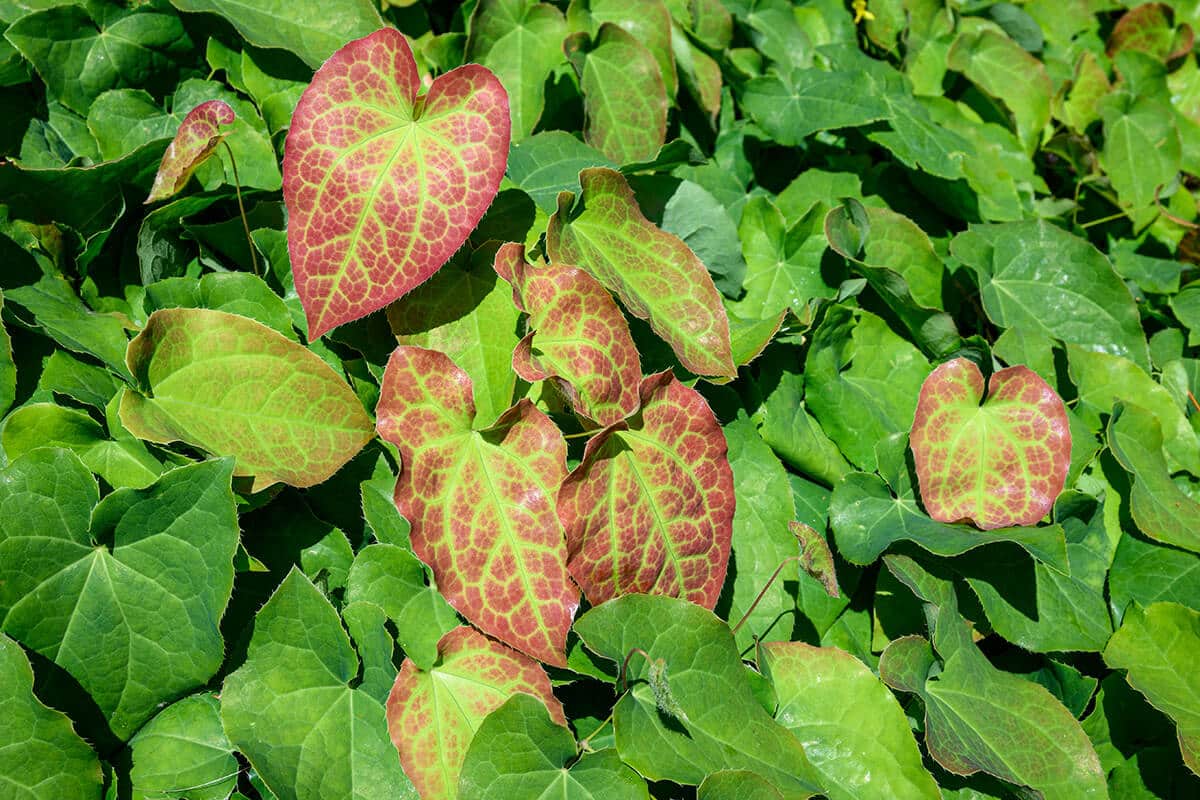
What is Epimedium, and which species are sold as horny goat weed?
Epimedium is a genus of perennial plants in the family Berberidaceae, and the herb sold as horny goat weed is the dried leaf. Several species carry the name, and they are not chemically interchangeable. The four most commonly traded are Epimedium sagittatum, Epimedium brevicornum, Epimedium koreanum, and Epimedium grandiflorum. Analytical work using pressurized liquid extraction and HPLC to measure 15 flavonoids across 26 Epimedium samples found the samples separated into three distinct clusters by flavonoid content, with wide variation between species (Chen et al., 2007, Journal of Chromatography A, PMID: 17606269).
That variation is the practical reason a label reading only “Epimedium” is an incomplete statement. Our team treats a missing species name as a sourcing question rather than a formatting oversight. The two we work with are Epimedium brevicornum, wild-harvested from the Qinling Mountains, and Epimedium sagittatum from Luotian County in Hubei province.
Icariin, the compound behind the research
Icariin is a prenylated flavonol glycoside and the most studied constituent of the genus. It is not the only one. Epimedin A, epimedin B, epimedin C, icariside II, and baohuoside I all appear in the leaf, and the four markers used for quality control of material sold as yin yang huo are epimedin A, B, C, and icariin together. When a study reports on Epimedium, it is usually reporting on icariin, and the concentration of that single compound is the number most supplement labels are describing when they print a percentage.
How icariin interacts with PDE5
Icariin inhibits phosphodiesterase type 5, the enzyme that breaks down cyclic guanosine monophosphate and therefore regulates smooth muscle relaxation and blood flow. This is the same enzyme target as prescription PDE5 inhibitors, which is the origin of most claims made about the herb.
The size of that effect is where most consumer articles stop short. In a study screening plant extracts against human recombinant PDE5A1, icariin showed an IC50 of 5.9 micromolar. Sildenafil, measured in the same assay, showed an IC50 of 74 nanomolar (Dell’Agli et al., 2008, Journal of Natural Products, PMID: 18778098). That is a difference of roughly 80-fold in potency. The same research group produced a synthetic icariin derivative that closed the gap almost entirely, which tells you the scaffold is pharmacologically interesting, and also that the naturally occurring compound in the leaf is not the potent version.
For a deeper treatment of the icariin and erectile function research, including the animal model data and the single human trial, our article on icariin and erectile function covers that ground in full. This page stays with the broader plant.
What are the main benefits of horny goat weed?
Traditional use is broad. Modern human evidence is narrow, and it is not strongest where the marketing is loudest. We have separated the two below rather than blending them, because the distinction is the most useful thing a reader can take from this section.
Supporting male vitality
This is the most common reason people seek the herb out, and it rests on the PDE5 mechanism described above plus a long record of traditional use. Most of the supporting research is laboratory work and animal models. Human trial evidence in this specific area remains limited, and honest sourcing means saying so.
Bone density and the postmenopausal research
The strongest human data for Epimedium is in bone, not in libido. A 24-month randomized, double-blind, placebo-controlled trial in 100 late postmenopausal women tested a daily dose containing 60 mg icariin alongside 15 mg daidzein and 3 mg genistein. Lumbar spine bone mineral density declined 2.4 percent in the placebo group over 24 months, while the treatment group held at plus 1.3 percent, and the bone resorption marker deoxypyridinoline fell 39 percent. Neither serum estradiol nor endometrial thickness changed measurably (Zhang et al., 2007, Journal of Bone and Mineral Research, PMID: 17419678).
A later randomized, double-blind, placebo-controlled trial in 58 postmenopausal women examined safety and pharmacokinetics of a purified Epimedium prenylflavonoid extract at 740 mg daily for six weeks, and reported higher levels of bone-specific alkaline phosphatase, a marker of bone formation (Yong et al., 2021, Phytomedicine, PMID: 34352588). Our dedicated article on Epimedium for women covers the menopause and bone question at full depth, including what these trials do and do not establish.
Other traditional uses
In Traditional Chinese Medicine, the herb appears in formulas addressed to fatigue, lower back weakness, and joint discomfort. These applications have far less clinical investigation behind them than the bone research and should be read as traditional context rather than as tested outcomes.
How does horny goat weed compare to other traditional libido botanicals?
People rarely evaluate this herb in isolation. It sits in a category of botanicals with overlapping reputations and completely different chemistry. The table below is an orientation tool, not a ranking. Each of these plants has its own research base, its own standardization conventions, and its own safety profile.
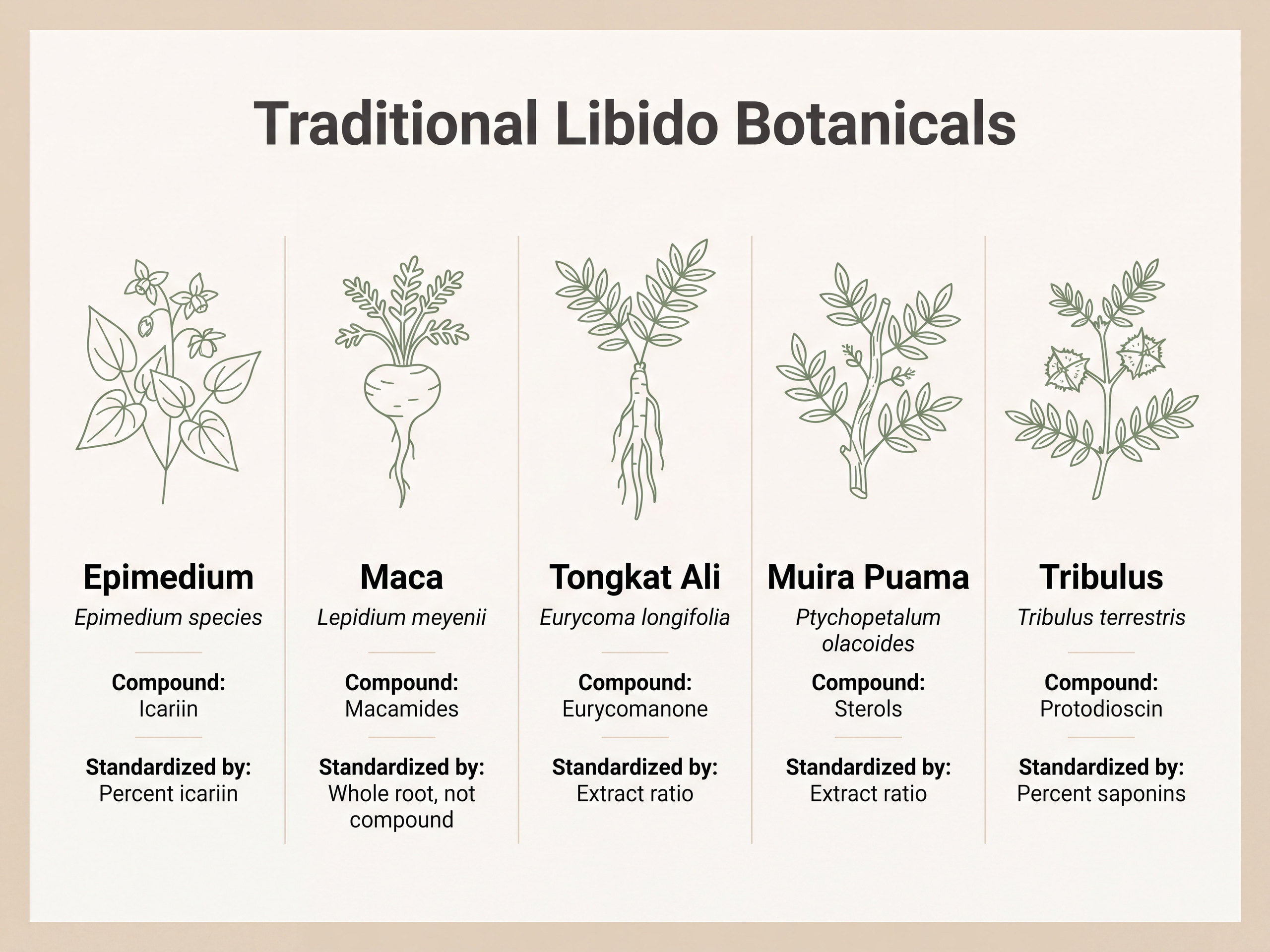
| Botanical | Primary compound class | Traditional use category | Typical standardization |
|---|---|---|---|
| Epimedium species | Prenylated flavonol glycosides (icariin) | Circulation and vitality support | Percentage icariin by weight of extract |
| Maca (Lepidium meyenii) | Glucosinolates and macamides | Energy and hormonal balance support | Usually sold as whole root, gelatinized or raw |
| Tongkat ali (Eurycoma longifolia) | Quassinoids (eurycomanone) | Male hormonal support | Extract ratio, sometimes eurycomanone percentage |
| Muira puama (Ptychopetalum olacoides) | Sterols and essential oils | Nervine and vitality support | Extract ratio, rarely compound-standardized |
| Tribulus (Tribulus terrestris) | Steroidal saponins (protodioscin) | Vitality and athletic support | Percentage saponins by weight |
The pattern worth noticing is the standardization column. Epimedium and Tribulus are conventionally sold against a named compound percentage. Maca and muira puama usually are not. That difference changes what a label can meaningfully promise, and it is why the next section matters more for this herb than it would for maca.
How much icariin should a quality supplement contain?
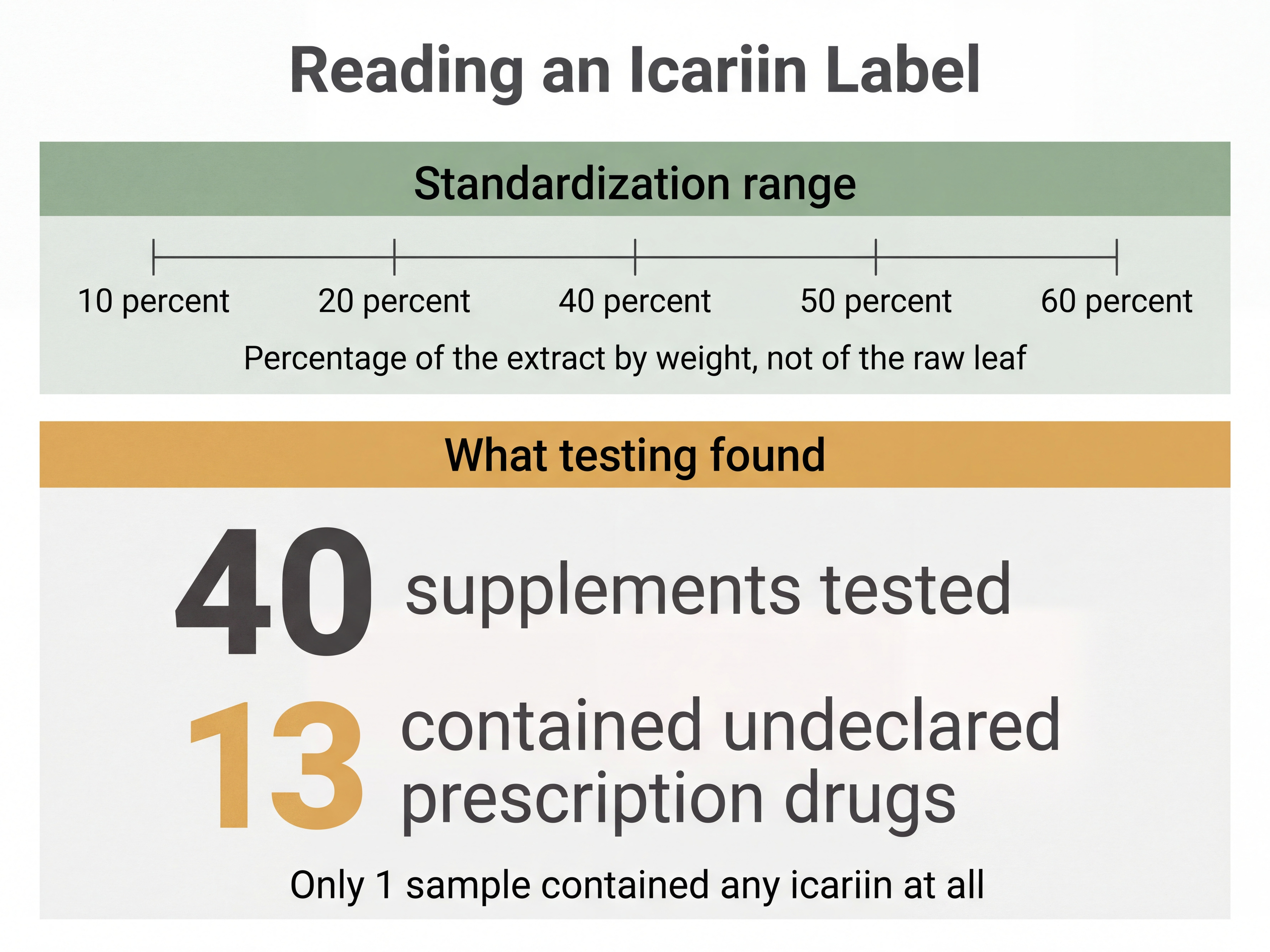
Commercial Epimedium extracts are typically standardized to 10, 20, 40, 50, or 60 percent icariin. That figure describes the proportion of icariin by weight of the finished extract, not of the raw leaf. Whole dried leaf powder sits far below those numbers naturally. A product that prints no percentage at all has told you nothing about its icariin content, and given the species variation described earlier, the genus name alone does not fill that gap.
Two findings from the analytical literature shape how our team reads this category.
The first concerns sampling. A quality control study on Epimedium pubescens and Epimedium brevicornu tested how many individual plants must be pooled before an assay result represents the batch. Measuring a single plant produced results that deviated substantially from the true value, and the deviation shrank as more individuals were pooled. The authors concluded that quality control sampling should use more than 10 individual plants, and that 50 or more gives a better representation of the material (Wang et al., 2009, China Journal of Chinese Materia Medica, PMID: 19639790). A certificate of analysis run on a thin sample is a weaker document than it appears.
The second concerns adulteration, and it is the reason we treat this category with more caution than most. A study analyzed 40 herbal supplements marketed for sexual performance using both a PDE-Glo bioassay and LC-MS/MS confirmation. Undeclared sildenafil was found in 10 samples, vardenafil in 2, and tadalafil in 1. Six of the supplements carried estimated daily intakes above 100 mg sildenafil equivalents. Only one sample in the entire set contained any icariin at all, at 0.013 mg per gram, a concentration far too low to account for the biological activity measured. Follow-up analysis of one supplement identified hydroxythiohomosildenafil, a sildenafil analogue that was not yet in the reference library used for screening (Akuamoa et al., 2022, Food Additives and Contaminants Part A, PMID: 35323088).
Read that last finding carefully. In a set of products sold on the strength of a botanical, the measured activity in the most potent samples came from undeclared pharmaceuticals rather than from the plant. That is the specific risk that a standardization percentage, third-party identity testing, and a named species are there to address.
How do you use horny goat weed?
Finding an appropriate dose
Doses used in research vary by preparation and by what is being measured. The 24-month bone trial described above used 60 mg icariin daily as part of a combined flavonoid preparation. The six-week safety and pharmacokinetic trial used 740 mg daily of a purified prenylflavonoid extract. These are different preparations answering different questions, and neither is a general recommendation. Start with the lowest dose suggested on the product label and observe the response before adjusting.
One pharmacokinetic detail deserves attention because it complicates the whole idea of dosing by icariin content. In the six-week trial, the compounds actually detected in participants’ serum were desmethylicaritin, icaritin, and icariside II. Icariin itself and icariside I were below detection limits, with desmethylicaritin the predominant metabolite (Yong et al., 2021, Phytomedicine, PMID: 34352588). The compound on the label is not the compound circulating in the blood. It is metabolized first.
Forms of the supplement
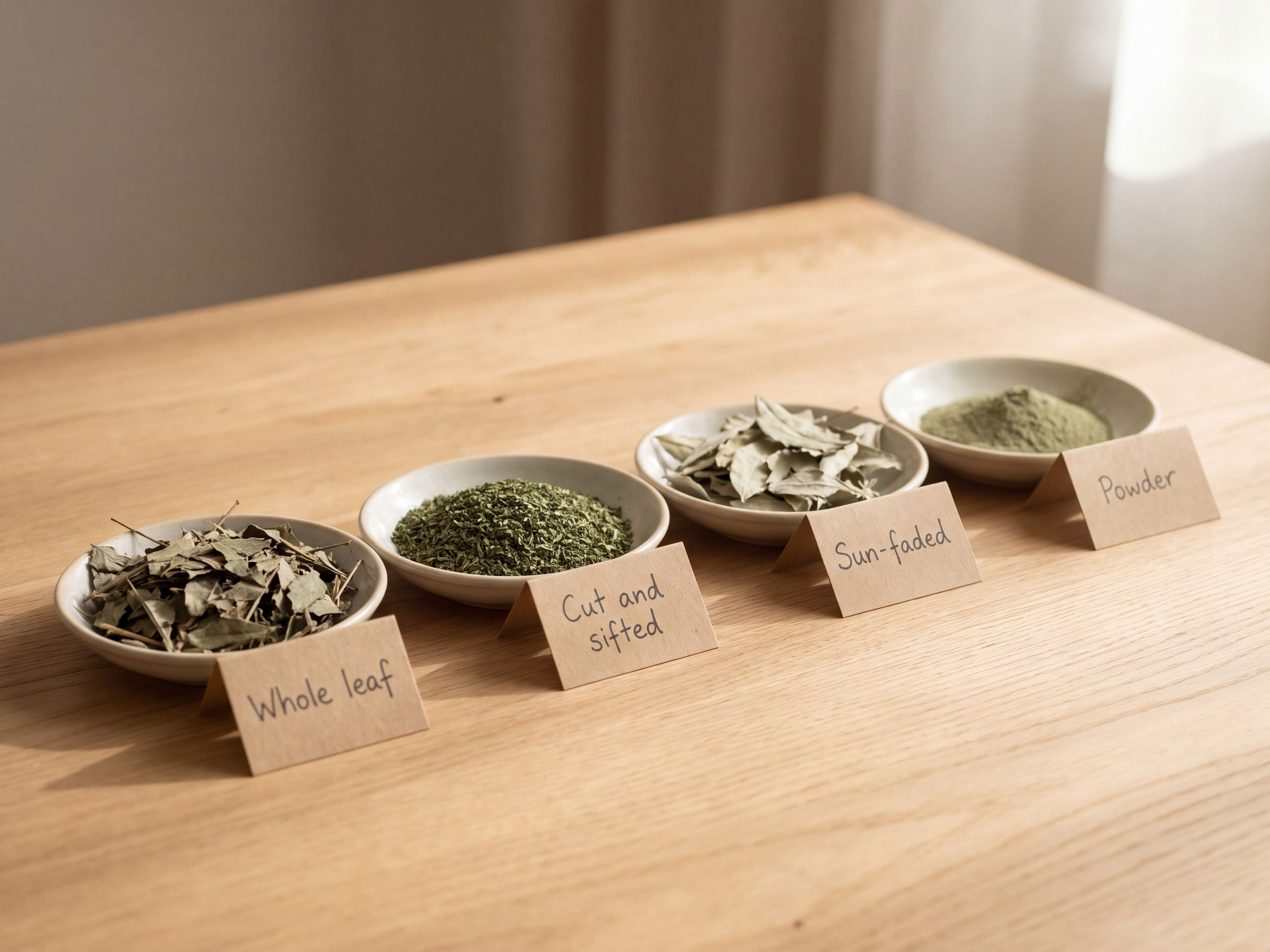
The herb is sold as whole leaf powder, as capsules, as standardized extract, and as tincture. Whole leaf powder gives you the full flavonoid profile at naturally occurring concentrations. Standardized extracts concentrate icariin to a stated percentage. Neither form is inherently better. They answer different purposes, and the extract form is the one where the percentage figure becomes meaningful.
Can it be combined with other supplements?
Traditional Chinese formulas rarely use yin yang huo alone, and combining botanicals is normal practice rather than an exotic risk. The specific caution with Epimedium is additive rather than exotic. Because icariin acts on a pathway that influences blood flow and blood pressure, stacking it with other circulation-supporting botanicals can compound that effect in ways neither product’s label anticipates. The same applies to stacking with anything affecting clotting.
Our practical guidance is to introduce one botanical at a time and hold it long enough to observe a response before adding another. A stack assembled all at once tells you nothing about which component did what, and if an adverse response appears, you have no way to identify the source.
What are the side effects of horny goat weed?
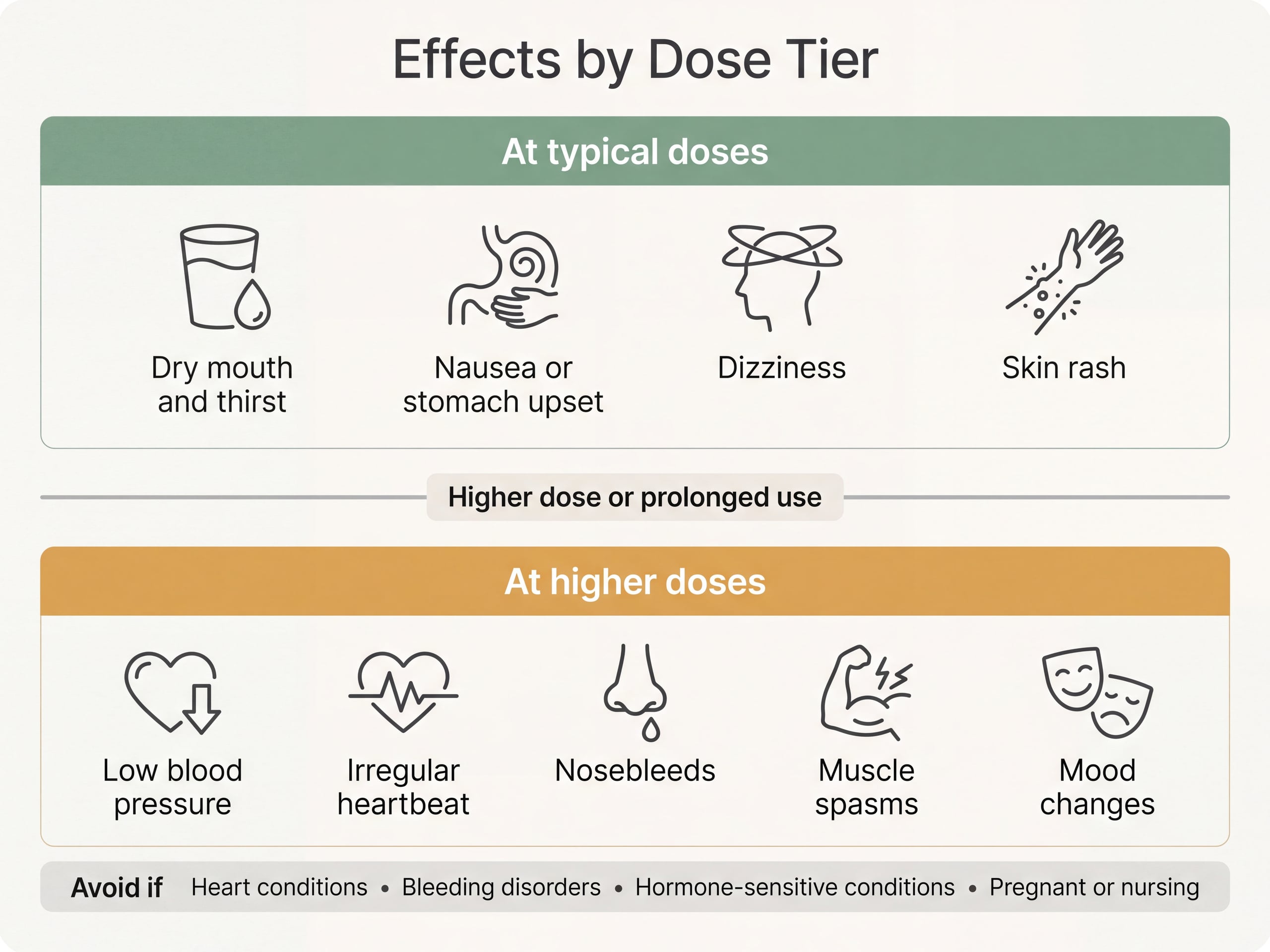
Reported effects separate into two tiers by dose and duration. That distinction is more useful than a single undifferentiated list, and it is missing from most consumer write-ups.
At typical doses and short-term use, commonly reported effects include:
- Dry mouth and increased thirst
- Nausea, vomiting, or general stomach discomfort
- Dizziness or vertigo
- Skin rash
At higher doses or with prolonged use, more serious effects have been reported:
- Low blood pressure
- Rapid, pounding, or irregular heartbeat
- Nosebleeds
- Muscle spasms and severe breathing difficulty
- Mood changes and irritability
The National Institutes of Health LiverTox database maintains a monograph on Epimedium, which is the reference our team points to for the clinical detail behind these listings.
Who should avoid it
Four groups have clear reasons to stay away from this herb entirely. People with heart conditions, because it can alter heart rhythm and lower blood pressure. People with bleeding disorders, because it may slow clotting. People with hormone-sensitive conditions, including breast and uterine cancers, because the phytoestrogen content raises a theoretical concern regardless of what the endometrial data in the bone trial showed. And anyone pregnant or nursing, where safety has not been established.
Medication interactions
Named drug classes with documented or mechanistically expected interactions include anticoagulants and antiplatelet drugs, antidepressants, blood pressure medications, and nitrates such as nitroglycerin. The nitrate interaction follows directly from the PDE5 mechanism and is the one to take most seriously. If you take prescription medication of any kind, this is a conversation to have with your prescriber rather than a risk to evaluate on your own.
Quality and sourcing considerations
Given the adulteration data above, the questions worth asking about any Epimedium product are narrow and specific. Which species is in the bottle? What percentage of icariin, measured against what? Whether identity and contaminant testing were performed by a third party. Whether the sampling behind the certificate of analysis was deep enough to represent the batch.
From our hands-on assessment of material across multiple growing regions, terroir shows up in the leaf before it shows up in the assay. Our Epimedium brevicornum is wild-harvested from the Qinling Mountains, and our Epimedium sagittatum comes from Luotian County in Hubei. Both are named on the label because the species is not a detail we consider optional. Readers wanting the whole herb can look at our Epimedium Sagittatum Powder, and those preferring a capsule format can look at our Horny Goat Capsules.
Frequently Asked Questions
How long does it take to notice effects?
Reports vary widely. Some people describe subtle changes within a few days of consistent use, while for others it takes several weeks. The action appears cumulative rather than acute. The bone research that produced measurable outcomes ran for 24 months, which is a useful reminder that the timeframes in the literature are far longer than the timeframes in the marketing.
Can it be taken every day?
Many traditional sources suggest cycling rather than continuous use, for example five days on followed by two days off. Continuous daily use over long periods has not been well characterized outside the clinical trial settings described above, and those trials used specific preparations under supervision.
Does horny goat weed work for women?
The strongest human evidence for Epimedium in any population is in postmenopausal women, and it concerns bone mineral density rather than libido. Our dedicated article on Epimedium for women covers this in full.
Is horny goat weed the same as icariin?
No. Horny goat weed is the plant material from Epimedium species. Icariin is one flavonoid compound within it, alongside epimedin A, B, C and several others. A supplement can contain the herb without containing a meaningful quantity of the compound.
What percentage icariin should I look for?
Commercial extracts commonly range from 10 to 60 percent icariin by weight of extract. The right figure depends on the preparation and purpose rather than on higher being better. What matters more is that a percentage is stated at all, that the species is named, and that third-party testing supports both claims.
Why do some horny goat weed supplements get recalled?
Adulteration with undeclared prescription PDE5 inhibitors is a documented problem in the sexual-performance supplement category. In one analysis of 40 such products, undeclared sildenafil, vardenafil, or tadalafil appeared in 13 samples, several at daily intakes exceeding 100 mg sildenafil equivalents (PMID: 35323088). Third-party testing and transparent sourcing are the practical defenses.
Does icariin work like prescription ED medication?
It acts on the same enzyme, at substantially lower potency. Laboratory measurement puts icariin roughly 80 times weaker than sildenafil against human PDE5A1 (PMID: 18778098). Mechanistic similarity is not equivalence, and the herb should not be approached as a substitute for prescribed treatment.
Related Reading
Continue with our articles on icariin and erectile function, Epimedium for women, and increasing male libido naturally for adjacent coverage of this topic.
Important: This article is for educational and informational purposes. The statements have not been evaluated by the Food and Drug Administration. The herbs and herbal products discussed are not intended to diagnose, treat, cure, or prevent any disease, including erectile dysfunction or osteoporosis. Information presented here is not a substitute for professional medical advice, diagnosis, or treatment. Always consult a qualified healthcare provider for medical guidance specific to your circumstances. Do not delay seeking medical care because of information you have read on this site.