Ageratum Conyzoides Capsules
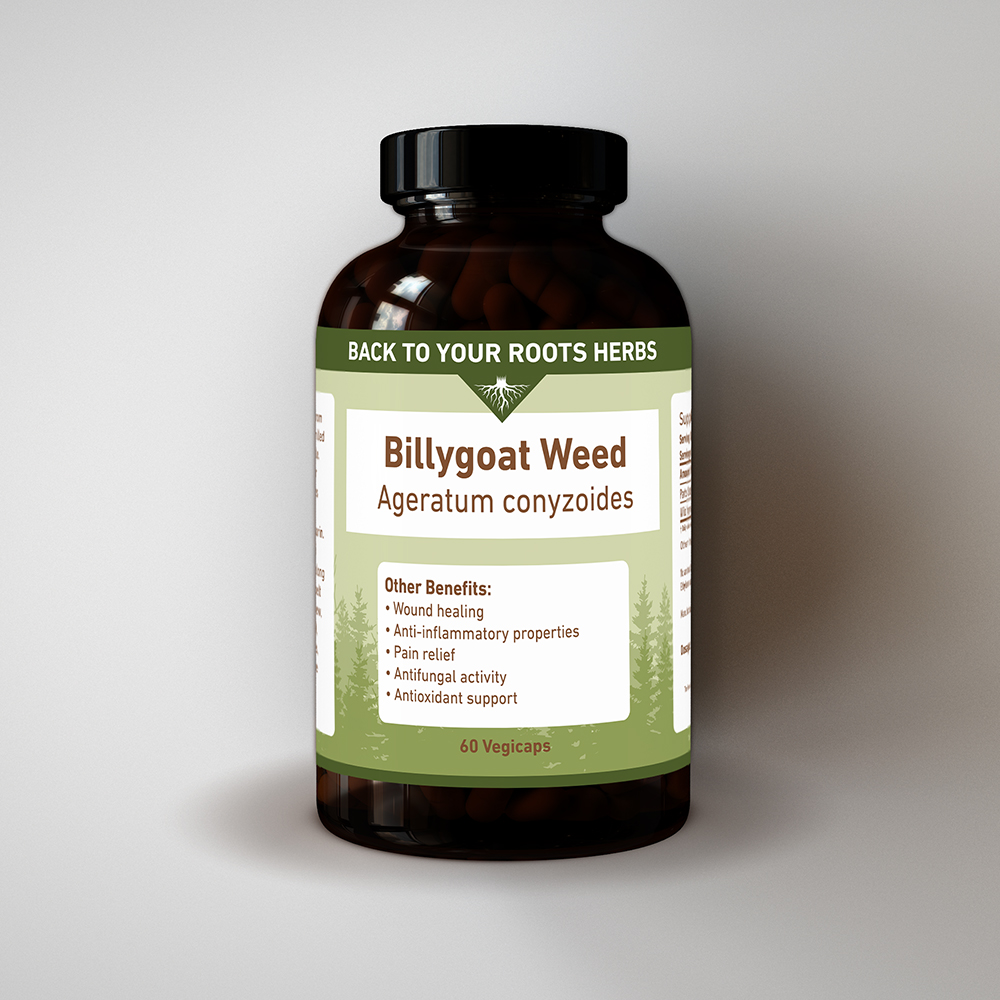
Ageratum conyzoides capsules hold the dried, milled leaf of Ageratum conyzoides L., a pantropical annual herb of the Asteraceae family that is native to tropical America and known as billygoat weed. Each 600 mg capsule is whole leaf powder, not an extract. The species contains pyrrolizidine alkaloids (PAs), so every lot is tested for them and released only when none are detected.
Back To Your Roots Herbs encapsulates this Ageratum conyzoides supplement in Virginia Beach, Virginia, from a traced lot of leaf grown in Ghana’s Ashanti Region, around Kumasi. We built this page the way we judge a herb ourselves. Identity first. Chemistry second. Safety in plain view.
- Identity: Goatweed or tropical whiteweed in English, family Asteraceae.
- Form: 60 vegetable capsules, each with 600 mg of whole leaf powder.
- Traditional use: West African, Brazilian, and Southeast Asian household herbalism.
- Safety: Contains PAs in nature. Not for pregnancy, nursing, liver conditions, or anyone under 18.
- Research: Mostly cell and animal studies of extracts. Human trials used standardized extracts, not whole leaf.
The Verdict: Internal Quality Score
Potency Score: 1:1 whole leaf in every capsule. Nothing is extracted, concentrated or standardized, so each capsule carries the leaf’s natural spread of polymethoxyflavones, chromenes and coumarin. This lot comes from Ghana’s Ashanti Region, where the plant grows wild along farm edges in the hot, humid forest belt around Kumasi. We release a lot only when its certificate of analysis shows heavy metals within limits and pyrrolizidine alkaloids not detected by LC-MS/MS.
– Back To Your Roots Herbs Research Group
Sensory Analysis: Billygoat Weed Leaf Powder
- Look: Fine, pale olive-green powder with lighter flecks from the hairy leaf surface. Even grind. No stems.
- Smell: Musky and sharp, with the goat-like note behind its common names: billy goat weed in English, catinga-de-bode in Brazilian Portuguese, and wedusan in Javanese.
- Taste: Open a capsule, and the raw powder hits bitter first, turns slightly astringent, then leaves an herbal musk at the back of the tongue.
What Is Ageratum Conyzoides (Billygoat Weed)?
This soft-stemmed annual of the sunflower family is native to tropical America and now spread across tropical and subtropical Africa, Asia, and beyond. Farmers call it a weed. Herbalists call it a medicinal plant. Both are right. Kato-Noguchi and Kato (2024) describe an invasive alien species with a short life cycle, early maturity, and prolific seed production, protected by its own secondary metabolites against insects and fungal pathogens.
Ageratum Conyzoides Herb: Identity, Genus and Common Names
The genus Ageratum holds at least 30 species in the tribe Eupatorieae. The species epithet conyzoides means “like Conyza,” another daisy-family genus. To identify the plant, look for opposite, oval, hairy leaves with round-toothed edges and small fuzzy flower heads in lavender, pale blue, or white. Crush a leaf, and you smell the goat. The garden floss flower, Ageratum houstonianum, looks similar but is a different species.
The plant is known by various local names: imi esu in Yoruba (Nigeria), mentrasto and catinga-de-bode in Brazil, bandotan in Indonesia, wedusan in Java, and rumput tahi ayam in Malaysia. The USDA PLANTS Database lists it as tropical whiteweed, and ITIS, Tropicos, and the NCBI Taxonomy database track its scientific name and classification.
How Do Ageratum Conyzoides Capsules Work?
- The Herb: Ageratum conyzoides leaf sourced from Ghana’s Ashanti Region (6.6885° N, 1.6244° W), dried and milled whole.
- The Mechanism: No human mechanism is established for the whole leaf. Lab work centers on its polymethoxyflavones and chromenes, defense compounds the plant makes against insects and fungi.
- The Evidence: Research by Faqueti et al. (2017) confirmed 27 compounds in a water extract of the ageratum plant, including coumarin, nobiletin and eupalestin, plus the toxic pyrrolizidine alkaloids. Twelve of them were new records for the species (PMID 29843205).
The capsule delivers the leaf as the plant made it. Nothing more.
Leaf Phytochemicals and Their Roles
Okunade’s 2002 review, Ageratum conyzoides L. (Asteraceae), lists alkaloids, flavonoids, chromenes, benzofurans, and terpenoids from the species. Two groups matter most to a capsule buyer.
Polymethoxyflavones, Chromenes and Coumarin
Nobiletin, 5′-methoxynobiletin, and eupalestin are polymethoxyflavones, flavonoids that carry several methoxy groups. The chromenes precocene I and II block juvenile hormone production in insects (Kato-Noguchi and Kato 2024). Coumarin, the sweet-hay aroma compound also found in cassia cinnamon, is one of the quantified markers. European food rules cap coumarin because large intakes can strain the liver in sensitive people.
Pyrrolizidine Alkaloids: Lycopsamine and Echinatine
Wiedenfeld and Röder (1991) isolated the pyrrolizidine alkaloids lycopsamine and echinatine from the plant. Bosi et al. (2013) later found lycopsamine, dihydrolycopsamine, and acetyl-lycopsamine, with their N-oxides, in medicinal tea sold in Brazil. A 2024 study even traced PAs in stingless bee honey back to the weed growing near the hives (Hungerford et al. 2024). In people, the liver converts PAs into reactive compounds that can injure it with repeated intake (Wiedenfeld 2011).
Traditional Uses of Ageratum in Africa, Brazil and Asia
Traditional use is recorded history, not clinical proof. We report it by region, with sources, and make no treatment claims for these capsules.
West Africa: Imi Esu
Yoruba herbalists in Nigeria know the plant as imi esu. In African traditional medicine, it serves as a home digestive preparation and as a dressing applied to the skin (Diallo et al. 2014).
Brazil: Mentrasto and Catinga-de-Bode
Brazilians call the plant mentrasto or catinga-de-bode, and its leaf tea is a long-standing folk preparation. ANVISA, Brazil’s health regulator, lists the species among its medicinal crude drugs. Even so, Bosi et al. (2013) found PAs in commercial Brazilian teas.
Asia: Bandotan, Wedusan and Ayurveda
In Indonesia, the plant is bandotan, and in Java it is wedusan, from wedus, goat. Indonesian researchers Kotta, Lestari and colleagues (2020) review bandotan’s chemistry and its pharmaceutical formulation research.
Is it an official Ayurvedic herb? No. The plant reached South Asia from the Americas long after the classical texts, so the Charaka Samhita never mentions it. Modern Ayurvedic knowledge bases that give Ageratum a dravya profile (rasa, guna, vipaka, karma) offer recent interpretation, not classical Ayurveda.
Critical Usage: Ageratum Conyzoides Capsule Dosage and Side Effects
The risks are real, and the human data are thin, so this section comes before the specs.
Suggested Use for Ageratum Conyzoides Capsules
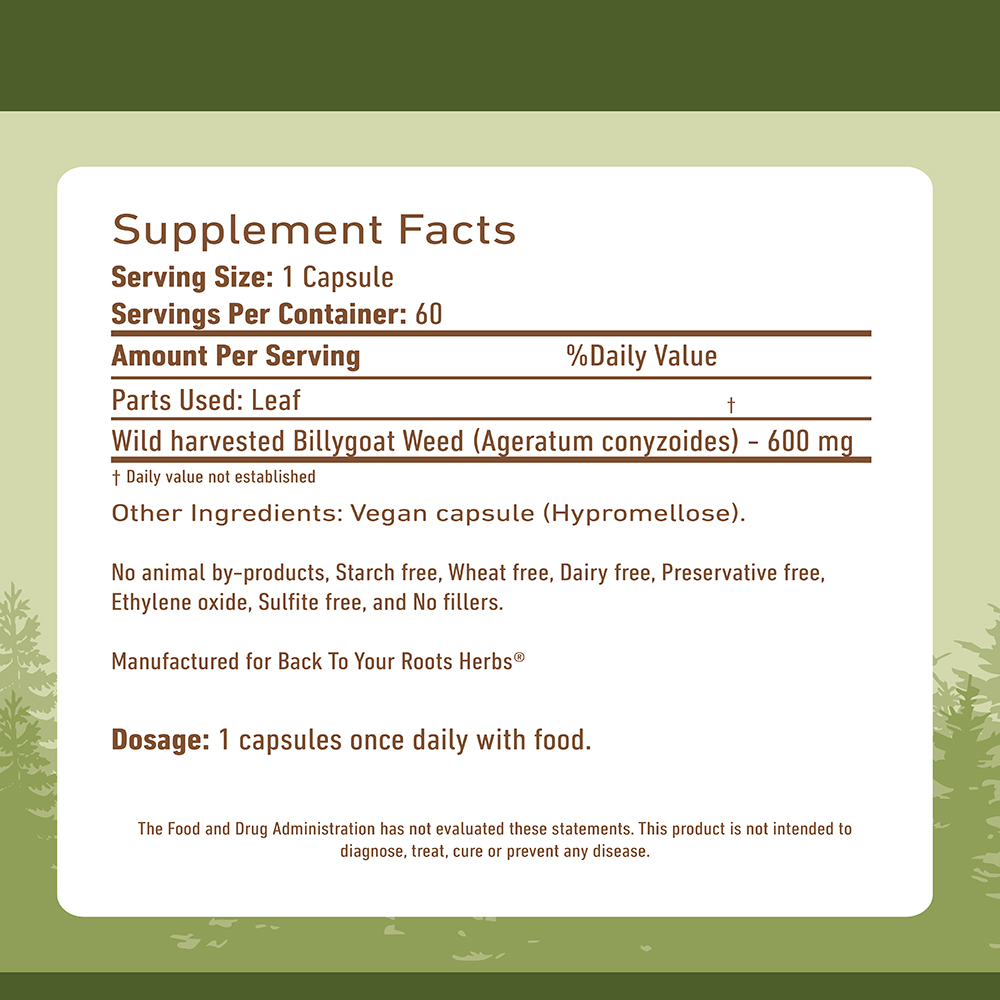
Take 1 capsule (600 mg) once a day with food and a full glass of water. Use it for up to 4 weeks, then stop for at least 2 weeks. Do not exceed the label serving. No clinical dose exists for whole Ageratum leaf, so more is not better. Ask your healthcare provider before you start.
Is Ageratum Conyzoides Toxic to the Liver?
The plant contains pyrrolizidine alkaloids, and the answer depends on the preparation and its PA content. In rats, a hydroalcoholic leaf extract given for 90 days at 500 and 1000 mg/kg raised the liver enzymes ALT, AST, and ALP, enlarged the liver, spleen, and kidneys, and caused anemia. The authors tied these side effects to the plant’s PAs (Diallo et al. 2014).
A Brazilian 90-day rat study at 250 and 500 mg/kg found no treatment-related changes in blood chemistry (Moura et al. 2005). An ethanolic extract developed as a food ingredient caused no toxic changes in rats at up to 2000 mg/kg a day for 90 days (Palmer et al. 2019). Different preparations, different results. Does every ageratum extract carry the same toxicity? No. That is why we test the lot itself. FDA’s position since 2001 is that a dietary supplement containing any source of pyrrolizidine alkaloids is adulterated, so a lot ships only when testing finds none.
Who Should Not Take These Capsules
- Anyone pregnant, trying to conceive, or breastfeeding
- Children and teens under 18
- Anyone with liver disease, past liver problems, or raised liver enzymes
- Anyone who drinks alcohol daily
- Anyone taking other PA-containing herbs such as comfrey, borage or coltsfoot
Medicines to Review With Your Pharmacist
We found no published drug interaction study for this herb. As a precaution, ask a pharmacist before you combine it with any daily prescription drug, especially:
- Medicines that are hard on the liver, such as acetaminophen, statins, and some antiretrovirals
- Blood thinners such as warfarin
- Medicines that change how the liver processes other drugs
Stop Use and Call Your Doctor If You Notice
- Yellowing of the skin or eyes
- Dark urine or pale stools
- Pain or swelling under the right ribs
- Unusual tiredness, nausea, or loss of appetite
Ageratum Conyzoides Capsules Clinical Specs
| Spec | Detail |
|---|---|
| Serving Size | 1 Capsule (600 mg Whole Leaf Powder) |
| Frequency | Once daily with food, up to 4 weeks, then a 2-week break |
| Active Marker | Polymethoxyflavones (nobiletin, eupalestin) and coumarin, naturally present, not standardized |
| Processing | Dried whole leaf, milled to powder (no extraction, no heat concentration) |
| Safety | Heavy Metal Tested (Pass), Pyrrolizidine Alkaloids Not Detected (LC-MS/MS, lot COA) |
| Ingredients | Ageratum conyzoides (Billygoat Weed) Leaf Powder |
| Other Ingredients | Vegetable Cellulose (Capsule) |
| Purity | Non-GMO, Vegan |
| Free From | Wheat, Gluten, Soy, Dairy, Binders, Fillers |
| Origin | Kumasi, Ashanti Region, Ghana (6.6885° N, 1.6244° W) – Specified Terroir |
| Manufactured | Virginia Beach, VA, USA |
Comparison Table: Whole Leaf vs Generic Ageratum Conyzoides Extract
| Feature | BTYRH Ageratum Conyzoides Capsules | Generic Imported Extract |
|---|---|---|
| Origin | Ashanti Region, Ghana, traced lot | Unspecified |
| Preparation | 600 mg whole leaf powder, nothing removed or concentrated | Solvent extract of unstated strength and plant part |
| Taste | Bitter, slightly astringent, musky goat note | Flat, processed |
| Safety | Heavy metals and PAs tested on every lot (COA) | Unknown/Untested |
Imported marketplace ageratum capsules rarely state fill weight, plant part, or PA status. Commercial alkaloid-free Ageratum extracts, like the powder Gencor researchers tested in rats (Subah et al. 2020), remove the PAs on purpose and concentrate selected compounds. They are a different product from whole leaf.
Frequently Asked Questions
Is an Ageratum Conyzoides Extract Stronger Than Whole Leaf?
Stronger is the wrong measure. An Ageratum conyzoides extract concentrates some compounds and drops others, depending on the solvent. Our capsules hold whole leaf in each capsule at 1:1, so lot testing, not processing, controls PA exposure.
Is Billygoat Weed the Same as Horny Goat Weed?
No. Billygoat weed is Ageratum conyzoides, a member of the daisy family. Horny goat weed is Epimedium, a genus in the barberry family (Berberidaceae) used in Chinese herbalism. The two share the word goat and nothing else. If you came for Epimedium, see our Horny Goat Capsules or our horny goat weed guide.
Can I Take It While Pregnant or Breastfeeding?
No. There are no human safety data for Ageratum in pregnancy or nursing, and pyrrolizidine alkaloids are a recognized liver hazard. The prenatal study we found tested an alkaloid-free extract in rats (Subah et al. 2020), which says nothing about whole leaf powder.
Can I Take These Capsules Every Day?
Only in short courses: 1 capsule a day for up to 4 weeks, then at least 2 weeks off. PA harm builds with repeated intake.
References and research databases
- Faqueti et al. (2017), J Pharm Biomed Anal 145:621-628, PMID 29843205 (DOI)
- Wiedenfeld and Röder (1991), Planta Med 57(6):578-579, PMID 17226207
- Bosi et al. (2013), Rev Bras Farmacogn 23(3):425-432, DOI 10.1590/s0102-695×2013005000028
- Wiedenfeld (2011), Food Addit Contam Part A 28(3):282-292, PMID 21360374
- Diallo et al. (2014), J Ethnopharmacol 155(2):1214-1218, PMID 25048610
- Moura et al. (2005), Phytomedicine 12(1-2):138-142, PMID 15693721
- Palmer et al. (2019), Regul Toxicol Pharmacol 103:140-149, PMID 30684565
- Subah et al. (2020), Regul Toxicol Pharmacol 117:104748, PMID 32800848
- Kato-Noguchi and Kato (2024), Molecules 29(19):4673, PMC11478290
- Okunade (2002), Fitoterapia 73(1):1-16, PMID 11864757
- Kotta, Lestari et al. (2020), Scientifica 2020:6420909, PMC7578719
- Hungerford et al. (2024), Toxins 16(1):40, PMID 38251258
- US Food and Drug Administration (2001), advisory on comfrey and other sources of pyrrolizidine alkaloids (FDA archive)
- USDA Dr. Duke’s Phytochemical and Ethnobotanical Databases: Ageratum conyzoides
- CABI Compendium: species datasheet
- PFAF Plant Database: plant record. Its Known Hazards field reads “None known,” which the PA research above contradicts.
- Google Scholar: current research search
This page was reviewed by the Back To Your Roots Herbs Editorial Team. Last Reviewed: November 2026.
DISCLAIMER: These statements have not been evaluated by the Food and Drug Administration. This product is not intended to diagnose, treat, cure, or prevent any disease. Consult your healthcare provider before use, especially if you are pregnant, nursing, taking medication, or managing a liver condition. Keep out of reach of children.
Reviews
There are no reviews yet.