The world of tropical plants offers a vast array of unique and beneficial species, and among them stands Aegle marmelos, commonly known as Bael. This distinctive fruit, also called Stone Apple or Bengal Quince, holds significant cultural importance, particularly in India, and is valued for both its unique culinary applications and its long history in traditional medicine systems. Understanding this remarkable fruit involves looking at the tree it grows on, its unusual characteristics, how it’s used, and the traditional knowledge surrounding its benefits.
What is Bael Fruit? Understanding Aegle marmelos
To appreciate the Bael fruit, it helps to understand the plant itself and the specific features that make the fruit stand out.
The Bael Tree: Characteristics and Habitat
The Bael fruit grows on a deciduous tree, Aegle marmelos, which typically reaches moderate heights of up to 12-15 meters. Native to the Indian subcontinent and Southeast Asia, these trees are known for their slow growth and resilience. The trunk is often stout, covered in bark that can range from soft and corky to thicker and harder as the tree ages. Sharp thorns, about an inch long, are commonly found along the branches. The leaves are compound, usually trifoliolate (three leaflets), and possess a distinct aroma when crushed, reminiscent of citrus, as the plant belongs to the Rutaceae family, the same family as oranges and lemons. This hardy tree thrives in tropical and subtropical climates, often found growing wild in dry forests and cultivated in home gardens and temple compounds across India and neighboring regions.
The Bael Fruit: A Unique Exterior and Interior
The fruit itself is quite unusual. It’s typically spherical or slightly pear-shaped, ranging in size from 5 to 15 cm in diameter, comparable to a large grapefruit. Its most defining feature is its incredibly hard, woody shell, which starts green and ripens to a yellowish or greyish hue. This shell is notoriously difficult to crack open, often requiring a hammer or machete.
Inside this protective casing lies the aromatic pulp. The pulp is dense, fibrous, and typically orange-yellow in color. Embedded within the pulp are numerous hairy seeds, each encased in a slimy, transparent mucilage. The texture of the pulp is pasty and somewhat sticky due to this mucilage.
Distinctive Taste and Aroma
The flavor profile of Bael fruit is complex and often considered an acquired taste. Ripe pulp is generally sweet but carries unique resinous, tangy, and aromatic undertones, sometimes described as having hints of marmalade or tamarind. The aroma is equally potent and fragrant. Unripe Bael fruit, conversely, is highly astringent due to its tannin content. People often ask how ripe bael actually tastes compared to fruits they already know. In our tasting notes, the ripe pulp is sweet, dense, and aromatic, closer to a thick fruit preserve than to a juicy fresh fruit. The flavor is frequently compared to marmalade, which is one reason Aegle marmelos picked up the old name Bengal quince, carrying warm resinous notes that many people liken to roasted dates, dried tamarind, or honey with a faint musky edge. The texture is what sets it apart from most tropical fruits. Rather than crisp or watery, the pulp is sticky and slightly grainy around hard seeds, which is why it is so often strained into the cooling drink known as bael sharbat rather than eaten in neat slices.
Origin and Global Presence
Native primarily to India, Aegle marmelos trees are found throughout Southeast Asia, including Sri Lanka, Thailand, Malaysia, and Vietnam. Due to its cultural significance and uses, it has been introduced to other tropical regions, although it remains less common globally compared to more commercially widespread fruits. It holds a special place in Hindu traditions, where the tree and its leaves are considered sacred and often used in religious rituals, particularly associated with Lord Shiva.
Spiritual and Cultural Significance
Few fruit trees carry the religious weight that the bael tree holds across the Indian subcontinent. In Hindu tradition, the tree is sacred to Lord Shiva, and its trifoliate leaf, the bilva patra, is one of the most important offerings in his worship. The three leaflets are widely understood to represent a trinity, read variously as the three eyes of Shiva, the three gunas, or the trident he carries. Devotees offer bilva leaves at Shiva temples throughout the year and especially during the festival of Maha Shivaratri.
The Sanskrit name Bilva, along with regional forms such as Vilvam in Tamil, appears in classical texts that predate most written botanical records, which is part of why mature bael trees are so often found in temple compounds rather than commercial orchards. The fruit and leaf are also linked in folk tradition to the goddess Lakshmi and to ideas of prosperity and purification. In our reading of the ethnobotanical record, this sacred status is one reason the plant was protected, propagated, and carried across regions for centuries, long before its culinary or wellness uses were formally catalogued.
Is Bael Fruit Edible? Culinary Uses and Preparation
Yes, the pulp of the Bael fruit is edible, though the preparation requires getting past the formidable shell. It’s consumed both fresh and in various traditional preparations, particularly during hot weather.
Eating Bael Fruit Fresh
Once the hard shell is cracked (carefully, to avoid injury), the fibrous pulp can be scooped out. The seeds and the surrounding mucilage are often discarded, although the mucilage itself is edible. Due to its intense flavor and fibrous nature, the fresh pulp is frequently mixed with a little water, sugar, or jaggery to make it more palatable before eating.
Traditional Culinary Preparations (Focus on Fresh Pulp)
The Bael fruit pulp is a key ingredient in several traditional recipes, especially in the Indian subcontinent.
Bael Sharbat: A Refreshing Indian Drink
Perhaps the most popular use is Bael Sharbat (or Sherbet). This cooling summer beverage is made by soaking the fresh pulp in water, then mashing and straining it to remove fibers and seeds. The resulting liquid is typically sweetened with sugar or jaggery and sometimes flavored with roasted cumin powder, black salt, or cardamom. It’s valued not just for refreshment but also for its perceived digestive properties.
Bael Murabba: A Sweet Preserve
Bael Murabba is a traditional Indian preserve. Pieces of unripe or semi-ripe Bael fruit (sometimes after boiling to soften slightly) are slowly cooked in a thick sugar syrup until they become tender and translucent. This preserve can be stored for longer periods and is often consumed in small quantities, which is traditionally believed to aid digestion.
Other Food Uses
Beyond sharbat and murabba, the pulp can be used to make jams, jellies, puddings, or blended into smoothies. In some areas, like Thailand, the young, tender leaves and shoots of the Bael plant are occasionally eaten as vegetables. The Aegle marmelos fruit lends itself well to preparations where its unique aroma and flavor can be appreciated.
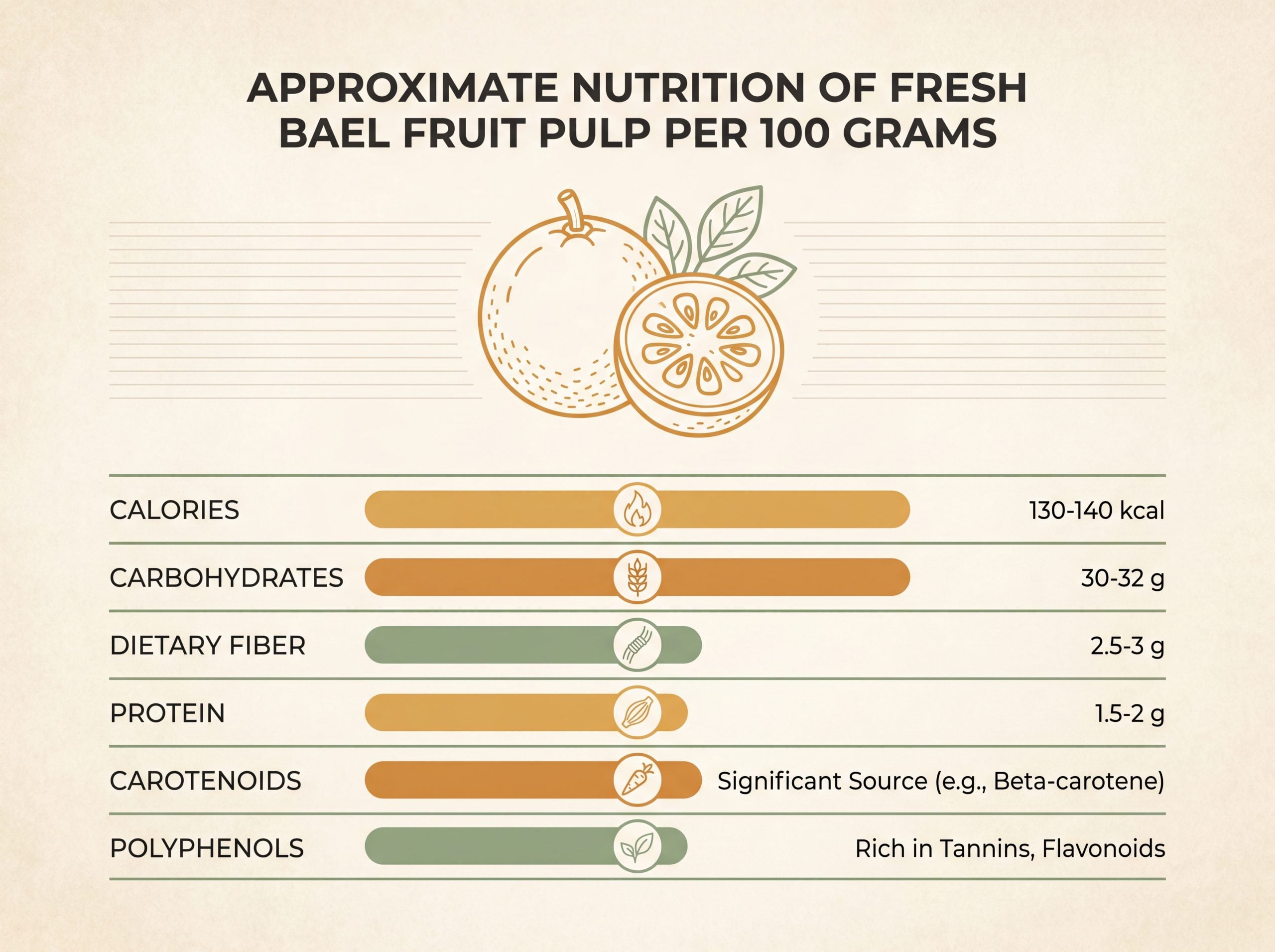
Nutritional Profile of Fresh Bael Fruit Pulp
The fresh pulp of Bael fruit offers a source of energy, fiber, vitamins, and minerals. While nutritional values can vary based on ripeness, growing conditions, and specific variety, a general profile for 100 grams of fresh Bael pulp is approximately:
| Nutrient | Approximate Amount per 100g | General Significance |
|---|---|---|
| Calories | 80-140 kcal | Energy source |
| Carbohydrates | 28-32 g | Primary source of energy |
| Dietary Fiber | 2-3 g | Supports digestion, promotes satiety |
| Protein | 1.5-2.5 g | Building blocks for tissues |
| Fat | 0.2-0.4 g | Minimal fat content |
| Vitamin C | 8-15 mg | Antioxidant supports immune function |
| Beta-carotene | Moderate amounts | Precursor to Vitamin A (vision, immunity) |
| Riboflavin (B2) | Significant amounts | Energy metabolism, cell function |
| Thiamine (B1) | Present | Energy metabolism, nerve function |
| Calcium | 80-90 mg | Bone health |
| Potassium | 500-600 mg | Blood pressure regulation, muscle function |
| Phosphorus | 50-60 mg | Bone health, energy transfer |
(Note: Values are approximate and gathered from various sources. Fresh fruit nutrition can differ from dried or powdered forms.)
The presence of dietary fiber and mucilage contributes significantly to its traditional use in digestive health. The vitamin and mineral content adds to its overall nutritional contribution. In our editorial review of the published literature, the nutritional value of bael is tied closely to its fiber and plant compounds rather than to any single nutrient. A 2021 critical review of Aegle marmelos in Critical Reviews in Food Science and Nutrition catalogued the fruit’s carbohydrates, dietary fiber, carotenoids, and polyphenols, and connected its traditional food applications to that compound profile (PMID: 33159390). The ripe pulp is also a notable source of mucilage and pectin, the soluble fibers that give bael sharbat its characteristic body and that sit behind much of the fruit’s traditional reputation.
Traditional Medicinal Significance and Potential Health Aspects
Aegle marmelos holds a revered position in traditional medicine systems, particularly Ayurveda, Siddha, and folk medicine practices across South Asia. Different parts of the plant, including the fruit (ripe and unripe), roots, bark, and leaves, have been used for centuries.
Role in Ayurveda and Traditional Systems
In Ayurveda, Bael is known as ‘Bilva’ or ‘Vilvam’. It’s considered a sacred tree and highly valued for its medicinal properties. It’s often described as having properties that can help balance the three Doshas (Vata, Pitta, Kapha), particularly Kapha and Vata. Traditional texts describe various preparations using Bael for a range of ailments.
Digestive Health Support: A Primary Traditional Use
The most well-documented traditional use of Bael fruit relates to digestive health. Interestingly, it’s used for seemingly opposite conditions depending on its ripeness:
- Unripe or Half-Ripe Bael: The pulp (often dried into a powder or used in decoctions) is astringent due to its high tannin content. Traditionally, it’s widely used to manage diarrhea, dysentery, and other conditions involving loose stools. The astringency is thought to help bind stools and reduce irritation in the digestive tract.
- Ripe Bael: The sweet, mucilaginous pulp of the ripe fruit is considered a natural laxative. The fiber and mucilage are believed to help bulk up stool, retain water, and ease bowel movements, making it traditionally useful for constipation. Bael Sharbat is often consumed for this purpose.
The digestive reputation of bael is one of the better studied aspects of the plant in preclinical research. Laboratory work on unripe bael fruit has examined the antidiarrhoeal activity that traditional systems describe, attributing part of the effect to the fruit’s tannins and mucilage and to its influence on gut bacteria and enterotoxins (PMID: 19930633). Related animal research has looked at the gastroprotective and antidiarrhoeal properties of unripe fruit extract (PMID: 16281828). This evidence is preclinical and traditional rather than confirmation from human clinical trials, so bael is best understood as a food traditionally used to support digestive comfort rather than as a remedy for any condition.
Other Traditional Medicinal Applications
Beyond digestion, various parts of the Bael plant, especially the fruit and leaves, have been used traditionally for other purposes:
Antimicrobial and Antiparasitic Considerations
Traditional practices use Bael fruit extract and leaf preparations against certain bacterial, fungal, and parasitic infections. Compounds like tannins and marmelosin (a furanocoumarin found in the fruit) are thought to contribute to these properties.
Anti-inflammatory Properties in Tradition
Bael is traditionally believed to possess anti-inflammatory qualities. Preparations involving the fruit or leaves have been used historically to address inflammatory conditions.
Perspectives on Blood Sugar Levels
Some traditional systems suggest that parts of the Bael plant, including leaf extracts, might help in managing blood sugar levels. However, scientific evidence in humans is limited, and caution is advised, especially for individuals with diabetes.
Respiratory Comfort and Cooling Effects
The fruit pulp and leaf decoctions have been used traditionally for respiratory issues like coughs, colds, and asthma. The cooling effect attributed to Bael Sharbat also makes it popular in hot climates for general well-being.
Traditional Skin Applications
Poultices made from Bael leaves or applications of the fruit pulp have been used traditionally for skin conditions like rashes, itching, or minor wounds.
Disclaimer: The information provided regarding traditional medicinal uses is for educational purposes only. It is not intended as medical advice. Many of these uses are based on centuries of practice but may lack extensive validation through modern clinical trials. Always consult with a qualified healthcare professional before using any herbal remedy, especially if you have underlying health conditions, are pregnant or breastfeeding, or are taking other medications.
Beyond the Pulp: Other Uses of the Aegle marmelos Plant
The value of the Aegle marmelos plant extends beyond its fruit pulp:
- Leaves: Sacred in Hinduism, used in religious offerings. Also used in traditional medicine.
- Shell: The hard, durable shell is sometimes cleaned and used as a container, cup, or craft item. It can also serve as fuel.
- Seeds: While often discarded, seeds might have limited use in some traditional practices.
- Bark and Root: Used in various Ayurvedic and folk medicine preparations.
- Gum: A gum or mucilage obtained from the tree trunk has been used as a natural adhesive.
How to Grow a Bael Tree (Aegle marmelos) at Home
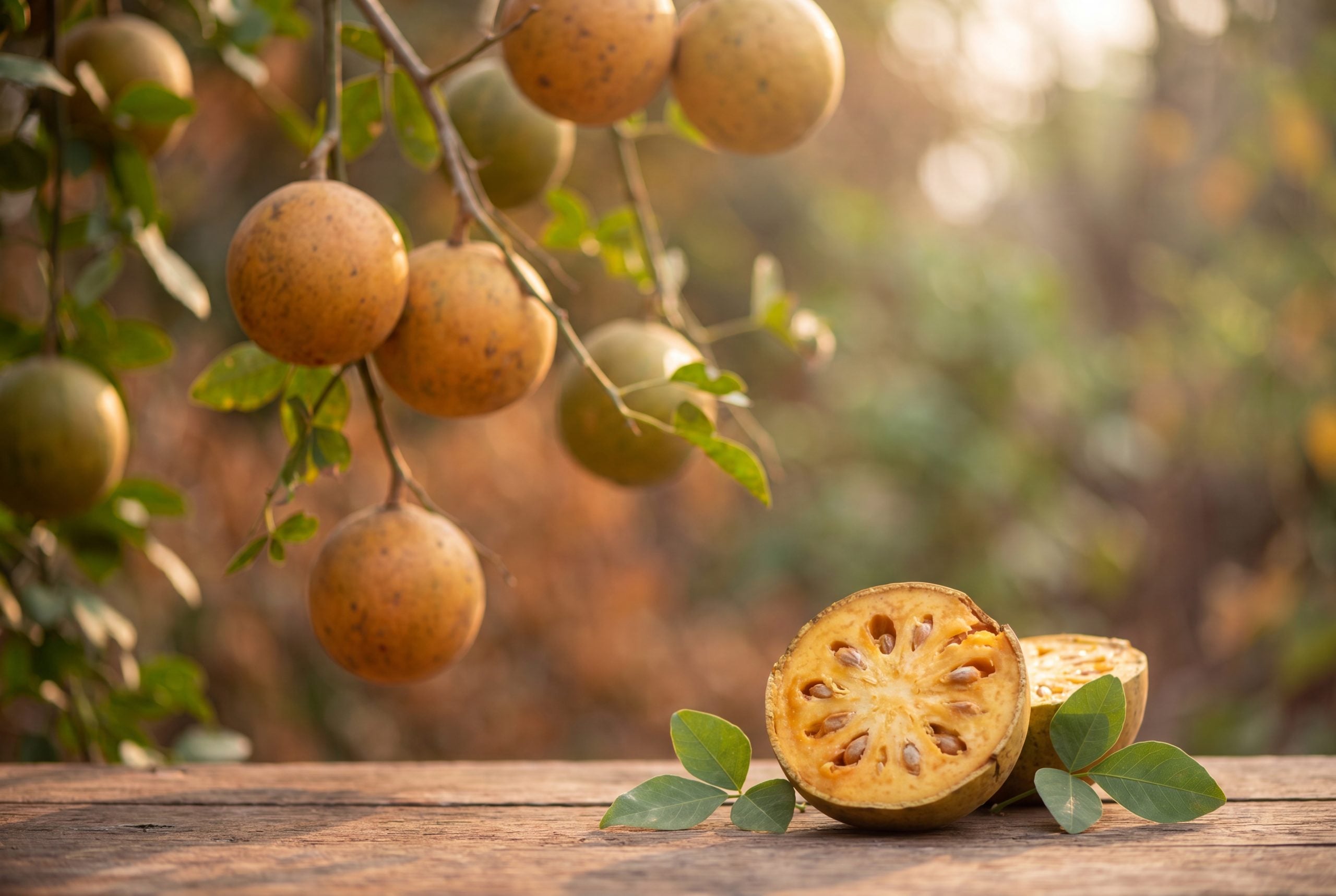
One of the most common questions about Aegle marmelos is whether it can be grown at home, and the answer depends almost entirely on climate. Bael is a hardy, deciduous, subtropical-to-tropical tree that tolerates conditions many fruit trees cannot, including poor, dry, alkaline, and even mildly saline soils. It does best in regions with a distinct dry season and handles drought well once established. In our sourcing experience, the healthiest trees grow where summers are long and hot and winters stay dry rather than wet.
Gardeners propagate bael in two main ways. Seeds germinate readily from fresh ripe pulp, but seedling trees are slow and can take seven to eight years or more to fruit, and they do not always come true to the parent. Vegetative methods such as root cuttings, budding, and grafting are preferred for reliable fruit and a shorter wait, often around four to five years. A young tree needs full sun, deep and well-drained soil or a large container, and steady warmth while it is establishing.
Cold tolerance is the main limit for home growers. Mature, dormant bael trees tolerate light frost, but young trees are sensitive, so the tree is reliable outdoors only in roughly USDA zones 10 and 11 and is marginal in zone 9 with winter protection. In cooler climates, it can be grown in a large pot that moves into a greenhouse or bright indoor space for winter, though fruiting indoors is uncommon. Because the tree is deciduous, expect it to drop its trifoliolate leaves during the dry or cool season. That is normal and not a sign of poor health.
Finding, Selecting, and Handling Bael Fruit
Finding fresh Bael fruit outside its native regions can be challenging. Look for it in Indian or Southeast Asian grocery stores or specialty tropical fruit markets, particularly during its fruiting season (typically late spring to summer).
When selecting, look for fruits that are heavy for their size, without cracks in the hard shell. Ripeness can be tricky to judge; a slight yellowish tinge (depending on variety) might indicate ripeness, but the shell remains very hard.
Handling requires care due to the extremely tough shell. The most common method to open it is to strike it firmly and repeatedly against a hard surface or use a heavy object like a hammer or the back of a sturdy knife (with extreme caution) to crack the shell open. Once open, scoop out the pulp and discard the seeds if desired. Fresh bael can be difficult to find outside its native growing regions, since the hard-shelled fruit is seasonal and does not ship as easily as softer tropical fruits. When fresh fruit is out of reach, shelf-stable forms preserve much of the pulp’s fiber and aromatic compounds. Our team offers traditionally prepared bael fruit powder made from the dried pulp, along with bael capsules for those who prefer a measured serving. Both are practical ways to keep bael on hand year-round when the fresh fruit is out of season.
Important Considerations and Precautions
While Bael fruit is generally considered safe when consumed in moderation as food, there are some points to consider:
- Digestive Effects: Consuming large amounts of ripe Bael pulp, especially without adequate fluid intake, could potentially lead to excessive bloating or constipation due to its high fiber and mucilage content. Unripe Bael is astringent and can cause or worsen constipation if consumed excessively.
- Blood Sugar: As Bael might influence blood sugar levels, individuals with diabetes or hypoglycemia should monitor their levels closely if consuming Bael, particularly medicinal preparations or extracts, and consult their healthcare provider.
- Pregnancy and Breastfeeding: There is limited reliable information on the safety of consuming Bael fruit (especially in concentrated forms or medicinal preparations) during pregnancy and breastfeeding. It is advisable to consult a doctor before use.
- Allergies: While uncommon, allergic reactions are possible. Discontinue use if any adverse symptoms occur.
- Shell Hazard: Exercise significant caution when attempting to crack open the hard shell to avoid injury.
Disclaimer: These statements have not been evaluated by the Food and Drug Administration. This product is not intended to diagnose, treat, cure, or prevent any disease. The information here is educational and is not medical advice. Consult your healthcare provider before using bael (Aegle marmelos) or any botanical, especially if you are pregnant or breastfeeding, manage diabetes or blood sugar, or take prescription medication.