Key Takeaways
- Shilajit supports bodybuilding by helping muscle hold strength under fatigue and by acting on connective tissue repair markers, not by adding muscle mass on its own.
- In a randomized trial of 63 recreationally active men, 500 mg daily of purified shilajit limited strength loss to 8.9 percent after a fatiguing protocol against 16.0 percent for placebo (Keller et al., 2019, J Int Soc Sports Nutr, PMID: 30728074).
- The peer-reviewed testosterone trial most often quoted for bodybuilding enrolled men aged 45 to 55, not young trained lifters (Pandit et al., 2016, Andrologia, PMID: 26395129).
- Purified shilajit upregulated 17 extracellular matrix genes tied to tendon, ligament, and muscle repair (Das et al., 2016, J Med Food, PMID: 27414521).
- Purity is the single largest variable. Unpurified resin can carry lead, arsenic, mercury, and cadmium, so batch-level third-party testing is a precondition, not a bonus.
Does Shilajit Actually Build Muscle, or Just Support the Work?
Shilajit does not directly build muscle on its own, but in trials it helped muscle hold strength under fatigue. It is a mineral-rich resin (Asphaltum punjabianum) whose fulvic acid and dibenzo-alpha-pyrones act on fatigue and tissue repair. In one randomized trial, 500 mg daily held strength loss to 8.9 percent against 16.0 percent for placebo (PMID: 30728074).
That distinction matters more than any marketing line written about this resin. Hypertrophy comes from progressive resistance training and adequate protein. What the published trials actually measured was different: how much strength a lifter retained after a fatiguing protocol, how quickly connective tissue markers responded, and how hard a given session felt. Those are real outcomes. They are not the same outcome as adding muscle mass.
Our editorial team read every human trial on shilajit and physical performance, including the two that appeared in 2026, before updating this guide. The honest read is that the evidence supports shilajit as a training-quality supplement. It helps you show up to the next session in better shape. It does not put tissue on the frame by itself.
What do the newest 2026 trials add?
Two shilajit trials appeared in 2026. Both tested the traditional resin rather than a standardized extract, and both list authors from the botanicals company that supplies it. The first, a 28-day pilot in 25 men, was peer-reviewed but had no placebo group (Yadav et al., 2026, Cureus, PMID: 41613504). The second randomized 100 resistance-trained men aged 21 to 50 to 250 mg of resin twice daily or placebo for 90 days. It is an industry-affiliated preprint, not yet peer-reviewed, and its corresponding author works in the company’s research and development department (Yadav et al., 2026, medRxiv preprint, DOI: 10.64898/2026.07.27.26358996).
When we reviewed that preprint, two details stood out. The placebo group also got much stronger, as trained men who keep training should, so the gap between groups matters more than the raw gain. And the trial measured strength, endurance, soreness, and blood markers, not muscle size. Until independent, peer-reviewed replication arrives, we treat it as the most relevant signal in this field, not as proof.
| Study | Design and review status | Who took part | Dose, form, and duration | Headline result | Key limitation |
|---|---|---|---|---|---|
| Keller et al., 2019 (PMID: 30728074) | Randomized, placebo-controlled. Peer-reviewed. | 63 active men, mean age 21.2 | 250 or 500 mg daily, extract, 8 weeks | At 500 mg, 8.9 percent strength loss after fatigue against 16.0 percent on placebo | Significant only in the stronger half |
| Das et al., 2016 (PMID: 27414521) | Single group with muscle biopsies. Peer-reviewed. | Overweight and class I obese adults | 250 mg twice daily, extract, 8 weeks plus 4 weeks with exercise | 17 extracellular matrix genes upregulated | No placebo group, not athletes |
| Yadav et al., 2026, Cureus (PMID: 41613504) | Open-label, single-arm. Peer-reviewed. | 25 healthy men aged 21 to 55 | 250 mg twice daily, resin, 28 days | Leg press one-rep max (1RM) up 12.94 percent | No control group, small sample, industry-affiliated authors |
| Yadav et al., 2026, medRxiv (DOI: 10.64898/2026.07.27.26358996) | Randomized, double-blind, placebo-controlled. Preprint, not yet peer-reviewed. | 100 trained men aged 21 to 50 | 250 mg twice daily, resin, 90 days | Leg press 1RM up 26.0 percent against 18.4 percent on placebo | Industry-affiliated, not yet replicated |
| Review status checked against PubMed and the medRxiv preprint server in October 2026. | |||||
Is shilajit worth it for building muscle? The evidence by training goal
The fairest answer is goal by goal, because the evidence is uneven. Here is how the human research grades out for the outcomes lifters ask about most.
| Training goal | What the best human evidence shows | Review status | Honest grade |
|---|---|---|---|
| Muscle size | Lean mass rose 1.5 percent in a 28-day pilot with no placebo group (PMID: 41613504) | Peer-reviewed, uncontrolled | Not shown in controlled trials |
| Maximal strength | Better strength retention under fatigue over 8 weeks (PMID: 30728074). Leg press 1RM up 26.0 percent against 18.4 percent on placebo in the 90-day resin trial. | Peer-reviewed, plus an industry-affiliated preprint not yet peer-reviewed | Preliminary |
| Muscular endurance | Up 110.8 percent against 80.5 percent on placebo in the 90-day resin trial | Industry-affiliated preprint, not yet peer-reviewed | Preprint only |
| Recovery and soreness | Lower hydroxyproline, a collagen breakdown marker (PMID: 30728074). Less soreness and a larger creatine kinase drop in the 90-day resin trial. | Peer-reviewed, plus an industry-affiliated preprint not yet peer-reviewed | Preliminary |
| Testosterone, men aged 45 to 55 | Total and free testosterone and DHEAS rose against placebo over 90 days (PMID: 26395129) | Peer reviewed | Limited (one population) |
| Testosterone, trained men under 50 | Total testosterone up 15.6 percent against a 3.8 percent fall on placebo, a secondary endpoint in the 90-day resin trial | Industry-affiliated preprint, not yet peer-reviewed | Preprint only |
| Fat loss | No controlled trial of shilajit alone. The 28-day pilot’s small body fat drop had no placebo comparison. | Peer-reviewed, uncontrolled | Not established |
| Sources: Keller et al., 2019, PMID: 30728074. Pandit et al., 2016, PMID: 26395129. Yadav et al., 2026, Cureus, PMID: 41613504. Yadav et al., 2026, medRxiv preprint, DOI: 10.64898/2026.07.27.26358996. | |||
Read the grades as a ranking of confidence, not of effect size. Nothing in that table competes with resistance training, protein, or creatine monohydrate for adding muscle. Shilajit’s realistic role is supporting the training that does.
What Is Shilajit, and What Is Actually In It?
Shilajit is a blackish-brown exudate that seeps from rock layers in high mountain ranges during summer heat. It forms over centuries as microbial action breaks down plant matter compressed between strata. In practical terms, it is a concentrated form of ancient humus, and Ayurvedic tradition classifies it as a rasayana, a rejuvenating preparation.
The material sold today comes primarily from the Himalaya, Karakoram, and Altai ranges. Altitude and source rock both shape the mineral profile, which is why two jars labeled the same way can test differently. A 2026 analysis of 12 samples from different regions confirmed wide variation in their mineral and trace element content (Kamgar et al., 2026, Journal of Trace Elements in Medicine and Biology, PMID: 42364294).
The compounds that do the work
Three fractions carry most of the documented activity.
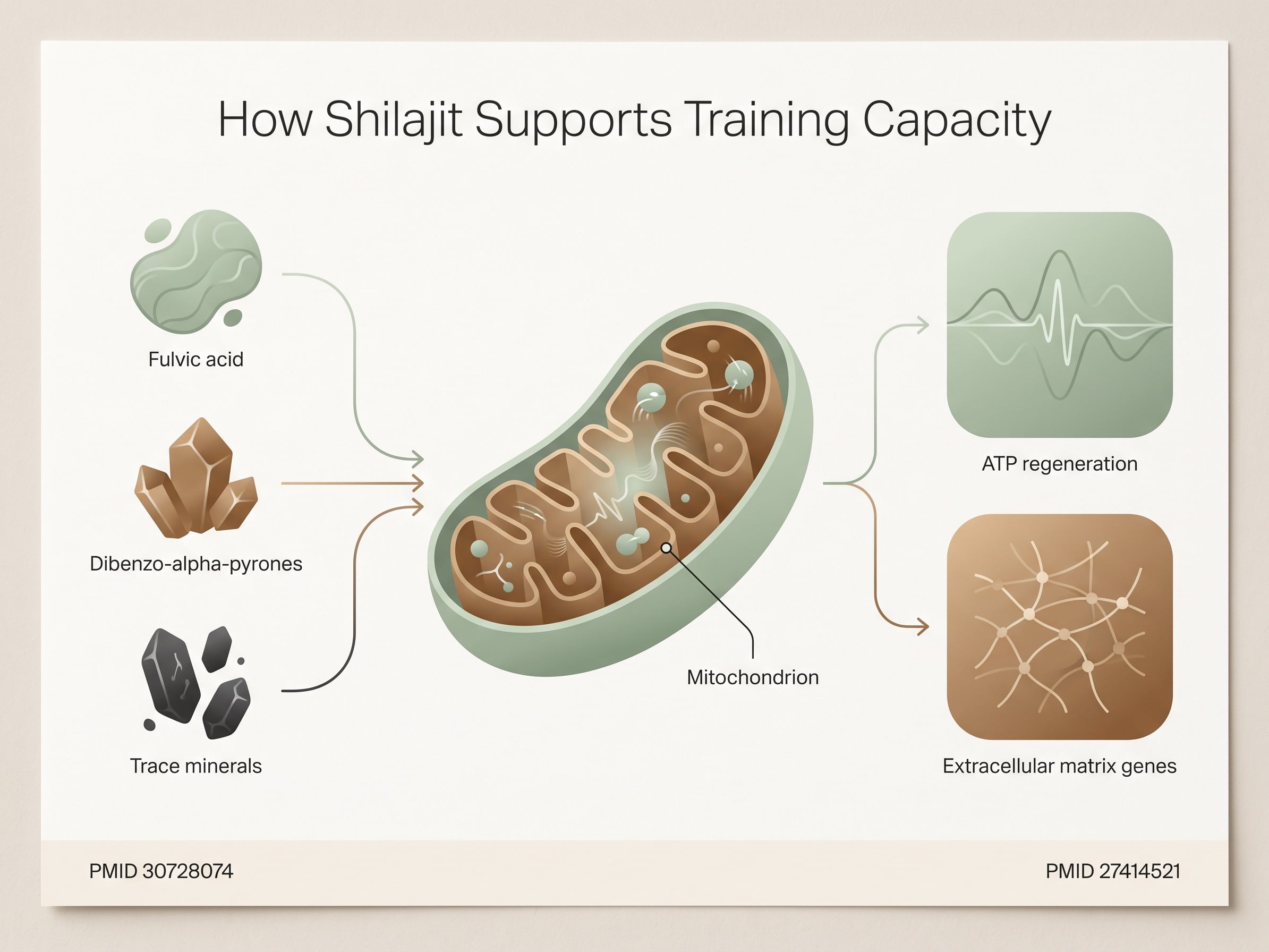
- Fulvic acid. A low-molecular-weight organic acid that chelates minerals and carries them across cell membranes. It is the transport mechanism behind most of shilajit’s secondary effects.
- Dibenzo-alpha-pyrones. The fraction most closely associated with mitochondrial function. These are the compounds standardized extracts are measured against.
- Humic acid and trace minerals. The bulk fraction, contributing the mineral density the resin is known for.
In our sourcing experience, the fulvic acid percentage on a label tells you far less than a batch-level certificate of analysis does. Two suppliers can both claim high fulvic content while differing sharply on what else came along with it.
How Does Shilajit Support Muscle and Performance?
Four mechanisms carry the evidence. Each is worth reading with its study population attached, because the population is where most articles on this topic quietly overreach.
Does shilajit support cellular energy and ATP production?
Every repetition draws on adenosine triphosphate, regenerated inside the mitochondria. Shilajit’s dibenzo-alpha-pyrones appear to support mitochondrial function, which is the mechanistic argument for reduced fatigue during training.
A 28-day open-label pilot in 25 healthy men aged 21 to 55 recorded a 23.63 percent drop in rating of perceived exertion and a 12.30 percent rise in muscle endurance on 500 mg of resin daily (Yadav et al., 2026, Cureus, PMID: 41613504). It was the first peer-reviewed trial on resin, but with no control group, it is suggestive rather than confirmatory.
Does shilajit help recovery and connective tissue?
This is where the evidence is strongest and least discussed. Intense training creates microscopic damage and oxidative stress. Recovery is the repair process that makes the tissue stronger.
In a randomized controlled trial, 63 recreationally active men with a mean age of 21.2 years took 250 mg daily, 500 mg daily, or placebo for eight weeks. Among the stronger half of participants, the 500 mg group lost only 8.9 percent of maximal voluntary isometric contraction strength after a fatiguing protocol, against 16.0 percent for placebo. Serum hydroxyproline, a collagen turnover marker, also fell (Keller et al., 2019, Journal of the International Society of Sports Nutrition, PMID: 30728074). The effect reached significance in the upper 50th percentile subgroup rather than across the whole sample, a limitation most summaries of this study omit.
A separate clinical trial supplies the mechanism underneath that result. Eight weeks of 250 mg twice daily upregulated a cluster of 17 extracellular matrix genes in muscle biopsies, including tenascin XB, decorin, myoferlin, collagen, elastin, fibrillin 1, and fibronectin 1 (Das et al., 2016, Journal of Medicinal Food, PMID: 27414521). Those genes govern how muscle transmits force and repairs itself, and several of them code for structural proteins of the tendons and ligaments around a joint. The participants were overweight or class I obese adults rather than trained athletes, so the finding establishes the pathway without confirming the size of the effect in a lean, conditioned population.
The 90-day resin trial adds a muscle damage angle. Creatine kinase, an enzyme that leaks from stressed muscle, fell 33.6 percent on shilajit against 6.9 percent on placebo, a secondary endpoint in an industry-affiliated preprint not yet peer-reviewed. In lab assays from a 2026 paper whose lead author runs a shilajit company, samples showed moderate free radical scavenging activity (Rizun et al., 2026, Pharmaceuticals, PMID: 42797531), but that is test-tube chemistry, not a measured effect in muscle.
Does shilajit raise testosterone, and in whom?
Testosterone is one mechanism among four here, and it is the one most often stretched past what the data supports.
A randomized, double-blind, placebo-controlled trial gave 250 mg twice daily for 90 consecutive days to healthy male volunteers. Total testosterone, free testosterone, and DHEAS all rose against placebo, while luteinizing hormone and follicle-stimulating hormone stayed steady (Pandit et al., 2016, Andrologia, PMID: 26395129). Those volunteers were aged 45 to 55.
We cover the hormonal pathway in depth in our separate guide to shilajit for libido and testosterone, which walks through the HPG axis and the 90-day timeline in full. For a training audience, the relevant point is narrower and appears below.
Does age change the answer? Shilajit for younger lifters
Yes. This is the correction we consider most important on this page, and the evidence moved in 2026.
The 45-to-55 age band in the testosterone trial is not incidental. Testosterone declines with age, and supplements that raise it in men whose levels have drifted downward frequently do nothing measurable in young men whose levels are already normal. A 2024 systematic review graded purified shilajit extract as possibly effective specifically for men with late-onset hypogonadism, not for healthy athletes (Morgado et al., 2024, International Journal of Impotence Research, PMID: 37697053).
In the 90-day resin trial, total testosterone in resistance-trained men aged 21 to 50 rose 15.6 percent against a 3.8 percent fall on placebo, and free testosterone rose 21.8 percent against a 2.9 percent fall. Those were secondary endpoints in an industry-affiliated preprint not yet peer-reviewed or replicated, so they do not yet carry the weight of the 45-to-55 trial.
The performance findings run the other way. The strength retention trial enrolled men with a mean age of 21.2 years, and the 2026 resin pilot enrolled men aged 21 to 55. So for a lifter in their twenties or thirties, the fatigue and recovery case still rests on better-matched evidence than the hormone case. If you’re taking shilajit for a hormonal effect at 25, treat that as unproven for now. For fatigue resistance and connective tissue support, the evidence is on firmer ground.
Nutrient absorption and fulvic acid
A high-protein diet only helps if the nutrients reach the tissue. Fulvic acid chelates minerals and carries them across cell membranes, which is the argument for improved assimilation of the minerals and amino acids already in a lifter’s diet. The extracellular matrix findings above are the closest thing to direct human evidence that this transport activity translates into a measurable tissue response.
What Is the Best Shilajit Dosage for Bodybuilding?
- 500 mg daily is the best-supported performance dose (PMID: 30728074).
- 250 mg twice daily was the testosterone-trial dose in men aged 45 to 55 (PMID: 26395129).
- No performance trial has tested more than 500 mg a day, so 1,000 mg products sit outside the studied range.
- Human trials ran 28 to 90 days of daily use. There is no human safety data beyond 90 days.
- Beginners can start at 100 to 250 mg to check tolerance first.
- Peer-reviewed controlled data is mostly on standardized extract. Resin has one pilot and one preprint trial awaiting peer review.
- Third-party batch testing comes before any dose is worth taking.
Dosage and form
Every trial that recorded performance effects used 500 mg per day, given once daily or as 250 mg twice daily. In the one trial that compared doses, 250 mg daily did not separate from placebo (PMID: 30728074). Starting around 150 to 250 mg is still a reasonable way to check tolerance before moving up.
One distinction deserves more attention than it usually gets. Most peer-reviewed evidence on shilajit comes from purified, standardized extract, most often the PrimaVie preparation used in the strength retention and gene expression trials. Resin has centuries of traditional use but far less controlled data: one peer-reviewed pilot, and one larger trial that is still an industry-affiliated preprint awaiting peer review. That does not make resin inferior. It means most dose numbers in this category were set on extract, and applying them to resin involves an assumption.
| Form | Typical dosage | Evidence status and notes |
|---|---|---|
| Standardized extract (capsules) | Follow label, commonly 250 to 600 mg | Carries most of the peer-reviewed clinical data. Dose precision is highest. Verify the standardization marker. |
| Resin | Pea-sized amount, roughly 250 to 300 mg | Traditional form. One 28-day open-label pilot (PMID: 41613504) and one 90-day placebo-controlled trial that is still an industry-affiliated preprint, not yet peer-reviewed. Dissolves in warm water or milk. |
| Powder | 300 to 500 mg | Mixes into shakes. Quality varies most widely in this format. Purity documentation matters most here. |
| Sources: Keller et al., 2019, PMID: 30728074. Das et al., 2016, PMID: 27414521. Yadav et al., 2026, Cureus, PMID: 41613504. Yadav et al., 2026, medRxiv preprint, DOI: 10.64898/2026.07.27.26358996. | ||
Can you take shilajit every day, and for how long?
Yes, daily use is how every human trial cited here gave it, but only for 28 to 90 days. No human study has followed continuous use beyond 90 days, so long-term safety is not established. Cycling schedules such as eight weeks on and two to four weeks off circulate widely in training circles, but no trial has tested them.
If you plan to use it for longer than three months, review that with a healthcare provider. A September 2026 rat study, whose lead author runs a shilajit company, found mild to moderate liver and kidney tissue changes after a single very high dose (Rizun et al., 2026, Pharmaceuticals, PMID: 42797531). That says little about human use, but it is one more reason long-term safety remains open.
Is it better to take shilajit before the gym or after?
No trial has compared taking shilajit before training with taking it after. The studies that recorded strength and recovery effects used consistent daily dosing, either once a day or 250 mg twice a day, for 28 to 90 days. Pick a time you can repeat every day, including rest days.
It also means the effects build up over weeks of steady use. The drop in perceived exertion in the 2026 pilot was measured after 28 days of daily dosing, not after a single pre-workout serving.
No study has compared taking it with food against an empty stomach either, so take it with a meal if it unsettles your stomach. Some people report that a late-evening dose disrupts their sleep. That is anecdotal, but it is an easy reason to dose earlier in the day.
Is Shilajit Better Than Creatine?
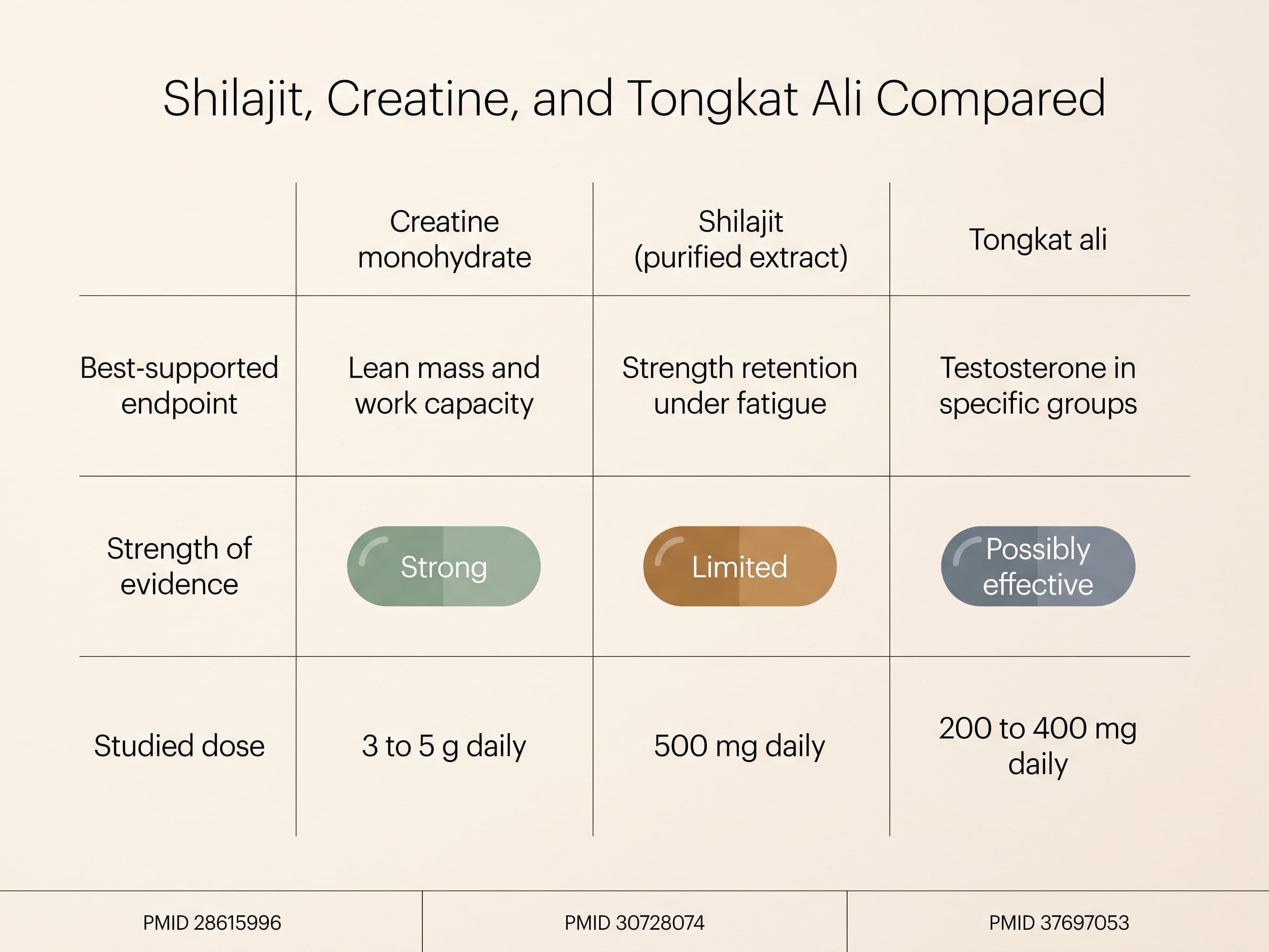
No. For adding lean mass, creatine monohydrate has the deepest evidence base of any legal ergogenic aid, summarized in the International Society of Sports Nutrition position stand (Kreider et al., 2017, Journal of the International Society of Sports Nutrition, PMID: 28615996). Shilajit does not compete with it on that endpoint. They do different jobs.
Creatine works on phosphocreatine resynthesis, which raises repeatable work capacity across sets. More quality volume over months produces more hypertrophy. Shilajit works on fatigue resistance, connective tissue adaptation, and mineral transport. One raises the ceiling on the work you can perform. The other supports how well you absorb and recover from that work.
| Compound | Best-supported endpoint | Strength of evidence | Typical studied dose | What it does not do |
|---|---|---|---|---|
| Creatine monohydrate | Lean mass and repeatable work capacity | Strong. Decades of randomized trials (PMID: 28615996). | 3 to 5 g daily | Does not act on hormones or connective tissue repair |
| Shilajit (purified extract) | Strength retention under fatigue, connective tissue adaptation | Limited. Small randomized trials, subgroup-limited findings. | 500 mg daily | Does not increase muscle mass independent of training |
| Tongkat ali (Eurycoma longifolia) | Testosterone support in specific populations | Graded as possibly effective for healthy men and late-onset hypogonadism. | 200 to 400 mg daily | Does not have direct hypertrophy evidence |
| Creatine evidence and dosing per the ISSN position stand, Kreider et al., 2017, PMID: 28615996. Evidence grading for shilajit and tongkat ali follows Morgado et al., 2024, Int J Impot Res, PMID: 37697053. Shilajit performance data from PMID: 30728074 and PMID: 27414521. | ||||
Can you take shilajit and creatine together?
No human trial has tested shilajit and creatine together, and no interaction between them has been reported in the research literature. They act on different parts of energy metabolism: creatine on phosphocreatine recycling, shilajit on mitochondrial and mineral pathways. Creatine’s own evidence stands without help (PMID: 28615996). Check the pairing with your healthcare provider.
The idea that fulvic acid improves creatine uptake is mechanistic reasoning, not a demonstrated effect, so do not expect a combined effect that has never been measured. We flag it because the claim circulates widely in this category and has no trial behind it.
How Does Shilajit Compare to Tongkat Ali and Other Herbal Testosterone Support?
The most useful answer comes from a single source that graded both on the same scale. The 2024 systematic review covering 52 studies and 27 marketed testosterone supplements found that most fail to raise total testosterone at all (Morgado et al., 2024, International Journal of Impotence Research, PMID: 37697053).
Two herbs in this category cleared the bar, and each cleared it for a specific population. Purified shilajit extract was graded possibly effective for men with late-onset hypogonadism. Eurycoma longifolia, sold as tongkat ali, was graded possibly effective for both healthy men and men with late-onset hypogonadism. On testosterone specifically, tongkat ali carries the broader population support of the two.
That does not make tongkat ali the better choice for a lifter. The endpoints differ. Shilajit is the one with human data on strength retention under fatigue and on extracellular matrix gene expression. Tongkat ali is the one with broader hormonal support. Choosing between them means choosing which outcome you are actually after, and our guide to tongkat ali for fitness and performance covers that side in more detail.
Withania somnifera, better known as ashwagandha, occupies a third position with its own trial base on strength and body composition. We compare that herb against creatine directly in our guide to ashwagandha for strength and recovery, and set it beside shilajit in our guide to shilajit and ashwagandha.
Is Shilajit Safe? Heavy Metals, Side Effects, and Who Should Avoid It
Shilajit was well tolerated across the published trials. In the 2026 pilot, no serious adverse events occurred, and liver, kidney, and hematological parameters stayed within normal limits over 28 days (PMID: 41613504). The 2016 gene expression trial reported no changes in blood glucose, lipid profile, creatine kinase, or serum myoglobin over 12 weeks (PMID: 27414521). The 90-day resin trial, an industry-affiliated preprint not yet peer-reviewed, recorded no adverse events in the shilajit group.
The meaningful risk in this category is not the compound. It is what the compound arrives with.
Recent lab work shows how much that varies. A 2026 analysis of 12 samples from different regions detected cobalt, nickel, lead, cadmium, and mercury below established toxicity thresholds in those samples but with wide differences by origin (Kamgar et al., 2026, Journal of Trace Elements in Medicine and Biology, PMID: 42364294). A 2025 study found more thallium in some finished supplements than in raw shilajit (Kamgar et al., 2025, BMC Chemistry, PMID: 39827344), so processing does not automatically mean cleaner. The National Center for Complementary and Integrative Health notes that some Ayurvedic preparations may contain lead, mercury, or arsenic in amounts that can be toxic.
A September 2026 rat study adds a different caution. A single very high oral dose caused no deaths, but tissue analysis found mild to moderate degenerative and necrotic changes in the liver and kidneys (Rizun et al., 2026, Pharmaceuticals, PMID: 42797531). It is a single-dose animal study, and its lead author runs a shilajit company, so it says nothing about human use. It does explain why we treat batch testing and medical guidance as non-negotiable.
How to verify shilajit purity before you buy
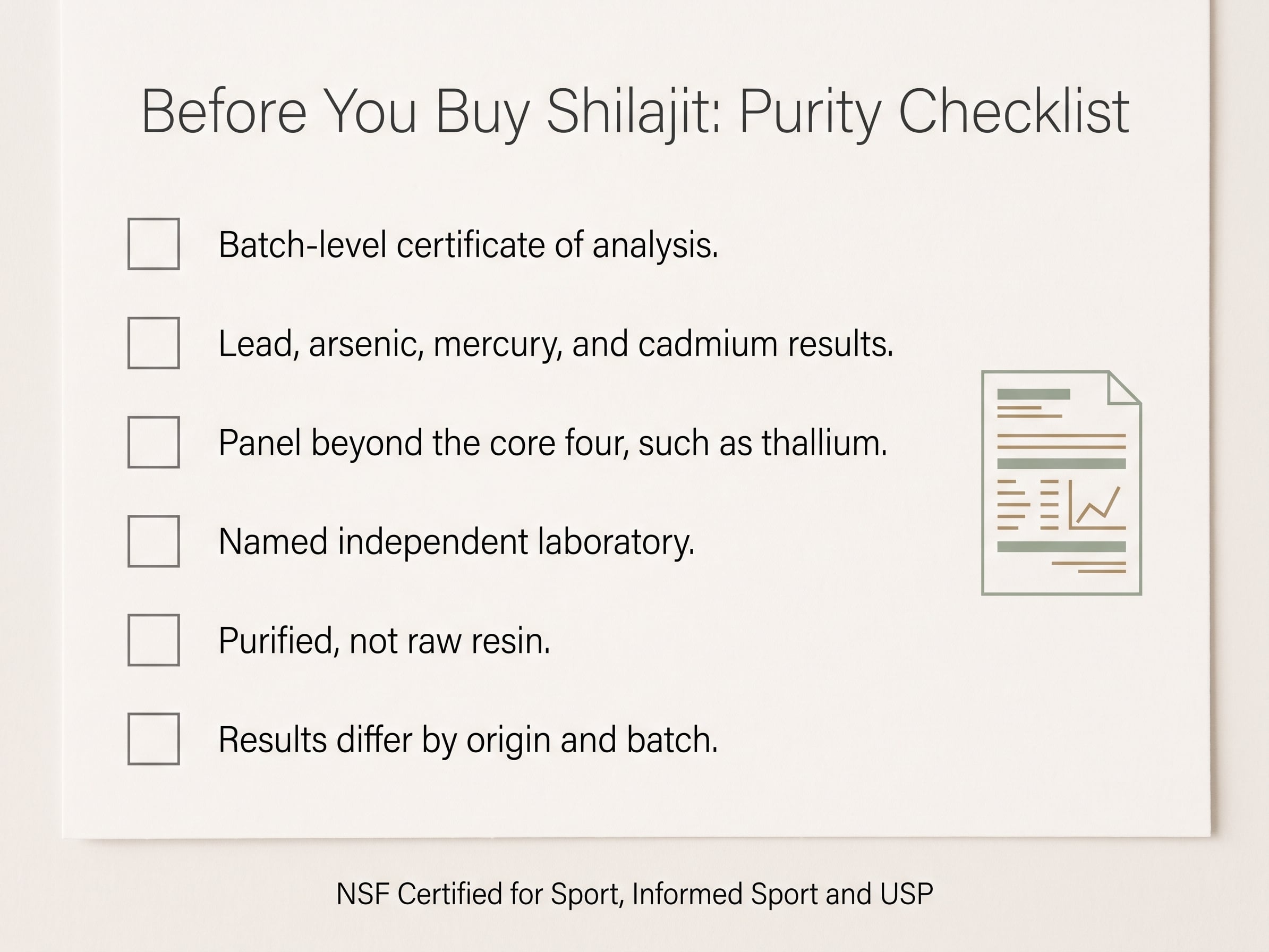
- Require a batch-level certificate of analysis naming lead, arsenic, mercury, and cadmium results.
- Ask whether the panel goes further, such as thallium, which one study found higher in some supplements than raw material.
- Confirm the testing laboratory is named and independent of the seller.
- Look for NSF Certified for Sport, Informed Sport, or USP verification marks.
- Choose purified material. Raw, unprocessed resin is the main contamination risk.
- Expect contaminant levels to differ by origin and batch, so one undated certificate is not enough.
- Treat vague claims like lab tested with no accompanying document as unverified.
Raw shilajit scraped from rock and sold unprocessed can carry heavy metals, free radicals, and mycotoxins. Purification is a real processing step that removes these fractions, and it is the difference between a supplement and a geological sample. From our hands-on assessment of supplier documentation across this category, the gap between brands that publish batch-level results and brands that publish a single undated certificate is the most reliable quality signal available to a buyer.
Our own Shilajit Extract Capsules are made from purified Karakoram-Himalaya resin, cleaned by traditional Shodhana water filtration and prepared as a whole standardized extract. That is the same general format as most of the clinical research, though not the specific branded extract those trials used. Every batch is screened for lead, arsenic, mercury, and cadmium, and the certificate of analysis is available on request.
Who should not take shilajit?
People who are pregnant, breastfeeding, or trying to conceive; people with liver, kidney, or heart conditions; and anyone on testosterone therapy should avoid shilajit or check with a clinician first.
Avoid shilajit, or speak with a clinician before starting, if any of these apply to you:
- You’re pregnant, breastfeeding, or trying to conceive.
- You have liver or kidney disease.
- You have gout or high uric acid. Our guide to shilajit and uric acid explains why.
- You have heart disease or blood pressure concerns.
- You have a bleeding or clotting disorder, or you take blood thinners.
- You have diabetes or an autoimmune condition.
- You have hemochromatosis, sickle cell anemia, or thalassemia.
- You take testosterone replacement therapy or any testosterone-containing medicine.
- You’re under 18. No trial has studied shilajit in teenagers.
Hemochromatosis, sickle cell anemia, and thalassemia are firm exclusions because shilajit’s iron and mineral load can worsen conditions involving iron handling. The wider list follows Cleveland Clinic’s guidance on shilajit and WebMD’s pharmacist-reviewed monograph, which flags testosterone replacement therapy specifically.
What side effects does shilajit cause?
Reported side effects are uncommon and generally mild. The ones to watch for include nausea, vomiting, diarrhea, stomach discomfort, headache, dizziness, and rash or other signs of an allergic reaction. Stop taking it and speak with a healthcare provider if any of them appear.
Will shilajit show up on a drug test?
Shilajit is not listed on the WADA Prohibited List. That said, dietary supplements are not pre-approved by the FDA, and third-party contamination has been documented across the supplement category as a whole. Athletes subject to testing should choose products certified by NSF Certified for Sport or Informed Sport and confirm with their compliance officer before use. The certification exists precisely because a permitted ingredient says nothing about whether the product is clean.
Frequently Asked Questions
Does shilajit actually build muscle or just support energy?
It supports the training rather than building the tissue. No controlled trial has shown shilajit to increase muscle mass on its own. The documented effects are strength retention after fatigue, connective tissue gene expression, and reduced perceived exertion. Resistance training and adequate protein remain the mechanisms that add mass.
Can shilajit raise testosterone in men?
In one randomized controlled trial, it raised total testosterone, free testosterone, and DHEAS in healthy men aged 45 to 55 over 90 days (PMID: 26395129). A 2024 systematic review graded purified shilajit extract as possibly effective for men with late-onset hypogonadism specifically (PMID: 37697053). A 2026 trial in resistance-trained men aged 21 to 50 reported modest rises, but it is an industry-affiliated preprint that has not been peer-reviewed or independently replicated.
How long does it take to see results from shilajit?
Effects on perceived exertion and fatigue appeared within 28 days in the 2026 pilot. The strength retention and connective tissue findings came from 8- to 12-week protocols. Treat 8 weeks as the realistic evaluation window rather than 2.
Is shilajit better than creatine for muscle gain?
No. Creatine monohydrate has substantially stronger evidence for increasing lean mass (PMID: 28615996). Shilajit addresses fatigue resistance and recovery instead. If the goal is added muscle mass and you are choosing one, the evidence favors creatine.
Can shilajit improve athletic performance in young athletes?
For adult lifters, the performance evidence is better matched to younger trainees than the hormone evidence is. The strength retention trial enrolled men with a mean age of 21.2 years, and the 2026 resin pilot enrolled men aged 21 to 55. No trial has enrolled anyone under 18, and Cleveland Clinic advises against giving shilajit to children, so we do not recommend it for teenage athletes.
Is shilajit safe given heavy metal contamination concerns?
Purified, batch-tested shilajit was well tolerated in published human trials with no serious adverse events. Contaminant levels vary widely by origin and batch, and one study found more thallium in some finished supplements than in raw material (PMID: 39827344). Require a batch-level certificate of analysis from a named independent laboratory.
Can women take shilajit for training?
No performance trial has enrolled women, so the direct evidence is thin. Cleveland Clinic notes that shilajit may raise testosterone, which in women could bring acne, irregular periods, or hair loss. Avoid it if you are pregnant, breastfeeding, or trying to conceive, and talk with your provider before starting. Our guide to shilajit benefits for women covers the research on women specifically.
Should I take shilajit as resin, powder, or capsules?
Standardized extract capsules carry most of the peer-reviewed clinical evidence and offer the most consistent dosing. Resin is the traditional form, backed by one open-label pilot and one placebo-controlled trial that is still an industry-affiliated preprint awaiting peer review. Powder is convenient but shows the widest quality variation. Purity documentation matters more than format.
Related Reading
Continue with our companion guides on shilajit for libido and testosterone, tongkat ali for fitness and performance, ashwagandha for strength and recovery, shilajit and uric acid, and our roundup of the top herbs for muscle growth.
Important: This article is for educational and informational purposes. These statements have not been evaluated by the Food and Drug Administration. This product is not intended to diagnose, treat, cure, or prevent any disease. Consult your healthcare provider before use, especially if you are pregnant, nursing, taking medication, or have a medical condition.