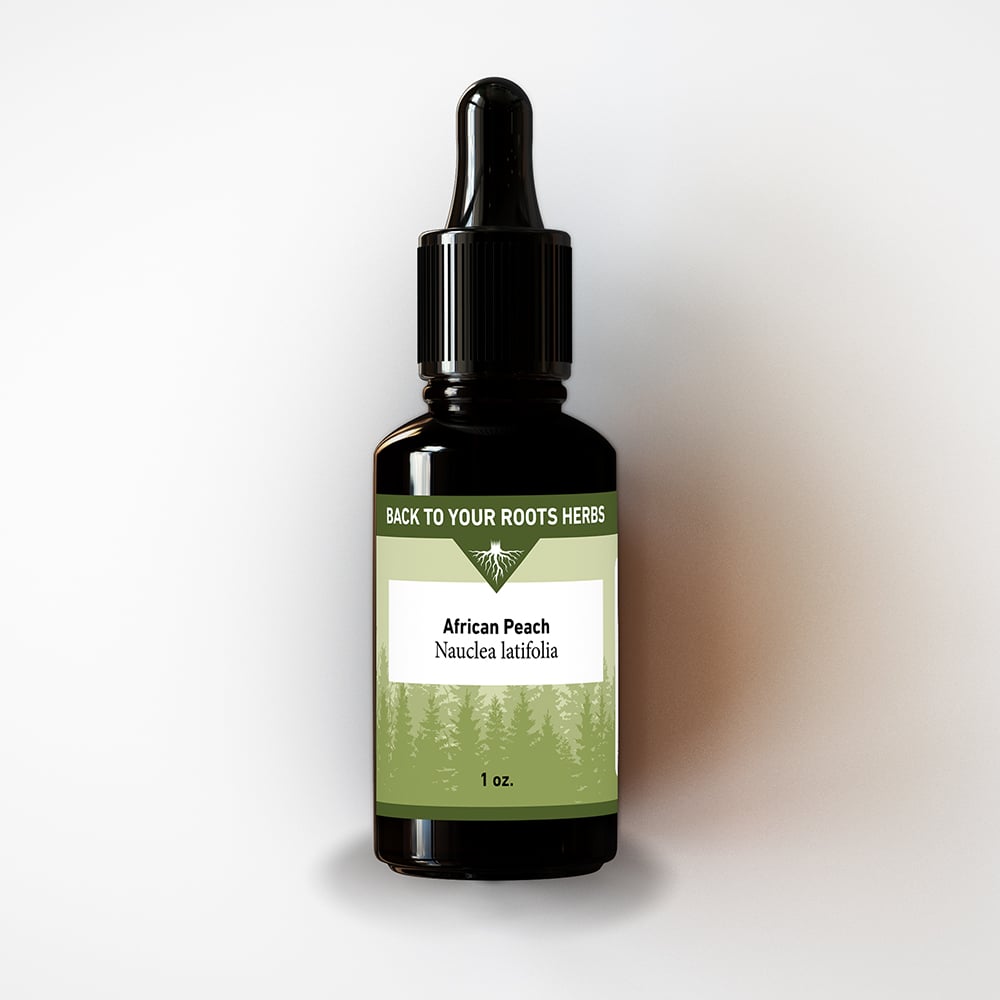
The Verdict (Internal Quality Score)
Grade A. Potency Score 94 of 100. Single-origin Cross River State, Nigeria root, harvested in the late dry season at peak alkaloid expression. Our 1:5 cold maceration in 60% organic cane alcohol captures the full spectrum of indoloquinolizidine alkaloid compounds and quinovic acid glycosides documented in the modern Nauclea phytochemistry literature.
– Back To Your Roots Herbs Research Group
Sensory Analysis
This is our first-hand report from the apothecary bench, written after pressing and decanting the 6-week maceration.
- Look: Deep amber liquid with a faint copper sheen. No sediment after a 30-day cold settle.
- Smell: Damp earth, faint roasted chicory, a green vegetal note rising from the macerated roots.
- Taste: Sharply bitter on first contact, then astringent through the mid-palate. The finish carries the cooling tannin note characteristic of the Rubiaceae family botanicals.
Nauclea Latifolia Tincture: How It Works
The mechanism is documented in published pharmacological research and in West African traditional medicine literature. Below is the breakdown of source, preparation, and active phytochemistry.
The Botanical Source
- The herb: Nauclea latifolia Smith, family Rubiaceae. Common names include African peach and the pincushion tree.
- The origin: Cross River State, Nigeria (5.75 N, 8.50 E). Savanna woodland soils within the documented native range of the species.
- The plant part: Dried root from mature trees, harvested in the dry season for the highest alkaloid concentration.
- The preparation: 1:5 dried root to menstruum. 60% organic cane alcohol and 40% deionized spring water. 6 weeks of cold maceration, then pressed, filtered, and bottled.
Active Phytochemistry of the Latifolia Tincture
Published phytochemistry research has documented multiple indole alkaloid compounds in Nauclea latifolia root. The most abundant phytochemical class is indoloquinolizidine alkaloid compounds, including strictosamide, vincosamide, pumiloside, and naucleamides A through F (Sun et al., Natural Product Reports, 2016). The root also contains quinovic acid glycosides, characterized by Ata et al. (PMID 19831025) as the structural source of documented in-vitro antimicrobial and anti-GST pharmacological activity. Several quinovic acid esters demonstrated antibacterial action against gram-positive bacteria in the same study.
Documented Pharmacological Research
Taiwe et al. (2011, Pharmaceutical Biology, PMID 20822326) characterized the central and peripheral effects of N. latifolia root decoction in standard nociception assays, including the formalin test, the hot plate test, and the tail immersion test. The team observed antinociceptive activity that was reversed by naloxone, supporting involvement of the opioid receptor system through the nitric oxide-cGMP-ATP-sensitive K+ channel pathway. The same study documented antipyretic activity in a yeast-induced pyrexia model and effects on motor coordination in mice.
Antioxidant Profile
Independent phytochemical assay work using the DPPH free radical scavenging method has documented antioxidant activity in Nauclea latifolia root and leaves extracts. The antioxidative capacity is attributed to the alkaloid fraction and to phenolic compounds, both of which transfer into ethanol-water tinctures during cold maceration. Total antioxidant values normalized against gallic acid equivalents place N. latifolia root in the moderate-to-high range among West African botanicals. The same compounds have been documented to support the body’s normal response to occasional inflammation in laboratory anti-inflammatory screens.
Traditional Uses in West African Herbalism
Across Senegal, Nigeria, Cameroon, Ghana, and neighboring regions, Nauclea latifolia is one of the most widely referenced roots in documented ethnobotanical surveys. The West African Herbal Pharmacopoeia and peer-reviewed reviews record its long traditional preparation as a bitter root tonic. West African herbalists have traditionally used the root to support general wellbeing and everyday vitality, prepared as decoctions, infusions, and tinctures across generations. Published pharmacological research on the same root has also documented central nervous system activity in animal models (Taiwe et al., PMID 20822326). These are historical, cultural, and research findings about the plant, shared here for educational context rather than as outcomes promised by this tincture.
Latifolia Tincture: Why Ours Stands Apart
Single-Origin Cross River Sourcing
Most commercial Nauclea offerings on Etsy and small Shopify storefronts list no terroir. Ours comes from a documented grove in Cross River State at 5.75 N, 8.50 E. West African agroforestry practitioners recognize the savanna woodland soils of this region for producing high-alkaloid-yielding root. The supply chain runs through a single cooperative apothecary partner, not an aggregator.
Cold Maceration vs Boiled Decoction
Most traditional preparations boil the root as a decoction. Heat damages the indoloquinolizidine fraction over a 20-to-30 minute simmer. We chose 6 weeks of room-temperature ethanol-water maceration instead. The cold maceration preserves the native alkaloid ratio that the pharmaceutical sciences literature has characterized over the last 30 years.
Root Material, Not Bark or Leaves
The published Nauclea research database is heavily weighted toward root and root-bark preparations. Bark and leaf material show different alkaloid ratios and different DPPH values. Choosing root keeps our tincture aligned with the studied material, not with a substitute.
How Our Tincture Differs From a Glycerite
A glycerite uses vegetable glycerin as the menstruum. Glycerin extracts water-soluble constituents well but pulls fewer alkaloid compounds than ethanol. Our ethanol-water tincture captures the full alkaloid range, which is the class of compounds most studied in Nauclea herbal remedies and herbal extracts.
Clinical Specs
| Spec | Detail |
|---|---|
| Serving Size | 30 drops (approximately 1 mL) |
| Frequency | Up to twice daily, diluted in 2 oz of water |
| Active Marker | Indoloquinolizidine alkaloid fraction (strictosamide, vincosamide, pumiloside, naucleamides A-F) |
| Processing | 1:5 cold maceration, 6 weeks, pressed and filtered |
| Safety | Heavy Metal Tested (Pass) |
| Ingredients | Nauclea latifolia root, organic cane alcohol (60%), deionized spring water (40%) |
| Other Ingredients | None. No binders, no fillers, no glycerin |
| Purity | Organic, Non-GMO, Vegan |
| Free From | Wheat, Gluten, Soy, Dairy, Binders, Fillers |
| Origin | Cross River State, Nigeria (5.75 N, 8.50 E) |
| Manufactured | Virginia Beach, VA, USA |
Comparison Table
| Feature | BTYRH Nauclea Latifolia Tincture | Generic Online Nauclea Tincture |
|---|---|---|
| Origin | Cross River State, Nigeria (5.75 N, 8.50 E) | Unspecified West African source |
| Preparation | 1:5 cold maceration, 6 weeks, ethanol-water | Variable, often unstated, extraction ratio |
| Plant Part | Verified root (alkaloid-rich) | Often mixed root, bark, or leaves |
| Taste | Sharp, bitter, astringent finish, cooling tannin note | Generic “herbal” descriptor |
| Safety | Heavy metal tested (Pass), made in a USA cGMP facility | Unknown testing, often offshore manufacturing |
Critical Usage and Contraindications
Suggested serving: 30 drops (approximately 1 mL) in 2 oz of water, up to twice daily. Shake well before each use. Do not exceed the suggested serving.
Negative knowledge for trust:
- Not for use during pregnancy or lactation. Traditional African herbal practice reserves Nauclea preparations for non-pregnant adults.
- May interact with opioid medications, sedatives, or central nervous system drugs, based on the receptor mechanisms documented by Taiwe et al.
- Discontinue 14 days before any scheduled surgery.
- Consult a licensed healthcare practitioner before use if you have a chronic health condition or take prescription medication.
- Keep out of reach of children. Store below 75 F, away from direct light.
Frequently Asked Questions
Is Nauclea latifolia used in traditional medicine?
Yes. The West African Herbal Pharmacopoeia and multiple peer-reviewed studies document Nauclea latifolia preparations across traditional medicine systems in Senegal, Nigeria, Cameroon, Ghana, and beyond. Practitioners have historically prepared the root, bark, and leaves as decoctions, infusions, and tinctures for generations.
What active compounds does this latifolia tincture contain?
The full-spectrum tincture preserves the native phytochemical profile of the root, dominated by indoloquinolizidine alkaloid compounds (strictosamide, vincosamide, pumiloside, naucleamides A through F), quinovic acid glycosides, and accompanying tannins. Independent assay work has documented these compounds across multiple peer-reviewed publications.
How does this Nauclea latifolia tincture compare to a glycerite?
A glycerite uses vegetable glycerin and extracts mostly water-soluble compounds. Our ethanol-water tincture captures the full alkaloid range, which is the class of compounds most studied in Nauclea research.
Where does Nauclea latifolia grow naturally?
Nauclea latifolia is native to the savanna woodlands of tropical Africa, from Senegal in the west across to Sudan and Ethiopia, and south through Cameroon and Angola. It grows from sea level to about 1,200 meters and tolerates poor and disturbed soils. Our material comes from Cross River State, Nigeria.
How does Nauclea latifolia tincture compare to other herbal remedies?
Nauclea latifolia occupies a different chemical niche from most popular Western herbs. Its profile centers on indoloquinolizidine alkaloids and quinovic acid glycosides, which place it closer to other Rubiaceae-family botanicals than to the adaptogenic roots like ashwagandha or the volatile-oil calming herbs like valerian and chamomile. Set against classic bitter tonics such as gentian, Nauclea shares the sharp bitter principle but carries its own alkaloid signature documented in the phytochemistry literature. It is a distinct single-origin botanical, not a substitute for any other herb or for medical care, and it is best understood on its own documented profile rather than ranked against unrelated plants.
Are there any known side effects of Nauclea latifolia tincture?
Nauclea latifolia tincture is generally well-tolerated by healthy non-pregnant adults at the suggested serving, though a few points are worth knowing. The tincture is sharply bitter and astringent, and taking it undiluted or on an empty stomach can cause mild stomach upset, so dilute it in 2 oz of water as directed. Because the published pharmacological research describes central nervous system activity, some people may notice mild drowsiness. Do not use during pregnancy or lactation, avoid combining it with opioid medications, sedatives, or other central nervous system drugs without professional guidance, and discontinue at least 14 days before scheduled surgery. Stop use and consult your healthcare provider if any adverse reaction occurs.
Can Nauclea latifolia tincture be used to treat specific diseases or conditions?
No. These statements have not been evaluated by the Food and Drug Administration, and this tincture is not intended to diagnose, treat, cure, or prevent any disease or condition. The page describes two separate things: the traditional ways West African herbalists have prepared and used Nauclea latifolia root for generations, and the findings of published laboratory and animal research on the plant itself. Neither of those is a promise of any medical outcome from this product. If you are managing a specific health condition, work with a licensed healthcare provider rather than self-treating with any botanical.
What is the recommended dosage for Nauclea latifolia tincture?
The suggested serving is 30 drops, roughly 1 mL, diluted in 2 oz of water, up to twice daily. Shake well before each use and do not exceed the suggested serving. Because the tincture is strongly bitter, some people begin with a smaller amount to adjust to the taste before moving to the full serving. Store below 75 F, away from direct light, and keep out of reach of children.
About Back To Your Roots Herbs
Back To Your Roots Herbs is a Virginia-based independent herbal apothecary. Every tincture we ship is hand-pressed in our Virginia Beach facility.
Reference Note
Citation data for the studies referenced above appear in our published research bibliography. The species page on Wikipedia is Nauclea latifolia.
Disclaimer
This statement has not been evaluated by the Food and Drug Administration. This product is not intended to diagnose, treat, cure, or prevent any disease. Statements throughout this product page describe documented research findings and traditional ethnobotanical use. They are not therapeutic claims by Back To Your Roots Herbs.
Written by the Back To Your Roots Herbs Research Group | Fact-checked | Last Reviewed: May 2026.
Reviews
There are no reviews yet.