Key Takeaways
- An herbalist is a practitioner of phytotherapy who works with whole plants and plant preparations to support wellness and, in most US states is not a licensed medical provider.
- No federal license and no single government certification exists for herbalists in the United States. The recognized credential is voluntary and awarded by peer review.
- As of August 2026, the American Herbalists Guild has paused new Registered Herbalist applications and revised its criteria to allow five years for logging 80 client consultations.
- Herbalists and naturopathic doctors differ in scope, not only in modality. Naturopathic doctors complete a four-year graduate program and hold licenses in some states.
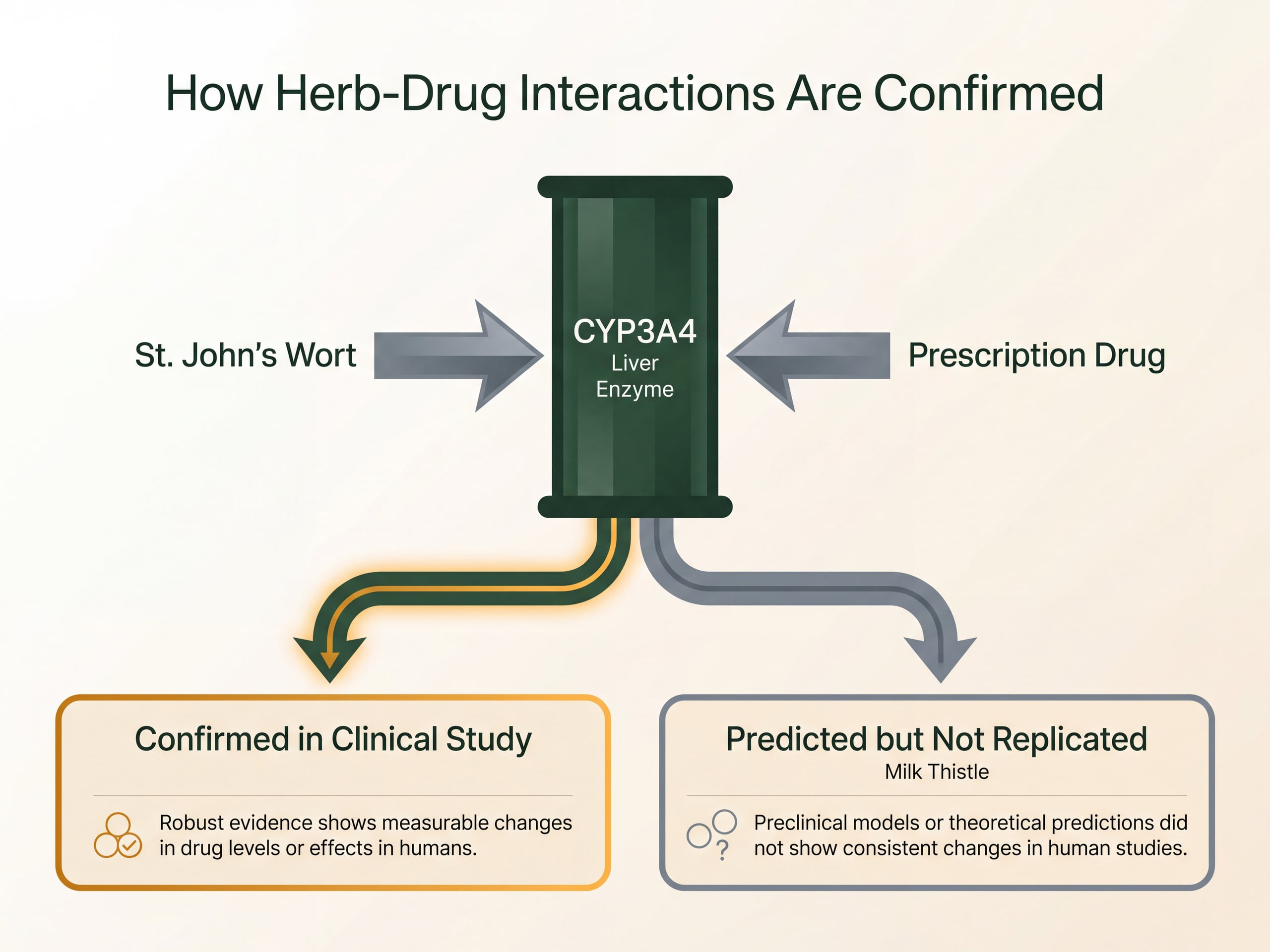
- Herb and drug interactions are specific rather than general. St. John’s wort induces CYP3A4, while several other predicted interactions have not replicated in clinical testing.
What is an herbalist? An herbalist is a person trained to work with medicinal plants and plant preparations to support health and wellness. The practice is ancient. The profession as it exists in the United States today is shaped by a specific and frequently misunderstood legal reality, which is that no federal license governs it and the credential most often cited is voluntary rather than governmental.
This article covers what herbalists actually do, how the recognized types of practice differ from one another, how herbalist certification works as of 2026, how the role compares to naturopathic medicine, what the work pays, and where the real safety considerations sit.
Our editorial team reviewed the American Herbalists Guild’s current registration criteria, the herb monographs published by the National Center for Complementary and Integrative Health, and the peer-reviewed pharmacology literature while preparing this piece. Where the widely circulated version of a fact is out of date, we have corrected it and dated the correction.
What Does an Herbalist Actually Do?
An herbalist is a practitioner of phytotherapy, the applied study of plants such as chamomile (Matricaria chamomilla) and milk thistle (Silybum marianum) for wellness support. In most US states, an herbalist is not a licensed medical practitioner. The work centers on consultation, formulation, and education rather than diagnosis.
Interest in this kind of guidance has grown alongside supplement use itself. Dietary supplement use among US adults rose from 54 percent to 61 percent between 2007 and 2018 across the NHANES survey cycles, per Cowan et al. (2022), Journal of Nutrition, PMID: 35918260.
The daily work breaks down into a handful of recognizable activities:
- Consultations. Meeting with clients to take a detailed health, diet, and lifestyle history.
- Formulation. Preparing custom tinctures, infusions, salves, syrups, and teas matched to an individual’s stated goals.
- Education. Teaching workshops, writing, and helping people use plants safely and knowledgeably.
- Medicine making. Extracting, drying, macerating, and quality-checking raw plant material.
- Growing and wildcrafting. Cultivating medicinal plants or harvesting them from wild stands under sustainable protocols.
- Research and review. Tracking new pharmacology and safety findings, because that literature changes.
Practitioners consider the whole person, including physical symptoms, lifestyle, diet, and emotional state. The focus is not the symptom in isolation but the pattern around it.
One distinction gets blurred constantly in search results, and it is worth stating plainly. In the United Kingdom, a medical herbalist typically holds a Bachelor of Science degree in herbal medicine and may register with the National Institute of Medical Herbalists. That is a British framework. It has no American equivalent. Applying it to a US practitioner describes a requirement that does not exist here.
What Are the Different Types of Herbalists?
The field is broad, and the labels below are the ones practitioners actually use about themselves.
- Clinical herbalist. Works one-to-one with clients, in private practice or alongside other providers in an integrative setting.
- Community or folk herbalist. Works within a local circle, often in a tradition carried informally rather than through a school.
- Commercial or production herbalist. Formulates and manufactures products such as supplements, teas, and skincare.
- Medicine maker. Specializes in the craft of extraction and preparation rather than in consultation.
- Grower and wildcrafter. Cultivates medicinal plants or harvests them from wild stands.
What the categories share is a working knowledge of plants as whole materials rather than as isolated compounds.
Where Do Herbalists Work?
Settings vary more than most professions. Private consultation practice is the most visible, but it is not the most common. Herbalists also work in integrative clinics alongside licensed providers, in retail apothecaries and health food stores advising walk-in customers, in product formulation for supplement companies, on herb farms and in seed conservation, in classrooms and online teaching programs, in botanical research, and in writing and publishing. Many people combine several of these at once.
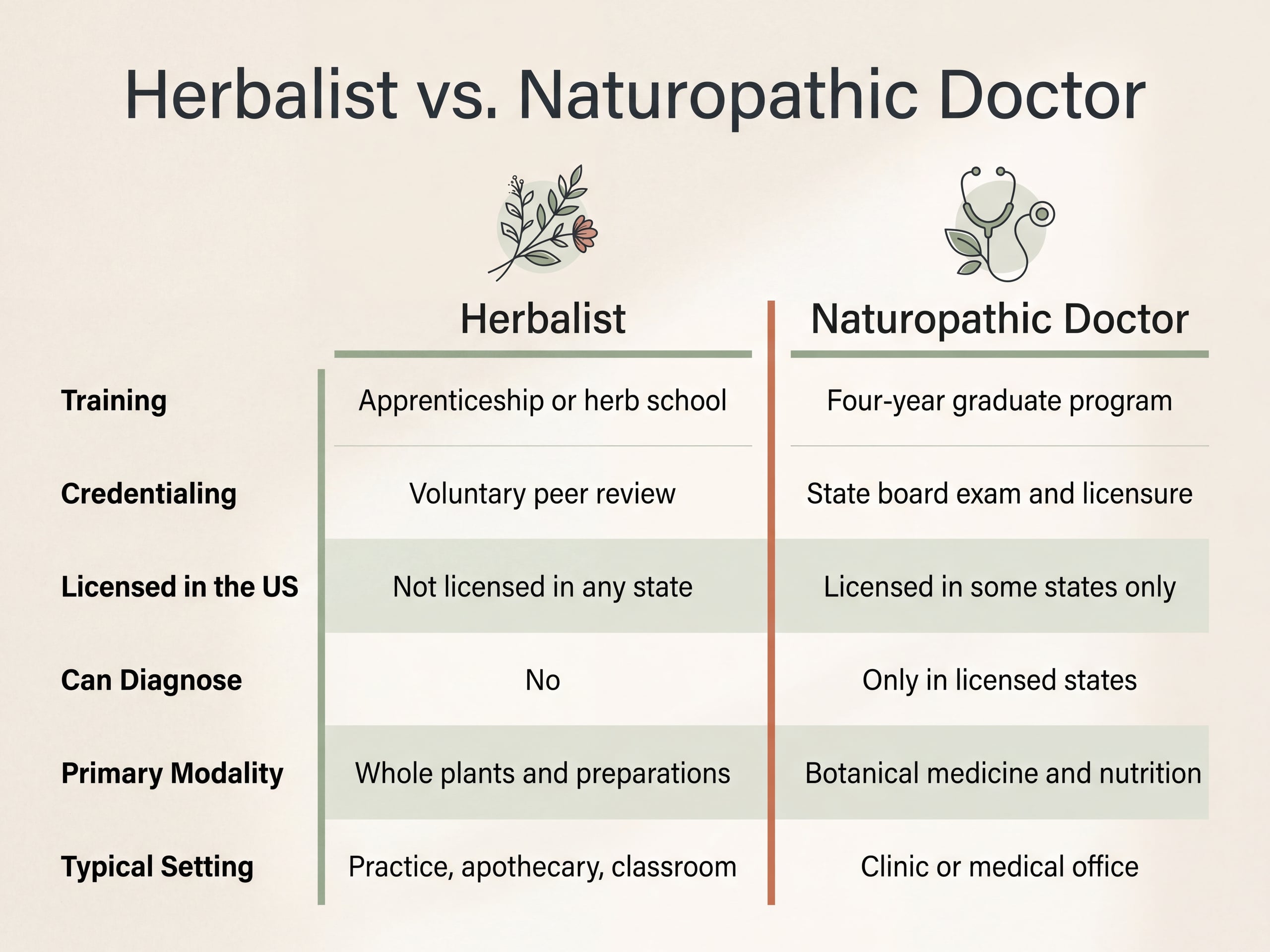
Herbalist vs. Naturopath: What’s the Difference?
An herbalist works within one modality, plant medicine, and holds no state license in most of the United States. A naturopathic doctor completes a four-year graduate program, may be licensed to diagnose and order laboratory testing in states that regulate the profession, and uses plant medicine as one tool among several. The practical difference for you is scope, not just subject matter.
| Factor | Herbalist | Naturopathic Doctor (ND / NMD) |
|---|---|---|
| Typical training | Apprenticeship, herb school, or self-directed study. No standardized national curriculum. | Four-year graduate program at an accredited naturopathic medical school. |
| Credentialing body | American Herbalists Guild, voluntary peer review, Registered Herbalist designation. | State licensing board in regulated states, following board examination. |
| Licensed in the US? | No. Not licensed in any state as a distinct profession. | Yes in some states, no in others. Regulation varies by jurisdiction. |
| Can diagnose or order labs? | No. | In licensed states, generally yes, within the state’s defined scope. |
| Primary modality | Whole plants and plant preparations. | Botanical medicine, nutrition, physical medicine, counseling, and others. |
| Typical setting | Private practice, apothecary, farm, classroom, product formulation. | Clinic or medical office. |
| Sources: American Herbalists Guild registration criteria, retrieved 2026-08-17, and Enioutina et al. (2020), Expert Review of Clinical Pharmacology, PMID: 32730191. | ||
Herbalist, Apothecary, or Herbologist: Which Term Is Right?
Three related words circulate, and only one of them is a current professional title.
Herbalist is the working term. It is what the American Herbalists Guild uses and what practitioners call themselves.
Apothecary was historically a practitioner who compounded and dispensed medicines, a direct ancestor of the modern pharmacist. In present-day usage, the word almost always refers to the shop rather than the person. A herb shop may be called an apothecary. The person behind the counter is an herbalist.
Herbologist is not a recognized professional title in the United States. It appears in casual usage and in fiction, but no credentialing body issues it, and no practitioner community uses it formally.
How Do You Become a Certified Herbalist?
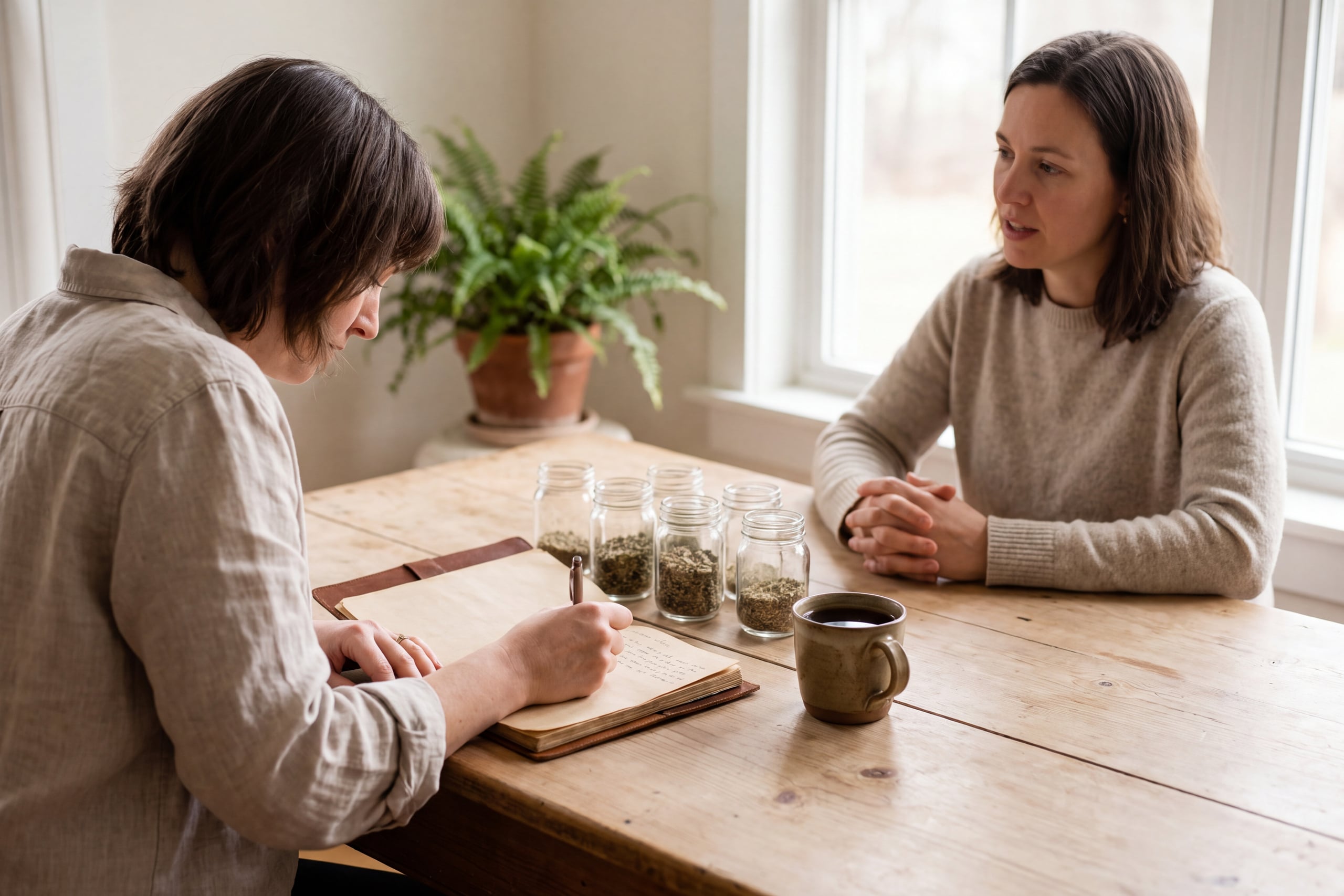
There is no federal license and no single government certification required to practice as an herbalist in the United States. The most widely recognized voluntary credential is the Registered Herbalist designation from the American Herbalists Guild, awarded through peer review rather than examination. As of August 2026, the Guild is not accepting new Registered Herbalist applications and has announced plans to reopen the process, with revised criteria giving applicants five years to log 80 individual client consultations, per the Guild’s application page updated 2026-08-03 and retrieved 2026-08-17.
That detail matters more than it might appear. Much of what is currently published about herbalist certification, including summaries generated automatically by search engines, still describes an older hour-based standard of roughly 800 study hours and several hundred clinical and client-contact hours. Anyone planning an application in 2026 should work from the Guild’s current published criteria rather than from those older figures.
A realistic path looks like this:
- Foundational coursework in botany, human anatomy and physiology, pharmacology, nutrition, and materia medica.
- Supervised clinical hours worked under an experienced practitioner.
- A log of individual client consultations accumulated over several years.
- Submission of written case studies for peer review by the credentialing body.
- Continuing education, because the safety and pharmacology literature keeps moving.
- Clarity about scope, since no amount of coursework confers a medical license.
The Guild also maintains a directory of member herb schools, which is a more reliable starting point than a general web search when comparing programs.
Are Herbalists Licensed in the United States?
No state licenses herbalists as a distinct profession. What varies between states is not the herbalist credential but the surrounding law, specifically how broadly each state defines the practice of medicine and what health-freedom or safe-harbor provisions it has enacted. A few states have passed statutes that expressly protect unlicensed complementary practitioners who disclose their training and stay within stated limits. Others have not, and the boundary there is defined by the medical practice act rather than by anything specific to herbalism.
One adjacent credential causes regular confusion. Practitioners of Chinese herbal medicine may hold certification through the National Certification Commission for Acupuncture and Oriental Medicine, and acupuncture is licensed in most states. That is a separate professional track with its own scope. Holding it does not make someone a Registered Herbalist, and holding a Registered Herbalist designation does not authorize acupuncture.
What an Herbalist Cannot Do
This section is the one most often left out, and it is the one that protects both practitioner and client.
An herbalist who is not separately licensed as a medical provider does not diagnose disease, does not treat disease, does not prescribe, does not order or interpret laboratory tests, and does not advise anyone to stop or change a prescribed medication. Herbal products sold in the United States are regulated as dietary supplements under the Dietary Supplement Health and Education Act, which places them in a different regulatory category from both conventional pharmaceuticals and FDA-reviewed botanical drugs, as described in Enioutina et al. (2020), Expert Review of Clinical Pharmacology, PMID: 32730191.
A practitioner who understands that boundary will say so unprompted. One who blurs it is a warning sign.
Are Herbalists Legitimate? How Do You Vet One?
The profession is legitimate. Individual practitioners vary, and because there is no license to check, the burden of assessment falls on you. From our editorial team’s review of how credentialing actually works, these are the questions worth asking before a first appointment:
- Where did you train, and for how long? A specific answer with a named program is a good sign.
- Do you hold a credential, and from which body? Registered Herbalist through the American Herbalists Guild is the recognized one in the US.
- Will you coordinate with my physician, and will you put your recommendations in writing?
- What will you not advise on? A practitioner who has a clear answer has thought about scope.
- How do you handle drug interactions with my current prescriptions?
The American Herbalists Guild maintains a public directory of Registered Herbalists, which is the most direct way to confirm that a credential someone claims is real.
Is Herbalism Backed by Science?
Herbal medicine, or phytotherapy, sits between two bodies of knowledge. One is long traditional use. The other is a growing but uneven modern research literature. Both matter, and collapsing one into the other causes problems in both directions.
Some plants have been studied extensively. Curcuma longa, the source of turmeric, is among the most heavily researched botanicals in the modern literature, though bioavailability remains an active research question rather than a settled one. Echinacea purpurea contains polysaccharides and alkylamides that have been studied for their role in supporting immune function. Many plants contain complex arrays of constituents that appear to act together rather than singly, which is part of why isolating a single molecule does not always reproduce the effect of the whole plant.
A fair reading of the evidence has to hold both halves. Some traditional uses have held up under controlled testing. Others have not. Our editorial team treats that unevenness as information rather than as something to write around.
Which Herbs Are Commonly Used in Western Herbal Practice?
A working Western practitioner draws on a core group of plants. Naming them properly, by Latin binomial, is part of the discipline, because common names are ambiguous across regions.
- Chamomile, Matricaria chamomilla, traditionally used to support calm and digestive comfort.
- Milk thistle, Silybum marianum, whose seed contains the silymarin complex, is traditionally associated with liver support.
- Elderberry, Sambucus nigra, used in syrups and traditionally associated with seasonal immune support.
- Nettle, Urtica dioica, a mineral-dense nutritive herb used as a long infusion.
- Hawthorn, Crataegus monogyna, traditionally associated with cardiovascular support.
- Ginger, Zingiber officinale, a warming carminative used for digestive comfort.
- Valerian, Valeriana officinalis, traditionally used to support restful sleep.
- Ashwagandha, Withania somnifera, an adaptogen from Ayurvedic tradition containing withanolides.
The National Center for Complementary and Integrative Health publishes individual fact sheets on more than fifty of these plants through its Herbs at a Glance series, and it is the most reliable free reference for what the current evidence does and does not show.
In our sourcing experience, the form of the material changes how a practitioner uses it. Whole-seed material behaves differently from a standardized extract fraction, which is one reason our organic milk thistle seed powder is offered as whole ground seed rather than as a concentrated silymarin isolate.
What Is a Materia Medica and Why Do Herbalists Build One?
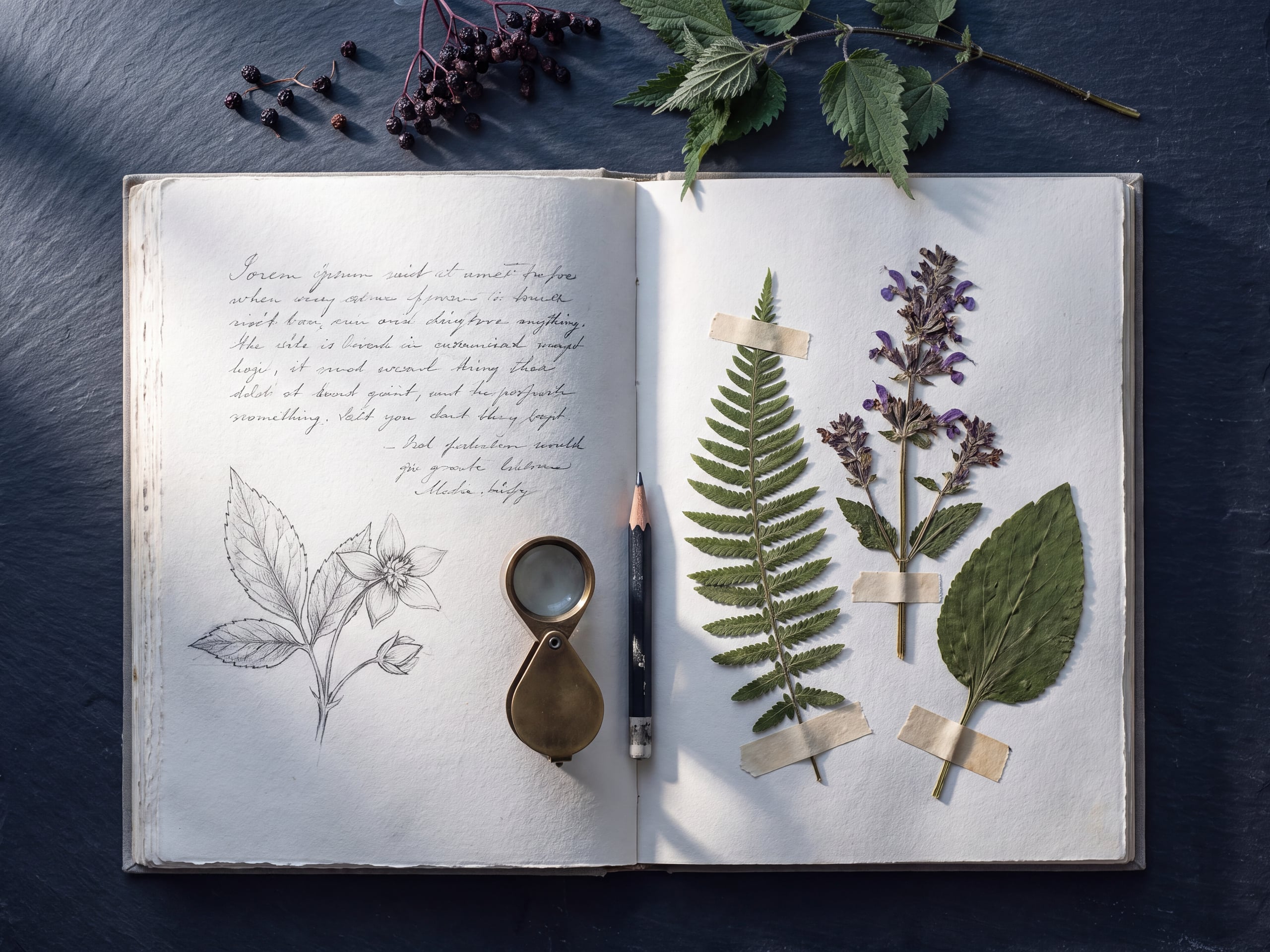
A materia medica is a practitioner’s own working encyclopedia of medicinal plants, built by hand over years. It is a rite of passage in herbal education and a permanent reference in practice. For each plant, an herbalist typically records the common and botanical names, the parts used, the plant’s traditional actions and uses, preparation methods and dosage ranges, and any known contraindications or interaction concerns.
The value is in the compiling. Writing an entry forces a practitioner to reconcile what the tradition says with what the research shows, and to notice where the two disagree.
Which Herbalists Shaped the Field?
Western herbalism has a documented lineage, and knowing it helps separate long-standing practice from recent invention. Hildegard of Bingen (1098 to 1179) recorded botanical and medical observations in twelfth-century Germany. Nicholas Culpeper (1616 to 1654) published his English-language herbal in 1653, deliberately writing in the vernacular rather than Latin so ordinary readers could use it. Samuel Thomson (1769 to 1843) built an American popular-herbalism system that spread widely in the nineteenth century. Maud Grieve (1858 to 1941) compiled A Modern Herbal in 1931, still one of the most consulted reference works in the field.
What Do Herbalists Earn?
Demand for practitioners with real botanical training has grown alongside general interest in complementary approaches. The career paths below are the ones that actually exist.
What Are the Career Paths in Herbalism?
| Career path | What the work involves |
|---|---|
| Clinical herbalist | Works directly with clients in private practice or in an integrative clinic setting. |
| Product developer | Formulates supplements, teas, extracts, and topical preparations for manufacturers. |
| Educator or author | Teaches classes and workshops, or writes books, courses, and articles on herbal practice. |
| Retail consultant | Advises customers in an apothecary or health food store on preparations and safe use. |
| Grower or wildcrafter | Cultivates or sustainably harvests medicinal plants for sale or for use in products. |
| Researcher | Conducts botanical or pharmacological studies in academic or private settings. |
| Quality and sourcing specialist | Vets raw material suppliers, verifies botanical identity, and manages testing protocols. |
How Much Do Herbalists Make?
Herbalist income is difficult to state precisely, and any single figure should be treated with caution. The US Bureau of Labor Statistics does not maintain a distinct Standard Occupational Classification code for herbalists, which means there is no federal wage survey covering the profession. Salary figures circulating online are drawn from job-board postings and self-reported surveys rather than from government data, and they should be read as rough estimates rather than as measured averages.
What can be said with more confidence is structural. Most working herbalists combine income streams rather than drawing a single salary. A practice might blend one-to-one consultations, product sales, teaching, and writing, with the mix shifting year to year. Consultation rates are set by the individual practitioner and vary widely by region and experience. Earnings in this field track business skill at least as closely as they track botanical knowledge, which is the part most training programs cover least.
Are Herbal Remedies Safe?
Natural does not mean inert, and professional herbalists are the first to say so. The clearest way to see this is in drug interactions, where the evidence is specific rather than general.
St. John’s wort, Hypericum perforatum, is the textbook case. It induces the cytochrome P450 enzymes CYP3A4 and CYP3A5, which speeds the clearance of a long list of prescription drugs and can reduce their intended effect. This has been confirmed in a controlled clinical study rather than predicted only from laboratory work, per Sprouse and van Breemen (2016), Drug Metabolism and Disposition, PMID: 26438626.
The same review makes a second point that receives far less attention. Several interactions predicted from laboratory data did not replicate when tested clinically. Milk thistle, Silybum marianum, is one of those. Blanket warnings and blanket reassurances are both wrong. The specifics are what matter, and a well-trained practitioner works from the specifics.
The National Center for Complementary and Integrative Health publishes a plain-language primer on how medications and supplements interact, which is a reasonable place to start before a consultation.
Three practical points apply to almost everyone:
- Tell your physician and pharmacist about every herbal product you take, including teas taken regularly.
- Be specific about the plant and the preparation. Species, plant part, and extract strength all change the picture.
- Raise pregnancy, nursing, upcoming surgery, and any prescription medication before starting anything new.
Informed consent is central to responsible practice. A practitioner should explain what they are recommending, what is known about it, what is not known, and what to watch for.
Frequently Asked Questions
Is an herbalist a doctor?
No. An herbalist is not a physician and is not licensed to practice medicine in the United States. Some individuals hold both an herbalist credential and a separate medical or nursing license, but the herbalist credential itself confers no medical authority. Herbalists do not diagnose, prescribe, or manage disease.
Do I need a degree to become a certified herbalist?
Not in the United States. There is no degree requirement and no federally mandated pathway. Training ranges from apprenticeship through formal herb school programs. The United Kingdom is different, where a medical herbalist typically holds a Bachelor of Science degree in herbal medicine. That British requirement is frequently mistaken for a US one.
How long does herbalist certification usually take?
Several years for most people, though there is no fixed term because the credential is not time-based. The American Herbalists Guild’s revised criteria give applicants five years to accumulate 80 individual client consultations before applying. Coursework and supervised clinical hours typically run alongside that period rather than before it.
Are there licensing rules for herbalists in my state?
No state licenses herbalists as a distinct profession. What differs between states is how broadly each defines the practice of medicine and whether it has enacted safe-harbor provisions for unlicensed complementary practitioners. Check your own state’s medical practice act, since that statute, rather than any herbalist-specific rule, sets the boundary.
What is the difference between a clinical herbalist and a community herbalist?
A clinical herbalist works one-to-one with clients in a structured consultation practice, often with formal training and case documentation. A community or folk herbalist works within a local circle, frequently in a tradition passed along informally. The distinction is about setting and formality of training rather than about depth of plant knowledge.
Can an herbalist tell me to stop taking my medication?
No, and a practitioner who does is operating outside their scope. Decisions about prescription medication belong to the prescriber. A responsible herbalist will ask what you take, watch for known interactions, and coordinate with your physician rather than work around them.
How do I find a qualified herbalist near me?
Start with the American Herbalists Guild’s public directory of Registered Herbalists, which lets you confirm that a claimed credential is real. Because no state license exists to verify, ask directly about training, credentialing body, and scope before booking a first appointment.
What kinds of concerns do people bring to an herbalist?
Most consultations concern general wellness goals such as sleep quality, stress resilience, digestive comfort, seasonal immune support, and energy. An herbalist supports wellness rather than addressing disease. Anything involving a diagnosed condition belongs with a licensed provider, ideally with the herbalist coordinating rather than substituting.
Related Reading
Continue with our related articles on adaptogens for stress, comparing the strongest adaptogens, and herbal teas for liver health.
Important: This article is for educational and informational purposes. The statements have not been evaluated by the Food and Drug Administration. The herbs and herbal products discussed are not intended to diagnose, treat, cure, or prevent any disease. Speak with a qualified healthcare provider before starting any new herbal regimen, especially if you are pregnant, nursing, taking medication, or managing a health condition.
References
- Cowan AE, Tooze JA, Gahche JJ, et al. Trends in Overall and Micronutrient-Containing Dietary Supplement Use in US Adults and Children, NHANES 2007-2018. Journal of Nutrition. 2022;152(12):2789-2801. PMID: 35918260. DOI: 10.1093/jn/nxac168
- Sprouse AA, van Breemen RB. Pharmacokinetic Interactions between Drugs and Botanical Dietary Supplements. Drug Metabolism and Disposition. 2016;44(2):162-171. PMID: 26438626. DOI: 10.1124/dmd.115.066902
- Enioutina EY, Job KM, Krepkova LV, et al. How can we improve the safe use of herbal medicine and other natural products? A clinical pharmacologist’s mission. Expert Review of Clinical Pharmacology. 2020;13(9):935-944. PMID: 32730191. DOI: 10.1080/17512433.2020.1803739
- American Herbalists Guild. Becoming a Registered Herbalist. Page updated 2026-08-03, retrieved 2026-08-17.
- National Center for Complementary and Integrative Health. Herbs at a Glance. Retrieved 2026-08-17.