Clinical-Grade He Shou Wu Capsules from the Daba Mountains
He shou wu capsules are a cornerstone of classical Chinese herbalism, and the quality of the root inside the capsule determines everything. Back To Your Roots Herbs sources Polygonum multiflorum (also catalogued as Reynoutria multiflora and as “fo-ti” in Western markets) from a single growing region in the Daba Mountain range at 32.05°N, 108.56°E. The Daba microclimate produces a denser, darker, more resinous root than lowland commercial stock, and the six-year maturation window is the minimum required by the Chinese Pharmacopoeia monograph for Radix Polygoni Multiflori Praeparata.
Every batch of our he shou wu supplement is cured using the traditional nine-steam, nine-sun black bean soup method. This is not a marketing phrase; it is the specific process that converts raw, astringent he shou wu root into the prepared form recognized in clinical Chinese herbal medicine. The preparation activates the stilbene glycosides while reducing the anthraquinone fraction responsible for the laxative action of the raw material. The result is a cured shou wu root with a sweet, smoky, umami profile rather than the bitter, harsh taste of uncured root.
What Makes Prepared He Shou Wu Different from Raw “Fo-Ti”
The Western supplement market often treats “fo-ti” and he shou wu as interchangeable. They are not. Raw Polygonum multiflorum root is classified in traditional Chinese pharmacology as a moving, descending herb used for short-term intestinal clearing. Prepared he shou wu root, the cured form inside every Back To Your Roots capsule, is classified as a restorative tonic directed toward the Liver and Kidney channels. The two preparations share a botanical source and share nothing else in clinical application.
The visible difference is stark. Raw root grinds to a fibrous, light-tan powder with an astringent aroma. Our prepared capsules open to a dense, dark-chocolate-brown powder with a deep earthy smell and notes of roasted nuts. That color shift is the visible signature of the black bean curing reaction.
The Marker Compound: 2,3,5,4′-THSG
The primary phytochemical marker of cured he shou wu root is 2,3,5,4′-tetrahydroxystilbene-2-O-β-D-glucoside, abbreviated as THSG. THSG is a stilbene glucoside structurally related to resveratrol and is the compound that the Chinese Pharmacopoeia uses to authenticate prepared Polygonum multiflorum material. Each serving of our he shou wu extract capsules delivers the THSG fraction characteristic of properly cured six-year root.
A 2015 peer-reviewed investigation published in Evidence-Based Complementary and Alternative Medicine (Li Y, Han M, Lin P, et al. “Hair Growth Promotion Activity and Its Mechanism of Polygonum multiflorum.” 2015;2015:517901. PMID: 26294926) examined the follicular activity of prepared Polygonum multiflorum root in a C57BL/6J mouse model and mapped its mechanism through β-catenin signaling. The study concluded that the prepared form (PMRP), not the raw form (PMR), was responsible for the hair-related outcomes observed.
Sourcing, Processing, and Quality Control
Daba Mountain Geography
The Daba range straddles the Sichuan-Shaanxi-Hubei border at roughly 32°N latitude. This is the upper edge of the historical Polygonum multiflorum growing belt and the region referenced in classical materia medica texts. Elevation, soil mineralization, and annual rainfall in the Daba range produce a visibly darker, denser root cortex than commercial Chinese lowland stock.
Six-Year Minimum Maturation
The Chinese Pharmacopoeia monograph for Radix Polygoni Multiflori Praeparata specifies the mature root. Back To Your Roots Herbs Research Group rejects any lot sourced from shou wu root younger than six growing seasons. Younger roots produce inconsistent THSG levels and retain a higher anthraquinone load.
Nine-Steam, Nine-Sun Black Bean Curing
The curing process is the single most important variable in he shou wu preparation. Raw sliced root is stewed with fermented black bean soup, then sun-dried, then re-steamed, then re-dried, and the cycle is repeated nine times. Each cycle deepens the color, sweetens the flavor, and progressively converts the chemistry from a raw laxative material to a restorative tonic material.
Capsule Composition
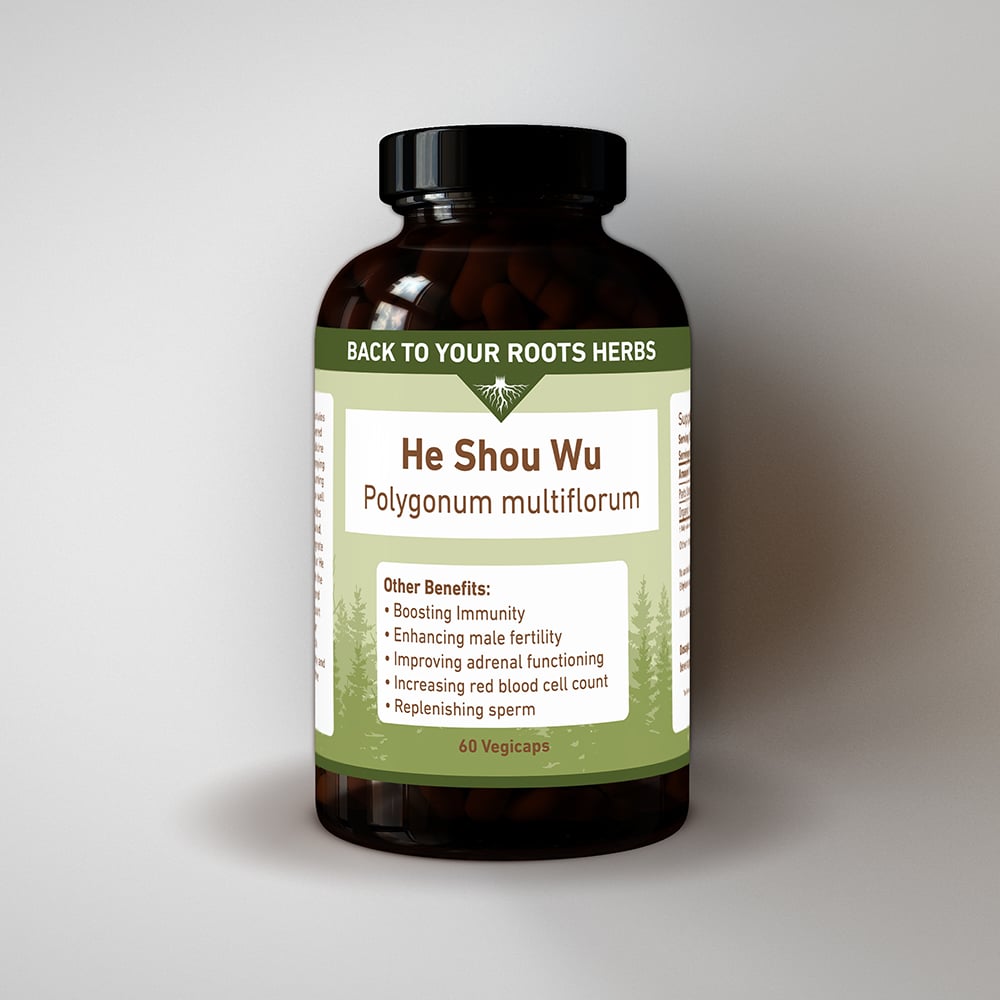
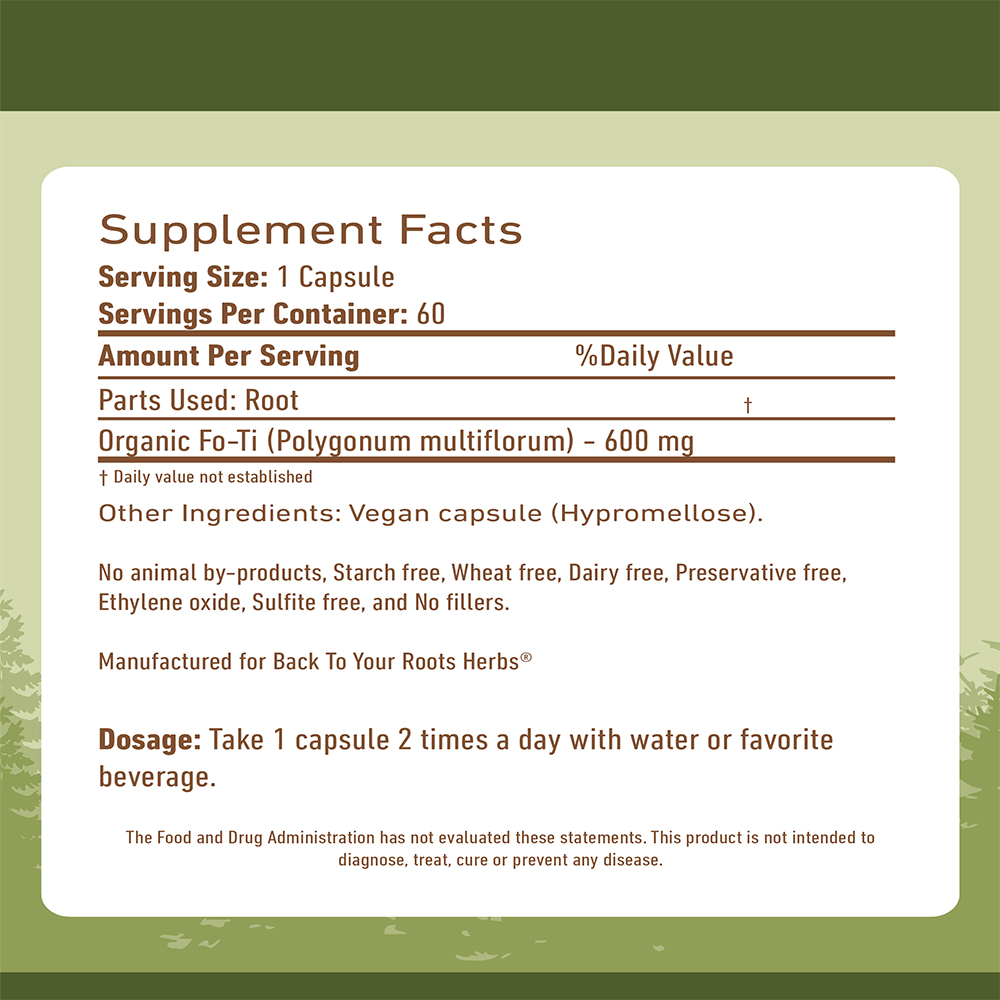
Every capsule is a plant-cellulose vegicap containing 500 mg of pure, prepared he shou wu powder. No magnesium stearate. No silicon dioxide. No rice filler. No maltodextrin. The only ingredient is the cured root itself.
Clinical Specs
| Attribute | Specification |
|---|---|
| Botanical Name | Polygonum multiflorum Thunb. (syn. Reynoutria multiflora) |
| Pharmacopoeia Name | Radix Polygoni Multiflori Praeparata |
| Part Used | 6-Year Mature Tuberous Root |
| Origin | Daba Mountains, Sichuan-Shaanxi border (32.05°N, 108.56°E) |
| Preparation | Nine-Steam / Nine-Sun Black Bean Soup Curing |
| Active Marker | 2,3,5,4′-Tetrahydroxystilbene-2-O-β-D-glucoside (THSG) |
| Capsule Count | 60 Vegicaps |
| Strength | 500 mg per capsule |
| Serving Size | 2 Capsules (1,000 mg) daily with warm water |
| Capsule Shell | Plant Cellulose Vegicap |
| Excipients | None (no magnesium stearate, no fillers, no flow agents) |
| SKU | FOCAP100 |
How Our Prepared Root Compares to Generic Fo-Ti
| Feature | BTYRH He Shou Wu Capsules | Generic “Fo-Ti” |
|---|---|---|
| Processing | Nine-steam, nine-sun black bean curing | Often raw or lightly dried |
| Source Region | Daba Mountains, 32.05°N 108.56°E | Unspecified lowland stock |
| Root Maturity | 6-year mature tuber | Undisclosed/mixed age |
| Pharmacopoeia Grade | Matches Radix Polygoni Multiflori Praeparata | Unverified |
| Color | Dark chocolate brown, dense grind | Light tan, fibrous grind |
| Taste Profile | Sweet, smoky, umami finish | Bitter, astringent, harsh |
| Capsule Fillers | None | Commonly magnesium stearate, silica, rice flour |
| Traditional Classification | Restorative Liver-Kidney tonic | Short-term intestinal clearing herb |
He Shou Wu Capsule Benefits and Traditional Uses
He shou wu earned its standing across centuries of Chinese herbalism for a specific cluster of traditional uses. The 2015 Journal of Ethnopharmacology review by Lin and colleagues catalogs the historical applications of Polygonum multiflorum as hair-darkening, Liver-and-Kidney-tonifying, and anti-aging (PMID: 25449462). Modern phytochemical work ties much of this profile to the stilbene fraction, led by THSG, the same marker compound our curing process is built to preserve.
- Antioxidant stilbene content. THSG is structurally related to resveratrol and is studied for antioxidant activity. This chemistry is the basis of he shou wu’s traditional anti-aging reputation.
- Traditional jing tonic. Prepared he shou wu is classified as a restorative for Liver and Kidney “jing” essence, the traditional framework that links the root to hair and vitality.
- Traditional beauty root. Within classical practice, he shou wu is the herb most associated with maintaining natural hair color and supporting the body’s own constitution through the aging process.
These are traditional-use and structure-function descriptions. They are not statements of disease treatment.
Does he shou wu support healthy hair and natural pigmentation?
Hair is the single most common reason people seek he shou wu. The connection is old. In Chinese herbal theory, hair is read as an outward expression of Kidney and Blood health, and prepared he shou wu is the classic tonic directed at that system. The herb’s Chinese name itself references the traditional account of restored dark hair.
There is mechanistic research behind the tradition. The 2015 study by Li and colleagues in Evidence-Based Complementary and Alternative Medicine mapped prepared Polygonum multiflorum activity at the hair follicle through β-catenin signaling in an animal model (PMID: 26294926). The prepared form, not the raw root, produced the follicular activity. This is why nine-steam curing matters for anyone choosing he shou wu with hair and scalp in mind.
He shou wu is traditionally used to support healthy hair and the body’s natural pigmentation processes. It is a botanical tonic, not a drug, and makes no claim to regrow hair or reverse graying.
Can he shou wu be used for hair and skin health together?
Yes, within a traditional-use framework. The same antioxidant stilbene chemistry that underlies the hair tradition also grounds he shou wu’s reputation as a beauty and longevity root. Classical practitioners used prepared he shou wu as a whole-system tonic rather than a single-target remedy, which is why hair and skin appear together in the old texts. Memorial Sloan Kettering’s About Herbs database profiles this same root under its Western name, fo-ti.
How long before you notice results from he shou wu?
He shou wu is a slow tonic, not a fast stimulant. Traditional use assumes consistent daily intake across many weeks, because jing-tonifying herbs are understood to work gradually as part of a steady routine. Most classical guidance frames he shou wu as a multi-month commitment taken at the standard two-capsule serving. Individual responses vary. No specific timeline or outcome is promised.
How he shou wu compares to other adaptogenic and beauty herbs
He shou wu sits in a different lane than the popular adaptogens. Ashwagandha and reishi are classed as adaptogenic herbs aimed at the stress response. He shou wu is a Blood and jing tonic aimed at the Liver-Kidney axis, which is the traditional root of the hair and aging discussion. Set against single-nutrient beauty products such as biotin or collagen, he shou wu is a whole-root botanical that carries its native stilbene profile rather than one isolated compound. Each category has its own job. He shou wu’s job is the traditional Jing-and-Blood tonic role.
Frequently Asked Questions About He Shou Wu Capsules
What is he shou wu used for in traditional Chinese herbalism?
In classical Chinese herbal practice, prepared he shou wu root (Radix Polygoni Multiflori Praeparata) is categorized as a Liver and Kidney channel tonic. It is used within traditional frameworks as a restorative for the “jing” essence. This is a traditional-use description, not a modern clinical claim.
How many he shou wu capsules should I take per day?
The recommended serving is two 500 mg capsules daily (1,000 mg total) taken with warm water. Do not exceed this serving unless directed by a qualified practitioner.
What is the difference between raw fo-ti and prepared he shou wu?
Raw Polygonum multiflorum root and prepared (cured) he shou wu root are treated as two distinct materials in Chinese pharmacology. Raw root is used for short-term intestinal movement. Prepared root, cured in black bean soup through the nine-steam, nine-sun method, is the restorative tonic form referenced in classical texts.
What is 2,3,5,4′-THSG and why does it matter?
2,3,5,4′-tetrahydroxystilbene-2-O-β-D-glucoside is the stilbene glucoside marker compound used by the Chinese Pharmacopoeia to authenticate prepared Polygonum multiflorum material. Its presence confirms proper curing and proper species identification.
Is he shou wu safe for everyone?
No. Prepared he shou wu should not be used by individuals with liver disease, individuals with a history of idiosyncratic drug-induced liver reactions, individuals who consume alcohol heavily, pregnant or nursing women, or children. Although traditional black bean curing reduces raw-root toxicity, rare idiosyncratic hepatic reactions have been documented. Discontinue immediately and consult a physician if you experience fatigue, abdominal discomfort, dark urine, or jaundice.
Is this he shou wu supplement vegan?
Yes. Each capsule is a plant-cellulose vegicap containing only prepared Polygonum multiflorum root powder. No animal derivatives, no magnesium stearate, no fillers.
Critical Safety Information
Do not use this product if you have liver disease, a history of drug-induced liver injury, or if you consume alcohol heavily. Stop use immediately and consult a physician if you experience unusual fatigue, abdominal pain, loss of appetite, or jaundice. Not for use during pregnancy or lactation. Keep out of reach of children.
Is he shou wu safe for long-term use?
Long-term use deserves specific caution. Polygonum multiflorum is one of the more commonly reported botanical causes of idiosyncratic liver injury, and the reactions are unpredictable rather than dose-dependent. A 2015 systematic review in Evidence-Based Complementary and Alternative Medicine (Lei et al., DOI: 10.1155/2015/459749) examined 450 reported cases and found that symptoms most often appeared about a month into use, showing up as fatigue, appetite loss, dark urine, or jaundice. Traditional black bean curing is relevant here. A 2024 comparative study found that the prepared (praeparata) form carries a different hepatotoxicity profile than raw root (PMID: 38632548), one reason we reject raw and under-cured stock. For anyone weighing extended daily use, periodic liver-enzyme monitoring with a physician is the sensible precaution, and the U.S. National Institutes of Health maintains a detailed He Shou Wu LiverTox monograph for reference. Cycle the herb, keep it away from heavy alcohol use, and stop at the first sign of the symptoms above.
Reviewed by the Back To Your Roots Herbs Editorial Team. Last Reviewed: June 2026. Our herbal content is grounded in primary research and classical materia medica. Key references for this page: PMID 26294926, PMID 25449462, PMID 38632548, and the NIH LiverTox He Shou Wu monograph.
These statements have not been evaluated by the Food and Drug Administration. This product is not intended to diagnose, treat, cure, or prevent any disease. Consult a qualified healthcare practitioner before use, especially if you take prescription medication or have a pre-existing medical condition.
Reviews
There are no reviews yet.