Traditional Uses of Eucommia Bark in Chinese Medicine
Eucommia ulmoides, commonly referred to as Du Zhong in Traditional Chinese Medicine (TCM), has been a cornerstone of herbal remedies for millennia. Its use is deeply rooted in the principles of TCM, where it’s revered for its ability to balance qi (vital energy) and strengthen yang, representing the body’s dynamic balance and vital force.
Historically, TCM practitioners have prescribed Eucommia ulmoides for a wide array of conditions. Its primary action is on the Liver and Kidney meridians, making it a key herb for addressing issues related to these systems. Ancient texts document its use in formulas designed to fortify sinews and bones, alleviate pain, and enhance overall vitality. It’s considered sweet, slightly acrid, and warm in nature.
Specifically, Du Zhong is known for the following TCM actions:
- Tonifies the Kidneys and Liver.
- Strengthens the sinews and bones.
- Was traditionally associated with calming and steadying a pregnancy (the TCM concept of an tai, or settling the fetus). Traditional use is not a medical recommendation, and safety data in pregnancy is limited, so see the precautions below.
- Aids in the smooth flow of Qi and Blood.
The herb’s application extends to promoting longevity and supporting the lower back and knees, areas often associated with aging and daily wear. Its adaptogenic properties also include supporting a healthy pregnancy and showcasing its versatility in promoting health across different life stages.
Nutritional Composition and Health Benefits of Eucommia Bark
Eucommia bark possesses a rich nutritional profile, making it a valuable addition to a health-conscious lifestyle. Its bioactive compounds, including lignans, iridoids, phenolics, and flavonoids, contribute to a range of health benefits. The bark is particularly valued for its ability to support kidney health, promote a healthy skeletal system, and maintain healthy blood pressure levels.
Research highlights its medicinal properties, especially in promoting cardiovascular health and protecting against the stresses of modern life. Its ability to combat oxidative stress and inflammation establishes it as a key component in health regimens focused on longevity and vitality. The phenolics and flavonoids contained in Du Zhong can help react with free radicals.
Specifically, eucommia bark’s contribution to kidney function and blood pressure regulation is significant. Studies indicate that compounds within the bark can stimulate the production of substances that enhance the strength and functionality of these systems. This reinforces its status in traditional medicine as a critical element in managing related conditions.
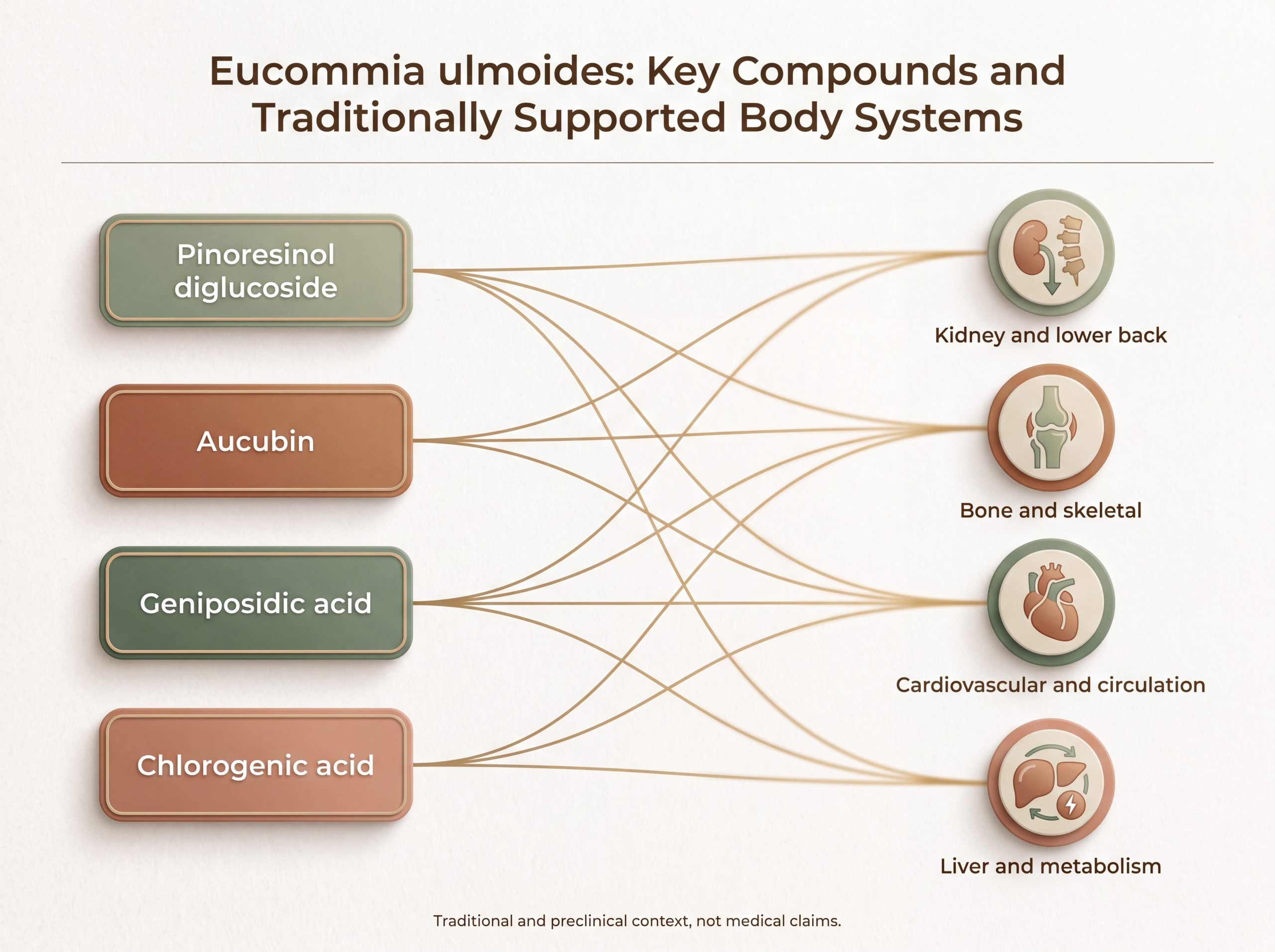
In our sourcing experience, the most studied constituents of Eucommia ulmoides bark fall into a few families: lignans such as pinoresinol diglucoside, iridoids such as aucubin and geniposidic acid, and phenolic acids such as chlorogenic acid. A network-pharmacology analysis of the bark’s iridoid glycosides mapped several of these compounds to bone-supporting pathways (Wang et al., 2022, Scientific Reports, PMID: 35523810), and a dedicated pharmacology and toxicology review catalogued the activity and safety profile of aucubin across several body systems (Zeng et al., 2020, Fitoterapia, PMID: 31790767).
Eucommia Bark vs. Eucommia Leaf: What Is the Difference?
Shoppers often ask our team whether eucommia leaf is interchangeable with the bark. They come from the same tree, Eucommia ulmoides, but they are not the same material. Du Zhong, the traditional Chinese tonic, is specifically the dried stem bark, and it carries the lignan and iridoid profile, including pinoresinol diglucoside and aucubin, that TCM has long relied on for kidney and bone support. The leaf, sold widely as a tea, is richer in chlorogenic acid and is the part most often studied for everyday antioxidant and lipid-related effects (Zhou et al., 2022, Journal of Pharmaceutical Analysis, PMID: 36320603). In our sourcing experience, a product that simply says eucommia tea is usually leaf, while capsules and powders labeled Du Zhong or eucommia bark are the traditional tonic material.
Modern Research on the Medicinal Properties of Eucommia Bark
The intersection of traditional knowledge and modern scientific inquiry has shed light on the mechanisms behind Eucommia bark’s long-standing health benefits. Studies have focused on quantifying the effects of Eucommia ulmoides on human health, using rigorous methods to understand its medicinal properties.
Cardiovascular Health and Blood Pressure
A significant area of research involves the bark’s impact on blood pressure. Studies have shown that extracts from Eucommia bark can have antihypertensive effects, helping to lower high blood pressure. This is attributed to the bark’s ability to promote vascular health and improve blood circulation. It may act as a vasodilator, potentially due to its lignan content, and may also influence vascular remodeling. Some research suggests it may have beta-adrenergic blocking activity and increase nitric oxide production, further contributing to its blood pressure-lowering effects.
Our editorial team reviewed the antihypertensive literature behind this traditional reputation. In spontaneously hypertensive rats, Eucommia ulmoides extracts were reported to reduce blood pressure (Luo et al., 2010, Journal of Ethnopharmacology, PMID: 20347950), and a later study attributed part of the effect to the iridoid geniposidic acid alongside improved renal blood flow (Hosoo et al., 2021, Biomedicine & Pharmacotherapy, PMID: 34328117). These are animal-model findings, and as the research note further down the page explains, they have not yet been confirmed in human clinical trials.
Bone Health and Osteoporosis
The growth-promoting effects of Eucommia bark on bone health have also garnered scientific attention. Research suggests that the extract can stimulate the activity of osteoblasts (bone-forming cells) while inhibiting osteoclasts (bone-resorbing cells). This dual action can contribute to increased bone mineral density and may offer benefits for conditions like osteoporosis.
The skeletal research is similar in character. Total lignans isolated from Eucommia bark were reported to reduce bone loss in laboratory and animal models (Zhang et al., 2014, Journal of Ethnopharmacology, PMID: 24786573), and a Du-Zhong cortex extract eased bone loss in a separate rat study (Liu et al., 2019, Biological Trace Element Research, PMID: 29740803). Our team reads these as supportive preclinical signals for the traditional bone-strengthening reputation, not as evidence of a treatment for osteoporosis.
Kidney Health
Eucommia ulmoides has a long history of use in TCM for supporting kidney function. Modern research is beginning to explore this traditional use, with some studies suggesting potential benefits in conditions like diabetic nephropathy. Research indicates it may help reduce kidney fibrosis.
Liver Health
Emerging research suggests that Eucommia bark may also have hepatoprotective effects. Studies have indicated that it may help reduce liver lipid accumulation and enhance lysosomal enzyme activity, contributing to overall liver health.
Anti-inflammatory and Antioxidant Properties
Eucommia bark’s antioxidant and anti-inflammatory properties are also under investigation. Studies suggest that it can inhibit the release of inflammatory mediators like nitric oxide (NO), TNF-α, IL-6, and IL-17A. This points to its potential role in managing conditions related to inflammation and oxidative stress.
On the antioxidant and anti-inflammatory side, the bark’s phenolic and iridoid fractions draw most of the attention. One study profiling the herb’s active-ingredient content also reported anti-rheumatoid-arthritis activity in an animal model (Sun et al., 2023, Fitoterapia, PMID: 37673275). As with the cardiovascular and bone research, these are preclinical mechanisms rather than confirmed human outcomes.
Metabolic Benefits and Obesity
Preliminary research suggests that Eucommia ulmoides may offer metabolic benefits. Some studies have explored its potential role in improving lipid metabolism and insulin resistance. Further research is needed to clarify these effects, especially the effects of eucommia leaves on induced obesity.
It’s important to acknowledge that much of the current research on Eucommia bark is preclinical, meaning it has been conducted on cells (in vitro) or animals. While these studies provide valuable insights, their results don’t automatically translate to the same effects in humans. More clinical trials are needed to confirm these findings and determine optimal dosages and long-term safety in humans.
Eucommia also comes up in conversations about male vitality and testosterone, an area with its own traditional context and a separate body of preclinical research. Because that topic deserves a fuller, careful treatment, our team covers it in a dedicated guide: Eucommia bark and testosterone.
Ways to Incorporate Eucommia Bark into Your Daily Routine
Integrating Eucommia bark into your daily routine can be achieved through several simple and effective methods:
Tea Infusions
A traditional and comforting way to consume Eucommia bark is by preparing a tea. Steeping approximately 3-9 grams of the dried bark in hot water for 10-15 minutes creates a beverage that incorporates its beneficial properties. This method aligns well with the daily habits of tea drinkers.
Supplements
Eucommia bark supplements, available in capsule or powder form, offer a concentrated and convenient way to incorporate the herb into your health regimen. When choosing a supplement, look for standardized extracts, particularly those standardized for pinoresinol diglucoside content, a key active compound. A preparation method for standardized extracts of eucommia ulmoides pinoresinol diglucoside exists.
For readers who prefer a ready-made option, our team offers Eucommia in two traditional forms: Eucommia bark capsules for convenient daily use and Eucommia bark powder for teas and decoctions.
Herbal Formulas
In TCM, Eucommia bark is often included in herbal formulas alongside other herbs, creating a synergistic blend tailored to specific health goals. Consulting with a qualified TCM practitioner can help you determine the most appropriate formula for your individual needs.
Topical Applications
Eucommia bark extract can also be found in creams and salves for external use. This method is particularly useful for addressing localized discomfort, such as back pain and muscle soreness. Because it helps the circulation of Qi and blood to the limbs, it can promote joint well-being.
How Long Until You Notice Effects?
Du Zhong is a traditional tonic, not a quick fix, and our team frames it that way for customers. In classical TCM practice, kidney-and-liver tonics like Eucommia are taken steadily over weeks as part of a daily routine rather than for a single acute result, and traditional sources describe support that builds gradually with consistent use. Because individual response varies and the human research is still limited, we suggest starting at the lower end of the traditional 3 to 15 gram daily range, keeping a simple note of how you feel, and checking in with a qualified practitioner before making it a long-term habit. The National Center for Complementary and Integrative Health also publishes practical guidance on using dietary supplements wisely.
Potential Side Effects and Precautions
While Eucommia bark is generally considered safe for most people when used appropriately, it’s essential to be aware of potential side effects and precautions:
Pregnancy and Breastfeeding
There is limited data on the safety of Eucommia bark during pregnancy and breastfeeding. It’s advisable for those who are pregnant or nursing to avoid its use or consult a healthcare professional before doing so.
Medication Interactions
Eucommia bark may interact with certain medications, including:
- Anticoagulants/Antiplatelets: May increase the risk of bleeding.
- Antihypertensives: May have additive blood pressure-lowering effects.
- Antidiabetic medications: May potentially lead to hypoglycemia.
If you are taking any of these medications, it’s crucial to consult your healthcare provider before using Eucommia bark.
Allergies
Individuals with a known allergy to latex must exercise caution with Eucommia bark. The Eucommia ulmoides tree contains natural latex, and allergic reactions are possible. Symptoms can range from mild skin irritation to severe anaphylaxis.
Estrogen-Dependent Cancers
Eucommia ulmoides is contraindicated in individuals with estrogen-dependent cancers. Consult with an oncologist or healthcare professional before using.
Long-Term Use
While generally considered safe, long-term, high-dose administration of Eucommia ulmoides extract may lead to reversible nephrotoxicity (kidney damage). More research is needed to fully understand the long-term effects. It’s generally recommended to vary herbal intake and not rely on a single supplement indefinitely.
Dosage
There is no single standard recommended dose of Eucommia bark. Dosages used in studies vary, and traditional usage ranges from 3-15 grams per day in decoction (tea). It’s always best to start with a low dose and gradually increase it under the guidance of a qualified healthcare professional, such as a licensed acupuncturist or a doctor specializing in TCM.
Du Zhong (Eucommia Bark) FAQ
What is Du Zhong (Eucommia bark) traditionally used for?
Du Zhong is the dried bark of Eucommia ulmoides. In Traditional Chinese Medicine it is classed as a kidney-and-liver yang tonic and has traditionally been used to support the lower back and knees, strengthen the sinews and bones, and promote overall vitality. These are traditional structure and function uses, not treatments for any disease.
How long has Du Zhong been used in Traditional Chinese Medicine?
Eucommia bark appears in Chinese herbal texts going back roughly two thousand years and is listed in classical materia medica as a superior tonic herb with a long, continuous record of use on the kidney and liver meridians. For background on this tradition, the U.S. National Center for Complementary and Integrative Health offers an overview of Traditional Chinese Medicine.
Can Du Zhong be combined with other herbs?
Yes. In Traditional Chinese Medicine, Eucommia is rarely used alone. It is usually built into formulas with other herbs chosen for a specific goal so the herbs work together, and a qualified TCM practitioner can match the right combination to an individual constitution.
Is Du Zhong safe to take daily?
Eucommia bark is generally well tolerated when used appropriately, and traditional dosing runs about 3 to 15 grams daily as a decoction. People who are pregnant or nursing, who have a latex allergy, or who have an estrogen-dependent cancer should avoid it or speak with a healthcare provider first, and long-term high-dose use is best avoided. Consult your healthcare provider before daily use.
What is the difference between eucommia bark and eucommia leaf?
Both come from Eucommia ulmoides, but the bark (Du Zhong) is the traditional tonic, richer in lignans and iridoids, while the leaf is higher in chlorogenic acid and is most common as a tea. They have overlapping but not identical compound profiles and traditional uses.
Disclaimer: These statements have not been evaluated by the Food and Drug Administration. This product is not intended to diagnose, treat, cure, or prevent any disease. The information in this article is for educational purposes only and is not a substitute for advice from a qualified healthcare provider. Consult your healthcare provider before use, especially if you are pregnant, nursing, taking medication, or managing a health condition. For general guidance on botanical supplements, see the NIH Office of Dietary Supplements botanical background.