THE VERDICT (POTENCY VERIFICATION):
Potency Score: 9.2/10. This devil’s claw root powder originates from wild-crafted Harpagophytum procumbens secondary tubers harvested in the Kalahari Basin of Namibia (22.56°S, 19.99°E). The sandy, mineral-rich soils of this region produce root systems with harpagoside concentrations that meet or exceed the European Pharmacopoeia minimum of 1.2%. Unlike standardized extracts that isolate single compounds, this whole-root powder preserves the full iridoid glycoside profile. Research by Mariano et al. (2022, PMID: 35455454) confirmed whole phytocomplexes outperform isolated harpagoside in activating CB2 cannabinoid receptors, a pathway directly tied to the body’s natural inflammatory response. Batch-tested for heavy metals (≤ 10 ppm).
– Back To Your Roots Herbs Research Group
SENSORY ANALYSIS:
Devil’s Claw Root Powder Appearance and Flavor
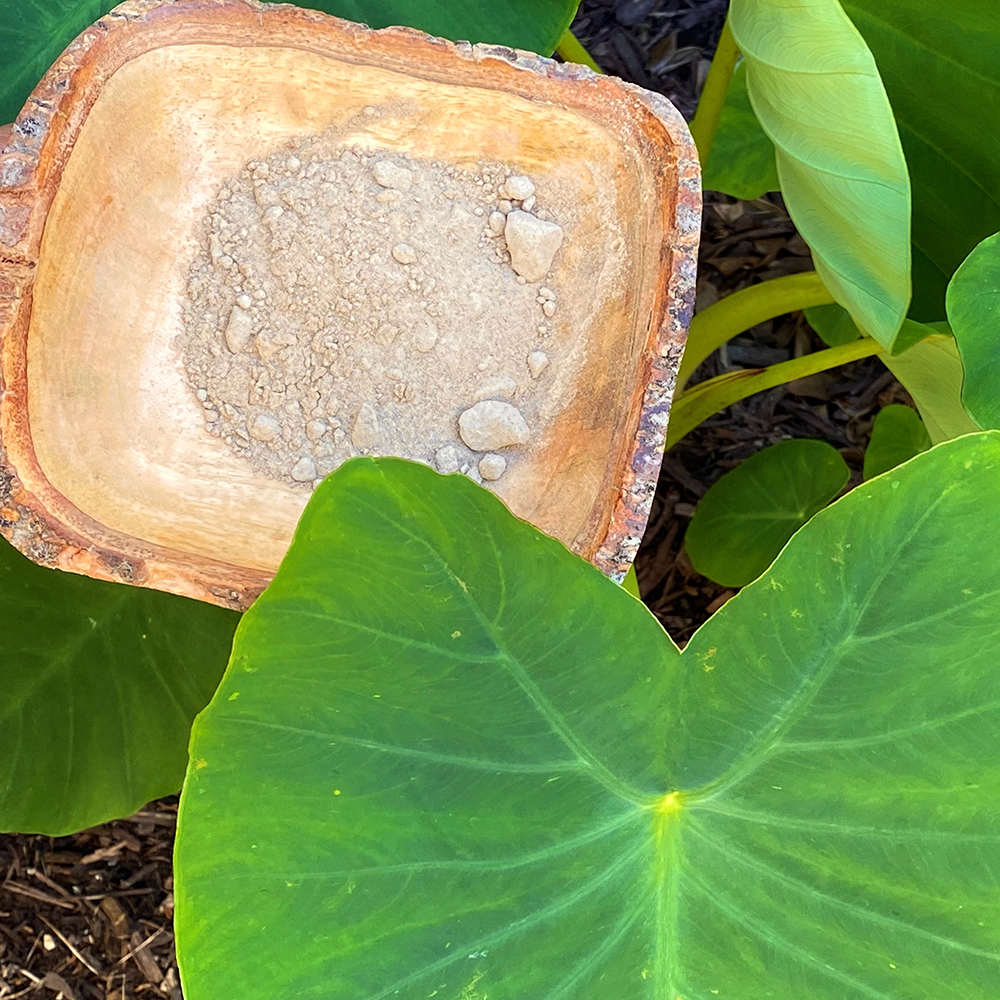
- Look: Fine, tan-to-light-brown powder with a slightly fibrous texture. Consistent grind. No visible foreign matter or discoloration.
- Smell: Faint earthy aroma with a dry, slightly woody undertone. Not pungent. Minimal scent until mixed with liquid.
- Taste: Intensely bitter. The bitterness comes from the iridoid glycosides (harpagoside, harpagide, procumbide). This bitterness is the quality marker. If your devil’s claw powder is not bitter, the active compounds may be degraded or absent.
HOW DOES DEVIL’S CLAW ROOT POWDER WORK?
Primary traditional uses: joint comfort, mobility, and a healthy inflammatory response.
Harpagophytum Procumbens Active Compounds
- The Herb: Harpagophytum procumbens sourced from the Kalahari Basin, Namibia. The San and Khoi peoples of southern Africa used devil’s claw root for generations before European contact. Traditional applications went far beyond joint support and included digestive disorders, fever, blood conditions, postpartum recovery, and topical wound care.
- The Mechanism: Devil’s claw root contains iridoid glycosides (primarily harpagoside, harpagide, and procumbide) that act on CB2 cannabinoid receptors in joint tissue. This triggers a downregulation of PI-PLC β2 in synovial membranes, reducing the production of inflammatory mediators at the cellular level. Devil’s claw also inhibits COX enzymes and blocks the AP-1 inflammatory pathway. The whole-root powder formula delivers the complete spectrum of these compounds rather than a single isolated extract.
- The Evidence: Research by Farpour et al. (2021, PMID: 34712343) demonstrated that Harpagophytum procumbens at 960 mg daily reduced pain scores and improved mobility in knee osteoarthritis patients over 8 weeks, with results comparable to the NSAID meloxicam (15 mg). A separate 2022 study (PMID: 35455454) confirmed CB2 receptor activation as a novel anti-inflammatory mechanism. A 90-day animal study also documented reduced uric acid levels, supporting traditional kidney and uric acid formula applications.
Wild-Crafted Devil’s Claw vs. Cultivated Sources
Wild-crafted devil’s claw root from the Kalahari grows in deep sandy soils under extreme conditions. These conditions stress the root system, concentrating the active iridoid glycosides in the secondary tubers. Cultivated specimens grown outside their native range produce lower harpagoside concentrations. Back To Your Roots Herbs sources only wild-crafted Harpagophytum procumbens root to preserve this natural potency.
Sustainability and Harvesting Practices
Only secondary tubers are harvested. The primary tuber and root crown remain intact, allowing the plant to regenerate. Field studies confirm a 70% survival rate in harvested populations. Between 10,000 and 15,000 harvesters across Namibia, Botswana, and South Africa depend on this wild-crafted supply chain. Governments in all three range states regulate harvest volumes.
CRITICAL USAGE:
Devil’s Claw Root Powder Dosage and Safety
Suggested Use: Take 1/2 to 1 tablespoon of dried devil’s claw root powder in 8 oz of juice, smoothie, or water once daily. Start with the lower dose to assess tolerance. The root is intensely bitter, so juice or a smoothie masks the taste best, and consistent daily use matters more than a single large dose.
Duration: Clinical studies used 4 to 8 week treatment periods. Consult your healthcare provider for use beyond 8 weeks.
Devil’s Claw Side Effects and Interactions
Contraindications:
- Do not use if you take Warfarin (Coumadin) or other blood-thinning medications. Devil’s claw may affect how the liver processes these drugs.
- Devil’s claw interacts with medications metabolized by CYP3A4, CYP2C19, and CYP2C9 liver enzymes. If you take prescription medications metabolized by the liver, consult your doctor before use.
- Avoid if pregnant or nursing.
- People with gallstones, stomach ulcers, or heart conditions should consult a physician before use.
- Devil’s claw may affect blood sugar levels. Monitor closely if diabetic.
- Possible side effects include mild digestive upset, diarrhea, or headache at high doses.
CLINICAL SPECS:
| Spec | Detail |
|---|---|
| Serving Size | 1/2 to 1 Tablespoon (approx. 3-6 g) |
| Frequency | Once Daily |
| Active Marker | Harpagoside (Iridoid Glycoside) – min 1.2% per EP standard |
| Processing | Whole Root, Dried, Ground to Fine Powder |
| Safety | Heavy Metal Tested (Pass) – ≤ 10 ppm |
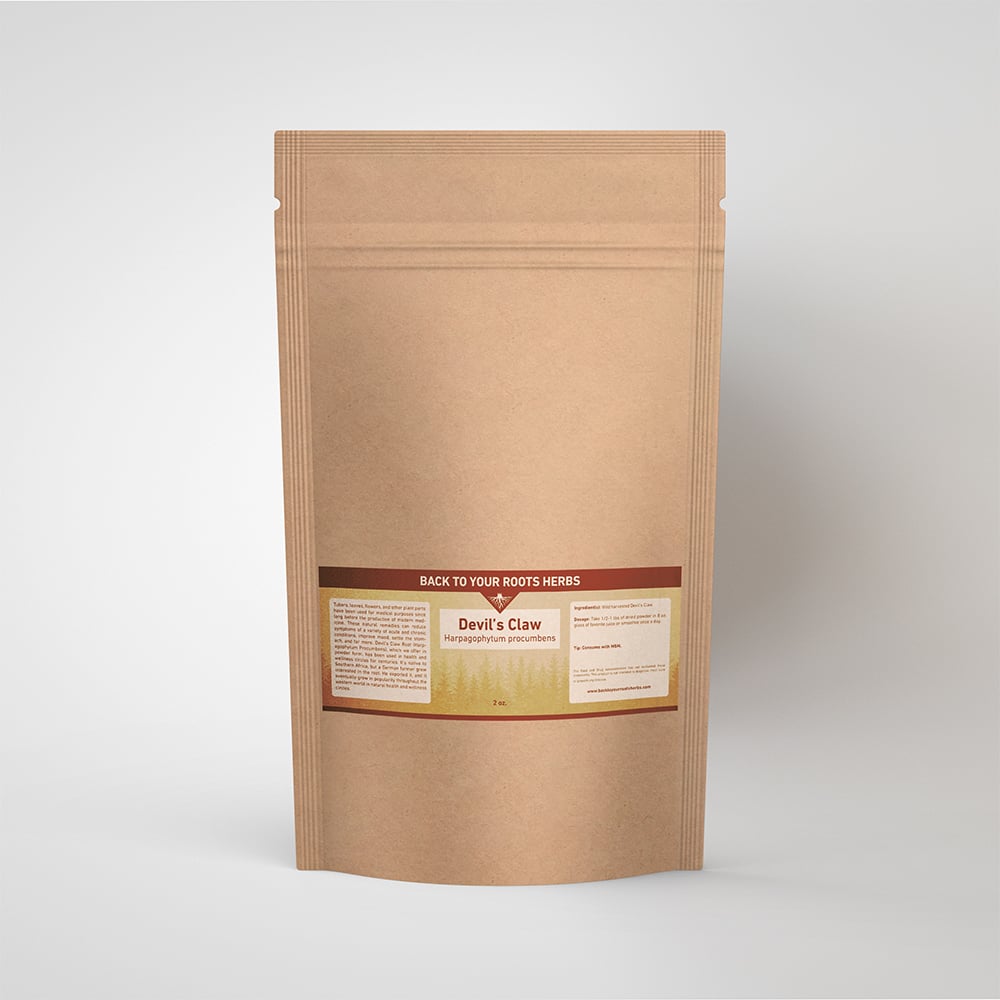
| Ingredients | Harpagophytum procumbens (Devil’s Claw) Root Powder |
| Other Ingredients | None |
| Purity | Non-GMO, Vegan, Wild-Crafted |
| Free From | Wheat, Gluten, Soy, Dairy, Binders, Fillers |
| Origin | Kalahari Basin, Namibia (22.56°S, 19.99°E) |
| Manufactured | Virginia Beach, VA, USA |
COMPARISON TABLE:
Why Choose Back To Your Roots Herbs Devil’s Claw
| Feature | BTYRH Devil’s Claw Root Powder | Generic Devil’s Claw Supplement |
|---|---|---|
| Origin | Kalahari Basin, Namibia (Wild-Crafted) | Unspecified / Cultivated |
| Preparation | Whole Root Powder (Full Spectrum) | Standardized Extract (Isolated Compound) |
| Taste | Intensely Bitter (Active Iridoid Marker) | Mild / Capsule-Masked |
| Safety | Heavy Metal Tested, Batch-Verified | Unknown / Untested |
DEVIL’S CLAW ROOT POWDER: FREQUENTLY ASKED QUESTIONS
What is devil’s claw root powder, and who is it for?
Devil’s claw is the dried root of Harpagophytum procumbens, a plant native to the Kalahari Basin of southern Africa, named for the small hooks on its fruit. This whole-root powder suits people who prefer a full-spectrum botanical over an isolated extract for traditional joint and mobility support. The root is intensely bitter, so most people mix it into liquid.
What are the health benefits of devil’s claw root powder?
Devil’s claw root is traditionally used to support joint comfort, mobility, and a healthy inflammatory response. Its iridoid glycosides (harpagoside, harpagide, and procumbide) are the studied active compounds. Herbalists in southern Africa also used the root for digestive support. These are traditional structure and function uses, not disease claims.
How do I use devil’s claw root powder effectively?
Mix 1/2 to 1 tablespoon (about 3 to 6 g) of powder into 8 oz of juice, smoothie, or water once daily. The root is intensely bitter, so juice or a smoothie masks the taste best. Start at the lower amount to assess tolerance. Clinical studies used consistent daily intake across 4 to 8-week periods, so regular use matters more than a single large dose.
Can devil’s claw root powder be used for arthritis relief?
Devil’s claw is traditionally used to support joint comfort. In a 2021 randomized clinical trial (Farpour et al., PMID: 34712343), Harpagophytum procumbens at 960 mg daily was associated with improved pain and function scores in knee osteoarthritis over 8 weeks, comparable to the NSAID meloxicam. Discuss any arthritis condition with your healthcare provider. This root is a traditional botanical, not a treatment.
Is devil’s claw root powder safe for long-term use?
Most clinical studies on devil’s claw ran 4 to 8 weeks, so long-term safety data is limited. The root is generally well-tolerated by healthy adults at suggested amounts. Avoid use if pregnant or nursing, or if you take blood thinners or medications processed by the liver. Consult your healthcare provider before using it beyond 8 weeks.
Authoritative references: Farpour et al., 2021 (knee osteoarthritis trial), Mariano et al., 2022 (CB2 mechanism), Memorial Sloan Kettering About Herbs: Devil’s Claw, and the NCCIH review of devil’s claw for osteoarthritis and back pain.
DISCLAIMER:
These statements have not been evaluated by the Food and Drug Administration. This product is not intended to diagnose, treat, cure, or prevent any disease. Consult your healthcare provider before use if you are pregnant, nursing, taking medication, or have a medical condition.
Reviews
There are no reviews yet.