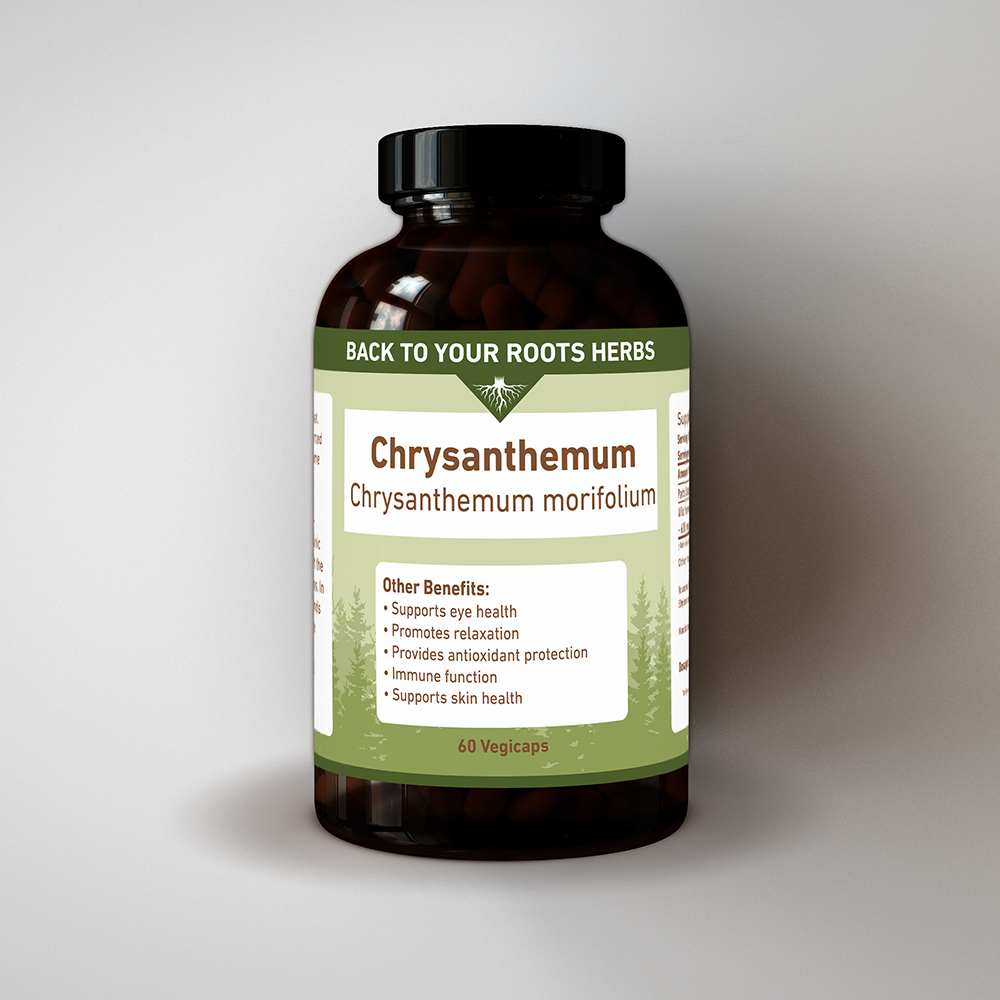
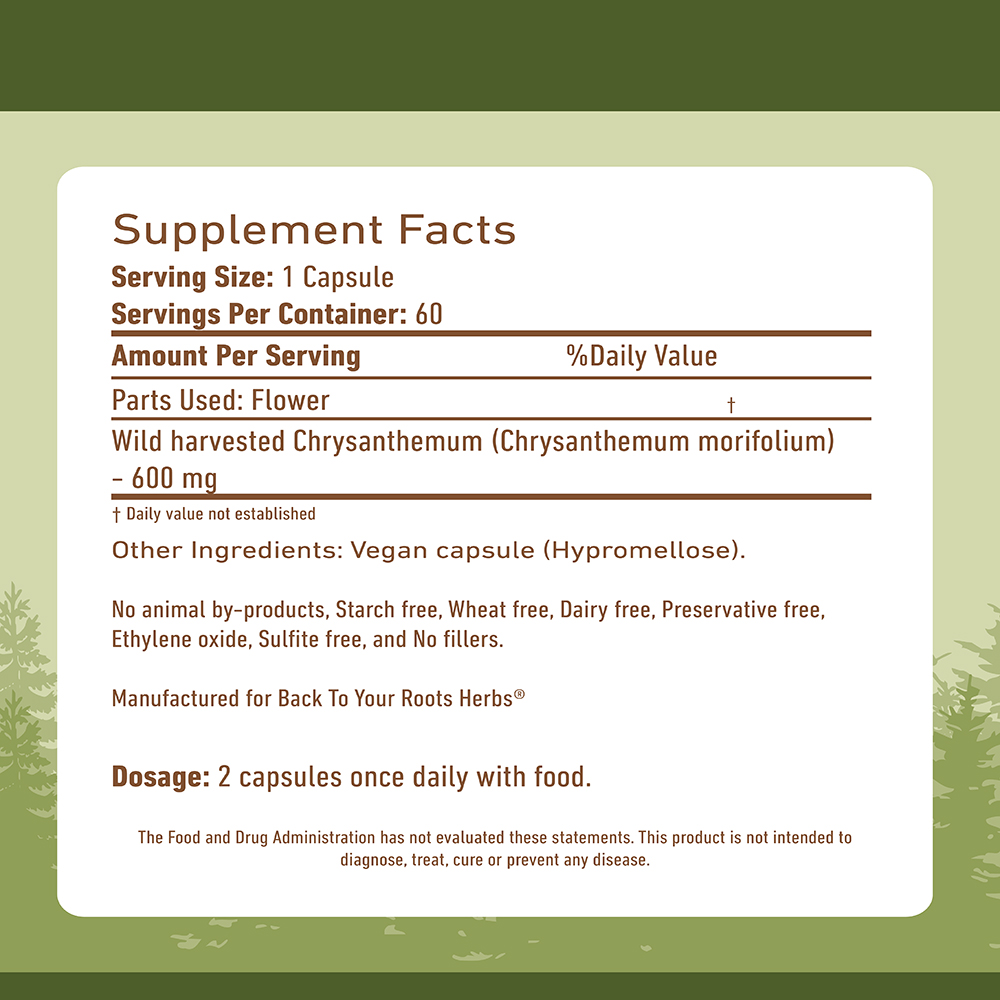
This chrysanthemum supplement holds a single herb: whole, autumn-harvested Chrysanthemum morifolium flower heads from Zhejiang Province, China, milled to a fine powder and packed at 500 mg per vegetarian capsule. Chinese herbalists call this chrysanthemum flower Ju Hua, and Chinese families steep it as chrysanthemum tea. No extract. No fillers. Many chrysanthemum supplements skip the species or the plant part. This dietary supplement names both, plus the province, the bare minimum any herbal supplement should tell you.
THE VERDICT (INTERNAL QUALITY SCORE):
Grade A. Single-species Chrysanthemum morifolium flower heads from Zhejiang Province, the coastal province south of Shanghai whose northern plains gave China the Hangju chrysanthemum. The powder smells of hay and honey, tastes sweet before it turns gently bitter, and finishes cool, the same profile as a well-made cup of chrysanthemum tea. Whole flower. 500 mg per capsule. Species, plant part and province disclosed.
– Back To Your Roots Herbs Research Group
SENSORY ANALYSIS:
Notes from a freshly opened capsule.
- Look: A fine, pale straw-gold powder flecked with darker yellow specks from the central disc florets. Soft and slightly fluffy. It clumps when you pinch it.
- Smell: Sweet hay and wildflower honey first, then a cool, faintly camphor-like lift. Open the bottle, and it smells like a fresh pot of chrysanthemum tea.
- Taste: Mild sweetness on the tip of the tongue, a clean bitter middle, then a cooling, slightly dry finish. No burnt or musty notes.
Chrysanthemum Flower Powder in Warm Water
Stir the contents of one capsule into 100 ml of warm water. Within a minute, the water turns pale gold and smells like chrysanthemum tea. The fiber never dissolves. It settles because this is the whole chrysanthemum flower, not a water-soluble extract.
HOW DOES THIS CHRYSANTHEMUM SUPPLEMENT WORK?
- The Herb: Chrysanthemum morifolium Ramat. (Ju Hua), whole flower heads sourced from Zhejiang Province, China, home of the Hangju type in the Chinese Pharmacopoeia.
- The Mechanism: Acts as a dietary source of flavonoids (luteolin, apigenin, luteoloside) and caffeoylquinic acids (chlorogenic acid) to support the body’s normal antioxidant defenses. In laboratory models, these compounds quench free radicals and influence cell signaling pathways tied to oxidative stress and other normal physiological processes.
- The Evidence: In an animal study of a Hangju flower extract, not of these capsules, research by Lao et al. (2026) found that mice eating feed with 0.5% Hangju chrysanthemum extract kept more skin moisture and collagen fiber density, with less wrinkle formation, during 11 weeks of UVB exposure. No study has tested this supplement in people.
Why Whole Flower Instead of a Chrysanthemum Extract?
An extract concentrates selected compounds and discards the rest. The Lao mouse study used a commercial Hangju extract standardized to at least 5% flavones. Our capsules keep the full flower: flavonoids, phenolic acids, volatile oils, polysaccharides, and fiber, in the ratios the plant made them. The trade-off is honest. Whole-flower powder delivers less of any single marker per milligram. Many chrysanthemum extracts on the market list a ratio such as 4:1 and no marker content at all.
WHICH CHRYSANTHEMUM IS IN THESE CAPSULES?
Shop for chrysanthemum supplements across brands and you will find at least four different plants sold under the name, and articles on chrysanthemum tea health benefits often blur them together. This supplement contains only Chrysanthemum morifolium Ramat., the species the Chinese Pharmacopoeia lists as Ju Hua (Chrysanthemi Flos). In botany, it is a flowering plant in the daisy family, Asteraceae. Snow chrysanthemum tea is another plant, Coreopsis tinctoria.
| Plant | Part Used | Typical Form | In This Bottle? |
|---|---|---|---|
| Chrysanthemum morifolium (Ju Hua) | Flower head | Tea, capsules, extracts | Yes |
| Chrysanthemum indicum (wild chrysanthemum, Ye Ju Hua) | Flower head | TCM decoctions | No |
| Feverfew (Tanacetum parthenium, once Chrysanthemum parthenium) | Leaf | Capsules, tablets | No |
| Chrysanthellum americanum | Aerial parts | Capsules, liquid extracts | No |
| Garland chrysanthemum (Glebionis coronaria) | Leaf | Cooked greens, salads | No |
Chrysanthemum morifolium: The Flower in This Bottle
This is the species behind garden chrysanthemums, bred in China for more than a thousand years. Florists sell it as mums. Chinese pharmacies sell its dried flower head as Ju Hua.
Feverfew Is a Different Plant
Feverfew (Tanacetum parthenium) was once filed under Chrysanthemum, and some shops still sell feverfew supplements as “chrysanthemum parthenium.” It is a leaf herb with its own chemistry. It is not in this bottle.
Chrysanthemum Leaf and Garland Greens
The chrysanthemum leaf in hot pot and salad comes from garland chrysanthemum (Glebionis coronaria), sold as shungiku or tong ho in East Asian cooking. Our capsules never contain the chrysanthemum leaf or stem: chrysanthemum flower heads only.
CHRYSANTHEMUM FLOWER ORIGIN: ZHEJIANG, CHINA
The flowers in this supplement are grown in Zhejiang Province on China’s east coast. Hangju, named for Hangzhou, the provincial capital, is one of the five commercial types of Ju Hua in the Chinese Pharmacopoeia. The district most tied to Hangju is Tongxiang (30.63° N, 120.53° E), a county-level city of canals and farm plots between Hangzhou and Jiaxing that holds an annual chrysanthemum festival.
Autumn Harvest
Chrysanthemums flower as the nights lengthen. Growers pick open flower heads in batches from September to November, the window the pharmacopoeia sets for Ju Hua, then dry them before milling.
WHAT IS INSIDE A CHRYSANTHEMUM FLOWER?
Each flower head carries a dense load of phytochemicals. Reviews group its bioactive compounds into flavonoids, phenylpropanoids such as phenolic acids, terpenoids and essential oils, and polysaccharides, with a wide range of biological activities in lab models (Liang et al., 2025; Lao et al., 2026).
Flavonoids: Luteolin, Luteoloside and Apigenin
Flavones such as luteolin and apigenin, and glycosides such as luteoloside (luteolin-7-O-glucoside) and linarin, are the best-studied group. One analysis of the Chuju cultivar isolated 16 different flavonoids from its dried flowers (Hu et al., 2017). China’s pharmacopoeia uses luteoloside as a quality marker, with a floor of 0.080% in the dried flower.
Phenolic Acids: Chlorogenic and Dicaffeoylquinic Acids
Caffeoylquinic acids form the second marker family, with pharmacopoeia floors of 0.20% chlorogenic acid and 0.70% 3,5-O-dicaffeoylquinic acid. These are organic acids in the chemistry sense, the same acid family found in artichoke leaves.
Essential Oils and Terpenoids
Kuang et al. (2018) steam-distilled Chrysanthemum morifolium and identified 56 compounds in its volatile oil, mostly monoterpenes and sesquiterpenes, alongside phenols and organic acids, with alpha-curcumene the largest single peak at 12.55%. These terpenoids carry the honey-and-camphor aroma you notice when you open the bottle.
Polysaccharides, Anthocyanins and Carotenoids
Polysaccharides round out the bioactive compounds. Pigments vary by cultivar: anthocyanins color red and purple chrysanthemums, and carotenoids color the yellow ones.
Chrysanthemum Nutrition: Calories, Protein and Sugar
Two capsules equal 1 g of dried flower, which supplies fewer than 5 calories and only trace protein, sugar, and lipids. That is not a meaningful source of nutrients, vitamins, and minerals. People take chrysanthemum supplements for the phytochemicals, not for nutrition.
CHRYSANTHEMUM TEA VS. CHRYSANTHEMUM CAPSULES
What Is Chrysanthemum Tea, and Why Do People Drink It?
Chrysanthemum tea is an infusion of whole dried flower heads in hot water. It is caffeine-free, faintly sweet, and served hot in winter or as iced tea in summer across China and Southeast Asia, often with honey, rock sugar, or goji berries. Hangju and Gongju are the classic chrysanthemum teas of eastern China.
Why Some People Prefer Chrysanthemum Capsules
Unlike a teapot, supplements give a measured dose: 500 mg in every capsule, with no brewing, no sugar, and no cup to carry. A supplement capsule also delivers the whole flower, including the fiber and less water-soluble compounds that stay behind in a tea bag. Chrysanthemum teas mainly carry the water-soluble phenolics.
Common forms on the market:
- Chrysanthemum tea
- Chrysanthemum extract
- Whole-flower chrysanthemum capsules
CHRYSANTHEMUM HEALTH RESEARCH: WHAT THE DATA SHOW
Most research on chrysanthemum supplements is preclinical: chemistry, cell studies, and animal experiments. Here is what the strongest recent work found, and where it stops.
Dietary Chrysanthemum Supplementation in Photoaged Mice (Lao et al., 2026)
A team of scientists led from China Agricultural University tested dietary supplementation with a Hangju flower extract against skin photoaging, the damage that builds up with repeated UV exposure. Nutrients published the paper in January 2026.
Chrysanthemum Extract Study Design
Female SKH-1 hairless mice ate a diet supplemented with 0.5% (w/w) Hangju flower extract, about 500 mg per kg of body weight per day by the authors’ estimate, while their skin took UVB light three times a week for 11 weeks. The extract was standardized to at least 5% flavones.
What the Researchers Reported
Compared with mice that received UVB alone, the extract group showed these changes.
Skin Moisture, Wrinkles and Epidermal Thickness
Less skin dryness (higher moisture content by wet and dry tissue weight), shallower wrinkles on silicone skin replicas, and less epidermal thickening on hematoxylin and eosin-stained sections.
Collagen Fiber Density
Masson’s trichrome staining showed that dietary supplementation restored collagen fiber density in photoaged skin.
DNA Damage and Senescence Markers
Lower expression of p53, a marker of UVB-induced DNA damage, and p21, a marker of cellular senescence.
Skin Gene Expression
Transcriptome sequencing found differentially expressed genes clustered in signaling pathways tied to skin homeostasis, a shift in gene expression.
Gut Microbiota
The gut microbiota of the extract group looked more like that of unexposed control mice, with more Verrucomicrobiota.
Method Note: Fecal 16S rRNA Gene Sequencing
The team ran DNA extraction on fecal samples, then 16S rRNA gene sequencing, with three mice per group.
What This Mouse Study Does Not Show
It tested a concentrated extract in mice, not whole flower powder in people. Groups were small, only females were studied, and the authors did not show that gut changes caused the skin changes. The paper’s conflicts of interest statement notes that three co-authors worked for Amway subsidiaries in China. Our supplement was not tested in this model, and we make no skin claim for it.
Volatile Oil and Antimicrobial Activity (Kuang et al., 2018)
In lab dishes, steam-distilled Chrysanthemum morifolium volatile oil inhibited all five bacterial strains tested, with the widest inhibition zone against Pseudomonas aeruginosa (20.43 mm). That is antimicrobial activity of a concentrated oil in a Petri dish. It does not mean this supplement acts as an antimicrobial in your body.
Human Clinical Trials: Still Limited
Human clinical trials on chrysanthemum are few and small, and most chrysanthemum supplements, ours included, have never been tested in one. WebMD notes there isn’t enough reliable information to know an appropriate dose, and a 2020 review of Juhua called for more safety evaluation (Yuan et al., 2020). We would rather tell you that than oversell the evidence.
CHRYSANTHEMUM IN TRADITIONAL CHINESE MEDICINE (TCM)
Ju Hua in the Chinese Pharmacopoeia
Ju Hua is the chrysanthemum herb of Chinese pharmacy. The 2020 Chinese Pharmacopoeia’s description defines it as the dried flower head of Chrysanthemum morifolium Ramat., family Compositae: slightly cold, sweet and bitter, entering the lung and liver channels, with a dose of 5 to 10 g. Its quality floors are 0.20% chlorogenic acid, 0.080% luteoloside and 0.70% 3,5-O-dicaffeoylquinic acid, with no more than 15.0% moisture.
Five Commercial Types: Hangju, Gongju, Boju, Chuju and Huaiju
The pharmacopoeia sorts Ju Hua by origin and processing into Boju (Bozhou, Anhui), Chuju (Chuzhou, Anhui), Gongju (Huangshan, Anhui), Hangju (Zhejiang) and Huaiju (Henan). Reviewers note that methods to tell cultivar flowers apart and confirm authenticity are still lacking (Yuan et al., 2020).
How Is Chrysanthemum Tea Related to Traditional Chinese Herbalism?
Traditional Chinese medicine classifies Ju Hua as a heat-clearing flower, which is why a cup of chrysanthemum tea is a traditional summer drink in China. It is also the classic eye health flower of Chinese herbal medicine, often paired with goji berry. These are traditional descriptions, not proven medical effects.
CRITICAL USAGE:
Suggested use: Take 2 capsules (1,000 mg) once daily with food and a full glass of water, or as directed by your healthcare professional. Start with 1 capsule a day for the first three days to see how you respond.
Context on dose: The Chinese Pharmacopoeia lists 5 to 10 g of dried flower per day, usually brewed. WebMD notes there isn’t enough reliable information to set an appropriate dose. Do not raise your intake toward decoction amounts without a qualified practitioner.
Safety information: Tell your healthcare professionals about all the vitamins and supplements you take, including this one.
Who Should Not Take Chrysanthemum?
- Anyone with ragweed allergies, or allergies to daisies, marigolds or other plants in the Asteraceae (daisy) family.
- Transplant patients and anyone taking immune-suppressing drugs. Memorial Sloan Kettering Cancer Center (MSKCC) advises transplant patients to avoid it after a kidney transplant patient reached toxic drug levels while drinking an herbal tea in which chrysanthemum was a likely contributor.
- Anyone in pregnancy or breastfeeding, because reliable safety data are lacking.
- Children, unless a pediatric healthcare professional advises it.
Chrysanthemum and Your Medications
Some supplements can interact with prescription drugs. In lab studies, chrysanthemum extracts both induce and inhibit CYP3A4, a liver enzyme that clears many drugs, and inhibit P-glycoprotein, a drug transporter protein. MSKCC rates the clinical relevance as unknown. If you take a prescription drug with a narrow dosing window, ask your pharmacist before use.
Chrysanthemum Side Effects
Reported side effects include skin redness, swelling, and itching, allergic reactions, and increased sensitivity to sunlight. Stop use and contact a healthcare professional if a rash or other reaction appears. Wear sun protection while you take it.
CLINICAL SPECS:
| Spec | Detail |
|---|---|
| Serving Size | 2 Capsules (1,000 mg) |
| Frequency | Once daily with food |
| Active Marker | Naturally occurring flavonoids (luteolin, luteoloside, apigenin) and caffeoylquinic acids (chlorogenic acid). Not standardized. |
| Processing | Autumn-harvested whole flower heads, dried and milled. No extraction, no carriers. |
| Safety | Heavy Metal Tested (Pass) |
| Ingredients | Chrysanthemum flower powder (Chrysanthemum morifolium Ramat.), 500 mg per capsule |
| Other Ingredients | Vegetable Cellulose (Capsule) |
| Purity | Non-GMO, Vegan |
| Free From | Wheat, Gluten, Soy, Dairy, Binders, Fillers |
| Origin | Zhejiang Province, China (Specified Terroir) |
| Manufactured | Virginia Beach, VA, USA |
COMPARISON TABLE:
| Feature | BTYRH Chrysanthemum Flower Capsules | Generic Chrysanthemum Capsules |
|---|---|---|
| Origin | Zhejiang Province, China, home of the Hangju type | Unspecified |
| Preparation | 100% whole Chrysanthemum morifolium flower heads, milled, 500 mg per capsule, no extract, no fillers | Species, plant part or extract ratio often not disclosed |
| Taste | Honeyed, gently bitter, cool finish, like a well-made chrysanthemum tea | Varies with age and storage, often not described |
| Safety | Heavy metal tested, with allergy, drug interaction, and side effects guidance on this page | Unknown (testing often not disclosed) |
HOW TO CHOOSE A HIGH QUALITY CHRYSANTHEMUM SUPPLEMENT
Use this checklist on supplements from any of the brands you consider, ours included. Supplements that skip these details are asking for blind trust.
- Exact species: the label should read Chrysanthemum morifolium. “Chrysanthemum” alone can hide feverfew or a blend.
- Plant part: flower heads, not leaf or stem.
- Amount: milligrams per capsule and per serving, plus the extract ratio and marker content if it is an extract.
- Origin: a named province or district, such as Zhejiang.
- Contaminant testing: heavy metals at minimum, ideally pesticides and microbes as well.
- Identity: cultivated Chrysanthemum morifolium and wild Chrysanthemum indicum flowers look alike, and chemists have published workflows to tell them apart (He et al., 2021).
- Other ingredients: the shorter the list, the better.
CHRYSANTHEMUM CAPSULES USER GUIDE
Directions:
- Take 2 capsules once a day with a meal.
- Swallow them with a full glass of water.
- Pair them with healthy eating. A supplement adds to a balanced diet and does not replace one.
- Keep out of reach of children.
How Much Chrysanthemum Should You Take?
Two capsules (1,000 mg) a day is our suggested dose of this supplement, so one bottle lasts 30 days. Think of it as a supplementary part of your routine, not a substitute for care from your doctor.
Best Time to Take Chrysanthemum Capsules
Any time with food. Many people take them with lunch or alongside an evening cup of chrysanthemum tea.
Storage and Moisture Content
Keep the bottle closed in a cool, dry place, away from mold and moths, as the pharmacopoeia advises for dried chrysanthemum. Moisture content matters: the standard caps the dried flower at 15.0%, and herbal supplements made from flowers lose their aroma fast when damp.
CHRYSANTHEMUM FAQ: SAFETY, DOSE AND DAILY USE
Safety Questions
Who can’t take chrysanthemum?
Skip it if you have ragweed or other daisy-family allergies, are pregnant or breastfeeding, have had an organ transplant, or take immune-suppressing medication.
Is it safe to take chrysanthemum with my medications?
Ask your pharmacist first. Lab studies show chrysanthemum extracts can affect CYP3A4 and P-glycoprotein, which could change blood levels of some drugs. Tell your pharmacist about every supplement you take.
Is chrysanthemum safe during pregnancy?
There isn’t enough reliable information, so avoid herbal supplements like this one during pregnancy or while breastfeeding unless your doctor approves.
What are the side effects of chrysanthemum?
Skin redness, itching, and swelling, allergic reactions, and sun sensitivity have been reported.
Product Questions
Do chrysanthemum capsules contain caffeine?
No. Like chrysanthemum tea, the capsules are naturally caffeine-free, and they contain only flower powder in a vegetarian cellulose shell.
Is this the same plant as feverfew?
No. Feverfew is Tanacetum parthenium, a leaf herb. This is Chrysanthemum morifolium flower.
What benefits does chrysanthemum offer?
In TCM, Ju Hua is a cooling flower traditionally used to support eye comfort. Lab and animal research centers on its flavonoids and phenolic acids, which show antioxidant activity. Human evidence for the supplement form is limited.
How long does one bottle last?
30 days at 2 capsules a day.
REFERENCES AND FOOTNOTES
Sources checked against the PubMed and NCBI databases in October 2026.
- Yujie Lao, Ruixuan Geng, Mengjie Li, Seong-Gook Kang, Kunlun Huang, Bin Deng, Huiji Zhou, Rong Luo, Tao Tong. Dietary Supplementation with Chrysanthemum morifolium Ramat cv. ‘Hangju’ Flower Extract Alleviates Skin Photoaging in SKH-1 Hairless Mice. Nutrients. 2026, 18(2):329. PMID 41599944. Chrysanthemum supplementation study on PubMed, NCBI full text, MDPI, doi.org/10.3390/nu18020329.
- Kuang CL, et al. Chemical composition and antimicrobial activities of volatile oil extracted from Chrysanthemum morifolium Ramat. J Food Sci Technol. 2018, 55(7):2786-2794. PMID 30042595. Chrysanthemum volatile oil study on PubMed.
- Yuan H, et al. J Ethnopharmacol. 2020; 261:113043 (review of Juhua, the flower head of Chrysanthemum morifolium, as a Chinese dietary herbal medicine). PMID 32593689. Chrysanthemum flower review on PubMed, doi.org/10.1016/j.jep.2020.113043.
- Liu Y, et al. Chrysanthemum morifolium as a traditional herb: A review of historical development, classification, phytochemistry, pharmacology and application. J Ethnopharmacol. 2024, 330:118198. PMID 38621465. Chrysanthemum morifolium review on PubMed.
- Liang Y, et al. Front Pharmacol. 2025, 16:1538311 (narrow review of the antimicrobial, anti-inflammatory, antioxidant, and immunomodulatory properties of Chrysanthemum morifolium and Chrysanthemum indicum). PMID 40176916. Chrysanthemum review on PubMed.
- He J, et al. An Effective Workflow for Differentiating the Same Genus Herbs of Chrysanthemum morifolium Flower and Chrysanthemum Indicum Flower. Front Pharmacol. 2021, 12:575726. PMID 33967745. Chrysanthemum identity study on PubMed.
- Hu J, Ma W, Li N, Wang KJ. Antioxidant and Anti-Inflammatory Flavonoids from the Flowers of Chuju, a Medical Cultivar of Chrysanthemum Morifolim Ramat. J Mex Chem Soc. 2017, 61(4):282-289. Chuju chrysanthemum flavonoid study (PDF).
- Memorial Sloan Kettering Cancer Center. About Herbs: Chrysanthemum, updated June 6, 2023. MSKCC chrysanthemum supplement profile.
- WebMD. Chrysanthemum: Uses, Side Effects, and More. WebMD chrysanthemum supplement monograph.
- Chinese Pharmacopoeia Commission. Pharmacopoeia of the People’s Republic of China, 2020 edition, Volume I: Chrysanthemi Flos (Juhua).
- Check the research yourself: Chrysanthemum morifolium on PubMed, chrysanthemum research on ScienceDirect, and chrysanthemum flower research on Google Scholar.
How we checked these chrysanthemum studies
We confirmed every PMID on PubMed and checked each paper for retractions before citing it. Footnote: We do not cite the 2023 Heliyon review Phytochemicals, therapeutic benefits and applications of chrysanthemum flower: A review (PMID 37860517), which many chrysanthemum pages still quote, because the journal retracted it in December 2025.
Written and reviewed by the Back To Your Roots Herbs® Editorial Team for our Chrysanthemum Flower Capsules page. Last reviewed: October 2026.
DISCLAIMER: These statements have not been evaluated by the Food and Drug Administration. This product is not intended to diagnose, treat, cure, or prevent any disease. Consult your healthcare provider before using any herbal supplement.
Reviews
There are no reviews yet.