Does Alfalfa Actually Build Muscle? The Honest Answer
No human clinical trial has shown that alfalfa on its own increases muscle mass or strength. We will say that plainly, at the top of the page, because it is what the evidence supports and because a bodybuilder deserves an accurate answer before a sales pitch.
The largest review of muscle-building supplements to date graded dozens of compounds by evidence quality. Creatine, dietary protein, and polyunsaturated fatty acids reached the highest tier for increasing or preserving muscle mass. Branched-chain amino acids and most minerals and vitamins landed in the mixed-or-unclear tier. Alfalfa does not appear anywhere in the evidence table, at any level, because the human trials have never been run (Valenzuela et al. 2019, European Journal of Nutrition, PMID: 30604177).
So what is Medicago sativa actually doing for an athlete? It is a micronutrient and phytonutrient food, not an anabolic agent. It supplies vitamins, minerals, chlorophyll, and antioxidant flavonoids at a very low calorie cost. Those things matter to a lifter, because a mineral deficit will quietly cost you recovery. But they work on the margins of a training program, not at its center.
Our editorial team has reviewed the alfalfa literature repeatedly over several years of sourcing this leaf, and the pattern never changes. The growth data is in livestock. The human data is in cholesterol and micronutrition. There is no bridge between the two, and anyone who tells you otherwise is selling from a horse-feed study.
The rest of this guide is about what alfalfa genuinely contributes to a training diet, and where it does not.
The Building Blocks: Alfalfa’s Protein and Amino Acid Profile
For any bodybuilder, protein is the most critical macronutrient, as its amino acids are the literal building blocks of muscle tissue. While not a high-protein food by volume compared to meat or whey, the quality of Alfalfa’s protein is notable.
Medicago sativa contains all the essential amino acids, making it a complete plant-based protein source. This is particularly significant for athletes, as it includes the three Branched-Chain Amino Acids (BCAAs):
- Leucine: Widely considered the most important BCAA for initiating muscle protein synthesis (the process of building new muscle).
- Isoleucine: Assists with muscle repair and recovery.
- Valine: Plays a role in energy production and muscle coordination.
Here is where honesty matters more than enthusiasm. Muscle protein synthesis responds to a threshold, not a trickle. Roughly 20 grams of whole protein in a single sitting is enough to maximally stimulate muscle protein synthesis after resistance exercise, and going beyond that in one dose simply increases amino acid oxidation (Moore et al. 2009, American Journal of Clinical Nutrition, PMID: 19056590). That 20-gram bolus carries roughly 2 to 3 grams of leucine, which is the amount that reliably flips the switch.
A realistic serving of alfalfa, in any form a human actually eats, delivers about one gram of total protein. That is not a leucine bolus. It is a rounding error against a lifter’s daily target. The amino acid profile of Medicago sativa is genuinely broad, and every essential amino acid is represented in the leaf. The quantity per serving is what fails, and no amount of profile quality fixes a quantity problem.
Treat alfalfa as a green micronutrient food that happens to carry amino acids, not as a protein source. The next section shows the arithmetic.
Alfalfa Sprouts vs Alfalfa Powder: The Protein Numbers
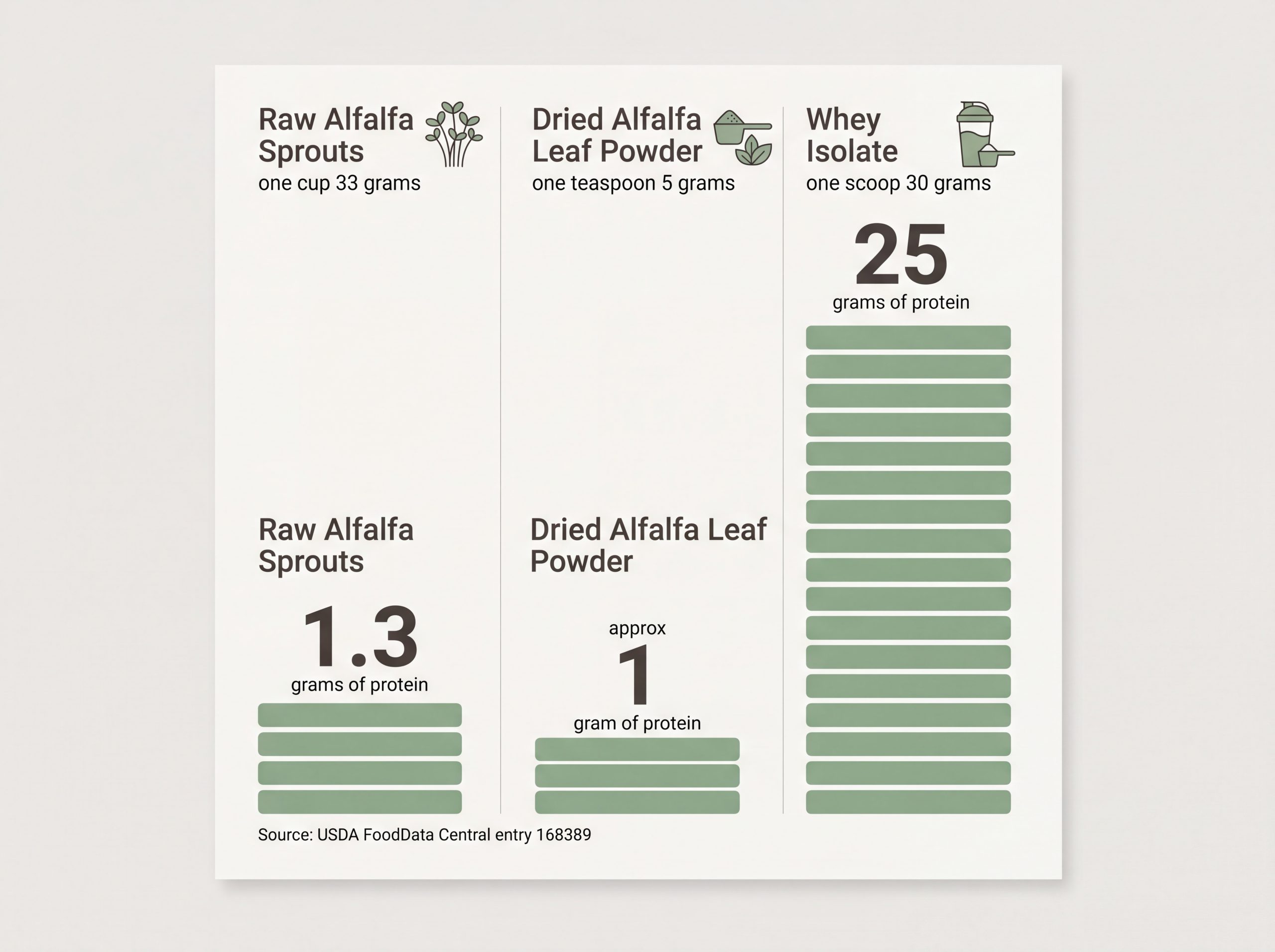
Almost every article about alfalfa and muscle blurs two very different foods into one word. Raw sprouts and dried leaf powder are not the same product; they are not eaten in the same quantities, and they do not deliver the same nutrition. Here are the actual figures, pulled from USDA FoodData Central rather than restated from a secondary source.
| Form | Realistic serving | Protein per serving | Calories | What it is actually good for |
|---|---|---|---|---|
| Raw sprouts | 1 cup (33 g) | ~1.3 g (3.99 g per 100 g) | ~8 kcal | Texture and vitamin K in a salad. Nutritionally close to free. |
| Dried leaf powder | 1 tsp (~5 g) | ~1 g (leaf is roughly 13 to 30 percent protein by weight, varying with cut, leaf-to-stem ratio, and drying method) | ~15 kcal | Concentrated minerals, chlorophyll, and flavonoids in a shake. |
| Whey isolate (for scale) | 1 scoop (~30 g) | ~25 g | ~110 kcal | Hitting the muscle protein synthesis threshold. |
| Source: USDA FoodData Central entry 168389 for raw sprouts. Leaf powder protein range reflects published variation in dried alfalfa leaf across cuts and processing methods. | ||||
Read that table again, because it is the whole argument. Dried leaf powder is roughly fifteen to twenty times more protein-dense than sprouts by weight, and it still lands at about one gram per teaspoon, because a teaspoon is a small amount of anything. The concentration jump is real. The per-serving payoff is not.
This is precisely the fact that gets lost when a page quotes “alfalfa is 20 to 30 percent protein” without telling you how much of it you are going to eat. In our sourcing work with Medicago sativa, we mill the leaf specifically for its mineral and phytonutrient density, and we price and position our organic alfalfa leaf powder as a green nutrient supplement. It is not a protein powder, and we do not sell it as one.
The Support Crew: Essential Vitamins and Minerals
Intense training places high demands on the body’s micronutrient stores. A deficiency in key vitamins and minerals can lead to fatigue, poor recovery, and plateaus in performance. Alfalfa provides a broad spectrum of these essential compounds.
| Nutrient Group | Key Components | Role in Bodybuilding & Athletic Performance |
|---|---|---|
| Vitamins | Vitamins A, C, E, K, and B-complex | Support immune function, energy production, and protect cells from damage. |
| Minerals | Calcium, Iron, Magnesium, Potassium, Zinc | Essential for bone strength, oxygen transport to muscles, and normal muscle contraction. Zinc and magnesium are cofactors in normal endocrine function, including the body’s own testosterone production, though a mineral in a food does not raise testosterone in someone who is not deficient. |
Adequate levels of minerals like iron are critical for preventing exercise-induced fatigue, while magnesium is directly involved in the process of muscle contraction and relaxation.
This is where alfalfa earns its place in a training diet. A lifter under a heavy training load is running a higher micronutrient turnover than a sedentary person, and the deficits that show up first are the quiet ones. Low iron blunts oxygen delivery. Low magnesium shows up as cramping and poor sleep. Neither one announces itself as a plateau, but both produce one.
Alfalfa is also unusually rich in vitamin K, at roughly 30 micrograms per 100 grams of raw sprouts. That is a genuine nutritional contribution, and it is also the single most important interaction to know about if you take an anticoagulant, because vitamin K directly opposes warfarin (see the NIH Office of Dietary Supplements vitamin K fact sheet). We return to this in the safety section.
On the hormonal question that comes up constantly in bodybuilding forums, we will be precise. Medicago sativa contains phytoestrogens, including coumestrol, which bind weakly to estrogen receptors. This is a reason for some men to be thoughtful about very high intakes, not a reason to expect a testosterone effect in either direction. There is no human trial showing that alfalfa raises testosterone.
Mechanisms for Recovery and Performance
Antioxidant and Chlorophyll Content
Intense exercise naturally generates free radicals, which cause oxidative stress that can damage muscle cells and delay recovery. Alfalfa is packed with antioxidants like flavonoids and phenolic compounds that help neutralize these free radicals. This action can help manage post-workout inflammation, reduce muscle soreness, and support a faster recovery process.
Alfalfa is also a rich source of chlorophyll, the pigment that gives the leaf powder its deep green color. Chlorophyll and its derivatives have been studied for antioxidant activity in laboratory settings. What we will not tell you is that it “detoxifies” you. That word does a great deal of marketing work, and very little scientific work, and your liver and kidneys were already handling the job before the smoothie.
Supporting Digestive Health and Nutrient Absorption
A bodybuilder’s diet is only as good as what the body can absorb. Alfalfa is rich in dietary fiber, which promotes a healthy digestive system. It acts as a prebiotic, feeding the beneficial bacteria in the gut microbiome. A well-functioning digestive system ensures that the protein, carbs, and fats from your entire diet are broken down and absorbed efficiently, maximizing their benefit for muscle growth and energy.
What the Animal Studies Do and Don’t Prove
Search for alfalfa and muscle, and you will land, within two clicks, on a horse feed page. There is a reason for that, and it is worth understanding before you draw the wrong conclusion from it.
Alfalfa is a foundational protein forage in livestock nutrition. It genuinely builds topline in horses, growth in pigs, and weight in cattle, and the agricultural literature on this is deep and reliable. The problem is one of dose. A working horse eats several kilograms of alfalfa per day. At that intake, a 15 to 20 percent protein forage is a serious protein source. You are not going to eat several kilograms of alfalfa, and if you tried, the saponins and fiber would settle the argument for you long before your biceps did.
So the livestock evidence is real, and it does not transfer. A study showing alfalfa supports growth in weanling rabbits tells you something true about rabbits and nothing at all about human hypertrophy. We flag this because the sourcing conversation around alfalfa is dominated by the feed industry, and a lifter searching in good faith gets served that literature without the translation note attached.
In human research, alfalfa’s tested effects sit somewhere else entirely. The controlled work is on cholesterol metabolism, where small trials have shown real reductions in total and LDL cholesterol from alfalfa seed preparations (Malinow et al. 1980, Experientia, PMID: 7379953; Mölgaard et al. 1987, Atherosclerosis, PMID: 3606731). That is the herb’s documented human territory. It is not the gym.
Alfalfa vs Whey, Creatine, Pea, and Soy: Where It Actually Fits
The honest way to place alfalfa is to put it next to the things that do have evidence, and let the comparison speak.
| Supplement | Evidence for muscle mass or strength | Role in a training diet |
|---|---|---|
| Creatine monohydrate | Highest tier (level A) | Core. Among the most reliably supported ergogenic aids that exist. |
| Dietary protein (whey, pea, soy, food) | Highest tier (level A) | Core. Gains from supplementation plateau once total intake reaches roughly 1.6 g per kg of bodyweight per day. |
| Branched-chain amino acids in isolation | Mixed or unclear (level B) | Redundant if total protein is adequate. |
| Most vitamins and minerals | Mixed or unclear (level B) | Matter when you are deficient. Do little when you are not. |
| Medicago sativa (alfalfa) | Not graded. No human trials on muscle mass or strength exist. | Micronutrient and phytonutrient support. Sits in the same slot as a greens powder, not the protein slot. |
| Protein intake threshold from Morton et al. 2018, British Journal of Sports Medicine, PMID 28698222. | ||
That protein number deserves a moment. A meta-analysis of 49 randomized controlled trials across 1,863 participants found that protein supplementation meaningfully improved strength and lean mass during resistance training, and that intakes beyond about 1.62 grams per kilogram of bodyweight per day produced no further gains in fat-free mass (Morton et al. 2018, British Journal of Sports Medicine, PMID: 28698222). For an 80 kg lifter, that is roughly 130 grams of protein daily. Alfalfa contributes about one gram of it. Everything else on your plate has to do the rest.
If you came to alfalfa looking for an herbal edge in the gym, the herbs with actual human trial data behind them for training-adjacent outcomes are elsewhere in our library. Cortisol management during heavy training blocks is the mechanism worth reading about in ashwagandha and bodybuilding, and the mitochondrial and energy angle is covered in our guide to shilajit for bodybuilding. Alfalfa is not in that category, and pretending otherwise would waste your money.
Important Considerations: Saponins and L-canavanine
While highly nutritious, it’s important to understand the full composition of Medicago sativa. It contains two compounds that require consideration:
- Saponins: These naturally occurring compounds can have some benefits, but they can also interfere with the absorption of certain other nutrients.
- L-canavanine: This non-protein amino acid can have immune-stimulating effects.
For these reasons, Alfalfa is best consumed in moderation as part of a varied and balanced diet, rather than as a primary, high-volume food source.
Both compounds deserve more than a passing mention, because they are the two most consequential molecules in the plant.
Saponins are the reason alfalfa has any human clinical literature at all. Steroidal saponins bind cholesterol in the gut, which is the proposed mechanism behind the cholesterol reductions observed in the small human trials cited above, and which Memorial Sloan Kettering’s About Herbs database identifies as alfalfa’s best-documented action. The same binding behavior is why saponins can interfere with the absorption of other nutrients, which is a real argument for moderation and against treating alfalfa as a bulk food.
L-canavanine is the compound that turns moderation from a suggestion into a rule. It is a non-protein amino acid structurally similar to arginine, and it makes up roughly 1.5 percent of the dry weight of alfalfa seeds and sprouts. The body can mistakenly incorporate it in place of arginine during protein synthesis, producing malformed proteins. Cynomolgus macaques fed alfalfa sprouts developed a lupus-like syndrome, and re-challenge with isolated L-canavanine reactivated it (Malinow et al. 1982, Science, PMID: 7071589). In human cells, L-canavanine has dose-related effects on immunoregulatory T cells that plausibly explain the reported cases of lupus flare after alfalfa tablet use (Alcocer-Varela et al. 1985, Arthritis and Rheumatism, PMID: 3155617. See also Akaogi et al. 2006, Autoimmunity Reviews, PMID: 16890899).
Canavanine concentrates in the seed and the sprout and declines as the plant matures, which is one of the practical reasons we source mature leaf rather than sprouted seed. Whether typical supplement doses deliver enough canavanine to matter in a healthy person remains genuinely debated in the literature. If you have lupus or another autoimmune condition, that debate is not one you want to settle personally.
How to Incorporate Alfalfa into Your Diet
Adding this nutrient-dense plant to your regimen is straightforward. As a company that prioritizes quality, we recommend always opting for organic or non-GMO sources.
- Smoothies and Shakes: The easiest method for many athletes is to blend Alfalfa powder directly into post-workout protein shakes or morning smoothies.
- Salads and Sandwiches: Fresh Alfalfa sprouts add a pleasant texture and nutritional component to salads and sandwiches.
- Cooked Dishes: Add fresh leaves or sprouts to stir-fries or sautés toward the very end of cooking to preserve their delicate nutrients.
Safety and Precautions
While generally safe for most people, there are important considerations:
- Hormonal Effects: Alfalfa is rich in phytoestrogens. Individuals with existing hormonal sensitivities should consult a healthcare professional before consuming it in large quantities.
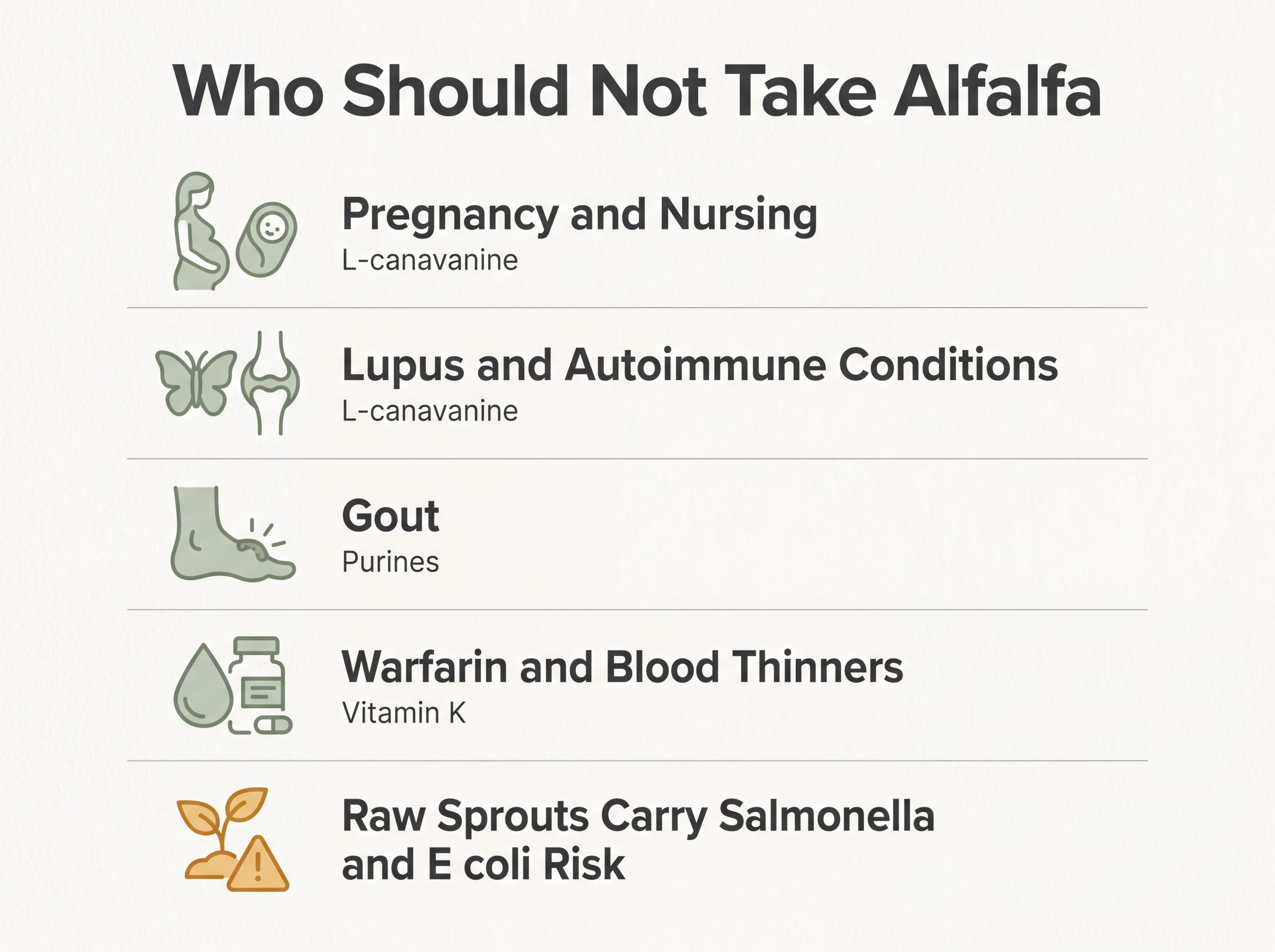
- Autoimmune Conditions: Due to the presence of L-canavanine, those with autoimmune conditions should approach Alfalfa with caution and speak with their doctor.
- Blood Thinners: Alfalfa is high in Vitamin K, which plays a role in blood clotting. Individuals on blood-thinning medications should consult their doctor to avoid potential interactions.
- Gout: Alfalfa sprouts contain purines, which can be converted to uric acid in the body. Those with a history of gout should be mindful of their intake.
Raw Sprouts and Food Safety
This is the caveat almost nobody attaches to an alfalfa article, and it is the one with actual case reports behind it. Raw alfalfa sprouts have been linked to multiple documented outbreaks of Salmonella and E. coli infection across California and Europe, because the warm, humid conditions that germinate a seed are the same conditions that culture bacteria. Memorial Sloan Kettering lists this under patient warnings for the herb.
Anyone who is pregnant, elderly, very young, or immunocompromised should avoid raw sprouts entirely. For everyone else, it is a real but manageable risk. Dried, milled leaf powder is not subject to the same hazard, which is quite a practical argument in its favor for anyone who wants the nutrition without the sprout tray.
Always start with a small amount to assess your own body’s response, and consult a healthcare expert if you have any concerns or pre-existing conditions.
How Much Alfalfa Should an Athlete Take Per Day?
There is no established clinical dose of alfalfa for athletic performance, because there is no clinical trial of alfalfa for athletic performance. What follows is culinary and traditional-use guidance, and it is worth reading in that spirit.
- Dried leaf powder: one to two teaspoons, roughly 5 to 10 grams, blended into a shake or smoothie. Start at one teaspoon. The flavor is grassy and assertive, and the fiber load is real.
- Fresh sprouts: a handful in a salad or sandwich. Treat it as a vegetable, not a supplement.
- Timing: irrelevant. Nothing in alfalfa has an acute window. Take it whenever you will actually take it consistently.
- What alfalfa is found in: loose-leaf powder, capsules and tablets, alfalfa tea, and as a component in greens and superfood blends. It also appears in sprout form in most grocery produce sections.
In our own testing, we blend alfalfa leaf powder into a post-training shake alongside a proper protein source rather than in place of one. That is the arrangement that makes sense given everything above. If you want the leaf on its own terms, our organic alfalfa leaf powder is milled from mature leaf, and you can find the rest of our training-adjacent botanicals in the athletic performance collection.
Do not take alfalfa if you are pregnant or nursing, if you have lupus or another autoimmune condition, if you have gout, or if you take warfarin or another vitamin K antagonist, without first speaking to your healthcare provider.
Frequently Asked Questions
Does alfalfa actually help build muscle?
Not directly, and not on its own. No human clinical trial has demonstrated that alfalfa increases muscle mass or strength, and it does not appear in the major evidence reviews of muscle-building supplements at any evidence tier (PMID: 30604177). It supplies vitamins, minerals, and antioxidants that support a training diet, which is a genuine but indirect contribution.
Are alfalfa sprouts good for protein?
No. One cup of raw alfalfa sprouts weighs about 33 grams and contains roughly 1.3 grams of protein, according to USDA FoodData Central. That is about one-twentieth of what a scoop of whey provides. Sprouts are a vitamin K and texture food, not a protein food.
What are the benefits of alfalfa for athletes?
Mineral density at very low calorie cost, antioxidant flavonoids that may help manage exercise-induced oxidative stress, dietary fiber that supports digestion, and a broad amino acid profile. The realistic benefit is nutritional insurance across a heavy training load, not hypertrophy.
How much alfalfa should I take daily?
There is no clinically established dose for athletic use. A common culinary serving of dried leaf powder is one to two teaspoons, roughly 5 to 10 grams, blended into a shake. Start with one teaspoon to assess tolerance, since the fiber and saponin content can affect digestion.
Is alfalfa safe as a supplement?
For most healthy adults, in moderate amounts, yes. It is not safe for people with lupus or other autoimmune conditions, because L-canavanine has been linked to lupus flares (PMID: 3155617). Avoid it in pregnancy and nursing, in gout, and if you take warfarin, since alfalfa is high in vitamin K. Raw sprouts also carry a documented Salmonella and E. coli risk.
What is the difference between alfalfa sprouts and alfalfa powder?
Sprouts are germinated seed eaten fresh, mostly water, at about 1.3 grams of protein per cup. Dried leaf powder is mature leaf that has been dried and milled, and it runs roughly 13 to 30 percent protein by weight. The powder is far more nutrient dense per gram, but because a serving is only a teaspoon, both forms land at around one gram of protein per realistic serving.
What does alfalfa do for men?
The same things it does for anyone. It supplies vitamin K, iron, magnesium, and antioxidant compounds. Alfalfa contains phytoestrogens including coumestrol, and there is no human evidence that it raises testosterone. Any page telling you otherwise is extrapolating from livestock studies.
Does alfalfa help lower cholesterol?
This is alfalfa’s best-documented human effect. Small trials found that alfalfa seed preparations reduced total and LDL cholesterol, with the steroidal saponin fraction binding cholesterol in the gut as the proposed mechanism (PMID: 7379953 and PMID: 3606731). Larger controlled trials are still needed, and this effect is not related to muscle growth.
*These statements have not been evaluated by the Food and Drug Administration. This product is not intended to diagnose, treat, cure, or prevent any disease.