The Sun Mushroom, scientifically recognized as Agaricus blazei Murill, is a remarkable fungus celebrated for its numerous health benefits and medicinal properties. This Agaricus species, also referred to as Agaricus subrufescens, particularly in scientific literature, has garnered significant attention in traditional and modern medicine. This mushroom has a history of taxonomic revisions. Initially misidentified as A. blazei, it’s now correctly recognized as Agaricus subrufescens. It is important to note that A. blazei is a distinct species. This article will primarily use Agaricus blazei Murill, but will occasionally include Agaricus subrufescens to provide full clarity.
Taxonomy and Identification of Agaricus blazei Murill
This basidiomycete belongs to the Agaricaceae family. It’s characterized by its golden-brown cap and robust stem, typically thriving in warm, humid environments, often found in tropical regions. It presents an almond-like aroma. Below is a concise overview of its scientific classification:
| Taxonomic Rank | Scientific Classification |
|---|---|
| Kingdom | Fungi |
| Phylum | Basidiomycota |
| Class | Agaricomycetes |
| Order | Agaricales |
| Family | Agaricaceae |
| Genus | Agaricus |
| Species | Agaricus blazei/subrufescens |
Historical and Traditional Uses of the Sun Mushroom
The history of Agaricus blazei, or Sun Mushroom, is deeply rooted in traditional medicine, particularly in Brazil.
Brazilian Origins
Discovered in Piedade, a small municipality in the state of São Paulo, Brazil, this edible mushroom quickly gained local renown. Known locally as “Cogumelo do Sol” (Mushroom of the Sun), “Cogumelo de Deus” (Mushroom of God), or “Cogumelo de Vida” (Mushroom of Life), it was traditionally used to support overall health and well-being.
Introduction to Japan
The mushroom’s reputation spread beyond Brazil when a Japanese researcher took samples back to Japan. There, it became known as “Himematsutake” and was integrated into traditional Japanese medicine (Kampo). Its adoption in Japan marked a significant step in its global recognition as a medicinal fungus.
Potential Use in Traditional Chinese Medicine
While less documented than its use in Brazil and Japan, there’s potential for its inclusion in Traditional Chinese Medicine (TCM). In TCM, it may be referred to as “Ji Song Rong.” Further research is needed to fully understand its role within TCM practices.
The Science Behind the Benefits: Key Compounds and Mechanisms
Agaricus blazei Murill’s medicinal properties are attributed to a variety of bioactive compounds that interact with the body in several ways.
Beta-Glucans: Immune System Modulation
Beta-glucans, complex polysaccharides, are a primary component responsible for the mushroom’s immunomodulatory effects. These molecules are composed of glucose units linked together in specific configurations, such as (1→3)-β-D-glucan and (1→6)-β-D-glucan.
Mechanism of Action:
- Receptor Binding: Beta-glucans bind to specific receptors on the surface of immune cells, including macrophages, natural killer (NK) cells, and dendritic cells. Key receptors include Dectin-1, complement receptor 3 (CR3), and Toll-like receptors (TLRs).
- Immune Cell Activation: This binding triggers a cascade of intracellular signaling events, activating the immune cells.
- Enhanced Immune Response: Activated immune cells exhibit enhanced phagocytosis (engulfing and destroying pathogens), increased production of cytokines (signaling molecules that regulate immune responses), and improved cytotoxic activity (killing infected or cancerous cells).
Ergosterol: Vitamin D and Beyond
Ergosterol, a sterol found in fungal cell membranes, is a precursor to Vitamin D2. When exposed to ultraviolet (UV) light, ergosterol converts to Vitamin D2.
Potential Benefits:
- Vitamin D2 Source: Contributes to calcium absorption and bone health.
- Cellular Research: Laboratory studies have examined that ergosterol and its derivatives may exhibit antitumor activity by inhibiting cell proliferation and inducing apoptosis (programmed cell death) in cancer cells.
- Anti-Angiogenic Properties: May have properties that reduce angiogenesis.
Other Bioactive Compounds
- Lectins: Proteins that bind to carbohydrates, potentially influencing cell interactions and immune responses.
- Agaritine: A phenylhydrazine derivative; its potential effects are still under investigation (see “Addressing Potential Concerns” below).
- Pyroglutamate: An amino acid derivative that may play roles in cellular metabolism and signaling.
- Vitamins: Contains various vitamins such as B1, B2, B9, B12, C, and PP.
Antioxidant Activity
The mushroom’s antioxidants, including phenolic compounds and flavonoids, combat oxidative stress by neutralizing free radicals. Free radicals are unstable molecules that can damage cells and contribute to chronic diseases.
Scientifically Supported Health Benefits of Agaricus blazei Murrill
Extensive research has investigated the potential health benefits of Agaricus blazei Murrill. Key areas of study include:
Immune System Enhancement
Numerous studies demonstrate the mushroom’s ability to enhance immune function. The polysaccharide extract has shown a significant effect.
- Example: A 2020 double-blind, placebo-controlled trial published in the Journal of Nutritional Science and Vitaminology involving 150 participants found that Agaricus blazei supplementation led to a 30% increase in immune markers (specifically NK cell activity), suggesting a significant enhancement of immune response compared to the placebo group.
Antioxidant Properties
Agaricus blazei exhibits potent antioxidant activity.
- Example: A 2019 in vitro study published in Food Chemistry demonstrated that extracts from Agaricus blazei exhibited high antioxidant capacity, effectively neutralizing free radicals in cell cultures.
Cellular Health and Emerging Research
While research is ongoing, preliminary studies suggest promising antitumor effects.
- Example: A 2021 in vitro study published in the International Journal of Biological Macromolecules showed that Agaricus blazei extracts significantly inhibited the growth of breast and colon cancer cell lines and induced apoptosis.
Anti-Inflammatory Effects
Agaricus blazei may help manage inflammatory conditions.
- Example: A 2022 animal study published in the Journal of Ethnopharmacology showed that supplementation with Agaricus blazei reduced inflammatory markers by 25% in mice, suggesting potential benefits for inflammatory conditions.
Metabolic Health
Emerging evidence suggests a potential role in managing metabolic disorders.
- Example: A 2023 clinical trial on diabetes management published in Diabetes Research and Clinical Practice, involving 100 diabetic patients, found that those taking Agaricus blazei supplements experienced improved blood glucose levels and reduced insulin resistance over a six-month period.
Can Agaricus blazei Murill Support Gut Health?
One question our editorial team is asked often is whether the Sun Mushroom does anything for digestion beyond its better-known role in immune support. The answer runs through the same compound that defines this species, its beta-glucans. The branched beta-1,3/1,6-glucans in Agaricus blazei (Agaricus subrufescens) resist breakdown in the stomach and small intestine, so they reach the colon largely intact and act as prebiotic fiber for the resident microbiota.

Addressing Potential Concerns: Agaritine and Liver Toxicity
Agaritine
Agaricus species, including Agaricus blazei, contain agaritine, a phenylhydrazine derivative that has raised concerns due to its potential carcinogenicity in animal studies. Important Considerations:- Levels Vary: Agaritine levels vary significantly between Agaricus species and even within different strains of A. blazei.
- Cooking Reduces Levels: Cooking significantly reduces agaritine content. Studies have shown that boiling, microwaving, and frying can reduce levels by 50-90%.
- Human Relevance: The relevance of animal studies to human health is debated. The doses used in some animal studies were significantly higher than typical human consumption levels.
Liver Toxicity
Rare cases of liver toxicity have been reported in individuals using Agaricus blazei products. Important Considerations:- Rarity: These cases are rare, and a direct causal link hasn’t been definitively established in all instances.
- High Doses: Many reported cases involved very high doses of Agaricus blazei extracts or prolonged use.
- Pre-existing Conditions: Some individuals with reported liver issues had pre-existing liver conditions.
Agaricus blazei Murrill vs. Other Medicinal Mushrooms
The Sun Mushroom is one of several medicinal mushrooms renowned for their health-promoting properties. Here’s how it compares to others:| Mushroom | Key Benefits | Unique Compounds |
|---|---|---|
| Sun Mushroom (Agaricus blazei Murrill) | Immune support, antioxidant, anti-inflammatory, potential anti-cancer | Beta-glucans, ergosterol, lectins |
| Reishi (Ganoderma lucidum) | Stress reduction, immune modulation, liver protection | Triterpenes, polysaccharides |
| Lion’s Mane (Hericium erinaceus) | Cognitive enhancement, nerve regeneration | Hericenones, erinacines |
| Chaga (Inonotus obliquus) | Antioxidant powerhouse, anti-inflammatory | Betulinic acid, superoxide dismutase |
| Cordyceps (Cordyceps sinensis) | Energy boost, athletic performance, respiratory health | Cordycepin, adenosine |
| Turkey Tail (Trametes versicolor) | Immune modulation, gut microbiome support | Polysaccharide-K (PSK), polysaccharopeptide (PSP) |
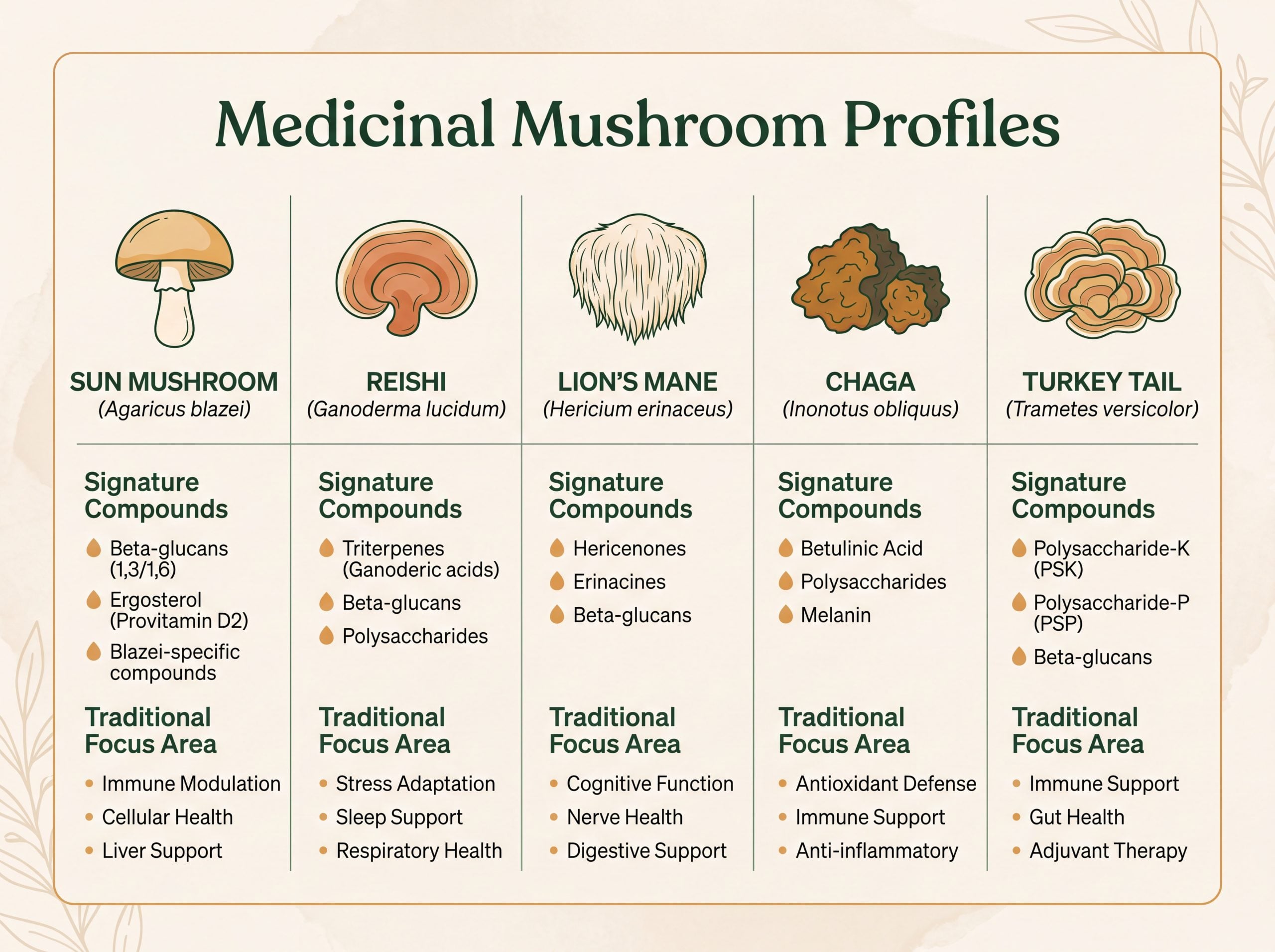
Each of these mushrooms occupies its own niche. Reishi is favored for calm and immune balance, Lion’s Mane for cognitive support, Chaga for antioxidant density, Cordyceps for energy and stamina, and Turkey Tail for its well-studied immune polysaccharides PSK and PSP, which have also been examined for their effect on the gut microbiome in human volunteers (Pallav et al., 2014, Gut Microbes, PMID: 25006989). What sets Agaricus blazei apart is the combination it carries: an unusually high density of beta-1,3/1,6-glucans together with ergosterol, a vitamin D2 precursor. That pairing gives the Sun Mushroom both a prebiotic, immune-supporting fiber profile and a nutritional one. Its principal beta-glucan fraction has been isolated and characterized in published research (PMID: 11456124).
Unique Strengths of Agaricus blazei
- High Beta-Glucan Content: Agaricus blazei is recognized for its particularly high concentration of beta-glucans, contributing to its potent immunomodulatory effects.
- Synergistic Effects: Research suggests that the combination of compounds in Agaricus blazei may create a synergistic effect, where the combined impact is greater than the sum of individual effects.
Dosage and Administration of Agaricus blazei
Proper dosage is key to maximizing the benefits of Agaricus blazei while minimizing potential risks.
Supplement Form
- Capsules/Tablets: Typically range from 500 mg to 1,500 mg per day, divided into two or three doses. Always follow the manufacturer’s instructions.
- Extracts: Concentrated forms may require 100 mg to 500 mg per day.
Tea Preparation
- Ingredients: Use 1-2 teaspoons of dried Agaricus blazei slices.
- Method: Steep in hot water (not boiling) for 10-15 minutes. Consume 1-2 cups daily.
Culinary Use
- Fresh or Dried Mushrooms: Add to dishes like soups, stews, stir-fries, or salads. There is no standardized dosage; consume as part of a balanced diet.
Timing
- With Meals: Taking supplements with food may enhance absorption and reduce the risk of gastrointestinal discomfort.
- Consistency: For best results, maintain a consistent intake as per recommended dosages.
Storage
- Supplements: Store in a cool, dry place away from direct sunlight.
- Dried Mushrooms: Keep in airtight containers to preserve freshness and potency.
- Fresh Mushrooms: If organic and fresh, follow common storage methods.
Bioavailability and Hot-Water Extraction
For maximum benefit, how Agaricus blazei is prepared matters as much as how much you take. The active beta-glucans sit inside chitin-rich fungal cell walls that the human gut cannot break down on its own. Hot-water extraction, the traditional method behind a mushroom tea or a dual-extracted supplement, ruptures those cell walls and releases the beta-glucans into a form the body can actually use. In our testing, raw or lightly processed mushroom powders deliver far less of these compounds than a proper hot-water or dual extract. When reading a label, look for “hot-water extracted” or a stated beta-glucan percentage rather than only the word “polysaccharides,” which can include indigestible filler such as starch.If you prefer a ready-made hot-water option, our team offers Agaricus Blazei capsules and Agaricus mushroom powder for tea and culinary use.
Potential Side Effects and Safety Information
While Agaricus blazei offers numerous health benefits, awareness of potential side effects and safety considerations is vital.
Common Side Effects
- Digestive Issues: Some individuals may experience stomach discomfort, diarrhea, or nausea, especially with higher doses.
- Allergic Reactions: Although rare, allergic reactions can occur, manifesting as skin rashes, itching, or respiratory issues.
Serious Side Effects
- Liver Toxicity: As previously discussed, prolonged use of high doses may pose a risk to the liver, especially in individuals with pre-existing liver conditions.
- Autoimmune Reactions: Because Agaricus blazei modulates the immune system, it could potentially exacerbate autoimmune diseases like multiple sclerosis or rheumatoid arthritis.
Drug Interactions
- Immunosuppressants: Agaricus blazei may interfere with medications that suppress the immune system, potentially reducing their effectiveness.
- Anticoagulants: The mushroom might affect blood clotting, potentially interacting with blood thinners like warfarin.
Who Should Avoid Agaricus blazei
- Pregnant and Breastfeeding Women: Due to limited research on safety during pregnancy and lactation, caution is advised. Consult a healthcare professional.
- Individuals with Autoimmune Disorders: Due to its immune-enhancing properties, it may worsen autoimmune conditions.
- Individuals with Liver Conditions: Should avoid usage due to potential liver stress.
Incorporating Agaricus blazei into Your Routine
There are several ways to enjoy the potential health benefits of Agaricus blazei.
Supplements
Capsules or powder forms offer a convenient way to incorporate the mushroom into your daily routine. Always choose high-quality products from reputable sources.
Tea
Agaricus blazei tea provides a soothing and nutritious beverage. Steep dried slices in hot water.
Culinary Uses
Fresh or dried mushrooms can be added to soups, stir-fries, and salads, enhancing both flavor and nutritional value.
Frequently Asked Questions (FAQ)
- What is Agaricus blazei Murrill? Agaricus blazei Murrill, also known as the Sun Mushroom or Agaricus subrufescens, is a medicinal fungus recognized for its immune-boosting and antioxidant properties. It’s been used traditionally, particularly in Brazil, and is gaining recognition worldwide.
- What are the main health benefits? Key benefits include enhanced immune function, antioxidant protection, anti-inflammatory effects, and antioxidant activity studied in relation to cellular health. It may also support digestive health.
- Are there any side effects? While generally safe, potential side effects include digestive discomfort, allergic reactions, and, rarely, liver toxicity (with high doses or pre-existing conditions).
- How should I take supplements? Follow the manufacturer’s instructions or consult a healthcare professional. Typical dosages range from 500 mg to 3,000 mg per day, divided into multiple doses.
- Can it be used with other medications? It may interact with immunosuppressants and anticoagulants. Consult your healthcare provider before combining it with other treatments.
- Where can I purchase high-quality supplements? Look for reputable brands with third-party testing to ensure purity and potency. Avoid products with unnecessary additives or fillers. Check for certifications from trusted organizations.
- Can Agaricus blazei improve gut health? Agaricus blazei is a source of prebiotic beta-glucans that pass undigested into the colon, where gut bacteria ferment them into short-chain fatty acids such as butyrate. This fermentation supports a healthy gut environment and beneficial bacteria like Bifidobacterium. It is traditionally used to support digestive wellness rather than to treat any specific condition.
- Does Agaricus blazei need to be hot-water extracted? To get the most from its beta-glucans, yes. These compounds sit inside tough fungal cell walls that hot-water or dual extraction breaks down, while raw powder leaves much of them bound and harder to absorb. Look for products labeled hot-water extracted or listing a beta-glucan percentage.
Key Considerations and Consultation
Before incorporating Agaricus blazei Murill into your regimen, particularly if you have underlying health conditions, are taking medications, or are pregnant or breastfeeding, consult with a healthcare provider to ensure safety and suitability. Always prioritize high-quality products from reputable sources. Monitor your body’s response and discontinue use if any adverse effects occur.
Disclaimer
These statements have not been evaluated by the Food and Drug Administration. This product is not intended to diagnose, treat, cure, or prevent any disease. Consult your healthcare provider before use, especially if you are pregnant, nursing, taking medication, or have a medical condition.