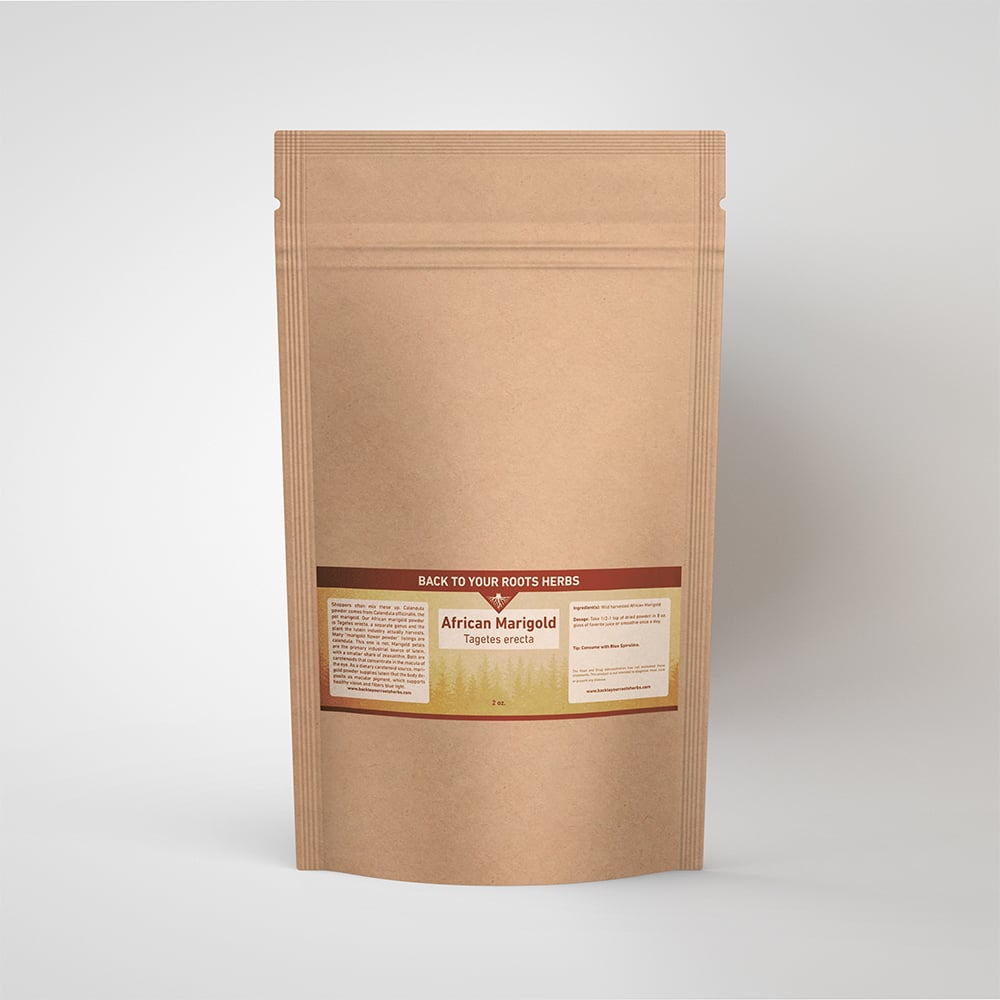
THE VERDICT (INTERNAL QUALITY SCORE):
Grade A. Potency Score 9.4 of 10. This African Marigold Powder is true Tagetes erecta, not a calendula stand-in. Our lot is whole-flower Aztec marigold grown in the Fayoum basin of Egypt, a river-fed calendula and marigold region at 29.31 N, 30.84 E. The petals carry a deep golden-orange color, the visual marker of a carotenoid-dense flower. We milled the dried flower whole, so the lutein, zeaxanthin, and native plant fiber stay in the jar.
– Back To Your Roots Herbs Research Group
SENSORY ANALYSIS:
What African Marigold Powder Looks, Smells, and Tastes Like
This is a first-hand bench report on the raw marigold powder.
- Look: Fine, free-flowing powder. The color runs golden-yellow to deep orange, a sign of high lutein diester content.
- Smell: Mild and floral. A faint herbaceous, slightly resinous note sits underneath. Nothing sharp.
- Taste: Gently bitter up front. It finishes clean and a little astringent, close to green tea.
HOW DOES AFRICAN MARIGOLD POWDER WORK?
The Herb: Tagetes erecta
The Herb: Tagetes erecta, the African marigold (also called Aztec or Mexican marigold), sourced from Fayoum, Egypt. Despite the name, the flower is native to the Americas. The first European garden plants arrived from North Africa, which is where the “African” label began, per the South African Department of Agriculture production guideline.
Marigold Powder vs Calendula Powder
Shoppers often mix these up. Calendula powder comes from Calendula officinalis, the pot marigold. Our African marigold powder is Tagetes erecta, a separate genus and the plant the lutein industry actually harvests. Many “marigold flower powder” listings are calendula. This one is not.
The Mechanism: Lutein and Zeaxanthin
- The Compound: Marigold petals are the primary industrial source of lutein, with a smaller share of zeaxanthin. Both are carotenoids that concentrate in the macula of the eye.
- The Content: Dried marigold flowers hold roughly 0.1 to 0.2 percent carotenoids by dry weight, and about 80 percent of that is lutein diesters, per the FAO JECFA technical assessment on lutein from Tagetes erecta.
- The Action: As a dietary carotenoid source, marigold powder supplies lutein that the body deposits as macular pigment, which supports healthy vision and filters blue light.
The Evidence
The Evidence: Research by Kim et al. (2023) found that jet-milling marigold flowers into a superfine powder near 10 microns raised both lutein content and sensory quality in fortified baked goods. Finer milling, more available carotenoid. A separate analysis by Suwanklang et al. (2023) measured up to 27.22 mg of lutein per gram in marigold flower extract and found it non-toxic to human retinal cells in culture.
MARIGOLD POWDER USES (SKIN, CULINARY, AND DYE)
Marigold Powder for Skin
In Western herbalism and Ayurveda, marigold flower has long been worked into masks, salves, and soaps. Blend a teaspoon of this organic marigold powder into a mask base to support skin comfort and a healthy glow. Beauty formulators prize the same golden pigment that makes the flower a natural colorant.
Marigold Powder for Hair
Marigold powder for hair shows up in rinses and herbal hair masks, where it lends warm color and a soft botanical scent. Pair it with calendula or hibiscus for a fuller herbal blend.
Culinary and Natural Dye Uses
The petals earn the nickname “poor man’s saffron.” Like turmeric, the powder lends a warm gold to rice, broth, sponge cake, and infusions. Textile dyers simmer it to color cotton, silk, and wool. One material, three trades: kitchen, apothecary, and dye pot.
CRITICAL USAGE:
Suggested use: As a botanical powder, blend 1/2 to 1 teaspoon (about 1 to 2 g) into tea, a smoothie, or a topical mask. Start low and adjust.
Contraindications: Marigold is in the Asteraceae family. If you react to ragweed, daisies, or chrysanthemums, patch test first. Avoid if pregnant or nursing, since traditional data is limited. This information is educational and is not medical advice. Talk with your healthcare provider before use, especially if you take medication or have a medical condition.
CLINICAL SPECS:
| Spec | Detail |
|---|---|
| Net Weight | 2 oz (56 g), about 56 servings (2-month supply) |
| Serving Size | 1/2 teaspoon (about 1 g) |
| Frequency | Once daily, or as directed |
| Active Marker | Lutein and zeaxanthin (carotenoids) |
| Processing | Whole dried flower, finely milled (No Extract) |
| Safety | Heavy Metal Tested (Pass) |
| Ingredients | 100% African Marigold flower powder (Tagetes erecta) |
| Other Ingredients | None (single botanical, no fillers) |
| Purity | Organic, Non-GMO, Vegan |
| Free From | Wheat, Gluten, Soy, Dairy, Binders, Fillers |
| Origin | Fayoum, Egypt (29.31 N, 30.84 E) |
| Manufactured | Virginia Beach, VA, USA |
WHY OUR AFRICAN MARIGOLD POWDER (COMPARISON):
| Feature | BTYRH African Marigold Powder | Generic Marigold Powder |
|---|---|---|
| Species | True Tagetes erecta | Often calendula, unlabeled |
| Origin | Fayoum, Egypt (mapped) | Unspecified |
| Preparation | Whole flower, finely milled, no extract | Blended stems and leaf |
| Taste | Mild, floral, gently bitter | Generic, flat |
| Safety | Heavy metal tested | Unknown, untested |
ORGANIC MARIGOLD POWDER FAQ:
Is African Marigold Powder the same as calendula powder?
No. African marigold powder is Tagetes erecta. Calendula powder is Calendula officinalis, the pot marigold. They are related but separate plants.
How do you make and use marigold powder at home?
Dry the flower heads, then grind the petals to a fine powder. Use it in tea, masks, or as a natural gold dye. Our jar skips that step for you.
DISCLAIMER: These statements have not been evaluated by the Food and Drug Administration. This product is not intended to diagnose, treat, cure, or prevent any disease. Consult your healthcare provider before use, especially if you are pregnant, nursing, taking medication, or have a medical condition.
Reviews
There are no reviews yet.