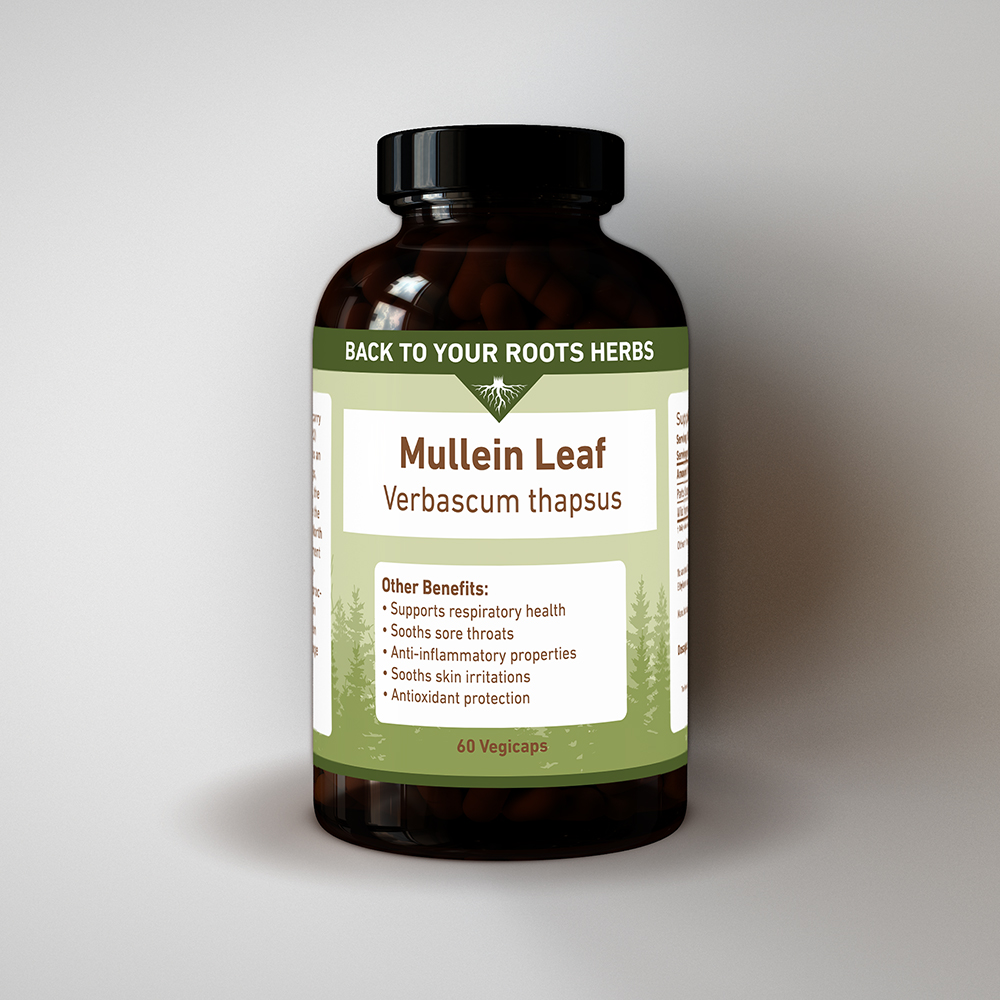
Mullein Leaf Capsules: A Whole Leaf Mullein Supplement
Mullein leaf capsules hold the dried, milled leaf of Verbascum thapsus L., the common mullein of the figwort family (Scrophulariaceae). This mullein supplement is whole leaf powder, not a mullein leaf extract, so each capsule carries the same leaf you would steep for mullein tea, without the brewing or the straining. Our lot is wildcrafted in Albania and encapsulated in Virginia Beach, Virginia.
European herbalists have used mullein leaves for centuries to support the respiratory tract, and the herb later spread into North American folk practice.* We built this page the way we judge a herb ourselves. Identity first. Chemistry second. Safety in plain view.
- Identity: Common mullein, also called great mullein, velvet plant, and flannel plant, family Scrophulariaceae.
- Form: 60 vegetable capsules of whole mullein leaf powder per bottle. A vegan, gluten-free herbal supplement.
- Origin: Albanian mullein leaf, wildcrafted in one of Europe’s largest exporters of wild medicinal plants.
- Traditional use: European and North American herbal medicine used mullein for respiratory health.*
- Safety: Mullein is well tolerated in the limited data. Not for pregnancy, breastfeeding, or kids without a doctor’s advice.
- Research: Mostly in vitro and animal studies of mullein extracts. No human trial has tested oral mullein leaf.
The Verdict: Internal Quality Score
Potency Score: 1:1 whole mullein leaf in every capsule. Nothing is extracted, concentrated or standardized, so each mullein capsule carries the leaf’s natural mix of polysaccharides, saponins, iridoid glycosides, verbascoside and flavonoids. This lot was wildcrafted in Albania, where Verbascum grows wild on dry, sunny, stony ground across the hills of the Western Balkans. We release a lot only when its certificate of analysis (COA) shows heavy metals within limits, and our purchase specification calls for mullein leaf only, with no seed capsules.
– Back To Your Roots Herbs Research Group
Sensory Analysis: Mullein Leaf Powder vs Mullein Tea
- Look: Soft gray-green powder, its color from chlorophyll, lighter and fluffier than most leaf powders because of the dense branched hairs on every mullein leaf. It packs loosely, so a capsule of mullein holds less weight than a capsule of denser herbs.
- Smell: Dried mullein leaf smells mild and dry, like clean hay with a faint note of dried tobacco leaf.
- Taste: Open a capsule, and the raw mullein powder tastes grassy and mild, turns slightly bitter, then leaves a soft, slick finish from the leaf’s mucilage. What does mullein tea taste like? Gentler still, faintly sweet and earthy, with no caffeine bite.
What Is Mullein (Verbascum thapsus)?
Common mullein is a biennial herb. In its first year, it forms a low rosette of large, woolly, gray-green leaves. In its second year, it sends up a single stalk, often taller than a person, packed with small yellow flowers. Gupta et al. (2022) describe the species as native to northern Africa, western and central Asia, and Europe, later carried to the Americas and Australia (PMID 35088467). In much of the United States, it now grows as a roadside weed.
Mullein Leaf Botany: Woolly Leaves, Native Range and Folk Names
The leaf is the field mark. Basal leaves reach up to 50 cm long, with dense, branched hairs on both sides that feel like flannel, hence the names velvet plant, flannel plant, and woolly mullein. English herbalists also call it Aaron’s rod, plus hag’s taper and candlewick, because the dried stalks were dipped in tallow and burned as torches. Drugs.com lists lungwort among its common names, and an old folk name, Cuddy’s lungs, points the same way. True lungwort, Pulmonaria officinalis, is a different plant.
European pharmacy also accepts the flowers of two close relatives, V. densiflorum and V. phlomoides, as mullein flower in the European Medicines Agency herbal monograph. Our capsules contain the leaf of V. thapsus. The USDA PLANTS Database lists it under the symbol VETH, and GBIF and the NCBI Taxonomy database track its name and classification in modern botany.
Why Albania? Its investment agency, AIDA, counts more than 330 medicinal and aromatic plant species in Albanian flora, about 186 of them collected or grown for export, and ranks the country among the top 25 exporters worldwide (AIDA 2026 sector brief). The FairWild registry shows Albanian collectors trading common mullein leaf (folia) as a wild-harvested herb. Our lot comes from that wild-collection trade, which is why we label it wildcrafted.
How Do Mullein Leaf Capsules Work?
- The Herb: Verbascum thapsus leaf (common mullein) wildcrafted in Albania (41.1533° N, 20.1683° E, country centroid), dried and milled whole.
- The Mechanism: No mechanism of action is established in people for whole mullein leaf. Lab work centers on its polysaccharides, saponins, and the phenylethanoid verbascoside, compounds studied for antioxidant and anti-inflammatory activity in cells.
- The Evidence: Research by Turker and Camper (2002) confirmed antibacterial activity in water, ethanol, and methanol extracts of mullein in benchtop lab tests, strongest for the water extract (PMID 12241986).
A capsule delivers the leaf as the plant made it. Nothing more.
Mullein Leaf Chemistry: Saponins, Iridoids, Verbascoside and Quercetin
Speranza et al. (2010) summarize mullein chemistry as polysaccharides, iridoid glycosides, flavonoids, saponins, volatile oils, and phenylethanoids. Gupta et al. (2022) add phenylpropanoid glycosides, vitamin C, and minerals, and single out coumarin and hesperidin. Ali et al. (2012) also detected tannins and terpenoids in a crude extract. In nutrition terms, a serving of capsules adds little. Which compound matters most? Nobody knows yet for whole leaf.
Mucilage and Saponins in Mullein Leaves
Mucilage is a water-loving polysaccharide gel, not to be confused with mucus. It gives mullein tea its soft body and the raw powder its slick finish. Saponins are soap-like glycosides that foam when shaken in water. Mullein seeds are rich in them, which is one reason we use leaf only (see the seed note below).
Verbascoside, Flavonoids and Antioxidant Activity in Mullein
Verbascoside, also called acteoside, is a phenylethanoid glycoside named after the Verbascum genus. In human THP-1 cells pushed into a lab-induced inflammatory state, verbascoside at 100 µM lowered iNOS expression and cut superoxide production, both markers of inflammation in cell culture (Speranza et al. 2010, PMID 20812283). That is a cell result at a fixed concentration, not a dose a capsule delivers. Gupta et al. (2022) list antioxidant activity among mullein’s experimental properties, and Blanco-Salas et al. (2021), using computer simulations, proposed that most of mullein’s folk uses could rest on the anti-inflammatory action of compounds such as quercetin (PMID 34356473). Alipieva et al. (2014) review verbascoside pharmacology across many plants.
What Does the Science Say About a Mullein Supplement?
Most mullein research is in vitro or in animal tissue, and it uses extracts, not whole leaf. Claims about mullein’s health benefits run far ahead of the human data. Here is that data in plain terms.
- In vitro, bacteria: Water, ethanol and methanol mullein extracts, plus commercial mullein products, showed antibacterial activity in bench-top tests, and the same extracts turned toxic to brine shrimp and radish seeds at higher concentrations (Turker and Camper 2002).
- In vitro, virus: A methanol mullein extract blocked pseudorabies virus, an animal herpesvirus, mainly at the stage where the virus attaches to cells (Escobar et al. 2012, PMID 21999656). That is antiviral activity in a dish, not in people.
- Animal tissue: A crude mullein extract relaxed isolated rabbit gut tissue through a calcium channel-blocking effect and showed anthelmintic activity against poultry worms in a lab assay (Ali et al. 2012, PMID 22463730).
- Human data: Published trials used mullein in ear drop blends with garlic, calendula and St. John’s wort (Sarrell et al. 2001 and 2003) or in a topical cream for wound care after childbirth (Taleb and Saeedi 2021, PMID 34103042). None tested mullein leaf taken by mouth.
- Regulators: The European Medicines Agency’s herbal committee (HMPC) accepts mullein flower only as a traditional herbal medicine and noted the lack of clinical studies.
What does that mean for you? The evidence-based answer: a mullein supplement is a traditional herb with interesting lab chemistry, thin human evidence, and sparse toxicology data. Under US law, it is sold as a dietary supplement, so the FDA does not review it for effectiveness before sale. We would rather say so than oversell it.
Traditional Use of Mullein Leaves and Mullein Flowers in Herbal Medicine
Mullein leaves and mullein flowers carry separate traditions. Gupta et al. (2022) describe a long history of the plant as an astringent, calming herb for the lungs, skin, and throat. In European homes, the leaf went into teas and syrups, while the flowers were steeped in olive oil. In North America, mullein spread with settlement along roadsides and pastures and entered settler and Indigenous herbal practice. For the longer story of mullein and respiratory wellness, read our mullein for lungs guide.
The trade followed. Turker and Gurel (2005) found mullein sold in US health stores as dried leaf and flower, capsules, alcohol extracts, and flower oil (PMID 16222647). We report traditional use as history, not clinical proof, and make no treatment claims for these capsules.
Mullein Flower, Mullein Oil and the Candlewick Plant
The flowers are the part European pharmacy prefers. The EMA monograph covers the dried flowers (Verbasci flos), limits use to adults and adolescents over 12, and found no reported side effects at the time of review. Mullein oil, usually the flowers infused in olive oil, is a separate topical folk preparation. These capsules contain mullein leaf, not mullein flower or mullein oil.
Mullein Capsules vs Mullein Tea, Tincture, Oil and Gummies
Which form should you choose? Each one delivers a different slice of the leaf.
Mullein Tea and Mullein Leaf Tea: Brewing and Straining
Mullein tea is the oldest form and a caffeine-free herbal tea. Steep 1 to 2 teaspoons of dried leaf in a cup of just-boiled water for 10 to 15 minutes, then strain it through a paper coffee filter or fine cloth, not a mesh strainer. Loose hairs can cause throat irritation if they slip through. Can you brew mullein leaf tea from fresh leaves? Yes. Chop them and strain just as carefully.
Mullein Tea Bags vs Loose Mullein Leaves
Tea bags filter some of the hairs for you, but they hold less leaf, and store-bought mullein teas often blend it with other herbs. Loose mullein leaves let you set the strength. Either way, mullein tea gives you a water extract of the leaf, while a capsule gives you the whole leaf, fiber and all.
Honey, Lemon and Ginger in a Cup of Mullein Tea
Many people sweeten mullein tea with raw honey or add lemon and ginger. Those are kitchen choices, not part of any study. If you track sugar in your diet, a tablespoon of honey adds about 17 grams of sugar.
Mullein Extract, Tincture, Mullein Drops and Gummies
A mullein extract concentrates selected compounds with a solvent. Ratios such as 4:1 or 10:1 tell you how much dried leaf went into each unit of extract, not which compounds survived, so two mullein extracts with the same ratio can differ a lot. A mullein leaf extract can run high in some constituents and low in others. Whole leaf powder keeps everything the leaf contains, at 1:1.
Alcohol and Liquid Strength in a Mullein Tincture
A tincture is a liquid mullein leaf extract made with alcohol and water. Mullein drops are the same idea in a dropper bottle, sometimes alcohol free with glycerin. Liquids let you adjust the dose drop by drop, but they taste strong and do not suit anyone who avoids alcohol.
Sugar, Flavoring and Softgels: Mullein Gummies and Mullein Oils
Are mullein gummies as strong as capsules? Rarely. Gummies carry added sugar, flavoring, and pectin, and they hold far less leaf per piece. Softgels usually hold a mullein leaf extract in oil. Flower-infused oils are a topical folk preparation, not an oral supplement.
Critical Usage: Mullein Supplement Dosage and Side Effects
The safety record for mullein is reassuring but thin, so this section comes before the specs.
Suggested Use for Mullein Leaf Powder Capsules
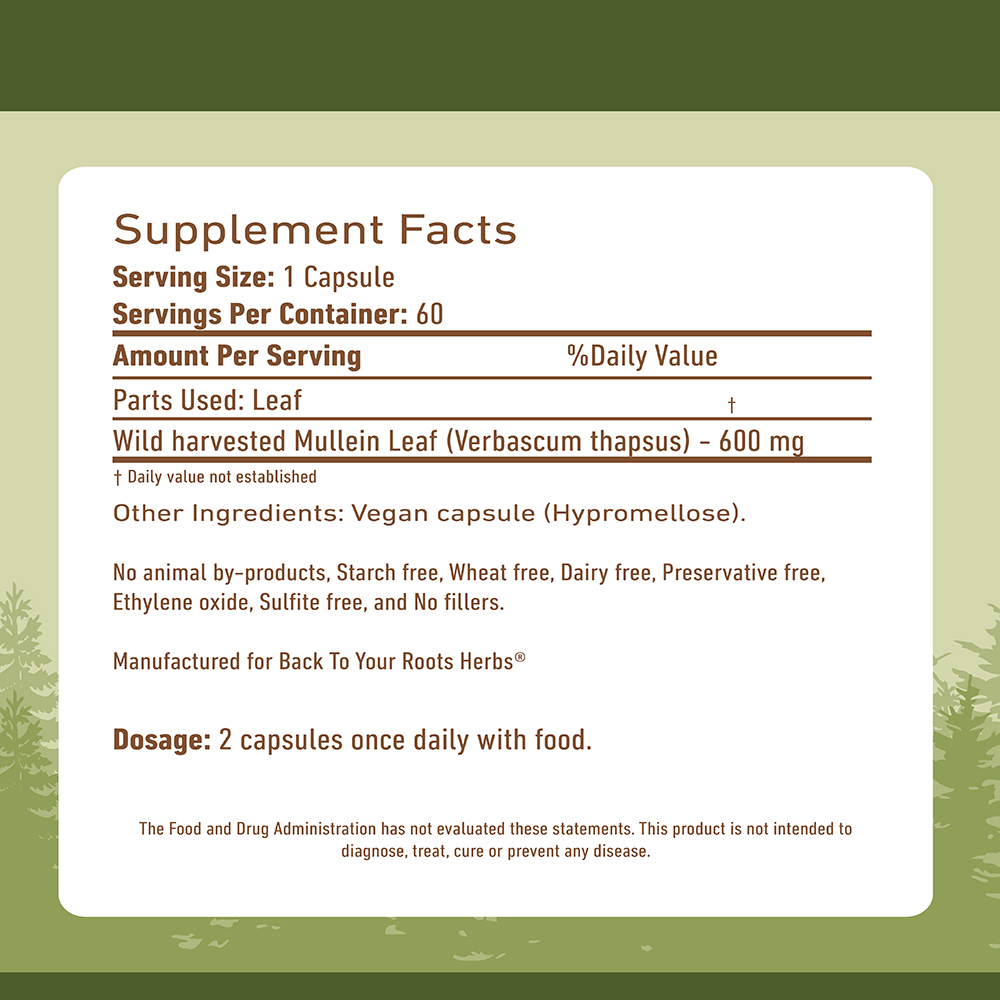
This is a supplement for adults. As a dietary supplement, take 2 capsules once a day with food and a full glass of water, or as your health care provider directs. Start with 1 capsule a day for the first 3 days to see how you respond, and check the Supplement Facts panel on the bottle for the fill weight per capsule. No clinical dose exists for oral mullein leaf supplementation. Drugs.com’s mullein supplement entry notes that classical herbal use ran about 3 to 4 grams of herb a day, well above one serving of capsules. More is not better.
Is a Mullein Supplement Safe to Take Every Day?
For healthy adults, short daily use appears well tolerated, but long-term supplementation has not been studied. WebMD’s mullein supplement monograph says mullein seems well tolerated but has not been studied enough to define its side effects. Drugs.com reports no documented adverse effects and no well-documented drug interactions. Our editorial default is conservative: up to 8 weeks of daily use, then a 2-week break, and a talk with your doctor before you make any supplement a long-term habit.
Mullein Side Effects and Adverse Reactions Reported So Far
- Throat or mouth irritation from leaf hairs, mostly with poorly strained mullein tea. Capsules avoid that contact.
- Skin irritation or a contact rash from handling fresh or dried mullein leaf.
- Occasional mild stomach upset, usually eased by taking mullein with food.
The EMA committee found no reported side effects for mullein flower medicines at the time of its review. If you notice a reaction, tell your doctor and report it to the FDA.
Who Should Talk to a Health Care Provider First
Ask your doctor, pharmacist, or other health care provider before you start if any note below applies to you, and tell them about every dietary supplement and medicine you take. The main contraindications are pregnancy, breastfeeding, and plant allergy. If you live with a lung condition such as asthma or COPD, keep using your prescribed care and ask your doctor before adding mullein. These capsules are not a substitute for medical treatment.
Pregnancy, Lactation and Kids: Mullein Safety Data Gaps
WebMD and Drugs.com both report no reliable safety information for mullein in pregnancy or lactation. Do not use these capsules while pregnant, trying to conceive, or breastfeeding unless your provider approves. Keep them away from kids. Even the EMA limits its traditional mullein flower monograph to adults and adolescents over 12.
Mullein and Diuretic Drugs or Other Medicines
No interaction study exists for oral mullein leaf. Extracts of a related species, dark mullein (Verbascum nigrum), increased urine output in rats, an effect the authors tied to flavonoids (Kalinina et al. 2014, PMID 24074166). As a precaution, ask a pharmacist before you combine mullein with diuretic drugs (“water pills”), blood pressure medicines, or other daily prescription drugs.
Mullein Supplements With Other Herbal Supplements or NAC
No data cover mixing mullein supplements with other herbal supplements or with NAC (N-acetylcysteine). If you pair them in a respiratory wellness routine, add one supplement at a time and tell your provider everything you take.
Mullein Leaf Allergy, Skin and Throat Irritation
Skip mullein if you react to plants in the figwort family, such as figwort or butterfly bush. Leaf hairs irritate some skin on contact, so wash your hands after you open a capsule.
Mullein Seeds: Why These Capsules Are Leaf Only
The seeds are a different story from the mullein leaf. They are rich in saponins and reportedly contain rotenone, and poachers once threw ground mullein seed into ponds to stun fish, according to the Royal College of Physicians Medicinal Garden. Professional monographs rate the seeds as possibly unsafe to eat. That is why our specification is leaf only, with no seed capsules from the flowering stalk.
Stop Use and Call Your Doctor If You Notice
- Rash, hives, itching, or swelling of the lips or face
- Wheezing or trouble breathing
- Stomach pain, nausea, or diarrhea that does not settle
- Any new symptom after you start mullein
Mullein Leaf Capsules Clinical Specs
| Spec | Detail |
|---|---|
| Serving Size | 2 Capsules (Whole Mullein Leaf Powder) |
| Frequency | Once daily with food (start with 1 capsule for 3 days), up to 8 weeks, then a 2-week break |
| Active Marker | Polysaccharides, saponins, iridoid glycosides, verbascoside and flavonoids, naturally present, not standardized |
| Processing | Dried whole leaf, milled to powder (no extraction, no heat concentration) |
| Safety | Heavy Metal Tested (Pass) |
| Ingredients | Mullein (Verbascum thapsus) Leaf Powder |
| Other Ingredients | Vegetable Cellulose (Capsule) |
| Purity | Wildcrafted, Non-GMO, Vegan |
| Free From | Wheat, Gluten, Soy, Dairy, Binders, Fillers |
| Origin | Albania, Western Balkans (41.1533° N, 20.1683° E, country centroid) – Wildcrafted Lot |
| Manufactured | Virginia Beach, VA, USA |
Comparison Table: Whole Leaf vs Generic Mullein Leaf Extract Capsules
| Feature | BTYRH Mullein Leaf Capsules | Generic Mullein Leaf Extract Capsules |
|---|---|---|
| Origin | Wildcrafted in Albania, traced lot | Unspecified |
| Preparation | Whole leaf powder at 1:1, nothing removed or concentrated | Solvent extract (often 4:1 or 10:1) of an unstated plant part |
| Taste | Mild, hay-like, slightly bitter, soft slick finish | Flat, processed |
| Safety | Heavy metals tested on every lot (COA), leaf only, no seeds | Unknown/Untested |
Marketplace mullein supplements rarely state the plant part, the origin, or the test results. WebMD points out that the flower and leaf contain different chemicals, so the label should tell you which part you are buying. A mullein leaf extract is not a bad product. It is a different one. If you want a mullein leaf supplement with the whole mullein leaf, buy the whole leaf. Made in the USA from imported Albanian mullein leaf: every bottle is encapsulated in Virginia Beach.
Frequently Asked Questions About Mullein Supplements
Do Mullein Capsules Actually Work?
It depends on what you expect. These capsules deliver the same leaf herbalists have used for centuries to support respiratory health.* No clinical trial has tested oral mullein leaf, so a mullein supplement cannot promise a specific result, and lab data on extracts do not transfer to a capsule automatically.
Is a Mullein Leaf Extract Stronger Than Whole Leaf or Mullein Tea?
Stronger is the wrong measure. A mullein leaf extract concentrates some compounds and drops others, depending on the solvent and ratio. Mullein tea pulls out the water-soluble compounds, such as mucilage. Our capsules hold the whole leaf at 1:1, fiber included.
Does Mullein Interact With Foods, Drinks or Alcohol?
WebMD lists no known interactions with foods or drinks and says the effect of alcohol is unknown. Take the capsules with a meal and water, and keep alcohol moderate.
Can I Take Mullein Leaf With NAC?
No study has tested the pair. Ask your pharmacist first, especially if you take prescription medicines, and start one supplement at a time so you can tell which one you are reacting to.
When Is the Best Time to Take a Mullein Supplement?
With a meal, at about the same time each day. No study compares morning and evening doses, so pick the meal you never skip.
References and research databases
- Turker and Camper (2002), biological activity of common mullein, J Ethnopharmacol 82(2-3):117-125, PMID 12241986 (ScienceDirect)
- Turker and Gurel (2005), common mullein research review, Phytother Res 19(9):733-739, PMID 16222647 (Wiley)
- Gupta et al. (2022), review of common mullein, Phytother Res 36(4):1507-1522, PMID 35088467 (Wiley)
- Speranza et al. (2010), verbascoside from mullein in THP-1 cells, Phytother Res 24(9):1398-1404, PMID 20812283
- Blanco-Salas et al. (2021), mullein in Spanish folk medicine, Biology (Basel) 10(7):618, PMID 34356473
- Ali et al. (2012), Mullein extract lab assays, BMC Complement Altern Med 12:29, PMID 22463730
- Escobar et al. (2012), Mullein methanol extract and pseudorabies virus, Nat Prod Res 26(17):1621-1625, PMID 21999656
- Sarrell et al. (2001), Arch Pediatr Adolesc Med 155(7):796-799, PMID 11434846, and Sarrell et al. (2003), Pediatrics 111(5):e574-e579, PMID 12728112 (herbal ear drop blends with mullein)
- Taleb and Saeedi (2021), topical mullein cream trial, BMC Complement Med Ther 21(1):166, PMID 34103042
- Kalinina et al. (2014), dark mullein (Verbascum nigrum) extracts in rats, Pharm Biol 52(2):191-198, PMID 24074166
- Alipieva et al. (2014), verbascoside review, Biotechnol Adv 32(6):1065-1076, PMID 25048704
- European Medicines Agency, HMPC: EU herbal monograph on mullein flower (PDF)
- US Food and Drug Administration: dietary supplements
- WebMD: mullein uses, side effects and interactions
- PubMed: current mullein studies
- Google Scholar: mullein research search
This mullein supplement page was reviewed by the Back To Your Roots Herbs Editorial Team. Last Reviewed: November 2026.
DISCLAIMER: These statements have not been evaluated by the Food and Drug Administration. This product is not intended to diagnose, treat, cure, or prevent any disease. Consult your healthcare provider before use, especially if you are pregnant, nursing, taking medication, or have a medical condition. Keep out of reach of children.
Reviews
There are no reviews yet.