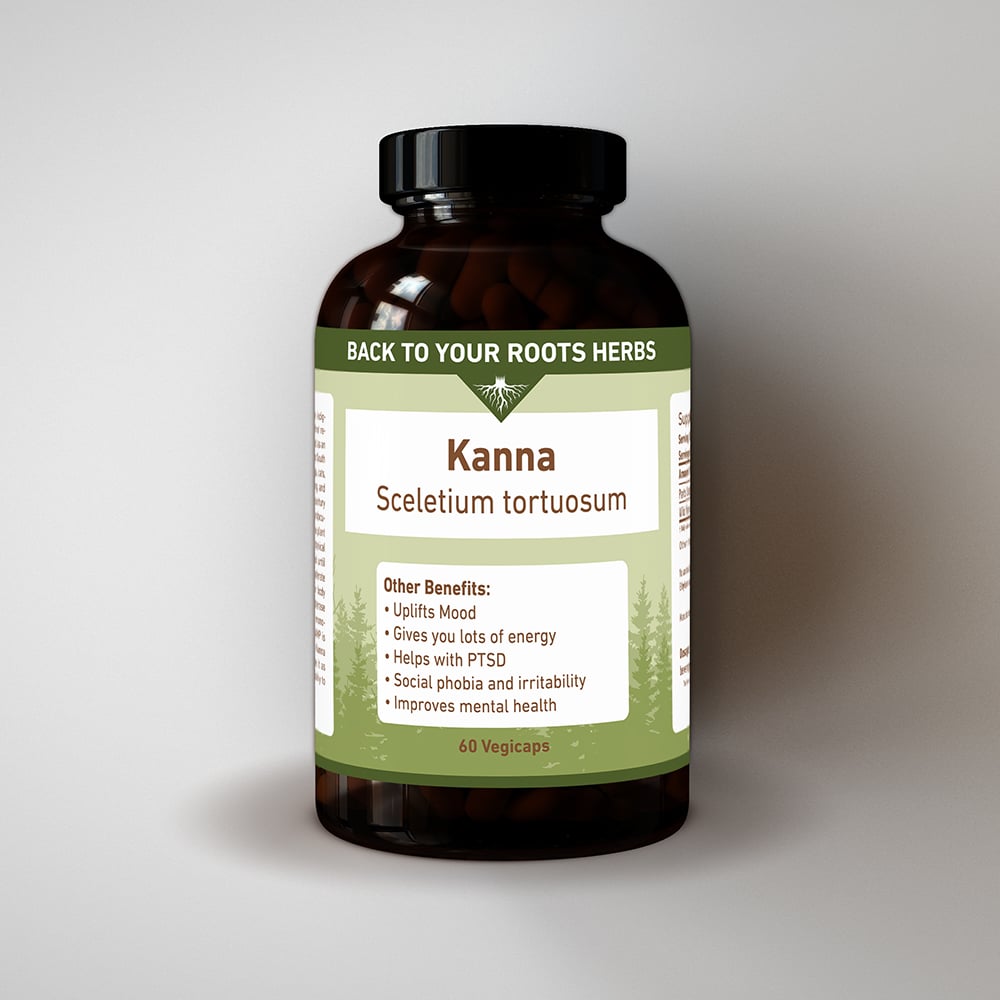
Why Choose Our Kanna Extract Capsules?
Back To Your Roots Herbs offers authentic Kanna Extract Capsules pressed from whole, traditionally fermented Sceletium Tortuosum. Unlike a 20:1 or 200:1 concentrated kanna extract, our capsules preserve the full-spectrum alkaloid matrix of the plant – mesembrine, mesembrenone, delta-7-mesembrenone, mesembrenol, and mesembranol – in the same balance South African herbalists have relied on for centuries. Each bottle contains 60 vegan Vegicaps filled with 550mg of fibrous, earthy kanna powder. No fillers, no binders, no flow agents, no added solvents. Just the Kougoed your grandmother would recognize, measured into a capsule for modern life.
Our kanna capsules are made for people who want a daily mood support herb that behaves like a botanical rather than a pharmaceutical. That means a gentler, slower onset, no dramatic surge, no crash, and a calm focus profile that pairs well with morning routines, afternoon social moments, or wind-down rituals. If you have tried concentrated kanna extract capsules and found the experience too sharp, whole-herb kanna capsules are the traditional starting point.
Every batch of our Sceletium Tortuosum is sourced from the Succulent Karoo corridor running from Namaqualand in the Western Cape down through Montagu and out to Aberdeen in the Eastern Cape. That terroir – quartz-rich soil, hot days, cool nights, the shelter of indigenous shrubs – is what gives traditional kanna its distinct alkaloid profile. We do not substitute greenhouse-grown material.
The Verdict: Internal Quality Score for Our Kanna Capsules
Our in-house herbalist grades every batch against a Grade A Traditional Standard. The current Kanna Capsules lot scores as follows:
- Potency: Grade A – 100% Succulent Karoo Non-Extract. No concentration ratio applied.
- Alkaloid Matrix: Grade A – Full spectrum with traditional fermentation signature. Mesembrine is reduced naturally through fermentation, and mesembrenone is elevated.
- Purity: Grade A – No fillers, no flow agents, no magnesium stearate, no silicon dioxide. Vegan Vegicap shell only.
- Origin Traceability: Grade A – Wild-sourced from known Succulent Karoo cooperatives with Khoisan heritage acknowledgement.
- Sensory Consistency: Grade A – Earthy, fibrous, slightly sour aroma consistent with traditional Kougoed ferment.
Sensory Analysis of Whole Sceletium Tortuosum Kanna
Kanna capsules tell you a lot about the raw material they came from. Before you swallow one, it is worth opening a capsule and using your senses. A whole-herb kanna capsule should never look, smell, or taste like a clean white concentrate.
Look of the Kanna Capsules
Open one of our kanna capsules, and you will see a warm khaki-to-olive powder, not the sand-white color of a processed kanna extract. Tiny, darker specks indicate the fibrous aerial parts of the plant. Color will shift slightly from batch to batch because wild Sceletium Tortuosum shifts with the season – that natural variation is a sign the material was not bleached, polished, or mixed with excipients.
Smell and Aroma Profile
The aroma is earthy, vegetal, and slightly sour in the way a lacto-fermented herb should be. You may catch a faint hay or dried green tea note underneath. This is the fingerprint of traditional fermentation, where the living microbiome of the plant transforms raw mesembrine into the softer, mood-supporting mesembrenone and delta-7-mesembrenone profile.
Taste of Whole Kanna
If you touch the powder to your tongue, expect a grassy, slightly bitter, faintly tingling sensation. A quick numbing sensation on the tip of the tongue is a traditional marker of authentic kanna. Concentrated kanna extract powder is sharper and more astringent. Whole-herb kanna is rounder and softer.
How Does Whole Kanna Work for Mood Support?
Modern pharmacology confirms what South African herbalists have reported for generations. Sceletium Tortuosum is a dual-mechanism botanical. Published research on standardized sceletium extracts shows two characterized pathways: selective serotonin reuptake interaction and phosphodiesterase-4 (PDE4) modulation. In laboratory assays, sceletium material has shown 5-HT transporter binding at an IC50 of approximately 4.3 micrograms per millilitre and PDE4 inhibition at an IC50 of approximately 8.5 micrograms per millilitre (Harvey et al., 2011, PubMed 21798331).
In a human neuroimaging study of healthy adults, a single 25mg dose of standardized sceletium reduced amygdala reactivity to threatening faces while preserving normal amygdala-hypothalamus coupling (Terburg et al., 2013, PubMed 23903032). A separate proof-of-concept randomized controlled trial of cognitively healthy subjects reported cognitive-flexibility performance changes associated with PDE4 engagement (Chiu et al., 2014, PubMed 25389443). A 2022 peer-reviewed review consolidated the phytochemistry, pharmacokinetics, and pre-clinical activity of Sceletium Tortuosum (PubMed 34758918).
Important framing: these studies used standardized sceletium extracts under research conditions in healthy volunteers. Our Kanna Extract Capsules are a dietary supplement, not a medication, and are intended to support everyday balance rather than to address any diagnosed condition.
Critical Usage Guidelines for Kanna Extract Capsules
Take one kanna capsule with a light meal or a small amount of healthy fat. Alkaloids in sceletium share absorption pathways with lipids, so a teaspoon of nut butter, coconut oil, or full-fat yogurt can smooth the onset. Onset typically begins within 30 to 60 minutes and settles gradually. A second capsule may be taken later in the day if desired. We do not recommend exceeding 2 capsules in 24 hours for a whole-herb kanna product.
Kanna is traditionally considered a botanical for calm focus, so many people prefer mornings or midday windows. If you are sensitive to caffeine or adaptogens, start with a single capsule and observe how your body responds across 3 to 5 days before adjusting.
Kanna is not intended to be taken alongside SSRIs, SNRIs, MAOIs, or other serotonergic prescription medications. Because Sceletium Tortuosum interacts with serotonin pathways, stacking with a pharmaceutical that acts on the same system is not appropriate. Please consult a qualified health care provider before starting any new supplement.
CLINICAL SPECS:
| Spec | Detail |
|---|---|
| Botanical Name | Sceletium Tortuosum (syn. Mesembryanthemum tortuosum) |
| Common Name | Kanna, Kougoed, Channa |
| Plant Part | Aerial parts (whole herb, traditionally fermented) |
| Serving Size | 1 Capsule (550mg) |
| Count | 60 Vegicaps per bottle |
| Concentration | 1:1 Non-Extract (no concentration ratio applied) |
| Active Marker | Full-Spectrum Mesembrine Alkaloid Matrix (mesembrine, mesembrenone, delta-7-mesembrenone, mesembrenol, mesembranol) |
| Processing | Traditional cloth-wrapped fermentation, low-temperature drying, coarse milling |
| Origin | Succulent Karoo, South Africa (Namaqualand to Aberdeen corridor, -33.5 S, 22.0 E) |
| Capsule Shell | Plant-based HPMC Vegicap (vegan, gluten-free) |
| Other Ingredients | None. No fillers, flow agents, or preservatives. |
| Certifications | Vegan, Gluten-Free, Non-GMO, No Added Solvents |
| Suggested Serving | 1 to 2 capsules per day with food |
| Shelf Life | 24 months when stored cool, dry, and sealed |
| Manufactured | Virginia Beach, VA, USA |
| Legal Status | Dietary Supplement under DSHEA 1994 |
COMPARISON TABLE:
| Feature | BTYRH Kanna Extract Capsules | Generic 200x Kanna Extract Tablets |
|---|---|---|
| Origin | Succulent Karoo, South Africa (verified) | Unspecified |
| Preparation | Traditional cloth-wrapped fermentation, whole herb, no solvents | Solvent-extracted 200:1 concentrate |
| Alkaloid Profile | Full-spectrum mesembrine matrix (balanced ensemble) | Mesembrine-dominant, ensemble stripped |
| Onset | 30 to 60 minutes, gradual | 5 to 15 minutes, sharp |
| Experience | Soft, grounded, calm focus | Intense, short-lived |
| Taste | Earthy, fibrous, slight numbing tingle | Sharp, astringent, chemical finish |
| Solvents Used | None | Usually ethanol, sometimes CO2 |
| Traditional Match | Closest to Khoisan Kougoed practice | Modern laboratory form |
| Safety Testing | Third-party HPLC alkaloid assay + heavy metal testing | Unknown/untested |
| Best For | Daily mood support, ritual users, beginners | Occasional, acute-use scenarios |
The Ethnobotanical History of Kanna
Europe’s first written record of kanna dates to 1662, when the Dutch colonial governor Jan van Riebeeck noted that the Khoi people traded a fermented chewing plant called “channa.” German natural historian Peter Kolben documented the traditional preparation in detail in 1738, describing how the aerial parts of the plant were bruised, wrapped, fermented in animal skins or cloth bundles, then dried for later chewing. The Khoisan language gives us the word Kougoed, which translates approximately to “something to chew.” The fermentation step is not optional in the traditional method. It is the step that softens the mesembrine-dominant profile of the raw plant into the mesembrenone-forward profile that South African herbalists associate with balanced mood support.
Modern botanical identity of the plant has been updated. Kanna is now classified as Mesembryanthemum tortuosum, though the older name Sceletium Tortuosum remains the industry standard on supplement labels and in peer-reviewed pharmacology literature. Our Kanna Extract Capsules honor that lineage on the label and in the process.
Alkaloid Profile of Sceletium Tortuosum
Whole Sceletium Tortuosum contains more than twenty identified alkaloids. Three carry the bulk of the mood-supportive conversation in pharmacology.
Mesembrine
Mesembrine is the best-studied kanna alkaloid. In fresh, unfermented plant material, mesembrine can reach roughly 1.33 percent of dry weight. Traditional fermentation reduces mesembrine to approximately 0.05 percent while elevating mesembrenone. That is the botanical signature of Kougoed and one reason whole-herb fermented kanna feels different from a mesembrine-heavy 200x extract.
Mesembrenone
Mesembrenone is the alkaloid elevated by fermentation. In standardized sceletium extracts studied for PDE4 engagement, mesembrenone is often more active than mesembrine for the enzyme pathway. It is one reason traditional fermented kanna is associated with a softer, longer, more grounded experience.
Delta-7-Mesembrenone
Delta-7-mesembrenone rounds out the primary trio, alongside mesembrenol and mesembranol. Together, these alkaloids make up the full-spectrum matrix that our whole-herb Kanna Extract Capsules retain. Concentrated 3 percent or 5 percent commercial kanna extracts often tilt sharply toward one alkaloid and strip out the ensemble. That is a legitimate choice for a different product, but it is not what whole-plant tradition offers.
Terroir and Succulent Karoo Origin
Geography shapes alkaloid content in Sceletium Tortuosum more than almost any other variable. The Succulent Karoo biome runs from Namaqualand in the north through the Western Cape to Aberdeen in the Eastern Cape. Within that corridor, quartz-rich soil patches, hot arid days, cool nights, and partial shade under indigenous shrubs produce the “trek” chemotype traditionally favored by herbalists. Wild total alkaloid content in that chemotype ranges around 2 percent dry weight. The milder “mak” chemotype sits closer to 0.2 percent. We source from cooperative harvesters in the trek corridor and verify chemotype by laboratory assay on every incoming lot.
Traditional Fermentation Method
Fermentation is what turns raw sceletium into kanna. The aerial parts of the plant are bruised to break cell walls, wrapped in cloth or hide, and allowed to ferment for 8 to 14 days, depending on ambient temperature. During that window, the microbiome of the plant, together with atmospheric and surface microbes, converts mesembrine and mesembrenol into mesembrenone and related alkaloids. The material is then low-temperature dried to preserve the transformed profile and coarsely milled for capsule filling. No solvents, no high-heat extraction, no concentration ratios.
Who Benefits From Kanna Extract Capsules?
Our Kanna Extract Capsules are crafted for adults seeking a daily, traditional botanical option for mood support. Typical users include people who want a gentler alternative to concentrated kanna extract, herbalists building a stress-resilience stack alongside ashwagandha or rhodiola, ritual-minded users who value the Kougoed heritage, and first-time kanna customers who want to begin at the whole-herb baseline rather than with a 200x tablet.
Suggested Dosage and Timing for Kanna Capsules
Start with one 550mg capsule in the morning with food for the first three days. Observe your response. If the baseline feels right, continue at one capsule daily. If you would like a fuller profile, add a second capsule in the early afternoon. Avoid taking kanna capsules within four hours of bedtime during your first week, since individual response to calm-focus herbs varies.
Take kanna capsules with a small amount of healthy fat to smooth absorption. A piece of dark chocolate, a spoon of almond butter, or a meal containing olive oil works well. Water alone on an empty stomach can produce a faster but shorter arc.
Contraindications and Safety Information
Do not combine kanna with SSRIs, SNRIs, MAOIs, tramadol, or other serotonergic medications. Do not combine with prescription stimulants that act on the monoamine system. Pregnant and nursing individuals should not take Sceletium Tortuosum. People with cardiovascular conditions, bipolar spectrum conditions, or a history of serotonin-related events should consult a qualified health care provider before use. Discontinue at least two weeks before scheduled surgery. Keep out of reach of children.
Kanna Side Effects and Tolerability: What to Know
Whole-herb kanna is generally well-tolerated by healthy adults when used as directed. In a three-week randomized, placebo-controlled crossover study of a standardized Sceletium Tortuosum extract, a 25mg daily dose was reported as well tolerated, with positive changes in mood and sleep noted by researchers (Chiu et al., 2014, Evidence-Based Complementary and Alternative Medicine, PMCID PMC4217361).
Some users report mild, short-lived effects, most often in the first few days or at larger servings:
- Mild headache or a light pressure feeling
- Shifts in alertness, either slight drowsiness or a faintly wired feeling
- Stomach sensitivity when taken on an empty stomach
- Dry mouth
Can You Take Kanna Daily Without Side Effects?
Many traditional and modern users take kanna daily. The conservative approach is to begin with one capsule, use the lowest serving that feels right, and take periodic breaks. Tolerability is individual, and the contraindications above still apply to daily use.
Do Kanna Tea and Powder Carry the Same Side Effects?
The tolerability profile is similar across forms because the active mesembrine-type alkaloids are the same. Kanna tea brewed from the powder has a strong, bitter taste and a heavier alkaloid load per cup, so the stomach-sensitivity note applies more to tea than to a pre-measured 550mg capsule. Start with a small amount of any new form.
These notes do not replace the contraindication list above. If you take serotonergic medication or have any condition listed under Contraindications and Safety Information, talk with your healthcare provider before use.
Storage and Shelf Life of Kanna Capsules
Store kanna capsules in a cool, dry place, away from direct sunlight and humidity. An amber glass jar at room temperature works well. Sealed and stored correctly, our Kanna Extract Capsules retain their alkaloid profile for 24 months from the batch date printed on the bottle. Refrigeration is not required and can actually introduce moisture if the seal is opened and closed in a humid environment.
How Kanna Capsules Compare to Other Consumption Methods
Kanna is consumed in several traditional and modern forms. Whole-herb powder can be brewed into a tea, though the flavor is strong and bitter. Kanna tincture offers a fast sublingual onset but exposes the user to alcohol. Kanna extract powder allows custom dosing but requires a gram scale. Sublingual 50mg 200x tablets offer the fastest, sharpest signal. Our Kanna Extract Capsules sit squarely in the middle of this menu. They give you the full-spectrum whole-herb profile, the convenience of a pre-measured dose, the closest modern match to Kougoed, and no requirement to weigh powder or taste the bitter alkaloids.
Quality Commitment: Batch Testing and Sourcing
Every incoming lot of Sceletium Tortuosum is verified by macroscopic inspection, organoleptic review by our herbalist, and third-party HPLC alkaloid assay. We confirm chemotype, total alkaloid content, absence of adulterants, and heavy-metal compliance. Capsules are filled in small batches in a GMP-registered facility. We publish batch records on request for wholesale partners.
Frequently Asked Questions About Kanna Extract Capsules
Kanna Powder vs. Kanna Extract Powder
Kanna powder is the fermented, dried, milled aerial parts of Sceletium Tortuosum. It retains the full alkaloid matrix. Kanna extract powder has been through a solvent step that concentrates specific alkaloids, often mesembrine, to a stated ratio such as 3 percent or 5 percent. Our capsules hold kanna powder, not kanna extract powder. If you want the concentrated ratio, you would look at a different product category.
Can I Open Kanna Capsules to Make Tea?
Yes. Each Vegicap separates into two halves. Empty the 550mg of kanna powder into hot (not boiling) water with a small splash of lemon juice or a pinch of tartaric acid and steep for 10 minutes. Strain and sip slowly. Flavor will be earthy, slightly sour, and fibrous. Some traditional users prefer this chewed or pouched approach over swallowing the capsule.
How Long Are Kanna Capsules Good For?
Our Kanna Extract Capsules carry a 24-month best-by date from batch printing. Store sealed, cool, and dry to preserve alkaloid content. Properly stored whole-herb kanna often remains sensory-stable beyond the printed date, though we recommend rotating stock for peak quality.
What Should I Tell My Health Care Provider Before Using Sceletium?
Disclose any serotonergic medications (SSRIs, SNRIs, MAOIs, tramadol, some migraine medications), any cardiovascular medications, any psychiatric medications, pregnancy or nursing status, upcoming surgery within two weeks, and any history of serotonin-related events. Your health care provider can help you determine whether kanna fits your current stack.
How Does Kanna Compare to CBD for Mood Support?
Kanna and CBD support a sense of calm through different biology. Kanna acts through its mesembrine-type alkaloids, which research characterizes as dual serotonin-reuptake and PDE4 activity (Terburg et al., 2013, Neuropsychopharmacology, PMID 23903032). CBD interacts mainly with the endocannabinoid system. Kanna is a fast, mood-and-focus botanical taken in small servings, while CBD is usually measured by the dropper in tens of milligrams. They are different plants with different traditions, and some people use them at different times of day. Neither is a medication, and neither should replace one without guidance from your healthcare provider.
How Does Kanna Compare to Other Mood-Support Botanicals Like Ashwagandha and L-Theanine?
Kanna is felt within an hour, which suits acute moments of stress. Ashwagandha is an adaptogen taken daily over several weeks to support the body’s stress response, so its effect is gradual rather than acute. L-theanine, the calming amino acid from tea, supports relaxed focus without sedation and pairs well with caffeine. Rhodiola is taken for stamina under fatigue. Many herbalists rotate these by goal and time of day rather than choosing only one, and kanna fills the fast, in-the-moment role in that group.
FDA Disclaimer: These statements have not been evaluated by the Food and Drug Administration. This product is not intended to diagnose, treat, cure, or prevent any disease. Dietary Supplement under DSHEA 1994.
Reviews
There are no reviews yet.