Jergon Sacha Powder Quality Verdict
Grade A potency. This jergon sacha powder is wildcrafted Dracontium loretense rhizome harvested from the alluvial soils of the Peruvian Amazon near Iquitos, Loreto Region (approximately 3.7437°S, 73.2516°W). The corms are slow-dried at low heat and finely stone-milled to preserve the full spectrum of native oxylipins, protease inhibitors, saponins, and mineral content. No extraction, no fillers, no binders. The whole-root profile is what traditional herbalists of Peru have reached for across generations, and it is what our quality team requires for every lot.
– Back To Your Roots Herbs Research Group
Sensory Analysis of Our Jergon Sacha Powder
What follows is our research team’s first-hand sensory report on this specific lot of jergon sacha root powder.
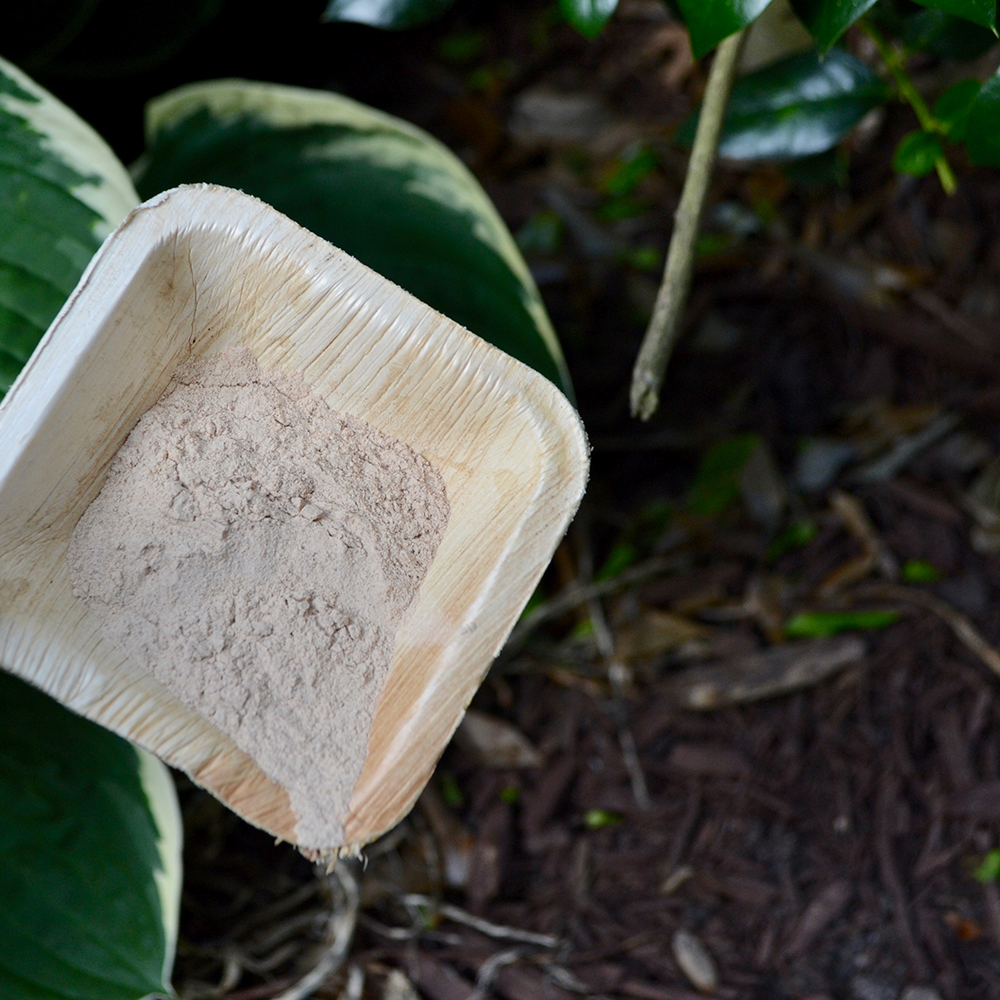
- Look: Fine, uniform powder with a warm tan to light-brown color and visible flecks of the dried rhizome cortex.
- Smell: Earthy and slightly pungent, with a wet-soil note and a clean mineral finish that signals intact volatile content.
- Taste: Mildly bitter, woody, and faintly astringent on the back palate. The rhizome character is clean, never musty, which is our marker for proper low-heat drying.
How Does Jergon Sacha Work in the Body?
Our research group fields this question every week, so here is the plain-language answer for curious customers.
- The Herb: Dracontium loretense Krause is a rainforest understory plant of the Araceae family. It produces a single, deeply divided leaf on a long, mottled stem that resembles a fer-de-lance viper, which is where the Spanish name jergon sacha (wild viper) comes from. The medicinal part is the underground corm, or rhizome.
- The Origin: Our jergon sacha powder is sourced from small-scale wildcrafters in the Peruvian Amazon, specifically the Loreto Region around Iquitos. This is the terroir that gives the corms their characteristic oxylipin profile.
- The Compounds: The rhizome is rich in protease inhibitors, saponins, phenolic compounds, and a family of novel oxylipins first characterized by Benavides and colleagues in 2009.
- The Mechanism (as studied): In peer-reviewed laboratory work, one of the isolated oxylipins from Dracontium loretense showed an immunostimulatory effect on human peripheral blood mononuclear cell (PBMC) proliferation in vitro.
- The Evidence: Benavides A, Napolitano A, Bassarello C, et al. Oxylipins from Dracontium loretense. Journal of Natural Products, 2009 (PMID 19341262). This is laboratory evidence, not a clinical claim.
Traditional Context of Jergon Sacha Root
Peruvian herbalists have used the rhizome of Dracontium loretense for generations as part of their immune and upper respiratory wellness toolkit. Across the Loreto Region, families reached for the jergon rhizome to support several body systems at once. Traditional use centers on daily immune resilience, upper respiratory and seasonal wellness, traditional topical skin support through poultices, and general cellular resilience rather than any single complaint. Every one of these is a traditional, structure-and-function use. Jergon sacha is a traditional wellness herb, not a medicine or a treatment for any specific health condition.
The plant is a staple of Amazonian ethnobotany and is often discussed alongside other understory allies such as cat’s claw and chuchuhuasi. The name jergon sacha translates loosely as “false fer-de-lance,” a nod to the mottled, snake-skin stem that mimics the bushmaster and fer-de-lance vipers of the rainforest floor. Loreto folk tradition holds that a plant resembling the snake offers protection against it, and Amazonian herbalists historically kept the rhizome on hand in snakebite country. That folklore is cultural heritage, not a medical claim. Today the rhizome remains one of the signature foundational herbs of Peruvian Amazonian ethnobotany, passed down through generations of ribereño and Indigenous knowledge. Our role at Back To Your Roots Herbs is to source the real article, verify its identity, test it for heavy metals, and deliver it to you as a pure whole powder.
Who Reaches For Jergon Sacha Powder?
Customers who choose jergon sacha powder are typically focused on seasonal immune support, upper respiratory resilience, and traditional Amazonian wellness practices. It is also popular with practitioners of Peruvian plant medicine who want a clean, unextracted powder for personal formulations, capsule filling, or tea decoctions.
Critical Usage: Jergon Sacha Dosage and Cautions
How To Use Jergon Sacha Root Powder
The traditional Amazonian preparation is a simple decoction. A common starting approach is one-quarter to one-half teaspoon of jergon sacha powder simmered in 8 to 12 ounces of water for 10 to 15 minutes, strained, and taken once daily with food. Many customers also fill their own capsules with the powder or blend it into smoothies with honey or cacao to soften the earthy taste.
Can You Combine Jergon Sacha Powder With Other Herbs?
Yes. A whole, unextracted powder is easy to combine, which is one reason practitioners of Peruvian plant medicine keep it on the shelf. In traditional Amazonian practice, the jergon rhizome is commonly discussed alongside other understory botanicals such as cat’s claw (uña de gato) and chuchuhuasi. At home, customers often simmer it as part of a multi-root decoction, fill their own capsule blends, or stir it into a smoothie with a vitamin C source such as camu camu. Keep each herb in its own traditional lane and start with a single herb at a time so you know how your body responds. If you take prescription medication, are pregnant or nursing, or manage a health condition, talk with a qualified herbalist or your healthcare provider before combining herbs.
Jergon Sacha Side Effects and Tolerability
Are there side effects from jergon sacha? Whole-rhizome jergon sacha powder is generally well-tolerated by healthy adults at the traditional serving. The most common feedback is simply the earthy, woody taste of the raw powder and the clean mineral finish noted in the sensory profile, both of which are normal for this herb. For general guidance on using herbal supplements safely, the U.S. National Center for Complementary and Integrative Health (NCCIH) is a reliable resource. The cautions below still apply.
- Oxalate sensitivity: Like most Araceae plants, the jergon rhizome contains calcium oxalates. If you have a history of kidney stones, consult your physician before use.
- Pregnancy and nursing: Do not use if you are pregnant, nursing, or trying to conceive.
- Medications and surgery: Do not use if you are taking immunosuppressant medication or preparing for surgery. Check with your healthcare provider if you take other prescription medications.
- Keep out of reach of children.
Storage and Shelf Life
Store the jergon sacha powder in a sealed container away from direct sunlight, heat, and humidity. Kept cool and dry, the powder retains its aroma and color for 18 to 24 months.
Clinical Specs of This Jergon Sacha Powder Lot
| Spec | Detail |
|---|---|
| Serving Size | 1/4 to 1/2 teaspoon (approx. 1 to 2 g) |
| Frequency | Once daily, ideally with food |
| Active Marker | Native oxylipins and protease inhibitors (whole matrix) |
| Processing | Low-heat dried, stone-milled, sieved to a fine powder |
| Safety | Heavy Metal Tested (Pass) |
| Ingredients | 100% wildcrafted jergon sacha root powder (Dracontium loretense rhizome) |
| Other Ingredients | None. No capsule, no filler, no flow agent |
| Purity | Organic, Non-GMO, Vegan |
| Free From | Wheat, Gluten, Soy, Dairy, Binders, Fillers |
| Origin | Peruvian Amazon, Loreto Region near Iquitos (approx. 3.7437°S, 73.2516°W) |
| Manufactured | Virginia Beach, VA, USA |
Jergon Sacha Powder Comparison Table
| Feature | BTYRH Jergon Sacha Powder | Generic Jergon Sacha Powder |
|---|---|---|
| Origin | Peruvian Amazon, Loreto Region near Iquitos | Unspecified “South America” |
| Preparation | Whole rhizome, stone-milled, low-heat dried, no extract | Often leaf powder or blended material, heat-processed |
| Taste | Earthy, woody, mildly bitter, clean mineral finish | Generic “herbal” taste, sometimes musty |
| Safety | Heavy metal tested, lot-verified identity, COA on file | Unknown testing, no published COA |
| Plant Part | Rhizome (corm), the traditionally used part | Often leaf or mixed plant material |
Jergon Sacha vs Other Amazonian Herbs
How does jergon sacha compare to other natural remedies from the Amazon? Each rainforest botanical has its own traditional lane. Cat’s claw (uña de gato, Uncaria tomentosa) is traditionally used to support joint comfort and immune balance. Chanca piedra (Phyllanthus niruri) is traditionally used to support kidney and urinary health. Camu camu (Myrciaria dubia) is prized for its naturally high vitamin C content and traditional immune support. Chuchuhuasi (Maytenus macrocarpa) is a traditional Loreto bark tonic for joint comfort and stamina. Jergon sacha sits alongside these as a whole-rhizome immune and cellular-support herb with its own rare oxylipin chemistry. Many Loreto households use them together rather than choosing only one.
Where to Buy Jergon Sacha Powder Online
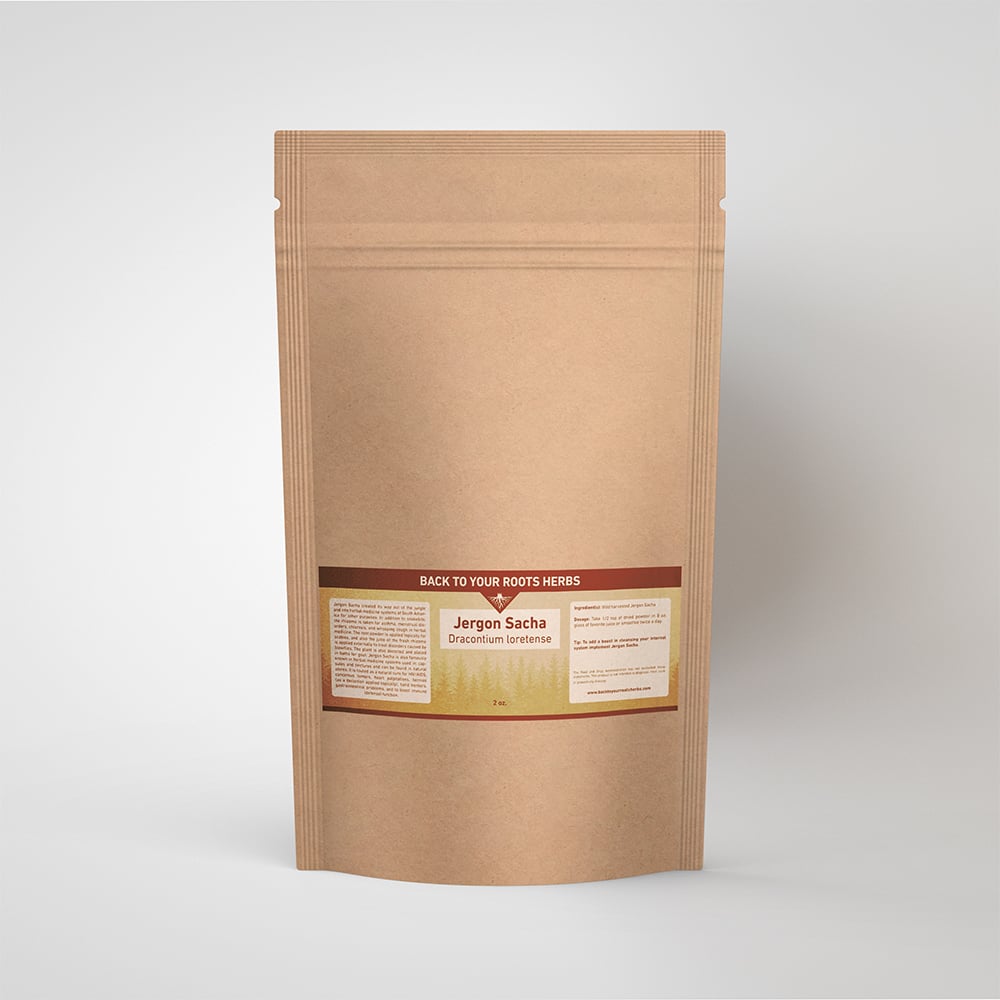
You can buy jergon sacha powder directly on this page. Back To Your Roots Herbs mills and ships every 2 oz (57 g) pouch from Virginia Beach, Virginia, with fast domestic delivery across the United States. Because jergon sacha is a niche Amazonian herb, quality varies widely between online sellers. Before you buy jergon sacha powder online, check four things:
- Single-origin sourcing: Look for a named region. Ours is the verified Loreto Region of Peru, not a generic “Amazon” or “South America” label.
- Whole rhizome, not leaf or extract: Confirm the powder is made from the rhizome (corm), the traditionally used part, rather than cheaper leaf material or a narrow extract.
- Heavy-metal tested with a COA: Ask for confirmation the batch passed heavy-metal testing and has a certificate of analysis on file.
- No fillers or flow agents: The label should read 100% jergon sacha rhizome powder, nothing else.
Frequently Asked Questions About Jergon Sacha Powder
What is jergon sacha powder used for traditionally?
Traditionally, Peruvian herbalists use jergon sacha rhizome powder as part of seasonal immune and upper respiratory wellness routines. It is not a medicine or a treatment for any disease.
Is this jergon sacha powder made from the root or the leaf?
It is made from the rhizome (underground corm), which is the part traditionally used. We do not use leaf material.
Does jergon sacha powder have any side effects?
Whole-rhizome jergon sacha powder is generally well-tolerated by healthy adults at the traditional serving. Expect an earthy, woody taste. Avoid use during pregnancy, nursing, or before surgery, and consult your provider if you take immunosuppressant or other prescription medication or have a history of kidney stones.
How does jergon sacha work?
Published laboratory research on Dracontium loretense has identified novel oxylipins in the corm, one of which showed an immunostimulatory effect on human PBMC proliferation in vitro (Benavides et al., 2009, PMID 19341262). This is laboratory evidence, not a clinical claim.
When is the best time to take jergon sacha powder?
Most customers take it once daily with food in the morning. Consistency over weeks is more important than the timing of any single dose.
DISCLAIMER:
These statements have not been evaluated by the Food and Drug Administration. This product is not intended to diagnose, treat, cure, or prevent any disease. Consult your healthcare provider before use, especially if you are pregnant, nursing, taking medication, or managing a health condition.
Reviewed by the Back To Your Roots Herbs Editorial Team. Last Reviewed: June 2026.
Reviews
There are no reviews yet.